Vol. 09, Issue 5 (May. 2019), ||S (IV) || PP 41-46
“
Performance Analysis of ACO Based PID Controller in AVR
System”
Prof. P. G. Dhawale
1, Prithviraj Patil
2, Nilesh Kumbhar
3, Rasika Mandlik
4,
Pranali Nikam
5, Saraswati Kamble
6Sanjay Ghodawat Group of Institutions, Kolhapur.
Abstract: AVR (Automatic Voltage Regulator) plays a key role in generating stations. To maintain voltage stability of the generator the terminal voltage should remain constant all the times. In a large interconnected system manual regulation is much complicated and therefore automatic generation and voltage regulation is necessary. So, to maintain a constant voltage level, Automatic voltage regulators are used at each generating station. This paper presents the MATLAB simulation based on Ant Colony Optimization (ACO) technique used for the tuning of the PID(Proportional, Integral, Derivative) controllers which are used for AVR system. Ant Colony Optimization technique is recognized from the behavior of real ants within the colony to find optimum gain value in a shortest time period. In this paper, an attempt has been made to find out an optimal gain values for tuning of PID controller based on ACO algorithm to improve the overall transient performance of an AVR system for the control of terminal voltage following disturbance through MATLAB simulation.
Keywords:
AVR, PID, ACO, ACO-PID etcI. Introduction
In power system most of the equipments are designed to work in predetermined values of voltage and frequency of operation. So it is desirable that overall voltage profile must be within the permissible limit at all the times during the operation. In case of any deviation from these values results in decrease in performance and lifetime of these equipments. Hence for effective operation of the power system the Automatic Voltage Regulator (AVR) is installed at each generating plants. The main objective of AVR system is to maintain the terminal voltage of the alternator in the generating station. To deal with this PID controllers are used. PID controller is one of the Fixed gain system which is not a best solution for AVR system because of fluctuating load and constant gain, which reduces the performance of AVR system. Hence, it is desirable to increase the capability of PID controllers to meet the needs of present days application.
The design of PID controller requires the three main parameters: namely Proportional gain (Kp), Integral time constant (Ki) and derivative time constant (Kd). Where Kp, Ki and Kd are the proportional, integral and derivative parameters respectively. The proportional gain makes the controller respond to the error value while the integral gain help to eliminate steady state error and derivative gain to prevent overshoot. The proportional, integral and derivative terms are given by:
P=Kp error (t) I = Ki error t dt D= Kd d (error)/dt
PID controller improves transient response by reducing settling time and overshoots of system results in performance improvement. Traditionally tuning PID by trial and error method is very tedious and time consuming. To reduce this complexity, Evolutionary algorithm techniques are established by various researchers which solves wide range of practical problems. Evolutionary algorithms like Simulated Annealing (SA), Genetic Algorithm (GA), and Particle Swarm Optimization (PSO), Ant Colony Optimization (ACO) has been employed in control applications.
II. Literature Review
Zwe-Lee Gaing (2004)presented PSO for optimum design of PID controller in AVR system. The simulation results proved the proposed method in improving the step response of an AVR system.[11]
the proposed method generates a solution very near to the global optimum solution. Ying-Tung Hsiao presents an optimum approach for designing of PID controllers using ACO to minimize the integral absolute control error. The experiment results demonstrate that better control performance can be achieved in comparison with conventional PID method.[6] Duan Hai-bin presented a parameter optimization strategy for PID controller using ACO Algorithm. The algorithm has been applied to the combinatorial optimization problem, and the results indicate high precision of control and quick response. Mohd. Rozely Kalil, Ismail Musirin proposed Ant Colony Optimization (ACO) technique for searching the optimal point of maximum loadability point at a load bus.. Hamid Boubertakh, Mohamed Tadjine, Pierre-Yves Glorennec and Salim Labiod has proposed theory that although conventional PID controllers are the most used in the industrial process, their performance is often limited when it is poorly tuned and/or used for controlling highly complex processes with nonlinearities, complex dynamic behaviors.[3] Ing-Tung Hsiao proposed a solution algorithm based on the ant colony optimization technique to determine the parameters of the PID controller for getting a well performance for a given plant. Simulation results demonstrate that better control performance can be achieved in comparison with known methods.[4] Kiarash , Mehrdad Abedi,(2011) Shuffled frog leaping and particle swarm optimization this two algoritm are used to determine optimal PID controller in AVR system and also shows that for tuning PID controller using various optimization technique reduces complexity and find more realistic result than trial and error method.[4] Hany M. Hasanien (2013) propose optimization of PID controller in AVR system shows that minimize the maximum percentage overshoot, the rise time, the settling time and oscillation and step response of AVR system can be changed. Richa Singh (IEEE 2016)-ACO is popular technique which shows behavior of real ant colonies to find solutions to discrete optimization problems.[13]
III. ACO Algorithm
Ant Colony Optimization (ACO) was introduced in around 1991-1992 by M. Dorigo and colleagues. In this algorithm, computational resources are allocated to give shortest possible path to get optimum tuning the gain of PID controller. ACO is a technique inspired by the natural behavior of ants within a colony searching for shortest path from their nest to a food source. The shortest path is formed by the fact that ants communicate via pheromones disposed on the path while walking, Ants can follow through to a food source because, they deposit pheromone on the ground. The path having more pheromones are preferred by the other following ants. Therefore, the amount of pheromones increases more rapidly on the shortest paths attracting more and more ants. Eventually, all ants will take the same path, i.e. the shortest path.
This behavior inspired the ACO algorithm in which a set of artificial ants cooperate in the solution of a problem by exchanging information via pheromone deposited on graph edges. The importance of ACO is that it gives fine tuning to PID controller in AVR system.
IV. ACO-PID Controller
In control system PID control system is more popular for parameter tuning purpose. This gain of the controller is tuned by trial and error method based on the experience and plant behavior. This process will consume require more time and will be suitable only for particular operating condition. In this project, ACO algorithm is used to optimize the gains, and the values are transferred to the PID controller of the plant representing AVR of the power generating system as shown in Figure 1.
V. MATLAB Simulation
This chapter presents the simulation of PID Controller and ACO with PID controller for the AVR application.
A. PID only with AVR system: Steps that follows simulation-
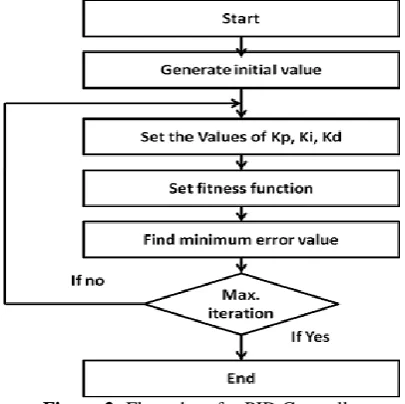
1)Define the algorithm parameters like number of iterations, required arrays and decay rate. Then define the values of Kp, Ki and Kd for further operation randomly from the pool of 0.1 to 10 with necessitate increment in its array. Initially set all arrays blank.
Figure 2: Flow chart for PID Controller
2) Load the arrays which are initially blank.
3) Initiate the loop, immediately iterations starts building solution incrementally. The values starts updating and every time results are stored in the output array.
4) Now generate error value. Error values are calculated by subtracting output values from set value which are stored in array after every iteration. Finally all the data is stored in global array.
5) This loop continues till minimum error value is detected, and maximum iteration will satisfied.
6) If maximum iteration is not satisfied then loop repeats itself by setting the new values of Kp, Ki, Kd till minimum error value is detected.
Table 1: Performance of PID controller
Figure 3: Performance of PID controller
PARAMETERS ONLY PID
This is the result of MATLAB simulation of PID controller in AVR system. Every time the output result is compared with set value. When minimum error value is reached, the cycle stops repeating and declares that value as final result.
B. ACO-PID with AVR system:
The initialization process of simulation of ACO with PID controller is similar to only PID controller in AVR system excect the absolution of pheromone. First section introduces the performance of PID only and second section portrays the performance results of PID with ACO. The performance results are stored subsequently in „Output array_1‟ and „Output array_2‟. Then error values are set. Error value changes at every iteration. Later on as loop is cycled, error value is settled at minimum value.
Steps that follows simulation-
1) Define the algorithm parameters like number of iterations, required arrays and decay rate. Then define the values of Kp, Ki and Kd for further operation randomly from the pool of 0.1 to 10 with necessitate increment in its array. Initially set all arrays blank.
2) Load the arrays which are initially blank.
3) Set initial pheromone value as a blank and set fitness function.
4) Load the values such as output array 1, output array 2, global array and error array which are initially blank. 5) Initiate the loop, immediately iterations start building solution incrementally. The values starts updating and every time results are stored in the output array.
6) Now generate error value. Error values are calculated by subtracting output values from set value which are stored in array after every iteration. Finally all the data is stored in global array.
Figure 4: Flow chart for ACO with PID
7) This loop continues till minimum error value is detected, Then calculate pheromone value by following fitness function.
8) When maximum intensity of pheromone is reached, the system stops computing further iterations.
9) If maximum iteration is not satisfied then loop repeats itself from setting the new values of Kp, Ki, Kd till minimum error value is detected.
10) All the results are stored in global array.
Figure 5: Performance of PID with ACO
The above fig shows result of only PID and ACO based PID controller in AVR. From above performance it is understood that by using Ant colony system and PID controller for AVR improves settling time, peak overshoot and oscillation of system. The red line shows performance with only PID and the green line shows performance with ACO-PID controller. The optimum result is reached due to pheromone concept of finding shortest possible path to get desired results.
Table 2: Performance of PID controller with ACO
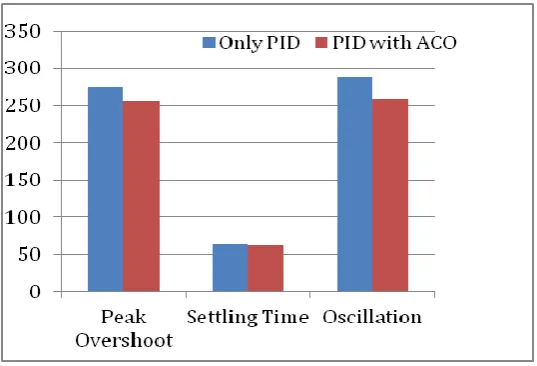
Comparison of output results of both systems sows that all the parameter of control system such as peak overshoot, settling time and oscillation are improved. Hence it proves that by using ANT COLONY ALGORITHM with PID controller in AVR system, performance gets improved. This is graphically represented as below. This gives clear idea of about increasing performance by using ACO in PID. The blue line shows performance with only PID and the red line shows performance with ACO-PID controller.
Figure 6: Comparison chart of parameters PARAMETER ONLY PID PID WITH
ACO
Peak Overshoot 290.43 259.24 Settling Time 64 61
VI. Conclusion
The performance of AVR system with conventional fixed gain PID controller and ACO algorithm based PID is compared in MATLAB by measuring the settling time, peak overshoot and oscillation.
The results obtained shows, the proposed method overcomes the drawbacks of conventional fixed gain controller and improvement is achieved in terms of settling time, oscillations and overshoot. Also the comparison of conventional and the implemented work shows ant colony based AVR gives better performance.
References
[1]. Ying-Tung Hsiao, Cheng-Long Chuang “Ant Colony Optimization for Designing of PID Controllers” 2004 IEEE lntemational Symposium on Computer Aided Control Systems.
[2]. Mohamed Tadjine, Salim Labiod “Tuning Fuzzy PID Controllers using Ant Colony Optimization” 17th Mediterranean Conference on Control & Automation Makedonia Palace, Thessaloniki, Greece June 2009.
[3]. Nazli Madinehi, Kiarash Shaloudegi, Mehrdad Abedi, Hossein Askarian Abyaneh “Optimum Design of PID Controller in AVR System Using Intelligent Methods” IEEE Trondheim Power Tech 2011.
[4]. S. Dadvandipour, N. Khalili Dizaji, S. Rosshan Entezar “An Approach to Optimize the Proportional, Integral- Derivative Controller System” 2015 16th international Carpathian control conference (ICCC), 95-99.
[5]. Alireza Abbasy, Seyed Hamid Hosseini “Ant Colony Optimization-Based Approach to Optimal Reactive Power Dispatch: A Comparison of Various Ant Systems” IEEE PES Power Africa 2007 - Conference and Exhibition Johannesburg, South Africa, 16-20 July 16-2007.
[6]. Ying-Tung Hsiao, Cheng-Long Chuang and Cheng-Chih Chien “Ant Colony Optimization for Designing of PID Controllers” 2004 IEEE international Symposium on Computer Aided Control Systems Design Taipei, Taiwan, September 24,2004.
[7]. Nazli Madinehi, Kiarash Shaloudegi, Mehrdad Abedi, Hossein Askarian Abyaneh “Optimum Design of PID Controller in AVR System Using Intelligent Methods” IEEE Trondheim Power Tech 2011.
[8]. K. Ogata “Modern Control Engineering” New Jersey; Prentice –Hall, Tehran; Aeizh,2002
[9]. D. P. Kothari and I J Nagrath “Modern Power Systems Analysis”, Tata McGraw-Hill. New York.3rd edition, 1997. [10]. P. Kundur “Power System Stability and Control” Mc Graw-Hill Companies Schaurns, New York
[11]. Zwe-Lee Gaing, "A Particle Swarm Optimization Approach for Optimum Design of PID Controller in AVR System”, IEEE Transactions on Energy Conversion, Vol. 19, No.2, June 2004, pp384-391.
[12]. Rohit Kumar Pancholi “Particle Swarm Optimization for Economic Dispatch with Line flow and Voltage Constraints” optimal operations of power system, IEEE Treansactions 2003.