e
-ISSN: 2278-067X,
p
-ISSN: 2278-800X, www.ijerd.com
Volume 7, Issue 1 (May 2013), PP. 100-108
Minimum-Utilization-Energy-Type routing in wireless
sensor network
Tosal M.Bhalodia
1, Rashmi S. Agrawal
2, J. N. Rathod
31, 2, 3 Atmiya Institute of Technology & Science, Rajkot, Gujarat, India
Abstract:- Wireless sensor networks (WSNs) are worked with limited energy sensor nodes it is difficult and even impossible to be replaced due to the isolated environment in which they are deployed. Thus, management of power of sensor nodes is one of the important topics in WSNs. In this thesis, a new concept for energy aware routing, Minimum-Utilization-Energy-Type-Routing (MUETR), is proposed to expand the lifetime of the WSNs. MUETR uses statistics of the energy consumed for each type of node activities which include data sensing, processing, transmission like a source node, and data reception or transmission as routing node used for routing decision. In particular, MUETR selects a node with high residual energy used as a routing node which seldom plays a role of source node. Proposal is to maintain the energy of active source nodes to extend the functionality of the WSNs. Partial Utilized Energy (PUE), proposed in this thesis, derives a partial utilized factor for a node that frequently plays a role of routing node and a node that frequently plays a role of source node. Simulation study derives that the lifetime of the geographical and energy aware routing (GEAR) can significantly extend with MUETR based on PUE.
Keywords:- Minimum Utilization Energy, Packet delay, Number of packets.
I.
INTRODUCTIONWireless Sensor Networks (WSNs) have been receiving a great amount of attention recently due to their substantial applicability to improve our lives [1-6]. They relieve us by extend our capacity to correctly monitor of objects, study of objects, and control objects and environments of various scales and conditions such as human body, geological survey, habitat, and security observation.
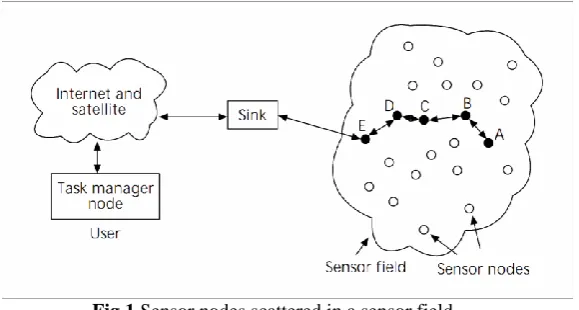
A WSN is composed of a large number of networked sensor nodes that are densely deployed either inside the event or to its propinquity [7] as shown in Fig 1.
Fig 1 Sensor nodes scattered in a sensor field
In these environments, nodes should autonomously construct its connection after they are deployed, and the deployment of sensor nodes is at one particular time only. It means the lifetime of sensor nodes will directly find out the lifetime of sensor networks. Study is aggravated by the following observations concerning energy efficiency in sensor nodes:
1)In many applications, the frequency of sensing activities between the deployed sensor nodes in the network is not consistently distributed. This is since, in many cases, we cannot specially identify a set of definite observation points at the time of utilization phase of the wireless network.
Thus, reducing energy for transmission and reception activities has important impact for extending the lifetime of all sensor nodes.
3)The set of actively sensing nodes, as sources of data initiation, utilize extensive energy. So, its residual energy should be considered more precious than the residual energy of the node which does not perform sensing activities; conversely, no resources are investigated to save actively sensing node in the literature. 4)Energy-Aware Routing (EAR) algorithms effort to minimize energy requirements at every node or a by and
large network to transfer individual packets and to maximize the action time of a given network. It usually calculates the smallest amount of cost path based on several metrics which include residual energy, broadcast power, and node location. All of these metrics, residual energy acting the primary role in the routing decision. Although various EAR algorithms have been proposed and studied in literatures, none of the EAR algorithms obtain in consideration the amount of energy each type of activities utilized.
II.
BACKGROUND ALGORITHM IN WIRELESS SENSOR NETWORKAn excess of routing protocols has been investigate in Wireless sensor networks. In the earliest work known as geographic location based routing was introduced by Finn. Geographic routing gives to a relation of techniques to route data packets in a sensor network. Main idea is that packets should be aware/know of its destination and messages will be routed hop to hop for nodes which closer to the destination until the message reaches its final destination, which could be a point/region in that case of recasting [8-10]. That implies the hosts participating in routing process should be aware of its geographic positions.
A.Greedy Perimeter Stateless Routing
As packet flooding utilizes substantial amounts of energy in whole network, Karp et al. proposed Greedy Perimeter Stateless Routing (GPSR), which gracefully avoided packet-flooding problems by derive a planar graph (A planar graph is a graph which can be drawn with no edges inter) out of the original network graph. Still GPSR is one of the most popular geographical routing protocols; which is initially designed for ad-hoc networks. Since the characteristics of the geographic routing, GPSR tries to find the shortest path to forward packets to next hop nodes as in Fig 2.
Fig. 2 Greedy forwarding, y is the x’s closest neighbor y to the destination node D
B. Greedy Other Adaptive Face Routing(GOAFR)
Kuhn et al. proposed Greedy Other Adaptive Face Routing (GOAFR), which gives a geographical routing algorithm that is both asymptomatically worst-case optimal and average-case efficient, which is similar to GPSR, GOAFR combines greedy routing and face routing. As in Fig. 3, starting at s, GOAFR works in greedy mode until reaching the n1 facing routing hole problem with F. This algorithm switches to face routing mode and gives the boundary of F to n2, the node closest to t on boundary of F. GOAFR cannot give back to greedy mode again and at last it reaches t. Last section, a number of routing algorithms especially suited for conserving energy of sensor nodes in WSNs.
Fig. 3 Greedy Other Adaptive Face Routing (GOAFR)
Many topologies have been proposed in WSNs. Topology types are mainly divides into four parts in terms of a way for each node to deliver data to the sink.
Fig. 4 - Packet forwarding with and without clustering and aggregation
In a network which uses single hop transmission without clustering like (a) in Fig 4 utilizes the nodes which use single hop transmission to the sink then it is sensing information. In fig(b) Packet is transmitted by multi-hop route and delivered to the sink or target region. This is a more efficient way to save the energy utilization. In Fig (c) splits the network into sections so that each node inside each section can communicate each other by one hop. In Fig (d) it has both nodes inside clusters and cluster heads use multi-hop data transmission among nodes or among cluster heads to relay packets.
D.Localization Algorithm
Global Positioning System (GPS) is the most popular way which gives location information of nodes; but, because of its size and cost, this is still not easy to deploy for a number of all sensors. This localization method proposed to work with an idealized radio model and proposes a simple connectivity-based localization method for which devices in unconstrained in environments. Rao et al. worked mainly on the sensor network which has no nodes location information. The approach gives assigning virtual co-ordinates to every node so that every nodes have virtual connection with its neighbour nodes by local connectivity, which applies a standard geographic routing over those coordinates. But nodes always know its neighbours and keep connectivity with it, that technique can be used in most WSN. Their approach shows that greedy routing performs better using virtual coordinates than using true geographic coordinates.
Fig. 5 - Routing by COMPOW in a typical non-homogeneous networks, S is the sender, N1 and N2 is the inter-cluster relay nodes, and the node D is the destination
III.
OVERVIEW OF MINIMUM ENERFY UTILIZATION AND PRAPOSED WORKA. Minimum-Utilization-Energy-Type Routing (MUETR)
Some WSN applications continuously monitor environmental changes in an entire region. Some WSN applications, which has frequency of any sensor node using the origin of data sending activity is more/less uniformly distributed throughout the WSN, and accessibility of each node is more or less equally important. In many other WSN applications, some sensors actively capture and disseminate good information than the rest of the sensors do. For example is this a collection of sample data which is sent from a target region its exact location is unknown at the deployment of sensor nodes. That gives the situation as some phenomena exits in fixed regions inside the sensor field. In the observer does not know that exact location of phenomenon at the deployment of sensor nodes, he has to deploy sensor nodes for wide range of field to those actual regions of his interest.
MUETR is the focus of this research. MUETR’s routing decision which is based on the different activities (i.e., transmission, reception, sensing, and processing) in that each node engages. It investigation of MUETR comprised of data sending activity and also data routing activity for each node as their energy consumptions are used by transmission and reception operations in it turn dominate the total energy utilized for node activities. Now it defines that data sending activity at the node which transmits data as a source node to the direct neighbour node. In data routing activity each node is defined as an intermediate router as it receives and transmits data. In sensor network activities, that importance of role of every node is not equal for some time. There are possibilities that only particular nodes could continue to originate collected data as given in Fig 3.4. That case, it keeps such sensor nodes active as much as possible is the rational way to the lifetime of sensor network rather than keeping them engaged in both data sending and routing activities. MUETR is particularly suited for the applications with this type of characteristics. The MUETR is a general solution to preserve active source nodes which has a potential to improve existing energy-aware routing algorithms in general to prolong the lifetime of the WSNs.
Fig. 6 Routing Scheme for path selection
I. MUETR with Partial Utilized Energy (PUE)
MUETR gives simple statistics for different types of energy utilizing activities. For each node keeps statistics of the energy utilized for data transmissions as a source node while data transmission and reception works as an intermediate router. Due to the transmission and reception operations dominate energy utilization of sensor nodes in WSNs, these statistics are useful for identifying which nodes are primarily active as a source node and which nodes are primarily active as a routing node. In that, the statistics which can be used to establish routing paths so that MUETR selects a sensor node with high residual energy as well as one that which has rarely consumed energy as a source node. We can define a Partial Utilized Energy (PUE) at node i, Ni as,
)) ( )( 1 ( )) ( ( )
(Ni UEs Ni PUEr Ni
PUE
network and each node calculates BCE based on β. Assuming that transmission cost among the direct neighbor nodes are the least cost path which is derived based on the total energy utilization at each node i, UEi. If UEx=0.55 and UEy=0.6, the least cost path. In equation with β=0.9, cost will be computed as
PUE(Nx)=0.9(0.5)+0.1(0.05)≈0.46
And
PUE(Ny)=0.9(0.2)+0.1(0.4)≈0.21
II.
MUETR FOR GEAR
GEAR considers both the residual energy and the distance to the destination when selecting a routing node. The idea for MUETR is incorporated with GEAR to evaluate a relative performance improvement of MUETR.
The energy aware portion of GEAR is important algorithm worked in past. In the Fig 7, which is source node, S, while destination node, T, with the shortest path is S-A-B-C-D-T. When the shortest path is worked with every time, the nodes A, B, C, D on the path S-A-B-C-D-T will be depleted quickly since intermediate routing nodes consume energy for routing including data transmission and reception with contrast of S and T, which concentrate on data transmission/reception. If S and T on the path S-A-B-C-D-T are also depleted, it has no way to send packets from P to Q, which is known as network partition. Instead of using the path S-A-B-C-D-T, the another paths, in which the load balancing and the shortest path routing can spread the load of energy consumption. It not only for extends the lifetime of node S and T longer but also delays intermediate nodes from quick depletion of their energy.
R
C
N
= Transmission range = Node = Path R C N R C N
= Transmission range = Node
= Path
= Transmission range = Node
= Path
= Transmission range = Node
= Path
Fig 7 - Greedy packet forwarding
According to a node N trying to forward a packet which destination is centroid C with target region R, while node N routes the packet toward the target region as in shown fig. At the same time, it tries to balance the energy consumption across all its neighbours. After that next hop determined by the smallest learned cost across all neighbors is:
)
,
(
)
,
(
)
,
(
N
R
c
N
N
minh
N
minR
h
Learned cost is the combination of distance from sender to its neighbour node Ni, residual energy of node N, and the learned cost of its neighbour Ni for that target region R, h(Ni,R). When a node which has no neighbour hi of h(Ni,R), it computes the estimated cost c(Ni, R) of Ni as a default value for h(Ni, R) is given below:
αd(Ni, R) + (1-α)e(Ni)
where d(Ni,R) is the normalized distance from Ni to the cantoris C of the region R and expressed as
)) , ( Distance ( ) , ( Distance ) , ( )
( N R
and e(Ni) is the normalized utilized energy at node Ni, and that given as
Fig 8 - Load balancing and the shortest path routing
In this figure, we give that energy worked inside each cluster which is already optimized by existing multi-hop routing protocols such as GEAR. In that case, each node in a cluster which deliver its packet for their cluster head. And then cluster heads receives packets from its cluster, which deliver packets to that observer using multi-hop routing. So, we can substitute routing in hierarchical network in Fig. 8 that overlay network among cluster heads. In that, MUETR can be incorporated to a routing algorithm which used among the cluster heads. The same logic of applying MUETR to that routing scheme can be used logically. Locally-improved routing decisions among nodes inside the clusters and cluster heads can create globally-improved routing decisions for the whole network.
Fig. 9 – Routing on the hierarchical network structure
III.
TYPE OF TRAFFICS FOR MUETR
Uniform Traffic
Pairs of source nodes and target regions are uniformly distributed in the whole network. Five source and target region pairs are randomly selected and paired with each other. In the performance of the network with applications requiring relatively uniformly distributed communication patterns.
Non Uniform Traffic
Source nodes are clustered so that concentrates part of the traffic. In initial source node which is selected randomly out of all nodes in the network. A set of nodes which are the closest to the initial source node is selected to form a cluster of 5 source nodes. And according to it we can find the energy path.
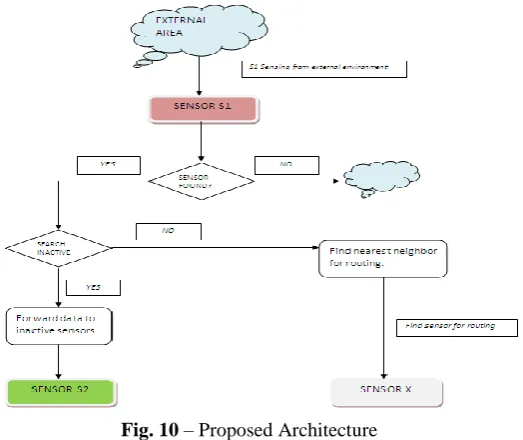
Fig. 10 – Proposed Architecture
In this it works as shown in Fig. 10 with main to point data sending and data routing.
data sending activity
We define the data sending activity at a node as it transmits data as a source node to its direct neighbor node.
data routing activity
The data routing activity at a node is defined as it receives and transmits data as an intermediate router.
There are possibilities that only particular nodes could continue to originate collected data. In that case, keeping such sensor nodes active as much as possible is the rational way to prolong the lifetime of sensor network rather than keeping them engaged in both data sending and routing activities. MUETR is particularly suited for the applications with this type of characteristics. The MUETR is a general solution to preserve historically active source nodes and has a potential to improve existing energy-aware routing algorithms in general to prolong the lifetime of the WSNs.
IV.
EVALUATION OF PROPOSED FRAMEWORK
A. MUETR with PUE(uniform)
The results for GEAR and MUETR with PUE have almost the same results and do not exceed 10000 packets delivery. GEAR with DATP can send 50.8% more packets on average than the GEAR without transmission power control. In that result indicates that significant energy saving occurs at each node by dynamically adjusting transmission power.
Fig. 12 MUETR with PUE for different β (uniform traffic)
B. MUETR with PUE (non-uniform traffic)
In the Fig. 13 shows the result of the number of packets successfully delivered before network partitioning for the non-uniform traffic experiment using a cluster of 10 closest senders. In this experiment, MUETR with PUE can send 12.1% over GEAR. In the GEAR with DATP and MUETR with PUE and DATP can send on average of 43% and 61.6% more packets, than that of GEAR.
Fig. 13 - MUETR with PUE (non-uniform traffic)
Fig. 14- MUETR with PUE for different β (non-uniform traffic)
V.
CONCLUSIONMinimum-Utilization-Energy-Type routing (MUETR), proposed the energy of active source nodes by discouraging them to participate for routing tasks. MUETR uses statistics of the energy utilized for every type of node activities including sensing, data processing, data transmission to a source node, when data receiving/transmission as a routing node for routing. MUETR selects a node with high residual energy which seldom works a role of source node as a routing node. The Idea for maintain the energy of active source nodes to prolong of the WSNs.
REFERENCES
[2]. Workshop: "Sensors for Environmental Observatories," Final report available on https://wtec.org/seo/final/Sensors_for_Environmental_Observatories.pdf, University of Washington, Seattle, November 30 – December 2, 2004
[3]. T. T. Hsieh, "Using sensor networks for highway and traffic applications," Potentials, IEEE, pp. 13-16, vol 23, issue 2, April-May, 2004
[4]. K. Martinez, J. K. Hart, R. Ong, "Environmental Sensor Networks," Computer, August 2004
[5]. A. Mainwaring, J. Polastre, Robert Szewczyk, David Culler, and John Anderson, "Wireless Sensor Networks for Habitat Monitoring," WSNA'02, Georgia, September 2002
[6]. M. Kuorilehto, M. Hännikäinen, and T. D. Hämäläinen, "A Survey of Application Distribution in Wireless sensor networks," EURASIP J. Wirel. Commun. Netw. 5, 5 (Oct. 2005).
[7]. I. F. Akyildiz, Y. Sankarasubramaniam, and E. Cayirci, “A survey on sensor networks,” IEEE Commun.Mag., vol. 40, pp. 102-114, Aug. 2002.
[8]. Y. Yu, R. Govindan, and D. Estrin, “Geographical and Energy Aware Routing: A Recursive Data Dissemination Protocol for Wireless Sensor Networks,” UCLA Computer Science Department Technical Report UCLA/CSD-TR-01-0023, May 2001.
[9]. S. Ito and K. Yoshigoe, "Exponentially Aggressive Preservation of Nearly Depleted Nodes for Wireless Sensor Networks," to appear in the International Conference on Information Technology: New Generations, April 2-4, 2007.
[10]. Pramod Kumar, Ashvini Chaturvedi, M. Kulkarni, "Geographical Location Based Hierarchical Routing Strategy For Wireless Sensor Networks”, Communications Magazines, April 2012.
[11]. Ian Akyildiz, Weilian Su, YogeshSankarasubramanian, Erdal Cayirci, "A Survey on Sensor Network," IEEE Communications Magazines, August, 2002.
[12]. Huifeng Hou, Xiangwen Liu, Hongyi Yu, Hanying Hu, "GLB-DMECR: Geographic Location-Based Decentralized Minimum Energy Consumption Routing in Wireless Sensor Networks",IEEE Proceedings of the Sixth International Conference on Parallel and Distributed Computing, Applications and Technologies (PDCA T'05),2005.