Design & Fabrication of Automatic Seat-Belt
System
Tom K. Thomas
Department of Mechanical Engineering St. Joseph’s College of Engineering, India
Abstract
Seats belts play a vital role in the safety of passengers. Seat belts are designed to keep the passengers from being thrown from the car. They are also designed to absorb the impact of a crash. Seat belts also stretch slightly so our body doesn't stop abruptly, and they prevent us from colliding with a part of the car or another person. An automatic seat-belt system can go a long way in ensuring usage of seat-belts. Automatic seat belts have been introduced as early as 1975 but there is no such arrangement in the industry at present. Such belts were discarded because of various disadvantages. Also it gets in the way of side curtain air bags. However automatic belt systems also presented several operational disadvantages. Motorists who would normally wear seat belts must still fasten the manual lap belt, thus rendering redundant the automation of the shoulder belt.
Keywords: Colliding, Airbags, Redundant
________________________________________________________________________________________________________
I. INTRODUCTION
History of Seat Belts
Seat belts were invented by English engineer George Cayley in the mid-19th century, though Edward J. Claghorn of New York, was granted the first patent (U.S. Patent 312,085, on February 10, 1885 for a safety belt). Claghorn was granted United States Patent #312,085 for a Safety-Belt for tourists, painters, firemen, etc. who are being raised or lowered, described in the patent as "designed to be applied to the person, and provided with hooks and other attachments for securing the person to a fixed object". American car manufacturers Nash (in 1949) and Ford (in 1955) offered seat belts as options, while Swedish Saab first introduced seat belts as standard in 1958. After the Saab GT 750 was introduced at the New York Motor Show in 1958 with safety belts fitted as standard, the practice became commonplace. However, the first modern three point seat belt (the so-called CIR-Griswold restraint) used in most consumer vehicles today was patented in 1955 U.S. Patent 2,710,649 by the Americans Roger W. Griswold and Hugh DeHaven. Fatal car accidents were rapidly increasing in Sweden during the 1950s. When a study at Vattenfall of accidents among employees revealed that the majority of casualties came from car accidents, two Vattenfall engineers (Bengt Odelgard and Per-Olof Weman) started to develop the safety belt. Their work set the standard for safety belts in Swedish cars and was presented to Swedish manufacturer Volvo in the late 1950s.
Type of Systems
Manual Lap Belt with Automatic Motorized Shoulder Belt
When the door is opened, the shoulder belt moves from a fixed point near the seat back on a track mounted in the door frame o f the car to a point at the other end of the track near the windshield. Once the door is closed and the car is started, the belt moves rearward along the track to its original position, thus securing the passenger. The lap belt must be fastened manually.
Manual lap belt with automatic non-motorized shoulder belt this system was used in American-market vehicles such as the Hyundai Excel and Volkswagen Jetta. The shoulder belt is fixed to the aft upper corner of the vehicle door, and is not motorized. The lap belt must be fastened manually.
Organization of Thesis
Design & Fabrication of Automatic Seat-Belt System (IJSTE/ Volume 5 / Issue 5 / 002)
II. LITERATURE REVIEW
Factors Impacting Seat-Belt Usage
Factors influencing seat belt usage have been extensively researched in the safety analysis literature. Most of this research has focused on factors that influence seat belt usage for a driver and front seat passenger in a vehicle. Few research studies have investigated factors that impact seat belt usage for back seat occupants. This research investigates the factors associated with seat belt usage for front-seat as well as backseat occupants of vehicles in the state of New Jersey. Using logistic regression, seat belt usage models were developed to examine the contribution of several variables on seat belt usage for five vehicle occupants. The age of the occupant was found to be a significant factor for influencing the seat belt usage of both the driver and the right-back passenger.
A comprehensive literature review on back seat passenger seat belt usage was conducted in this research. Injury severity models were developed in this research to obtain injury severity level of drivers and right-front seat occupants in motor vehicle crashes, using several independent variables. Using SPSS version 10.00 Statistical software, ordinal logistic regression models were developed.
The results showed among other variables that seat belt usage by back seat occupants has an impact on the injury severity of front seat occupants. In particular, the impact is greater as the number of back seat occupants in the vehicle during a crash increases.
Effectiveness of Seat-Belt
In the last 25 years there have been many studies that have attempted to confirm that seat belts actually reduce the road toll. In the literature of any discipline, some papers are cited more frequently than others. With apologies to the authors of numerous other worthy papers, I have selected the following papers as signposts in the development of our cultural attitude to seat belts.
All of the evidence (most of which has been sponsored by various government traffic safety authorities or automobile manufacturers) that has been used to establish that seat belts save lives has been discredited. No discredited study has been able to show that nett lives have been saved by adoption of seat belts. Scientists have constructed theories to explain this failure to establish in the real world that safety belts are saving lives. One theory is the "Selective Recruitment Theory" by Evans. Another is the risk homeostasis theory, (Wilde) otherwise known as the "risk compensation theory"(Adams).Those theories were independently produced by scientists who accepted that seat belts actually do reduce the likelihood that the wearer would be a fatality, but recognized that the evidence for that proposition did not meet the expectations generated by predictions calculated from seat belt effectiveness data.
III. RELEVANCE OF THE JOURNAL
Ejection from the vehicle is one of the most injurious events that can happen to a person in a crash.
Major cause of fatalities in road is due to non-usage of seat-belt by passengers which can be attributed to various reasons like: 1) Carelessness and forgetfulness of the passengers.
2) Absence of concrete legislative laws for wearing seat belts. 3) Ignoring the importance of seat belts.
Also most people nowadays tend to sometimes forget to fasten on their manual seat-belts thus this system solves this issue. Despite the proven effectiveness of seat belt use and enacted seat belt legislation, a high amount of car occupants fail to use seat belt. This system concentrates on eliminating these discrepancies and reducing the number of occurring accidents and thus saving lives.
The introduction of automatic seat-belt can lead to the reduction of vehicle accidents which in turn could lead to the lowering of car insurance installments due to the lower risk involved.
IV. METHODOLOGY
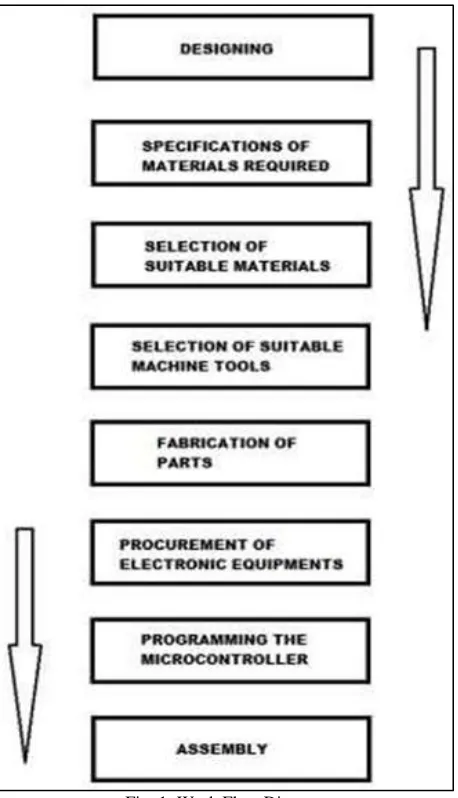
Fig. 1: Work Flow Diagram
V. DESIGN
First Proposed Design
Design & Fabrication of Automatic Seat-Belt System (IJSTE/ Volume 5 / Issue 5 / 002)
Fig. 2: Initial 2D Design
Final Design
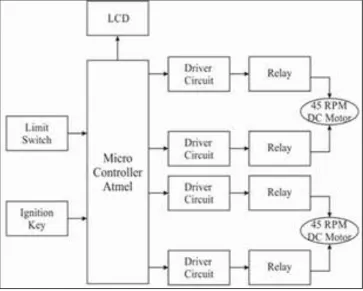
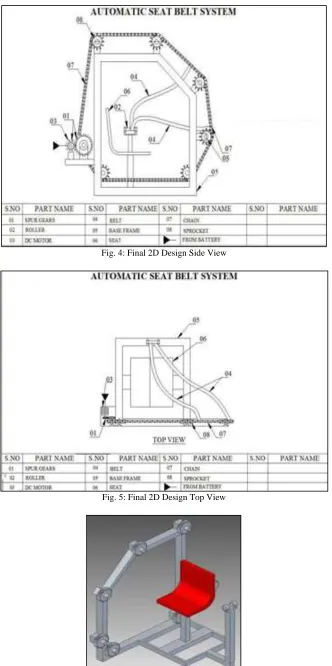
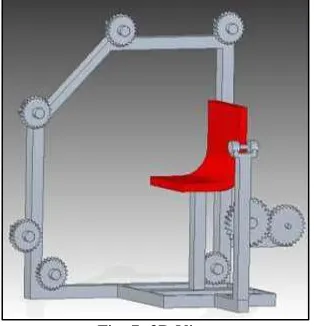
Due to the limitations of the first proposed design another design was made consisting of chain driven by sprockets which are in turn driven by a geared motor. However this system just like the first requires the same conditions to initiate that is the ignition must be on and there must be the presence of a person on the seat. The seat belts are fixed onto the chain by means of screws and bolts and these are controlled by using the micro-controller unit.
Fig. 4: Final 2D Design Side View
Design & Fabrication of Automatic Seat-Belt System (IJSTE/ Volume 5 / Issue 5 / 002)
Fig. 7: 3D View
System Components
Mechanical Components
a) DC Motor
A DC motor is any of a class of rotary electrical machines that converts direct current electrical power into mechanical power. The most common types rely on the forces produced by magnetic fields. Nearly all types of DC motors have some internal mechanism, either electromechanical or electronic, to periodically change the direction of current flow in part of the motor.
b) Frame
The frame consists of base frame and support frame onto which the seat, guide way and other equipment’s are mounted on. Dimensions of the frame are 5ft x 3ft x 3ft.
c) Roller
The roller is mounted onto the dc motor which rotates due to the output of the dc motor and this causes movement of the mechanism used for the motion of seat belt across the guide way. The roller is allowed to rotate in both clockwise and anti-clockwise according to signals sent by the micro-controller.
d) Spur Gear
Spur gears are the most common type of gears. They have straight teeth, and are mounted on parallel shafts. Sometimes, many spur gears are used at once to create very large gear reductions. They consist of a cylinder or disk with teeth projecting radially. Though the teeth are not straight-sided the edge of each tooth is straight and aligned parallel to the axis of rotation. These gears mesh together correctly only if fitted to parallel shafts. No axial thrust is created by the tooth loads. Spur gears are excellent at moderate speeds but tend to be noisy at high speeds.
e) Sprocket
A sprocket or sprocket-wheel is a profiled wheel with teeth, cogs, or sprockets that mesh with a chain, track or other perforated or indented material.
Electronic Components
a) Micro-Controller
A micro-controller (or MCU for micro-controller unit) is a small computer on a single integrated circuit. In modern terminology, it is a System on a chip or SoC. A micro-controller contains one or more CPUs (processor cores) along with memory and programmable input/output peripherals. Program memory in the form of Ferroelectric RAM, NOR flash or OTP ROM is also often included on chip, as well as a small amount of RAM. Microelectronic are designed for embedded applications, in contrast to the microprocessors used in personal computers or other general purpose applications consisting of various discrete chips.
b) Limit Switch
In electrical engineering a limit switch is a switch operated by the motion of a machine part or presence of an object. They are used for controlling machinery as part of a control system, as a safety interlocks, or to count objects passing a point.
A limit switch is an electromechanical device that consists of an actuator mechanically linked to a set of contacts. When an object comes into contact with the actuator, the device operates the contacts to make or break an electrical connection.
c) Relay
A relay is an electrically operated switch. Many relays use an electromagnet to mechanically operate a switch, but other operating principles are also used, such as solid-state relays. Relays are used where it is necessary to control a circuit by a separate low-power signal, or where several circuits must be controlled by one signal. The first relays were used in long distance telegraph circuits as amplifiers: they repeated the signal coming in from one circuit and re-transmitted it on another circuit. Relays were used extensively in telephone exchanges and early computers to perform logical operations.
d) LCD Display
Specifications of the automatic seat belt Time taken for seat belt to fasten: 25sec 45 rpm dc geared motor
No of sprockets: 7 Length of chain: 425cm No of relays: 2
Battery: 12 volt, 7.5 A Torque: 4.05 kg/cm2 Rated voltage: 12volt
VI. CONCLUSION
The aim of this journal is the fabrication of a seat belt system with automated shoulder and lap belts. According to various studies the severity of injuries caused due to accidents can be greatly reduced by the use of seat belts. And out of this a large percentage of these accidents are caused by people forgetting to wear seat belts or by negligent behaviour. Our project hopes to solve this problem by being a system which takes option of putting on a seat belt and makes it compulsory thereby addressing the problems of forgetfulness and negligence.
The project was completed in different phases. The first phase consisted of gathering information about existing systems and brainstorming ideas. After obtaining the required information the feasibility of various designs were checked and decided upon. A 2d top and side view of the proposed system was created. Due to difficulty in fabricating frame for attaching the running belt and due to economic costs the first design was found to be not feasible. Further brainstorming led to the final design of a system utilizing a chain system driven by a motor. The frame of the system was built and assembled using MS steel. Then the sprockets were mounted on the frame and the chain was rolled over the sprockets. A metallic sheet was bent and shaped into the form of a seat and mounted on the frame. A 45rpm geared motor was selected and connected to the frame in such a way as to drive the sprockets which in turn drive the chain. The seat belts were then attached to the chain using screws and bolts and clipped onto a support. The electronic components were then purchased and were programmed to detect ignition and presence of a passenger on the seat.
REFERENCES
[1] R Prakash; K Sai Krishna, Automatic seatbelts for passenger vehicles, International Journal of advanced engineering technology, July 2016. [2] AsmoCo,Ltd , Auxiliary mechanism for seat belt apparatus, Jul 19, 2011.
[3] Wesley T, Leedy, Automatic restraint belt release system, Nov 26, 2013. [4] Trw Inc., Seat belt tightening apparatus, Publication date: Apr 10, 2001.