Experiment of Air Flow in Cold Storage To
Minimize The Weight Loss of Vegetable using
CFD Analysis
Khanteshkumar Manubhai Patel Darshan Gajdhar
PG Student Assistant Professor
Department of Mechanical Engineering Department of Mechanical Engineering
D.J.M.I.T, MOGAR, India D.J.M.I.T, MOGAR, India
Vivek Patel Krunal A. Shah
Assistant Professor Assistant Professor
Department of Mechanical Engineering Department of Mechanical Engineering
D.J.M.I.T, MOGAR, India D.J.M.I.T, MOGAR, India
Abstract
The understanding of the flow field inside the cold store is very important to food storage at low temperatures. Transport phenomena, comprising air flow, hit and mass transfer are key processes in refrigerated storage. Temperature homogeneity in most food refrigeration systems is directly governed by the airflow patterns in the system. Numerical modelling of airflow provides an opportunity to develop improved understanding of the underlying phenomena influencing system performance, which can lead to reduced temperature heterogeneity and increased effectiveness and efficiency of refrigeration systems. With the rapid advances in computational power of recent years, the use of Computational Fluid Dynamics (CFD) techniques in this application has become popular. This the application of CFD and other numerical modelling techniques to the prediction of airflow in refrigerated food applications including cool stores and reduce bad food ratio and reduce heat and mass transfer in food.
Keywords: Air Temperature, CFD, Cold Store, Heat Transfer, Humidity Modeling, Mass Transfer, Speed
________________________________________________________________________________________________________
I. INTRODUCTION
In chilled and frozen food applications, temperature (and often humidity) control during cooling, storage, transportation and display is essential to the maintenance of product quality. In the majority of food refrigeration systems, heat is transferred primarily by convection; therefore, the temperature and its homogeneity are directly governed by the patterns of airflow. Recent studies have shown a significant level of spatial temperature variability in some food refrigeration systems, with non-uniform airflow implicated as a major cause of this variability. For sensitive products, this level of temperature variability may have significant food quality and safety implications.
Thorough comprehension of the phenomena, associated with airflows and product temperatures in refrigerated systems, is a complex task, as there are numerous interdependent factors which act simultaneously. These factors may also be dependent on operating and/or ambient conditions. Therefore, optimizing these systems is not an elementary problem; optimisation of just some components may require extensive experimentation. Numerical modelling offers an economic alternative to physical experiments, although it is imperative that the reliability of the model be established through validation against experimental data.
Researchers have been developing models of airflow for food refrigeration systems for over 30 years. Early models were very simple descriptions of the systems; however, the proliferation of powerful computers in recent times has paved the way for researchers to develop more detailed models. Over the last 16 years, Computational Fluid Dynamics (CFD) has become the methodology of choice for the development of airflow models.
With an increasing emphasis on the power consumption of refrigeration systems, and an increasing awareness of temperature heterogeneity and its implications for food safety, characterizing and developing effective air distribution systems will continue to be an important area of research in food refrigeration. This review aims to examine the numerical models for prediction of airflow in refrigerated food applications published to date and provide insight to the future directions of research in this area.
All rights reserved by www.ijste.org 79 The variability of the cooling rate as well as the temperature of the product inside a cool store causes the product quality to deteriorate through either increased respiration at higher temperature or by chilling or freezing injury at lower temperature. One of the main aims in designing storage enclosures is to ensure a uniform targeted temperature and humidity in the stored bulk products. The intricate transport mechanics and the complex geometry of a fully loaded cool store make it difficult to determine the optimal configuration and operation parameters of the store in an empirical way. A model-based approach can prove to be advantageous for design purposes with small added cost. With the increasing availability and power of computers together with efficient solution algorithms and processing facilities, the technique of Computational Fluid Dynamics (CFD) can be used to solve the governing fluid flow equations numerically.
II.SCOPE OF THIS WORK
Proper test chamber air flow distribution and thermal comfort of matter are the important aspects of the cooling & conditioning. The primary objective of the cooling & conditioning is to create thermal comfort environment which is largely depends on the IAQ (internal air quality) and room air flow pattern. Further, test chamber air flow patter in a conditioned space is situation dependent and cannot be generalized. In view of this fact the proposed project work involves the experimental study to visualize and analysis the test chamber air flow pattern under different conditions. Further, thermal comfort is also quantified.
III. LITERATURE REVIEW
In view of the complexity and the importance of the room air diffusion, it has been widely studied by the many researcher in past. A significant amount of work has been done in the field of air distribution system, in airflow pattern and in thermal comfort. With the development in the field of computational fluid dynamics (CFD) and the availability of the advanced software such as FLUENT, majority of the work on room air diffusion to predict the temperature distribution and the velocity field is carried out theoretically. In some cases it is well supported by the experiments. The reported works are related to model based or numerical studies, experimental studies, CFD simulation, and thermal comfort studies. This chapter is an attempt to summarize the past work carried out by various researchers.
Model based Numerical Studies
A methodology for obtaining reduced order models for temperature distribution in air conditioned rooms was developed and analysed by Sempey et al. [4]. The focus of the work was to test the feasibility of the approach. A two-dimensional configuration was considered here, as the dimension is not a crucial point concerning the application of the proper orthogonal decomposition (POD). As the studied flow is a mixed convection, a limited number of air flow patterns (four) are retained in order to have negligible changes of the buoyancy forces as a function of the boundary conditions. Although this model can be simulated in a few minutes on personal computer, its order is then reduced by using the POD with snapshot method.
Yongson et al. [5] had done the simple numerical study of the turbulent flow over an enclosed air conditioning system. The different locations of blower placement were analyzed for better comfort of occupant in the room. Sevilgen Gokhan et al. [6] had done a three-dimensional steady - state numerical analysis in a room heated by two - panel radiators. A virtual sitting manikin with real dimensions and physiological shape was added to the model of the room, and it was assumed that the manikin surfaces were subjected to constant temperature. Heat interactions between the human body surfaces and the room environment, the air flow, the temperature, the humidity, and the local heat transfer characteristics of the manikin and the room surfaces were computed numerically under different environmental conditions. The results show that energy consumption can be significantly reduced while increasing the thermal comfort by using better insulated outer wall materials and windows.
Experimental Studies
An airflow pattern sensor was developed to measure the trajectory of a non-isothermal air jet in a building with a single or multiple air inlet(s) by Ozcan and Vranken [7]. The experimental conditions covered the whole year characteristics to come up with a general conclusion in an experimental room of 8 m×4 m×4 m. The principle of the airflow pattern sensor is to predict the trajectory of a non-isothermal air jet from the temperature distribution measured near to the air inlet.
Ho Son H. et al. [8] presented air velocity and temperature distribution in a refrigerated warehouse. The refrigerated space under study has a set of ceiling-type cooling units installed in front of the arrays of stacks of palletized product packages. Numerical solutions of the steady-state airflow and heat transfer were done using a complete three-dimensional model and an equivalent two-dimensional model. It was found that a better cooling effectiveness and uniformity of temperature in the refrigerated space could be achieved by using higher blowing air velocity and/or locating the cooling units lower and closer toward the arrays of product packages.
temperature and RH increasing. The organic compounds composing the dust also had great impact on microbial growth. The basic researches are contributed to control the growth of microorganism and improve the indoor microenvironment in the air-conditioning room.
Simplified relationship was established to enable a study to be made of the temperature distribution using reduced scale model by Pallier et al. [10]. The experiment was carried out and compared with 0.3 scale model. It was shown that the Archimedes number could be considered a characteristic number for the room air supply. The limit values required for good thermal comfort in a given room were established. Fostera et al. [11] performed a experiment to measure and predict air movement through doorways in refrigerated rooms, their aim is to reduce the amount of air infiltration through the doorways of food storage rooms would improve temperature control and the overall economics of food storage. Experiments were conducted in a mock-up of an office room to study the air velocities in the occupied spaces by Kosonen Risto et al. [12]. The maximum air velocity measured was still below 0.25 m/s with the extremely high heat gain of 164 W/m2. The results demonstrate that analysis methods were the interaction of convection flow and jet are not taken into account could not accurately describe air movement and draught risk in the occupied room space.
IV. EXPERIMENTAL MODELING & ANALYSIS
Problem Definition
Due to large Agricultural products wastage in India, It is supposed to store in cold place for future use. Cold storages are built to fulfill this requirement of Vegetable and Fruits storage. But for the long time storage there is quality and quantity loss due to improper distribution of air flow velocity and temperature in the porous media. To meet the demand of this industry there is analytic and software based observation is required in fully empty condition and loaded condition of the cold storage. After that with help of a CFD analysis optimization of Duct implementation and such other phenomena are required to change and minimize the quality loss.
AIM
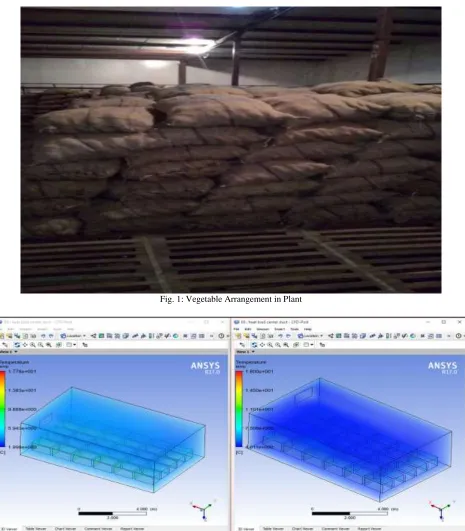
All rights reserved by www.ijste.org 81 Fig. 1: Vegetable Arrangement in Plant
Fig. 2: Loading Condition Temperature Distribution in Room
V.CONCLUSION
Fig. 3: Temperature Decrement with Time in Room
REFERENCES
[1] American Society of Heating Refrigerating and Air Conditioning Engineers (ASHRAE) Fundamentals (2001), Thermal comfort. (p. 8.1 - 8.29). [2] Shan K. Wang, Handbook of air conditioning and refrigeration, McGraw-Hill publication, Second Edition, (p. 4.14 - 4.20).
[3] American Society of Heating Refrigerating and Air Conditioning Engineers (ASHRAE), (1992) Thermal Environmental Conditions for Human Occupancy (ASHRAE Standard 55-1992).
[4] Sempey A., Inard C., Ghiaus C., and Allery C. Fast simulation of temperature distribution in air conditioned rooms by using proper orthogonal decomposition. Building and Environment 44(2009); 280-289.
[5] Ooi Yongson, Badruddin Irfan Anjum, Zainal Z.A. and Narayana P.A. Air flow analysis in air conditioned room, Building and Environment, vol. 43, Issue 3; (2007), 1531-1537.
[6] Sevilgen Gökhan, Kilic Muhsin, Numerical analysis of air flow, heat transfer, moisture transport and thermal comfort in a room heated by two-panel radiators, Energy and Buildings 43 (2011) 137-146.
[7] Ozcan S. Eren, Vranken E. Determination of the Airflow Pattern in a Mechanically VentilatedRoom with a Temperature-based Sensor Biosystems Engineering Volume 90, Issue 2, February (2005), p. 193-20.
[8] Ho Son H., Rosario Luis, Muhammad M. Rahman, Numerical simulation of temperature and velocity in a refrigerated warehouse, international journal of refrigeration 3(2010)1015-1025.
[9] Li Angui, Liu Zhijian, Zhu Xiaobin, Liu Ying, Wangb Qingqin, The effect of air-conditioning parameters and deposition dust on microbial growth in supply air ducts, Energy and Buildings 42 (2010) 449-454.
[10] Pallier J. M., Yezou R. and Brau J. Temperature Distribution in air conditioned room Applied Energy 14 (1983) 49-64.
[11] Foster M., Barrett R., James S.J., Swain M.J. Measurement and prediction of air movement through doorways in refrigerated rooms. International Journal of Refrigeration 25 (2002) 1102-1109.