ISSN (e): 2250-3021, ISSN (p): 2278-8719
Vol. 08, Issue 6 (June. 2018), ||V (V) || PP 37-43
Enhancing Energy Efficiency in Wireless Sensor Network
Smt. Sheetalrani R Kawale,
1Dr. Ramesh K
2 1Assistant Professor, Dept. of Comp. Sci., AWU, Vijayapura, Karnataka, India 2Associate Professor, Dept. of Comp. Sci., AWU, Vijayapura, Karnataka, IndiaCorresponding Author: Smt. Sheetalrani R Kawale
Abstract
- There is a need for wireless communication, especially in situations where traditional infrastructure communication networks do not exist. This has encouraged the appearance of the infrastructure referred to as (WSNs). WSNs are multi-hop, self-organized and decentralized networks. The dynamic nature of WSNs provides many challenges that require extensive research in order to provide a satisfying performance to their users. The usage of battery is the most important concern in a WSNS network. In this work the Energy Balancing Routing protocol (EBRP) is developed and simulated which is used to obtain the efficient use of node energy so that secure route is obtained.Key Words: — Wireless Sensor networks, energy efficient routing, Sensor Nodes, Cluster Head.
--- --- Date of Submission: 07-06-2018 Date of acceptance: 23-06-2018 ---
---I.
INTRODUCTION
The development of WSNs in wireless technology has enabled the development of low cost, low power, multifunctional sensor nodes that are in small size and communicate in small distances [2]. These tiny sensor nodes are used to sense the physical parameter and then to communicate to a remote place. One very important characteristic of this WSN is that they are application oriented. They are designed as per the requirements of applications. Individually, these sensing nodes are resource constrained and therefore are capable of limited processing and communication [9]. Location of these sensor nodes can be changed without rewiring and can be configured into different network topologies like Star, Mesh, Bus, etc.
II.
EXISTING SYSTEM
In the existing system, the Sensor Networks are still in an early stage in terms of technology. Needs improvement or new routing protocol focus on energy efficient routing whose target is to find an optimal path to minimize energy consumption in whole sensor network [2]. The energy aware routing maintains multiple paths and properly chooses one for each packet delivery to improve network survivability. It may be quite costly since indeed to exchange routing information very frequently and may result in energy burden and traffic overload for the nodes [2]. For these reasons it is very important to enhance energy for routing efficiently. [8]
III.
PROBLEM IDENTIFICATION
Energy is an important resource for a sensor node [2]. The main problem is its low battery-power. When its battery power gets off the sensor node will die. These sensor nodes are like use and throw type. Its life depends on its battery power. So it is very important in wireless sensor networks (WSN) [2] to make energy-efficient protocol design that can handle this type of challenging problem.
IV.
PROPOSEDSYSTEMDESIGN DESCRIPTION EBRPFigure 1 shows the proposed system architecture diagram for the EBRP routing algorithm.
4.1 NODE DEPLOYMENT ALGORITHM:
This algorithm is responsible for deployment of nodes in a particular area.
Fig.4.1 EBRP: Node Deployment Algorithm
4.2 ZONE FORMATION ALGORITHM:
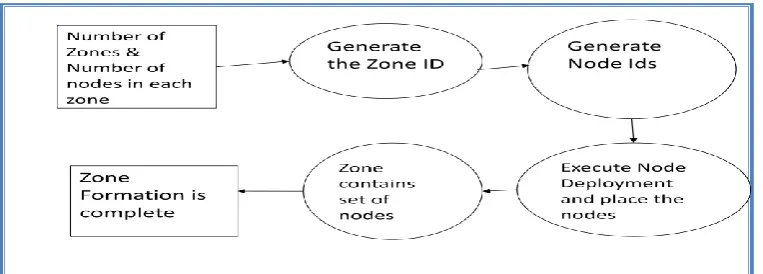
Zone Formation algorithm divides the entire are into multiple zones. Each Zone having a set of nodes in its zone. This is the algorithm which is responsible for deploying the nodes. The entire area is divided into zones with each zone bounded with the limits with some xmin and xmax. The y region is bounded within the limits ymin and ymax. Each zone is allocated a set of nodes.
Fig.4.2 EBRP: Zone Formation Algorithm
4.3 CLUSTER HEAD ELECTION:
4.4 MULTIPLE ROUTE DISCOVERY:
This is used to find multiple routes from source node to destination node.
Fig.4.4 EBRP: Multiple Route Discovery Algorithm
Fig.4.4 shows the information about route discovery process: 1. Source Node & Destination Node are inputs
2. Check whether the source and destination in same zone. If Yes Communication happens directly.
3. If Source Node & Destination Node are not in same zone. then check whether source node is zone leader. If source node is Zone Leader then add to route. Otherwise find the zone leader of the source node then add the source node to route and then zone leader of source node to route.
4. Check whether destination node is zone leader then destination node is added to route. Find the destination zone leader and add to route and then add destination node to route.
4.5 BEST ROUTE SELECTIONS:
This algorithm is responsible for selecting the best route which has the minimum Forward Factor.
Calculation of FAF Forward Factor
1. No. of Hops
2. Total Distance Compute over the route 3. Total Energy Consumed over the route FAF = { Nhops + Dtotal + Econsumed }
Best route = min {FAF}
Energy Consumed Econsumed is calculated by the following formula:
V.
TRIPLE DES ENCRYPTION ALGORITHM
All three keys being identical is known as triple DES. The triple DES key length contains 168 bits but the key security falls to 112 bits.[13]
Fig.5 Triple DES Algorithm
Fig5.1Data Fragmentation Output
Fig5.3 Packet Formation Output
VI.
RESULTS
6.1 Energy Consumption Comparison between EBRP and LEACH
Chart 6.1: Energy Consumption Comparison
6.2 Hops Comparison between EBRP and LEACH
6.3 Time Taken Comparison between EBRP and LEACH
Chart 6.3: Time Taken Comparison
6.4 No. of Sleep Nodes Comparison between EBRP and LEACH
Chart 6.4: Sleep nodes Comparison
6.5 No. of Non-Sleep Nodes Comparison between EBRP and LEACH
Chart 6.5: Non-Sleep nodes comparison
VII.
CONCLUSION
ACKNOWLEDGEMENT
I would like to acknowledge my guide Dr. Ramesh K. for guiding me in my research work and for his kind support.
REFERENCES
[1]. J.Hill, R. Szewczyk, A, Woo, S, Hollar, D. Culler, and K. Pister, System Architecture Directions for Networked Sensors, ASPLOS, November 2000.
[2]. B. Karp, Geographic Routing for Wireless Network, PhD Dissertation, Harvard University October 2000. C. Intanagonwiwat, R. Govindan, and D. Estrin, Directed Diffusion: AScalable Routing and Robust Communication Paradigm for Sensor Netwoks, Mobicom, Ausgust 2000.
[3]. J. Elson, L. Girod, and D. Estrin Fine-Grained Network Time Synchronization Using References Broad-casts, OSDI, December 2002. S. Ganeriwal, R. Kumar, and M. Srivastava, Timing-sync Protocol for Sensor Networks, AMC SenSys, November 2003.
[4]. T. He, JStankovin, C. Lu and T. Abdelzaher, A Spatiotemporal Communication Protocol for Wireless Sensor Networks IEEE Transactions on Parallel and Distributed Systems, to appear.
[5]. T. He C. Huang, B. Blum, J. Stankovic, T. Abdezaher, Range-Free Localization and Its Impact on Large Scale Sensor Networks, ACM Trasactions on Embedded Computing System, to appear.
[6]. T. He., S. Krishnamurthy, J. Stankovic, T. Abdelzaher, L. Luo, T. Yan, R. Stoleru, L. Gu, G. Zhou, J. Huiand B. Lrpgj, VigilNet: An Integrated Sensor Networks System for Energy Efficient Surveillance, ACM Transactions on Sensor Networks, to appear.
[7]. T. He, P. Vicaire, T. Yan, L. Luo, L. Gu, G. Zhou, R. Stroleru, Q. Co, J. Stankovic, and T. Abdelzaher, Real-Time Analysis of Tracking Performance in Wireless Sensor Networks, IEE Applications Real-Time Symposium, May 2006.
[8]. Incorporating Concepts of Nanotechonology Services and Computing For Smart Classrooms” Research Paper Research Link – 100, Vol –XI (5) July 2012, Page No. 26-29 RNI No. MPHIN- 2002-7041, ISSN No.-0973-1628
[9]. Enhancing Energy Efficiency in WSN using Potential Concepts” International conference on Advances in Computer and Electrical Engineering (ICACEE’2012) Nov. 17-18, 2012 manila (Philippines) ISBN: 978-93-82242-11-6 Page No. 118-122.
[10]. Enhancing Energy Efficiency in WSN using Energy Potential And Energy Balancing Concepts” International Journal of Innovative Research in Information Security (IJIRIS) volume 1, Issue 2, August 2014 ISSA*/2349-7009(Online) ISSN /2349-7017 (Print) Page no. 15-17.
[11]. RECR Routing Algorithm In Wireless Sensor Network” International journal Of Emerging Technology & Research(IJETR) Volume 1, Issue 6, Sep-Oct, 2014 ISSN(E):2347-5900 ISSN (P):2347-6079 Page no. 89-91.
[12]. Low Power Wireless Sensor Networks Algorithm: EASRP IOSR Journal of Computer Engineering (IOSR-JCE) volume:19 Issue:3 Ver.VI (May-June 2017), e-ISSN:2278-0661, p-ISSN:2278-8727 Page No. 42-46
[13]. https://en.wikipedia.org/wiki/Triple_
BIOGRAPHIES
Smt. Sheetalrani R. kawale is serving as an Assistant Professor in the Department of Computer Science at the Akkamahadevi Women's University, Vijayapura. She has 12 yrs of teaching experience and pursuing PhD in the computer science field. Her area of interest is in networking. She has published 8 peer reviewed & indexed international journals.
University, Vijayapura. He has
33 Peer reviewed & Indexed
International Publications, 50
Invited
presentations,
presented around 10 papers
at
various
International
conferences and 6 Books as a
main author.