The Min-max Decoding Algorithm of Nonbinary
LDPC Codes Based on Early Stopping
Zhongxun Wang
School of Opto-electronic Information Science and Technology of Yantai University,Yantai ,China Email:[email protected]
Xinglong Gao
School of Opto-electronic Information Science and Technology of Yantai University,Yantai ,China Email :[email protected]
Abstract—In this paper, we propose the min-max decoding algorithm of nonbinary LDPC codes based on early stopping by analyzing and combining traditional min-max decoding algorithm of nonbinary LDPC codes and the early stopping rule of binary LDPC codes. The simulation indicates that the proposed algorithm can greatly reduce the number of iterations in decoding process with almost no decoding performance loss compared with traditional minsum decoding algorithm of nonbinary LDPC codes and traditional min-max decoding algorithm of nonbinary LDPC codes in low signal-to-noise ratio region , which is in additive Gaussian white noise channel and under binary phase shift keying modulation. So the computational complexity can be effectively reduced and the real-time performance can be well improved.
Index Terms—traditional min-max decoding algorithm, traditional minsum decoding algorithm, the early stopping rule, nonbinary LDPC codes
I. INTRODUCTION
In the year of 1962,Gallager opened up new field about encoding and decoding theory by discovering LDPC codes[1].But this kind of new code was forgotten very quickly because of the backward technology level and the lack of theoretic knowledge that time.With thedevelopment of the times, in the 1990s,LDPC codes was discovered again because of approaching the capacity of Shannon limit in long codes[2-3].Later a lot of study of LDPC codes was emerged which is mainly based on binary field. In 1998,the sum-product decoding algorithm of nonbinary LDPC codes was proposed[4], which shows good performance at the cost of higher computational complexity which is about 0(q^2).Then many scholars tried to simplify the algorithm for the purpose of getting low computational complexity. This includes two aspects:1)the decoding algorithm of nonbinary LDPC cdoes based on fast Fourier transform in frequency domain[5],which makes computational complexity become 0(p2^p) by Fast Fourier Transform and Fourier Inversion.Addition,the paper [6] introduces a very effective method to implement the decoding process of LDPC codes by FPGA ,which show very low
computational complexity.2)the decoding algorithm of nonbinary LDPC codes based on log-likelihood ratio in log-domain, which introduces log-likelihood ratio in the message passing process[7].And then in log-likelihood domain, by simplifying the sum-product algorithm in log-domain, the minsum decoding algorithm of nonbinary LDPC codes was proposed, however, this algorithm still needs 0(q^2) adding operations. Next, a kind of more effective decoding algorithm which is called extended minsum decoding algorithm was proposed, which adopts partial information of elements in Galois Field when processing check nodes .So the computational complexity was effectively reduced[8-9].It was in [10],the author proposed a kind of algorithm which is called min-max decoding algorithm of nonbinary LDPC codes. It was in this algorithm that the adding operations was completely abandoned in check node processing. That What is needed is simple comparison operation including getting minimum and maximum value, so the computational complexity was effectively reduced. The author proposed a kind of rule which can early stop the iteration process of binary LDPC codes in [11].In our paper, we try to use this rule in the decoding process of nonbinary LDPC codes. Combined with traditional min-max decoding algorithm of nobinary LDPC codes, we propose the decoding algorithm which is called the min-max decoding algorithm of nonbinary LDPC codes based on early stopping, which can effectively reduce the computational complexity and lower the decoding latency.
II. THE OUTLINE OF NONBINARY LDPC CODES
Nonbinary LDPC code is a kind of linear block code which is defined by sparse parity-check matrix whose elements come from Galois field and the most elements of which is zero. A matrix which owns m rows and n columns can be seen as a bipartite graph. Further more, the m rows of parity-check matrix represent m check nodes of the bipartite graph and the n columns of the parity-check matrix represent n variable nodes. If the element of the i-th row and the j-th column in the matrix is not zero, there exists a line between the i-th check node and the j-th variable node. In the traditional sense, we adopt sum-product decoding algorithm which is based on Galois field to decode nonbinary LDPC codes. However, the high computational complexity of this algorithm interferes with its hardware implement. The proposed min-max decoding algorithm in [10] can effectively reduce the computational complexity, which does not need any adding operation and multiplying operation except simple comparison operation in check node processing. So in order to further reduce computation complexity, combining with the early stopping rule of binary LDPC code, the author proposes the min-max decoding algorithm of nonbinary LDPC codes based on early stopping. Because the codes still can not be decoded correctly even if the maximum iteration were reached in low signal-to-noise region. So we can try to stop decoding in advance without reaching the maximum iteration in the circumstance where the number of calibration equation does not vary dramatically. The result is that the decoding complexity is effectively reduced.
III THE MIN-MAX DECODING ALGORITHM OF
NONBINARY LDPC CODES BASED ON EARLY STOPPING
The early stopping of iteration in LDPC code happens in the circumstance where the number of calibration equation does not vary dramatically, which indicates the decoding process may be oscillating or obstructed. It was only in the two processes that the early stopping rule is very effective.
Before including the min-max decoding algorithm of nonbinary LDPC codes based on early stopping, we should denote the following some notations.
﹡
M n
( ) { :
=
m h
mn≠
0}
,the neighboring check nodes about the variable node n.In other words,the nonzero elements of the nth column in the matrix.﹡
M n
( ) \
m
,the neighboring check nodes about the variable node n except the check node m.﹡
N m
( ) { :
=
n h
mn≠
0}
,the neighboring variable nodes about the check node m.In other words,the nonzero elements the m-th row in the parity-check matrix.﹡
N m
( ) /
n
,the neighboring variable nodes about the check node m except the variable node n.﹡ a mn
Q
,the information from the variable node n to the check node m when the variable node n is a.﹡ a mn
R
,the information from the check node m to the variable node n when the variable node n is a.In other words,the log-domain information when the variable node n is a and the m-th check equation is true.All the process of the min-max decoding algorithm of nonbinary LDPC cdoes based on early stoping is as follows.
Initialization
log( (
) / (
))
a
n n n n
f
=
pr x
=
s channel
⎪
pr x
=
a channel
⎪
,where
s
nmeans the most likely value of the variablenode n.
① Decide whether k reaches the biggest iteration
MAXITER. If the answer is yes, then exit the whole cyclic process. Otherwise go to step ②.
② Message exchanging. Exchange the
information outputted by the variable node according to the parity-check matrix. Simply put, if we know
a mn
Q
,then the information from the variable node n to the check node m is ahmnmn
Q
across the corresponding edge toh
mn.The most important is that all the divisionand multiplication in the formula operates in Galois field.
③ The check node processing. Do as the
following formula(1). '
' ' ( )\ ' :
min( max (
))
n
a b
mn mn
n n m n b V x a
R
Q
∈ ∈ =
=
(1)where v means the vector set that satisfies the m-th check relationship.
④ The reverse exchange of the information. It is
the opposite process of .The formula is as follows. ②
1 'a ahmn
mn mn
R
=
R
− .⑤ The information updates of the variable
nodes.Do as the following formula (2).
( )\
a a a
mn n m n
m M n m
f
R
′′∈
′
∇ =
+
∑
(2)then do the formula (3)as follows.
a a
mn mn mn
Q
= ∇ − Δ
(3)then perform the following formula (4).
( )
min (
a)
mn mn
a GF q∈
Δ =
∇
(4)⑥ Try to collect all the information of the
variable nodes as the formula(5) . '
'
a a a
do as the formula
( )
arg min( )
an n
a GF q
x
Q
∈
=
todetermine the codeword.
⑦ Determine whether the iteration process can be
stopped. The whole stopping rule is as follows.
S1 when the number of iteration is 1.initialize
d
c
to zero.S2 Perform the formula (6)
NSPC=length(find(gf2dec(H*x',DD,prim_poly )==0)) (6)
to compute the number that the codeword satisfies the check equation.
S3 if NSPC is M,then exit the whole iteration process;Otherwise go to step S4.
S4 when the iteration k is bigger than one,then perform the following formula (7).
1
k k k
spc
d
=
NSPC
−
NSPC
− (7)otherwise goto step S2. S5 if the k
spc d
d
≤
ϑ
is true,then set1
d d
c
= +
c
,otherwise setc
d to zero and goto step S2.S6 if the
c
d≥
θ
max andNSPC
≤
θ
NSPCare true,then exit all the iteration process.Otherwise set
c
d to zero and goto stepS2.
⑧ set k=k+1.
According to the above analysis, such stopping iteration rule can effectively reduce the number of the iteration of nonbinary LDPC codes in low signal-to-noise ratio region. On oscillating or obstructed process, without doubt it is a good method to improve decoding efficiency and reduce decoding latency in low signal-to-noise region. In short, such method can effectively improve the convergence speed of the min-max decoding algorithm and reduce the number of iteration, so that the computational complexity can be greatly reduced.
IV THE PERFORMANCE ANALYSIS
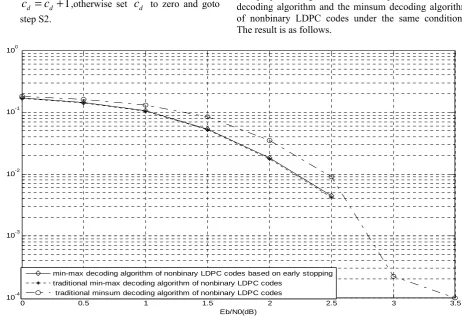
For the convenient analysis, we adopt 0.5-rate regular nonbinary LDPC code whose code length is 400,which is in additive Gaussian white noise channel [12]and under binary phase shift keying modulation. In order to analyze the proposed algorithm, we compare the min-max decoding algorithm and the minsum decoding algorithm of nonbinary LDPC codes under the same conditions. The result is as follows.
Fig. 1 The relational graph between bit error rate(BER) and signal to noise ratio (Eb/N0)
0 0.5 1 1.5 2 2.5 3 3.5
10-4 10-3 10-2 10-1 100
Eb/N0(dB)
BER
min-max decoding algorithm of nonbinary LDPC codes based on early stopping traditional min-max decoding algorithm of nonbinary LDPC codes
0 0.5 1 1.5 2 2.5 3 3.5 4 4.5 5 0
5 10 15 20 25
Eb/N0(dB)
a
v
er
a
ge i
ter
at
ion
min-max decoding algorithm of nonbinary LDPC codes based on early stopping traditional min-max decoding algorithm of nonbinary LDPC codes
traditional minsum decoding algorithm of nonbinary LDPC codes
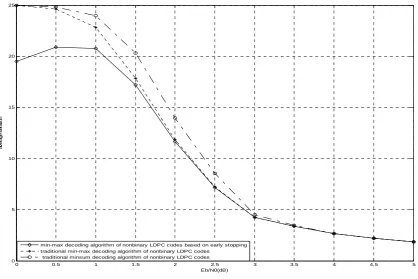
Fig. 2 The relational graph between average iteration and signal to noise ratio(Eb/N0)
What we can see from Fig.1 is that the error in the min-max decoding algorithm of nonbinary LDPC code based on early stopping、traditional min-max decoding
algorithm of nonbinary LDPC codes and traditional minsum decoding algorithm of nonbinary LDPC codes becomes less and less with the improvement of signal to noise ratio. And it is obvious that the performance of the min-max decoding algorithm based on early stopping and traditional min-max decoding algorithm is much better than that of traditional minsum decoding algorithm in such region, and the most important thing is that the performance curve of the min-max decoding algorithm of nonbinary LDPC codes based on early stopping and that of traditional min-max decoding algorithm of nonbinary LDPC codes are quite consistent, which means that the proposed algorithm almost does not cause performance loss in comparison with traditional min-max decoding algorithm of nonbinary LDPC codes. From Fig.2 we can see that all the number of the average iteration of the three kinds of decoding algorithm gets less and less .And it is very obvious that the needed number of average iteration about the min-max decoding algorithm of nonbinary LDPC codes based on early stopping and traditional min-max decoding algorithm of nonbinary LDPC codes is less than that of traditional minsum decoding algorithm of nonbinary LDPC codes. Further, the curve of the first two kinds of algorithm is almost consistent in high signal-to-noise ratio region, however, in low signal to noise ratio region the needed number of
decoding algorithm. So we can know that the proposed algorithm can reduce the number of iteration by decoding very well with almost no impact on performance. So the computational complexity can be effectively lowered and the decoding latency can be reduced.
V CONCLUSION
In the paper, we analyze traditional min-max decoding algorithm of nonbinary LDPC codes and the early stopping rule of binary LDPC codes ,and then we propose the min-max decoding algorithm of nonbinary LDPC codes based on early stopping. The simulation indicates that the number of iteration needed by decoding can be less, the computational complexity can be well lowered and the decoding latency can be well reduced. All in all, it can be one of the solutions for hardware to implement the decoding of nonbinary LDPC codes in low signal-to -noise region.
ACKNOWLEDGMENT
This paper is supported by Scientific and technological projects of Shandong province (2012J0030009).
REFERENCES
[1] R. G. Gallager, "Low-Density Parity-Check Codes," IRE Trans. Inf. Theory, vol. 8, pp. 21-28, January 1962. [2] D. J. C. Mackay and R. M. Neal, "Near Shannon limit
within 0.0045 dB of the Shannon limit," IEEE Commun. Lett., vol. 5, pp. 58-60, February 2001.
[4] M. C. Davey and D. MacKay, "Low-density parity check codes over GF(q)," IEEE Commun. Lett., vol. 2,pp. 165-167, June 1998.
[5] L. Barnault and D. Declercq, "Fast decoding algorithm for LDPC over GF(2q)," in IEEE Information Theory Workshop , Paris, France, pp. 70-73, March 2003,
[6] Vikram Arkalgud Chandrasetty, Syed Mahfuzul Aziz,” FPGA Implementation of a LDPC Decoder using a Reduced Complexity Message Passing Algorithm”,Journal of Networks, Vol 6, pp. 36-45, January 2011.
[7] H. Wymeersch, H. Steendam,and M. Moeneclaey,
"Log-domain Decoding of LDPC codes over GF(q)," in IEEE International Conference on Communications: Paris:IEEE , pp. 772-776.,2004.
[8] D. Declercq and M. Fossorier, “Extended min-sum
algorithm for decoding LDPC codes over GF (q),” in Information Theory,ISIT 2005. Proceedings. International Symposium on, p. 464–468.,2005.
[9] D. Declercq and M. Fossorier, “Decoding algorithms for nonbinary LDPC codes over GF(q),” Communications, IEEE Transactions on, vol. 55, pp. 633–643,2007.
[10]Jun Lin,Jin Sha,"An Efficent VLSI Architecture for Nonbinary LDPC Decoders," in IEEE TRANSACTIONS
ON CIRCUITS AND SYTEMS,vol.57,January 2010.
[11]Xiuqiang Xu,”The research and analysis about the
decoding algorithm of LDPC codes”,Master degree theses, Nanjing Aeronautics and Astronautics University,2009. [12]Dominique Pastor, Asmaa Amehraye,” Algorithms and
Applications for Estimating the Standard Deviation of AWGN when Observations are not Signal-Free”, Journal of Computers,Vol 2,2007.
Zhongxun Wang,Professor in School of Opto-electronic
Information Science and Technology of Yantai University,the tutor of postgraduate.He has worked on emcoding and decoding theory for many years,and has obtained many achivements of encoding and decoding theory.
Xinglong Gao,Postgraduate student,he has been working on the