Abstract—This study will discuss the vehicle routing problem with simultaneous pickup and delivery in a cross-docking environment. The transportation system includes three stages: (1) pickup goods, (2) delivery goods and pickup returned goods, and (3) delivery all returned goods. In the second stage, some operations of stage (3) may be accepted if time and loading capacity are available. We believe this special design can further reduce the transportation cost. A mathematical model is developed. The objective of this model is to minimize overall transportation cost including the vehicle transportation cost and the fixed cost of each route. An appropriate heuristic algorithm for solving the problem is also developed by using Tabu logic. Result of numerical example indicates that the proposed three-stage transportation system and heuristic algorithm can solve the vehicle routing problem effectively and efficiently.
Index Terms—Cross-docking, pickup and delivery, vehicle routing problem.
I. INTRODUCTION
In the extremely competitive and rapidly changing market, improving the efficiency of logistics system can not only reduce operation cost for enterprises but also improve customer satisfaction. A traditional transportation system can either deliver goods or pickup goods through vehicle routings. However, simultaneous pickup and delivery within single operation becomes a new trend in Taiwan. In addition, the cross-docking concept has been introduced to logistic system. This approach can effectively reduce the cost of warehouse facilities and increase operation efficiency. It is believed that a cross-docking system combined with simultaneous pickup and delivery operations will be a new idea for design of logistic system.
This study proposes a new concept of transportation system assuming simultaneous pickup and delivery operations in a cross-docking environment. Within a planning period, this transportation system aggregates all delivery and pickup operations in three consecutive transportation stages. In the first stage, all goods are picked up from the suppliers to the cross-docking area by several independent vehicle routings. The second transportation stage, all goods are delivered to the end customers. Simultaneously, this stage performs pickup operations for all returned goods from the end customers if they call for. All vehicles in this stage depart from the cross-docking area and
Manuscript received August 25, 2013; revised November 6, 2013. This work was supported in part by the National Science Counsel, Taiwan ROC under Grant NSC 102-2221-E-224-030.
Chikong Huang and Yun-Xi Liu are with the National Yunlin University of Science and Technology, Yunlin 640, Taiwan (e-mail: [email protected], [email protected]).
come back to the same area gathering all returned goods. After sorting the returned goods at the cross-docking area, the third transportation stage starts at the same time. In this stage, all returned goods will be delivered back to the suppliers through several independent vehicle routes.
One special design in the second stage is that we accept some vehicles to deliver the returned goods to their final destinations if time and loading capacity are permitted. We believe this optional task, which originally should be executed in the third transportation stage, can further reduce the overall transportation cost.
The three-stage transportation system in this research makes the solution process more difficult. However, if the overall cost can be further reduced, it is still worth to do. Based on this idea, a mathematical model will be developed in section III and a solution algorithm is also proposed in section IV.
II. LITERATURE REVIEW
A. Cross-Docking Transportation
The cross-docking transportation is one strategy of warehouse design. Goods can stay in cross-docking area for sorting and re-loading vehicle in a short period of time. Goods will be delivered to next destination by another fleet which usually departs the cross-docking area at the same tome. Due to the short time storage and minimum storage facilities required, it is believed that the cross-docking design can effectively reduce transportation cost and minimize inventory cost [1]. Reference [2]indicates that this approach can also increase customer satisfaction, reduce operating time, and reduce lead time of delivery.
In the real-world application of cross-docking design, both Wal-Mart and Toyota show benefits on cost-effective. Timing is an important design factor, especially for vehicle pickup and delivery system [3]. This paper will try to take these advantages in developing a new vehicle transportation system.
B. Vehicle Routing Problems
The vehicle routing problem (VRP) is first discussed by Dantzing & Ramser [4] on the truck dispatching problem (TDP). Traditional VRP is focused on dispatching fleet on execution the delivery service given a single depot, service nodes and quantities required. The objective is to minimize travel distance or delivery cost. In the recent years, several real-world constraints have been considered to a traditional vehicle routing problem, such as the capacitated VRP, the multi-depot VRP, the VRP with time windows, the pick-up and delivery VRP. These additional conditions make the problem more realistic but more difficult to solve.
Chikong Huang and Yun-Xi Liu
Since the cross-docking operations will connect two consecutive deliveries, therefore, the VRP with hard time windows will applies in this research. In addition, a fixed and given loading capacity for each vehicle and simultaneous pickup and delivery operations in the second stage are all necessary assumptions.
C. Heuristic Algorithms
In the recent years, several meta-heuristic algorithms have been well developed for solving the NP-hard vehicle routing problems, such as Simulated Annealing algorithms [5], Tabu Searches, Genetic Algorithms [6]. For effectively use of each meta-heuristic, a set of design parameters should be tested and fine-tuned. This study will apply the logic of Tabu search. The design parameters include length of Tabu list, number of iterations, and probabilities of neighborhood searching approaches. The Taguchi approach will be used in this study to decide suitable design parameters for Tabu search.
III. PROBLEM ASSUMPTIONS AND MODEL CONSTRUCTION
A. Problem Statement and Assumptions
The proposed three-stage transportation system will be modeled in this section and it will also be described in details. Operations in one transportation stage are independent to the operations in other stages. All transportation operations should be ended within a given planning period or working period.
The first transportation stage performs all pickup operations from the suppliers. In this stage, all vehicles depart the cross-docking area at the same time and they will return to the cross-docking area within a given time window. After sorting and arranging goods at the cross-docking area, the second stage can be started.
The second transportation stage executes two tasks for end customers: (1) goods delivery to end customers and (2) pickup returned goods from end customers. In this stage, all vehicles depart the cross-docking area at the same time and they will return to the cross-docking area within a given time window. After sorting and arranging the returned goods at the cross-docking area, the third transportation stage can be started.
The third transportation stage delivers all returned goods back to the suppliers or return points. All vehicles in the third stage depart the cross-docking area at the same time and they should return to the cross-docking area before the end of planning period, i.e. the end of working period.
Because the single cross-docking area plays an important role for goods sorting, vehicle dispatching, and vehicle re-loading. Therefore, a hard time window is absolutely necessary especially for the time period between the 1st and 2nd stages and the time period between the 2nd and 3rd stages. Several assumptions and limitations should be clearly defined before the model construction.
The basic assumptions applied for all three stages are listed as follows.
There is a single cross-docking area, location is fixed, given, and known.
Location and quantity for each supplier and end customer are fixed, given, and known.
In each stage, each node can be served by one vehicle and
be served once only.
Only one vehicle type, loading capacity and vehicle speed are fixed, given, and known.
Transportation cost per unit distance and fixed cost per rout are fixed, given, and known.
Delivery quantity for each node should be less than the vehicle loading capacity.
No inventory and no defect item occur in all stages. All goods and returned goods are balanced in the system. Time for goods sorting, vehicle dispatching, and vehicle
re-loading at the cross-docking area is fixed, given, and known. No inventory cost is considered in this study. All operations should be finished within the planning
period.
Shipping quantities of the planning period should meet the quantities required by end customers.
The basic assumptions for the first transportation stage are listed as follows:
1) Only pickup operations are executed in this stage. 2) All vehicles depart from the cross-docking area at the
same time with empty loading.
3) All vehicles return to the cross-docking area within a given time window.
The basic assumptions for the second transportation stage are listed as follows:
1) Assume three types of delivery requirement for the end customer: (1) delivery goods only, (2) returned goods only, (3) both delivery goods and returned goods at the same time.
2) Vehicle can send the returned goods directly to the final destinations, i.e. suppliers, if the time and loading capacity are tolerable.
3) All vehicles depart from the cross-docking area at the same time which is estimated by the latest vehicle return time in the first stage plus the fixed sorting time spent in the cross-docking area.
4) All vehicles should return to the cross-docking area within a given time window.
The basic assumptions for the third transportation stage are listed as follows.
1) Only the returned goods will be served in this stage. 2) All vehicles depart from the cross-docking area at the
same time which is calculated by the latest vehicle return time in the second stage plus the fixed sorting time spent in the cross-docking area.
3) All empty vehicles should return to the cross-docking area before the end of planning period.
B. Definitions of Variables and Notations
The following definition for notations, sets, parameters, and decision variables will be used in the mathematical model.
Notations:
i, j, h: Index for suppliers, end customers, and return points (i.e. suppliers)
𝑘: Index for vehicles Sets:
N: The set of all nodes which include suppliers (n), end customers (m), and return points (n)
N0: The set of all nodes including cross-docking point
P: The set of all suppliers including cross-docking point,
𝑃 = 0, 1, 2, … , 𝑛
d: The set of all end customers,
𝑑 = 𝑛 + 1, 𝑛 + 2, … , 𝑛 + 𝑚
D: The set of all end customers including cross-docking point, 𝐷 = 0, 𝑛 + 1, 𝑛 + 2, … , 𝑛 + 𝑚
z: The set of all return points, 𝑧 = 𝑝
Z: The set of all return points including cross-docking point, 𝑍 = 𝑃
K: The set of all vehicles Parameters:
C: Transportation cost per unit distance FC: Fixed cost per route
Q: Loading capacity of vehicle
𝐷𝑞10𝑘: In the 1st stage, loading quantity of vehicle k when it departs from cross-docking point
𝐷𝑞1𝑖𝑘: In the 1st stage, loading quantity of vehicle k when it departs from node i
𝐷𝑞20𝑘: In the 2nd stage, loading quantity of vehicle k when it departs from cross-docking point
𝐷𝑞2𝑖𝑘: In the 2nd stage, loading quantity of vehicle k when it departs from node i
𝐷𝑞30𝑘: In the 3rd stage, loading quantity of vehicle k when it departs from cross-docking point
𝐷𝑞3𝑖𝑘: In the 3rd stage, loading quantity of vehicle k when it departs from node i
𝑝𝑖: Pickup quantity at supplier i
𝑑𝑖: Delivery quantity at end customer i
𝑑𝑝𝑖: Pickup quantity for returned goods at end customer i
𝑧𝑖: Quantity of returned goods at return point (supplier) i
𝑑𝑖𝑗: Distance from node i to node j SP: Vehicle speed
𝐶𝑖𝑗: Transportation cost from node i to node j, 𝐶𝑖𝑗 = 𝐶 ∗
𝑑𝑖𝑗
𝑒𝑡𝑖𝑗: Vehicle travel time from node i to node j, 𝑒𝑡𝑖𝑗 = 𝑑𝑖𝑗 𝑆𝑃 UP1: After end of 1st stage, time for sorting and reloading vehicle at cross-docking point
UP2: After end of 2nd stage, time for sorting and reloading vehicle at cross-docking point
si: Service time at node i
𝐷𝑇1𝑖𝑘: In the 1st stage, departure time of vehicle k at node i
𝐴𝑇1𝑖𝑘: In the 1st stage, arrival time of vehicle k at node i
𝐷𝑇2𝑖𝑘: In the 2nd stage, departure time of vehicle k at node i
𝐴𝑇2𝑖𝑘: In the 2nd stage, arrival time of vehicle k at node i
𝐷𝑇3𝑖𝑘: In the 3rd stage, departure time of vehicle k at node i
𝐴𝑇3𝑖𝑘: In the 3rd stage, arrival time of vehicle k at node i
𝐴𝑇𝑃𝑚𝑎𝑥: In the 1st stage, the latest vehicle returning time at cross-docking point
𝐴𝑇𝐷𝑚𝑎𝑥: In the 2nd stage, the latest vehicle returning time at cross-docking point
𝐷𝐷𝑇: In the 2nd stage, departure time for all vehicles at cross-docking point, 𝐷𝐷𝑇 = 𝐴𝑇𝑃𝑚𝑎𝑥 + 𝑈𝑃1
𝑍𝐷𝑇: In the 3rd stage, departure time for all vehicles at cross-docking point, 𝑍𝐷𝑇 = 𝐴𝑇𝐷𝑚𝑎𝑥 + 𝑈𝑃2
𝑇𝑝: Service time (upper limit) for the 1st stage
𝑇𝑑: Service time (upper limit) for the 1st stage plus the 2nd stage
T: Service time (upper limit) for all three stages, time for one planning period
M: a maximal positive number Decision variables:
𝑋𝑖𝑗𝑘:
1, If vehicle 𝑘 serve the path between node 𝑖 and node 𝑗 in the first stage 0, Otherwise
𝑌𝑖𝑗𝑘:
1, If vehicle 𝑘 serve the path between node 𝑖 and node 𝑗 in the second stage 0, Otherwise
𝑍𝑖𝑗𝑘:
1, If vehicle 𝑘 serve the path between node 𝑖 and node 𝑗 in the third stage 0, Otherwise
𝑈𝑖𝑘: 1, If vehcle 𝑘 serve node 𝑖 in the first stage0, Otherwise
𝑉𝑖𝑘: 0, Otherwise 1, If vehcle 𝑘 serve node 𝑖 in the second stage
𝐵𝑖𝑘: 0, Otherwise 1, If vehcle 𝑘 serve node 𝑖 in the third stage
C. Model Construction
The mathematical model in this section integrates three transportation stages and it becomes a complicate and large-scale vehicle routing problem.
Minimize Z =
𝐶𝑖𝑗𝑋𝑖𝑗𝑘 𝑘∈𝐾 𝑗 ∈𝑃
𝑖∈𝑃 + 𝑖∈𝑁0 𝑗 ∈𝑁0 𝑘∈𝐾𝐶𝑖𝑗𝑌𝑖𝑗𝑘+
𝐶𝑖𝑗𝑍𝑖𝑗𝑘 𝑘∈𝐾 𝑗 ∈𝑍
𝑖∈𝑍 + 𝑗 ∈𝑝 𝑘∈𝐾 𝐹𝐶 𝑋0𝑗𝑘 +
𝐹𝐶 𝑌0𝑗𝑘 𝑘∈𝐾
𝑗 ∈𝑁 + 𝑗 ∈𝑧 𝑘∈𝐾 𝐹𝐶 𝑍0𝑗𝑘 (1)
Subject to:
𝑋𝑖𝑗𝑘 = 1 𝑘∈𝐾
𝑖∈𝑃 𝑗 = 1, … , 𝑛 (2)
𝑋𝑖𝑗𝑘 = 1 𝑘∈𝐾
𝑗 ∈𝑃 𝑖 = 1, … , 𝑛 (3)
𝑌𝑖𝑗𝑘= 1 𝑘∈𝐾
𝑖∈𝑁 𝑗 = 1, … , 𝑛 (4)
𝑌𝑖𝑗𝑘 = 1 𝑘∈𝐾
𝑗 ∈𝑁 𝑖 = 1, … , 𝑛 (5)
𝑍𝑖𝑗𝑘 ≤ 1 𝑘∈𝐾
𝑖∈𝑍 𝑗 = 1, … , 𝑛 (6)
𝑍𝑖𝑗𝑘 ≤ 1 𝑘∈𝐾
𝑗 ∈𝑍 𝑖 = 1, … , 𝑛 (7)
𝑋𝑖𝑗𝑘
𝑖∈𝑃 − 𝑖∈𝑃𝑋𝑗𝑖𝑘= 0 𝑗 ∈ 𝑃 𝑘 ∈ 𝐾 𝑖 ≠ 𝑗 (8)
𝑌𝑖𝑗𝑘
𝑖∈𝑁0 − 𝑖∈𝑁0𝑌𝑗𝑖𝑘= 0 𝑗 ∈ 𝑁 𝑘 ∈ 𝐾 𝑖 ≠ 𝑗 (9)
𝑍𝑖𝑗𝑘
𝑖∈𝑍 − 𝑖∈𝑍𝑍𝑗𝑖𝑘= 0 𝑗 ∈ 𝑍 𝑘 ∈ 𝐾 𝑖 ≠ 𝑗 (10)
𝑋𝑜𝑗𝑘
𝑗 ∈𝑝 = 1 𝑘 ∈ 𝐾 (11)
𝑋𝑖𝑜𝑘
𝑖∈𝑝 = 1 𝑘 ∈ 𝐾 (12)
𝑌𝑜𝑗𝑘
𝑗 ∈𝑑 = 1 𝑘 ∈ 𝐾 (13)
𝑌𝑖𝑜𝑘
𝑖∈𝑁 = 1 𝑘 ∈ 𝐾 (14)
𝑍𝑜𝑗𝑘
𝑗 ∈𝑧 ≤ 1 𝑘 ∈ 𝐾 (15)
𝑍𝑖𝑜𝑘
𝑖∈𝑧 ≤ 1 𝑘 ∈ 𝐾 (16)
𝐷𝑞10𝑘 = 0 𝑘 ∈ 𝐾 (17)
𝐷𝑞1𝑗 ≥ 𝐷𝑞0𝑘+ 𝑝𝑗 − 1 − 𝑋0𝑗𝑘 × 𝑀 𝑗𝜖𝑝 𝑘𝜖𝐾 (18)
𝐷𝑞1𝑗 ≥ 𝐷𝑞1𝑖+ 𝑝𝑗− 1 − 𝑋𝑖𝑗𝑘 × 𝑀 𝑖, 𝑗𝜖𝑝 𝑘𝜖𝐾 (19)
𝐷𝑞2𝑗 ≥ 𝐷𝑞20𝑘− 𝑑𝑗+ 𝑑𝑝𝑗 − 1 − 𝑌0𝑗𝑘 × 𝑀 𝑗𝜖𝑁, 𝑘𝜖𝐾 (21)
𝐷𝑞2𝑗 ≥ 𝐷𝑞2𝑖− 𝑑𝑗+ 𝑑𝑝𝑗 − 𝑧𝑗− 1 − 𝑌𝑖𝑗𝑘 × 𝑀
𝑖, 𝑗𝜖𝑁, 𝑘𝜖𝐾 (22)
𝐷𝑞30𝑘= 𝑖∈𝑍 𝑗 ∈𝑧𝑧𝑗 × 𝑍𝑖𝑗𝑘 𝑘 ∈ 𝐾 (23)
𝐷𝑞3𝑗 ≥ 𝐷𝑞30𝑘− 𝑧𝑗− 1 − 𝑍0𝑗𝑘 × 𝑀 𝑗𝜖𝑧 𝑘𝜖𝐾 (24)
𝐷𝑞3𝑗 ≥ 𝐷𝑞3𝑖− 𝑧𝑗− 1 − 𝑍𝑖𝑗𝑘 × 𝑀 𝑖, 𝑗𝜖𝑧 𝑘𝜖𝐾 (25)
𝐷𝑞10𝑘 ≤ 𝑄 𝑘 ∈ 𝐾 (26)
𝐷𝑞20𝑘 ≤ 𝑄 𝑘 ∈ 𝐾 (27)
𝐷𝑞30𝑘 ≤ 𝑄 𝑘 ∈ 𝐾 (28)
𝐷𝑞1𝑗 ≤ 𝑄 + 1 − 𝑖∈𝑝𝑋𝑖𝑗𝑘 × 𝑀 𝑗 ∈ 𝑝 𝑘 ∈ 𝐾 (29) 𝐷𝑞2𝑗 ≤ 𝑄 + 1 − 𝑖∈𝑝𝑌𝑖𝑗𝑘 × 𝑀 𝑗 ∈ 𝑝 𝑘 ∈ 𝐾 (30)
𝐷𝑞3𝑗 ≤ 𝑄 + 1 − 𝑖∈𝑝𝑍𝑖𝑗𝑘 × 𝑀 𝑗 ∈ 𝑝 𝑘 ∈ 𝐾 (31)
𝑝𝑖 𝑖∈𝑃 ∗ 𝑈𝑖𝑘= 𝑖∈𝐷𝑑𝑖× 𝑉𝑖𝑘 𝑘 ∈ 𝐾 (32)
𝑑𝑝𝑖∗ 𝑉𝑖𝑘 𝑖∈𝐷 = 𝑖∈𝑃𝑧𝑖∗ 𝑉𝑖𝑘+ 𝐵𝑖𝑘 𝑘 ∈ 𝐾 (33)
𝑠𝑖𝑋𝑖𝑗𝑘+ 𝑘∈𝐾 𝑗 ∈𝑃 𝑖∈𝑃 𝑖∈𝑃 𝑗 ∈𝑃 𝑘∈𝐾𝑒𝑡𝑖𝑗𝑋𝑖𝑗𝑘 ≤ 𝑇𝑝 (34) 𝑠𝑖𝑋𝑖𝑗𝑘+ 𝑘∈𝐾 𝑖∈𝑃 𝑗 ∈𝑃 𝑘∈𝐾𝑒𝑡𝑖𝑗𝑋𝑖𝑗𝑘 + 𝑗 ∈𝑃 𝑖∈𝑃 𝑠𝑖𝑌𝑖𝑗𝑘+ 𝑘∈𝐾 𝑖∈𝐷 𝑗 ∈𝑁 𝑘∈𝐾𝑒𝑡𝑖𝑗𝑌𝑖𝑗𝑘≤ 𝑇𝑑 𝑗 ∈𝑁 𝑖∈𝐷 (35) 𝑖∈𝑃 𝑗 ∈𝑃 𝑘∈𝐾𝑠𝑖𝑋𝑖𝑗𝑘 + 𝑖∈𝑃 𝑗 ∈𝑃 𝑘∈𝐾𝑒𝑡𝑖𝑗𝑋𝑖𝑗𝑘+ 𝑠𝑖𝑌𝑖𝑗𝑘+ 𝑘∈𝐾 𝑗 ∈𝑁 𝑖∈𝐷 𝑖∈𝑃 𝑗 ∈𝑃 𝑘∈𝐾𝑒𝑡𝑖𝑗𝑌𝑖𝑗𝑘+ 𝑖∈𝑃 𝑗 ∈𝑃 𝑘∈𝐾𝑠𝑖𝑍𝑖𝑗𝑘+ 𝑖∈𝑃 𝑗 ∈𝑃 𝑘∈𝐾𝑒𝑡𝑖𝑗𝑍𝑖𝑗𝑘 ≤ 𝑇 (36)
𝐷𝑇1𝑗𝑘≥ 𝑒𝑡𝑖𝑗 + 𝐷𝑇𝑖𝑘+ 𝑠𝑗−(1 − 𝑋𝑖𝑗𝑘) × 𝑀 𝑖, 𝑗 ∈ 𝑃 𝑘 ∈ 𝐾 (37)
𝐷𝑇2𝑗𝑘 ≥ 𝑒𝑡𝑖𝑗 + 𝐷𝑇𝑖𝑘+ 𝑠𝑗−(1 − 𝑌𝑖𝑗𝑘) × 𝑀 𝑖, 𝑗 ∈ 𝑁0 𝑘 ∈ 𝐾 (38)
𝐷𝑇3𝑗𝑘≥ 𝑒𝑡𝑖𝑗 + 𝐷𝑇𝑖𝑘+ 𝑠𝑗−(1 − 𝑍𝑖𝑗𝑘) × 𝑀 𝑖, 𝑗 ∈ 𝑍 𝑘 ∈ 𝐾 (39)
𝐴𝑇1𝑗𝑘≥ 𝑒𝑡𝑖𝑗 + 𝐷𝑇𝑖𝑘− (1 − 𝑋𝑖𝑗𝑘) × 𝑀 𝑖, 𝑗 ∈ 𝑃 𝑘 ∈ 𝐾 (40) 𝐴𝑇2𝑗𝑘≥ 𝑒𝑡𝑖𝑗 + 𝐷𝑇𝑖𝑘− (1 − 𝑌𝑖𝑗𝑘) × 𝑀 𝑖, 𝑗 ∈ 𝑁0 𝑘 ∈ 𝐾 (41) 𝐴𝑇3𝑗𝑘≥ 𝑒𝑡𝑖𝑗 + 𝐷𝑇𝑖𝑘− (1 − 𝑍𝑖𝑗𝑘) × 𝑀 𝑖, 𝑗 ∈ 𝑍 𝑘 ∈ 𝐾 (42) 𝐴𝑇1𝑚𝑎𝑥 = 𝑀𝑎𝑥{𝐴𝑇10𝑘𝑋𝑖0𝑘 𝑖 ∈ 𝑃 𝑘 ∈ 𝐾 } (43)
𝐴𝑇2𝑚𝑎𝑥 = 𝑀𝑎𝑥 𝐴𝑇20𝑘𝑌𝑖0𝑘 𝑖 ∈ 𝑁0 𝑘 ∈ 𝐾 (44)
𝐷𝐷𝑇 ≥ 𝐴𝑇1𝑚𝑎𝑥 + 𝑈𝑃1 − 1 − 𝑋𝑖0𝑘 𝑘∈𝐾 × 𝑀 𝑀𝑖 ∈ 𝑃 𝑘 ∈ 𝐾 (45)
𝑍𝐷𝑇 ≥ 𝐴𝑇2𝑚𝑎𝑥 + 𝑈𝑃2 − 1 − 𝑌𝑖0𝑘 𝑘∈𝐾 × 𝑀 𝑖 ∈ 𝑁 𝑘 ∈ 𝐾 (46)
𝑋𝑖𝑗𝑘 𝑗 ∈𝑃 = 𝑈𝑖𝑘 𝑖 ∈ 𝑝 𝑖 ≠ 𝑗 𝑘 ∈ 𝐾 (47)
𝑌𝑖𝑗𝑘 𝑗 ∈𝑁0 = 𝑉𝑖𝑘 𝑖 ∈ 𝑁 𝑖 ≠ 𝑗 𝑘 ∈ 𝐾 (48)
𝑍𝑖𝑗𝑘 𝑗 ∈𝑍 = 𝐵𝑖𝑘 𝑖 ∈ 𝑧 𝑖 ≠ 𝑗 𝑘 ∈ 𝐾 (49)
𝑈𝑖𝑘 𝑘∈𝐾 = 1 𝑖 ∈ 𝑝 (50)
𝑉𝑖𝑘 𝑘∈𝐾 = 1 𝑖 ∈ 𝑑 (51)
𝑉𝑖𝑘 𝑘∈𝐾 + 𝑘∈𝐾𝐵𝑖𝑘= 1 𝑖 ∈ 𝑧 (52)
𝑋𝑖𝑗𝑘 ∈ 0,1 𝑖, 𝑗 ∈ 𝑃 𝑘 ∈ 𝐾 (53)
𝑌𝑖𝑗𝑘∈ 0,1 𝑖, 𝑗 ∈ 𝑁0 𝑘 ∈ 𝐾 (54)
𝑍𝑖𝑗𝑘 ∈ 0,1 𝑖, 𝑗 ∈ 𝑍 𝑘 ∈ 𝐾 (55)
𝑈𝑖𝑘 ∈ 0,1 𝑖 ∈ 𝑃 𝑘 ∈ 𝐾 (56)
𝑉𝑖𝑘 ∈ 0,1 𝑖 ∈ 𝑁0 𝑘 ∈ 𝐾 (57)
𝐵𝑖𝑘 ∈ 0,1 𝑖 ∈ 𝑍 𝑘 ∈ 𝐾 (58)
The objective function in equation (1) is to minimize overall cost, which include transportation costs in three stages and fixed costs of vehicle routing in three stages. Equation (2) to (7) makes sure that each node in each stage is served once by one vehicle. Equation (8) to (10) indicates a balanced flow quantity in each stage. Equation (11) to (16) confirms that each route starts from the cross-docking point. Vehicle loading constraints and limitations are described from equation (17) to (31). Equation (17) makes sure the vehicle in the 1st stage should be empty when departing from the cross-docking point. For each transportation stage, equation (18)-(19), (20)-(22), and (23)-(25) show the variation of loading quantity between two successive nodes in a route. Equation (26) to (31) confirms that no overloading is acceptable.
Equation (32) makes sure that total pickup quantity in the 1st stage equals to total delivery quantity in the 2nd stage. For the returned goods, equation (33) indicates the pickup quantity is the same as the delivery quantity.
The constraints of operation time and time fence are described from equation (34) to (46). Equation (34) to (36) indicates that all operations in each stage should be finished within time window. Equation (37) to (42) shows how to accumulate departure time and arrival time between two successive nodes. Equation (43) to (44) defines the latest returning time for the 1st stage and the 2nd stage. Equation (45) to (46) defines the departure time for the 2nd stage and the 3rd stage.
Equation (47) to (49) defines the relationship between two decision variables. Equation (50) makes sure that each supplier should be served by one vehicle only. Equation (51) makes sure that each end customer should be served by one vehicle only. Equation (52) makes sure that each return point should be served by one vehicle only either in the 2nd stage or in the 3rd stage. Finally, equation (53) to (58) forces the decision variables to be an integer, either 0 or 1.
IV. CONCEPT OF SOLUTION ALGORITHM
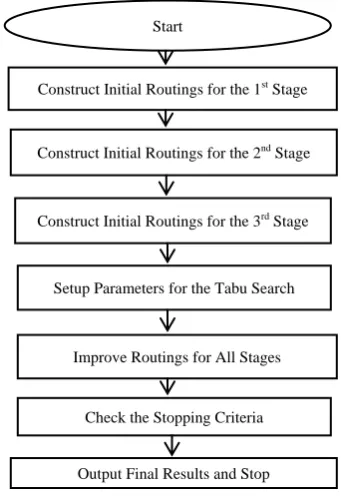
of all routes in each transportation stage. The overall design logic of this proposed solution algorithm is presented in Fig. 1.
Fig. 1. Design logic for the solution algorithm.
There are two phases in the design logic. The first phase is to construct initial vehicle routings starting from the 1st transportation stage to the 3rd transportation stage in sequence. The basic idea for constructing an initial routing is using the neighborhood searching approach starting from the depot point, i.e. the cross-docking point in this research. Once a nearest new service node is found, several checking criteria should be considered, such as the accumulated loading quantity, the accumulated service time, time left to return to the depot point. In each transportation stage, these iterations will be repeatedly executed until all service points are arranged in a routing plan.
The second phase of the design logic is to improve the initial vehicle routings in the system. This phase applies the Tabu logic for routing improvement and integrates all three transportation stages in one improving process. The design parameters of this Tabu search include the length of Tabu list, number of iteration to end the searching process, probabilities for selection of neighborhood exchange approaches. There are four possible neighborhood exchange approaches developed in each transportation stage. For the first transportation stage, the improvement approaches include: (1) external route 1-0 node change, (2) external route 1-1 node exchange, (3) internal route 2-opt node exchange, and (4) internal route or-opt node exchange. The improvement approaches for the second and third stage are: (1) external route 1-0 node change, (2) external route 2-exchange, (3) internal route 2-opt node exchange, and (4) internal route or-opt node exchange.
In addition, the Taguchi experiment approach is used for fine tuning the design parameters of Tabu search. For solving the real-world and large-scale problem, the solution algorithm developed in this research is further coded by the VBA language and running on Windows 7 system.
V. DEMONSTRATION EXAMPLE AND DISCUSSION
A. Basic Data of the Illustration Example
A numerical example with one cross-docking point is developed in this section to demonstrate effectiveness of the mathematical model and the efficiency of the solution algorithm proposed in this study. In this example, there are 50 nodes within a square area, i.e. 100 by 100 kilometer. 20 nodes out of 50 are suppliers which also recognized as the return points. The rest of them are the end customers. Fig. 2 indicates all locations including: the cross-docking point (yellow square), all suppliers (blue triangles), and all end customers (red circles). Delivery quantities are generated by a uniform distribution between 10 and 50. Quantities of returned goods are also uniformly distributed between 0 and 20.
Fig. 2. Locations of cross-docking point and 50 nodes.
The loading capacity of each vehicle is 150 units and the average vehicle speed is 60 kilometer per hour. The fixed cost for each vehicle route is $500. Service time at each supplier or end customer is 0.1 minute per unit.
The operation time for all three transportation stages is 480 minutes which is also recognized as one planning period. The time period for the first stage operation is 160 minutes. After sorting goods and reloading truck, all vehicles should leave the cross-docking area and start the second transportation stage. The operation time for the second stage is 200 minutes and it is followed by the time for goods sorting and truck reloading. All operations should be ended by 480 minutes.
B. Design Parameters of Tabu Search
When the solution program and basic data of example are ready, a Taguchi experiment is conducted to set up appropriate design parameters for Tabu search. As indicated in section IV, the design parameters include: length of Tabu list, maximal iteration number, and probabilities for selecting improvement approaches. Since each parameter is defined in three levels, the L9 orthogonal table is suitable in this case.
The final results of Taguchi experiment are summarized in Table I and Table II for all three stages.
TABLE I: THE DESIGN PARAMETERS FOR THE FIRST STAGE
Parameter Level Values Remarks Length of Tabu
list 2 7 —
Maximal iteration
number 3 150 —
Probabilities for improvement approaches
3
2/6 2/6 1/6 1/6
External 1-0 change External 1-1 exchange Internal 2-opt exchange Internal or-opt exchange
0 20 40 60 80 100 120
0 20 40 60 80 100
Start
Construct Initial Routings for the 1st Stage
Construct Initial Routings for the 2nd Stage
Construct Initial Routings for the 3rd Stage
Setup Parameters for the Tabu Search
Improve Routings for All Stages
Check the Stopping Criteria
TABLE II: THE DESIGN PARAMETERS FOR THE SECOND AND THIRD STAGE
Parameter Level Values Remarks Length of Tabu
list 2 7 —
Maximal iteration
number 3 150 —
Probabilities for improvement approaches
2
1/6 1/6 2/6 2/6
External 1-0 change External 2-exchange Internal 2-opt exchange Internal or-opt exchange
C. Solution of the Example and Discussion
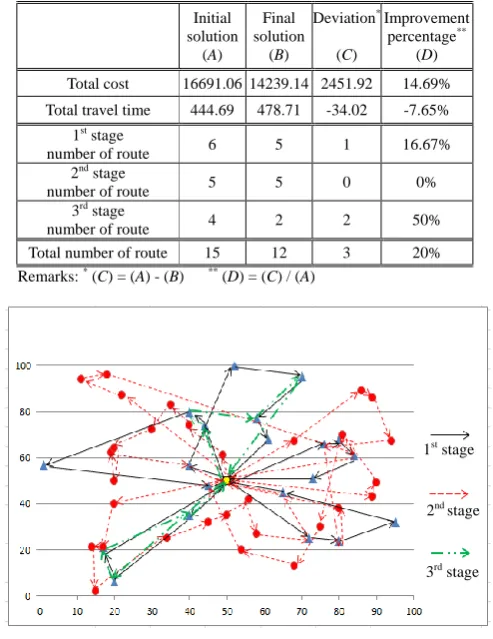
Based on the solution algorithm described in section IV, a computer program is then developed to solve this numerical example. For demonstration and comparison purpose, Table III and Table IV show the initial solution and the final solution, respectively. Table V compares the initial and final solutions on the basis of total cost, travel times, and number of routings used in each stage. Fig. 3 shows the final vehicle routings for all stages in details.
By comparing the initial solution and the final solution, the total cost can be reduced 14.69% and the number of routing can be effectively reduced up to 20%. Reduction of routings, i.e. 3 routing in this example, may represent a better utilization of vehicle and fully utilizing the time of panning period. These results indicate that the proposed solution algorithm can effectively reduce the cost and increase the efficiency of the transportation system.
There are 135 returned goods should be delivered back to suppliers starting from end customers. Data from the initial solution indicates that 35 returned goods, i.e. 25.93%, are delivered to their destination earlier in the second stage. In the final solution, however, this quantity increases to 70, i.e. 51.85%.
TABLE III: THE INITIAL SOLUTION OF THE ILLUSTRATION EXAMPLE
Veh.
ID Routing
Arri. time (min.)
Dept. time (min.)
Cost
1st stag
e
1
0-3-11-15-19-16-10-0 102.68
2 0-4-18-12-13-0 94.45
3 0-14-1-9-8-0 123.53
4 0-20-5-2-0 127.50
5 0-6-0 100.99
6 0-17-7-0 122.97 128.50 6055. 66
2nd stag
e
1* 0-46-32-33-44-47-4
2-50-11*-0 255.72
2 0-31-39-40-36-28-2
7-43-41-34-0 317.59
3* 0-22-45-48-23-38-21-49-18*-0 328.21
4* 0-37-29-30-35-9*-0 301.49
5* 0-26-24-25-12*-0 322.38 329.21 6525. 96
3rd stag
e
1 0-3-15-19-20-0 433.85 2 0-5-2-0 444.69 3 0-14-1-4-0 439.93
4 0-16-7-0 430.25
4109. 44
Total cost 16691.06
Total travel time 444.69
Remarks: * Earlier delivery in the second stage
TABLE IV: THE FINAL SOLUTION OF THE ILLUSTRATION EXAMPLE
Veh
ID Routing
Arri. Time (min.)
Dept. time (min.)
Cost
1st stag e
1 0-15-19-6-3-0 137.53 2 0-4-18-12-13-0 94.45 3 0-1-9-8-14-0 119.87 4 0-20-2-5-0 126.48
5 0-11-17-7-16-10-0 138.25 139.25 5277.8 8
2nd stag
e
1* 0-46-32-33-44-47-50
-42-11*-0 278.63
2* 0-38-21-49-18*-45-4
8-23-3*-0 332.30
3* 0-37-29-30-35-4*-9*
-22-0 335.35 4* 0-26-25-24-12*-0 330.91
5* 0-31-39-40-36-28-27
-43-41-34-1*-14*-0 356.63 357.63 6788.3
6 3rd
stag e
1 0-15-19-16-7-0 471.13
2 0-2-5-20-0 478.71 2172.9 0
Total cost 14239.14
Total travel time 478.71 Remarks: * Earlier delivery in the second stage
TABLE V: COMPARISON OF THE INITIAL AND FINAL SOLUTIONS
Initial solution
(A)
Final solution
(B)
Deviation*
(C)
Improvement percentage**
(D)
Total cost 16691.06 14239.14 2451.92 14.69%
Total travel time 444.69 478.71 -34.02 -7.65%
1st stage
number of route 6 5 1 16.67% 2nd stage
number of route 5 5 0 0%
3rd stage
number of route 4 2 2 50%
Total number of route 15 12 3 20% Remarks: * (C) = (A) - (B) ** (D) = (C) / (A)
Fig. 3. Final vehicle routings for all stages.
Additional experiment has been conduct to compare the system with pure independent three-stage (i.e. no earlier delivery in the second stage) and the system with some flexibility in the second stage (i.e. accept earlier delivery in the second stage) as proposed in this research. Table VI indicates the differences based on cost, time, and number of route. It is obviously that the earlier delivery policy is better than no earlier delivery policy. The total cost will further reduce up to 9.40%. This phenomenon may imply that the earlier delivery policy suggested in this research is worth to implement in real-world cases.
1st stage
2nd stage
TABLE VI: COMPARISON OF THE EARLIER DELIVERY POLICY No
earlier delivery
(A)
Earlier delivery
(this study)
(B)
Deviation*
(C)
Improvement percentage**
(D)
Total cost 15717.05 14239.14 1477.91 9.40% Total travel
time 436.08 478.71 -42.63 -9.78% 1st stage
number of route
5 5 0 0%
2nd stage number of
route
5 5 0 0%
3rd stage number of
route
5 2 3 50%
Total number
of route 15 12 3 20%
Remarks: * (C) = (A) - (B) ** (D) = (C) / (A)
VI. CONCLUSION
This paper proposes a new concept for vehicle transportation system. The mathematical model and the associated solution algorithm are also presented in details. Finally, the illustration example further confirms that the three-stage vehicle routing system proposed in this paper is an efficient transportation system which is worth to implement in real world cases.
ACKNOWLEDGMENT
This research is supported by the National Science Counsel, Taiwan under grant: NSC 102-2221-E-224-030.
REFERENCES
[1] U. M. Apte and S. Viswanathan, “Effective cross docking for improving distribution efficiencies,” International Journal of Logistics, vol. 3, no. 3, pp. 291-302, 2000.
[2] A. B. Arabania, M. Zandiehb, and F. S. M. T. Ghomi, “Multi-objective genetic-based algorithms for a cross-docking scheduling problem,”
Applied Soft Computing, vol. 11, no. 8, pp. 4954-4970, 2011.
[3] Y. H. Lee, W. J. Jung, and K. M. Lee, “Vehicle routing scheduling for cross-docking in the supply chain,” Computers and Industrial
Engineering, vol. 51, no. 2, pp. 247–256, 2006.
[4] G. B. Dantzig and J. H. Remser, “The truck dispatching problem,”
Management Science, vol. 6, no. 1, pp. 80-91, 1959
[5] S. Kirkpatrick, C. D. Gelatt, and M. P. Vecchi, “Optimization by simulated annealing,” Science, vol. 220, no. 4598, pp. 671-680, 1983 [6] H. F. Wang and Y. Y. Chen, “A genetic algorithm for the simultaneous
delivery and pickup problems,” Computers and Industrial Engineering, vol. 62, no. 1, pp. 84–95, 2011.
[7] C. J. Liao and Y. Lin, “Vehicle routing with cross-docking in the supply chain,” Expert Systems with Applications, vol. 37, no. 10, pp. 6868–6873, 2010.
[8] G. Clarke and J. G. Wright, “Scheduling of vehicles from a central depot to a number of delivery points,” Operational Research, vol. 12, no. 4, pp. 568-581, 1964.
Chikong Huang was born in Taiwan on July 06 1958.
He received his Bachelor degree on industrial engineering from Tunghai University, Taichung, Taiwan ROC in 1981. In 1987, he received his Master degree on industrial engineering from the University of Texas at Arlington, Arlington, Texas USA. He received his Ph.D. degree on industrial engineering from the University of Texas at Arlington, Texas USA in 1991. He is a Professor in the Department of Industrial Engineering and Management, National Yunlin University of Science & Technology, Touliu, Yunlin, Taiwan ROC since August 1991. He has been worked as an Industrial Engineer in the Organization & Efficiency Department of Philips Taiwan Ltd., Chupei Factory, Taiwan ROC from March 1984 to July 1986. He also worked as a Production Planner in the Production Planning Department of the Chin-Fong Machines Ltd., Changhua, Taiwan ROC from September 1983 to February 1984. Currently, his research interests are facilities planning & design, production & operations management, and logistic planning & design. Prof. Huang is a member of CIIE, Taiwan ROC.
Yun-Xi Liu was born in Taiwan on August 30 1989.