Traffic Rule Violation Detection System using
Raspberry Pi and ML
Shakib Deshmukh Amit Rangwal
Student Student
Jayawantrao Sawant College of Engineering, Pune, India Jayawantrao Sawant College of Engineering, Pune, India
Hrishikesh Atole Balaji Kokil
Student Student
Jayawantrao Sawant College of Engineering, Pune, India Jayawantrao Sawant College of Engineering, Pune, India
Prof. Shipra Saraswat Assistant Professor
Jayawantrao Sawant College of Engineering, Pune, India
Abstract
Traffic Rule Violations are leading cause of accidents, According to WHO India is a leading country in casualties occurring on road. The current system uses human interaction for rule violation detection, as it is a manual process it has some limitations, on multiple occasions we find the system gets corrupt. An alternative solution would be AI-developed System. With our system, we can detect multiple rule violations, for example, Vehicle crossing signal during red light or driving without a helmet, etc. Basic idea is to detect these violations through preinstalled cameras. We can do it by ML based algorithm where we can detect the violators by Image-Processing, getting the number plate, categorizing violation accordingly and issuing fine. Which will help increase the efficiency of traffic rule enforcement.
Keywords: CNN, ML, Wi-fi, YOLO, KNN
________________________________________________________________________________________________________
I. INTRODUCTION
India has the highest rates in road accidents, also it has highest rate of increase in accidents per year in whole world. We know that there are many factors that incur on occurrence of accidents, but if we consider the main cause of these accidents are traffic rule violations. The Problem is so severe that many people simply don’t know that these rules even exist. Current system to enforce the rules are largely manual much more of part of the system are humanly operated which gives it limitations and system becomes prone to errors, however there is infrastructure that has great potential but it is underdeveloped. Which involve an officer surveilling multiple displays, looking for a violation. Only if the violation is noticed by officers it is put in system.
It detects vehicles that do not obey traffic rules, such as breaking signal, driving in wrong direction, making illegal turns, not wearing helmet, and other violations. Basically, due to human errors or technical errors these violators escape and sometimes there are also chances of accidents occurring.
The Idea of the System we have is using the infrastructure of these high surveillance systems and integrating them with Deep Learning to identify the violations. Real time identification systems are very important and needful for safety, security rule following and socialism and also for own safety concerns.
Traffic rules are important for safety as traffic laws are to prevent drivers of vehicles from causing accidents or hitting pedestrians. They are also to help control the flow of traffic so that it is more efficient. The severity of different kind of punishment depends upon the nature of committed offence with regards to breaking traffic rules citizens have to pay the fine, serves the jail term or banned from driving any vehicle.
II. GUIDELINES FOR MANUSCRIPT PREPARATION
Abbreviations and Acronyms:
Raspberry Pi:
Red Light Camera:
A red light camera (short for red light running camera is a type of traffic enforcement camera that captures image of vehicle that has entered an intersection in spite of the traffic signal indicating red (during the red phase). By automatically photographing vehicles that run red lights, the photo is evidence that assists authorities in their enforcement of traffic laws.
Wi-Fi:
Wi-Fi is a family of wireless networking technologies, based on the IEEE 802.11 family of standards, which are commonly used for local area networking of devices and Internet access. Wi Fi is a trademark of the non-profit Wi-Fi Alliance, which restricts the use of the term Wi-Fi Certified to products that successfully complete interoperability certification testing. Along with Wi-fi we can also use Bluetooth and other connecting devices.
Math
Three main algorithms are being used, first algorithm is edge detection in an image is to find object boundaries, which in turn can reduce the amount of data to be analyzed in an image, second algorithm CNN is used for object detection so as to detect the object using a software name YOLO. The last algorithm K-Nearest Neighbour is used to recognize the segmented characters which is performed on extracted license plate image. The three algorithms are mentioned namely:
a) Edge Detection:
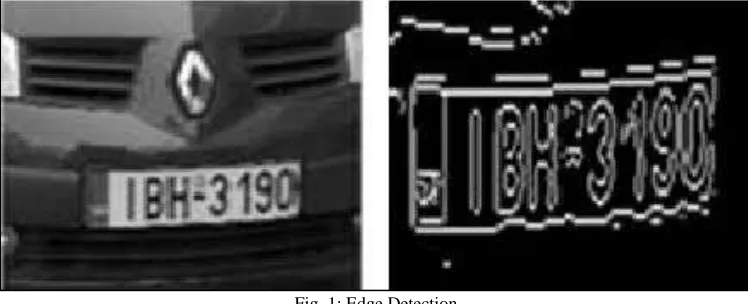
Edge detection includes a variety of mathematical methods that aim at identifying points in a digital image at which the image brightness changes sharply or, more formally, has discontinuities. The points at which image brightness changes sharply are typically organized into a set of curved line segments termed edges.
Although certain literature has considered the detection of ideal step edges, the edges obtained from natural images are usually not at all ideal step edges. Instead they are normally affected by one or several of the following effects:
Focal blur caused by a finite depth-of-field and finite point spread function. Penumbral blur caused by shadows created by light sources of non-zero radius Shading at a smooth object
A number of researchers have used a Gaussian smoothed step edge (an error function) as the simplest extension of the ideal step edge model for modeling the effects of edge blur in practical applications.
We can use a periodical convolution of the function f with specific types of matrices m to detect various types of edges in an image: f’ (x,y ) =f(x,y )* m[x,y ]= ∑ 𝑥 𝑤−1 𝑖=0 ∑ 𝑦 ℎ−1 𝑗=0 f(x,y)* m[mod(x-i),mod(y-j)]
Where w and h are dimensions of the image represented by the function f.
Fig. 1: Edge Detection b) CNN (Convolutional Neural Network):
In neural networks, Convolutional neural network (ConvNets or CNNs) is one of the main categories to do images recognition, images classifications. Objects detections, recognition faces etc., are some of the areas where CNNs are widely used. They are regularized versions of multilayer perceptrons. Multilayer perceptrons usually mean fully connected networks, that is, each neuron in one layer is connected to all neurons in the next layer. The "fully-connectedness" of these networks makes them prone to overfitting data. Typical ways of regularization include adding some form of magnitude measurement of weights to the loss function.
Fig. 2: Convolutional neural network c) K-Nearest Neighbour:
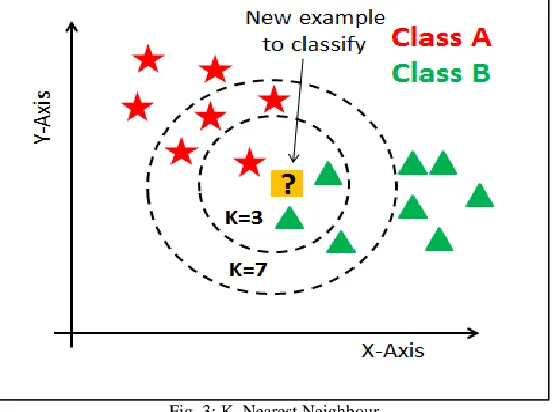
The k-Nearest-Neighbors (kNN) method of classification is one of the simplest methods in machine learning are regularized versions of multilayer perceptrons. Multilayer perceptrons usually mean fully connected networks, that is, each neuron in one layer is connected to all neurons in the next layer. Typical ways of regularization include adding some form of magnitude measurement of weights to the loss function and is a great way to introduce yourself to machine learning and classification in general. At its most basic level, it is essentially classification by finding the most similar data points in the training data, and making an educated guess based on their classifications. Although very simple to understand and implement, this method has seen wide application in many domains, such as in recommendation systems, semantic searching, and anomaly detection.
The k-nearest neighbors (KNN) algorithm is a simple, easy-to-implement supervised machine learning algorithm that can be used to solve both classification and regression problems. The KNN algorithm assumes that similar things exist in close proximity. In other words, similar things are near to each other. As we would need to in any machine learning problem, we must first find a way to represent data points as feature vectors. A feature vector is our mathematical representation of data, and since the desired characteristics of our data may not be inherently numerical, preprocessing and feature-engineering may be required in order to create these vectors. Given data with N unique features, the feature vector would be a vector of length N, where entry I of the vector represents that data point’s value for feature I.
III. SOFTWARE DESIGN
Flowchart:
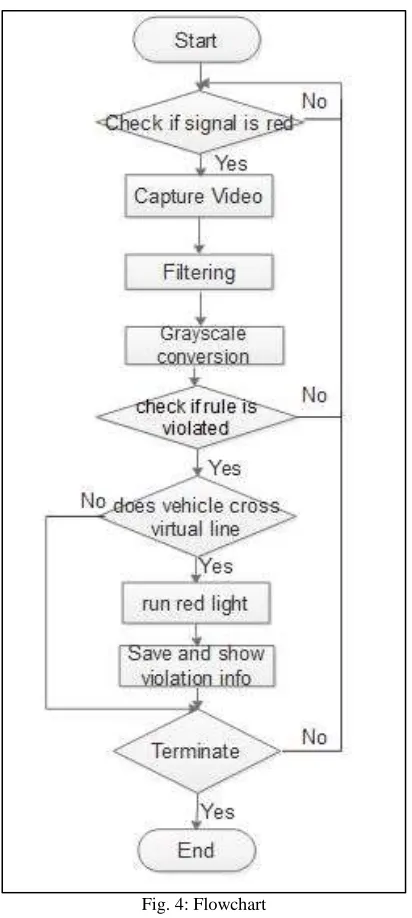
Fig. 4: Flowchart
The process followed by python and yolo for the project is shown in flowchart:
1) Check the Signal: If signal is red then start capturing the video to search for any violators. If not then do not capture anything 2) Capture the Video (Image): The video should be captured in such a way that number plate of the vehicle should be visible
clearly and illumination is also to be considered.
3) Filtering: Filter the captured video and capture only image of the number plate of vehicle which has broken the rule.
4) Preprocessing of Vehicle Image: Convert the color (rgb) image to gray scale image. Applying prewitt’s edge detection method finds the edges of vehicle image. Apply the morphological function “imdilate” to dilute the image, so that edge lines become thinner and unwanted small lines will be washed out.
5) Check for Violation: If any violation occurs the only save those vehicle images who had done violation into the database for further processing
6) Extract Number Plate from Vehicle Image: Once we get the plate area, it is cropped out from vehicle image and made a separate image. This image is converted to optical image format by complimenting its black and white image.
Results and Finding:
YOLO (You Only Look Once):
In general, single-stage detectors tend to be less accurate than two-stage detectors but are significantly faster. Compared to other region proposal classification networks (fast RCNN) which perform detection on various region proposals and thus end up performing prediction multiple times for various regions in an image, Yolo architecture is more like FCNN (fully convolutional neural network) and passes the image (nxn) once through the FCNN and output is (mxm) prediction. This the architecture is splitting the input image in mxm grid and for each grid generation 2 bounding boxes and class probabilities for those bounding boxes. Note that bounding box is more likely to be larger than the grid itself.
Cameras will capture the image using yolo object detection technique. When the signal turns red there will be a virtual line which will be activated by the software system overlapping the zebra crossing if any vehicle gets ahead of the virtual line the vehicle will be detected as violator after which the vehicle or violators image will be cropped the cropped image will help in detecting vehicle’s number plate with help of featuring extraction technique the number of vehicle will be scanned out and send for further processing.
The further processing is confirmation by the policeman and fining the violator; violator will be seen and according to violation detected will be culprit will be fined.
Fig. 5: Object Detection Number Plate Extraction:
It will occur in the following phases: Detection:
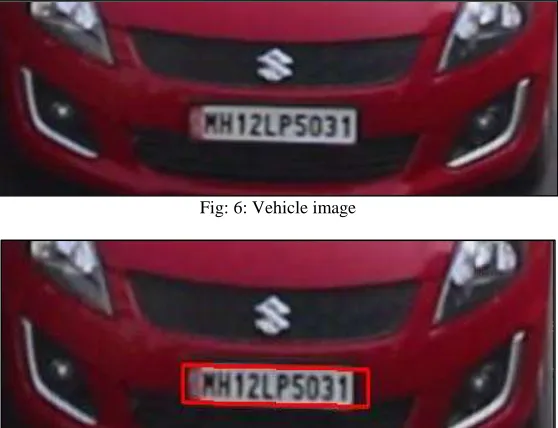
The detection phase happens one time for each input image. It uses the LBP algorithm (generally used for face detection) to find possible license plate regions (x,y, width, height). Each of these regions is sent to the later pipeline phases for further processing. The detection phase is usually the most processing-intensive phase. It can be GPU accelerated to improve performance.
Fig: 6: Vehicle image
Binarization:
This phase (and all subsequent phases) occur multiple times -- once for each possible license plate region. The binarization phase creates multiple binary images for each plate region. The reason multiple binary images are used is to give us the best possible chance of finding all the characters. A single binarized image may miss characters if the image is too dark or too light.
Character Analysis:
Character analysis attempts to find character-sized regions in the plate region. It does this by first finding all connected blobs in the license plate region. Then it looks for blobs that are roughly the width and height of a license plate character and have tops/bottoms that are in a straight line with other blobs of similar width/height.
Character Segmentation:
The character segmentation phase tries to isolate all the characters that make up the plate image. It uses a vertical histogram to find gaps in the plate characters. This phase also cleans up the character boxes by removing small, disconnected speckles and disqualifying character regions that are not tall enough. It also tries to remove "edge" regions so that the edge of the license plate doesn't inappropriately get classified as a '1' or an 'I'
Fig. 8: Number Plate Extracted
IV. CONCLUSIONS
With implementation of this system the manual work will be reduced, even the human limitation will be effectively overcome. Now the window of getting away of the violators due to negligence will be narrowed. More violators can be scanned. We will be working towards and automated environment which reduce the workload on police officers too, now the work flow will become efficient. With inculcation of this new system rule will be enforced more actively and decrease the road accidents and casualties.
Thus far the system will be automated. Work flow will be efficient. Rule enforcement will decrease the road accidents and casualties.
REFERENCES
[1] Padmaja B, Sunil M P Dynamic Traffic Rule Violation Monitoring System Using Automatic Number Plate Recognition with SMS Feedback
[2] R Shreyas, Pradeep Kumar B V, Adithya H B, , Department of Electronics and Communication Engineering School of Engineering and Technology, Jain University, Bangalore, India
[3] Comparison of feature extraction techniques to recognize traffic rule violations using low processing embedded system Manishkumar Purohit Department of Electronics & Communication Engineering Parul Institute of Engineering and Technology Vadodara, Gujarat, India [email protected]
[4] Comprehensive Traffic Management System: Real-time traffic data analysis using RFID
[5] Meghana B S, Department of Computer Science and Engineering, Ramaiah University of Applied Sciences͒ Bengaluru, India͒ [email protected] [6] YOLO-https://pjreddie.com/darknet/yolo/