Using Hypergraphs Models for CIS Modelling
Sihem Chabchoub
*, Yemna Sayeb, Henda Ben Ghazela
National School of Computer Science, Research laboratory RIADI-GDL, Manouba, Tunisia.
* Corresponding author. Tel.: +216 22 201 282; email: [email protected]
Manuscript submitted December 16, 2017; accepted February 9, 2018. doi: 10.17706/jcp.13.8 971-978.
Abstract: Companies are moving towards a more collaborative and open perspective for interaction between different partners. Based on the strong dependence between the company and its information system, Collaborative information systems (CIS) have been growing and gaining substance in technological infrastructure and application areas. They involve large networks of information systems that manage large amounts of information and computing services and cooperate to fulfill their mission. In the last few years, one promising source of ideas for designing collaborative information systems is the field of System of Systems. They appear to be more flexible, modular, and robust than traditional. The main theme presented in this paper is the modelling of collaborative information systems.
Key words: Information system, collaboration, collaborative network, collaborative information system, modelling, hypergraph, service.
1.
Introduction
Companies are in perpetual evolution in order to cope with a changing environment. To remain agile and competitive, companies are required to make fundamental changes to their organization and to be more open to their environment in order to take advantage of new opportunities [1]. In fact, Information technologies and the World Wide Web are changing the way business enterprises work [2].Thus, working together for a company, is today becoming an essential economic imperative to survive a competition increasingly difficult. The quality and the potential of collaborations become a determining factor in assessing their survivability [3]. As a result, companies tend to network and build partnerships to improve their responsiveness [4]. Any company can have one or more information systems (IS) to describe their business model and facilitate decision-making, coordination and control [5], [6]. Undoubtedly, the collaboration of companies impacts necessarily their information systems. That's why information systems have experienced a new wave of development. They evolve from a highly segregated organization, where each organizational entity manages its IS independently, to a more open organization, where many IS exchange continually [7] while taking into account technological changes and envisaged strategy. The challenge of such an information system is that of developing the same capacity, creativity, and competence to work efficiently and effectively with partners across the boundaries of time, space, culture and the same complex challenges inherent in working with other human beings in the ever-changing external and internal landscape [8], [9].
space and time. The collaboration of the different stakeholders allows to achieve a common objective or to respond to an opportunity in the market [12]. In our context, we are interested to the collaboration among information systems because the integration of different partners greatly depends on the ability of their Information Systems to interact effectively. So, Collaborative Information System presents a set of information systems that work together to achieve a common global goal. Ensuring a dynamic and reactive CIS with several heterogeneous partners is a really subtle mission because [12]:
Partners involved in the collaboration, come with their own processes, services, semantics and a given data format. Each of them wishes to preserve its functional autonomy and technical architecture, and exhibits the only skills [process, services, and data] that it would like to share with the outside,
Organizations should be able to integrate or leave the collaboration in a simple way and with less effort.
The partnership should tolerate evolutions and changes in activities and /or priorities.
Thus, our work proposes a new modeling approach of CIS which focuses on detecting potential collaborative partners in an IS network according to the characteristics and objectives of the collaboration.
2.
Related Works
2.1.
Collaborative Networks
According to the literature [13], [14], collaboration can be qualified through several key elements such as: (1)
Objective: describes why collaboration is established in terms of products or services to be offered.
Partner: it can be a organization, person or information system that participates in the collaboration.
Relationship: describes the implementation of the strategy among partners.
Collaboration Network (CN): refers to a group or set of partners that exchanges products or services through collaboration to achieve a common goal.
The establishment of a collaboration necessarily leads to the establishment of a collaborative network. The definition given by [14], [15] refers to a collaborative network as an alliance of a variety of autonomous entities, and heterogeneous in terms of environment, culture, social capital and objectives, but which collaborate to better achieve common objectives and whose interactions are supported by a computer network. According to [16], the collaborative network is a network of entities working together to achieve a common goal, taking into account certain parameters (cost, time, quality) and using ICT. It emphasizes shared capacities and resources (services, data, infrastructure) based on communication and information exchange [17]. Collaborative networks are manifested in a wide variety of forms, including extended enterprises, virtual enterprises, dynamic supply chains, collaborative virtual laboratories, etc [18], [19]. Most forms of collaborative networks involve a sort of organization on the objectives and participants by identifying the role of each participant and some rules of governance. A network can be defined as proposed by [20] depending on the components that constitute it. A network is a set of nodes and links between these nodes. The components of a network are: (1) node presents a participant in the collaboration, it can be an individual, a department, a department, a company, etc. Each node has its own characteristics and (2) links that determine how the different nodes are interconnected and interact. In terms of topology, three configurations of collaboration networks are treated in the literature [18], [19], [21]:
Chain topology, the case of supply chains in enterprises. It presents an interaction model where partners are connected in the right order according to the direction of transfer of resources.
has the decision-making authority and coordinates the tasks. He can lead and modify the whole network according to his strategies, his skills, and political power.
Point-to-point topology in which there is no dominant member it is not only a kind of point-to-point interaction, but also a more general form of collaboration involving several partners, or even all of them . It is characterized by the absence of hierarchy. Management skills are distributed in the members and the decision-making power is equal for all members.
2.2.
Collaborative Information System
The concept of the collaborative information system can be defined as a set of IS partners that can be heterogeneous and distributed. It is based on the use of web services [12]. It presents a system that enables the coordination of the activities of several partners and the execution of collaborative processes [22]-[24]. Considerable research efforts has tried to offer many approaches for CIS modeling. These works mainly focused on static dimension of collaboration. Some researchers [24], [25] have proposed a CIS meta-model based on service-oriented architectures and which is derived from a collaborative process model that seen as a provider of collaborative knowledge. The basic element of this meta-model is the mediator. This meta-model is divided into three views: (1) services view : consists of the services that are used in the collaboration and descriptions of partners and their services, (2) informations view : presents data exchanged between services, and (3) process view : describes the interaction between the service view and the process view and it deals with a specification of the orchestration of services in the collaborative process.
The meta-model proposed in the work [12] present a meta-model of collaborative information systems on demand where partners have heterogeneous and distributed information systems. This meta-model consists of three sub meta models which are: (1) the Opportunity metamodel: describes the opportunity that prompted the initiating organization of the collaborative project. This gives rise to several projects and missions that will be carried out through one or more activities, (2) the IS meta-model : describes the different components of the information system, and (3) the Processing System meta-model : brings together the services exhibited by partners involved in collaborative projects, as well as mediation services useful for collaboration.
In addition, as part of the "ISyCri" project (Interoperability of System in Crisis Situation), the proposed meta-model [25] consists of three subsystems: the first (Crisis Characterization) contains the description of the crisis, the second (Studied System) presents the events, risks, indicators.... and the last (Treatment System) corresponds to the collaborative information system. The latter describes the collaboration between different actors via services. It also contains the description of the collaborative process.
3.
CIS Characterization
3.1.
The Proposed CIS Meta-Model
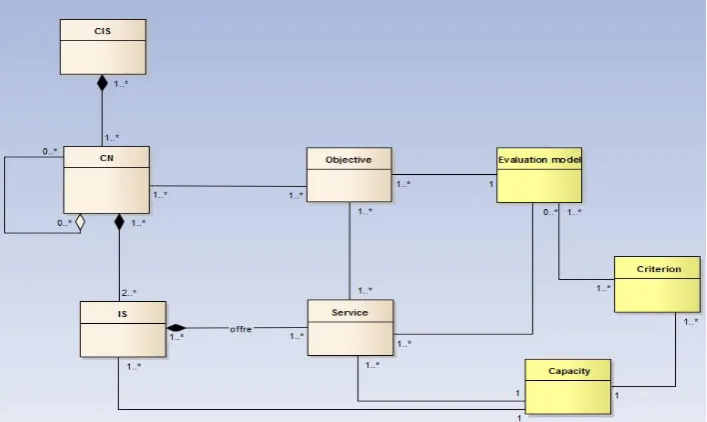
break down an information system into a set of basic functions called "services". In this sense, the CIS is perceived as a collaborative solution that implements SOA concepts. In fact, CIS can be considered as composed of collaborative networks of IS and the different services of the partners. The components of the meta-model are: (1) CN: is a set of IS partner involved in a collaboration, (2) IS: is an information system participating in a collaboration. It consists of a set of services, (3) Service: is exhibited by an IS participating in the collaboration, (3) Objective: describes a result desired by the collaboration and realized by one or more services, (4) Criterion: result of the collaboration objective and with which the resulting collaborations will be evaluated, (5) Evaluation model: allows to measure the expected performance for each capacity and (6) Capacity: details the value of an operational capacity owned by each entity. The proposed meta-model is illustrated by Fig. 1.
Fig. 1. The proposed CIS meta-model.
3.2.
Hypergraphs for CIS Modeling
by relation. An hypergraph H is a pair (S, E) such that:
S = {S1, S2, …., Sn} is a non-empty finite set of vertices of H ;
E = {E1, E2, ….., Em} ⊆ is a set of non-empty subsets of representing hyperedges H, with .
We note the set set of non-empty subsets of S containing at least one and at most n element. 1. Representation using Hypergraph: consists in detectingcollaborative networks of IS in order to select
those that are candidate for collaboration.
2. Transformation towards a dual Hypergraph: highlights the importance of identifying CN. In fact, each CN can be presented as an edge. Two vertices ISi,j and ISi',j' are linked between them if and only if, there
exists a non-empty intersection between them.
That's mean each edge from H* is valued by a function defined as follows:
Fig. 2. Transformation towards a dual hypergraph.
3. Tagging hyper-edges: To study the characteristics of collaboration forms, we have equipped each edge of a function F. This function will allow as to select adequate Collaborative Networks for CIS.
4.
Implementation and a Case Study
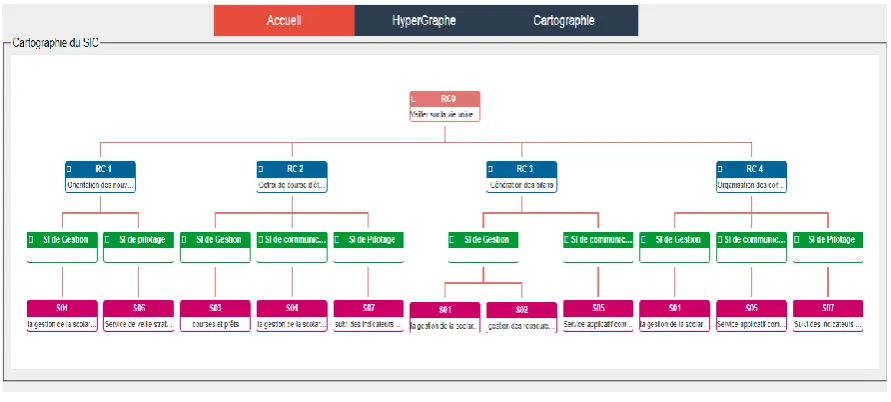
Fig. 3. Print Screen of SINUS model.
step is to use the editor tool in order to load necessary data for the framework (set of services offered, evaluation models and set goals with the required services). Once we have introduced necessary data, we can then generate the hypergraph of collaborative networks that compose our CIS. Finally, we can generate the SIC map using a multi-level representation as shown in the Fig. 3.
5.
Evaluation of the Proposed Meta-Model
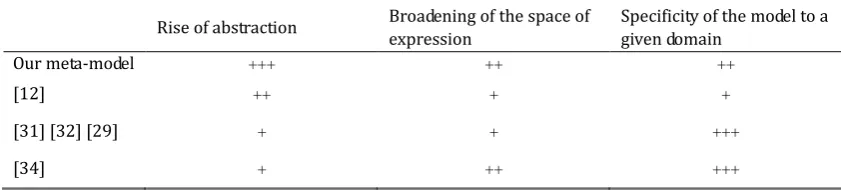
Our aim here is to ascertain the relevance of the proposed model of CIS in our approach. We propose to evaluate our meta-model in relation to other works according to the following criteria [29]: (1) rise of abstraction, (2) broadening of the space of expression and (3) specificity of the model to a given domain. The Table 1 resume the evaluation of the overall approach according to the criteria already mentioned:
Table 1. Summary Table for Comparison of Our Approach
Rise of abstraction Broadening of the space of expression Specificity of the model to a given domain
Our meta-model +++ ++ ++
[12] ++ + +
[31] [32] [29] + + +++
[34] + ++ +++
Note that: (+++): very important, (++): important, (+): medium, (-): weak
6.
Concluding Remarks and Future Research
This paper presents a new approach for modeling Collaborative Information Systems. In this approach, we have well formalized the CIS concept, which is based on collaborative networks and service-oriented architectures, and implemented a generic model with its modeling framework. Then, this approach was applied to the concrete case of the SINUS system which concerns the collaborative information system of higher education. For future research we intend, in the one hand, to extend our framework to support services orchestration and to generate functional map of CIS for decision-makers. In the other hand, we are exploring cloud computing for the deployment of CIS services.
References
[1] Mu, W., Bénaben, F., & Pingaud, H. (2016). Collaborative process cartography deduction based on collaborative ontology and model transformation. InternationalJournal of Information Sciences, 83–
102.
[2] Qin, S. F, & Sun, G. (2006). Analysis and control of complex collaborative design systems. International Journal of General Systems, 35, 377-386.
[3] Boughzala, I., & Devreede, G. J. (2015). Evaluating team collaboration quality: The development and field application of a collaboration maturity model. Journal of Management Information Systems,
129-157.
[4] Bénaben, F., Mu, W., Boissel-Dallier, N., & Pingaud, H. (2014). Supporting interoperability of collaborative networks through engineering of a service-based mediation information system (MISE 2.0). Journal of Enterprise Information Systems, 556-582.
[5] Laudon, K. C., & Laudon, J. P. (2000). Management Information Systems: Organization and Technology in the Networked Enterprise. Prentice Hall.
[7] Bertin, E., & Crespi, N. (2013). Architecture et Gouvernance Des Services de Communication. Lavoisier. [8] Coleman, D., & Stewart, L. (2008). Collaboration 2.0: Technology and Best Practices for Successful
Collaboration in a Web 2.0 World. Happy About.
[9] Su, C. J., & Chiang, C. Y. (2012). Enabling successful collaboration 2.0: A rest-based web service and web 2.0 technology oriented information platform for collaborative product development. Journal of Computers in Industry, 63, 948-959.
[10]Boughzala, I., & Devreede, G. J. (2012). A collaboration maturity model: Development and exploratory application. Proceedings of the 45th Hawaii International Conference on System Sciences (pp. 306-315). [11]Camarinha-Matos, L. M., Afsarmanesh, H., Galeano, N., & Molina, A. (2009). Collaborative networked
organizations — Concepts and practice in manufacturing enterprises. Journal of Computers & Industrial Engineering, 57, 46-60.
[12]Jaafri, M., Ettalbi, A., & Nassar, M. (2014). Designing a collaborative information system for a business opportunity. International Journal of Engineering Sciences & Emerging Technologies, 6, 389-399.
[13]Camarinha-Matos, L. M., Afsarmanesh, H., & Ollus, M. (2006). Designing a collaborative information system for a business opportunity. International Journal of Engineering Sciences & Emerging Technologies, 6, 389-399.
[14]Camarinha-Matos, L. M., & Afsarmanesh, H. (2005). Collaborative networks: A new scientific discipline.
Journal of Intelligent Manufacturing, 16, 439-452.
[15]Afsarmanesh, H., Sargolzaei, M., & Shadi. M. (2012). A framework for automated service composition in collaborative networks. Proceedings of the IFIP WG 5.5 Working Conference on Virtual Enterprises (pp. 63-73).
[16]Stegarua, G., Danila, C., Sacala, I., Moisescu, M., & Stanescu, A. (2014). E-Services quality assessment framework for collaborative networks. Journal of Enterprise Information Systems, 9, 583-606.
[17]Camarinha-Matos, L. M., & Afsarmanesh, H. (2008). Collaborative Networks: Reference Modelling. Springer.
[18]Camarinha-Matos, L. M., & Afsarmanesh, H. (2012). Taxonomy of collaborative networks forms. Final Report of FInEs Task Force of Collaborative Networks and SOCOLNET-Society of Colllaborative Networks. [19]Poulin, D., Montreuil, B., & Gauvin, S. (1994). L'entreprise réseau: Bâtir aujourd'hui l'organisation de
demain.
[20]Katzy, B., & Loh, H. (2003). Virtual enterprise research state of the art and ways forward. Proceedings of the 9th Internationnal Conference on Concurrent Entreprising (pp. 343-353).
[21]Mace Ramete, G., Lauras, M., Bénaben, F., & Lamothe, J. (2012). A collaborative information system supporting decision and coordination in transport crisis context. Proceedings of the 9th International Conference of Modeling, Optimization and Simulation.
[22]Tahir, O., Andonoff, E., Hanachi, O., Sibertin-Blanc, C., & Benaben., F., et al. (2008). Collaborative information system architecture for process-based crisis management. Proceedings of the 12th International Conference: Knowledge-Based Intelligent Information and Engineering Systems.
[23]Touzi, J., Benaben, F., Pingaud, H., & Lorré, J. (2009). A model-driven approach for collaborative service-oriented architecture design. International Journal of Production Economics, 5-20.
[24]Bénaben, F., Touzi, J., Rajsiri, V., Truptil, S., & Lorré . J., et al. (2008). Mediation information system design in a collaborative SOA context through a MDD approach. Proceedings of the 1st International Workshop on Model Driven Interoperability for Sustainable Information Systems (MDISIS’08) (pp. 89-103).
International Conference on Interoperability for Enterprise Software and Applications, IESA 2008. [26]Jamshidi, O. (2009). Systems of Systems Engineering: Principles and Applications. CRC Press.
[27]Khalil, K., Merzouki, R., Ould-Bouamama, B., & Haffaf, H. (2012). Hypergraph models for system of systems supervision design. Journal of IEEE Transactions on Systems, Man, and Cybernetics — Part A: Systems and Humans, 42, 1005-1012.
[28]Maeir, M. (1998). Architecting principles for systems-of-systems. Journal of Systems Engineering, 1,
267-284.
[29]Soussi, A. (2011). Modélisation centrée sur les processus métier pour la génération complète de portails collaboratifs. Technique et Science Informatiques.
Sihem Chabchoub is a Ph.D student at National School in Computer Sciences (ENSI) at Manouba University. She was born in July 21, 1984 in Sfax. She have a master degree in computer science (National School in Computer Sciences), Manouba University in 2011.
Yemna Sayeb is an assistant professor at the Higher Institute of Multimedia Arts of Manouba (ISAMM). She was born in October 14, 1972 in Tunis. She have a Ph.D degree in computer science (National School in Computer Sciences), Manouba University.