ISSN (Online): 2320-9364, ISSN (Print): 2320-9356
www.ijres.org Volume 4 Issue 10 ǁ October. 2016 ǁ PP. 46-52
A method for example of machining priority sequence segment
and sorting by genetic algorithm to enhance process route
Liujianfei,Yandong
Faculty of Mechanical Engineering, Shanghai University Of Engineering Science, China
Abstract:
As an important part of computer aided process design,Research significance of optimization of process route is more and more attention by everyone.This paper based on academic achievements of many scholarsuse decision making method for example of machining priority sequence segment and sorting by genetic algorithm to enhance process route.At first the processing route of each feature is used as a transaction,using Apriori algorithm in data mining algorithm to find frequent itemsets K- itemsets machining priority sequence segment.Then using sequence segments of each priority sequence as genes to optimize genetic algorithm .Using MATLAB to write a program,the rationality and validity of the method are verified by an example.Keywords:
CAPP,machining priority sequence segment,genetic algorithmI.
INTRODUCTION
The research and development of CAPP technology originated in 1960s.1969 Norway launched the first AUTOPROS system ,and commercialized it In 1973.The United States began in the late 70s and early 1960s CAPP system[1].Computer aided process planning process engineer can greatly reduce the heavy labor and improve the quality of technological process, shorten production cycle, improve productivity and reduce manufacturing costs, both for the production of many varieties of small batch or mass production has important significance.It includes part of process decision processing method determination processing order arrangement (process sort) and four aspects of machine tools and related technology and equipment selection and process of clamping and working step and the station arrangement etc[2].One of the core content is the process of working order and It determines the level of application of the CAPP system to a large extent, and it is also an important symbol to measure the degree of intelligence and practicality of CAPP system.In this paper, the Apriori algorithm and genetic algorithm are used to optimize the process route.
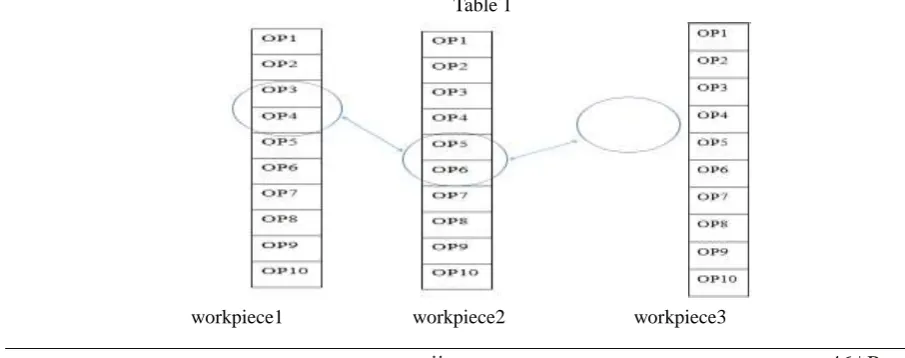
The characteristics of mechanical parts can be analyzed that the parts have Similarity[3] between 80% and 70%.And similar parts generally have similar process route and process rules, thus the priority of the process sequence segment is highlighted.machining priority sequence segment[4] is a process chain which is similar to the high frequency and high repetition rate in the process of the parts.As shown in Table 3 below,If process segment in the three oval is the same,it is the priority of the process sequence segment.Then they are put together as a whole in the decentralized process , and then sorted by genetic algorithm.This can improve the process design standardization, standardization, and can be optimized process design results.
Table 1
2.Relevant concepts of association rules in Apriori algorithm
2.1 K-itemsets and frequent itemsets
If the event A contains k elements, then called the event A for the K-itemsets[5].If the support of a K-itemsets is greater than or equal to the minimum support threshold , then the K-itemsets is called the frequent itemsets.
2.2 The support
the percentage of the total number of records and the corresponding support number of A front or back part of a rule.
2.3 Reliability
Refers to the occurrence of event A based on the probability of occurrence of event B.
2.4 Strong association rules are generated from frequent itemsets
1) K dimensional data itemsets LK is the necessary condition of frequent itemsets,its all K-1 dimensional sub item sets are also frequent itemsets,denoted by LK-1.
2) If any K-1 dimensional subset Lk-1 in the K dimensional data itemsets LK is not a frequent itemsets, then the K dimensional data itemsets LK itself is not the largest data itemsets.
3) LK is K dimensional frequent itemsets,if the number of all K-1 dimensional frequent itemsets Lk-1 contains K-1 dimensional sub sets of LK is less than K,Then Lk is not the most frequent data item in K dimension.
4) At the same time to meet the minimum support threshold and minimum confidence threshold rule is called strong rules.
The specific approach is to traverse the entire database, to find out the frequent 1- itemsets, denoted as L1,Then use the L1 to find the candidate set C2 to determine the L2 according to the association rules.In order to continue to cycle to find, until you can not find more frequent k- item set so far.The following is apriori algorithm of matlab program about confidence and support.
function [C,D]=zcd(L1)
%%%%%%Calculate support, confidence and find k-1 frequent sets PFJ=cell(X2,2);
LK=cell(n,0); zcdcount=0; zxdcount=0;
PFJ= nchoosek(L,2); %range,combination for j=1:nchoosek(X2,2)
for i=1:m
if any(A(:,i)==PFJ(j,1))&any(A(:,i)==PFJ(j,2)) zcdcount=zcdcount+1;
[x,y]=find(A(:,i)==PFJ(j,1)); if any(A(x+1,y)==PFJ(j,2)) zxdcount=zxdcount+1; end
C(j)=zcdcount/m; D(j)=zxdcount/zcdcount; if C(j)>min_sup&D(j)>min_con PFJ{j,1}=[PFJ(j,1),PFJ(j,2)]; end end
After the process route of the same process type is extracted, machining priority sequence segment with other process and step is used the genetic algorithm to optimize .A typical process generally generated through three steps of processing methods, processing method of sorting, choosing machine tool, cutting tool. this is not in the repeat.Using genetic algorithm for process route scheduling[6] is based on the current environment to generate an optimal or near optimal process route.
III.
PROCESS CONSTRAINT AND ITS TREATMENT METHOD
A reasonable process line must be established to consider the precedence relation between the machining characteristics and the machining method.Mainly include: the first rough after the essence, the first benchmark after the other, the first face after the hole, the first main and later, the characteristics of parent-child relationship, processing chain order.According to the precedence relation constraint principle, combined with processing element`s feature information,processing method information, clamping scheme and other information the system to classify the processing element, which belongs to a processing element between different categories with the corresponding system according to constraint matrix conversion principle it assigns the corresponding matrix elements in the matrix to 1.
Take the principle of the first rough after the essence[7] as an example.According to the processing method of each processing element first traversal of all processing elements,place the rough processing stage, semi finishing stage and finishing stage of the processing elements into its corresponding set;The elements in the process of rough machining stage are prior to the elements in the process of semi finish machining according to he principle of the first rough after the essence,The elements in the set of semi finish machining stage are prior to the elements in the process of finishing the elements in the finishing stage.Finally, according to the principle of the constraint matrix transformation, the two elements with precedence relation are assigned to the 1.After dealing with the precedence relation between the machining elements generated by all the principles, the process constraint matrix is automatically generated.
IV. GENETIC ALGORITHM
4.1 Determination of objective functionLess machine transformation, it means to reduce the time and cost of installation and handling ,clamping and tool change times of less means lower the time and cost of changing knife, tool which from the side to reflect the quality of the process.In this paper,that the number of machine tool transformation and the clamping, the number of tool change is the least, the time is short and comply with process constraints to be used as the optimization goal.The following is the objective function[8]:
f f k k m m x x n i i n i i i i i i n i i i i n i n j j i iF
a
F
a
F
a
F
a
F
Di
x
Ot
x
Tl
Tr
x
Os
x
s
F
x
F
1 n 1 1 1 1 1 ,)
(
)
(
)
(
In the objective function,ax is precedence constraint weight,Fx is precedence relevance grade, am is
weight of clustering constraint, Fm is relevance grade of clustering constraint, ak is adjacency order weight, Fk is
relevance grade of adjacency order, af is optimization constraint weight,Ff is relevance grade of optimization[9].
the relationship between the insertion location, the selection and change of the device, but also the cost change caused by the change of equipment.If the introduction of the new feature causes the change of the machine equipment, the Sij column of the I row in the matrix J will have the corresponding value, otherwise the position value is 0.Tr and Tl from 1 to n sum term represents tool conversion cost, Tr represents the right tool transformation cost, Tl represents the tool left transform cost.
Os and Ot represent the original equipment cost and the original tool switching costs, due to be inserted into the change between the two functions of the new features of the original priority, so the original equipment and tool costs should be subtracted.
First type last one represents the time cost, the less the total use, the higher the efficiency, that is in accordance with the goal of maximizing the interests of enterprises.
4.2 Code
The genetic algorithm does not operate on the actual decision variables of the optimization problem,so that the first problem of application of the genetic algorithm[10] through is encoding decision variables represent clusters of data structurethe[11].Gene coding is the first step in the application of genetic algorithm, which can not be used to express the process route.In this paper, used a multi parameter concatenated coding scheme.In order to facilitate the generation of the genetic manipulation and the constraint matrix, a processing element of each gene corresponding to the work piece of the work piece is processed.Therefore, each gene is composed of 6 parts, which respectively correspond to the 6 components of the processing element.the machining priority sequence segment haven be found together incorporated.The gene in the program is described by the following structure: struct gene
{
int id; //Processing element code int feature; //Processing characteristic code int peocess; //Processing method code
int constraint; //Constrained linear weight coding int equipment; //Equipment cost coding
int time; //Time cost coding }
Among them, the processing element code, the processing characteristic code, the processing method code and the natural number chain are one by one correspondence,which is the mark of distinguishing the processing element,to conduct genetic operations on behalf of the processing element; the other parts are represented by two decimal numbersIn the process of program operation.it is required to determine the priority relation between machining elements and calculate the fitness value of the chromosome according to the codes.
4.3 Initial population generation
Initial population is the determine number of processing elements sequence based on a set of randomly sets of workpiece processing elements generated.In the initial population, there may be an invalid processing element sequence that does not satisfy the precedence relation.so It is necessary to transform them into efficient processing elements by constraint matrix and processing element sequence alignment algorithm,In order to make the chromosomes in the initial population accord with precedence relation constraints.
4.4 Select
The selection process is to use the decoded adaptive value of the individual , eliminate some of the poorer individuals and select some of the better individuals, in order to carry out the next step of crossover and mutation operation.The following is the algorithm program.
4.5 Across
4.6 Aberrance
For binary gene string, mutation operation is to select the mutation point randomly according to the mutation probability.At the variation point, the position can be taken back.The following is the algorithm program.
IV.
CASE ANALYSIS
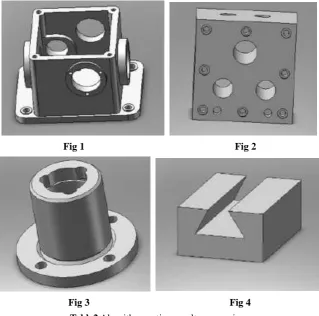
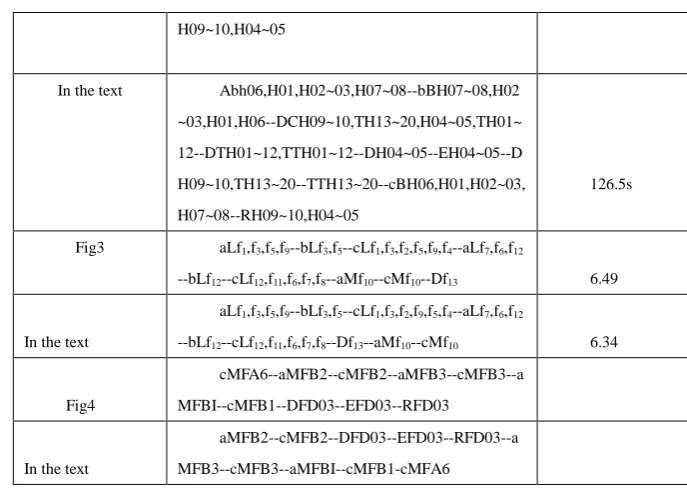
Fig1, 2, 3, and 4 are similar to the research in this paper. They all use the intelligent algorithm to solve the problem of the part process scheduling.In order to verify the effectiveness of the algorithm designed in this paper, we use the algorithm to process the parts of the graph to be machined.In Fig 1 the shortest auxiliary processing time is 65s, and the shortest processing time is 53s in the text. In Fig 2, the shortest auxiliary processing time is 135.5s, and the shortest processing time directly obtained by the algorithm in this paper is 126.5s.In Fig 3 the shortest weighted Hamming distance is 6.49, and the optimal algorithm is 6.34. Under the assumption that the tool change time is the same as that of the table, the algorithm obtained in this paper is the same optimal solution as Fig 4 .
Fig 1 Fig 2
Fig 3 Fig 4
Table2 Algorithm sorting results comparison
Algorithm
source
Optimal ordering Optimal value
Fig1 aMf15--cMf15--aMf4--cMf4--aMf7--cMf7--aMf10--cMf10
--aMf13--cMf13--Df12--aBf11,f5--Df6,f3,f14,f9--aBf8
,f1,f2--cBf1,f2,f5,f8,f11
65s
In the text
aMf10,f7,f4,f13,f15--cMf15,f10,f7,f4,f13--Df12,f9,f6,f3,f14--aB
f11,f8,f5,f1,f2--cBf1,f2,f11,f8,f5 53s
Fig2 aBH01,H06,H07~08,H02~03--bBH02~03,h07~08,H0
6,H01--DCTH01~02,H04~05,H09~10,TH13~20--DT
H13~20,H09~10,H04~05,TH01~12--TTH01~12--EH
H09~10,H04~05
In the text Abh06,H01,H02~03,H07~08--bBH07~08,H02
~03,H01,H06--DCH09~10,TH13~20,H04~05,TH01~
12--DTH01~12,TTH01~12--DH04~05--EH04~05--D
H09~10,TH13~20--TTH13~20--cBH06,H01,H02~03,
H07~08--RH09~10,H04~05
126.5s
Fig3 aLf1,f3,f5,f9--bLf3,f5--cLf1,f3,f2,f5,f9,f4--aLf7,f6,f12
--bLf12--cLf12,f11,f6,f7,f8--aMf10--cMf10--Df13 6.49
In the text
aLf1,f3,f5,f9--bLf3,f5--cLf1,f3,f2,f9,f5,f4--aLf7,f6,f12
--bLf12--cLf12,f11,f6,f7,f8--Df13--aMf10--cMf10 6.34
Fig4
cMFA6--aMFB2--cMFB2--aMFB3--cMFB3--a
MFBI--cMFB1--DFD03--EFD03--RFD03
In the text
aMFB2--cMFB2--DFD03--EFD03--RFD03--a
MFB3--cMFB3--aMFBI--cMFB1-cMFA6
The above example basically contains the typical characteristics of the box parts, the algorithm in a few examples have been made to a better solution, and the processing line to meet the process constraints, the initial description of the algorithm on the box part process line scheduling has some advantages.
Table 3 Part Feature Information Table
Feature
number
Feature name Processing
accuracy
Feature number Feature name Processing
accuracy
f 1 Front face IT8 f11 Left end IT8
f2 Through hole IT7 f12 Through hole IT7
f3 Hole system IT7 f13 Hole system IT7
f4 Right end IT8 f14 Top surface IT8
f5 Through hole IT7 f15 Hole system IT7
f6 Hole system IT7 f16 mesa IT8
f7 Rear end IT8 f17 Sink hole
system
IT8
f8 Through hole IT7 f18 Bottom IT8
f9 Hole system IT7 f19 Through hole IT7
f10 Through hole IT7 f20 hole IT8
V.
RESULT ANALYSIS
Each iteration of the genetic algorithm must maintain the number of population unchanged. When N is small, it can improve the running speed of genetic algorithm, but it reduces the diversity of population and may cause premature phenomenon.When the value of N is large, it will reduce the efficiency of genetic algorithm.In this paper, the population size N is 20, the crossover probability Pc is 0.6, the mutation probability Pm is 0.1, the maximum M is 1500, and the iteration algebra E is 4s, the time of table turning 90º is 2s, each clamping time is 20s.
worst solution.Set the crossover probability Pc = 0.8, mutation probability Pm = 0.4, run 50 times, the optimal solution is 585.Adjusting the algorithm of the optimal route for the algorithm to get the maximum fitness before and after the adjustment and the shortest machining time for the part is 913s.The optimal technological route is that
aMf14,f16,f1,f4,f7,f11--cMf11,f7,f1,f4,f16,f14--Df15,f17,f3,f6,f13,f9--aEf9,f8,f10,f12,f13,f15,f2,f3,f5,f6--Cf17--cEf5,f6,f8,f9,f10,f2,
f3,f12,f13,f15--cBf2,f5,f8,f10,f12--Rf13,f15,f9,f3,f6--aMf18--cMf18--aBf20--aEf19--bBf20--cEf19--cBf19.It can be seen that
the process route generated by this algorithm satisfies the process constraints and achieves the tool concentration and azimuth concentration to a great extent.
VII.
CONCLUDING REMARKS
In the paper,using the method of Combined decision - making method of example of Priority Sequence Segment with Genetic Algorithm Ranking to optimize of the process route[13].Considering the cost of machine tools, tooling and clamping, and adding constraints to the objective function, the optimization results are more accurate and reasonable.Four box parts model is taken as an example, the algorithm is validated, analyzed and optimized, and satisfactory results are obtained.Examples prove that the method of Combined decision - making method of example of Priority Sequence Segment with Genetic Algorithm Ranking whose results satisfy the conditional constraints and are near optimal compared with other single algorithm such as genetic algorithms.
REFERENCES
[1]. Xun Xu, Lihui Wang and Stephen T. Newman,Computer-aided process planning – A critical review of recent developments and future trends,International Journal of Computer Integrated Manufacturing, January 2011, 1–31
[2]. Roman Stryczek ,computational intelligence in computer aided process planning-a review,advances in manufacturing science and technology, Vol. 31, No. 4, 2007
[3]. chenzongshun.capp technology and process design of machinery manufacturing industry.tsinghua university press.2004.7
[4]. caoxiaobo.Research on CAPP strategy and its key technology based on the case of priority sequence.singhua university press.2005.3
[5]. chenyan.Data Mining Technology and Application.singhua university press.2011.5
[6]. zaryab ahmad,keyvan rahmani,applications of genetic algorithms in process planning:tool sequence selection for 2.5-axis pocket machining,18 November 2008
[7]. Molina, A., Rodriguez, C. A., Ahuett, H., Cortes, J. A., Ramirez, M.,Jimenez, G., & Martinez, S. (2005). Next-generation manufacturing systems: Key research issues in developing and integrating reconfigurable and intelligent machines. International Journal of Computer Integrated Manufacturing ,18(7),525-536
[8]. Mojtaba Salehi,RezaTavakkoli-Moghaddam,Application of genetic algorithm to computer-aided process planning in preliminary and detailed planning ,Engineering Applications of Artificial Intelligence ,19 March 2009
[9]. liuguohua.baohong.,Realization of Genetic Algorithm Program with MATLAB,Journal of Computer Applications.2001
[10]. L.Gao,Optimization of flexible process planning by genetic programming,original article,31 May 2007 [11]. Mariusz deja,Micezyslaw S,siemiatkowski,feature-based generation of machining process plans for
optimised parts manufacture,journal of intelligent manufacturing,Aug 2013
[12]. Türkay, D., & Filiz, H. (1999). Optimisation of process planning functions by genetic algorithms. Computers and Industrial Engineering,36, 281–308.