Development of Algorithm for Photomosaic
Generation using Soft Computing Techniques
Randeep Kaur Dr. Amardeep Singh
M. Tech. Student Professor
Department of Computer Engineering Department of Computer Engineering Punjabi University, Patiala Punjabi University, Patiala
Abstract
A photomosaic is an image generated by assembling smaller images called tiles. When viewed from far distance, a photomosaic relates to a target image. The technique to develop a photomosaic is an optimization problem in which tiles are organized to relate to a target image. We introduce restraint for repeating the tiles in the photomosaic. A hybrid optimization technique PSOGSA is used for generating the photomosaic. The results show that proposed hybrid technique gives more efficient results. Keywords: Photomosaic, PSOGSA Algorithm, Gravitational Search Algorithm (GSA), Optimization
________________________________________________________________________________________________________
I. INTRODUCTION
Photomosaic is the technique of generating an image from the smaller images called tiles. From the far distance a photomosaic resembles a desired target image and the input images have no individuality. But a closer view of the photomosaic image shows the detailed input image. Photomosaics are digital processing of historical mosaics that consists of chunks of glass, tiles or ceramic tiles of identical outline to construct bigger pictures.
A general method, the target image is reduced to a single color. The database images are also reduced to single color. The database images are then placed in every part of the target image with the maximum possible color matching. The target image is reduced in resolution and each pixel is replaced with the maximum color matching pixel from the database.
In the other advanced method, target image resolution is not reduced and for matching each pixel in the target image is compared with the corresponding pixel in the database. In this method more computation is needed than first method. But the results are much better because pixel-by-pixel matching gives better resolution.
II. RELATED WORK
The idea of photomosaic was introduced in a computer graphics called DomoniPix, where the images are made from set of dominoes. Later Silvers [11] gave the concept of generating computer developed photomosaic that was based on large image database that increases the possibility of matching the target image and the set of tiles. Genetic algorithm and genetic programming are compared for photomosaic generation [6]. The results from GP are much better than GA as GP produces photomosaic much closer to target image. RII produces photomosaic reducing the repetition of tiles and is more effective approach than GA [1]. In [10], hybrid PSOGSA algorithm is introduced to combine the strengths of PSO and GSA. 23 standard functions are representing the results of this hybrid method are compared with the individual PSO and GSA algorithm.
III. PRESENT WORK
Problem Formulation
To generate a photomosaic the problem can be defined as: we are given a target image and the pool of tiles. The tiles are to be assembled in a two-dimensional grid in such a way that assembling of tiles is similar to the target image as much as possible. Note that the repetition of tiles to generate photomosaic is to be prevented. For this a constraint is imposed for reusing the tiles to generate photomosaic. Suppose that 𝑛𝑚 is the maximum number of times for the use of tile in the photomosaic. It makes generating the photomosaic an optimization problem in which tiles are to be assembled in such a way that it appears as the target image with the maximum use of each tile 𝑛𝑚 times.
Neighborhood structure strategy is used to select the tiles from the database to generate photomosaic. Experimentally it is concluded that two neighbourhood structures are enough for generating a high quality photomosaic at considerable pace.
Neighborhood Structures
(IJSTE/ Volume 3 / Issue 02 / 016)
Fitness Evaluation
To calculate fitness of the photomosaic, difference between target image and photomosaic is computed. It is calculated as given below:
∑ X i=1 ∑ Y j=1
∑ |imgtarget(i, j, k) − imgmosaic(i, j, k)| 3
k=1
Here, imgtarget is the target image and imgmosaic is the generated photomosaic image. Also, k = 1, 2, and 3 is the red, green, and blue component of a pixel respectively and for an image img, img(i, j, k) is the kth color component of the pixel (i, j).
Particle Swarm Optimization
The basic PSO algorithm is an inspirational work from the communal management of living beings, particularly the capacity of some categories of animals that work in group to detect locations in a particular area for example, bird flocking or fish schooling. PSO initializes the particles randomly in the search space. The velocity of the agents are given by (1) in each iteration. The location of the agents is updated by (2). The position of the particles keep on changing until PSO reaches an end criterion.
PSO mathematically is described as follows:
𝑉𝑖𝑑𝑘+1 = 𝑤𝑉𝑖𝑑𝑘 + 𝑐1𝑟1(𝑝𝑏𝑖𝑑𝑘 − 𝑥𝑖𝑑𝑘) + 𝑐2𝑟2(𝑔𝑏𝑖𝑑𝑘 − 𝑥𝑖𝑑𝑘) (1)
𝑥𝑖𝑑𝑘+1= 𝑥𝑖𝑑𝑘 + 𝑉𝑖𝑑𝑘+1 (2)
Where 𝑖= 1, 2…, n and n is the population size, w is the inertia weight, 𝑝𝑏𝑖𝑑𝑘 is the pbest of agent 𝑖 at iteration 𝑡, 𝑔𝑏𝑖𝑑𝑘 is the best solution so far, 𝑥𝑖𝑑𝑘 is the current position of the agent 𝑖 at iteration 𝑡, 𝑐1, 𝑐2are the acceleration constants and 𝑟1, 𝑟2 are the two random values in the range [0,1].
The first term of (1) signifies inertia component that retains the direction of the motion of the moving particle, second makes the particle to return to that area of the search space where its individual fitness was high and third term makes the particle’s motion to the best area found by swarm so far.
Standard GSA Algorithm
GSA is a novel heuristic optimization technique inspired from Newton’s law of gravitation which states that: Every particle in the universe attracts every other particle with a force that is directly proportional to the product of their masses and inversely proportional to the square of the distance between them.
GSA in Mathematical Form
Consider a system consisting of N agents. Initially all the agents are laying haphazardly in the search area. At all the times, gravitational forces from agent j at agent i at a particular time t can be stated as:
𝐹𝑖𝑗𝑑(𝑡) = 𝐺(𝑡)
𝑀𝑝𝑖(𝑡)×𝑀𝑎𝑗(𝑡)
𝑅𝑖𝑗(𝑡)+∈ (𝑥𝑗 𝑑(𝑡) − 𝑥
𝑖𝑑(𝑡)) (3)
Where 𝑀𝑎𝑗 is the active gravitational mass related to agent j, 𝑀𝑝𝑖 is the passive gravitational mass related to agent i, 𝐺(𝑡) gravitational constant at time t, ∈ is the small constant and 𝑅𝑖𝑗(𝑡) is the Euclidian distance between i and j.
The 𝐺(𝑡) is calculated as:
𝐺(𝑡) = 𝐺0× exp (−𝛼 × 𝑖𝑡𝑒𝑟/𝑚𝑎𝑥𝑖𝑡𝑒𝑟) (4)
Where 𝛼 and 𝐺0 are descending coefficient and initial value respectively, 𝑖𝑡𝑒𝑟 is the present iteration and 𝑚𝑎𝑥𝑖𝑡𝑒𝑟 is the maximum number of iterations.
Force acting on agentiin the problem space of d-dimension is calculated as:
𝐹𝑖𝑑(𝑡) = ∑𝑁𝑗=1,𝑗≠𝑖𝑟𝑎𝑛𝑑𝑗𝐹𝑖𝑗𝑑(𝑡) (5) Where 𝑟𝑎𝑛𝑑𝑗 is the random number in the interval [0, 1].
Acceleration is given as:
𝑎𝑐𝑖𝑑(𝑡) = 𝐹𝑖𝑑(𝑡)
𝑀𝑖𝑖(𝑡)′ (6) Here 𝑡 is specific time, 𝑀𝑖 is the mass of agent i.
The velocity and location of agents is computed as:
𝑣𝑒𝑙𝑖𝑑(𝑡 + 1) = 𝑟𝑎𝑛𝑑𝑖× 𝑣𝑒𝑙𝑖𝑑(𝑡) + 𝑎𝑐𝑖𝑑(𝑡) (7)
𝑥𝑖𝑑(𝑡 + 1) = 𝑥𝑖𝑑(𝑡) + 𝑣𝑒𝑙𝑖𝑑(𝑡 + 1) (8) Where 𝑟𝑎𝑛𝑑𝑗 is the random number in the interval [0, 1].
GSA initializes all the agents with random values. On initialization, velocities of all masses are calculated using (7). Gravitational constant, total force, acceleration are computed using (4), (5) and (6) respectively. Eq. (8) gives the location of agents. At the end, GSA stops on meeting an end condition.
The Hybrid PSOGSA Algorithm
𝑉𝑖(𝑡 + 1) = 𝑤 × 𝑉𝑖(𝑡) + 𝑐1′× 𝑟𝑎𝑛𝑑 × 𝑎𝑐𝑖(𝑡) + 𝑐2′× 𝑟𝑎𝑛𝑑 × (𝑔𝑏𝑒𝑠𝑡 − 𝑋𝑖(𝑡)) (9)
Where 𝑉𝑖(𝑡) is the velocity of agent 𝑖 at iteration 𝑡, 𝑐1′ is a weighing factor, 𝑤 is a weighing function, 𝑟𝑎𝑛𝑑 is a random number between 0 and 1, 𝑎𝑐𝑖(𝑡) acceleration of agent 𝑖 at iteration 𝑡, and 𝑔𝑏𝑒𝑠𝑡 is the best solution till now. In each iteration the position of the agent is updated is as:
𝑋𝑖(𝑡 + 1) = 𝑋𝑖(𝑡) + 𝑉𝑖(𝑡 + 1) (10)
In PSOGSA, all the agents run haphazardly. Each agent is regarded as a candidate solution. On computing accelerations and using the upgraded best results computed by GSA till now (9) gives the velocity of all the particles. At the end, (10) gives the locations of the particles. The technique of upgrading the velocities and locations of the particles stops as it reaches the end condition.
IV. RESULTS AND DISCUSSIONS
Fig. 1: Reference Image
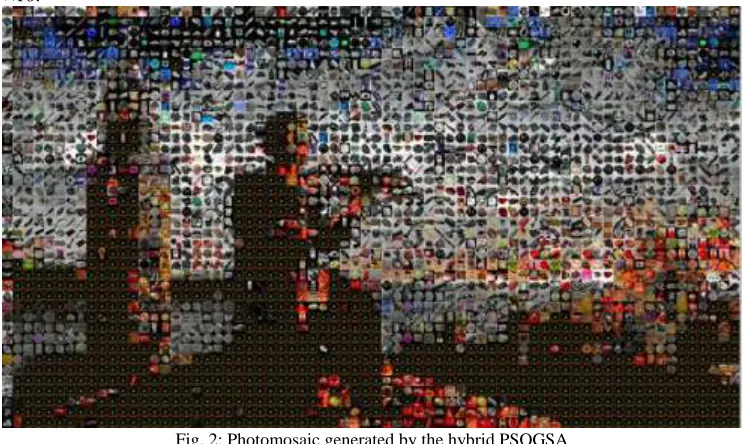
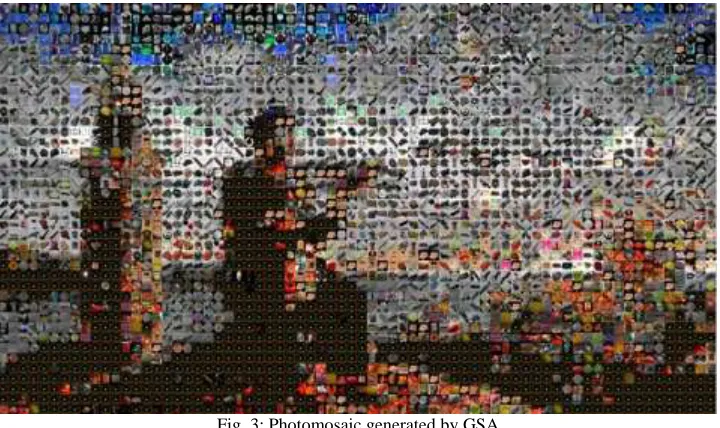
A database consists of 1831 images is taken from internet. Each tile can be repeated a maximum of 10 times. The algorithm shows results after 200 iterations repeatedly. The optimum results are shown for 10,000 iterations. The number of iterations can also be increased to get even much better results. The algorithm shows results of hybrid PSOGSA technique first and then GSA algorithm. A reference image of size 400×700 (fig.1) is selected for generating photomosaic and the size of each tile used for photomosaic is 10 ×10.
Fig. 2: Photomosaic generated by the hybrid PSOGSA
(IJSTE/ Volume 3 / Issue 02 / 016)
Fig. 3: Photomosaic generated by GSA
The plot in figure 4 and figure 5 respectively compares mean square error and the fitness of the hybrid PSOGSA and GSA. The convergence of PSOGSA is better than GSA showing the better performance of PSOGSA
Fig. 4: Mean square error of hybrid PSOGSA and GSA Fig 5: Fitness of hybris PSOGSA and GSA
V. CONCLUSION AND FUTURE SCOPE
A new hybrid technique is implemented for generating photomosaic thereby reducing the reiteration of tile images. The technique combines the merging capability of PSO with local search capability of GSA to generate a good quality of photomosaic. The results of the proposed technique are compared with that of GSA. It is proved that the hybrid PSOGSA is more efficient than GSA algorithm.
Future direction of work could be to improve the fitness function. In this technique fitness is computed by comparing each tile variation in the two images. Another direction of work could also be to fasten the fitness evaluation. The performance of hybrid technique can also be compared with other optimization techniques.
REFERENCES
[1] H. Narasimha, Sanjeev Satheesh,”A Randomized Iterative Improvement Algorithm for Photomosaic Generation”, Proc. 2009 Worlds Congress on Nature and Biologically Inspired Computing (NaBIC 2009) Mar, 2009, pp. 777-781
[2] G. Wijesinghe, S. Mat Shah, and V. Ciesielski, “Grid vs. arbitrary placement of tiles for generating animated photomosaics,” Proc. 2008 IEEE Congress on Evolutionary Computation (CEC 2008), Hong Kong, China, Jun. 2008, pp. 2734-2740
[3] A. Henriette Pascaline, Li C. Fong Christopher, M. Heenaye-M. Khan, S. Pudaruth, “Using Photomosaic and Steganography Techniques for Hiding Information inside Image Mosaics”, Proc. 2015 Intenational Conference on Advances in Computing, Communications and Informatics(ICACCI), 2015, April, 2015, pp. 1893-1897
[4] J. Alexendra Brown, D. Ashlock, J. Orth, S. Houghten, “Autogenration of Fractal Photographic Mosaic Images” 2011, April, 2011, pp. 1116-1122 [5] http://fractalfoundation.org/resources/what-are-fractals/ visited on March 9, 2016
[7] J. Shah, J. Gala, K. Pramar, M. Shah, M. Kambli, “Range Based search Algorithm for Photomosaic Generation”, International Journal of Advanced Research in Computer and Communication Engineering, 2014, pp. 5510-5512
[8] K.SakaMoto, Takayuki Itoh, “Photomosaic Generation for Photograph CollectionBrowsing”, July, 2015, pp. 216-219
[9] Achala Pandey, Umesh C. Pati, “A Novel Technique for Non-Overlapping Image Mosaicing based on Pyramid Method”, Annual IEEE India Conference (INDICON) 2013, Aug, 2013
[10] R. Silvers and M. Hawley, “Photomosaics”, Henry Holt, New York, 1997
[11] S. Mirjalili, Siti Zaiton, Mohd Hashim, “A New Hybrid PSOGSA Algorithm for Function Optimization”, International Conference on Computer and Information Applications (ICCIA 2010), July, 2010, pp. 374-377
[12] Hae Yeoun Lee, “Generation of Photo-Mosaic Images through Block Matching and Color Adjustment”, International Journal of Computer, Electrical, Automation, Control and Information Engineering, Volume 8, No. 3, pp 457-460, 2014
[13] R. Abraham, P. Simon, “Review on Mosaicing Techniques in Image Processing”, International Journal of Software Engineering Research & Practices, Volume 3, 2013, pp 21-26
[14] Hae Yeoun Lee, “Generation of Photo-Mosaic Images through Block Matching and Color Adjustment”, International Journal of Computer, Electrical, Automation, Control and Information Engineering, Volume 8, No. 3, pp 457-460, 2014
[15] R. Abraham, P. Simon, “Review on Mosaicing Techniques in Image Processing”, International Journal of Software Engineering Research & Practices, Volume 3, 2013, pp 21-26
[16] J. Dobashi, T. Haga, H. Johan, T. Nishita, “A Method for Creating Mosaic Images Using Voronoi Diagrams”, In Proceedings of Eurographics2002, September 2002
[17] G.M. Faustino, L.H. De Figueiredo,”Simple Adaptive Mosaic Effects”, in proceedings of SIBGRAPIC 2005, August 2005 [18] C. Kaplan, D.H. Salesin,”Escherization”, In Proceedings of SIGGRAPH2000, July 2000
[19] All rights reserved by www.ijste.org 5
[20] M.S. Dhawan, A. R. Dhonde, V.V. Jain, Prof. S. Tamboli, “Visual Quality Enhancement of Image Mosaic using Image Division and Texture Filtering Techniques,” International Journal of Latest Trends in Engineering and Technology (IJLTET) vol. 2, 2013, pp 245-250