SOME GROUP PRESENTATIONS
WITH FEW DEFINING RELATIONS
David Gill
A Thesis Submitted for the Degree of MSc
at the
University of St Andrews
1990
Full metadata for this item is available in
St Andrews Research Repository
at:
http://research-repository.st-andrews.ac.uk/
Please use this identifier to cite or link to this item:
http://hdl.handle.net/10023/15964
t o i t ï ) k t o H i i n i n g v t M w n s .
BY
DAVID GILL.
A THESIS SUBMITTED FOR THE DEGREE OF M.Sc. OF THE UNIVERSITY OF
ST. ANDREWS.
ProQuest Number: 10167129
All rights reserved
INFORMATION TO ALL USERS
The quality of this reproduction is dependent upon the quality of the copy submitted.
In the unlikely event that the author did not send a com plete manuscript and there are missing pages, these will be noted. Also, if material had to be removed,
a note will indicate the deletion.
uest
ProQuest 10167129
Published by ProQuest LLO (2017). Copyright of the Dissertation is held by the Author.
All rights reserved.
This work is protected against unauthorized copying under Title 17, United States C ode Microform Edition © ProQuest LLO.
ProQuest LLO.
789 East Eisenhower Parkway P.Q. Box 1346
Xw
ABSTRACT
We consider two classes of groups with two generators and three relations . One class has a similar presentation to groups considered in the paper by C.M.Campbell and R.M.Thomas , On (2,n)-Groups related to Fibonacci Groups ,Israel J.Math.,58 with one generator of order three instead of order two . We attempt to find the order of these groups and in one case find groups which have the alternating group A5 as a subgroup of index equal to the order of the second generator of the group . Questions remain as to the order of some of the other groups .
DECLARATIONS
(a) I hereby certify that this thesis has been
composed by myself, that it is a record of my own work, and that it has not been accepted in partial or complete fulfilment of any other degree or professional qualification.
Signed Date TOj 90
(b) I was admitted to the Faculty of Science of the University of St. Andrews under Ordinance General No. 12 on ly \0f3^ and as a candidate for the degree of M.Sc. on ly
Signed * Date \ j 9
0
CERTIFICATION
I hereby certify that the candidate has fulfilled the conditions of the Resolutions and Regulations appropriate to the degree of M.Sc.
Preface
I would like to thank Dr. C. M. Campbell , under whose supervision this work has been carried out , for his constant encouragement , invaluable guidance and informative lectures on Group Theory .
I am grateful to Dr. E. F. Robertson for his invaluable lectures on Maple which I attended during my first term at St. Andrews .
Abstract Declarations Certification Preface
CONTENTS
Chapter 1 INTRODUCTION 3
Maple 3
The Reidermeister-Schreier algorithm 4
The coset enumeration process 6
The modified coset enumeration process 1 0
Situations for usage 1 3
Chapter 2 CERTAIN (3,n)-GR0UPS 14
Introduction 14
The Groups (q V ^ s '^ t'^ ) 1 5
The case (e,0,0,f) 1 6
The case (1,1,-1,-1) 1 6
The case (1,1,1,1) 27
The case (1,-1,1,-1) 31
The cases (0,e,f,0) 36
The Groups (q^ r^s"\"^) 38
: The cases (0,0,e,f), (0,e,f,0)
and (e,0,0,f) 3 8
Chapter 3
The case (1,-1,1,-1) 38
The case (1,1,-1,-1) 39
The case (1,1,1,1) 42
The Groups (g ^ r^ s 'V ^ ) 44
THE H(a,b,C) GROUPS 48
Introduction 48
The general formula 48
Known results 49
Maple programs 52
f 52
inf, startvalues 53
g update 54
h 56
choice, supdatedd 57
recrelntest 59
f f 60
The output of the programs 61
Some new results 66
Conjecture 79
Cftanter I : Kntyo&ucttott
This thesis considers two classes of groups with two generators and three relations. The class considered in Chapter 2 has a similar presentation to groups considered in [4], with one generator of order three instead of order two. We attempt to find the order of these groups and in one case find groups which have the alternating group
A s as a subgroup of index equal to the order of one of the generators of the group.
The class considered in Chapter 3 has already been considered in [2] in which a formula for the orders of these groups was found. We attempt to find formulae involving recurrence relations for the orders of groups in subclasses and write Maple programs to enable us to do this.
Maple
but these require powerful machines.
Maple has a number of packages each of which contain various functions relating to a particular application. These packages have to be called when necessary. The package used in Chapter 3 Is the linear algebra package.
If it is possible to find a function that gives the orders of a certain class of groups, then Maple can be used to find relationships between the orders of groups within this class. This is the strategy used in Chapter 3.
Descriptions will now be given of the two processes used for finding presentations of subgroups of finite index that are used extensively in Chapters 2 and 3. For justification of these processes see [6], [7].
The Reidemeister-Schreler algorithm
This is a method of finding a presentation of a subgroup of finite index in a group. For the process to be carried out it is necessary to know a Schreier transversal of the subgroup with respect to a generating set of the group.
Lexicographic ordering
number of generators and their inverses appearing in the expression of the word so abaaba'^ bb has a appearing 3 times, b also 4 times and a'"* once giving a length of 8. If two elements have different lengths then the one with smaller length is said to be the smaller of the two words according to the ordering. For two different elements of the same length the ordering is determined by comparing elements in the same position. The ordering of the two words is defined to be the same as the ordering of the first pair of different elements starting from the left : so if we defined a < b then abaaba'^bb < abbab'^'^a'^a L
A Schreier transversal
A Schreier transversal of a subgroup H of F(X) consists of the least elements of each coset of H. It is possible to modify the construction of the Schreier transversal by restricting our attention to just those words with all the terms in the product being group generators rather than both group generators and their inverses. If such words are called positive then the Schreier representative in a coset is the least positive word in that coset. Each coset must contain a positive word providing the rank of the group is finite [7, p.17].
The algorithm
Let us say that we wish to find a presentation of a subgroup H in a group ( X | R >. Let N = B_ ( the normal closure of the subgroup generated by the elements of R ). We find a Schreier Transversal of N in the free group F(X). It is sometimes useful to use coset enumeration to do this (see below). Let the transversal be the set U. The set UX = {ux | u eU , xeX} is formed. Then for each element ux of
{uxux'^ I ue U, xeX, iiiLe U, uxux'^e H} is also formed. This set is a generating set of the subgroup H. To find the corresponding relators we first produce the set URU‘^={uru“'' | ue U, re R} and then we rewrite the members of this set in terms of the subgroup generators we have found. Thus we have a presentation for the subgroup H.
Useful Result
A useful result for doing the Reidermeister-Schreier process is that if an element in the Schreier transversal has x^ ...x^.^x^ as the
least word equal to it then x.,...x^.., is also in the transversal. Example
We will use the algorithm to find a presentation of the subgroup H=(a,b^) in <a,b|a®=1=b®, ab=ba). Here X={a,b}, H is normal as the group is abelian and a transversal is U={1,b}.
UX={a,b,ba,b2} UX]jX-i={a,1,bab-\b2}. Call these generators w,x,y,z.
URU'i=:(a^, b®, a b a -% '\ ba®b"\ b®, baba'^b'^} = {w®, z®, w y \ y®, yzw'^z'^}. Hence the subgroup has presentation : <y,z|y®=1=z®,yz=zy).
The coset enumeration process
subgroup must be of infinite index.
Unlike the Reidemeister-Schreier process it is necessary for a generating set of the subgroup to be known. Firstly the words in terms of the group generators are written down without using the common convention of writing the product of an element with itself many times over as that element raised to an integer power. Then the group relators are written in the same form. The number 1 is taken to represent the subgroup and for each of these words, on the row below them, 1 is written just to the left of the word and also just to the right of the word.
Choosing an example as to illustrate the coset enumeration process, at this stage we have :
_ Generators of H. Relators of G.
a a a a a b b b a b a'^ a'i a'^ b'l
1 1 1 1 1 1 1 1
first row in the third relator of G.
At this stage it is not possible to fill any more spaces, yet spaces remain, so it is now necessary to define another coset. Whenever we have n cosets then the (n+1) st is defined as the product of one of the n with, on the right, a group generator or the inverse of such (so all the cosets are right cosets), i.e. n+1 = j x where je {1,...,n} and x or x"^ is one of the generators of G. Whenever a new coset is defined a new row appears below each group relator, with first and last entries being filled by the number of the new coset (note that new rows do not appear in the subgroup generator tables). Once another coset has been defined, it is possible to fill more spaces and some new relations may be found ; once no more spaces can be filled yet another coset is defined and the process is continued. If at any stage a deduction is made that contradicts a previously known relation : for example if it is known that I x == j but the new deduction is i x = k, then we see from this that the cosets represented by j and k are the same. For convenience we choose the least of j and k (assume this is j here) to name this coset and wherever k appears we now replace It by j. This will often yield even more coincidences : for example if we knew that j y = h and k y = g where y is a group generator then identifying j and k tells us that h=g. In this way, new cosets are defined until all the tables have no spaces. Then we have all the cosets of the subgroup and hence the index of this subgroup. The TC program applies a version of this process to find the index of a subgroup. Coincidence processing is the subject of much study [8, p. 14]
In the example we could now define 1 b = 2 to produce :
a a a a a b b b a b a'^ a'^ a-^ b*^
1 1 1 1 1 1 1 1 2 1 1 1 2 2 1
2 2 2 1 2 2 2
Then 2 b = 3. Applying this to the second relator table we would gain the new information that 3 b = 1 and applying the latter and
I a = 1 to the third row of the third relator table we would see that 3 a = 3. The second row of the third relator table would tell us that 2 a = 2 and we would have completion :
a a a a a b b b a b a'** a*'' a*^ b'^
I I 1 1 1 1 1 1 2 3 1 1 1 2 2 2 2 1
2 2 2 2 2 2 3 1 2 2 2 3 3 3 3 2 3 3 3 3 3 3 1 2 3 3 3 1 1 1 1 3
Other applications
Coset enumeration can often be used to help in the Reidemeister-Schreier process by finding a transversal [7, Chptr.4]. After enumeration is completed, we use the coset definitions to find a Schreier transversal. Obviously the representative of the coset 1 is the element 1. We then scan the list of definitions for those cosets defined as the coset 1 multiplied by a group generator and represent these cosets by their corresponding group generator. Next we represent the cosets defined as a group generator multiplied by one of the cosets, already considered by the representative of the defining coset multiplied by the defining generator. Continuing in this way we produce a Schreier transversal of the subgroup. In the above example we would thus obtain {1,b,b^}.
normal. It is easy to see that a subgroup is normal iff i h = i for all cosets i and all subgroup generators h (each coset is of the form Hx where H is the subgroup. If H is normal and h is a generator of H then for any x, xhx'^ is in H i.e. xh and x are in the same coset i.e. Hxh=Hx. Conversely if g is in the group then if i h = i for all h and i, take i = Hg then ghg-^ is in H for all h). Clearly h can be written in terms of the group generators and then i h can be evaluated using the table of the products of the cosets with the group generators.
The modified coset enumeration process
Also used is the modified coset enumeration process ([1], [4]) which not only finds the index of a subgroup, but also a presentation for it. It is modified in the following ways : each of the subgroup generators is given a name, say x^ to x^. Here we will deal with coset representatives rather than cosets. So 1 is taken to be the representative of the 1st coset : the identity. The process Is continued much as before, except for when a new row is completed.
If this new row is in a table headed by a subgroup generator Xj then
the equation (*) 1 w (X j) = X| 1 is formed where w (X j) is the generator
Xj expressed as a word in the group generators. Let us call the group
generators y^ to y^ and let w ( X j ) = •••yz(u)'^^ • Now we
proceed to apply the coset representative information we have to this row. If we know what 1 yz(i)*^ is in terms of the other coset representatives : let us say that 1 yz(i)*^ = 3 for example, then we
replace 1 yz(i)^^ by 3 in equation (*) which would become
3 yz(2)'^^'"yz(u)'^^ = Xj 1. We would see whether we knew 3 yz(2)*^ : say that this is d 2 where d is some word in the subgroup generators, so (*) would be 2 yz(3)'*'^---yz(u)'^^ = d'^Xj 1. We continue
like this as far as possible : let us say that we obtain 6 yz(4)'^^"'yz(u)'^^ = 1. Then we write this equation as 6 = e'^X; 1
yz(u)''^^"-yz(4)''''^ and rewrite 1 y2(u)‘*'' if possible, continuing with this again as far as possible. Eventually we will obtain the new result, which will be entered in our table of results and used itself : it will be of the form i yz(d)^^ = w j, where w is a word in x^ to x^.
If the completed row is in a table headed by a group relator then the same process is carried out, the only difference being that initially the (*) equation is of the form i w(R) = i where the row starts and finishes with i and w(R) is the word at the top of the table.
If coincidence occurs then as before we identify the coset representatives at all positions. This may give us some more information : for example if we have that
3 Ys"' = Xi(i) 5 and 6 Vg-i = x^,,, ±iXj(2,±i ...Xj(„±i 5 then 6= Xj(.jj ...x^.|j-±i 3. Call this 6 = w 3. This is then used to replace the coset representative 6 by 3, we may have for example that 6 y^ = Wg 4 and 3 y^ = Wg 4, which would give the
subgroup relator w Wg^Wg.
Then when the tables are all completed, all the rows that did not supply any new relations are considered. Each row is of the form I w(R) = i where w(R), the relation at the top of the table is written in terms of the group generators. Then the definitions and deductions are applied to i w(R) = i to produce the relations of the subgroup. An example is given below
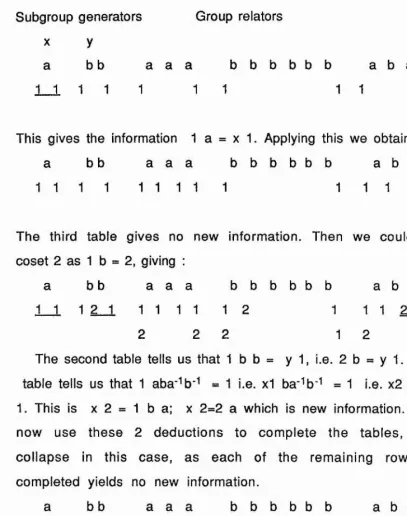
We will find a presentation of (a,b^) in <a,b|a®=1 =b®,ab=ba>.
Subgroup generators Group relators
X y
a bb a a a b b b b b b a b a ’^ b ’^
1 1 1 1 1 1 1 1 1 1
This gives the information 1 a = x 1. Applying this we obtain :
a bb a a a b b b b b b a b a ’^'b"'*
1 1 1 1 1 1 1 1 1 1 1 1 1
The third table gives no new information. Then we could define coset 2 as 1 b = 2, giving :
a bb a a a b b b b b b a b a'^ b'^
1 1 1 2__1 1 1 1 1 1 2 1 1 1 2__2 1
2 2 2 1 2 2
The second table tells us that 1 b b = y 1, i.e. 2 b = y 1. The fifth table tells us that 1 abab'^ = 1 i.e. x1 ba'^b'^ = 1 i.e. x2 a'^b'^ = 1. This is X 2 = 1 b a; x 2=2 a which is new information. We can
now use these 2 deductions to complete the tables, without collapse in this case, as each of the remaining rows when completed yields no new information.
a bb a a a b b b b b b a b a'^ b'^
1 1 1 2 1 1 1 1 1 1 2 1 2 1 2 1 1 1 2__2 1
2 2 2 2 2 1 2 1 2 1 2 2 2 1 1 2
Next we examine the rows which have not given any new
information ( i.e. those rows without an underlined part). The two rows under the a® relation : 1 a a a =1 Is x1 a a = 1 or x^ 1 a =1 or
X® 1 =1 giving x®=1, and the other row gives the same subgroup
relation. The second row of the fifth table is 2 a b a*'* b'^ = 2 which
[image:20.616.70.477.67.583.2]is 2 a b = 2 b a : x 2 b = 2 b a : x y 1 = 2 b a : x y 1 = y 1 a : x y 1 = y x 1 or xy=yx. The remaining two rows in the fourth table give the subgroup relation y®=1 and so the subgroup is seen to have index 2 in the group and presentation : (x,y | xy=yx, x®=1, y®=1>.
Situations for usage
The best of the above two methods to use depends on the particular problem. If the coset enumeration involves a lot of coincidences then it is obviously awkward to carry out the modified process. Similarly there is a problem if there are many cosets. Often it isn't known which is the most productive method until the presentations have been found.
The Reidemeister-Schreier method always produces (|U|-1) x |X| generators. Of course it is often easy to remove many of these. Nevertheless this process produces more generators for the subgroup than existed for the group, and often more than the other process. So attempting to identify a group by finding a presentation of a subgroup, then a presentation of a subgroup of the subgroup and then repeating this process can often soon produce presentations with many generators. In essence the Reidemeister-Schreier process and the modified coset enumeration process are the same method applied in two different ways.
Cf
taoter
2
: Certain
{ a )
introduction
In [2] and [4] a class of groups on two generators was considered. The class was those groups with one generator of order 2 and the other of order n and one further defining relation of a special type. This third relation was of (a,b)-length (define this to be the sum of the numbers of powers of a and b occuring in the word) at most 8 and in it the sum of the exponents of the element of order n was zero. Here certain groups of the associated class with generators of order 3 and n and an extra relation of the above type will be considered.
Define ( q*^r*sV )(^) = (a,b | a®=1, b"=1, a^b^a'"b'a%ia%^=1 ). Note that as in [2] and [4] we will take h+i+j+k=0. Clearly we need only to consider cases when n is positive as if n is zero then add the relation a=1 to obtain a free group. Three classes will be considered
( ) ’ ( ) and ( q ^ r^ s 'V ^ )■ each class
only those cases with a degree of symmetry in the sense that for all
n the group ( q^r's^t^ )(n) is isomorphic to ( t^s’r^q*^ )(n) will be considered. This condition is introduced because the other groups do not appear to be interesting.
( b ) I h e _ g ro U B S - ( q \ 2 g - 2 f i ) .
Let q = e ,, r=62, 8=63 and 1=64. Let the group (_^ r^ s ^ t h be
( 0 ^ ,8 2 , 6 3 , 8 4 ). Note that (e^ , 8 2 , 8 3 , e 4) Is isomorphic to
(-8 ^,-82,-83,-84) and also to (-8^,-84,-63,-82). So when all the e, are non-zero, the cases to consider are (1,1,1,1), (1,-1,1,-1) and
( 1 ,1 ,- 1 ,- 1).
Note the reasons for the above statements :- The case (1,1,1,-1) is not isomorphic to (-1,1,1,1) as when n = 2 the former is <a,b I a®=1, b^=1, aba=b) which is of order 6 whereas the latter is Cg. The fact that the class (1,1,-1,1) is not in general isomorphic to the class (1,-1,1,1) is seen by considering the n=4 groups. Use the coset enumeration algorithm to find the index and presentation of the subgroup (a, bab \..., b®ab'®> in (1,1,-1,1). This is therefore seen to
be <x^ ,...,X4 I Xj®=1, Xj^2Xi+iXj+2=Xj.,.4 ) and the Todd-Coxeter coset
enumeration program then tells us that the element x^ has index 25 and so the group Is finite. However carrying out the same process on the group (1,-1,1,1) we obtain the subgroup
(x^,...,X4 I X|®=1, Xj^4Xj^2Xi+i=Xj^2)‘ 's Seen that x^=x2-'‘x4-''x2 a n d
X3=X4'1X2'^X4 SO US8 these to remove the generators x^ and Xg.
Letting u=Xg and v=X4 we obtain the presentation
(u,v I u®=1, v®=1, u"^v"^uv-^u'^vuv^uv=1 ). Note that the last two relations that were obtained were the same so one has been removed. Now note that in the abelianised group u=v and so this group is C3 so this enables us to write a transversal for the derived group (1 ,u,u^}. Now carrying out the Reidemeister-Schreier process
the presentation of the derived group, with a=vu'^, b=uvu'2 and c=u^v, is (a,b,c | abc=1, b-^ab-^c=1, c"^bc-^a=1, a'^ca'^b=1). Removing 0 and a redundant relation we obtain <a,b | a=b^ab^, b=a^ba^ >. Add b^=1 and a^=1 to obtain <a,b | b^=1, a^=1 >. So it is seen that this group has infinite order.
No cases exist with just one of the e, of value zero. If two are zero then the cases are those of the form (0,02,03,0) and (e^,0 ,0 ,04).
When three of the Oj are zero, the group is and when all 4 are zero the group is the free product of C3 and and is hence infinite.
( 6 .1 )
The case
(e.O.O.f).These are the groups < a,b | a®=1, b"=1, a®ba^=b). If e=-f then they are CgxC^. If e=f then when n is odd a'^ba"^=b and aba=b so a'%^a=b^ and hence b"=aba(a'%^a)("'^)^^=ab'^a which with a®=1 implies that the group is Cp. When n is even carry out the modified coset
enumeration algorithm on <b) to show that <b) has index 3 and is Cp. Define 1 a = 2 and 2 a = 3.
b a b a b'"* a a a 1 1 1 2 3 11 1 2 3 1
2 3 2 3 2 3 1 1 2 3
Let the subgroup generator b be x then 1 x = 1, 2 x = 3 and 3 x = 2 and so when n is even the group is of order 3n.
(6 .2 )
The case (1.1.-1.-1).
The group obtained when e^ ,eg=1 and 63,84=2 is
<a,b I a®=1, b"=1, abab%"^b'^a'^b'^=1 ). Call this group Gp .The orders of these groups were first of all investigated using the Todd-Coxeter program on the Vax System of the University of St Andrews Computing Laboratory with the maximum number of cosets being 30,000 and the Index of the subgroup (b) being found. For the values of n from 1 to 5 the following results were obtained
n index of (b> max. number of cosets defined
1 3 9
2 3 5
3 27 32
4 39 63
5 93 1342
However for values of n above 5 the coset enumeration was not completed. Several of these cases were considered with a considerably higher maximum number of cosets (150,000) but again, no results were obtained. This and the contrasting ease with which the results for n from 1 to 5 were obtained suggested that these groups are infinite.
An attempt was made to prove that Gg was infinite Lemma 1
The group Gp has Hp=(x,y,z | x"=y"=z"=1 ,xy^=yz^=zx^) as a subgroup of index 3.
P ro o f
The modified Todd-Coxeter algorithm is used with the subgroup being (b,aba \a^ba'^).
Let x=b,y= aba'^ ,z= a^ba'^. Define 1 a= 2, 2 a= 3. Then the
subgroup generators give
b a b a*^ a a b a‘^a'^
1 1 1 2 2 1 1 2 3 3 2 1
1b=x1 2b=y2 3b=z3
Also the relation a®=1 gives that 3a=1. So completion occurs and the other two generators give the five relations.
Lemma 2
The group H„ has Bn=<b| | b," =1, b|+ib;+2 = bjb|+2b|+3Zbj+4, i=0,1 n ) as a subgroup of index n.
P ro o f:- Step
1:-Bp = ( x y \ x'^y, yz \ y^z) is a normal subgroup of Hp.
Note that z'^x, zx'^ g Bp.
x(xy^)x"^ = x^y^x'^ = z'^xy^y^x'^G Bp, x'X xy^)x G Bp, z(xy^)z'^
= zx"^ x^y^z"^ = zx'^ zx'^y^ y^z'^G Bp, z'^(xy^)zG Bp, y (xy^)y^ =
yx(x-^z'^x) G Bp, y X x y ^ )y e Bp. Therefore, by symmetry, all other
conjugates of Bp are in Hp.
Step
2:-The Reidemeister-Schreier process is now used to find a presentation of Bp.
Clearly, as Bp is normal in Hp, the presentation of the factor
group is <x | x" =1> and a transversal of Bp is U={1,x,x^,...,x"'i}. Take X
to be the set of generators of Hp. Then the set obtained when each element of UX is multiplied by the inverse of its coset representative is (x", x'yx ' ' \ x'zx'*''*}. Call these elements a, p.,
respectively. Then the set URU’’* in terms of these generators is obtained and on eliminating a, pj the required presentation is found.
Now the task was to prove that Bg is infinite. To attempt this the
homomorphic image of Bg obtained by setting was considered.
This is < a,b,c | a®=b®=c®=1, ab=cbc2a, bc=aca2b, ca=bab^c ) and appears to be infinite. However, using the Sun 3/260 with a maximum of 800,000 cosets, Dr. Campbell found that this was of order 27. (This is not easy to prove directly. To attempt to factor by one generator is of no use, so use N«a,b>). Clearly c®=(cbc’'')“'*(aba'‘') e N«a,b>), but as G/N«a,b>) =Cg, clearly c « N«a,b>). Therefore
{ 1,0 ,c^} is a tranversal for N«a,b>) and applying Reidemeister-Schreier a presentation for this group is
found:-{aQ,a-|,a2>bQ,b-|,b2>c j aj^, bj®, c^, agbg~b-jCaQ, a^b^ = b 2ca^,
a2b2=cboa2, bgC^agCagZbg, bg^aga^Zb^, bi=aia2^b2, cag=b2a2b2^c,
a.|«bgagbg2, a2=b.ja.jb^2). But proceeding from this leaves too many
generators or too long relations.)
An alternative method of looking at the group G^was then adopted.
Lemma 3
The group G„ has X|3=1, X|X|+i=X;^iXj^g) as a subgroup of index n.
Proof:- Use the Reidemeister-Schreier algorithm and the normal subgroup (a, bab \..., b"-^ab''-"). Clearly a transversal is {1,b,...,b"'^). The set UX(UX)'^ is (a, bab'\..., b"'^ab^'", b" } with URU*^ giving the required relations.
X-| is Cg.
Corollarv
3.2
Xg is Cg.
Corollarv
3.9
Xg is Cg X C gXC
Corollarv
3.4
X4 is of order 39. Proof
A presentation for X4 is
{X.j ,X2>Xg,X4 I Xj3s=1, X2=X2X4,
X3X4—X4X2, X4X^=X^Xg ).
Note that <X2X4 \ x 4 ^Xg) is a normal subgroup of X4 of index 3. (This can either be seen by listing conjugates or by carrying out coset enumeration and examining the coset table.) Clearly a transversal of the subgroup is { 1, Xg, Xg^} as Xg being in the subgroup would mean that the subgroup was the whole group. Now apply Reidemeister-Schreier to obtain < a,b,c | abc=1, bc^b = a, ac^=b^, ca'^c=b, ba^=c^, ab'^a=c, cb^=a^). Eliminate a using a= c-ib '\ Then b^cb=c^ and bcb2=c^ give that bc=cb, and the group is seen to be C.,3.
Note 3.5
Xg is of order 93.
A presentation for Xg is (x., ,X2,Xg,X4,X5 | Xj3=l, XiXg=XgX4,
Xg Xg —X 3 X 5 , XgX4==X4X-|, X4Xg = Xg Xg, X g X ^ = X . | X 3 ) . Note that ( X g X 4 ^ , X4 ^Xg)
is a normal subgroup of Xg of index 3 (most easily seen using coset enumeration). Again { 1, Xg, Xg^} is a transversal of the subgroup.
Apply Reidemeister-Schreier to get a presentation of this subgroup < a,b I a^b^a^b=1, a^^bab^^abab > but it is then not easy to proceed from here. Alternatively it is very easy to find a 2-generator 4-relation presentation using the modified coset enumeration algorithm but it is then difficult to proceed further.
This method doesn't give anything for Xg.
The following was then considered
Consider = <x,y,z | x"=y"=z"=1, xy^=yz^=zx3). Eliminate x to get
<y,z I (z^y-^)"=1, y"=1, z"=1, yz^^zyz^y^z^yZ) The last relation is z ‘‘'(yz)z=y(z2y'i)2y*i. Therefore if n is even (yz)"/^,^^ <=> (z2y-i)"= i
and = ( y,z | (yz)"/2=1, y"=1, z"=1, yz^=zyz^y"^z^y"^). So using
z y z = y z ' ^ y ^ we get Hg = < y, z | (yz)® = 1, y®=1, z ®=1 ,
yzy^z^y^z'^yz'^). (Note that Gg is <a,b | a^=1, b®=1, abab^a^b'%^b'^=1)
and this is isomorphic to <a,b | a^=1, b®=1, aba^b^a^b"^ab'^=1) under the isomorphism given by taking a a'^ and b b.)
Now carry out coset enumeration on Hg. Lemma 4
Hg has Ag = <ag,ai ,ag | ao®=a^3=a2®=1, (aga^a2)^=1, ag^a^aga^aga^^ =
a^ag, a^2a^a^a22a^a2=aga^, agag^ag^a^ag-a^) as a subgroup of index 3. Proof
Carry out the modified coset enumeration algorithm with the subgroup (y, zyz"^, z^yz'^). Let a; = z'yz ' for i from 0 to 5 Define
1 z = 2 and 2 z = 3. The generator aj then yields the information
that i+1 y= a, i+1.
z z ... z y z '\.. z'^ z*^ : a;
1 2 3... i+1 i+1 ... 3 2 1 1 z’yz“' = a; 1
i.e. i+1 y= a; i+1 . The relation (yz)®=1 gives that 3 z= ag-^a^-iag-i 1. The relation
yG=1 gives aj®=1 and the relation z®=1 gives that (aoa.,a2)^=1. The other relations are obtained from yz2=zyz^y-^z3y-2 .
It is now difficult to proceed from here. The Todd-Coxeter alogorithm with the maximum number of cosets being 300000 again does not produce completion. The homomorphic image obtained by setting aga^ag^l is however seen to be CgxCg. Call this image
Corollarv 4.1 ^Ag is Cg X Cg.
Proof
Using Lemma 4 a presentation for ^Ag is
(ao,a^,a2 I ao®=1, 8^6=1, ag^^l, aga^ag^l, a|a|+i2a.2a.^^ = i), (Note
that a|+3=a; ). Now use the 4th relation to eliminate ag to get
( a i . a g I ( a i a2)G=1, 8^6=1, a g ^ ^ l , 8 ^ = 8 2 2 8 ^ 3 2 , a ^ 3 2 2 3 ^ 2 3 2 = 1,
32=a.|323^2). Now multiplying the 4th relation by a^2 and applying
the last one gives a^i^czag^. So the 4th relation becomes aga^=a^4ag
which is 82=8 ^2a23^. Using the last relation we see that the group is
abelian and therefore is Cg x Cg.
In general modified coset enumeration can be carried out on to
produce a presentation for A^ However this does not yield a general
presentation. If the relation aga., ...an/2-i=1 is added to A^ then the associated groups ^A^ are produced and another of these was
considered. Lemma 5
If n is even then has
(ag,.. 8^/2-1 I ^0^1"'^n/2-1 ^ ' ^i^i+1 ^^i+3^^i+1 ” ^ ^ ^3 a
homomorphic image of a subgroup of Hp of index n. Proof
:-Carry out the modified coset enumeration algorithm with the subgroup (y,zyz \..., z^^^-iy^i-n/z^ in lemma 4. Add the relation agai...ap/2-i=1 to the subgroup relations. Again let a; =z'yz i Define i z= i+1 for cosets i =1,..,n. The new relation ensures that n z = 1 and the required presentation of ^Ap is obtained.
Corollary 5.1 ^Ag is of order 392.
Proof We proceed by using several lemmas. Lemma 5.1.1
hAg = <X,Z I X®=1, x4=%4, ZXZ=x3, X=(z2x2)3z(x2z2)3). Proof
A presentation for ^Ag is
<w,x,y,z I W®=x®=y®=z®=wxyz=wx2z2x=xy2w2y=yz2x2z=zw2y2w=1 >. Eliminate w=x'^z'2x'2 and y=z*''x’2z"2 to get
<X,Z I (x^z2)3 = X® = (z^x2)6 = Z® = XZ^XZX^Z =
Z^X^ZX^Z^X^.Z^XZ^X^Z^X^Z.X'^ = X^.Z^XZ^X^Z^X^Z.X^Z^X^Z^XZ*^ =1). Note that the last two relations have been split to show that they have a common string. Comparing these strings gives us that
z(zx2zx)(xz2xz) = x^z^x^z^x (r1 ).
Now replace the 7th relation by this. Apply the 5th relation to the left hand side of r1 to get
zx'^z"2x-2 = x^z^x^z^x (r2 )
and replace r1 by this. Note that r2 is
zx'^z’"' = (x3z2)3 (r3 )
and by symmetry
xz-^x"^ = (z3x2)3 (r4 ).
Now r3 gives that zx-^z'^= (x^z^)^ i.e. z = x^z^x® using the 1st relation and similarly r4 gives that xaz^x^z^ Together these give
x4= z4 (r5 ).
Now x"^ = z^ and x® = 1 acting on z = x^z^x® imply that
zxz = X® (r6 ).
Add r5 and r6 to the relations. Now r3 and r4 (which is obtainable from the 5th, 6th and 7th and the 7th is a consequence of r2, 5th and 6th) together with the 2nd, the 4th, r5 and r6 make the 1st and 3rd ones redundant (obtain zx ®z-^ = (x®z2)^ from r3 and apply r6 and then r5 and the 2nd to obtain the 1st; apply r6 to r4 to get x(x ®z) = (z®x2)3 or z^ = (z®x2)4 and then use the 4th to obtain the third) and r5 and the 2nd make the 4th redundant so what we have is
<X,Z I ZX"^Z'®X'2 « X®Z®X®z2x, X"^ = Z"^. ZXZ = X®, X® = xz^xzx^z = 1,
z2x2zx2z2x®z2xz®x2z®x2zx-1 = 1).
Now x®=1 gives that (zxz)(zxz)x®=1 which is xz2xzx^z=1 so remove xz2xzx®z=1. Multiply r6 by x to get xzx=z® then apply that and r6 to
Z2x®zx2z2x®z2xz2x2z®x2zx-1 = z2x2zX®Z®XZ®Xz2x®ZX®ZX*^ = z2x2zX®ZX®Zx2z®XZ®Xz2x"1 = z2x2z2xZ®Xz2x®ZX®ZX®z2x'1 = z2x2z®x2zx2z®XZ®Xz2x2z2x'1 = z2x2z2x2zX®ZX®ZX®z2x2z2x'^ = Z2x2z2x2z2xz®xz2x2z2x2z2x'1
= Z^X^Z^X^Z^X^ZX^Z^X^Z^X^Z^X'^ = 1
i.e. X = (z2x2)3z(x2z2)3.
So replace the last relation by this .Take x®z2x®z^x®z®x and apply the same two relations
X®z2x®z2x®z®x = zxz®x®z2x4zx2
= zxz4xz®x4zx2 (x^=z^ and x®=1) = z .
So it is seen that r2 is redundant giving the required presentation.
Lemma 5.1.2
^Ag has B = (b,c,d | cA=l, d=bdb, c=bcb, b?=1, d^^c^, c=d(cd)®> as a subgroup of index 2.
Proof Step 1
Note that the subgroup B = ( x^, z^, xzx'^z'^) has index 2 as is easily seen by coset enumeration. Therefore it is a normal subgroup. Clearly x g B as if so then by symmetry ze B and the index would not be 2. So { 1,x } is a transversal. Now using the Reidemeister-Schreier method the presentation <b,c,d | 0^=1, c2=(bd)2, bcb=c, c=d(bcd)®(cbd)®, c2=dbdb, (bdc)®(bcd)®b=1, d^^c^) is found.
Step 2
Note that 0^= dbdb => d = bdb (r1 ).
Therefore add this relation and remove the 2nd and 5th relations. Note that (bdc)(bcd) = bdc^b'^d = bd®b"^ = bd'^b'y = b® •
In fact (bdc)b^(bcd) = (Use bc=cb'^. )
=bdcb^+^cd (Use d2=c®, c4=l.) =bdc2b'"'^d (Use d'^b'^=bd \ )
= b d "% '"y =b"+2.
Therefore it is seen that (bdc)3(bcd)®b = 1 is equivalent to b^=1. Now consider (bcd)(cbd) = bcdb'^cd = bcbdcd = cdcd. Also (bcd)cdcd(cbd) = bcbdcdcdcd = cdcdcdcd. (Use db"^=bd and cb=b'^c which give that dcb=db‘‘‘c=bdc.) Furthermore (bcd)cdcdcdcd(cbd) = b(cd)®b"\ So it is seen that c = d(bcd)®(cbd)® may be replaced by c = d(cd)G and we have the required presentation.
Lemma 5.1.3
B has C = (x,y I X<=1, x2=y2, x=y(xy)®>as a subgroup of index 7. Proof
Carry out the modified coset enumeration algorithm using the subgroup <c,d>.
Let 1 c = x1 and 1 d = y1. Then define i b= i+1 for i from 1 to 6. The relation b?=1 gives that 7 b = 1, d=bdb gives that i d = y(9-i) for i from 2 to 6 and c=bcb gives that i c = x(9-i) for i from 2 to 6. The other relations then give the required presentation.
Proposition 5.1.4 C is of order 28. Proof
To see this use the modified coset enumeration alogorithim to find a presentation for the subgroup < x >, defining cosets 1 y =2, 2 x = 3, 3 y = 4, ...., 6 X = 7. There are no coincidences. The subgroup is
C4 and has index 7.
Hence ^Ag has the required order.
(6 .3 )
The case (1.1.1.1).
These are the groups G„= (a,b | a®=1, b"=1, abab^ab'®ab'i=1). Using the Todd-Coxeter program it can be quickly conjectured that for values of n divisible by 3, Gp has order 60n and otherwise the order is n.
Lemma 6
Gp has the group Xp = (x^,..., Xp | X;3=:1, X;X;^iX|+gX;+^ = 1 > as a subgroup of index n.
Proof
This is easily seen using coset enumeration. Let Xp =
(a, bab'\..., b"-^ab^ " > where the generators are named x X p .
Define i b = i+1 for i from 1 to n-1. Then the generator x, gives that i a = Xj i for i from 1 to n. The relation b"=1 implies that n b = 1 and the other relations give the full presentation.
Corollarv 6.1 X^ is trivial. Corollarv 6.2 Xg is trivial.
Xg is the alternating group Proof
Xg IS (x"ijXgjXg I Xj3=1, XgX^XgX^=1, x^XgX^Xg^^ .XgXgXgXg^s 1 ) . Define
s=x^X2X3'ix 2'^ X ia n d t=x^ then StS'^ = X.|X2Xg-1X2'1x.|X2XgX2'1x.,-1
= X.)X2-1XgX.|Xg-1X2Xi-1 = XiXg-^X^-IXgXgX^-l
= Xi-^XgXgXgX,-1
- Xg.
Also sts'\t"^s"^t = XgXgXgXg-i = Xg. So < s,t >= Xg. Clearly s®=1 , t®=1, (ts'^ts)2 = s-‘’(sts'''.t)2s = s"'*(XgX^)2s = 1. Consider (st)® =
(X,XgX3-1X2-1)='
Now X^XgXg'IXg-l. X^XgXg'^Xg-l = X^Xg'^XgX^XgXg-IXg"^ = XlXg-IXgXg-IXi'IXg-IXg-l = X^Xg-^XgXg'^XgX^Xg-l
= X^XgXg-IXgXgX^Xg'^ = X^XgXgXg'^X^Xg"^ = X.jXg-IXgX.iXg''' = XiXg-1Xi'1X2 = X^-^XgXg
So (X^XgXg ^Xg-^)^ = X^-IXgXg.XiXgXg-^Xg'^ .X.|-1XgX2 = X^-IXgX^-IXg-IXg-^X^-IXgXg = X^'1Xg-1X.;X2'^Xi-1XgX2
= X^-IXg-IX^'IXgXgXg = 1. Therefore Xg is a homomorphic image of
s,t I s®=1,t®=1, (ts-its)2=l, (st)®=1 >[5]. Now in call
Xi=(123), X2=(124) and Xg=(125). Then (x^, Xg, Xg ) is :Ag and X|3=1,
x^x^XgX^=1, x^XgX^Xg^l and XgXgXgXg^l. So »4.g is also a homomorphic image of Xg proving the result.
Corollarv 6.4 X 4 is trivial. Proof
%4 ” I Xj® — 1 , X^jXgX^Xg—1 ^ XgXgX^jXg — 1, Xg X 4 X g X 4 — 1 ,
X4X^XgX.j = 1 ).
Now x,XgX4X2X4= X4, therefore x^jXg = x^Xg. Similarly XgXg = X1X4.
x^jXgXg = X4Xg-i and x^-^X4 giving that x^X4 = X4X3. So Xg = X4 and
XiX2X4Xg= 1 gives that x^ = 1.
Corollarv 6.5
Xg is trivial.
Proof
X g = {X.j ,X g,Xg,X4,Xg I X|3 = 1 , X 4 X g X 4 X 2 = 1 , Xg,XgXgXg=1, X g X 4X ^ X 4= 1,
X^XgXgXg^l, XgX.jXgX.j=1).
1 = X^G^ (Xg'^Xg 1Xg'1)® = (Xg'^XgXgXgXg"^)® = (XgXg)®
1 = XgX^XgX^
= XgXg 1 X 4 " 1 X 2 - 1 X g X 2 -1 X 4 -1 X 2 '1
= X5XgXgXgX4-1XgXg-1X3X4-1XgXgX3
- XgXgXgXgXgXgXgXgXg'^XgXgXgXgXgXgXg
= XsXgXgXgXgXg-IXg-IXg-IXgXgXg-IXgXgXg-IXg-IXg'IXgXgXgXg
Now apply (XgXg)® =1 to get
1 ^XgXg-IXg-IXgXgXg-IXgXgXg-IXg-IXgXg-l
= XgXgXgXg-1XgXgXg-1,= Xg. (Spply ( X g X g ^ ) ® )
Theorem 6.6
Xg is the alternating group A ^ . Proof
X g = (X-j ,Xg ,X g,X4,Xg,Xg I Xj ® = 1 , X4XgX4X2=1, X g X g X g X g = 1 , XgX4X gX4= 1,
X ^ X g X ^ X g z l , XgXgXgXg =1, XgX.jXgX.j=1 ).
=X3-’ X5'’ ><3' ’ V ’ - X2X4-'. X3-IX5-IX3-IX4-I
"XjXgXjXs-IXjXgXgXgXjXg-IX^Xg
=X4XgX4Xs-1X4X5-1X4Xs-1X4Xg
=X4XgX4Xg (Now use that (x^Xg^jS»!) .
Therefore Xg^Xg and Xg= Xg.
Coronary 6.7
Xy is trivial.
Proof
X7 = (Xi ,X2»Xg,X4,Xg,Xg,Xy I X|2 = 1 , X^jXgX^Xg — l, XgXgXgXgSsI,
XgX^XgX^ssI , X^XgXyXgSsf , XgXgX.jXg = 1, XgXyX2Xy = 1 , XyX.jX3X.j=1 ),
Now 1 = XgXyXgXy
= XgX,-1X3'1Xi-1X2X,-1X3-1Xi-1
= XgX, 1X3 1X2 1x ,X2-1X3-1x , 1 (Use (X,Xg 1)==1)
= XgX, IXgXgXiXgXgX^-t
“
XgXgXgXgX^jXgXgXgXg-( Use X,3=1 => XgXgXgXgX^jXgXgXgXg-(X6XgX6)3=1 => XgXgXgXgX^jXgXgXgXg-(Xg-1Xg)==1 => XgXgXgXgX^jXgXgXgXg-(XgXgXg)3=1. )
Therefore
XgX^jXg^XgXgXg. ( X ) .
This gives Xg-ix^-ix^x^-ixg-i = x^XgXgXgX^
= Xg-1Xy 1XgXy-1Xg-1 = Xg-IXg-tXyXg-IXg-l ■
So X4-1x ,X4 1 = X gX g -I X g X g X y X g X g X g -I X g
= XsXg iXgX4X2X4XgXg-iXg (using ( I ) ).
= XsXg-IXy-IXg-IXgXg-IXy'IXg-IXg
— X g X y X g X g X ^ X g X g X y X g ^2^»
Therefore
Xi — Xg‘^X2Xg"'*X2Xg’^X2Xg'^ So X4 1 = X2Xg-1X2Xg-1X2Xg'1X2Xg-1X2
and X y = Xg 1 X 2 X g - 1 X 2 X g - 1 X 2 X g - 1 X 2 X g - 1 X 2 X g 1
= XiX2Xg-ix2Xg-i (using ( $ ) ).
= X2'1X4-1Xg-1X2Xg-1
= X2'^XgXyX2Xg-1 i.e.
X2XyXg=XgXyX2-Now (Z ) becomes x^ ix.,X4-i= X2XyX2XyX2= x^Xg 1X2 So Xg-i = X1X2X1X2X1 = x^x^ ix^ giving
X4=XiXgX^ (^)
This means that X4Xg=x.,Xg-i or X4XgXg=x^ which is Xg-ix4 ixg=x^
or Xg=X4XgXi and so XgXyX,=X4. Applying (4 ) it is seen that XgXy=x^Xg, so X4'i=x.|XgXg but this is Xg-1. So the group is trivial.
( 6. 4 )
The case (1.-1.1.-1).
Lemma 7
Some results about Fibonacci numbers ( f, is the ith Fibonacci
number where fg=0,f^=1, fj+2=^i+i+^i snd g^ is the nth Lucas number
( 9o=2, 9i=1, 9j+2”9i+i+9i ) )•
1 : ( fnJn+1+1) = ( fm+2,fm-i), when n=2m+1,
2- (^a'^b) ~ ^{a,b)»
3; (fn+i+1)(fn-i+1)-fn®=gn when n is odd. Proof
1 (Taken from [3,Thm. 2.3])
(^n'^n+1 )“ (^2m+1 '^2m+2"*'^ )"(^2m+1 >^2m+1'^^2m‘^^ )"(^2m+1 »^2m*^^ )" (^2m+f2m-i»^2m + 1) = (f2m -r ‘’ »^2m+‘^)- ‘nduction it is seen that
(f2m+i4 m+2+1) = (f2m-k+(-1 ) \ + i 'f2m-k+r(-1 ) \ ) • Taking k=m gives
the result (f2m+1 Tgrn+Z"*"^ )" Tm+1 — " )~(^m+2Tm-1 ) •
2
Firstly by induction show that fk+r=^r^k+i +4-i^k- Therefore (^k+rTk)=(Vk+i Tk)=(fr'V ^s dearly (fk+i »fk)='^ • Then induction using this on the maximum of {a,b} gives that (let a>b) (f^.f^) =
^(a-b,b)~^(a,b)-3
Firstly note that (-1)"=fn + i ^n-r^n^ which is easily seen by
Induction as fn + ifn -iV = fpfn-i+^n-i^-V = V i^ -V n -s - Then note that (f„^, + 1)(fn.,+1)-f„2 = fn+ifn-rfn^+ fn+1+fn-1+''= +^n+1+fn-1. It is easily seen that fn + i+^n-i “ 9n noting that n is odd completes the proof.
Corollary 7.1
(fn.fn+1+1) = W z.m -D- when n=2m+1. The groups to be considered are
Gp= (a,b I a®=1, b"=1, aba'^^ab ^a'^b'^ = 1). The orders of all these groups will be determined.
Lemma 8
Gp has the group Xp = (x,y,z | xn=1, y"=1, z"=1, yx^=xy®, zyZ=yz2,
xz2=zx2) as a subgroup of index 3.
Proof
Carry out coset enumeration with the subgroup Xp = <x,y,z> where x=b, y=aba-^ and z=a^ba"^. Define cosets 1 a = 2 and 2 a = 3. Then a®=1 gives that 3 a = 1 and the generators give that 1 b = x 1, 2 b ^ y 2 and 3 b = z 3, the other relations giving the required presentation.
Now when n is odd these groups have already been investigated in [10]. In the notation used in that paper Xp = SgGp and the result and proof are as follows, slightly simplified as the paper deals with a more general result.
Theorem 9
If n is odd then SgGp has order ngpZ if n is coprime to 3 or 2ngp2 otherwise.
Proof
Define m: SgGp -> Sp by x,y,z -+ (1 2 ... n) and let H=Ker(m), Now H
is a subgroup of index n in SgGp and so has tranversal U={ 1,x ... x"-^}. Using the Reidemeister-Schreier method we get generators yj=x'yx'*‘^ and Z|=x'zx-'"^ and the relations conjugated by U are
xi+iy2x-2y-ix-' = yi+iyj+gYi'^ and x'+^z^x ®z"^x ' = Zj^^Zj^2^i'^ with xiyz2y-2z-ix’i = yjZj^^Z|^2yi+2*^yi+r^2ij-i. The relations y"=1 and z"=1 give ygy^... yp.., = 1 and ZgZ^... Zp.., = 1 respectively. Note that the
third relation is y;Z; = Zjy-,. Consider the subgroup ( y, ). This is
clearly generated by yg and but these commute as follows. Apply
Yi = yi+iVi+2 to YoX, ... Yn., = 1 to gel YgZygy^ ... y„_3 = 1 then
substitute y„_3 = y^.^y^.g ^Yn.s = yn-6yn-4'’ and yn-y = yn-syn-e'’ to get yo^yiyn-z-'’ = 1, but y„_2 = y„.,yoandy„.i = y^y, so y^y, = y^Yo and
(y ,) is abelian. An inductive argument using this and y; = yj-aVi-i'^ gives that y| = where a(i)=(-1)'+®f|_i and b(i) = (-1)'+ifj . Using the fact that n is odd we see that yga(n-2)y^b(n-2) = y^ ^ = y^Zy^ and yQa(n-i)y^b(n-i) _ y^^ = y^y^ which gives the relation matrix
a(n-2)-2 b(n-2)-1
_ a(n-1)-1 b(n-1)-1 .
Notice, using Corollary 7.1, that (fnTn+i+1) is either 3 if n = 1 (mod 3) or 1 otherwise.
^n-2” ^ ^n+1
Case 1.
(n,3) = 1 Here (fp,fp^^+1)=1 so (y,) is cyclic and ygZ, = Zgy, shows
that the group H is abelian. Now | (y, )|= (fn+i+l )(fn-i+‘i)'^n^=9n f^'orn
Lemma 7. So H is the direct product of 2 cyclic groups of order g^ and G is of order 2g^2 .
Case 2.
When (n,3)=3 Here (fp,fp^i+1)=2. Notice that H = (yg.y-i ,Zq,z., >,
Since [y2'^'Zg]=1, y2=yoYi'^ ^"d Zg^ZgZ^^we have
yo"’ yiZozr'yr''yoZiZo’’
=i-Therefore observing that yg and y^ commute, Zg and z^ commute,
y g and Zg commute and y^ and commute we obtain
yo'’ z r ’ yoZiyr^Zo-iy,Zo=1 which is [yo.Zi][y,,Zo]“ 1 but lyo.z,] commutes with Zg and y^ and [y^,Zg] commutes with z^ and y g Since
[yo'Zi]=[yi,Zo]'^ and H^yQ.y,.Zq.z, ) we see that N=< [y^.z,] ) is
central in H. Now H/N is <yo,...,yn.,.Zo... z„., I y ry k iY i+ g . yoyi - y n -i=1.
Z|=Z|+^Z|+2, ZgZi ... Zp_i=1, [a,b]=1 where a,b are any elements of the
group ). This is because for H/N the relation [yg,z^] is added to the
relations for H so the generators of H = (yo,y-|,ZQ,z.j > are seen to commute and H is abelian. So it is seen that H/N is isomorphic to <yj>x(Zj)and is therefore of order g^2. Finally we show that [yg,zJ2=1. For yo-iz,-iyo2,yo-'Zi-iyoZi = yo'^z, iyo2z,
But because (fp,fp^i+1)=2 it is seen that yg® is a power of y^ which commutes with z^ so N has order 2 giving the original group order 2g„2 as required.
When n is even add the relation z=y to obtain the homomorphic image Xp^ = <x,y | x"=1, y"=1 ,yx®=xy^ ) which is the group H(2,n) from [11]. Notice as in [4] that the relation y"=1 is redundant as y" = (y2)n/2 ^ (y-2x)-i (x2)n/2(y-2x) |f the group is factored by its derived subgroup the factor group is Cp so x is not in the derived group which then has { 1, x, ... x"-^ } as a tranversal. On abelianising the relations of H(2,n), yx®=xy^ becomes x=y, so yx'^ is in the derived group and x'y has coset representative x'+^, giving subgroup generators {x'yx ''^ = a,}. The relations are x'+^y^x'^y^x ' =
so the derived group is the Fibonacci group F(2,n) (see [6]). It is now noted, as in [4], that F(2,n) is infinite for n even and greater than 4.
This leaves the cases n=2 and n=4. .ÇprQlIgry 9.1
^2“ ^2
Corollary 9.2 X4 is of order 100.
Proof
X4 = <x,y,z I x^=1, y4=l, z^^=1, yx^=xy®, zy^=yz^, xz^=zx^ ). Carry out
coset enumeration with the subgroup < x,y > defining i z = i+1 for i from 1 to 3. Then z^=1 gives that 4 z = 1. Define 3 x = 5 and completion occurs giving, after removing redundant relations, <a,b I a"^=1, b"^=1, ba^=ab^). Now use the process described above to show that F(2,4) has index 4 and note that F(2,4) is Cg [6 ,Chapter
16].
(6-5)
The cases (O.e.f.OL
Firstly we will consider the case obtained when e=f. This is the group <a,b | a®=1, b"=1, ab%=b^ ).
Theorem 10
The group <a,b j a®=1, b"=1, ab®a=b®> is Cp when n is odd or 2 and infinite otherwise.
Proof :»
If n is odd ab'=b^a'^b'"^ = b'^ab' '^ ... . So ab"+^ = b"+'^alwhere j= (-1)(n+i)/2 giving ab=ba when (n+1)/2 is even and so ab^a=b® and then a®=1 implies that a=1. When (n+1)/2 is odd we have that ab=ba'^ so ab ba'i =ba"^ ab which with ab®a=b® and then a®=1 again implies that a=1.
When n is 2 the group is Cg. For other even n let c=3n/2. If n/2 ^2 and is also even define A=(1 2 3)(4 5 6){7 8 9).. . and
B = ( 1 c+1 6 C+6 7 c+7 12 c+12 . . . c 2c)
( 2 2c+1 5 2c+6 8 2C+71 1 2C+12 . . . c -1 3c) ( 3 3c+1 4 3c+6 9 3 C + 7 1 0 3c+12 . . . c-2 4c)
( c+2 4c+1 c+5 4c+6 • . » )
( c+3 5c+1 c+4 5c+6 . • • )
( 2c+2 6c+1 2c+5 6c+6 • • • )
( 2c+3 7c+1 2c+4 7c+6 • • - )
Now A®=1, B"=1 and AB®A=B® but AB is of infinite order (consider the cycle containing 1).
If n/2 is odd then take
A = (1 2 3)(4 5 6) .. (c-5 c-4 c-3)(c-2 c-1 c)“^
(c+1 c+2 c+3) . . . (2c-5 2c-4 2c-3)(2c-2 2c-1 2c)- 1 and
B = ( 1 c+1 6 c+6 7 c+7 1 2 c+12 . . . c-2 2 c -2 )
( 2 2c+1 5 2c+6 8 2 C + 7 1 1 2C+12 . . . c-1 3 c -2 )
( 3 3 c + 1 4 3c+6 9 3C +710 3c+12 . . . c 4 c -2 )
and again AB is infinite.
Now the case with e=-f will be considered. Proposition 11
The group <a,b | a®=1, b"=1, ab®=b^a > is CgxCp when n is odd or infinite otherwise.
Proof
if n is even then add the relation b^=1 to get the free product of cyclic groups of order 2 and 3. If n is odd then
(b2)(n+i>/2^ (a b ® a g i v i n g that the group is abelian.
(c )
The gr
oup%.(q \^ s '\'^
)-Let q = e,, r=0 2, 3=83 and 1=6 4. Let the group
(©1, 6 g , 6 3 , 6 4 ) .
Notice that (e^, ©g, Og, ©4) is isomorphic to (-©.,, -eg, -©g, -©4) and
also to (©1, ©4, ©g, ©g). So when all the ©; are non-zero, the cases to consider are (1,1,1,1), (1,1,-1,-1) and (1,-1,1,-1).
(When n=4 it is seen that the groups (1,1,1,-1) and (-1,1,1,1) are different and (1,1,-1,1) and (1,-1,1,1) are also different using the Todd-Coxeter program.)
No cases exist with just one of the ©j zero. If two are zero then we need to consider (0,0,e,f), (0,e,f,0) and (e,0,0,f). If three are zero then a=1 and the group is Cp and if four are zero, then the group is infinite.
( c . l )
The cases (O.O.e.f).(O.e.f.O) and (e.Q.O.f).
These groups are all of the form <a,b | a®=1, b"=1, abai=b) where j is 1 or -1. So the groups are of order 3n or n (see the case (e,0,0,f)
in the (q^ r^s'^t"^) section above ).
( c .2 )
The case
(1 .-1.1.-1).These are the groups <a,b | a®=1, b"^=1, aba'^bab'^a'^b-^=1). Carry out the modified coset enumeration algorithm to find a presentation of the subgroup <b,aba \ a®ba ®). Let these generators be x, y and z respectively. Defining 1 a = 2 and 2 a = 3 causes completion of the algorithm and the presentation obtained is
(x,y,z I x"=1 ,y"=1 ,z"=1 ,xy=yx,xz=zx,yz=zy). So the original groups are of order
3n®-(c .3 )
The case
(1.1 .-1.-1).
These are the groups G„ = (a,b | a==1, b"=1, ababa‘^b''a'^b"'=1). First note that the factor group obtained by factorising by the normal closure of ((ab)®) is the von Dyck group (2,3,n) and so Gp is infinite for n>5 [1]. To investigate the other cases we proceed as below.
Lemma 12
The group Gp has Ap = (a.,,..,ap | a;3=1, a^a2=a2ag=aga4... ) as a subgroup of index n.
Proof
Carry out the modified Todd-Coxeter algorithm to find the index and presentation of the subgroup (a, bab \.., b"'^ab^'"). Let these generators be a^ ,..,ap respectively. Define the cosets 2 to n by i b = i+1. The generators and the relation b"=1 give that i a = aj i and n b
= 1 and so the algorithm is completed and Ap has index n. The other 2 relations of Gp give the required presentation for Ap.
Proposition 13
The group G^ has order 3, IGghlS, |Gg|=72, G^ is infinite and
|Gg|=1800. The group is infinite otherwise. Proof
Note that the relations ag®=1... ap®=1 are redundant ( as a^®=1=>
(agaga2^^®=1 i.e. ag®=1 etc.) so remove them and if n is odd a2®=1 is also redundant so remove it as well.
Also note that ag =
a^ = ag'^ a * ! ^2
% = ag-’^a-j-^g'^a^agaiag
Bg = ag-^a.|-ia2'"(a.|-iagaia2a^ag
and it is easily seen by induction that in general
agm = ( a , •"’32(3, 32)'"■■' and 32^., = (a,ag)’ -"'a,(3, 8 2 So the generators Bg, a^ can be removed to obtain the presentation
(a^.Bg I a^3=1, ag®=1, a^ag= (a^agj^'^^^agC aiB ga^ ) when n is
even and (a^,ag | a^®=1, a^Bg = (a^ ag)(^'")/®ai(aiBg )(n-i)/2 ) when n is odd.
Case 1 : n is even.
Here we have the group <x,y | x®=1, y®=1, (xy)"/®=(yx)"/® ). (Add the relation (xy)"/®=1 and let t=xy to get <x,t | x®=1, t"/®=1 ) which is
infinite provided n/2 > 1 as required.) Note that Ag is Cg x Cg .
Case 2 : n is odd.
This is the group (x,y | x®=1, y(xy)('^-^)/®=(xy)(""^)/®x ) . (Let z=xy and add the relation z"=1 which gives
<x,y,z I x®=1, z"=1, yz("-^)/® = z(" '')/®x, z = xy)
or <x,z I x®=1, z"=1, x-^z("+"')/® = z("-'')/®x ). The third relation is (z(f^-i)/®x)® = 1. Note that ((n-1)/2,n) = 1 so we can replace z by t=z("-'')/® to obtain <x,t | x®=1, t"=1, (xt)®=1 ) which is the Von Dyck group (2,3,n) and so is infinite for n>5.)
Note that A^ is Cg. For Ag we use the Reidemeister-Schreier algorithm. When Ag is abelianised it becomes Cg and also note that
y = xyx'^y^e Ag* so a transversal of the derived group is {1, x,
X ® }. The set of generators of the subgroup is {x®, yx'^, xyx ®, x®y}
(Call these a,b,c,d). The set of relations is { x®, x'yxyx'^y^x'i '}. so a=1 and the subgroup is (b,c,d \ bdc^=1, cbd'^=1, dcb"^=1). Removing d gives <b,c | bcb=c, cbc=b) which is the quaternion group of order 8. Ag is <x,y I x®=1, yxyxy=xyxyx >. This group has order 360. The last relation is x(xyx)x"Xxyx)'^= y ’^x, so again y ^x is contained in the derived group and a transversal is {1, x, x®}. As above the Reidemeister-Schreier method is used to obtain the following presentation for the derived group : (b,c,d | bdc=cb, cbd=dc, dcb=bd> which is <b,c | bc®b=cbc, cb®c=bcb>. This group is perfect since it is trivial when abelianised. It is also of order 120 and so is SL(2,5) the only perfect group of order 120. (To see that the group is of order 120 carry out coset enumeration on the subgroup (be, bc^b). The following definitions are made : 1b=2, 3c=2, 1b=4, 4a=5 and 4b=6. These cause completion of the process and the subgroup is of index 6 and has a presentation (x,y | yx®y=x®, xyx=y >. The first relation is equivalent to y®x®=1 (yx® = x® y^<=> yx® = x y ^ x '^ <=> yx®=y^x‘®) and it also gives that y®=x® (yx®=x®y^4=> x‘^yx®=x®y^<=> x-2yx=x®y^<=> x"®y=x®y'‘). So y^=1. Using the second relation any word in the group can be expressed as a power of x post-multiplied by a power of y. Then y®=x® can be used to reduce the power of x to an element of {0,1,2,3,4} and y"^=1 can then reduce the power of y to be from 0 to 3. So it is seen that there are at most 20 elements of this group. However if any two of these listed elements are the same then x'=yj for some ie {0,1,2,3,4} and je {0,1,2,3}. If 1,^0 then y is a power of x and if i=0 then j^^O so either j=1,3 and x is a power