ISSN (e): 2250-3021, ISSN (p): 2278-8719
Vol. 08, Issue 11 (November. 2018), ||V (II) || PP 60-69
Resource Allocation for Bidirectional Long Term Evolution
System
Swapna P S
1, Sakuntala S Pillai
21(Assistant Professor, Dept of ECE, Mar Baselios College of Engineering and Technology, 2(Former Dean, R&D, Mar Baselios College of Engineering and Technology,
Corresponding Author:Swapna P S
Abstract:
Performance enhancement of symmetrical services in mobile communication has been very essential today owing to the widespread acceptance and demand of these services in the present generation communication systems. The resource allocation problem formulated for an LTE system is a constrained multiobjective optimization problem and is solved using dual technique. The objectives of the problem is to maximize the data rate of individual user for joint direction of LTE system, on considering fairness as a constraint conjointly maintaining the difference in data rates within a specified limit, when interferences is also taken into account. The multiobjective problem is converted into a single objective optimization problem using the weighted sum approach. Performance results indicate the effectiveness of the proposed allocation scheme for such applications.Keyword:
dual decomposition, fairness, joint direction, multiobjective optimization, resource allocation. --- --- Date of Submission: 11-11-2018 Date of acceptance: 23-11-2018 --- ---I.
INTRODUCTION
The demands for capacity, driven by cellular networks, internet and multimedia services have been rapidly increasing worldwide. Due to the scarcity of spectrum, the techniques deployed for capacity enhancement need to be extremely efficient in terms of the spectrum usage (Alam and Shen, 2013). In addition, a major trouble in wireless communication system is multipath fading which arises when a transmission interferes with itself and the receiver cannot decode the transmission correctly. Since the delay time caused by multipath remains constant, Inter Symbol Interference (ISI) becomes a limitation in high-data-rate communication (Shannon, 1948). The system thereby faces many challenges to satisfy the high expectations through the narrow pipeline of the wireless channels.
State of the art wireless technologies have emerged with high data rate capabilities. OFDMA is selected as the multiple access scheme for downlink direction (El-Hajj and Dawy, 2011) and Single Carrier Frequency Division Multiple Access (SC-FDMA), a variant of OFDMA, in the uplink direction for 4G/LTE systems. OFDMA has been generally accepted due to its efficient utilization of spectrum and resolution of issues such as multipath fading, ISI etc. (Di et al, 2016).Different number of subcarriers can be allocated to the users depending on the QoS requirements of the users. Multiuser diversity is achieved in OFDMA by allowing subcarriers to be shared among multiple users.
The power and rate associated with each subcarrier can be optimized to maximize the rate for a given maximum transmit power or to minimize the transmit power for a desired minimum rate. (Yaacoub and Dawy, 2012) Assigning subcarriers flatly will result in extreme fading losses in certain frequencies and a single user might lose all the data. A fair approach is necessary and such requirements motivate logical scheduling designs for the next-generation wireless communication sector (Luo and Zhang, 2008). Resource allocation therefore is a key to efficient exploitation of the available radio resources (Mzoughi et al, 2016)
State of the art applications of smart phones like mobile gaming, video conferencing etc. have gained widespread popularity and demand symmetrical quality in both the uplink and downlink directions. Joint consideration of resource allocation at uplink and downlink significantly improves system efficiency (El-Hajj and Dawy, 2012)
1.1 Existing Works
resource allocation in both uplink and downlink is done jointly outperforms link-level scheduling, in which resource allocation in each of uplink and downlink is done separately. Resource allocation scheme with dynamic asymmetry uplink downlink ratio based on Basic Capacity-Based admission control is proposed by (Kou and Zhen, 2009) for a Time Division Duplexing (TDD) OFDMA system. It is shown that the challenge for maximizing utilization is to get load information efficiently and promptly.
A probabilistic channel-aware, queue-aware and service-aware joint uplink/downlink resource allocation scheme is proposed by (El-Hajj and Dawy, 2012). The approach consists of coupling the queue behavior probabilistically by minimizing the divergence between the queue distribution at the base station and mobile sides. (Chiang, Liao and Liu, 2007) investigate on a cross-layer design for bandwidth allocation to uplink and downlink channels for TDD based Wi-Max networks. They have proposed an Adaptive Bandwidth Allocation Scheme which adjusts the bandwidth ratio according to the current traffic profile. An energy efficient resource allocation technique for a single cell OFDMA system is proposed by (Xu, Yu and Jiang, 2015). Resource Allocation problem is modeled as a two sided stable matching game between the users and the subcarriers jointly for uplink and downlink conditions by (El-Hajj and Dawy, 2012). A pricing scheme is adopted to balance the allocation. Resource allocation techniques for cooperative OFDMA systems for single direction are investigated by (Di et al, 2016, Li and Murch, 2013, Chang and Restaniemi, 2013, Zhang et al, 2016 and Zhang 2014). (Alam et al, 2013) propose a QoS aware optimal relay, power and subcarrier allocation scheme. To reduce the computational complexity a sub-optimal scheme is also proposed. (Huang et al, 2009) proposes an Ant Colony Techniques for resource allocation for single direction of OFDMA system. A multiobjective optimization problem with the objective of minimizing the transmit power in both directions is solved by semi definite programming relaxation by (Liu et al, 2015). Resource Allocation techniques with interference minimization in single direction OFDMA system is investigated by (Mzoughi, 2016 and Liu et al, 2016).(Shehata et al,2015) formulated a problem taking into consideration multiple class of service, highlighting the fairness in the system.
In this paper, we focus on maximizing the data rate of each individual user for OFDMA and SC-FDMA system in the downlink and uplink direction respectively, maintaining the difference in data rates within a threshold value so that symmetry in quality is attained and ensuring minimum data rate for each user inorder to achieve fairness. While formulating the resource allocation problem the interference due to other users of the system and the interference due to the same user in the other direction is also taken into consideration. The only known variable in our formulation is the Channel State Information (CSI). A scheme that jointly optimizes the subcarrier and power allocation of the system in both the direction is proposed. The dual decomposition technique is used in deriving the solution and is effective in improving the data rate of each user independently, at the same time promising a minimum data rate for all users, so that the fairness is attained. Performance of the proposed scheme is verified by simulations.
This paper is organized as follows: Section II presents the system model used for investigation. An OFDMA system is implemented for downlink and SC-FDMA is implemented in the uplink direction. This section also brings out clearly the assumptions considered during problem formulation. Section III deals with the formulation of the problem and its solution approach. This section shows how the dual decomposition technique is employed for such a scenario. Initially the problem is formulated without considering the interference parameters. Later it is re-designed to include the interference into account. In Section IV the performance of the proposed system with dual technique is evaluated by simulations. Finally section V concludes this paper.
II.
SYSTEM MODEL
A single cell OFDMA system fordownlink and SC-FDMA in uplink is considered. CSI is assumed to be known at both the transmitter and the receiver. The cell spectrum is divided into a number of sub bands, each supported by a subcarrier. The total bandwidth of B Hz is divided into a set of M subcarriers and shared between a set of K users. We also assume that the bandwidth of each subcarrier is much less than the coherence bandwidth (Bc) of the wireless channel and consequently each subcarrier undergoes flat fading. The transmission process comprise of two phases:1)uplink phase 2) downlink phase.
A. Uplink Phase
In the uplink phase the data from the user is sent through an SC-FDMA system to the base station. There are K numbers of subcarriers which are to be allocated among M users. For each user i and subcarrierj,
the channel gain is denoted as hij2 . The signal to noise ratio is therefore hij 22
No .B/N and is denoted byγij2, where B
is the bandwidth, No is the noise power spectral density and N is the noise power.ωij2is the subcarrier allocation
relaxed to take a real value between [0,1] to simplify the solution. The data rate of the ith user in uplink is denoted byRi2. The power allocated to user i if the subcarrier j is allocated to user i is denoted aspij2.
B. Downlink Phase
In the downlink phase, the data from the base station is passed through an OFDMA system to the user. There are K numbers of subcarriers which are to be allocated among M users. For each user i and subcarrier j,
the channel gain is denoted as hij1 . The signal to noise ratio is therefore hij 12
No .B/N and is denoted byγij1 , where B
is the bandwidth, No is the noise power spectral density and N is the noise power.ωij1is the subcarrier allocation
metric and it takes the value 1 if jth subcarrier is allocated to the ith user , else it is set to 0. Later this variable is relaxed to take a real value between [0,1] to simplify the solution. The data rate of the ith user in downlink is denoted by Ri1. The power allocated to user i if the subcarrier j is allocated to user i is denoted as pij1.
III.
PROBLEM FORMULATION AND SOLUTION APPROACH
The formulation of the resource allocation problemresults in a constrained multiobjective optimization problem with the objective to maximize the data rate of each user in both direction and to minimize the difference in the data rates in the two directions.
The objectives of the problem include: 1. Maximize Ri1
2. Maximize Ri2
3. Minimize the difference in the magnitudes of the two rates of user i i.e., Ri1− Ri2
The expression for Ri1 is given as
ωij1. log 1 + pij 1.hij 12
No .B/N K
j=1 (1)
Similarly the expression for Ri2 is
ωij2. log 1 + pij 2.hij 22
No .B/N K
j=1 (2)
The third objective is to minimize the difference in the rates of the ith user i.e., Minimize Ri1− Ri2 . This
objective is converted into a constraint for reducing the complexity of the problem. The objective of the optimization problem is modified as
Max Ri1 , Ri2 (3)
with the following constraints,
C1: Mi=1ωij1 ≤1, for the downlink direction
C2: Mi=1ωij2 ≤1, for uplink direction
C3: 0 ≤ ωij1, ωij2 ≤ 1, ∀i, j
C4:pij2 ≥ 0, ∀i, j, if ωij 2 ≠ 0
C5: Kj=1pij2≤ Pt, for uplink
C6: Mi=1 Kj=1pij2 ≤ PBS, for Downlink
C7: Ri1− Ri2 n ≤ δ
C8: Ri1 ≥ Rmin
C9: Ri2 ≥ Rmin (4)
ωij1, ωij2ϵ(0,1)is relaxed to C3 to reduce the complexity of the solution. The constraint C7 plays a
significant role because in its absence the problem can be solved separately for uplink and downlink direction. It is this constraint that helps in attaining the symmetry in both directions.To convert this to a convex optimization problem, the variable ωijis relaxed and is made continuous in the interval [0, 1] via time sharing condition
which allows time sharing of each subcarrier. The constraints C8 and C9 indicate that the rate ofthe useri in the uplink and downlink will be atleast Rmin to ensure fairness among the users. The optimization problem is not
convex and belongs to the set of mixed integer programming problems which suffer from high computational complexity.
considering the uplink direction, the components to be included are the user signal, interference with other users in uplink and the interference due to the same user in the downlink and (2) is modified appropriately.
The expression for signal to interference plus noise ratio (SINR) in the uplink therefore becomes
SINR = pij 2. hij 2
2 pmj 2hmj 22 + 1≤ m ≤M
m ≠i
Nij 2+ pfdudd (5)
wherefdu is the channel gain of the same user in downlink when uplink is considered,dd is the data in downlink.
The first part in the denominator accounts to the sum of interferences due to the other users in uplink and the last part is the interference due to the same user in the downlink.
Therefore the expression for data rate in uplink for user i, Ri2gets modified as
ωij2. log 1 +
pij 2 . hij 22 pmj 2hmj 22 + 1≤ m ≤M
m ≠i
Nij 2+ pfdudd K
j=1 (6)
SINR for downlink is,
SINR = pij 1 . hij 1
2
Nij 1+ pfdddu (7)
wherefdd is the channel gain of the same user in uplink when downlink is considered, du is the data in uplink.
The second half in the denominator is the interference due to the same user in the uplink.
Therefore the downlink data rate Ri1is modified as
ωij1. log 1 +
pij 1. hij 12 Nij 1+ pfdddd K
j=1 (8)
Accordingly,
γij1is modified as hij 12
Nij 1+ pfdddd and γij2 is modified as
hij 22 pmj 2hmj 22 + 1≤ m ≤M
m ≠i
Nij 2+ pfdudu.
In (Liu et al, 2015) after assigning the optimal subchannel, optimal power allocation in the allocatedsubchannelis carried outusing weighted sum method.Similarly,multiobjective optimization problem formulated here is converted into a single objective optimization problem using the weighted sum method.Since the power constraints are stringent in uplink direction, higher weight is applied for uplink direction. Let this uplink weight be α2 and the weight for downlink beα1.The difference in the weights is set to δ. This is the
maximum allowable normalized difference in data rate also. i.e,
Ri1− Ri2 n = αi2− αi1 ≤ δ and 0 ≤ αi2, αi1 ≤ 1 (9)
Considering the weights given to the objective functions, the multiobjective optimization problem is converted to a single objective optimization problem with the objective,
Max(αi1Ri1+ αi2Ri2) (10)
The constraints remain the same as in (4) with an additional of two constraints C10: αi2− αi2≤ δ
C11: 0 ≤ αi2, αi1≤ 1 (11)
The lagrangian of the objective function iswritten as, L(.)=
αi1Ri1 K
j=1
+ αi2Ri2− [λij2. pij− PT] K j=1 M i−1 K j=1
— λi1 pij1 K
j=1
− PBS − νi1 Rmin − Ri1 M
i=1
− νi2 Rmin − Ri2 − [Rij1− Rij2− δ] K j=1 M i=1 M i=1
− [Rij2− Rij1− δ] K
j=1 M
i=1
− αi2− αi1− δ M
i=1
(12)
=
αi1 ωij1 K
j=1
log2 1 + γij1p ij1 + αi2 ωij2 K
j=1
log2 1 + γij2p ij2 + λi2 [pij1 K
j=1
ωij1− PBS]
+ λi2 p ij2 K
j=1
ωij2− PT + ϑi1 ωij1log2 1 + γij1p ij1 − ωij2 K
j=1
log2 1 + γij2p ij2 − δ K
j=1
+ ϑi2 ωij2log2 1 + γij2p ij2 − ωij1 K
j=1
log2 1 + γij1p ij1 − δ K
j=1
+ ϑi3 αi1− αi2− δ
+ ϑi4 αi2− αi1− δ + ϑi5 Rmin − ωij1 K
j=1
log2 1 + γij1p ij1
+ ϑi6 Rmin − ωij2 K
j=1
log2 1 + γij2𝑝 𝑖𝑗 2 13
Grouping the 𝑝 𝑖𝑗 1 𝑎𝑛𝑑 𝑝 𝑖𝑗 2 terms,
𝛼𝑖1 𝜔𝑖𝑗 1 𝐾
𝑗 =1
𝑙𝑜𝑔2 1 + 𝛾𝑖𝑗 1𝑝 𝑖𝑗 1 + + 𝜆𝑖1 [𝑝𝑖𝑗 1 𝐾
𝑗 =1
𝜔𝑖𝑗 1] + 𝜗𝑖1 𝜔𝑖𝑗 1𝑙𝑜𝑔2 1 + 𝛾𝑖𝑗 1𝑝 𝑖𝑗 1 𝐾
𝑗 =1
− 𝜗𝑖2 𝜔𝑖𝑗 1𝑙𝑜𝑔2 1 + 𝛾𝑖𝑗 1𝑝 𝑖𝑗 1 𝐾
𝑗 =1
− 𝜗𝑖5 𝜔𝑖𝑗 1 𝐾
𝑗 =1
𝑙𝑜𝑔2 1 + 𝛾𝑖𝑗 1𝑝 𝑖𝑗 1
+ 𝛼𝑖2 𝜔𝑖𝑗 2 𝐾
𝑗 =1
𝑙𝑜𝑔2 1 + 𝛾𝑖𝑗 2𝑝 𝑖𝑗 2 + 𝜆𝑖2 𝑝 𝑖𝑗 2 𝐾
𝑗 =1
𝜔𝑖𝑗 2 − 𝜗𝑖1 𝜔𝑖𝑗 2 𝐾
𝑗 =1
𝑙𝑜𝑔2 1 + 𝛾𝑖𝑗 2𝑝 𝑖𝑗 2
+ 𝜗𝑖2 𝜔𝑖𝑗 2𝑙𝑜𝑔2 1 + 𝛾𝑖𝑗 2𝑝 𝑖𝑗 2 𝐾
𝑗 =1
− 𝜗𝑖6 𝜔𝑖𝑗 2 𝐾
𝑗 =1
𝑙𝑜𝑔2 1 + 𝛾𝑖𝑗 2𝑝 𝑖𝑗 2 − 𝜗𝑖1 𝛿 − 𝜗𝑖2 𝛿
+ 𝜗𝑖3 𝛼𝑖1− 𝛼𝑖2− 𝛿 + 𝜗𝑖4 𝛼𝑖2− 𝛼𝑖1− 𝛿 − 𝜆𝑖1𝑃𝐵𝑆− 𝜆𝑖2𝑃𝑇+ 𝜗𝑖5 𝑅𝑚𝑖𝑛 + 𝜗𝑖6 𝑅𝑚𝑖𝑛
=
𝜔𝑖𝑗 1 𝐾
𝑗 =1
𝑙𝑜𝑔2 1 + 𝛾𝑖𝑗 1𝑝 𝑖𝑗 1 𝛼𝑖1+ 𝜗𝑖1− 𝜗𝑖2− 𝜗𝑖5 + 𝜆𝑖1 [𝑝𝑖𝑗 1 𝐾
𝑗 =1
𝜔𝑖𝑗 1]
+ 𝜔𝑖𝑗 2 𝐾
𝑗 =1
𝑙𝑜𝑔2 1 + 𝛾𝑖𝑗 2𝑝 𝑖𝑗 2 𝛼𝑖2− 𝜗𝑖1+ 𝜗𝑖2− 𝜗𝑖6 + 𝜆𝑖2 [𝑝𝑖𝑗 2 𝐾
𝑗 =1
𝜔𝑖𝑗 2] − 𝜆𝑖1𝑃𝐵𝑆
− 𝜆𝑖2𝑃𝑇− 𝜗𝑖1 𝛿 − 𝜗𝑖2 𝛿 − 𝜗𝑖3 𝛼𝑖1− 𝛼𝑖2− 𝛿 + 𝜗𝑖4 𝛼𝑖2− 𝛼𝑖1− 𝛿 + 𝜗𝑖5 𝑅𝑚𝑖𝑛
+ 𝜗𝑖6 𝑅𝑚𝑖𝑛 (14)
Let 𝑓(𝑝𝑖𝑗 1) = 𝛼𝑖1+ 𝜗𝑖1− 𝜗𝑖2− 𝜗𝑖5 𝑙𝑜𝑔2 1 + 𝛾𝑖𝑗 1𝑝 𝑖𝑗 1 + 𝜆𝑖1 𝐾𝑗 =1[𝑝𝑖𝑗 1] and
𝑓(𝑝𝑖𝑗 2) = 𝛼𝑖2− 𝜗𝑖1+ 𝜗𝑖2− 𝜗𝑖6 𝑙𝑜𝑔2 1 + 𝛾𝑖𝑗 2𝑝 𝑖𝑗 2 + 𝜆𝑖2 [𝑝𝑖𝑗 2 𝐾
𝑗 =1
]
Substituting in the above equation, L(.)=
𝜔𝑖𝑗 1𝑓(𝑝𝑖𝑗 1) 𝐾
𝑗 =1
+ 𝜔𝑖𝑗 2 𝐾
𝑗 =1
𝑓(𝑝𝑖𝑗 2) − 𝜆𝑖1𝑃𝐵𝑆− 𝜆𝑖2𝑃𝑇− 𝜗𝑖1 𝛿 − 𝜗𝑖2 𝛿 − 𝜗𝑖3 𝛼𝑖1− 𝛼𝑖2− 𝛿
+ 𝜗𝑖4 𝛼𝑖2− 𝛼𝑖1− 𝛿 + + 𝜗𝑖5 𝑅𝑚𝑖𝑛 + 𝜗𝑖6 𝑅𝑚𝑖𝑛
𝑑𝑓(𝑝𝑖𝑗 1)
𝑑𝑝 𝑖𝑗 1
= 𝛼𝑖1+ 𝜗𝑖1− 𝜗𝑖2− 𝜗𝑖5
𝛾𝑖𝑗 1
𝑙𝑜𝑔 2 (1 + 𝛾𝑖𝑗 1𝑝𝑖𝑗 1)
+ 𝜆𝑖1
Equating to zero yields,
𝛼𝑖1+ 𝜗𝑖1− 𝜗𝑖2− 𝜗𝑖5
𝛾𝑖𝑗 1
𝑙𝑜𝑔 2 (1 + 𝛾𝑖𝑗 1𝑝𝑖𝑗 1)
+ 𝜆𝑖1 = 0
= 𝛼𝑖1+ 𝜗𝑖1− 𝜗𝑖2− 𝜗𝑖5
𝛾𝑖𝑗 1
𝑙𝑜𝑔 2 (1 + 𝛾𝑖𝑗 1𝑝𝑖𝑗 1)
= −𝜆𝑖1
𝛼𝑖1+ 𝜗𝑖1− 𝜗𝑖2− 𝜗𝑖5 𝛾𝑖𝑗 1 = −𝜆𝑖1(𝑙𝑜𝑔 2 (1 + 𝛾𝑖𝑗 1𝑝 ) 𝑖𝑗 1)
= 𝛼𝑖1+ 𝜗𝑖1− 𝜗𝑖2− 𝜗𝑖5 𝛾𝑖𝑗 1= −𝜆𝑖1(𝑙𝑜𝑔 2 (1 + 𝛾𝑖𝑗 1𝑝 ) 𝑖𝑗 1)
= 𝛼𝑖1+ 𝜗𝑖1− 𝜗𝑖2− 𝜗𝑖5 𝛾𝑖𝑗 1
−𝜆𝑖1 𝑙𝑜𝑔2 = (1 + 𝛾𝑖𝑗 1𝑝𝑖𝑗 1)
= 𝛼𝑖1+ 𝜗𝑖1− 𝜗𝑖2− 𝜗𝑖5 𝛾𝑖𝑗 1 −𝜆𝑖1 𝑙𝑜𝑔2
− 1 = 𝛾𝑖𝑗 1𝑝𝑖𝑗 1
𝑝 = −𝑖𝑗 1∗
𝛼𝑖1−𝜗𝑖2+𝜗𝑖1−𝜗𝑖5 𝜆𝑖1 𝑙𝑜𝑔 2 −
1 𝛾𝑖𝑗 1
+
(15)
Similarly,
𝑝 = −𝑖𝑗 2∗
𝛼𝑖2−𝜗𝑖1+𝜗𝑖2−𝜗𝑖6 𝜆𝑖2 𝑙𝑜𝑔 2 −
1 𝛾𝑖𝑗 2
+
(16)
The optimum subcarrier allocation is given by,
𝜔𝑖𝑗 1∗ =
1, 𝑖𝑓 𝑎𝑟𝑔(𝑚𝑎𝑥 𝑓(𝑝𝑖𝑗 1 )
0, 𝑜𝑡𝑒𝑟𝑤𝑖𝑠𝑒 and
𝜔𝑖𝑗 2∗ = 1, 𝑖𝑓 𝑎𝑟𝑔(𝑚𝑎𝑥 𝑓(𝑝𝑖𝑗 2 )
0, 𝑜𝑡𝑒𝑟𝑤𝑖𝑠𝑒 (17)
The optimized solution for power and subcarriers depend only on the Lagrange multipliers.To complete the solution,the values of the Lagrange multipliers is determined usingsubgradientalgorithm.Thesubgradient method is a very simple algorithm for minimizing a non-differentiable convex function. The computational complexity is less since only one dual variable need to be updated at a time.
The projected subgradient has the following form:
𝜇𝑖(𝑘+1)= 𝜇𝑖𝑘+ 𝛽𝑘𝑓𝑖 𝑥(𝑘) +
,
Where 𝛽𝑘 is the step size, with different convergence properties.
Algorithm 1: Dual Variable Evaluation
1:𝜆0and 𝜗0 are initialized
2: Do, while (! Convergence) 3: Find 𝑔 𝜆𝑎, ϑa at the ath iteration
4: Subgradient for λa+1andϑa+1are modified as λa+1 = λa+ ρa∆λand ϑa+1= ϑa+ ρa∆λ
5: end while loop
In short, the power allocation in both directions follows the water filling algorithm while the subcarriers are allocated for downlink and uplink by maximizing f(pij1) abd f(pij2) respectively. The solution
depends on the coupling multipliers which imposes that the C7 constraint is satisfied. Moreover, the values of optimized power and subcarrier depend on these multipliers as well.
IV. RESULTS
A. Simulation ParametersFig 1: BER variation with SINR
The BER drops at higher SINR for the proposed method as shown in Fig.1. Since more power and subcarriers are allocated to the users with good channel condition, the chance of error is reduced for users with good channel condition.Incorporation of all possible interference, which is not considered in any related works, justifies the higher BER.
Fig 2.Data rate for each user in various subcarriersfor downlink
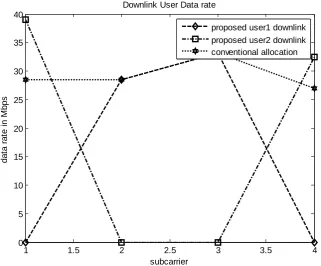
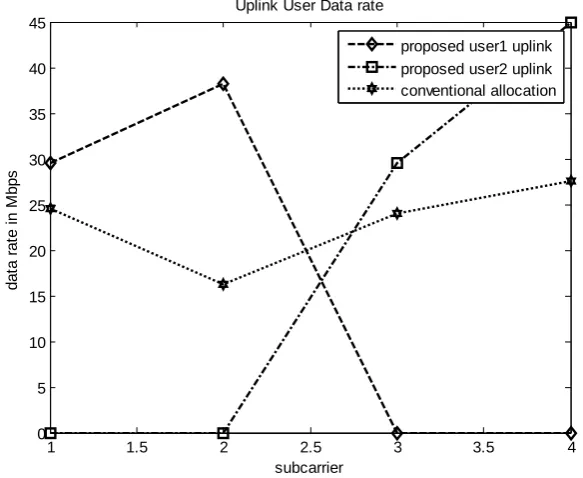
The proposed allocation scheme has been evaluated in terms of data rate of each user in the single cell OFDMA system. The rates received for the proposed allocation scheme for downlink and uplink is shown in Fig.2 and Fig.3respectively, with weights as shown in table 1. The main objective of the optimization problem was to improve the data rate of each user in the system and at the same time provide users with almost similar uplink and downlink data rate. The plot of conventional allocation algorithm shows the overall data rate of the system in all the subcarriers. Since the power constraints are more in the uplink direction the overall data rate achieved in uplink is less than in downlink while simulating the conventional allocation algorithm. The other plots verify that once a subcarrier is allocated to a user, it is not further allocated to any other user to reduce interference between the user signals. While formulating the optimization problem, it was ensured that higher weight is given to uplink which justifies the higher rates in uplink compared to downlink unlike the
1 1.5 2 2.5 3 3.5 4
0 5 10 15 20 25 30 35 40
Downlink User Data rate
subcarrier
d
a
ta
r
a
te
i
n
M
b
p
s
2015)even after considering the interference from other users.The difference in weights for user1 in uplink and downlink is greater than for the user2 as shown in the table.1.The figure 2 and 3 shows that the symmetry for user1 is less compared to that of user 2, even if it is within the threshold value. Moreover since the weights given to user 2 in uplink and downlink is greater than that of user 1 , the rates achieved by user 2 in both the directions is greater.
Fig.3. Data rate for each user in various subcarriers for uplink
Direction User 1 User2
Uplink weight α12= 0.7 α22= 0.8
Downlink weight α11= 0.3 α21= 0.5
Difference in weights 0.4 0.3
Table. 1
Fig. 4. Data rate for each user
1 1.5 2 2.5 3 3.5 4
0 5 10 15 20 25 30 35 40 45
Uplink User Data rate
subcarrier
d
a
ta
r
a
te
i
n
M
b
p
s
At each time instance, new channel gains are generated and the allocation is done dynamically. Fig.4 shows the data rate for each user over a period of time. It is noted that the similarity between uplink and downlink data rates is maintained with a minimum data rate for each user. The sudden change in data rate that can be observed in the plot is due to the reallocation of subcarriers as a result of change in channel condition.
V.
CONCLUSION
We formulated and solved a resource allocation problem in LTE system specifically for joint uplink-downlink directions considering the perspectives of maximizing the data rates, fairness and symmetry in services. All possible interferences were taken into account. The problem of resource allocation was a multiobjective optimization problem and was solved using the dual decomposition algorithm. Performance results demonstrate that the difference in data rates in uplink and downlink directions is within a specified limit thereby conserving the symmetry nature for services like video conferencing, mobile gaming etc at the same time maintaining a minimum data rate of 20Mbps for both the users.
REFERENCES
[1]. Boya Di, SiavaashBayat, LingyangSong,Yonghui Li and Zhu Han, “ Joint User Pairing, Subchannel, and Power Allocation in Full-Duplex Multi-User OFDMA Networks”, IEEE Transactions on Wireless Communications, Vol.15, No.12,pp-8260-8272,December 2016.
[2]. MdShamsulAlam, XueminShen, “Relay Selection and Resource Allocation for multiuser Cooperative OFDMA Networks, IEEE Transactions on Wireless Communications, Vol 12, No. 5, pp. 2193-2205, May 2013.
[3]. E. Shannon, “A Mathematical Theory of Communication”, Bell Syst. Technical Journal, Vol. 27, pp. 379-423, 1948
[4]. Ahmad M El-Hajj, Mariette Awad, ZaherDawy, “SIRA:A socially inspired game theoretic uplink/downlink resource aware allocation in OFDMA systems”, 2011 IEEE International Conference on Systems, Man and Cybernetics.
[5]. Elias Yaacoub, ZaherDawy, “A survey on uplink resource allocation in OFDMA wireless networks”, IEEE Communications surveys and tutorials,Vol 14, No 2,pp. 322-337, second quarter 2012.
[6]. Zhi-QuanLuo and Shuzhong Zhang,”Dynamic Spectrum Management:Complexity and Duality”, IEEE Journal of Selected Topics in Signal Processing, Vol.2, No.1, pp. 57-73, February 2008.
[7]. HoudaMzoughi, FaouziZarai and LotfiKamoun, “Interference-Limited Radio Resources Allocation in LTE_A system with MIH Cooperation”, The 22nd Asia-Pacific Conference on Communications,2016. [8]. Ahmad M. El-Hajj, ZaherDawy, “On Probabilistic Queue Length based Joint Uplink/Downlink resource
allocation in OFDMA networks”, 19th International Conference on Telecommunications 2012.
[9]. Sungyeon Kim, Jang-Won Lee” Joint Resource Allocation for Uplink and Downlink in Wireless Networks: A Case Study with User-Level Utility Functions”, 69th IEEE Vehicular Technology Conference, 2009. VTC Spring 2009.
[10]. Mingyan Kou, Yanxiang Zhen,”Dynamic Uplink/Downlink Resource Allocation For TDD OFDMA Access Network”, 2009 International Conference on Communications and Mobile Computing.
[11]. Chih-He Chiang, Wanjiun Liao, and TehuangLiu,”Adaptive Downlink/Uplink Bandwidth Allocation in IEEE 802.16 (WiMAX) Wireless Networks: A Cross-Layer Approach”,IEEE Global Communications Conference (GLOBECOM) 2007.
[12]. LukaiXu, Guanding Yu and Yuhuan Jiang, “Energy-Efficient Resource Allocation in Single-Cell OFDMA Systems:ulti-Objective Approach, IEEE Transactions on Wireless Communications, Vol.14, No.10,pp. 5848-5858, 2015.
[13]. Ahmad M El-Hajj, ZaherDawy, “On optimized joint uplink/downlink resource allocation in OFDMA networks”, 2011 IEEE Symposium on Computers and Communications.
[14]. Shenghong Li and Ross D. Murch, “Realizing Cooperative Multiuser OFDMA Systems with Subcarrier Resource Allocation”, IEEE Transactions on Wireless Communications Vol.12, No.4, pp 1923-1935, April 2013.
[15]. Zheng, Chang, Tapani, Restaniemi, “Asymmetric resource allocation for OFDMA networks with collaborative relays”, The 10th Annual IEEE CCNC-Wireless Networking track, 2013.
[16]. Haijun Zhang, Hong Xing, Julian Cheng, ArumugamNallanathan and Victor C M Leung, “Secure Resource Allocation for OFDMA Two-Way Relay Wireless Sensor Networks Without and With Cooperative Jamming”, IEEE Transactions on Industrial Informatics, Vol.12, No.5, pp 1714-1725, October 2016.
International organization of Scientific Research
69 | Page
[18]. Zhaowen Huang, SuiliFeng, Wu Ye, HongchengZhuang ,”Ant-Colony-Based Resource Allocation inOFDMA MESH Network “,IEEE 5th International Conference on Wireless communications, networking and mobile computing2009.
[19]. Lihan Liu, Zhuwei Wang, Xing Zhang, Hong Wu, “Radio Resource Management for the Uplink OFDMA System with Imperfect CSI”, 2015 IEEE Wireless Communications and Networking Conference. [20]. Miao Liu, Tiecheng Song, Lei Zhang and Jing Hu,“ Interference Minimization Approach for Joint
Resource Allocation in Cognitive OFDMA Networks”, 83rd IEEE Vehicular Technology Conference, 2016.
[21]. Mohamed K. Shehata, Safa M. Gasser, Hesham M. El-Badawyand Mohamed E. Khedr,” Optimized Dual Uplink and Downlink Resource Allocation for Multiple Class of Service in OFDM Network”, 2015 IEEE International Symposium on Signal Processing and Information Technology (ISSPIT).
[22]. Yan Sun, Derrick Wing Kwan Ng and Robert Schober,”Multi-Objective Optimization for Power Efficient Full-Duplex Wireless Communication Systems”, 2015 IEEE Global Communications Conference (GLOBECOM).