PROJECT MANAGEMENT PRACTICES AND THE PERFORMANCE OF VIRTUAL PROJECT TEAMS IN A CASE OF UPWORK GLOBAL
INCORPORATED
MUMBUA NG’ETICH LYDIA
D53/OL/CTY/26397/2015
A RESEARCH PROJECT SUBMITTED TO THE SCHOOL OF BUSINESS IN PARTIAL FULFILLMENT OF THE REQUIREMENTS FOR THE DEGREE
OF MASTERS OF BUSINESS ADMINISTRATION (PROJECT MANAGEMENT OPTION) OF KENYATTA UNIVERSITY
DECLARATION
Declaration by the candidate
This is my original research project. It hasn’t been presented for a degree in any other University. No part of this project is to be reproduced without the author’s and or / Kenyatta University’s permission.
Signature: __________________________ Date: ________________
Mumbua Ng’etich Lydia
D53/OL/CTY/26397/2015
I confirm that the work in this research project was done by the candidate under my guidance as the appointed university supervisor.
___________________________________ Date: ________________
Dr. Caleb Kirui,
School of Business,
Department of Management Science,
iii
DEDICATION
To my mum: Ann; dad: William and father- in-law Benjamin: thank you for your support and counsel. To my husband Simeon: thank you for your unwavering encouragement throughout the entire period of my studies. To my daughter and sons,
iv
ACKNOWLEDGEMENT
v
TABLE OF CONTENTS
DECLARATION... ii
DEDICATION ... iii
TABLE OF CONTENTS ...v
LIST OF FIGURES ... ix
ABBREVIATIONS AND ACRONYMS...x
OPERATIONAL DEFINITIONS OF TERMS...xi
CHAPTER ONE: INTRODUCTION ... 1
1.1 Background to the Study ... 1
1.2 Statement of the Problem... 7
1.3 Study Objectives ... 9
1.3.1 The General Objective ... 9
1.3.2 The Specific Objectives ... 9
1.4 Research Questions ... 9
1.5 Significance of the Study ... 10
1.6 The Scope of the Study ... 10
1.7 Limitations of the Study ... 11
1.8 Organization of the Study ... 11
CHAPTER TWO : LITERATURE REVIEW ... 12
2.1 Introduction ... 12
2.2 Theoretical Review... 12
2.2.1 Control Theory ... 12
2.2.2 Contingency Theory ... 14
2.3.1 Project Management Strategies and Virtual Team Performance ... 16
2.3.2 Managerial Experience and Performance of Virtual Project Teams ... 18
2.3.3 Collaborative Technology and Performance of Virtual Project Teams ... 20
2.3.4 Risk Management and Performance of Virtual Project Teams ... 21
2.4 The Literature Review Summary and Research Gaps ... 23
CHAPTER THREE: RESEARCH METHODOLOGY ... 29
3.1 Introduction ... 29
vi
3.3 Target Population ... 29
3.4 Sampling Design ... 30
3.5 Data Collection Instruments ... 30
3.6 Validity and Reliability ... 31
3.6.1 Validity of Research Instruments ... 31
3.6.2 Reliability of Research Instruments ... 31
3.7 Data Collection Procedure ... 32
3.8 Data Analysis and Presentation... 33
3.8.1 Empirical Model... 33
3.9 Ethical Consideration ... 34
CHAPTER FOUR: DATA PRESENTATION, DATA ANALYSIS AND DISCUSSION ... 35
4.1 Introduction ... 35
4.2 Background Information ... 35
4.2.1 Response Rate ... 35
4.2.2 Virtual Respondents Demographics ... 36
4.2.3 Project Management Strategies and Performance ... 40
4.2.4 Managerial Experience and Performance of Virtual Project Teams in Kenya41 4. 2.5 Collaborative Technology... 43
4.2.6 Risk Management and Performance of Virtual Project Teams in Kenya... 44
4.3 Inferential Statistics ... 46
4.3.2 Pearson’s r test on Managerial Experience ... 48
4.3.3 Pearson’s r test on Collaborative Technology ... 50
4.3.4 Pearson’s r test on Risk Management ... 51
4.3.5 Regression Analysis: Model Summary ... 53
4.3.6 Regression Analysis: ANOVA ... 54
4.3.7 Regression Analysis: Coefficient Table ... 55
CHAPTER FIVE: THE SUMMARY, CONCLUSION AND RECOMMENDATION ... 57
5.1 Introduction ... 57
vii
5.3 Conclusion ... 60
5.4 Recommendations ... 61
5.4.1 Suggestions for Further Research ... 62
APPENDIX I: LETTER OF INTRODUCTION ... 63
APPENDIX II: QUESTIONNAIRE ... 64
REFERENCES... 68
ANNEX I : UPWORK GLOBAL INCORPORATED: KENYAN PROFILES ………..76
viii
LIST OF TABLES
Table 2:1 Literature Gaps Summary ... 24
Table 3.1 Sample Size ... 30
Table 3.2 Case Processing Summary ... 32
Table 3.3 The Reliability Statistics ... 32
Table 4.1 Response Rate ... 35
Table 4.2 Virtual Respondents Professional Demographics ... 36
Table 4.3 Project Management Strategies: Descriptive Statistics ... 40
Table 4.4 Managerial Experience: Descriptive Statistics ... 42
Table 4.5 Collaborative Technologies : Descriptive Mean Statistics... 43
Table 4.6 Risk Management : Descriptive Mean Statistics ... 45
Table 4.7 Correlation Results on Project Management Strategies ... 47
Table 4.8 Correlation Results on Managerial Experience ... 49
Table 4.9 Correlation Results on Collaborative Technology ... 50
Table 4.10 Correlation Results on Risk Management ... 52
Table 4.11 Model Summary for Project Management Practices ... 53
Table 4.12 ANOVAa ... 54
ix
LIST OF FIGURES
x
ABBREVIATIONS AND ACRONYMS
GVT’S Global Virtual Teams
xi
OPERATIONAL DEFINITIONS OF TERMS
Collaborative Technology Digital tools used to communicate and submit work online.
Freelancer An online outsourcing organization where prospective employers post work seeking virtual employees to complete the tasks.
Key Performance Gauges of measuring virtual team performance based Indicators on the influence of project management practices
(project management strategies, managerial experience, collaborative technology and risk management)
Managerial Experience Prior work experience in team management
Online Outsourcing Internet based companies and organizations that prospective employers use to post tasks and hire skilled virtual employees to complete the tasks.
Payooner An online organization with virtual working opportunities for freelancers
Performance The ability for a virtual team to meet an organization’s or employer’s expectations concerning a given task on time, within specified costs and according to task requirements.
Project Management Methods that enable goal achievement when dealing Practices with virtual team projects
Project Management Plans that organizations use to ensure that their virtual Strategies teams have a high performance rate.
Risk Management Strategies taken by virtual team managers and virtual team members to make sure nothing makes it difficult for the team to complete the project on time, within the budget and set standards
xii
Upwork An online organization used by individuals and organizations to find and post virtual employment opportunities
Virtual Employee An employee who uses technology to work for an organization while they themselves may be located in a different part of the world
Virtual Office An online working platform with tools that allow virtual employees/ and teleworker freelancer work and communicate with their employer and colleagues Virtual team Group of individuals who work together on a project
while they are located in different geographic locations and also use online tools to work and communicate Zhubajie/ Witmart A virtual organization that enables freelancers find
xiii ABSTRACT
CHAPTER ONE
INTRODUCTION 1.1 Background to the Study
Around the world employers are beginning to appreciate a new breed of specialist employee- the virtual employee also known as the teleworker freelancer. This type of employee relies heavily on technology to get their work done. A strong internet connection, Wi-Fi, project management skills and software applications are their tools of trade. They are also not limited by borders. In this type of work environment, it is not unusual for virtual project managers to have team members located in different countries. According to Johnson, Heimann and O’Neill (2001) most western organizations have ‘moved away from working with people in visual proximity to working with people around the globe.’ Dulebohn and Hoch (2017) are in agreement and cite a survey of ‘1372 business respondents from 80 countries’ that found that ‘85 per cent of them were in virtual teams.’
2
Gillam and Oppenheim (2006) define virtual teams as ‘groups of people who work across time, space and often organizational boundaries using interactive technology to facilitate communication and collaboration.’ Ebrahim, Ahmed and Taha (2009) define virtual teams as one whose ‘members are located in more than one physical location.’ This location more often than not, is where they live: that is, their home (Kim, 2004). The virtual team like the traditional team is managed by a manager. Smith and Sinclair (2003) define a virtual manager as a person who ‘manages people; works from a different geographical location from their team and communicates with them through email and phone.’
1.1.1Project Management Practices
According to Casio (2000) virtual work is project based because of its heavy emphasis on results. This means that project management has become important to this sector. Beise, Carte, Vician and Chidambaram (2010) noted that ‘there has been a growth of structured project management practices worldwide. Such practices have been formalized in industry standards such as the Project Management Body of Knowledge (Project Management Institute, 2004) and the APM Body of Knowledge (Association for Project Management, 2006) ‘PMBOK and APMBOK respectively.’
3
short of their intended goals’. Ebrahim, Nader and Taha (2009) ‘found that success in implementing virtual team working is more about processes and people than about technology.’ This collaborates with findings by Rad and Levin (2003) who stated that the ‘successful performance of the project team, traditional and virtual alike is characterized by the team’s performance in handling the full complement of life-cycle issues of the project.’ According to Cooke-Davis (2001) ‘performance of projects can be improved through the identification and understanding of those project management practices that lead to superior performance’. This identification is important because it enables the manager and the team to use what works for them. According to Lu, Watson-Manheim, Chudoba and Wynn (2006) “having a variety of practice too many practices can negatively impact the virtual teams’ performance.”
4
Turner (2012), identified a number of project management practices which includes : requirements definition (strategies); risk management; activities related to managerial experience such as status reports ‘ time, work breakdown, issue management, status reports ‘ costs, resource schedules, project road map, team building, and responsibility assignment matrix; project book and agile methods (collaborative technology). Beiseet al. (2010) quotes (Tiwana and Keil, 2006) who in their study identified risk management as a project management practice ‘project management practices that have been linked to information technology project success include risk management’. Dube and Marnewick (2016) identified the following as criteria for measuring virtual project team performance: leadership, trust, communication, team cooperation, reliability, motivation, comfort and social interaction. Based on these prior identified practices, the researcher in this study focused on the following practices: project management strategies, managerial experience, collaborative technology and risk management.
1.1.2 Performance of Virtual Project Team
5
(2001) to improve on the performance of the virtual teams and their managers lies in identifying and adopting project management practices.
Dube et al. (2016) cited (Meyer, Roodt and Robbins, 2011) who defined ‘performance as an act of doing something which focuses on monitoring the progress and accomplishment of the activities through measurable parameters.’ A virtual project team leader does not have the privilege of physically seeing the team members and therefore the measurement of a team’s performance has to be different. This agrees with Weimann et. al. (2013) support this emphasis on team performance from the client’s point of view that ‘virtual team performance is often evaluated on the basis of acceptance of a specified output by a customer.’ Cune and Fogelberg (2012) agreed with this and reported that ‘in order to evaluate a virtual teams progress and productivity, remote managers have to switch from appraising their reports not on the work they put in, but on the results they get out.’
6
interdependent, team members are likely to work together more effectively than they might with independent, individual goals.’
1.1.3 Upwork Global Incorporated
There are a number of online outsourcing platforms that corporations use to find virtual employees who ultimately make up their virtual team. In the World Bank report by Kuek Siou, Paradi-Guilford, Fayomi, Imaizuni, Ipeirotis, Pina and Sing (2015), they identified Upwork Global Incorporated (formerly oDesk), Freelancer and Zhubajie/ Witmart as the top three online outsourcing organizations with a representation of both genders. According to a survey on freelancers from 170 countries, conducted by Payooner (2018), another online outsourcing organization, 23 per cent of freelancers are ladies while 77 per cent are men. Kenya and South Africa are the continental leaders on the supply of virtual employees on these online platforms. According to Lehdonvirta (2017) majority of African freelancers, opt for translation and writing jobs .
7
On their initial public offering prospectus (2018) filed with the US Securities and Exchange Commission, Upwork Global Incorporated company report states that one of the risks they face is “freelancers on their platform providing services that do not meet their clients requirements.” To ensure that freelance work performance is always at its best, job success rates are indicated on each freelancer profile. According to Green, Walker, Alabulththim, Smith and Phillips (2018) these are “ranking and reputation scores” that indicate what clients think about the freelancers work quality; ability to meet deadlines and how they interact / communicate. A job success rate of 80% and above is preferable since it indicates high job performance and reassures prospective clients that the freelancer in question will deliver on their work as required.
1.2 Statement of the Problem
8
Work statistics from Upwork (2017) on Kenyan virtual workers using their platform between November 2017 to April 2018 show that during this 6-month period, out of the 17968 who had registered for work, only 1494 worked between 1 – 100 hours. Of these 1494, only 582 had a job success rate of 80 per cent and above and about 92 per cent had a job success rate of 79 per cent and below. These figures show that out of the registered freelancers, only 8 per cent worked between 1 and 100 hours in that 6 month period. Secondly, of those that did work in that hour category, only 39 per cent had a favorable job success rate. These figures collaborate with a study done by Ferrazzi (2014) citing Deloitte (2005) who found that 66 per cent of clients were not satisfied with the work done by information technology virtual teams.
To address these challenges project management skills and knowledge have become a common requirement from clients seeking to hire virtual freelancers. This is a skill that cuts across all disciplines. According to Aritz, Cardon, Logemann, Marsen and Walker (2016) “a project management approach helps develop virtual team skills that will impact positively on their performance” and avoid situations where work is below par. Ilies, Crisan and Muresan (2010) noted that these practices “reduced failure and maximized the achievement of set goals.”
9
and Ives (2000) on the USA; and Pullan and Prokopi (2016) on Europe. A gap exists on the Kenyan context. The purpose of the study was therefore to establish the influence of project management practices on the performance of virtual teams in Kenya.
1.3 Study Objectives
1.3.1 The General Objective
The study investigated effects of project management practices on the performance of virtual project management teams in Kenya.
1.3.2 The Specific Objectives
The study’s specific objectives were:
i. To establish the effect of project management strategies on the performance of virtual project management teams in Kenya
ii. To determine the effect of managerial experience on the performance of virtual project teams in Kenya
iii. To assess the effect of collaborative technology on the performance of virtual project teams in Kenya
iv. To establish the effect of risk management on the performance of virtual project teams in Kenya.
1.4 Research Questions
The following questions guided the study:
10
ii. What effect does managerial experience have on the performance of virtual project management teams in Kenya?
iii. What effect does collaborative technology have on the performance of virtual project management teams in Kenya?
iv. What effect does risk management have on the performance of virtual project management teams in Kenya?
1.5 Significance of the Study
This study helped in understanding the dynamics that lead to having a virtual project management team that performs by meeting client expectations such as starting and completing the project on time, within the set budget and resources. This was information that organizations in Kenya with virtual teams would find useful. Entrepreneurs thinking of venturing in the online outsourcing business would also find this research beneficial since it would help them identify whom to hire and how to retain freelancers who will be part of a virtual team that performs.
1.6 The Scope of the Study
11 1.7 Limitations of the Study
The researcher anticipated and did experience an unwillingness to provide information by key virtual business decision makers. The internet connection was good and caused no delay in data collection. However, due to respondent suspicions there was a delay in questionnaire responses and online communication that extended the data collection process by a month. Nevertheless, the researcher did make the effort to explain the importance and nature of the study so that the respondents were cooperative. The researcher also made sure that they had the permission to collect data so that respondents were more confident of providing information.
1.8 Organization of the Study
12
CHAPTER 2
LITERATURE REVIEW
2.1 Introduction
This chapter gives the background information that helped the researcher to understand the topic under investigation. It covers a literature review of past studies on project management practices and the effects they have on virtual team performance. Included also is the conceptual framework.
2.2 Theoretical Review
According to Lu et. al (2006) and Ebrahim, Ahamed and Taha (2009) the use of virtual teams to get work done is a growing global trend among organizations . As a result, studies on virtual teams are on the increase. Previous studies focused on issues such as the characteristics of knowledge workers, and leadership in virtual teams. Performance of virtual teams has also been an area of study. This review looked at studies and theories that shed light on project management practices and how they influenced the performance of virtual teams.
2.2.1 Control Theory
13
that others work towards achieving the set organizational goals.’ Based on this definition, the Control theory is applicable to virtual team managers whose goal is to ensure that virtual teams meet the client or organization objectives. They have to rely on certain tools and techniques to ensure high performance (Attarzadeh, et al , 2008).
Objective one of the study sought to establish the effect of project management strategies on the performance of virtual project teams in Kenya. The control theory guided this objective because it addressed the organizational goals that virtual teams deal with on a daily basis (Kirsch, 1996). This corresponds to Schiller and Mandviwalla (2007) who in their study on the different theories researchers have used in ‘Virtual Team Research’ identified the control theory as one that was used when dealing with the outcomes of a virtual teams work.
For Piccoli, Powell, and Ives (2004), the control theory dealt with the mechanisms through which an organization could be managed so that it moved toward its objectives and was conceptualized as the effort to ensure that individuals working on team projects act in conformity with predefined strategies (Kirsch, 1996). Non-conforming team members are therefore a risk that the rest of the virtual team and their manager have to monitor so that their work performance is not affected (Solomon, 2016). The control theory was appropriate because it focused on the importance of having a manager to guide the team.
14
their study confirmed that when ‘task uncertainty is low, an individual’s performance can be improved by making use of existing practices (March, 1991). The results from their study also showed that there was a relationship between control mechanisms and performance, though more complex than Ouchi had put forth.”
According to Piccoli and Ives (2000) Ouchi identified three types of control mechanisms: output, behavior and clan control. The behavior control mechanism is more suited to virtual teams. Townsend, DeMarie and Hendrickson (1998) noted that the behavior control applied to the virtual team manager more than the traditional manager because the virtual team manager had to monitor how the team actually works, communicates and manages whatever data they use (Piccoli and Ives, 2000). The aim of objective four was to determine the effects of risk management on the performance of virtual project teams in Kenya. It was guided by the control theory because it addressed the control mechanisms on virtual team behavior which is part of risk identification and its management (Piccoli &Ives, 2004).
2.2.2 Contingency Theory
15
theory was a ‘valid approach because it has broadened the scope of leadership understanding, from a single focus to emphasizing on the importance of a leader’s style and the demands placed on them in different situations’.
The study’s objective number two was to determine the effect of managerial experience on the performance of virtual teams in Kenya. The contingency theory was relevant because it helps identify the different demands placed on virtual managers which require a different style of leadership as compared to managing a team that they can see. The theory was applicable because it dealt with the task motivated leadership styles which are characterized by activities which typify how virtual team managers plan to start and complete assigned projects and how to motivate the team members to complete those tasks (Northouse, 2007).
16 2.3 Empirical Review of Literature
2.3.1 Project Management Strategies and Virtual Team Performance
Pullan and Prokopi (2016) using a questionnaire sampled 168 participants in virtual teams and leading them in their study on ‘Leading Virtual Project Teams: Do’s and Don’ts’. They established that there were strategies that virtual team leaders could use to help their teams be successful. They found that virtual teams that were successful were those that paid attention to communication, risks, and training of team members. They also found out that all this was pegged to hiring the right people to be in the virtual team. This would assure the hiring client or organization that they had a team that would deliver as and when required.
Based on their review of literature in their study on ‘What is Project Strategy?’, Artto
17
under the obedient servant strategy was relatively high since they enjoyed strong support from the organizations decision makers.
According to an interview conducted by Innovative Management (2013) on two senior executives from Accenture, the team with an independent innovator strategy is not afraid to take risks and also aim to take their project a notch higher by coming up with new ways to meet the projects goals. The researchers also reported that this team is ambitious, has specific targets and does not shy away from doing things differently from the competition as they try to take advantage of technology and gaps to be filled. This meant that the team members needed to have strong negotiating and conflict resolution skills and still be focused on delivering as expected, on time and within the budget (Artto et al. 2008). They also measure their success according to the impact the project has on society and the environment rather than how the project will affect the stakeholders profit side of the business (Artto et.al. 2007).
18
those stakeholders who they had determined as necessary to help them meet the projects objectives.
2.3.2 Managerial Experience and Performance of Virtual Project Teams
Jarvenpaa and Leidner (1998) using questionnaires sampled 350 participants from all the continents in their study of ‘Communication and Trust in Global Teams’. They found out that many managers are uncomfortable with the concept of a virtual team because successful management of virtual teams may require new methods of supervision. However, Smith et al. (2003) found out that this only indicates the need for a project manager to run these virtual teams. Hoefling (2012), a virtual work professor and expert, confirmed these results by stating that the work of the project manager in a virtual team is to oversee the teams’ progress as well as the project’s progress. Rad and Levin (2003) in their study on ‘Achieving Project Management Success Using Virtual Teams’ acknowledged that virtual team management is not a simple, seamless transition, or one that can withstand a template one size-fits-all approach. They quoted (Wardell, 1998) who believes that managers must have already achieved success managing conventional in-house teams before they can be expected to manage an invisible team.
19
to complete the various tasks; assessing the teams on their individual strengths and weaknesses. Hamilton, Hodgkinson, and Byatt (2016), experts in project management, in their article on ‘managing virtual project teams’, identified them as the five aspects virtual teams project managers should concentrate on: managing goals; managing communications; keeping people motivated; regularly assessing the effectiveness of the remote communications and use of collaboration tools.
Virtual project teams that benefit from project managers with managerial experience will perform well in their work. Piccoli et al (2004) suggested based on conclusions of earlier research work on leadership (Kayworth and Leidner, 2001/2002) and individual roles in the virtual environment (Vogel et al. 2000) that ‘virtual teams benefit from the presence of individuals whose role is to stimulate regular, detailed, and prompt communication, and ensure that all team members are clear on their responsibilities.’ A study carried out by ‘Tiri, Ogolla, and Mburu (2015) on the transformational leadership role on performance of virtual teams focused on the leadership role of virtual project management team managers and how they influenced the teams’ performance. They found out that there was a positive relationship between leadership style and the team’s performance.’
20
they are taking on more work than others. Team members will be able to manage and adjust their schedules when they know what tasks they have to do, when they are due and are able to balance work and other social commitments’.
2.3.3 Collaborative Technology and Performance of Virtual Project Teams According to Peters, Linda and Manz (2007) in their study on ‘team performance’ teams involved in virtual collaboration do not physically interact but communicate exclusively through technological channels. Wipro (2012) in the study on ‘the virtual office : the next –generation workplace’ determined that the term virtual office arose because virtual teams work online. According to Sproull and Kiesler (1992) the concept of the virtual office would be non-existent were it not for technology. Gratton et. al (2007) found that virtual teams that performed well had a number of characteristics in common, among them ‘effective collaborative tools’. Rad et al.
(2003) agree that virtual project team members rely heavily on technology to achieve their goals and objectives and therefore proposed that a common suite of tools and appropriate training as necessary. Mortensen and O’Leary (2012) in their review on ‘managing a virtual team’ noted that synchronization was necessary to keep one team member’s work up-to-date with the rest of the members. Hoefling (2012) however cautioned managers to never to assume that all virtual team members understand how to use an organizations specific collaboration tools.
21
messaging tools that are used to chat if the other virtual team member is online (Hamilton et al. 2012). A study by Mugwika (2016) on the ‘telecommuting model for small and medium enterprises (SMES) in Kenya, looked at the technology available for employees working virtually for the 2-3 days they were away from the office and found that the organization did not require to inject huge sums of money to meet such basic requirements. Concerning performance, Rad et al.(2003) noted that the increased use of virtual communication influences not only the team’s outcomes but its processes as well.
Edwards, Abigail, Wilson and John (2003) in their book ‘implementing virtual teams’ noted that influences such as being in different countries and working for different companies, have caused individual virtual team members to come up with their own style of communicating while online. To avoid any confusion that may arise, they recommend a general communications guideline that needs to be discussed by all members and agreed upon. Rad et al. (2003) recommended the use of unique metrics and tools to measure how virtual teams and their managers deal with issues pertaining to distant communication and the proper use of technology. Managers also needed to make sure that the team members’ software is compatible and more so if they have been working for different organizations (Wipro, 2012).
2.3.4 Risk Management and Performance of Virtual Project Teams
22
growing online outsourcing market which companies use to hire skilled freelancers to form virtual online teams. They also acknowledged that their report did not capture data on virtual team members who opt to stop virtual work. This is a risk that hiring managers have to contend with as they look to hire and maintain teams that will stay on to the end of the project.
Hoefling (2012) identifies team members who are ill prepared to work at a distance as a source of conflict: they pose a risk to the virtual teams’ project progress. A hindrance in a project increases its scope, costs and delays the delivery date. According to Rad et al. (2003), the best way to deal with this problem was to use the team approach in risk management. ‘This means that team members are also involved in the management process. The project manager is in charge of the team’s performance but when the virtual team members are allowed to identify, classify, estimate their probability, impact and time frame of their occurrence, no stone is left unturned. According to Harpham (2015) a project management expert in his article ‘lead virtual teams’ this enables the team to continue with their work and finish on time’.
23
wrote the book ‘project management the agile way: making it work in the enterprise’ and in it noted that virtual project managers need to “recognize and understand” what the threats are. Grabowski and Roberts (1999) in their review in ‘risk mitigation in virtual organizations’ found out that it was necessary for virtual organizations to have a plan / strategy that would identify and help in managing situations that may affect project completion within the set conditions. They identified four processes that should make up the risk management strategy. These included ‘communication, culture and trust.’
According to Plump and Ketchen (2013) in their review on ‘navigating the possible legal pitfalls of virtual teams’ they noted that organizations hiring virtual teams can easily overlook labor and personnel issues and intellectual property rights ultimately pose a risk to their project goals and virtual team performance. They recommend examination of legal requirements of the nation that the organization or employer is hiring from as well as employee contracts which not only protect the organization but also reassure the virtual employees and impacting positively on their performance.
2.4 The Literature Review Summary and Research Gaps
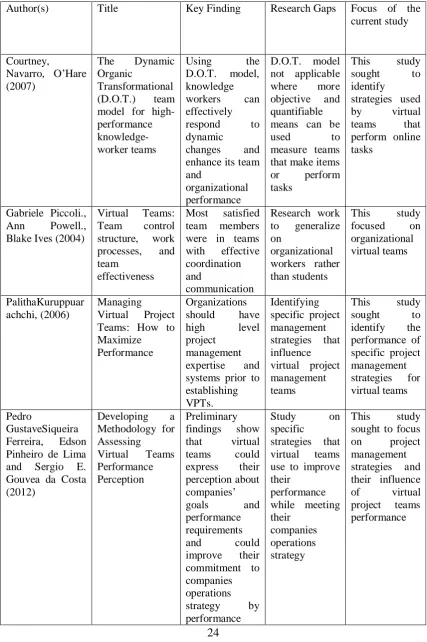
24 Table 2:1 Literature Gaps Summary
Author(s) Title Key Finding Research Gaps Focus of the current study
Courtney,
Navarro, O’Hare (2007)
The Dynamic Organic
Transformational (D.O.T.) team model for high-performance knowledge-worker teams
Using the
D.O.T. model, knowledge workers can effectively respond to dynamic
changes and enhance its team and
organizational performance
D.O.T. model not applicable where more objective and quantifiable means can be
used to
measure teams that make items or perform tasks
This study sought to identify
strategies used by virtual teams that perform online tasks
Gabriele Piccoli., Ann Powell., Blake Ives (2004)
Virtual Teams: Team control structure, work processes, and team
effectiveness
Most satisfied team members were in teams with effective coordination and
communication
Research work to generalize on
organizational workers rather than students
This study focused on organizational virtual teams
PalithaKuruppuar achchi, (2006)
Managing Virtual Project Teams: How to Maximize
Performance
Organizations should have high level project
management expertise and systems prior to establishing VPTs.
Identifying specific project management strategies that influence virtual project management teams
This study sought to identify the performance of specific project management strategies for virtual teams
Pedro
GustaveSiqueira Ferreira, Edson Pinheiro de Lima and Sergio E. Gouvea da Costa (2012)
Developing a Methodology for Assessing
Virtual Teams Performance Perception
Preliminary findings show that virtual teams could express their perception about companies’
goals and
performance requirements
and could
improve their commitment to companies operations strategy by performance
Study on
specific
strategies that virtual teams use to improve their
performance while meeting their
companies operations strategy
25
gap assessment Tiri, Ogolla,
Mburu (2005)
Transformational Leadership Role on Performance of Virtual Teams
There is a positive
relationship between
influence of transformational leadership styles and virtual team performance in Safaricom Company Limited
Influence of managerial experience on the
performance of the virtual project
management team
This study sought to identify the influence of managerial experience on the
performance of the virtual teams
Gabriele Piccoli., Ann Powell., Blake Ives (2004)
Virtual Teams: Team control structure, work processes, and team
effectiveness
Self-directed teams report higher
individual satisfaction with team and project control factors. There is no significant impact.
Research work on managerial experience impact on virtual team performance.
This study sought to identify how managerial experience affects the performance of virtual teams
Hosseira, Chileshe, Ghoddousi, Jahanshahloo, Katebi, Saeedi (2013)
Performance Evaluation for Global Virtual Teams (GVTS); Application of Data
Envelopment
Performance measure is a crucial
management task
Is managerial experience necessary
This study sought to identify the influence of managerial experience in the
performance of virtual teams Ross, Jones
(2007)
Can Team
Effectiveness be Predicted?
The study
expands on the theory of team effectiveness and
demonstrates
that a
theoretically developed empirical model can be predict team
effectiveness quantitatively
Future research to determine what should be the standard variables to measure performance, behavior, attitude, team member style and corporate culture.
This study sought to identify
whether managerial experience is one of the standard variables that influence performance
Mugwika,
Mwangi, George (2016)
Telecommuting Model for Small and Medium Enterprises
Adoption and implementation of the proposed telecommuting
Addressing the issues of trust and campaigns to create
This study sought to find
out how
26
(SMEs) in Kenya model would require minimal resources
awareness on the importance of
telecommuting
software technology is being used for communication purposes and its influence on the
performance of virtual teams Siou Chew Kuek,
Cecilia Paradi-Guilford,
ToksFayomi, SaoriImaizumi, PanosIpeirotis, Patricia Pina, Manpreet Singh (2015)
The Global Opportunity in Online
Outsourcing
In online
outsourcing
(OO) the
primary
beneficiaries are the population that has access to the internet and online payment system
Further research needed to identify whetherOO is only applicable to those who are ‘reachable’ or whether it
can be
extended to the ‘unreachable’ population through
training and extra support
This study sought to find
out how
training of virtual team members on collaborative technology can influence virtual team performance
Stephen M. Mutala (2002)
Internet
Connectivity and Services in Kenya: Current Development
For internet uptake to be enhanced, there is need for infrastructure improvement to improve
accessibility
Identify other opportunities online
This study sought to identify how the use of virtual teams software technology influences the virtual teams performance Remco de Jong
Rene Schalk, Petru L. Curseu (2008)
Virtual
Communicating, Conflicts and Performance in Teams
Importance of acknowledging the different types of conflict and their impact
on team
performance especially perceived team performance
Study on the development of new media and new ways of communicating
This study sought to identify how new media is influencing virtual team performance
Siou Chew Kuek, Cecilia Paradi-Guilford,
The Global Opportunity in Online
Virtual work as potential for socioeconomic
What factors drive the decision for
27
ToksFayomi, SaoriImaizumi, Panos (2015)
Outsourcing development in developing countries
people to leave OO work
risks that virtual teams face and how it affects their performance Oertig and Buergi
(2006)
The Challenges of Managing Cross-Cultural Virtual Project Teams
The key themes reported to be of significance
were the
challenges of leadership, managing ritual aspects of communication and developing trust
The study focused on a specific
organization in the West. A Kenyan
perspective is missing.
This study sought to focus on the risks Kenyan virtual
organizations face and how it affects the virtual teams performance
Mwaniki (2014) Virtual
Workforce in the Kenya’s Higher Education and Research Service Sector
Virtual
workforce in Kenyan higher education and research
institutions enjoy l support from their managers
Secondary data
was not
sampled
This study sought to use secondary data to reduce bias
on the
influence of risk on the performance of virtual project teams
Jong, Schalk and Curseu, (2008)
Virtual
Communicating, conflicts and performance in teams
Level of team virtuality
influences the relationship between intra-team conflict and perceived team
performance
Study on the development of new media and how it is influencing team
performance
This study sought to identify how new media that was used to counter risk influences the virtual
teamsperforma nce
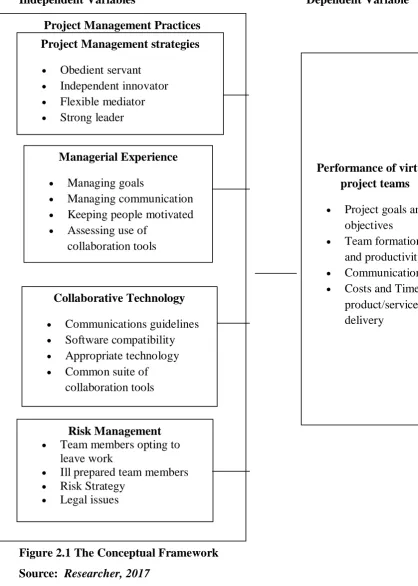
28 Conceptual Framework
Independent Variables Dependent Variable
Figure 2.1 The Conceptual Framework Source: Researcher, 2017
Project Management Practices Project Management strategies
Obedient servant
Independent innovator
Flexible mediator
Strong leader
Managerial Experience
Managing goals
Managing communication
Keeping people motivated
Assessing use of collaboration tools
Collaborative Technology
Communications guidelines
Software compatibility
Appropriate technology
Common suite of collaboration tools
Risk Management
Team members opting to leave work
Ill prepared team members
Risk Strategy
Legal issues
Performance of virtual project teams
Project goals and objectives
Team formation and productivity
Communication
29
CHAPTER THREE RESEARCH METHODOLOGY
3.1 Introduction
This chapter discusses the methods and procedures that were used to conduct this study. It deals with the research design, targeted population, the sampling design, data collection instruments, the procedure, analysis and data presentation.
3.2 The Research Design
The study had a descriptive research design. According to Sachdeva (2008) a descriptive design is ‘concerned with finding out who, what, where, when or how much’. The descriptive research design was appropriate in providing a description of the characteristics of the individual objectives (Mugenda and Mugenda 2009). Data collected was evaluated and enabled the researcher to draw conclusions that generalized findings to a larger population. (Saunders et al. 2009)
3.3 Target Population
30 3.4 Sampling Design
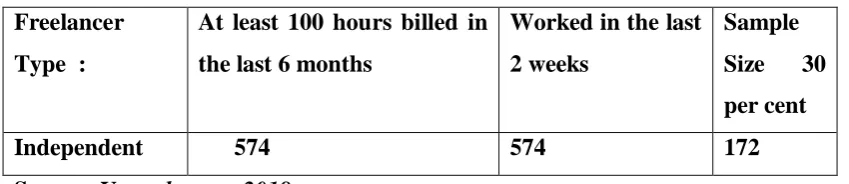
The researcher conducted simple random sampling. This enabled the researcher to give an equal selection opportunity to the target population that had actively engaged in online work through this platform and had managed to clock in at least 100 hours. According to Hill (1998), citing Roscoe (1975) the general rule of thumb is that the minimum size of a sample is 30 per cent. Based on this the researcher had a sample of 172 Kenyan virtual freelancers on the Upwork platform.
Table 3.1 Sample Size Freelancer
Type :
At least 100 hours billed in the last 6 months
Worked in the last 2 weeks
Sample Size 30 per cent
Independent 574 574 172
Source: Upwork.com , 2018
3.5 Data Collection Instruments
31 3.6 Validity and Reliability
3.6.1 Validity of Research Instruments
The questionnaire was tested for validity using face and content validity. According to Taherdoost (2016) face validity determines ‘whether the questionnaire is relevant, readable, and consistent in style, language use and formatting’ while content validity determines ‘whether all aspects of the topic have been covered (Mugenda et al (2003).’ The researcher sent the questionnaire to freelancers who determined at face value that it was relevant. Formatting errors were identified and the researcher corrected them. The freelancers also determined that the content was well covered.
3.6.2 Reliability of Research Instruments
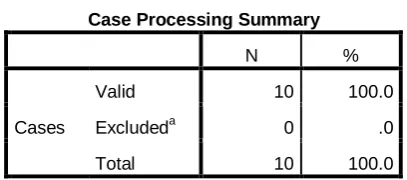
32 Table 3.2 Case Processing Summary
Case Processing Summary
N %
Cases
Valid 10 100.0
Excludeda 0 .0
Total 10 100.0
a. Listwise deletion based on all variables in the
procedure.
Source: Research Data, 2018
Table 3.3 The Reliability Statistics
Reliability Statistics
Cronbach's
Alpha
N of Items
.856 4
Source: Research Data, 2018
According to Santos (1999), a research instrument is considered reliable if α > or = 0.70. Findings from Table 3.3 reliability statistics show that Cronbach’s Alpha is 0.856 indicating that the questionnaire used for this study was reliable
3.7 Data Collection Procedure
33 3.8 Data Analysis and Presentation
Data sampled was analyzed using descriptive and inferential statistics. This included frequencies, measures of central tendencies which show the mean, median or mode and measures of dispersion which involve standard deviation, range or variance. The researcher also used computer aided packages for qualitative data to help in analyzing the sampled data. The researcher also used tables and graphs in the presentation of the data. The researcher also did a preliminary diagnostics for regression modeling and the data was presented in tables and graphs.
3.8.1 Empirical Model
The researcher used the multiple regression analysis technique because it showed the relationship between one dependent variable, performance, and several independent variables, project management strategies, managerial experience, collaborative technology and risk management. According to Hair, Money, Page and Samouel (2007), this is a realistic model because ‘in the real-world predictions almost always depend upon multiple factors and not just one”. The model proposed for this research project was based on performance (Y) which is a function of project management strategies (PMS), Managerial Experience (ME), Collaborative Technology (CT), and Risk Management (RM).
Y= β0X0 + β1X1+ β2X2+ β3X3+β4X4 Where:
34 X1 = Project Management Strategies
X2= Managerial Experience X3= Collaborative Technology X4= Risk Management
This model helped in understanding the relationship between performance and the dependent variables. According to Lui et al. (2010) results are best presented in two steps to first show the effect on performance by changes in one of the project management practices and secondly how having a specific performance target can be used to make changes on the independent variables to attain that particular goal. Both showed the changes virtual team members needed to make on certain practices to be a high performing team that met its set targets. According to Mugenda and Mugenda (2009) ‘multiple regression yields a number of statistics. These would show whether the independent variables can be used to significantly predict the dependent variable and in doing so answer the research questions.”
3.9 Ethical Consideration
35
CHAPTER FOUR
DATA PRESENTATION, DATA ANALYSIS AND DISCUSSION
4.1 Introduction
In this part, the researcher discusses the research project findings guided by the research questions. The chapter also deals with the presentation of data and their analysis. Analysis is both descriptive and inferential and was carried out using SPSS. Graphs are used to give a visual representation of the data.
4.2 Background Information
In this section, the researcher collected background data on the respondents’ profession, gender, and age, and freelance work type, length of time they have worked as virtual freelancers, their virtual project team size and project management work experience as well as the response rate. The data helped the researcher understand the type of people drawn to working online in virtual teams.
4.2.1 Response Rate
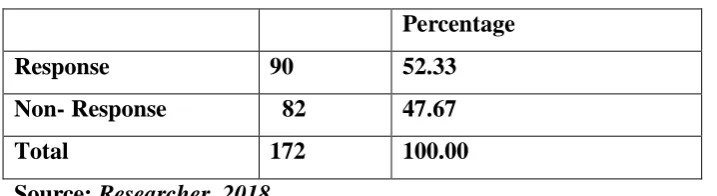
The researcher emailed a questionnaire to 172 respondents. There were a total of 90 responses. Table 4.1 presents the response rate in table form.
Table 4.1 Response Rate
Percentage
Response 90 52.33
Non- Response 82 47.67
Total 172 100.00
36
Findings in Table 4.1 indicate that the response rate was 52.32 per cent. According to Mugenda and Mugenda (2003), “50 per cent is adequate for analysis and reporting.” The response rate of 52.32 per cent therefore indicated that the study would not be invalidated.
4.2.2 Virtual Respondents Demographics
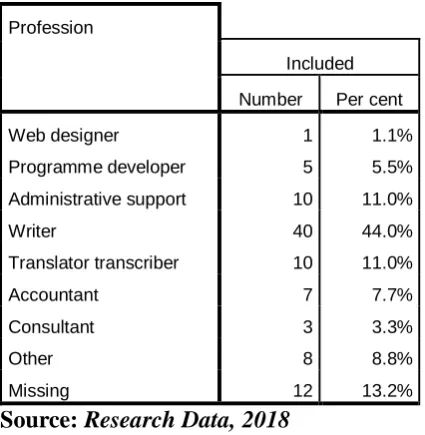
To understand the respondents, their professional demographics responses were computed into one table. Table 4.2 presents the respondents demographics.
Table 4.2 Virtual Respondents Professional Demographics Profession
Included
Number Per cent
Web designer 1 1.1%
Programme developer 5 5.5%
Administrative support 10 11.0%
Writer 40 44.0%
Translator transcriber 10 11.0%
Accountant 7 7.7%
Consultant 3 3.3%
Other 8 8.8%
Missing 12 13.2%
Source: Research Data, 2018
37
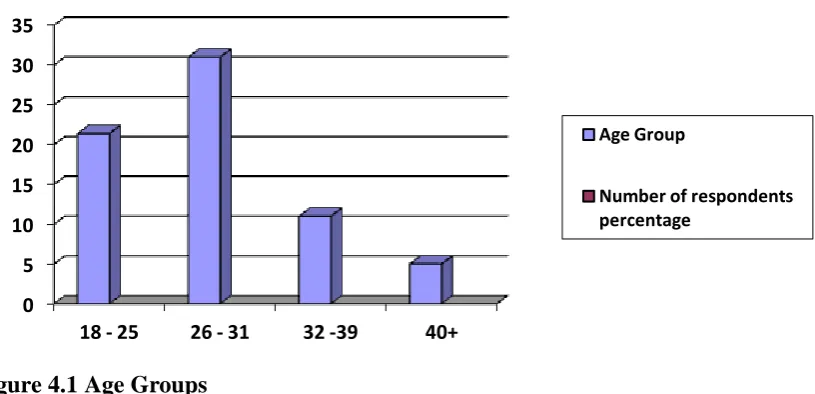
Of the 90 responses received, 38.9 per cent were female while 50 per cent were male. This suggested that there were more men involved in online work, implying that there are more men than women with access to digital work information and possibly devices such as laptops and affordable WI-FI that are necessary tools for online work. This corresponds to the survey findings conducted by Payooner (2018) on freelancers from 170 countries, which included Kenya that showed that 23 per cent of freelancers were ladies while 77 per cent were men. Figure 4.1 presents the responses received from the respondents about their age groups in bar graph form
Figure 4.1 Age Groups Source: Research Data, 2018
Research findings presented in Figure 4.1 showed that age group 26-31 had the highest number of freelancers. This is probably because they are millenials: the first generation to grow up surrounded by digital technology. This implied that millenials are comfortable with freelance virtual work. This corresponds with findings by
0 5 10 15 20 25 30 35
18 - 25 26 - 31 32 -39 40+
Age Group
38
Constantin, Jonut (2008) who reported that ‘virtual reality was not virtual for anyone born after 1985.’
Of the responses received, 32 per cent of the respondents indicated that they were part-time freelancers while 37 per cent were full time freelancers. This implied that there are more people in Kenya who are now seeking self employment opportunities online instead of looking for white collar jobs. This is probably because the government has started the Ajira platform that encourages more people to adopt online work as a way to be in gainful employment.
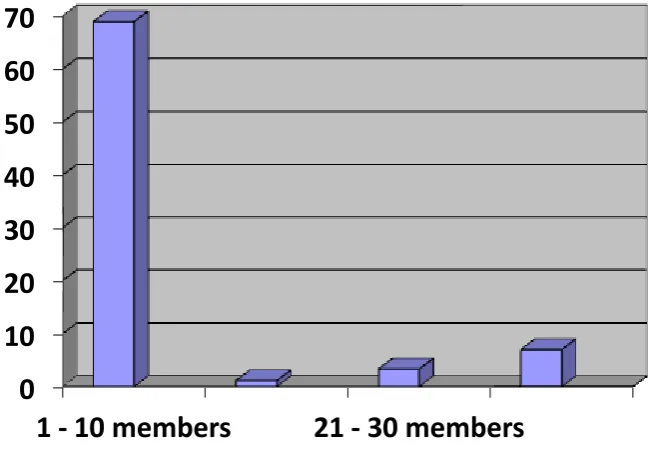
Figure 4.2 presents the responses received from the respondents about their virtual project team sizes in bar graph form.
Figure 4.2 Virtual Team Members Source: Research Data, 2018
0
10
20
30
40
50
60
70
1 - 10 members
21 - 30 members
39
Research findings presented in Figure 4.2 showed that most of the respondents were in virtual teams made up of 1-10 members. This is probably because smaller teams are easier and cheaper to manage. This corresponds to findings by Ferrazzi (2014) who reported that getting ‘virtual teams right was not easy.’
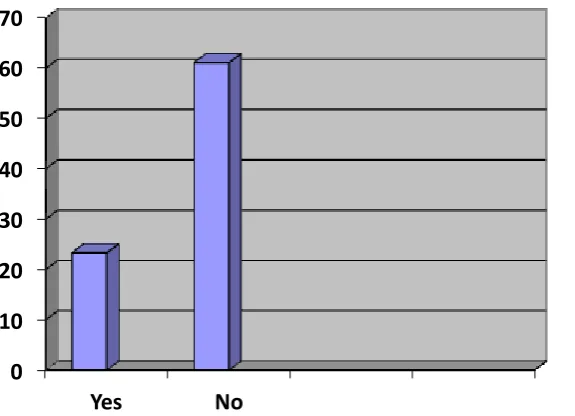
Figure 4.3 presents the respondents project management experience in bar graph form.
Figure 4.3 Project Management Experience Source: Research Data, 2018
Research finding presented in Fig. 4.3 showed that 23.3 per cent of the respondents indicated that they have project management experience while 61.1 per cent did not. This is probably because previously it was not considered a necessary skill. This corresponds to the findings by Jarvenpaa et. al. (1998) who reported that many managers were hesitant in managing virtual project teams because they did not have the necessary skills to do so.
0 10 20 30 40 50 60 70
Yes No
40
4.2.3 Project Management Strategies and Performance
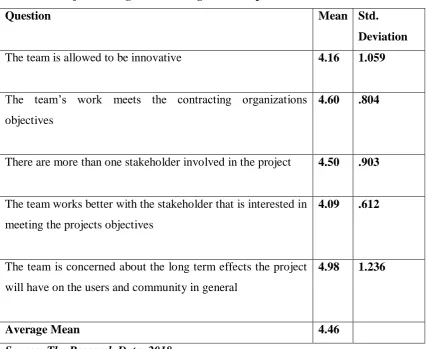
The study’s objective number one was to establish the effect project management strategies had on the performance of virtual project teams in Kenya. Using a scale from 1 to 5, where 1 was ‘Strongly Disagreed 2: Disagreed 3: Balanced 4: Agreed and 5: ‘Strongly Agreed’ ; respondents were expected to give their opinions on questions on teams being allowed to be innovative; meeting organizational objectives; number of stakeholders and concern about the long-term effects of a project on users and the community in general. Table 4.3 presents the mean and standard deviation of the Likert items for question.
Table 4.3 Project Management Strategies: Descriptive Statistics
Question Mean Std.
Deviation
The team is allowed to be innovative 4.16 1.059
The team’s work meets the contracting organizations objectives
4.60 .804
There are more than one stakeholder involved in the project 4.50 .903
The team works better with the stakeholder that is interested in meeting the projects objectives
4.09 .612
The team is concerned about the long term effects the project will have on the users and community in general
4.98 1.236
Average Mean 4.46
41
The research findings presented in the above table indicated that the average mean for the Likert items was 4.46 implying that most of the respondents strongly agreed on most of the Likert items. This corresponds to findings by Pullan and Prokopi (2016) who reported that the implementation of certain strategies and practices were necessary for virtual team success. The highest mean was 4.98 which showed that the respondents strongly agreed that they were concerned about the long term effects a project would have on users and the community in general. This corresponds with the findings by Artto et. al. (2007) who reported that the project team with a strong leader strategy based its success on how a “project impacted the society and environment as a whole.”
4.2.4 Managerial Experience and Performance of Virtual Project Teams in Kenya
42
Table 4.4 Managerial Experience: Descriptive Statistics
Question Mean Std.
Deviation The team is able to complete the project on time 4.57 .80
The team is in constant communication with the project manager
4.77 .61
The team undergoes regular training sessions , both online and off line
3.28 1.20
The team uses online tools to track their work, get updates and any other important information regarding the project at hand.
4.66 .85
Your tracking and communication system functions as it should
4.68 .84
The team is motivated 4.49 .78
Average Mean 4.40
Source: The Research Data, 2018
43
findings by Hoefling (2012) who reported that virtual team managers should never assume that all tem members know how to use the collaborative tools implying that there were some managers who did not train their team members.
4. 2.5 Collaborative Technology
Objective three of the study sought to assess the effects collaborative technology had on the performance of virtual project teams in Kenya. Using a scale from 1 to 5, where 1 was ‘Strongly Disagreed 2: Disagreed 3: Balanced 4: Agreed and 5: ‘Strongly Agreed’ ; respondents were expected to give their opinions on questions on the use of common guidelines, device compatibility, and training of new team members and use of similar software. Table 4.5 presents the mean and standard deviation of the Likert items for each question.
Table 4.5 Collaborative Technologies : Descriptive Mean Statistics
Question Mean Std.
Deviation The team is guided by a common set of guidelines. 4.17 .944 All team member computers, laptops , tablets, smart phones
they use for working are tested for compatibility with the organizations system
3.33 1.492
New team members are trained on software that the team uses 3.19 1.32 Team members use the same software and system for
communicating and submitting their work
4.67 .88
Average Mean 3.84
Source: Research Data, 2018
44
team members using the same software and system to communicate and submit work had the highest mean of 4.67. This is in agreement with the results of a study conducted by Rad et al (2003) that reported that virtual teams should use a common suite of tools. The lowest mean was 3.19 which showed that respondents had balanced view on this item implying that some of them agreed that new members were trained on the software the team used while the others disagreed. This corresponds to a study by Hoefling (2012) who reported that virtual team managers should not assume that all team members knew how to use the organizations collaboration tools.
45
Table 4.6 Risk Management : Descriptive Mean Statistics
Question Mean Std.
Deviation The team performance is affected when a team member leaves
suddenly before the end of the project?
3.61 1.51
The team performance is affected by entry of new members into the team
3.28 1.27
There is a strategy for identifying situations that may hinder the completion of the project
4.21 1.32
The contracting organization/ employer meet labor and personnel legal requirements in your residing country before hiring you.
3.92 .60
Average Mean 3.75
Source: Research Data, 2018
Research findings presented in Table 4.6 showed that the average mean for the Likert items was 3.75 implying that most of the respondents agreed on the Likert items. This corresponded with study results reported by Grabowski and Roberts (1999) and Rad et al (2003) who reported that a risk management plan was important and that it should involve all team members in the implementation process. The highest mean was 4.21 where respondents agreed that there was a strategy in their virtual project teams for identifying situations that may hinder the completion of the project. This agrees with the study done by Harpham (2015) who reported that virtual team members should be part of the risk management process.
46
was balanced but leaned more towards agreeing with the statement. This is probably because the Kenyan government has recommended Upwork Global Incorporated has one of the sites that freelancers can look for online work. This corresponds to a study done by Plump and Ketchen (2013) who concluded that government and organizational involvement was necessary as a way of protecting the virtual workers legal personnel rights and positively influencing their performance.
4.3 Inferential Statistics
4.3.1 Pearson’s r test on Project Management Strategies
47
Table 4.7 Correlation Results on Project Management Strategies Innovativenes s Objective s Stakeholde r Interested stakeholde r Effect s Innovativenes s Pearson Correlatio n
1 .338** -.024 .082 .355**
Sig.
(2-tailed) .001 .826 .440 .001
N 90 90 90 90 90
Objectives Pearson Correlatio n
.338** 1 .155 .096 .183
Sig.
(2-tailed) .001 .145 .368 .084
N 90 90 90 90 90
Stakeholder Pearson Correlatio n
-.024 .155 1 .102 .071
Sig.
(2-tailed) .826 .145 .340 .509
N 90 90 90 90 90
Interested stakeholder
Pearson Correlatio n
.082 .096 .102 1 -.012
Sig.
(2-tailed) .440 .368 .340 .909
N 90 90 90 90 90
Effects Pearson Correlatio n
.355** .183 .071 -.012 1
Sig.
(2-tailed) .001 .084 .509 .909
N 90 90 90 90 90
**. Correlation is significant at the 0.01 level (2-tailed). *. Correlation is significant at the 0.05 level (2-tailed) Source: Research Data, 2018
48
independent variables effects and objectives had the closest p <0.05 at .084 implying that there was no significant relationship between the two and were therefore independent. These results do not agree with the studies done by Katzenbach and Smith (1993) and Artto et. al (2007). Katzenbach and Smith (1993) reported that the independent team was interested in meeting the project objectives. In their study Artto
et. al (2007) reported that the independent team was concerned about the long term effects of the project on users and the community in general. Both objectives and effects were related and not independent. This is probably because most people venturing onto virtual work do so to have an income from a platform that enables them to have a work- life balance. They will meet the project’s goals so that they may be paid but not necessarily because they are concerned about the effects their work will have on the community. This agrees with a study by Manyika, Lund, Bughin, Robinson, Mischke and Mahajan (2016) that those who by choice chose to work virtually, have income and expanding opportunities as their priorities.
4.3.2 Pearson’s r test on Managerial Experience