Journal of Engineering Innovation and Research, Volume: V, Issue:1, January-March 2015 1 Available online at ISSN2230- 9373
www.a2zknowledge.com Volume-V, Issue-1
January-March, 2015
EFFECTS AND OPTIMIZATION OF MACHINING
PARAMETERS IN HARD TURNING PROCESS: A
REVIEW
Sudhansu Ranjan Das1*, Deepak Kumar Mohapatra2, Purna Chandra Routray3, Biswaranjan Rout4
Abstract-
In today’s rapidly changing state in metal cutting industries, applications of optimization techniques in hard turning processes is essential for a manufacturing unit to replace grinding/finishing operations due to the development of advanced tool materials and rigid machine tools, which can ensure the same accurate geometrical and dimensional tolerances. The complex machining process gets influenced by multiple process parameters, particularly in a finish hard turning operation, which often determines the final quality of the parts. This article presents a brief review of the techniques of modeling and optimization that have significant influence in hard turning. The main objectives of this study investigate and evaluate the effect of different machining parameters on surface roughness, tool wear, tool life, cutting forces, power consumption, material removal rate and cutting temperature and chip morphology during turning of different hard steels with hardness more than 45 HRC.
1. INTRODUCTION
The quality of design can be improved by improving the quality and productivity in companywide activities. Those activities concerned with quality, include in quality of product planning, product design and process design [1]. The traditional method of machining the hardened steels (≤45HRC) includes rough turning, heat
treatment, and then grinding process. Recently, hard machining is an emerging technology and an attractive alternative to conventional grinding due to its potential benefits such as short cycle time, process flexibility, higher material removal rate, compatible surface roughness and less environmental problems without the use of cutting fluid (Figure 1). In hard turning, there are many factors affecting the cutting process behavior such as tool variables (tool materials, cutting edge geometry, clearance angle, nose radius, etc.), workpiece variables (materials and hardness), cutting conditions (cutting speed, feed and depth of cut), machining time, tool vibrations, cutting environments (dry and wet)and chip morphology.
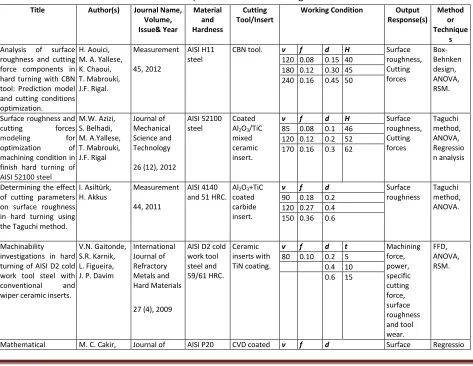
Journal of Engineering Innovation and Research, Volume: V, Issue:1, January-March 2015 2 aspects using several workpieces in hard turning is presented in Table 1.
Figure 1. Hard turning versus cylindrical grinding process
Hard turning Cylindrical grinding
TABLE 1. Overview of different work materials and machining parameters with various optimization techniques used in hard turning.
Title Author(s) Journal Name, Volume, Issue& Year
Material and Hardness
Cutting Tool/Insert
Working Condition Output Response(s)
Method or Technique
s
Analysis of surface roughness and cutting force components in hard turning with CBN tool: Prediction model and cutting conditions optimization.
H. Aouici, M. A. Yallese, K. Chaoui, T. Mabrouki, J.F. Rigal.
Measurement
45, 2012
AISI H11 steel
CBN tool. v f d H Surface
roughness, Cutting forces
Box-Behnken design, ANOVA, RSM. 120 0.08 0.15 40
180 0.12 0.30 45 240 0.16 0.45 50
Surface roughness and cutting forces
modeling for
optimization of machining condition in finish hard turning of AISI 52100 steel
M.W. Azizi, S. Belhadi, M. A.Yallese, T. Mabrouki, J.F. Rigal
Journal of Mechanical Science and Technology
26 (12), 2012
AISI 52100 steel
Coated Al2O3/TiC
mixed ceramic insert.
v f d H Surface
roughness, Cutting forces
Taguchi method, ANOVA, Regressio n analysis 85 0.08 0.1 46
120 0.12 0.2 52 170 0.16 0.3 62
Determining the effect of cutting parameters on surface roughness in hard turning using the Taguchi method.
I. Asiltürk, H. Akkus
Measurement
44, 2011
AISI 4140 and 51 HRC.
Al2O3+TiC
coated carbide insert.
v f d Surface
roughness
Taguchi method, ANOVA. 90 0.18 0.2
120 0.27 0.4 150 0.36 0.6
Machinability investigations in hard turning of AISI D2 cold work tool steel with conventional and wiper ceramic inserts.
V.N. Gaitonde, S.R. Karnik, L. Figueira, J. P. Davim
International Journal of Refractory Metals and Hard Materials
27 (4), 2009
AISI D2 cold work tool steel and 59/61 HRC.
Ceramic inserts with TiN coating.
v f d t Machining
force, power, specific cutting force, surface roughness and tool wear.
FFD, ANOVA, RSM. 80 0.10 0.2 5
0.4 10 0.6 15
Journal of Engineering Innovation and Research, Volume: V, Issue:1, January-March 2015 3 modeling of surface
roughness for evaluating the effects of cutting parameters and coating material.
C. Ensarioglu, I. Demirayak materials processing technology 209, 2009 cold work tool steel and 52-54 HRC.
(TiCN/Al2O3/T
iN) and PVD coated (TiAlN) carbide inserts.
120 0.12 1 roughness. n analysis. 160 0.18 1.5
200 0.22 2
Experimental investigations of cutting parameters influence on cutting forces and surface roughness in finish hard turning of MDN250 steel. D.I. Lalwani, N.K. Mehta, P.K. Jain Journal of Materials Processing Technology 206(1–3), 2008 MDN 250 steel and 50 HRC.
Coated ceramic inserts.
v f d Cutting
forces, surface roughness.
RSM, ANOVA. 55 0.04 0.1
74 0.08 0.15 93 0.12 0.2
Investigating the machinability evaluation of Hadfield steel in the hard turning with Al2O3/TiC
mixed ceramic tool based on the response surface methodology. J.T. Horng, N.M. Liu, Ko-Ta Chiang. Journal of Materials Processing Technology 208 (1–3), 2008 Hadfield steel and 210 HV. Uncoated Al2O3/TiC
mixed ceramic tool.
v f d r Flank wear,
Surface roughness.
RSM, SAO method, ANOVA. 100 0.05 0.25 0.8
175 0.1 0.50 1.0 250 0.15 0.75 1.2
Estimating the effect of cutting parameters on surface finish and power consumption during high speed machining of AISI 1045 steel using Taguchi design and ANOVA.
A.Bhattacharya S. Das, P. Majumder, A. Batish
Prod. Eng. Res. Devel.
3 (1), 2009
AISI 1045 steel and 50 HRC. (TiCN+TiN) multilayer coated carbide insert.
v f d Surface
roughness, power consumptio n. Taguchi design, ANOVA. 58 0.04
5 1.0
96 0.1 1.2 151 0.12
5 1.5
240 0.16 0
2.0
A surface roughness prediction model for hard turning process.
D. Singh, P.V. Rao International Journal of Advanced Manufacturing Technology 32 (11-13), 2007 AISI 52100 steel and 58-60 HRC.
Al2O3+TiCN
mixed ceramic tools.
v f d r α Surface
roughness FFD, ANOVA, RSM. 100 0.10 0.2 0.4 6
150 0.20 0.8 16 200 0.32 1.2 26
Design optimization of cutting parameters
when turning
hardened AISI 4140 (63 HRC) with Al2O3+TiCN mixed
ceramic tool. E. Aslan, N. Camuscu, B. Bingoren Materials & Design 28 (5)2007 AISI 4140 steel and 63 HRC.
Al2O3+TiCN
mixed ceramic tools.
v f d Flank wear,
surface roughness. Taguchi’s technique, ANOVA, regression analysis. 100 0.05 0.25
175 0.1 0.5 250 0.2 1.0
Statistical analysis of surface roughness and cutting forces using response surface methodology in hard turning of AISI 52100 bearing steel with CBN tool
K. Bouacha, M.A. Yallese, T. Mabrouki, J.F. Rigal
Int. Journal of Refractory Metals & Hard Materials
28, 2010
AISI 52100 steel and 64 HRC
CBN tools v f d Surface
roughness, Cutting forces Taguchi’s OA, ANOVA, RSM 125 0.08 0.15
176 0.12 0.30 246 0.16 0.45
Performance studies of multilayer hard surface coatings (TiN/TiCN/Al2O3/TiN)
of indexable carbide inserts in hard machining: Part-II (RSM, grey relational
and techno
economical approach)
A.K. Sahoo, B. Sahoo
Measurement
46 (8), 2013
AISI 4340 Steel
(47±1 HRC)
(TiN/TiCN/Al2
O3/TiN)
multilayer coated carbide insert
v f d Flank wear,
Surface roughness FFD, ANOVA, Taguchi design, Grey relational analysis, regression analysis, RSM 60 0.05 0.2
Journal of Engineering Innovation and Research, Volume: V, Issue:1, January-March 2015 4 Surface roughness
model in turning hardened hot work steel using mixed ceramic tool B. Fnides, M.A. Yallese, T. Mabrouki, J.F. Rigal MECHANIKA.
3 (77), 2009
AISI H11 steel (X38CrMoV 5-1) and 50 HRC
Al2O3/TiC
mixed ceramic tools.
v f d Surface
roughness Factorial DOE, ANOVA, Regressio n analysis, RSM 90 0.08 0.15
120 0.12 0.30
180 0.16 0.45 On the prediction of
surface roughness in the hard turning based on cutting parameters and tool vibrations Z. Hessainia, A. Belbah, M.A. Yallese, T. Mabrouki, J.F. Rigal Measurement 46, 2013 42CrMo4 steel and 56 HRC
Al2O3/TiC
mixed ceramic tools.
v f d Surface
roughness, Tool vibrations DOE, ANOVA, RSM 90 0.08 0.15
120 0.12 0.30 180 0.16 0.45
Machinability evaluation in hard turning of cold work tool steel (D2) with ceramic tools using statistical techniques.
J. P. Davim, L. Figueira
Materials & Design
28 (4), 2007
AISI D2 cold work tool steel and 60 HRC.
Ceramic tools v f d t Tool wear, specific cutting pressure, surface roughness. Taguchi’s OA, ANOVA. 80 0.05 0.2 5
150 0.1 10
220 0.15 15
Machinability investigations on hardened AISI 4340 steel using coated carbide insert
R. Suresh, S. Bsavarajapa, V.N. Gaitonde, G.L. Samuel
Int. Journal of Refractory Metals and Hard Materials
33, 2012
AISI 4340 steel and 48 HRC
(TiN/MT-TiCNAl2O3)
multilayer coated carbide insert
v f d t Machining
force, Surface roughness, Tool wear, Chip analysis FFD, ANOVA, RSM 80 0.10 0.8 2
140 0.18 1.0 4
200 0.26 1.2 6 min 260
Effects of cutting edge geometry, workpiece hardness, feed rate and cutting speed on surface roughness and forces in finish turning of hardened AISI H13 steel.
T. Özel, T.K. Hus, E. Zerne
Int J Adv Manuf Technol
25, 2005
AISI H13 steel and 51.3 & 54.7 HRC.
CBN insert. v f d H E Surface roughness, cutting forces. Factorial design, ANOVA. 10 0
0.1 0.2 51.3 Honed
20 0
0.2 54.7 Chamfere d
Turning of hardened 100Cr6 bearing steel with ceramic and PCBN cutting tools.
G.C. Benga, A.M. Arabo Journal of Materials Processing Technology 143–144, 2003 100Cr6 bearing steel and 62-64 HRC. Mixed alumina, Whiskers reinforced alumina inserts.
v f d Tool life,
surface finish.
FFD 100 0.06 0.25
140 0.14 180 0.22
2. LITERATURE REVIEW
Bartarya and Choudhury [2] had developed an interesting review on hard machining and on key issues related to the process performance. The review shows that tool material grade, cutting edge geometry and cutting parameters affect the process efficiencies in terms of tool forces and surface integrity evolution.
Aslan et al. [3] optimized the cutting parameters (v, f, d) for flank wear and surface roughness using Taguchi orthogonal array when turning hardened AISI 4140 steel (63 HRC) with Al2O3 + TiCN mixed ceramic tool. The relationship
between the parameters and the responses were
Journal of Engineering Innovation and Research, Volume: V, Issue:1, January-March 2015 5 ceramic tool through response surface
methodology (RSM) and sequential approach using face centered central composite design. The results show that the depth of cut is most significant factor for feed force and feed rate is most significant factor for surface roughness. Fnides et al. [6] Conducted experimental study to determine statistical models of surface roughness criteria in turning hardened AISI H11 (X38CrMoV5-1) steel (50 HRC) with mixed ceramic tool. Mathematical models were elaborated based on the software Minitab in order to express the influence degree of each cutting regime on surface roughness. The results indicate that feed rate is the dominant factor affecting surface roughness, followed by cutting speed. As for the depth of cut, its effect is not very important. Asilturk and Akkus [7] focused an optimization of turning parameters based on the Taguchi method to minimize surface roughness (Ra and Rz) in dry turning of hardened AISI 4140 (51 HRC) using Al2O3+TiC coated carbide cutting tools. The
statistical methods of signal to noise ratio (SNR) and the analysis of variance (ANOVA) are applied to investigate effects of cutting speed, feed rate and depth of cut on surface roughness. Results indicate that the feed rate has the most significant effect on Ra and Rz. In addition, the effects of two factor interactions of the feed rate-cutting speed and depth of cut-rate-cutting speed appear to be important. Bouacha et al [8] investigated the effect of cutting speed, feed rate and depth of cut on surface roughness and cutting forces using three level factorial design (33) during machining of bearing steel (AISI 52100) with CBN tool. Results show how much surface roughness is mainly influenced by feed rate and cutting speed and that the depth of cut exhibits maximum influence on the cutting forces as compared to feed rate and cutting speed. Sahoo and Sahoo [9] presented the mathematical modeling and parametric optimization on flank wear and surface roughness based on response surface methodology and grey based Taguchi method in finish hard turning of AISI 4340 steel (47±1 HRC) using multilayer coated carbide
(TiN/TiCN/Al2O3/TiN) insert under dry
environment. The economical feasibility of utilizing multilayer TiN coated carbide insert has been described. Model adequacy has been checked using correlation coefficients.
Davim and Figueira [10] investigated the machinability evaluation in hard turning of cold work steel (D2) by ceramic cutting tools, using statistical techniques. Results showed that the tool wear was highly influenced by the cutting speed, and in a smaller degree, by cutting time. The specific cutting pressure was also strongly influenced by the feed rate. The surface roughness is influenced by feed rate (29.6%) and cutting time (32%).Their tests also show that with the appropriated choice of cutting parameters it is possible to obtain a surface roughness (Ra <0.8 µm) that allows cylindrical grinding operations to be eliminated. Suresh et al [11] have analyzed the effects of process parameters (v, f, d, and t) on machinability aspects such as machining force, surface roughness and tool wear by using multilayer hard coatings (TiC/TiCN/Al2O3) on
cemented carbide substrate for machining of hardened AISI 4340. The analysis of results concluded that, low feed rate and depth of cut and high cutting speed was beneficial for minimizing the machining force and surface roughness and they also observed reduced tool wear with lower cutting speed and lower feed rate.
Azizi et al. [12] conducted an experiment to analyze the effect of cutting parameters (cutting speed, feed rate and depth of cut) and workpiece hardness in finish hard turning of AISI 52100 steel with coated Al2O3+TiC mixed ceramic cutting tools
Journal of Engineering Innovation and Research, Volume: V, Issue:1, January-March 2015 6 cutting parameters (v, f, d) at the different levels
of workpiece hardness on surface roughness and cutting force components in hard turning of AISI H11 with CBN tool. Results showed that the cutting force components were influenced principally by depth of cut and workpiece hardness; however, both feed rate and workpiece hardness had statistical significance on surface roughness. In the similar way, Dureja et al. [14] applied RSM to investigate the effect of cutting parameters on flank wear and surface roughness in hard turning of AISI H11 steel with a coated-mixed ceramic tool. The study indicated that the flank wear is influenced principally by feed rate, depth of cut and workpiece hardness whereas, feed rate and workpiece hardness are the most significant factors affecting the surface roughness. Ozel et al. [15] conducted a set of analysis of variance (ANOVA) and performed a detailed experimental investigation on the surface roughness and cutting forces in the finish hard turning of AISI H13 steel. Their results indicated that the effects of workpiece hardness, cutting edge geometry, feed rate and cutting speed on surface roughness are statistically significant; besides, the effects of two-factor interactions of the edge geometry and the feed rate, and the cutting speed and the feed rate are also important. They reported that especially, small edge radius and lower workpiece hardness increased surface roughness in their experiments. Singh and Rao [16] conducted an experimental investigation to determine the effects of cutting conditions (cutting speed and feed) and tool geometry (effective rake angle and nose radius) on the surface roughness in the finish hard turning of the bearing steel (AISI 52100). Mixed ceramic inserts made up of aluminum oxide (Al2O3) and titanium carbon nitride (TiCN) coated
tools were used. The study indicated that the feed is the dominant factor determining the surface finish followed by nose radius and cutting velocity. The effective rake angle has very little influence on surface finish, but the interaction effects of nose radius and effective rake angle are significant. Horng et al. [17] developed RSM
model using CCD in the hard turning using uncoated Al2O3/TiC mixed ceramics tool for flank
wear and surface roughness. Flank wear was influenced principally by the cutting speed and the interaction effect of feed rate with nose radius of tool. The cutting speed and the tool corner radius affected surface roughness significantly. Sharma et al. [18] studied machining variables such as cutting forces and surface roughness which are measured during turning at different cutting parameters such as approaching angle, speed, feed and depth of cut. The data obtained by experimentation is analyzed and used to construct model using neural networks and reported the following results: (i) approaching angle influences cutting force and feed force positively but thrust force negatively, (ii) speed influences thrust force and feed force positively but tangential force negatively, (iii) feed rate influences tangential force, feed force, and thrust force positively and (iv) depth of cut influences tangential force, thrust force, and feed force positively.
Benga and Abrao [19] studied the machinability of hardened 100Cr6 bearing steel (62–64 HRC) when dry turning using mixed alumina, whisker reinforced alumina and PCBN inserts. The best tool life results were obtained with the CBN compact followed by the mixed alumina at low feed rates and by the whisker reinforced alumina when feed rate was increased. Cakir et al. [20] studied the effects of cutting parameters on surface roughness in hard turning of AISI P20 steel (52-54 HRC) using CVD coated carbide (TiCN/Al2O3/TiN) and PVD TiAlN coated
Journal of Engineering Innovation and Research, Volume: V, Issue:1, January-March 2015 7 of cut and machining time on machinability
aspects such as machining force, power, specific cutting force, surface roughness, and tool wear by using second-order mathematical models during turning of high chromium content AISI D2 cold work tool steel with CC650, CC650WG and GC6050WH ceramic inserts. Their results revealed that CC650WG wiper insert performed better with respect to surface roughness and tool wear, whereas the CC650 conventional insert was useful in reducing the machining force, power, and specific cutting force. Gunay and Yucel [22] used Taguchi technique for determining optimum surface roughness in turning of high-alloy white cast iron. They machined high –alloy white cast iron on CNC lathe using ceramic and cubic boron nitride (CBN) cutting tools. Taguchi’s signal-to-noise ratio were used to determine the optimum cutting conditions which was calculated for surface roughness (Ra).
Aggarwala et al. [23] investigated the power consumption in hard turning of AISI P-20 tool steel (32-36 HRC) using TiN coated carbide insert with Taguchi’s and RSM technique. Cryogenic environment was the most significant factor in minimizing power consumption followed by cutting speed and depth of cut. The effects of feed rate and nose radius were found to be insignificant. RSM technique was found to be better than Taguchi’s method. Shihab et al. [24] investigated the effect of cutting parameters on cutting force components and material removal rate (MRR) in dry and wet hard turning of AISI 52100 steel with coated carbide tool.
Hessainia et al. [25] used Taguchi DOE method and RSM to investigate the effect of machining factors (i.e., cutting speed, depth of cut, feed rate) and cutting phenomenon (i.e, cutting tool vibration) on surface roughness in turning of 42CrMo4 hardened steel. The results indicate that the feed rate is the dominant factor affecting the surface roughness, whereas vibrations have a low effect on it.
Das et al. [26] experimentally investigated the machinability (surface roughness, flank wear and chip morphology) of hardened AISI 4140 steel (51
HRC) using PVD-TiN coated Al2O3 + TiCN mixed
ceramic inserts under dry environment. The machined surface characterization, tool wear mechanism and chip morphology were investigated, along with optimization and development of mathematical models for surface roughness and flank wear. Chip morphology indicates the formation saw-tooth/serrated chips at higher feed due to reduction of chip thickness, results in degradation of surface finish.
3. CONCLUSIONS
The present study has overviewed on turning of hardened steels that are used by ball bearings, automotive, gear, and die-making industries. Hard turning offers a number of potential benefits over traditional form grinding, including lower equipment costs, shorter setup time, fewer process steps, greater part geometry flexibility, and elimination of the use of cutting fluid.
The review has been organized in terms of role of machining parameters on machinability of hard steel. The cutting tool geometry, workpiece hardness, tool vibrations, tool materials, chip morphology, cutting environment and cutting parameters significantly affect the cutting forces, power consumption, surface roughness, MRR, tool wear, tool life and cutting temperature.
From above study it was found that for surface roughness feed is the most significant factor, for tool wear cutting speed is the most significant factor and for cutting force feed rate is the most significant factor. With a little help choosing the right application, right machine and right tooling, hard turning can quickly enhance the profitability of a variety of tight tolerance applications.
Journal of Engineering Innovation and Research, Volume: V, Issue:1, January-March 2015 8 REFERENCES
[1]S.R. Das, A. Kumar, D.Dhupal, Effect of Cutting Parameters on Tool Wear, Surface Roughness and Material Removal Rate during Dry Turning of EN-31 Steel, OPJIT International Journal of Innovation & Research, 2 (2013) 22-29.
[2]G. Bartarya, S.K. Choudhury, State of the art in hard turning. International Journal of Machine Tool Manufacturing, 53 (2012) 1–14. [3]E. Aslan, N. Camuscu, B. Bingoren, Design
optimization of cutting parameters when turning hardened AISI 4140 (63 HRC) with Al2O3+TiCN mixed ceramic tool, Materials &
Design 28 (2007) 1618–1622.
[4]A. Bhattacharya, S. Das, P. Majumder, A. Batish, Estimating the effect of cutting parameters on surface finish and power consumption during high speed machining of AISI 1045 steel using Taguchi design and ANOVA, Prod. Eng. Res. Dev. 3 (2009) 31–40. [5]D.I. Lalwani, N.K. Mehta, P.K. Jain,
Experimental investigations of cutting parameters influence on cutting forces and surface roughness in finish hard turning of MDN250 steel, Journal of Materials Processing Technology206 (2008) 167–179. [6]B. Fnides, M.A. Yallese, T. Mabrouki, J.F. Rigal,
Surface roughness model in turning hardened hot work steel using mixed ceramic tool. Mechanika, 3(2009) 68-73.
[7]I. Asiltürk, H. Akkus, Determining the effect of cutting parameters on surface roughness in hard turning using the Taguchi method, Measurement 44 (2011) 1697–1704.
[8]K. Bouacha, M.A. Yallese, T. Mabrouki, J.F. Rigal, Statistical analysis of surface roughness and cutting forces using response surface methodology in hard turning of AISI 52100 bearing steel with CBN tool, International Journal of Refractory Metals and Hard Materials 28 (2010) 349–361.
[9]A.K. Sahoo, B. Sahoo, Performance studies of multilayer hard surface coatings TiN/TiCN/Al2O3/TiN) of indexable carbide inserts in hard machining: Part-II (RSM, grey
relational and techno economical approach, Measurement 46 (2013) 2868–2884.
[10]J. P. Davim, L. Figueira, Machinability evaluation in hard turning of cold work tool steel (D2) with ceramic tools using statistical techniques, Materials and Design 28 (2007) 1186–1191.
[11]R. Suresh, S. Basavarajappa, V.N. Gaitonde, G.L. Samuel, Machinability investigations on hardened AISI 4340 steel using coated carbide insert, International Journal of Refractory Metals and Hard Materials 33 (2012) 75–86. [12]M.W. Azizi, S. Belhadi, M.A. Yallese, T.
Mabrouki, J.F. Rigal, Surface roughness and cutting forces modeling for optimization of machining condition in finish hard turning of AISI 52100 steel, Journal of Mechanical Science and Technology 26 (2012) 4105-4114. [13]H. Aouici, M.A. Yallese, K. Chaoui, T.
Mabrouki, J.F. Rigal, Analysis of surface roughness and cutting force components in hard turning with CBN tool: prediction model and cutting conditions optimization, Measurement 45 (2012) 344–353.
[14]J.S. Dureja, V.K. Gupta, V.S. Sharma and M. Dogra, Design optimization of cutting conditions and analysis of their effect on tool wear and surface roughness during hard turning of AISI-H11 steel with a coated–mixed ceramic tool. Journal of Engineering Manufacture, 223 (2009) 1441-1453.
[15]T. Özel, T.K. Hus, E. Zerne, Effects of cutting edge geometry, workpiece hardness, feed rate and cutting speed on surface roughness and forces in finish turning of hardened AISI H13 steel, Int. J. Adv. Manuf. Technol. 25 (2005) 262–269.
[16]D. Singh, P.V. Rao, A surface roughness prediction model for hard turning process. International Journal of Advanced Manufacturing Technology 32 (2005) 1115– 1124.
[17]J.T. Horng, N.M. Liu, K.Y. Chiang, Investigating the machinability evaluation of Hadfield steel in the hard turning with Al2O3/TiC mixed
Journal of Engineering Innovation and Research, Volume: V, Issue:1, January-March 2015 9 methodology, Journal of Materials Processing
Technology 208 (2008) 532–541.
[18]V.S. Sharma, S. Dhiman, R. Sehgal, S.K. Sharma, Estimation of cutting forces and surface roughness for hard turning using neural networks. Journal of Intelligent Manufacturing, 19 (2008) 473–483.
[19]G.C. Benga, A.M. Arabo, Turning of hardened 100Cr6 bearing steel with ceramic and PCBN cutting tools, Journal of Materials Processing Technology143–144 (2003) 237–241.
[20]M.C. Cakir, C. Ensarioglu, I. Demirayak, Mathematical modeling of surface roughness for evaluating the effects of cutting parameters and coating material, Journal of Materials Processing Technology 209 (2009) 102–109.
[21]V.N. Gaitonde, S.R. Karnik, L. Figueira, J.P. Davim, Machinability investigations in hard turning of AISI D2 cold work tool steel with conventional and wiper ceramic inserts, International Journal of Refractory Metals and Hard Materials 27 (2009) 754–763.
[22]M. Gunay, E. Yucel, Application of Taguchi method for determining optimum surface roughness in turning of high-alloy white cast iron. Measurement, 46 (2013) 913–919. [23]A. Aggarwala, K. Singh, P. Kumar, M. Singh,
Optimizing power consumption for CNC turned parts using response surface methodology and Taguchi’s technique-A comparative analysis. Journal of Materials Processing Technology, 200 (2008) 373-384. [24]S.K. Shihab, Z.A. Khan, A. Mohammad, A.N.
Siddiquee, Cryogenic Hard Turning of Alloy Steel with Multilayer Hard Surface Coatings (TiN/TiCN/Al2O3/TiN) insert using RSM. International Journal of Current Engineering and Technology, 2 (2014) 265-271.
[25]Z. Hessainia, A. Belbah, M.A. Yallese, T. Mabrouki, J.F. Rigal, On the prediction of surface roughness in the hard turning based on cutting parameters and tool vibrations, Measurement 46 (2013) 1671–1681.
[26]S.R. Das, D. Dhupal, A. Kumar, Experimental Investigation into Machinability of Hardened
AISI 4140 steel Using TiN Coated Ceramic Tool. Measurement, 62 (2015) 108-126.
Sudhansu Ranjan Das is an Assistant Professor in the Department of Mechanical Engineering, Orissa Engineering College, Bhubaneswar, India. He received his MTech in Manufacturing Processes & Systems from KIIT University, Bhubaneswar, India. His research areas of interest include Metal Cutting, hard turning, optimization and modelling.
Deepak Kumar Mohapatra is an Assistant Professor in the Department of Mechanical Engineering, Trident Academy of Technology, Bhubaneswar, India.
Purna Chandra Routray is an Assistant Professor in the Department of Mechanical Engineering, Trident Academy of Technology, Bhubaneswar, India.