Volume 17 Number 4 pp. 279–287 CThe Authors 2014 doi:10.1017/thg.2014.32
A Twin Study of Problematic Internet Use: Its
Heritability and Genetic Association With
Effortful Control
Mengjiao Li,1,2Jie Chen,1Naishi Li,3and Xinying Li1
1Key Laboratory of Mental Health, Institute of Psychology, Chinese Academy of Sciences, Beijing, China 2Graduate School of Chinese Academy of Sciences, Beijing, China
3Department of Endocrinology, Key Laboratory of Endocrinology of Ministry of Health, Peking Union Medical College
Hospital, Peking Union Medical College, Chinese Academy of Medical Sciences, Beijing, China
Our goal was to estimate genetic and environmental sources of influence on adolescent problematic inter-net use, and whether these individual differences can be explained by effortful control, an important aspect of self-regulation. A sample of 825 pairs of Chinese adolescent twins and their parents provided reports of problematic internet use and effortful control. Univariate analysis revealed that genetic factors explained 58–66% of variance in problematic internet use, with the rest explained by non-shared environmental fac-tors. Sex difference was found, suggesting boys’ problematic internet use was more influenced by genetic influences than girls’ problematic internet use. Bivariate analysis indicated that effortful control accounted for a modest portion of the genetic and non-shared environmental variance in problematic internet use among girls. In contrast, among boys, effortful control explained between 6% (parent report) and 20% (self-report) of variance in problematic internet use through overlapping genetic pathways. Adolescent problematic internet use is heritable, and poor effortful control can partly explain adolescent problematic internet use, with effects stronger for boys. Implications for future research are discussed.
Keywords:problematic internet use, effortful control, twin study, genetic, non-shared environment
With the rapid development of information technology, people can obtain access to the internet more easily than ever before. The ‘anytime, anywhere’ internet service facil-itates our life, but, on the other hand, it causes problems as well. Problematic internet use (PIU) is one of these prob-lems. PIU includes a series of symptoms that resemble the symptoms of pathological gambling, such as craving inter-net use, spending an increasing amount of time to achieve satisfaction in internet use, preoccupation with the inter-net, and unsuccessful attempts to control use of the internet (Young,1998a).
The prevalence of PIU ranges from 0.3% to approxi-mately 36.7% in different cultures (Cao & Su,2007; Fu et al.,
2010; Park et al.,2008; Shaw & Black,2008; Siomos et al.,
2008; Yen et al.,2008). Adolescents have been regarded as more vulnerable to PIU than other age groups (Song et al.,
2008). In China, the prevalence of PIU among adolescents has ranged from 2.4% to 14% (Cao & Su,2007; Lei & Liu,
2005; Xu & Zhang,2012), and is estimated to be 20% in Taiwan (Yen et al.,2007) and 38% in South Korea (Kim et al.,2006). If adolescents with PIU cannot control their use
of the internet, it may eventually harm their psychological, social, and academic performances (Cao & Su,2007; Young,
1998a). Hence, research on the etiological mechanisms of PIU is needed for establishing appropriate prevention and intervention strategies.
One key issue in understanding the etiological mecha-nisms of PIU is to find out to what extent the PIU is geneti-cally and environmentally influenced. Most previous stud-ies have explored finding environmental risk factors for PIU, such as poor family functioning, low socio-economic sta-tus, negative life events, and limited social supports (Hardie & Tee, 2007; Ni et al.,2009; Park et al., 2008; Yen et al.,
2007). However, as pointed out by Potenza (2006), the
RECEIVED7 November 2013;ACCEPTED29 April 2014. First
pub-lished online 16 June 2014.
ADDRESS FOR CORRESPONDENCE: Jie Chen, Assistant Professor in
Institute of Psychology, Chinese Academy of Sciences, LinCui Road No. 16, Chaoyang District, Beijing 100101, China. E-mail:
vulnerability to PIU may be due to a person’s genetic pre-disposition as well.
There are some indications that genetic factors may con-tribute to the development of PIU. First, studies of substance abuse and other types of behavioral addictions, such as pathological gambling, demonstrate potent genetic impacts (Eisen et al.,1998, Li et al.,2003; Xian et al.,2007). Given that PIU shares with these addictions some clinical symp-toms as well as a neural basis, genes may also affect PIU (Potenza,2006). Second, associations between PIU and per-sonality traits, such as impulsivity, sensation-seeking, self-control, and neuroticism, have been identified (Cao et al.,
2007; Kim et al.,2008; Lin & Tsai,2002). These personality traits have demonstrated salient genetic influence (Beaver et al.,2009; Heiman et al.,2003; Koopmans et al.,1995). Based on these findings, it can be speculated that genetic factors probably also influence the development of PIU. Un-til now, only one molecular genetics study (Lee et al.,2008) has shown the gene basis for PIU: The homozygous short allelic variant of the serotonin-transporter-linked polymor-phic region (5-HTTLPR) was more frequent in the PIU group than in the control group. The knowledge is still limited about how, and whether, genetic factors affect PIU. To fill the gap, the present study utilizes a twin design to estimate the extent to which genetic and environmental influences account for adolescent PIU.
As a component of self-regulation, effortful control is de-fined as ‘the ability to inhibit a dominant response and/or to activate a subordinate response, to plan, and to detect errors’ (Rothbart & Bates,2006, p. 129). It involves the vol-untary process of attentional regulation, the inhibition of inappropriate behaviors, and behaving in an adaptive man-ner (Kochanska et al.,2000). Poor effortful control has been reported to be associated with higher levels of externalizing behavior, aggression, and negative emotionality in previous studies (Eisenberg et al.,2005; Olson et al.,2005). Some re-cent studies have begun to identify the relationship between effortful control and PIU. Li and colleagues (2010) revealed that effortful control buffers the effect of negative life events on females’ PIU. Another study also detected an association between PIU and poor effortful control (Claes et al.,2012). While the above-mentioned studies have established an association between poor effortful control and PIU, the un-derlying mechanisms of the association remain unknown. An especially interesting question is the origin of this ob-served association; that is, whether the phenotypic associ-ation is genetically mediated or environmentally mediated. One possibility is that effortful control and PIU share some common genes. In fact, effortful control per se is a geneti-cally based temperament with moderate to high heritability (range 49–83%; Lemery-Chalfant et al., 2008; Yamagata et al.,2005). Thus, genes acting on effortful control may also have an effect on adolescents’ PIU. Alternatively, as effortful control is also open to the influence of environ-mental factors, it is likely that its association with PIU is
shaped by common environmental effects between the two, such as parenting style and peer affiliation (Grolnick & Ryan,1989). Hence, the second goal of the present study is to investigate how genetic and environmental factors in-fluence association between PIU and effortful control. If genetic factors account for a large proportion of the asso-ciation, future studies should focus on identifying specific gene loci; otherwise, the focus should be on identifying specific environmental factors.
Finally, sex differences in both effortful control and PIU have been detected. Boys have been found to have lower level of effortful control than girls (Li et al.,2010); boys are also more likely to be addicted to the internet than girls, as in China, the male-to-female ratio of internet addiction was found to be 4.8:1 (Cao & Su,2007). Similar sex differences have also been found in many other cultures (Jang et al.,
2008; Morahan-Martin & Schumacher, 2000). Thus, the third goal of this study is to explore sex differences in genetic and environmental effects on PIU and its association with effortful control.
Materials and Method
ParticipantsData for the present study were drawn from Beijing Twin Study (BeTwiSt), a longitudinal, population-representative study that has recruited reared-together twins of both sexes from Beijing, China. The first wave of data collection (the T1 assessment) was conducted from 2008 to 2009, in which 1,387 pairs of twins and their parents were recruited. Af-ter about 1.5 years (in 2009–2010), 1,004 twin families were traced through home visits (the T2 assessment). For detailed information of the recruitment and measurement, please refer to the introductory paper about BeTwiSt (Chen et al.,
2013). The present sample comprised 825 families from the T2 assessment, with each family having the same-sex twin pair (aged 10 to 20 years, mean (M)=15.47, standard devi-ation (SD)=2.68) and at least one parent. The participants comprised 449 female twin pairs (328 monozygotic [MZ], 121 dizygotic [DZ]) and 376 male twin pairs (279 MZ, 97 DZ). Written informed consents were obtained from twins and their parents, and all research protocols for BeTwiSt were ratified by the Institutional Review Board.
Measures
Problematic internet use. Twins completed a 13-item questionnaire adapted from Young’s Internet Addiction Test (IAT; Young,1998b). Items that were highly relevant to ado-lescents’ daily life were selected, such as ‘How often do your grades or school work suffer because of the amount of time you spend online?’; ‘How often do you choose to spend time online over going out with others?’; and ‘How often do you find that you stay online longer than you intended?’ Responses ranged from 1 (rarely) through 4 (always). The scores for all the items were added up to create a continu-ous variable that ranged from 13 to 52, with higher scores indicating more severe PIU. Cronbach’s alpha was 0.88, sug-gesting that this measure is reliable.
Effortful control. The self- and parent-reported adoles-cents’ effortful control were collected by using the Early Adolescent Temperament Questionnaire — Revised (Ellis & Rothbart,2001). This scale assesses individuals’ ability in attentional focusing (e.g., ‘It is easy for me/the kid to really concentrate on homework problems’), inhibitory control (e.g., ‘When someone tells me/the kid to stop doing some-thing, it is easy for me to stop’), and activation control (e.g., ‘If I have/the kid has a hard assignment to do, I/he or she get started right away’). The self-reported questionnaire com-prised 15 items, and the parent-reported one comcom-prised 17 items, with both scaling from 1 (almost always untrue) to 5 (almost always true). The total score ranges from 15 to 75 for the self-reported scale, and 17 to 85 for the parent-reported scale, with a higher score indicating a higher level of effort-ful control. The internal consistency of the self-reported and parent-reported scales was 0.79 and 0.82 respectively.
Controlled variables. The monthly family income was used as indicators of family’s socio-economic status (SES) and controlled in the analysis. The parents reported monthly family income (in US dollars) on an 8-point scale: 1ࣘ$100 (3.9%); 2=$100–$200 (6.1%); 3=$200– $350 (14.8%); 4=$350–$500 (20.4%); 5=$500–$1,000 (28.6%); 6=$1,000–$1,600 (13.1%); 7=$1,600–$3,300 (7.2%); 8ࣙ$ 3,300 (2.7%);M=4.50,SD=1.57.
Statistical Analysis
Bivariate correlation between PIU and effortful control was analyzed first to examine their phenotypic association. A regression analysis of the effect of effortful control on PIU was then conducted after controlling for the effect of age and family SES, as the latter has been found to have strong associations with both PIU and effortful control (Lengua,
2006; Yen et al., 2007). Before conducting model fitting analysis, scores for PIU and effortful control were residu-alized for age through a multiple regression procedure, as age may increase the sibling similarity on both phenotypes (McGue & Bouchard,1984).
Ac Cc Ec As Cs Es
Effortful
control Problematic internet use a1 c1 e1 a2 c2 e2 a3 c3 e3
FIGURE 1
The bivariate Cholesky decomposition model for effortful control and PIU. The model estimates common genetic (Ac) and environ-mental (Cc, Ec) factors contributing to both variables and genetic and environmental factors that are unique to PIU (As, Cs, and Es).
Univariate genetic analysis was utilized to divide the phe-notypic variances of PIU and effortful control into genetic (A), shared environmental (C), and non-shared environ-mental (E) components. As MZ twins share 100% of their genes and DZ twins just share half of their genes on aver-age, greater correlation between MZ twin pairs than that of DZ twin pairs may indicate the effect of genetic fac-tors. Any differences between MZ twins (indicated by an intraclass correlation of less than 1) growing up in one family can be attributed to the non-shared environmen-tal effects and measurement error. The rest of the vari-ance may be attributed to the shared environmental factor– sibling similarity that remains after controlling for genetic effects.
A sex-limitation model was tested to detect whether ge-netic, shared environmental and non-shared environmental factors contributed differently for girls and boys to variance in PIU and effortful control. For each variable, we first esti-mated the genetic, shared environmental, and non-shared environmental sources of variance for boys and girls freely, and then constrained the estimates of A, C, and E to be equal across the two sexes. If the constrained model turned out to have significantly better model fit than the uncon-strained models, it means that genetic and environmental factors may have similar effects for the two sexes; otherwise, they may contribute differently for girls and boys (Neale & Maes,2001).
We then used the bivariate Cholesky decomposition model (Neale & Maes,2001) to explore the relative con-tributions of genetic and environmental factors to the phe-notypic correlation between effortful control and PIU. A simplified representation of the Cholesky decomposition model, containing only one twin in a pair, is presented in
TABLE 1
Mean (SD) Scores and Twin Intraclass Correlation for PIU and Effortful Control by Sex and Zygosity
Boys Girls
Self-report Parent report Self-report Parent report
Variables M (SD) r M (SD) r M (SD) r M (SD) r
Effortful control
MZ 54.38 (8.45) 0.58 58.07 (9.05) 0.30 55.88 (8.30) 0.59 61.13 (9.63) 0.43 DZ 54.39 (8.86) 0.38 57.95 (9.91) 0.45 54.84 (7.98) 0.22 61.30 (9.71) 0.25 Total 54.40 (8.13) 58.03 (9.27) 55.61 (8.23) 61.18 (9.65)
PIU
MZ 21.99 (7.69) 0.65 20.29 (6.27) 0.58
DZ 22.83 (7.98) 0.30 20.82 (6.30) 0.36
Total 22.21 (7.77) 20.43 (6.27)
Note: All the correlations were statistically significant atp<.001.
TABLE 2
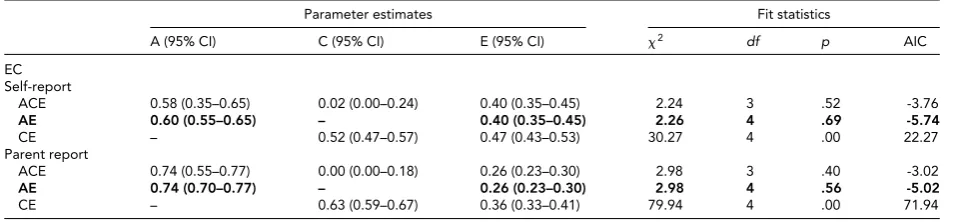
Standardized Estimate and Fit Statistics of Univariate Analysis of Effortful Control
Parameter estimates Fit statistics
A (95% CI) C (95% CI) E (95% CI) 2 df p AIC
EC Self-report
ACE 0.58 (0.35–0.65) 0.02 (0.00–0.24) 0.40 (0.35–0.45) 2.24 3 .52 -3.76
AE 0.60 (0.55–0.65) – 0.40 (0.35–0.45) 2.26 4 .69 -5.74
CE – 0.52 (0.47–0.57) 0.47 (0.43–0.53) 30.27 4 .00 22.27
Parent report
ACE 0.74 (0.55–0.77) 0.00 (0.00–0.18) 0.26 (0.23–0.30) 2.98 3 .40 -3.02
AE 0.74 (0.70–0.77) – 0.26 (0.23–0.30) 2.98 4 .56 -5.02
CE – 0.63 (0.59–0.67) 0.36 (0.33–0.41) 79.94 4 .00 71.94
Note: For self-reports, AE to ACE:2=0.02,df=1,p=.88; CE–ACE:2=28.03,df=1,p<.000.
For parent reports, AE to ACE:2=0.00,df=1,p=1; CE–ACE:2=76.96,df=1,p<.000.
Best models are denoted in bold.
variance of PIU explained by genetic, shared, and non-shared environmental influences could be calculated as a22 + a32, c22 + c32, e22 + e32. The portion of genetic
overlap between PIU and effortful control is calculated as a22/(a22 + a32). Similarly, c22/(c22 +c32) and e22/(e22 +
e32) denote the shared environment and non-shared
envi-ronment overlap between the two variables.
Structural equation models were conducted to fit twin correlations using the maximum-likelihood method in the statistical package Mx (Neale et al.,1999). In univariate genetic analysis, models were compared by estimating the differences in chi-square (2) values against the changes
in degrees of freedom (df). In the bivariate Cholesky de-composition model, standardized residuals of each vari-able were analyzed using the raw data option in Mx (Neale et al.,1999). We initially tested the full model and grad-ually dropped parameters to test the significance of each submodel. Models were evaluated using both -2 × log-likelihood values (-2LL) and Akaike’s Information Crite-rion (AIC); -2LLrepresents the difference between expected model and the observed data. If fixing a path to zero does not significantly deteriorate the full model, then this path has a non-significant contribution to the model and can be dropped. AIC weighs both model fit and parsimony with a lower AIC value indicating better fitting.
Results
Descriptive Statistics
Means and intraclass correlations of PIU and effortful con-trol are presented inTable 1. Boys scored significantly higher than girls in PIU (t=4.90,p<.001) but lower in effort-ful control (self-report:t=-2.85,p<.001; parent report:
t =-6.44,p< .001). Intraclass correlations in MZ twins were higher than in DZ twins for both PIU and effortful control, indicating that genetic factors might contribute to both variables.
The phenotypic correlation between effortful control and PIU was -0.33 for self-report (p<.01) and -0.21 for parent report (p<.01). After controlling for age and family SES, effortful control significantly predicted the severity of PIU (self-report: B=-0.27,=-0.32,t=-13.18,p<.001; parent report: B=-0.15,=-0.21,t=-7.99,p<.001).
Univariate Analysis
Standardized estimates and fit statistics of the univariate model for effortful control and PIU are presented inTables 2
TABLE 3
Standardized Estimate and Fit Statistics of Univariate Analysis of Problematic Internet Use for Different Sex
Boys Girls Fit statistics
A C E A C E
(95% CI) (95% CI) (95% CI) (95% CI) (95% CI) (95% CI) 2(df) p AIC
PIU
Model 1 Independent 0.66 0.00 0.34 0.43 0.15 0.42 2.21 (6) .90 -9.79 estimate (0.41–0.72) (0.00–0.23) (0.28–0.41) (0.13–0.64) (0.00–0.43) (0.36–0.50)
Model 2 Equal estimate 0.61 0.01 0.38 0.61 0.01 0.38 32.45 (9) .00 14.45 (0.39–0.67) (0.00–0.23) (0.33–0.43) (0.39–0.67) (0.00–0.23) (0.33–0.43)
Model 3 AE 0.66 – 0.34 0.58 – 0.42 3.05(8) .93 -12.95
(Compared with (0.58–0.72) (0.28–0.42) (0.51–0.65) (0.35–0.49) model 1)
Note: Model 2 to Model 1:2=30.24,df=3,p<.001; Model 3 to Model 1:2=0.84,df=2,p=.656.
Best models are denoted in bold.
TABLE 4
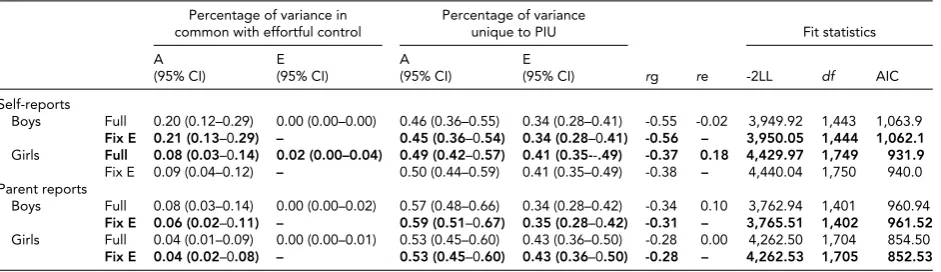
Parameter Estimates and Fit Statistics for the Bivariate Cholesky Model
Percentage of variance in Percentage of variance
common with effortful control unique to PIU Fit statistics
A E A E
(95% CI) (95% CI) (95% CI) (95% CI) rg re -2LL df AIC
Self-reports
Boys Full 0.20 (0.12–0.29) 0.00 (0.00–0.00) 0.46 (0.36–0.55) 0.34 (0.28–0.41) -0.55 -0.02 3,949.92 1,443 1,063.9 Fix E 0.21 (0.13–0.29) – 0.45 (0.36–0.54) 0.34 (0.28–0.41) -0.56 – 3,950.05 1,444 1,062.1 Girls Full 0.08 (0.03–0.14) 0.02 (0.00–0.04) 0.49 (0.42–0.57) 0.41 (0.35--.49) -0.37 0.18 4,429.97 1,749 931.9 Fix E 0.09 (0.04–0.12) – 0.50 (0.44–0.59) 0.41 (0.35–0.49) -0.38 – 4,440.04 1,750 940.0 Parent reports
Boys Full 0.08 (0.03–0.14) 0.00 (0.00–0.02) 0.57 (0.48–0.66) 0.34 (0.28–0.42) -0.34 0.10 3,762.94 1,401 960.94 Fix E 0.06 (0.02–0.11) – 0.59 (0.51–0.67) 0.35 (0.28–0.42) -0.31 – 3,765.51 1,402 961.52 Girls Full 0.04 (0.01–0.09) 0.00 (0.00–0.01) 0.53 (0.45–0.60) 0.43 (0.36–0.50) -0.28 0.00 4,262.50 1,704 854.50 Fix E 0.04 (0.02–0.08) – 0.53 (0.45–0.60) 0.43 (0.36–0.50) -0.28 – 4,262.53 1,705 852.53
Note: Self-report boys: Fix E-Full:2=0.07,df=1,p=.096; girls: Fix E-Full2=10.07,df=1,p=.002.
Parent report boys: Fix E-Full:2=2.58,df=1,p=.108; girls: Fix E-Full2=0.02,df=1,p=.884.
Best models are denoted in bold.
self-report and parent report indicated that the total vari-ances could be attributed to genetic and non-shared en-vironmental factors. The significance of shared environ-ment could be ignored. For both sexes, the heritability (i.e., the proportion of total variance due to genetic effects) for effortful control was 60–74%, with the rest attributed to non-shared environmental effects.
The same analysis was conducted for PIU, and the results are shown inTable 3. The equal model resulted in a signif-icant decrease in the model fit (2
(3)=30.24,p<.001)
when compared with the independent-estimated model. That is to say, a sex difference emerged in the etiology of PIU. Then a series of nested models gradually dropping A, C, and E components were fitted, and the results were com-pared with the results of the independent-estimate model to see whether genetic or environmental (shared and non-shared) factors could be eliminated. It turned out that the AE model with differing parameters between sexes was the best fitting model (2(2)=0.84,p=.66). For boys, genetic
effects accounted for the majority of the variance (66%), with the rest (34%) attributable to non-shared environ-mental variance. For girls, the heritability of PIU was 58%, slightly lower than that of boys, and the rest of the
vari-ance (42%) was attributed to non-shared environmental influences.
Bivariate Cholesky Decompositions
Cross-twin, cross-trait correlations were higher in MZ twins than in DZ twins for both boys and girls (rMZ= -0.33,
rDZ=-0.17 for boys;rMZ=-0.24,rDZ=-0.16 for girls,
correlation between effortful control and PIU wasrg= -0.56. Common genetic factors contributed to 21% of the to-tal variance of PIU, while specific genetic factors accounted for 45% of its total variance, with the rest attributed to specific non-shared environmental factors. For girls, both genetic and non-shared environmental correlation for ef-fortful control and PIU were significant (rg=-0.37 and
re = -0.18). Common genetic and common non-shared environmental factors together could explain 10% of the total variance of PIU, with the rest accounted for by spe-cific genetic and non-shared environmental factors. The bivariate Cholesky analysis using parent report confirmed this trend: The association between adolescents’ PIU and effortful control was almost fully mediated by common ge-netic influences, and this gege-netically mediated association was more substantial for boys than for girls.
Discussion
In this study, we utilized a twin design to examine how genetic and environmental factors affect adolescent PIU and its association with effortful control. The results pro-vide insight into the nature of individual differences in PIU among adolescents: PIU has a moderate to high heritabil-ity, with the remaining variance explained by non-shared environment. Furthermore, effortful control accounted for the modest portion of the genetic and non-shared environ-mental variance in PIU.
Consistent with previous studies, we also found signif-icant sex differences in PIU: boys presented with more symptoms of PIU than girls (Cao & Su,2007). Moreover, heritability was slightly higher and the magnitude of envi-ronment effects was much lower in boys than in girls. One possibility for this sex difference is that social norms (lower mean level of PIU in girls) restrict girls’ genetic propensi-ties to expression. This sex difference may also arise from some relatively stable personality traits and their underly-ing genetic neurobiological differences. A stronger impact of genetic effects on impulsivity, which is strongly related to PIU and other behavioral addictions, has been found in boys (Blanco et al.,2006). Similarly, a meta-analysis has revealed that males present more motivational responses captured by reward sensitivity, risk-taking, and sensation-seeking, which are associated with a higher risk of internet addiction for males than for females (Cross et al.,2011). From pre-adolescence to mid-adolescence, boys experience a more salient process of postnatal reduction of dopamine receptor density in striatum and prefrontal cortex than girls. This remodeling process may affect the dopamine activity in the reward circuitry, which would in turn result in an increase in reward-seeking (Sisk & Zehr,2005; Steinberg,
2008; Steinberg et al.,2008).
A significant overlap between genetic influences on PIU and effortful control implies that genetic influence on ado-lescent PIU may be partly due to the immature
neurobi-ological system underlying self-regulation and behavioral inhibition. As the dual system model (Steinberg, 2008) implies, reward-seeking behaviors common in adolescents may result from the different maturing time of two distinct neurobiological circuitries: the socio-emotional system and the cognitive control system. The socio-emotional system sits at the limbic and paralimbic area and arouses reward-seeking as the dopamine activity in this circuitry increases, while the cognitive control system is projected from the prefrontal cortex to other brain areas, and is responsible for the self-regulation process. The former system precedes the latter one in maturation, which may lead to increasing vulnerability of sensation-seeking during early- and mid-adolescence (Steinberg,2008).
In addition to genetic factors, non-shared environmen-tal effects also exerted a greater influence on adolescent PIU. The first and the most obvious environmental factor is accessibility to the internet. A great many studies have indicated that access to the internet is a risk factor for in-ternet overuse or addiction (Lin & Tsai,2002; Wang,2001; Yang & Tung,2007). As individuals grow from adolescence into early adulthood, they can afford to go to internet cafes and/or have their own internet-connected personal com-puters. Technical convenience, accompanied by inadequate self-control and other restrictions, exposes them to higher risk of PIU. Moreover, family factors, such as parent–child relationships and family functioning, also contribute to the risk of PIU. Prior studies have indicated that low family monitoring and high family conflict are two significant fac-tors for PIU. If the parent–child relationship deteriorates because of high family conflict, adolescents may turn to other resources, such as the internet, to seek warmth and support. On the other hand, low family monitoring may lead to fewer restrictions on the time adolescents spend on the internet (Liu & Kuo,2007; Yen et al.,2007). Another important environmental factor to consider is peer influ-ence. As individuals enter adolescence and early adulthood, peers can exert great influence on individuals’ opinions and behaviors, both directly and indirectly. Liu and Kuo (2007) have indicated that among college students, poor interper-sonal relationships may cause social anxiety and feelings of isolation, which in turn may prompt individuals to seek acceptance and support in the cyber world. As well, peer pressure and expectations may prompt adolescents to en-gage in a variety of activities that can promote the develop-ment of pathological drug and behavioral addictions (Kuss & Griffiths,2012).
improve their self-regulation and prevent them from be-coming addicted to internet (Yen et al.,2007). Results of the present study have both theoretical and practical impli-cations for PIU. To our knowledge, this is the first study to separate the effects of genetic and environmental influence on PIU and further investigate possible underlying mecha-nisms with core elements of self-regulation. Future research should pay more attention to both specific genes related to PIU (especially in boys) and specific environmental risks for PIU (especially in girls).
Several limitations should be mentioned. First, the mea-surement of PIU used in this study is a short version adapted specifically for adolescents; although its reliability has been estimated to be accepted, the validity has not been proven before. The results thus have to be explained cautiously due to the measuring instruments used. Second, the self-report questionnaire for both PIU and effortful control may be biased due to the risk of socially desirable responding. Another limitation is the cross-sectional design — in the current study, the sample age ranged from 10 to 21 years, and so it is not possible to reveal the longitudinal, dynamic trends of how genetic and environmental factors affect PIU and its association with effortful control. In addition, al-though significant gender differences were detected in the heritability of PIU and its association with effortful con-trol in the current study, the results should be interpreted with caution due to the relatively modest effects. Further replication of the gender differences is needed. Moreover, previous studies have revealed that adults are also likely to be addicted to the internet. Thus, to establish a full pic-ture of how genetic and environmental factors affect PIU through different developmental stages, longitudinal data across a relatively large age span is needed for future studies.
Conclusions
This study was designed to explore the source of individual differences in PIU, and whether effortful control is a source of these genetic and/or environmental variances. PIU was found to be affected by both genetic and non-shared envi-ronmental factors. As found in previous studies, PIU pre-sented significant sex difference: boys prepre-sented with more severe PIU symptoms than girls. Moreover, PIU in boys showed slightly higher heritability than in girls. This may be partly due to the genetic vulnerability to poor effortful control, which may result from the more salient underlying genetic and neurobiological process in boys, while for girls, specific genetic and non-shared environmental factors ex-erted a more crucial influence on PIU than those associated with effortful control.
Acknowledgments
This study was supported by the funds for young scholars of the Institute of Psychology, Chinese Academy of Science (Y0CX351S01), and the National Natural Science
Founda-tion of China (31170993, 91132728, and 31300841). This research was also supported by the Key Laboratory of Men-tal Health, Institute of Psychology, Chinese Academy of Sci-ences, and the BeTwiSt of Institute of Psychology, Chinese Academy of Sciences. Thanks to Professor Kirby Deater-Deckard from the Department of Psychology, Virginia Tech, for his suggestions and help in manuscript editing. The original principal investigator, Dr Xiaojia Ge, passed away during the course of this study and the authors dedicate this paper to his memory and for his great contribution in founding the BeTwiSt. We are also grateful to participating twin families and schools.
References
Beaver, K. M., Schutt, J. E., Boutwell, B. B., Ratchford, M., Roberts, K., & Barnes, J. C. (2009). Genetic and environ-mental influences on levels of self-control and delinquent peer affiliation results from a longitudinal sample of ado-lescent twins.Criminal Justice and Behavior,36, 41–60. Blanco, C., Hasin, D. S., Petry, N., Stinson, F. S., & Grant, B. F.
(2006). Sex differences in subclinical and DSM-IV patho-logical gambling: results from the National Epidemiologic Survey on Alcohol and Related Conditions.Psychological Medicine,36, 943–954.
Cao, F. L., & Su, L. Y. (2007). Internet addiction among Chinese adolescents: prevalence and psychological features.Child: Care, Health and Development,33, 275–281.
Cao, F., Su, L., Liu, T., & Gao, X. (2007). The relationship between impulsivity and Internet addiction in a sample of Chinese adolescents.European Psychiatry,22(7), 466–471. Chen, J., Li, X., Chen, Z., Yang, X., Zhang, J., Duan, Q., &
Ge, X. (2010). Optimization of zygosity determination by questionnaire and DNA genotyping in Chinese adolescent twins.Twin Research and Human Genetics,13, 194–200. Chen, J., Li, X., Zhang, J., Natsuaki, M. N., Leve, L. D., Harold,
G. T., . . . Ge, X. (2013). The Beijing Twin Study (BeTwiSt): A longitudinal study of child and adolescent development.
Twin Research & Human Genetics,16, 91–97.
Claes, L., M¨uller, A., Norr´e, J., Assche, L., Wonderlich, S., & Mitchell, J. E. (2012). The relationship among compul-sive buying, compulcompul-sive internet use and temperament in a sample of female patients with eating disorders.European Eating Disorders Review,20, 126–131.
Cross, C. P., Copping, L. T., & Campbell, A. (2011). Sex differ-ences in impulsivity: A meta-analysis.Psychological Bulletin,
137, 97–130.
Eisen, S. A., Lin, N., Lyons, M. J., Scherrer, J. F., Griffith, K., True, W. R., Goldberg, J., & Tsuang, M. T. (1998). Familial influences on gambling behavior: an analysis of 3359 twin pairs.Addiction,93, 1375–1384.
Eisenberg, N., Sadovsky, A., Spinrad, T. L., Fabes, R. A., Losoya, S. H., Valiente, C., . . . Shepard, S. A. (2005). The relations of problem behavior status to children’s negative emotion-ality, effortful control, and impulsivity: Concurrent rela-tions and prediction of change.Developmental Psychology,
Ellis, L. K., & Rothbart, M. K. (2001, April).Revision of the early adolescent temperament questionnaire. Poster presented at the Biennial Meeting of the Society for Research in Child Development. Minneapolis, MN.
Fu, K. W., Chan, W. S., Wong, P. W., & Yip, P. S. (2010). Internet addiction: Prevalence, discriminant validity and correlates among adolescents in Hong Kong.The British Journal of Psychiatry,196, 486–492.
Grolnick, W. S., & Ryan, R. M. (1989). Parent styles associated with children’s self-regulation and competence in school.
Journal of Educational Psychology,81, 143–154.
Hardie, E., & Tee, M. Y. (2007). Excessive internet use: The role of personality, loneliness and social support net-works in internet addiction.Australian Journal of Emerging Technologies & Society,5, 34–47.
Heiman, N., Stallings, M. C., Hofer, S. M., & Hewitt, J. K. (2003). Investigating age differences in the genetic and environmental structure of the tridimensional personal-ity questionnaire in later adulthood.Behavior Genetics,33, 171–180.
Jang, K. S., Hwang, S. Y., & Choi, J. Y. (2008). Internet addic-tion and psychiatric symptoms among Korean adolescents.
Journal of School Health,78, 165–171.
Kim, E. J., Namkoong, K., Ku, T., & Kim, S. J. (2008). The rela-tionship between online game addiction and aggression, self-control and narcissistic personality traits. European Psychiatry,23, 212–218.
Kim, K., Ryu, E., Chon, M. Y., Yeun, E. J., Choi, S. Y., Seo, J. S., & Nam, B. W. (2006). Internet addiction in Korean adoles-cents and its relation to depression and suicidal ideation: A questionnaire survey. International Journal of Nursing Studies,43, 185–192.
Kochanska, G., Murray, K. T., & Harlan, E. T. (2000). Effort-ful control in early childhood: Continuity and change, antecedents, and implications for social development.
Developmental Psychology,36, 220–232.
Koopmans, J. R., Boomsma, D. I., Heath, A. C., & van Doornen, L. J. (1995). A multivariate genetic analysis of sensation-seeking.Behavior Genetics,25, 349–356. Kuss, D. J., & Griffiths, M. D. (2012). Online gaming addiction
in children and adolescents: A review of empirical research.
Journal of Behavioral Addictions,1, 3–22.
Lee, Y. S., Han, D. H., Yang, K. C., Daniels, M. A., Na, C., Kee, B. S., & Renshaw, P. F. (2008). Depression like characteris-tics of 5HTTLPR polymorphism and temperament in ex-cessive internet users.Journal of Affective Disorders, 109, 165–169.
Lei, L., & Liu, M. (2005). The relationship of adolescents’ personality with their using social service of Internet.Acta Psychological Sinica.37, 797–802.
Lemery-Chalfant, K., Doelger, L., & Goldsmith, H. H. (2008). Genetic relations between effortful and attentional control and symptoms of psychopathology in middle childhood.
Infant and Child Development,17, 365–385.
Lengua, L. J. (2006). Growth in temperament and parenting as predictors of adjustment during children’s transition to adolescence.Developmental Psychology,42, 819–832.
Li, M. D., Cheng, R., Ma, J. Z., & Swan, G. E. (2003). A meta-analysis of estimated genetic and environmental ef-fects on smoking behavior in male and female adult twins.
Addiction,98, 23–31.
Li, D., Zhang, W., Li, X., Zhen, S., & Wang, Y. (2010). Stress-ful life events and problematic Internet use by adolescent females and males: A mediated moderation model. Com-puters in Human Behavior,26, 1199–1207.
Lin, S. S., & Tsai, C. C. (2002). Sensation-seeking and in-ternet dependence of Taiwanese high school adolescents.
Computers in Human Behavior,18, 411–426.
Liu, C. Y., & Kuo, F. Y. (2007). A study of internet addiction through the lens of the interpersonal theory. CyberPsychol-ogy & Behavior,10, 799–804.
McGue, M., & Bouchard Jr, T. J. (1984). Adjustment of twin data for the effects of age and sex.Behavior Genetics,14, 325–343.
Morahan-Martin, J., & Schumacher, P. (2000). Incidence and correlates of pathological internet use among college students.Computers in Human Behavior,16, 13–29. Neale, M. C., Boker, S. M., Xie, G., & Maes, H. M. (1999).
Statistical modeling. Richmond, VA: Department of Psychi-atry, Virginia Commonwealth University.
Neale, M., & Maes, H. (2001).Methodology for genetics studies of twins and families(6th ed.). Dordrecht: Kluwer. Ni, X., Yan, H., Chen, S., & Liu, Z. (2009). Factors influencing
internet addiction in a sample of freshmen university stu-dents in China.Cyberpsychology & Behavior,12, 327–330. Olson, S. L., Sameroff, A. J., Kerr, D. C., Lopez, N. L., &
Wellman, H. M. (2005). Developmental foundations of ex-ternalizing problems in young children: The role of effortful control.Development and Psychopathology,17, 25–45. Park, S. K., Kim, J. Y., & Cho, C. B. (2008). Prevalence of
Inter-net addiction and correlations with family factors among South Korean adolescents.Adolescence,43, 895–909. Potenza, M. N. (2006). Should addictive disorders include
non-substance-related conditions? Addiction, 101, 142– 151.
Rothbart, M. K., & Bates, J.E. (2006).Temperament. In W. Damon, R. Lerner, & N. Eisenberg (Eds.),Handbook of child psychology: Vol. 3. Social, emotional, and personality development(6th ed., pp. 99–166). New York: Wiley. Shaw, M., & Black, D. W. (2008). Internet addiction: definition,
assessment, epidemiology and clinical management.CNS Drugs,22, 353–365.
Siomos, K. E., Dafouli, E. D., Braimiotis, D. A., Mouzas, O. D., & Angelopoulos, N. V. (2008). Internet addiction among Greek adolescent students.CyberPsychology & Behavior,11, 653–657.
Sisk, C. L., & Zehr, J. L. (2005). Pubertal hormones organize the adolescent brain and behavior.Frontiers in neuroen-docrinology,26, 163–174.
Steinberg, L. (2008). A social neuroscience perspective on ado-lescent risk-taking.Developmental Review,28, 78–106. Steinberg, L., Albert, D., Cauffman, E., Banich, M., Graham, S.,
& Woolard, J. (2008). Age differences in sensation-seeking and impulsivity as indexed by behavior and self-report: Ev-idence for a dual systems model.Developmental Psychology,
44, 1764–1778.
Wang, W. (2001). Internet dependency and psychosocial ma-turity among college students. International Journal of Human-Computer Studies,55, 919–938.
Xian, H., Scherrer, J. F., Slutske, W. S., Shah, K. R., Volberg, R., & Eisen, S. A. (2007). Genetic and environmental con-tributions to pathological gambling symptoms in a 10-year follow-up.Twin Research and Human Genetics,10, 174–179. Xu, F., & Zhang, W. (2012). Relationship between adolescents’ alienation and pathological internet use: Testing the mod-erating effect of family functioning and peer acceptance.
Acta Psychological Sinica,43, 410–419.
Yamagata, S., Takahashi, Y., Kijima, N., Maekawa, H., Ono, Y., & Ando, J. (2005). Genetic and environmental etiology of effortful control.Twin Research and Human Genetics,8, 300–306.
Yang, S. C., & Tung, C. J. (2007). Comparison of internet ad-dicts and non-adad-dicts in Taiwanese high schools.Computers in Human Behavior,23, 79–96.
Yen, J. Y., Ko, C. H., Yen, C. F., Chen, S. H., Chung, W. L., & Chen, C. C. (2008). Psychiatric symptoms in adolescents with Internet addiction: Comparison with substance use.
Psychiatry and Clinical Neurosciences,62, 9–16.
Yen, J. Y., Ko, C. H., Yen, C. F., Wu, H. Y., & Yang, M. J. (2007). The comorbid psychiatric symptoms of Internet addiction: attention deficit and hyperactivity disorder (ADHD), de-pression, social phobia, and hostility.Journal of Adolescent Health,41, 93–98.
Yen, J. Y., Yen, C. F., Chen, C. C., Chen, S. H., & Ko, C. H. (2007). Family factors of internet addiction and substance use experience in Taiwanese adolescents.CyberPsychology & Behavior,10, 323–329.
Young, K. S. (1998a). Internet addiction: The emergence of a new clinical disorder.CyberPsychology & Behavior,1, 237– 244.