International Journal of Research (IJR)
e-ISSN: 2348-6848, p- ISSN: 2348-795X Volume 2, Issue 09, September 2015Available at http://internationaljournalofresearch.org
Fingerprint matching using sensor fabrication materials
P.Shashi Kiran
1&Dasari Manoj Reddy
21Department of ECE, MGIT, Email Id: - [email protected] 2Department of ECE, MGIT, Email Id: - [email protected]
Abstract
Elastic distortion of friction ridge skin is one of the major challenges in fingerprint matching. Since subsisting fingerprint matching systems cannot match solemnly distorted fingerprints, malefactors may intentionally distort their fingerprints to eschew identification. Subsisting distortion detection techniques require availability of specialized hardware or fingerprint video, constraining their utilization in authentic applications. In this paper we conduct a study on fingerprint distortion and develop an algorithm to detect fingerprint distortion from a single image which is captured utilizing traditional fingerprint sensing techniques. The detector is predicated on analyzing ridge period and orientation information. Promising results are obtained on a public domain fingerprint database containing distorted fingerprints.
Keywords: Fingerprint; minutiae; fake; matching; imaging sensors; fabrication materials
1. Introduction
Fingerprints have long been utilized for the identification of individuals for licit purposes. In an increasingly electronic society, automatic fingerprint apperception has become paramount as a highly precise method of identification of individuals for a range of commercial as well as civil regime purposes. Fingerprint apperception systems have been developed for many years, and perform very well in ideal circumstances, but quandaries remain with handling exceptional cases in particular, poor quality prints. Since an authentication system is as impuissant as its most impotent link, it is desirable to handle all prints without exception processing through some other technology. Much can be achieved by controlling the acquisition of the prints, but in some circumstances this is infeasible, or inadequate, and poor prints must be handled. This paper deals with the process of abstracting distortion from fingerprints to achieve the best match quality. The system can abstract distortion in
prints acquired as rolled or dabbed prints, scanned live or from ink on paper.
1.1 Minutia-predicated fingerprint matching:
A wide range of fingerprint matching algorithms subsist, utilizing a number of different techniques. The majority follow the long-established forensic procedures of minutia-matching. Minutia matching apperception algorithms seek to find recurrences of patterns of minutiae. Minutiae are associated with nearby geometric or topological features and a minutia from one print matches one in another print if the associated features are sufficiently homogeneous. If the minutiae of two fingerprints match well enough then the prints are deemed to be from the same finger.
International Journal of Research (IJR)
e-ISSN: 2348-6848, p- ISSN: 2348-795X Volume 2, Issue 09, September 2015Available at http://internationaljournalofresearch.org
These effects include the following: distortion due to elastic deformation of the finger; cuts and abrasions on the finger; dirt, oil or moisture on the finger or scanner; partial imaging of the finger tip; prints imaged with different rotations. Sundry techniques subsist to compensate for these quandaries, but this paper will concentrate on redressing for elastic distortion of the finger surface.
This quandary arises because of the intrinsically flexibility of the finger tips. Some elastic distortion will indispensably result as the skin of the finger is not a ruled surface. Consequently, pressing or rolling it against a flat surface induces distortions which vary from one impression to another. Such distortions result in relative translations of features when comparing one print with another. In extreme cases, signify cant distortions can be induced by applying a lateral force or torque while the finger is applied to the sensor or paper. A planar force will incline to compress or stretch the print, while a torque will induce relative rotations in the features.
There are two consequences of poor matching due to elastic deformation, depending on the deployment scenario of the fingerprint apperception system. In a cooperative scenario, where users wish to be identified, such as physical or electronic access control, consequential distortion will reduce the matching score and avert the utilizer from being apperceived. Failure to handle distortion will make the system frustrating for the unnecessarily repudiated users, or necessitate its operation with such a high mendacious accept rate that security is compromised. However, as users become utilized to the system, they will learn (or become conditioned) to minimize the distortion forces at capture time and the quandary should diminish. Utilizing an
unfamiliar scanner or capture configuration may well invalidate this acquired experience.
More earnest is the effect on a non-cooperative identification system, such as in driving license, voter registration or welfare situations. Here malevolent users may endeavor to evade being apperceived by the system (for instance when applying for a second drivers license under a mendacious name). Here the utilizer may deliberately endeavor to distort the fingerprint to obviate a match against their subsisting record. In this case, distortion is liable to be a consequential quandary and the utilizer may have every incentive to make it as astringent as possible.
To calculate the bifurcation angle, we use the advantage of the fact that termination and bifurcation are dual in nature. The termination in an image corresponds to the bifurcation in its negative image hence by applying the same set of rules to the negative image, we get the bifurcation angles. Figure 1 shows the original image and the extracted minutiae points. Square shape shows the position of termination and diamond shape shows the position of bifurcation as in figure 1 (b)
1.2 Methods for handling distortion:
International Journal of Research (IJR)
e-ISSN: 2348-6848, p- ISSN: 2348-795X Volume 2, Issue 09, September 2015Available at http://internationaljournalofresearch.org
conscientiously designing the fingerprint capture setting, for instance by guiding the finger to the capture surface with moldings around the scanner, the forces engendered during capture can be constrained, especially those engendered inadvertently. Of the proliferation of fingerprint scanners now commercially available, many have diminutive capture areas and physical guides which coalesce to constrain the distortion engendered by cooperative users.
As mentioned afore, as cooperative users are repudiated by the system they will learn (or can be trained) that minimizing distortion forces will avail them be apperceived. Providing visual feedback of the current image avails users to visually perceive when prints are impecunious and consequently avails this cognition. In the non-cooperative situation, such images might even be counterproductive. In this situation though, the capture can be supervised by a trained person who can observe the acquisition process and the resulting data, to ascertain that an undistorted print is acquired. However, distortions are not conspicuous either in the deportment of the person giving the print, or in the resultant data.
Police officers responsible for fingerprinting suspects receive special training in fingerprinting to enable them to make clean rolled ink prints with minimal distortion, even from non-cooperative subjects. Other methods to reduce fingerprint distortion have recently been proposed by Ratha et al. [1],[2]. The first is to quantify the forces and torques on the scanner directly and obviate capture when exorbitant force is applied. Naturally this requires specialized hardware to quantify the forces at capture time. The second method measures distortion in a video sequence of fingerprint images obtained as a finger is presented to the scanner.
When exorbitant distortion is optically discerned, the print can be abnegated and an incipient print requested. Here again there is a hardware requisite in the form of processor potency, since the live video victual from the scanner needs to be processed to quantify the distortion at the time of capture if distorted prints are to be repudiated when there is still an opportunity to capture another print. Both methods can be acclimated to optate the least distorted print from a capture sequence, though there are other criteria affecting the optimal cull of print, including image quality and area. All of these methods have the circumscription that once a print is acquired, nothing can be done about distortions in the data.
Immensely colossal legacy databases are in utilization, containing distorted prints which cannot benefit from these techniques. None of the techniques eschews distortion planarity. Each method just seeks to avert the acceptance of the most distorted data. To cope with the residual distortion error present in any fingerprint to some degree, fingerprint matchers have been designed to sanction for errors in the location and angle of minutiae. For instance, Ratha et al. [3] use tolerance boxes to sanction a minutia in one print to match a minutia falling anywhere within a tolerance region in the other print. Similarly Germaine al. [4] bins the parameters of their representation, coarsely quantizing to sanction robustness to distortion and quantification noise. However, these techniques reduce the precision of the match required and consequently have the circumscription of incrementing the probability of mistakenly believing that prints from two different fingers emanated from the same finger.
International Journal of Research (IJR)
e-ISSN: 2348-6848, p- ISSN: 2348-795X Volume 2, Issue 09, September 2015Available at http://internationaljournalofresearch.org
counting to alleviate quandaries of distortion. Here, for every dyad of minutiae under consideration, a count is composed of the number of ridges crossed by a straight line drawn between the minutiae. This quantification is sensitive to distortion only when the line passes proximate to other minutiae.
Kovacs-V ajna [5] additionally proposes a matching method that categorically takes into account distortion, demonstrating graphically the astronomically immense cumulative effects that can result from diminutive local distortions. The method uses tolerance bounds in inter-minutiae distances and angles to build up corresponding sets of minutiae that have the same geometry to within certain tolerance. Determinately Dynamic Time Warping is utilized to verify grey-level profiles along the inter-minutiae lines a technique cognate to ridge counting.
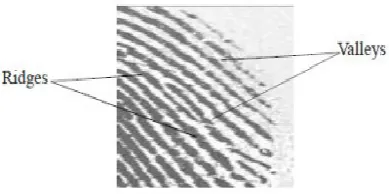
Fingerprint is an impression of the frictionridges of all or any part of the finger formed when a finger touches a surface. The ridges arerepresented by raised and dark portions while the valleys are the white and lowered regions asshown in Figure 2. Facts exist that the ridges of individual finger never change throughout his orher lifetime no matter what happens. Even in case of injury or mutilation, they will alwaysreappear within a short period. Five commonly found fingerprint patterns are arch, tented arch,left loop, right loop and whorl as presented in Figure 3.
Fig 2: Fingerprint Ridge and Valley.
Fig 3: Common Fingerprint Patterns.
2.
Related work
2.1 LITERATURE REVIEW
International Journal of Research (IJR)
e-ISSN: 2348-6848, p- ISSN: 2348-795X Volume 2, Issue 09, September 2015Available at http://internationaljournalofresearch.org
method is comparative to the best algorithms even though its performances may change when some information such as ridges, orientation and frequency images are not utilized.
The Euclidean space and ridge-predicated relative features among minutiae reinforce each other in the representation of a fingerprint. The authors in [6] proposed a novel algorithm predicated on ecumenical comprehensive homogeneous attribute with three phases. Firstly, a minutia-simplex that contains a dyad of minutiae as well as their associated textures was built to describe the Euclidean space-predicated relative features among minutiae. Its transformation-variant and invariant relative features were employed for the comprehensive kindred attribute quantification and parameter estimation respectively. Secondly, the ridge-predicated most proximate neighborhood among minutiae was acclimated to represent the ridge predicated relative features among minutiae. With this approach, minutiae were grouped according to their affinity with a ridge. Conclusively, the relationship between transformation and the comprehensive kindred attribute between two fingerprints was modeled in terms of histogram for initial parameter estimation. Experimental results show the efficacy and opportuneness of the method for inhibited recollection Automated Fingerprint Identification Systems (AFISs) owing to its very minimal template size.
Latent fingerprint identification is of critical consequentiality to law enforcement agencies in identifying suspects. They are inadvertent impressions left by fingers on surfaces of objects. While tremendous progress has been made in plain and rolled fingerprint matching, latent fingerprint matching perpetuates to be a conundrum. Poor quality of ridge impressions, diminutive finger area, and astronomically immense nonlinear distortion are the main
difficulties in latent fingerprint matching compared to plain or rolled fingerprint matching. A system for matching latent fingerprints found at malefaction scenes to rolled fingerprints enrolled in law enforcement databases has been proposed in [7]. Elongated features, including singularity, ridge quality map, ridge flow map, ridge wavelength map, and skeleton were utilized. The matching module consists of minutiae, orientation field and skeleton matching. The consequentiality of sundry elongated features was studied and the experimental results betoken that singularity, ridge quality map and ridge flow map are the most efficacious features in amending the matching precision. However, the proposed latent matching algorithm is still inferior to the performance of experienced latent examiners, which may be caused by the methodologies for matching ridge skeleton, minutiae and detailed ridge features. It may additionally be caused by difference in the approach to utilizing negative evidence.
International Journal of Research (IJR)
e-ISSN: 2348-6848, p- ISSN: 2348-795X Volume 2, Issue 09, September 2015Available at http://internationaljournalofresearch.org
Euclidean distance between the two corresponding Finger Codes. The experimental results show that the algorithm was profoundly expeditious with high verification precision which was only marginally inferior to the best results of minutiae-predicated algorithms presented in [9]. The proposed system performed better than state-of-the-art minutiae predicated system when the performance requisite of the application system does not authoritatively mandate a very low mendacious acceptance rate. The rudimental conception in several minutiae predicated techniques is connecting the neighbor minutiae with triangles utilizing a Delaunay triangulation and analyzing the relative position and orientation of the grouped minutiae. Even if rotations, translations and non-linear deformations are present, the obtained triangular structure does not transmute significantly, except where the feature extraction algorithm fails. That technique provides a good processing time, describes the minutia relationship with consistency and works well with the nonlinear distortions. However, for genuine match, the overlapping area between the matching fingerprints should be sizably voluminous.
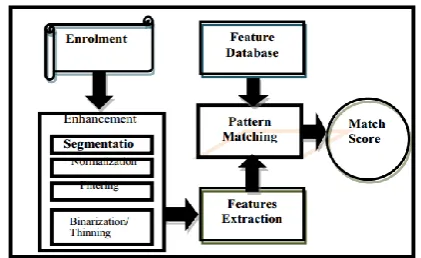
During minutiae-predicated fingerprint pattern matching, a match score between two fingerprints is computed predicated on the characteristics exhibited by the minutiae. Minutiae-based pattern matching is mostly utilized because forensic examiners have prosperously relied on minutiae to match fingerprints for a long period of time. Minutiae-predicated representation is storage efficient and expert testimony about suspect identity predicated on mated minutiae is admissible in courts of law [3].The latest trend in minutiae matching is to utilize local minutiae structures to expeditiously find a permissible alignment between two fingerprints and then consolidate the local matching results at an ecumenical
level. This kind of matching algorithm typically consists of the steps conceptualized in Figure 4.
Fig 4: A typical fingerprint pattern matching steps.
International Journal of Research (IJR)
e-ISSN: 2348-6848, p- ISSN: 2348-795X Volume 2, Issue 09, September 2015Available at http://internationaljournalofresearch.org
degree of match between the two fingerprints predicated on factors such as the number of matching minutiae, the percentage of matching minutiae in the overlapping area of the two fingerprints and the consistency of ridge count between the minutiae [3].
3.
Experimental Work
3.1 Matching results
In this section we present results for matching of fingerprints with and without distortion rectification. The matcher used is derived from that mentioned in Ratha et al. [3] which gives a kindred attribute score from 0 to 100 for pairs of prints. The experiment utilizes the image processing described in [3], which extracts ridges and minutiae. The minutiae from two
fingerprints are passed to the matcher resulting in a score. In the distortion-abstraction case, after calculating the distortion maps. The minutiae locations and angles are transformed with the inverse distortion transform. The transformed data are withal passed to the matcher to give a score. To assess the impact of the distortion abstraction on apperception, we calculate the scores for matching pairs of prints with and without distortion abstraction. The data used here consists of six sets of images, with each set containing five prints taken from a single finger. All the fingerprints are deliberately distorted by applying a lateral force as the finger comes in contact with the (glass) scanner surface. The distortions are all different. All pair-sagacious matches are made within each set.
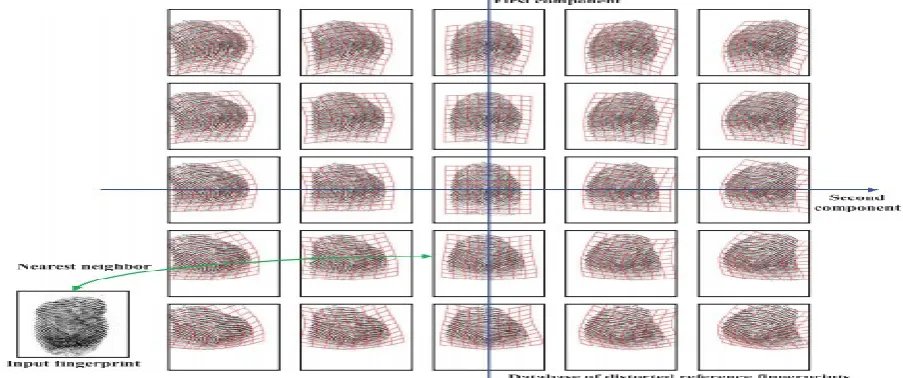
Fig 5: Fingerprint Input and output Structure.
International Journal of Research (IJR)
e-ISSN: 2348-6848, p- ISSN: 2348-795X Volume 2, Issue 09, September 2015Available at http://internationaljournalofresearch.org
Fig 6: The Receiver-operating curve for the distorted fingerprint set, with no distortion removal, and with 1-dimensional ‘ 9I“ ’ iJq’ i” F• distortion removal.
Table 1 shows the results of the experiments on thesmall dataset. The fourth column shows the average score
Table1: Transmutations in matcher performance when redressing for distortion, with and without adjusting minutia angles. Mean scores are presented for mated and non-mated pairs of prints (120 and 750 matches respectively). „Significance‟ is the – -statistic for the transmutation in paired matcher scores, for the mated and non-mated pairs. For
comparison, the tabulated values are -; f m F m¡ ¢m£7¤ and -; f@i m mF ] ¥œm¡ ¦7¤F¦ , exhibiting that the amelioration in mated pair scores is paramount, but the incrementation in non-mated pair scores is not. The mismatched column shows the scores when only one print in each match has distortion abstraction applied.
for mated pairs over 120 tribulations, with the fifth column exhibiting the consequentiality of the incrementation of distortion abstraction over the control. The § -statistic is utilized calculated on paired matching statistics. Similarly the vicissitude in non-mated pair scores is shown to be not paramount. The final two columns show that distortion redressing only one print in a match, with the unidimensional model does not harm the match precision. From the table, it can be visually perceived that the 1-dimensional distortion abstraction avails significantly with matching these distorted prints. Some pairs match less well, but the average match score increases. Figure 1 shows the receiver operating curve (Erroneous accept rate vs erroneous reject rate) for the minuscule data set, highlighting the
amendment in matching precision on distorted prints, and exhibiting that distortion abstraction on only one print avails matching precision.
International Journal of Research (IJR)
e-ISSN: 2348-6848, p- ISSN: 2348-795X Volume 2, Issue 09, September 2015Available at http://internationaljournalofresearch.org
To demonstrate that performance is not harmed when applied to undistorted prints, distortion abstraction was additionally carried out on all the dyads of prints from the NIST-4 database. These are ink rolled prints amassed professionally, with only an iota of distortion.
Here a frivolous amelioration in the match score is visually perceived by applying distortion abstraction to the prints. This is reflected in a marginal amelioration in the ROC as visually perceived in figure 2. Table 2 withal shows the nonessential effect of applying the technique to only one print in a dyad (which again results in a marginal amelioration in the ROC). This designates that the postulation on which the method is predicated is plausible i.e. the canonical print matches well with the true print. This has paramount implicative insinuations in practical implementations, categorically for utilizing open fingerprinting standards.
It is true that the features as translated by the distortion abstraction process are no longer the raw minutiae extracted by the pristine minutia extraction algorithm on its own and consequently can be considered an algorithm-concrete representation. They could thus be
International Journal of Research (IJR)
e-ISSN: 2348-6848, p- ISSN: 2348-795X Volume 2, Issue 09, September 2015Available at http://internationaljournalofresearch.org
4.
Conclusion
In this Paper we have proposed an incipient paradigm for handling distortion in fingerprints. Antecedent methods of dealing with distortion have sought to obviate distorted fingerprints from being captured or matched, or have sanctioned for distortion by incrementing tolerances which reduce the matcher precision. In contrast, we have designed a method which can authentically reduce distortion in anteriorly captured fingerprints, in an automatic, unsupervised manner, by exploiting a plausible posit about the undistorted fingerprint. The method has been demonstrated to amend matching scores significantly, with consequent amendment in precision.
5. References
[1] N. K. Ratha and R. M. Bolle, “Effect of controlled acquisition onfingerprint matching”, in Proceedings of the International Conferenceon Pattern Recognition, 1998, vol. II, pp. 1659–1661.
[2] ChitraDorai, NaliniRatha, and Ruud Bolle, “Detecting dynamic behavior in compressed fingerprint videos: Distortion”, in Proceedingsof Computer Vision and Pattern Recognition, June 2000, pp. 320–326.
[3] N. K. Ratha, K. Karu, S. Chen, and A. K. Jain, “A real-time matchingsystem for large fingerprint databases”, IEEE Transactions on Pattern Analysis and Machine Intelligence, vol. 18, no. 8, pp. 799–813,August 1996.
[4] R.S. Germain, A. Califano, and S. Colville, “Fingerprint matchingusing transformation parameter clustering”, IEEE Computational Science and Engineering, vol. 4, no. 4, pp. 42– 49, Oct-Dec 1997.
[5] Z.M. Kovacs-V ´ ajna, “A fingerprint verification system based on triangular matching and dynamic time warping”, IEEE Transactions onPattern Analysis and Machine Intelligence, vol. 22, no. 11, pp. 1266–1276, November 2000.
[6] Lawrence R. Thebaud, “Systems and methods with identity verification by comparison and interpretation of skin patterns such as fingerprints”, US Patent 5,909,501, June 1999.
[7] R.M. Bolle, N.K. Ratha, A. Senior, and S. Pankanti, “Minutia template exchange format”, in IEEE Workshop on Automatic Identification Advanced Technologies. October 1999, pp. 74–77, IEEE.