Geschke Center
Doctoral Dissertations Theses, Dissertations, Capstones and Projects
2015
Factors that Affect the Reading Comprehension of
Secondary Students with Disabilities
Karen L. Sanford
University of San Francisco, [email protected]
Follow this and additional works at:https://repository.usfca.edu/diss Part of theEducation Commons
This Dissertation is brought to you for free and open access by the Theses, Dissertations, Capstones and Projects at USF Scholarship: a digital repository @ Gleeson Library | Geschke Center. It has been accepted for inclusion in Doctoral Dissertations by an authorized administrator of USF Scholarship: a digital repository @ Gleeson Library | Geschke Center. For more information, please [email protected].
Recommended Citation
Sanford, Karen L., "Factors that Affect the Reading Comprehension of Secondary Students with Disabilities" (2015).Doctoral Dissertations. 125.
The University of San Francisco
FACTORS AFFECTING THE READING COMPREHENSION OF SECONDARY STUDENTS WITH DISABILITIES
A Dissertation Presented To
The Faculty of the School of Education Learning and Instruction Department
In Partial Fulfillment
of the Requirements for the Degree Doctor of Education
By
Karen L. Sanford San Francisco
THE UNIVERSITY OF SAN FRANCISCO
Dissertation Abstract
Factors that Affect the Reading Comprehension of Secondary Students with Disabilities
Thirty-million Americans are considered functionally illiterate and are unable to
complete job applications or understand health care forms. Fifty-seven percent of adults
with disabilities believe that job opportunities are limited due to their poor reading
ability. Without strong literacy skills, post-secondary college and employment options are
limited. The genesis of adult literacy issues can be linked to below-grade level reading at
the elementary and secondary school levels. For students with disabilities (SWD),
reading deficits are rampant and lead to low self-efficacy and higher drop-out rates.
While reading difficulties are not isolated to SWD, there is a significant gap in reading
achievement between students with and students without disabilities. Additionally, poor
academic outcomes for SWD are related to inconsistency in the application of teaching
reading strategies.
To understand the factors integral to reading comprehension, this study explored
the relative importance of working memory, vocabulary, prior knowledge, word
recognition, reading strategies, and motivation-to-read for the reading comprehension of
secondary SWD. These variables represent the major constructs of Kintsch’s
Construction Integration Model of reading and have been identified in reading
comprehension research as the factors integral to reading comprehension.
Participants were 158 SWD in grades 9 to 12 attending two large urban northern
California high schools. Multiple regression analyses were conducted with the affective
recognition, vocabulary, reading strategies, working memory, and prior knowledge were
found to influence the reading comprehension of secondary SWD. Of the
motivation-to-read factors, extrinsic motivation had a statistically significant negative relationship with
reading comprehension indicating that internally motivated students had higher reading
comprehension ability. Intrinsic motivation was also a significant contributor to reading
comprehension when the affective factors were regressed onto reading comprehension.
Differences in the relative importance of the cognitive components between low- and
high-comprehenders were also noted suggesting that high-comprehenders had more
internalized reading abilities than low-comprehenders.
The results from this study findings suggest a variety of cognitive and affective
factors influence the reading comprehension of secondary SWD. Knowing the relative
importance of these variables will help identify appropriate instruction to target key
reading deficits. Multi-sensory direct instruction in word recognition and vocabulary is
This dissertation, written under the direction of the candidate’s dissertation committee
and approved by the members of the committee, has been presented to and accepted by
the Faculty of the School of Education in partial fulfillment of the requirements of the
degree of Doctor of Education. The content and research methodologies presented in this
work represent the work of the candidate alone.
Karen L. Sanford May 13, 2015
Candidate Date
Dissertation Committee
Robert Burns, Ph. D. May 13, 2015
Committee Chair Date
Kevin Oh, Ph. D. May 13, 2015
Date
Helen Maniates, Ph. D. May 13, 2015
Dedication
The work herein is dedicated to the students and teachers I have had the pleasure
of working with for the past nine years. Every day I come to work, I am awed by the
resilience and eagerness my students express to learn to read. Through tears and laughter,
they strive to become stronger readers so that they will be able to have opportunities
when they graduate. Each and every one of them has learned that reading is the key to
their future and because of that they push themselves to overcome years of reading
failure.
This work is also dedicated to my colleagues who work diligently to make sure all
of their students can read. I have been blessed to work with a group of caring and creative
Acknowledgement
This work could not have been completed without the unwavering support of Dr.
Robert Burns, my committee chair. Dr. Burns was instrumental with this process from its
inception, and I am honored to have had his guidance and support. From my myriad
emails, to lengthy phone calls, to numerous revisions, Dr. Burns was patient in answering
all my questions and helping me turn this work into the best that it can be.
I would also like to thank my dissertation committee members, Drs. Kevin Oh
and Helen Maniates, who offered pointed insights, which helped perfect this work. The
faculty of the Learning and Instruction department at USF also deserves my unwavering
thanks for the countless hours they invested into my education and future. My heartfelt
thanks are also expressed to Dr. Yvonne Bui who was my committee chair, advisor, and
mentor during the last six years; without her assistance this work could not have been
completed.
Some believe it takes a village to raise a child, but I would like to posit that it also
takes a village to complete a large project like this as well. I could not have completed
this work without the support of the Elk Grove Unified School District. First, I would like
to express my thanks to Ms. Sylvia Brooks for her unfailing help in organizing students
and gathering data at my second school site. To the Resource Specialists at both school
sites, my appreciation is boundless. A special thank you is extended to Mr. Brad
Hemenway, Mr. Stephen Lee, and Mrs. Sarah McCleary for filling in when I was needed
elsewhere, helping assess students, and being available to do whatever was needed so I
school psychologist, Mr. Hung To, who tirelessly bounced ideas around with me,
explained psycho-educational testing and constructs, and helped administer tests.
Additionally, the principals at both school sites, Ms. Chelsea Bowler-Shelton and Ms.
Jana Durham, were gracious with their time and allowed me to use their school facilities
to test students. Their support of this project is an indication of their desire to ensure that
all students have the reading skills needed to be successful in their future endeavors.
Lastly, I could not have completed this project without the unwavering support of
my family. My parents, John and Betty, have always been my strongest supporters. They
have been in the trenches with me helping me organize, file, type, and be my general
“gophers.” I will always be grateful for their love and support. My children, David,
Lizzie, Adam, Vincent, Iris, and Deanna have sacrificed a lot of “mom” over the past two
years and, while those days can never be recovered, I am thankful that they have cheered
me on as I traveled this educational journey. Both my sister, Kathy, and my daughter,
Deanna, provided much-needed editing to ensure that my dissertation was readable.
Thank you one and all for your love and encouragement during the past six years; I could
TABLE OF CONTENTS
TABLE OF CONTENTS ...viii
LIST OF TABLES ...x
LIST OF FIGURES ...xii
CHAPTER ONE STATEMENT OF THE PROBLEM...1
Purpose of the Study ...7
Significance of the Study ...9
Theoretical Framework ...10
Background and Need ...19
Research Questions ...23
Definition of Terms...24
CHAPTER TWO LITERATURE REVIEW ...27
Working Memory...28
Vocabulary ...39
Prior Knowledge ...47
Word Recognition ...58
Reading Strategies ...72
Motivation-to-read ...82
Summary ...94
CHAPTER THREE METHODOLOGY ...104
Research Design...104
Sample...105
Protection of Human Subjects ...108
Instrumentation ...109
Procedure ...120
Preliminary Data Analysis ...129
Data Analysis ...134
CHAPTER FOUR RESULTS ...138
Research Question One ...139
Research Question Two ...141
Research Question Three ...144
Additional Exploratory Analyses ...148
Summary ...150
CHAPTER FIVE SUMMARY, LIMITATIONS, DISCUSSIONS, AND IMPLICATIONS ...153
Summary of Study ...153
Summary of Findings ...157
Limitations ...158
Discussion of Findings ...161
Implications for Research ...174
Implications for Practice ...177
Conclusions ...182
References ...185
Appendix A District Approval Letters ...197
Appendix B BADER Reading Inventory Test Instrument ...203
Appendix C Adolescent Motivation to Read Profile ...220
Appendix D Motivation to Read Questionnaire ...223
Appendix E IRB Approval Letter ...235
LIST OF TABLES
Table Page
1 Description of Major Reading Theories and Theorists, their Connection to
Reading Comprehension, and Key Construct(s) from each Theory... 96-7
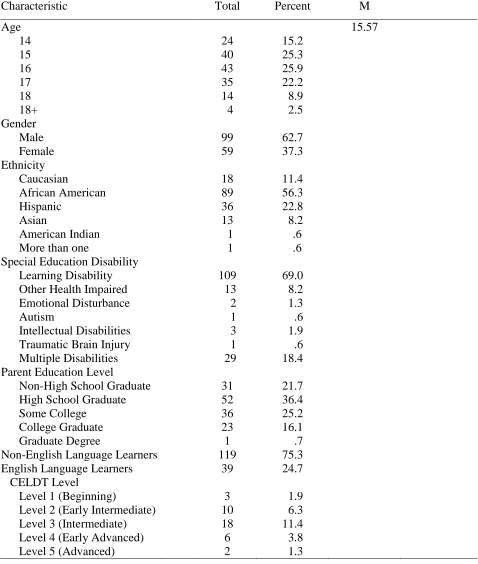
2 Demographic Characteristics of Participants in the Sample... 106
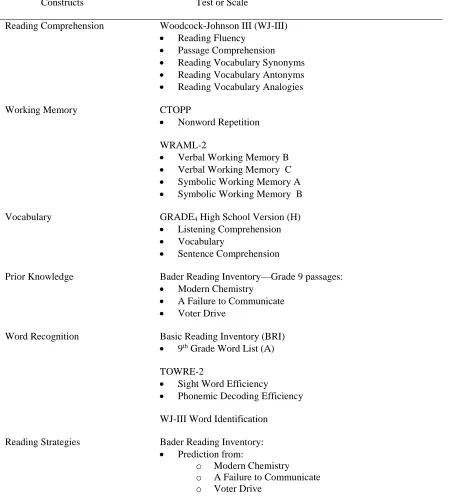
3 Instruments used to Measure Reading Comprehension, Working Memory,
Prior Knowledge, Word Recognition, Vocabulary, Reading Strategies,
Motivation-to-read, and General Knowledge... 110-1
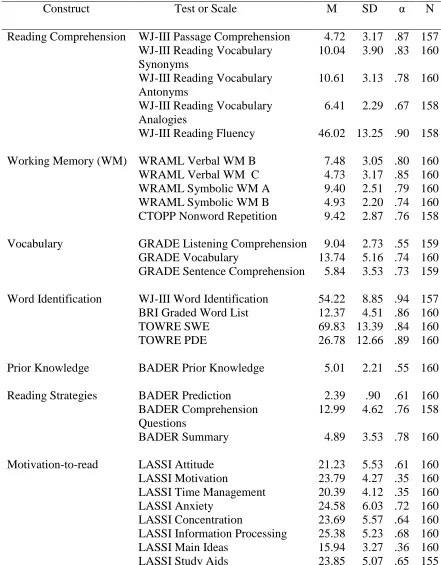
4 Means, Standard Deviations, Reliabilities, and Sample sizes for all Tests
Measuring the Seven Constructs... 121-2
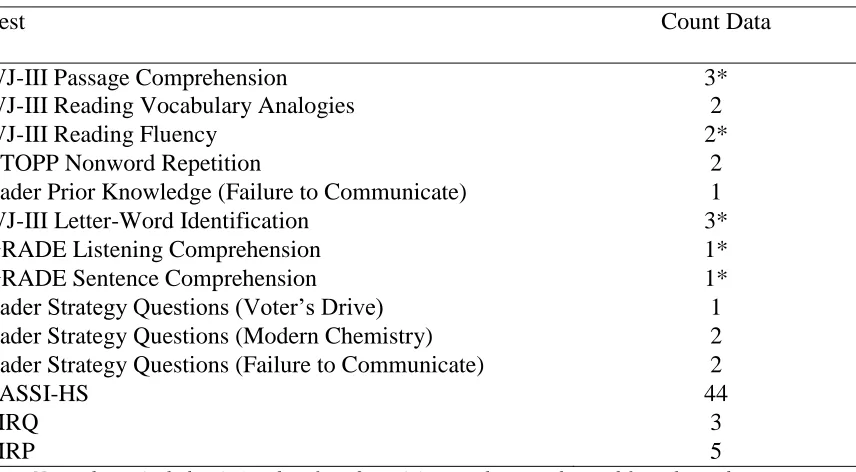
5 Count Variable data for Variables with Missing Data... 131
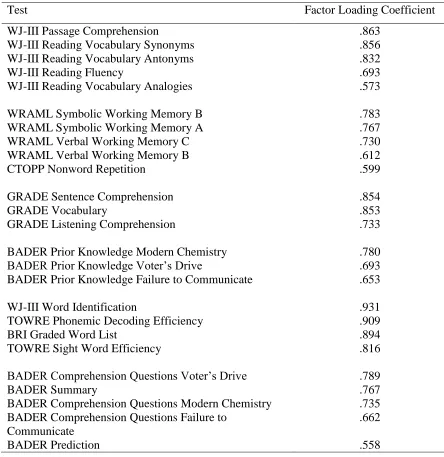
6 Factor Loadings from Principal Component Analysis with Varimax
Rotation of Cognitive Measures... 132
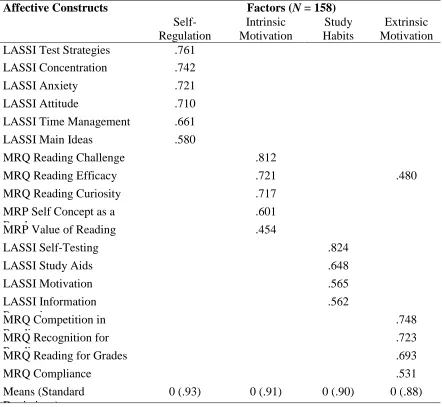
7 Factor Analysis of the 19 Affective Constructs from the LASSI, MRP, and
MRQ... 133
8 Cognitive Composite and Affective Factor Descriptors ………... 136-7
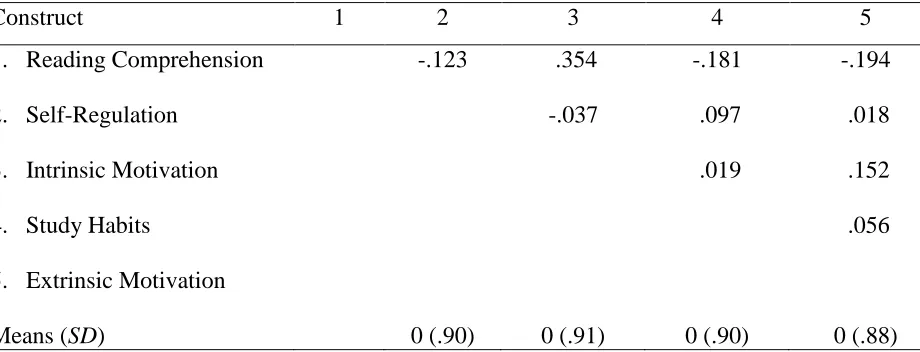
9 Intercorrelations, Means, Standard Deviations, and Significance between
Reading Comprehension, Self-Regulation, Intrinsic Motivation, Study
Habits, and Extrinsic Motivation... 140
10 Regression Model for Reading Comprehension and Predictor Variables of
Self-Regulation, Intrinsic Motivation, Study Habits, and Extrinsic
Motivation... 141
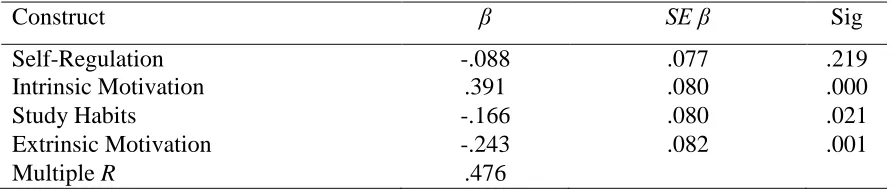
11 Beta Weights, Standard Errors, Statistical Significance, and the Multiple R from Regression of Reading Comprehension onto Self-Regulation,
Intrinsic Motivation, Study Habits, and Extrinsic Motivation... 141
12 Intercorrelations between Reading Comprehension, Working Memory,
Vocabulary, Prior Knowledge, Word Recognition, and Reading
13 Regression Model for Reading Comprehension and Predictor Variables of Working Memory, Vocabulary, Prior Knowledge, Word Recognition, and Reading Strategies... 143
14 Beta Weights, Standard Errors, and Statistical Significance from regression of Reading Comprehension onto Working Memory, Vocabulary, Prior Knowledge, Word Recognition, and Reading
Strategies... 144
15 Intercorrelations, Means, and Standard Deviations between Reading Comprehension, Working Memory, Vocabulary, Prior Knowledge, Word Recognition, Reading Strategies, Self-Regulation, Intrinsic Motivation,
Study Habits, and Extrinsic Motivation... 147
16 Regression Model for Reading Comprehension and Predictor Variables of Working Memory, Vocabulary, Prior Knowledge, Word Recognition, Reading Strategies, Self-Regulation, Intrinsic Motivation, Study Habits,
and Extrinsic Motivation... 148
17 Beta Weights, Standard Errors, and Statistical Significance from regression of Reading Comprehension onto Working Memory,
Vocabulary, Prior Knowledge, Word Recognition, Reading Strategies, Self-Regulation, Intrinsic Motivation, Study Habits, and Extrinsic
Motivation... 148
18 Beta Weights(β) from Regressing Reading Comprehension onto Working
Memory, Vocabulary, Prior Knowledge, Word Recognition, and Reading Strategies for All Students, Students with Learning Disabilities (LD) and Students without Learning Disabilities (non-LD), English Language Learners (EL), Non-English Language Learners (Non-EL), and Low
Comprehenders (below 45th percentile), and High Comprehenders (above
LIST OF FIGURES
Figure Page
1 The Reading Process based on the Construction-Integration Model………...12
CHAPTER ONE
STATEMENT OF THE PROBLEM
Reading difficulties are a major problem within the United States for both
children and adults. According to the National Association of Adult Literacy (NAAL), 30
million adults, aged 16 and above, need help to complete a job application (U.S.
Department of Education, 2003). Without strong literacy skills, post-secondary college
and employment options are limited. Lack of reading skills limits options for adults with
and without disabilities: 43% live in poverty, 50% have higher hospitalization rates due
to an inability to understand health information, and one in five is unable to access or use
the Internet (U.S. Department of Education, 2003). Poor literacy skills can also impact a
person’s perception of job opportunities. Fifty-seven percent of adults with disabilities
believe that job opportunities are limited due to their poor reading ability. Mellard and
Patterson (2008) reported that 50% of participants in their study with students with
learning disabilities earn less than $10,000 per year.
The genesis of adult literacy issues can be linked to below-grade level reading at
the elementary and secondary school levels. According to the National Assessment of
Educational Progress (NAEP), 29% and 20% of fourth- and eighth-grade students
without disabilities, respectively, scored below the basic reading level while 68% of
fourth-grade and 62% of eighth-grade students with disabilities (SWD) scored below the
basic reading level (NCES, 2011). While reading difficulties are not isolated to SWD,
without disabilities. In high school, 39% of students scored at the proficient level or
higher and 24% scored below basic on the NAEP (U.S. Department of Education, 2009).
Conversely, 64% of SWD (i.e., students who receive special education services) scored
below the basic reading level while only 10% scored at or above the proficient level.
Current reading research shows that several key factors impede a student’s
reading comprehension (National Reading Panel, 2000; Torgeson, 2002). One of the most
important is phonemic awareness, the ability to process the individual sounds of letters,
which is needed for word recognition. For instance, when a reader hears the word “bug,”
he must discriminate the three distinct phonemes within the word. The reader then blends
the sounds together to decode the word. Underdeveloped phonemic awareness and
phonics skills, as well as poor working memory, interfere with a student’s ability to read
words fluently (i.e., with automaticity), which is linked to reading comprehension deficits
(National Reading Panel, 2000; Torgeson, 2002). During a student’s first years in school,
reading instruction focuses on decoding and fluency, which require both strong phonemic
awareness and phonics skills according to the National Reading Panel’s (NRP) report of
2000. Further compounding these reading problems, the emphasis of reading instruction
shifts away from phonics instruction to reading comprehension around the third grade.
However, only a few studies focusing on secondary reading instruction were included by
the NRP as the main research focus centered on early identification of students at risk of
reading failure, evidence-based instruction, and the role of teachers in teaching reading. It
should be noted that since its release in 2000, this report has garnered criticism in how
effect sizes were computed and the subsequent recommendations made by the panel
Poor working memory is another factor that affects a student’s ability to read
proficiently and comprehend text (Alloway, Gathercole, Kirkwood, & Elliott, 2009;
Swanson, Kehler, & Jerman, 2009). Working memory allows a student to temporarily
store information in short-term memory while engaging in cognitive tasks. Thus, when a
student reads, he can activate prior knowledge about a topic or use context clues to
determine the meaning of a word while remembering what has just been read. Students
with disabilities often have low working memory capacities, which can negatively affect
reading comprehension. According to Swanson, Zheng, and Jerman (2009), students who
struggle to read are unable to retain ordered information which is directly related to
phonological retention processing. Retaining phonological information (i.e., blending
sounds within words, or segmenting multi-syllabic words), a task performed through
working memory, is essential to learning to read. Additionally, a direct relationship has
been found between working memory and learning, which Alloway, Gathercole,
Kirkwood, and Elliott (2009) posit is related to poor academic performance in both
reading and math.
Numerous cognitive processes are used when reading that aid comprehension.
Strong vocabulary skills are needed to aid a student’s ability to read proficiently (Taylor
et al., 2009). Unfortunately, as students struggle to read, they often avoid reading.
According to Cain and Oakhill (2011), reading influences vocabulary development;
however, when students do not read fluently or regularly, their vocabulary skills are
impacted. Additionally, Caccamise and Snyder (2005) reported that vocabulary
knowledge positively affects reading comprehension and academic performance. During
vocabulary base, students will struggle to understand what they have read; this problem is
compounded for SWD.
Another factor linked to reading difficulties is low prior knowledge (i.e., poor
general knowledge) and lack of breadth in vocabulary. Prior knowledge is directly linked
to reading comprehension and is a strong predictor of reading ability (Elbro &
Buch-Iversen, 2013). When a student lacks prior knowledge about a topic, reading
comprehension is impacted (Kintsch, 2013, Tarchi, 2010). Students who have a basic
understanding of what they are reading about can connect new information to what they
already know. Prior knowledge is formed through experience, by reading or hearing
about a topic, or through family customs. A student’s general cognitive ability is also a
contributor to prior knowledge. A student who reads, or who has been read to, is able to
access this knowledge when reading related topics, which can increase comprehension. It
is not known at this time, however, if there are mediating factors (e.g., working memory,
motivation, decoding) that might impede prior knowledge and impact reading
comprehension.
When students struggle to read, reading becomes amotivating and students avoid
reading. Reading comprehension is hindered when students lose interest and disengage
from reading (Guthrie, 2008). Many students begin to dislike reading because they
struggle to gain meaning from what they read. While research supports a strong
correlation between reading engagement and reading ability, students often do not read
well because they do not spend time reading. A cycle of reading apathy begins, which
makes it more challenging to support struggling readers (Bohn-Gettler & Rapp, 2011;
At the secondary level, if reading instruction is provided, the main focus is
teaching reading strategies such as summarizing and finding the main or key ideas to
improve student comprehension. Word recognition, which has been correlated to reading
comprehension, is not typically taught at the secondary level as it is presumed that
students have mastered this skill (Berkeley, Mastropieri, & Scruggs, 2011; Faggella-Luby
& Deshler, 2008; Watson, Gable, Gear, & Hughes, 2012). Additionally, the instructional
focus in high school is teaching standards-based curriculum, which is problematic for
SWD because they may not be able to access the curriculum content (i.e., read or
understand). To facilitate student learning, adaptions of the curriculum are needed, and a
focus on word recognition and reading strategies is necessary so that students can read
independently. Deshler et al. (2001) confirmed that two types of interventions are needed
at the secondary level to help students improve reading skills: (a) teaching that engages
students through interesting curriculum that is accessible to the learner, and (b) explicit
instruction of skills and strategies to access the curriculum. Secondary teachers are often
unsure how to teach students to improve deficient reading skills because they have not
been adequately trained in teaching reading strategies (Duchnowski, Kutash, Sheffield, &
Vaughn, 2006).
A gap also exists between reading research and the instructional practices of
special education teachers (Klingner, Urback, Golos, Brownell, & Menon, 2010). Poor
academic outcomes for SWD are related to inconsistency in the application of teaching
reading strategies. Reading comprehension is increased when strategies are explicitly
taught and used by the student during reading (Coyne et al., 2009; Duke & Pearson,
strategies alone may not be enough to improve the reading comprehension of SWD. In a
study over 30 years ago, teachers used a teaching model that included mentioning what
skill they should use while reading, practice of the skill (through worksheets/workbooks),
and assessment (Durkin, 1978). Notably missing was direct instruction on how to use the
skill. In their recent study, Klingner et al. (2010) noted very little has changed during the
past 30 years in the amount of reading comprehension instruction provided to SWD. It is
not known if teachers fail to provide this instruction because they do not know how or
what to instruct, but it is known that students need to use reading strategies to help them
understand what they read (Klingner et al., 2010).
While there are numerous reading strategies (e.g., visualization, talking to the
text), there are three reading strategies essential to reading comprehension:
summarization, prediction, and inference (Berkeley, Mastropieri, & Scruggs, 2011).
These strategies are crucial when reading, and if they are lacking, comprehension is
impacted. Students with disabilities are not often strategic readers. With the shift to the
Common Core State Standards (Shanahan, 2013), an emphasis of reading and
comprehending challenging texts will be placed on students with and without disabilities
(Shanahan, 2013). Critical reading will be paramount for students to make adequate
academic progress in school and on standardized tests.
Despite the large body of research on how to increase reading comprehension for
students with disabilities, there is no consensus on which factors influence students’
abilities to comprehend what they read or the relative importance of these factors.
Numerous theories (i.e., schema, auditory processing, socio-cultural, information
Richardson, et al., 2004; Allen, 2010) focus solely on improving word recognition skills
while others (Duke & Pearson, 2002; Sencibaugh, 2008; Coyne et al., 2009; McKeown,
Beck, & Blake, 2009) focus on building reading comprehension skills through reading
strategy instruction. However, no research has been undertaken on the influence working
memory, vocabulary, prior knowledge, word recognition, reading strategies, and
motivation-to-read on reading comprehension for secondary SWD. Without a clear
understanding of the relative importance of these factors’ influence on reading
comprehension, teachers are unsure of how to prioritize instruction to support students
(Deshler et al., 2001; Duchnowski, Kutash, Sheffield, & Vaughn, 2006; Kamil, 2003).
Purpose of the Study
The purpose of this study, then, was to examine the relative importance of
working memory, vocabulary, prior knowledge, word recognition, reading strategies, and
motivation-to-read to the reading comprehension of secondary students with disabilities.
Reading is a skill needed to be successful both in and out of school, and appropriate
reading instruction is essential to improve reading comprehension for SWD. To ensure
that instruction targets the skills that will improve reading comprehension, an
understanding of the relative importance of factors that improve reading comprehension
for secondary SWD is needed.
The study uses a multiple regression correlational design with reading
comprehension as the criterion variable. The independent variables are working memory,
vocabulary, prior knowledge, word recognition, reading strategies, and
motivation-to-read. The independent variables were chosen because they relate to the key components
Mastopieri, & Scruggs, 2011; Deshler, Hock, & Catts, 2006; Faggella-Luby & Deshler,
2008; Saenz & Fuchs, 2002) and Kintsch’s Construction-Integration model in particular.
These factors have particular relevance to students with disabilities because without a
clear understanding of which factor or factors are most important to reading
comprehension instructional methods may not address deficient skills.
Participants were chosen from a convenience sample among 350+ ninth to twelfth
grade students receiving special education services attending two comprehensive high
schools in a large urban school district. For the purposes of this study, participants were
those who had mild-to-moderate disabilities (i.e., specific learning disabilities, emotional
disturbance, other health impairment, emotional disturbance, autism, traumatic brain
injury, or specific language impairment).
Each construct in the study was operationally defined and assessed with multiple
measures so that each construct could be adequately measured. Data collection included a
combination of standardized tests (e.g., Woodcock-Johnson, 3rd edition),
curriculum-based measurement (e.g., reading strategies), rating scales (e.g., motivation-to-read), and
demographic data (e.g., student age, parent education, primary language). A combination
of existing scores for working memory, general math knowledge, and word recognition
already administered by the school psychologist or resource specialists and direct
administration of assessments was employed. If data were missing from the student’s
special education case file, those tests were individually administered by the researcher,
Significance of the Study
This study is important to the field of reading research for several reasons. First,
because reading is an essential life skill, post-secondary success for students with
disabilities hinges upon the ability to read. Whether these students attend college,
vocational training (e.g., mechanic schools, cooking school), or apply for jobs, they will
need to be proficient readers. It is widely accepted that reading is essential to provide a
strong academic base for students. (Lyon, Shaywitz, & Shaywtiz, 2003). Understanding
factors influencing reading comprehension is clearly important for tens of thousands of
poor readers.
There is a large body of research on the skills students need to learn to read;
however, the majority of current research focuses on elementary school students. The
amount of research on reading comprehension, while becoming more prevalent, still falls
behind that of teaching young children to read. For secondary students, far less research
is conducted, and research on factors that affect reading comprehension for students with
disabilities is negligible, and a consensus does not currently exist on which cognitive
factor/s have the most effect on reading comprehension (Berkeley, Mastopieri, &
Scruggs, 2011; Deshler, Hock, & Catts, 2006; Faggella-Luby & Deshler, 2008; Saenz &
Fuchs, 2002). Additionally, while motivation is one aspect to reading, fewer studies have
focused on the relative importance of affective factors to reading comprehension. Several
researchers, for example, Guthrie (2008), posit that a students’ motivation is integral to
reaching comprehension and achievement.
Lastly, very few studies have been conducted on the relationship of multiple
variables as this study. With the large number of adults who struggle to read, research
into the relative importance of factors that explain reading comprehension for secondary
students with disabilities is timely and important not only to high school students and
their teachers but to society as a whole. With a clearer understanding into the factors that
affect reading comprehension for secondary SWD, instructional programs can be
implemented that will target the specific skills needed to improve comprehension. To
realize this aim, teachers will also need to receive adequate professional training on how
to support older struggling learners.
Theoretical Framework
The research on reading comprehension is theoretically diverse, and difficult to
synthesize into a single framework. To provide a single framework for planning,
implementing and interpreting data, Kintsch’s Construction Integration (CI) model was
used. The CI model is a cognitive processing model that thoroughly describes how
readers comprehend, and is one of the most highly cited comprehension models (Deshler,
Hock, & Catts, 2006). The theory identifies both cognitive and affective processes that
affect reading comprehension and, while the theory itself will not be tested in this study,
the model will be applied and extended by testing the relative importance of the factors
since Kintsch does not rank them. Additionally, motivation-to-read was further explained
through Guthrie’s Engagement Model of Reading (Guthrie, 2008).
The fact that this study will not test Kintsch’s (1988) model directly does not
negate the use of the CI model as the framework for this study. The motivation for this
study is to test a variety of key constructs and variables posited in reading literature as
of these key constructs and variables are most important, which is why the Kintsch model
was not tested directly. Kintsch's CI model is useful as a framework for this study
precisely because it is comprehensive and includes most of the variables identified in the
literature. The model, however, is a cognitive processing model, studied by cognitive
psychologists using methods consistent with such models like latent semantic analysis.
This study is primarily a statistical model designed to measure and rank order factors
thought to contribute to reading comprehension.
Kintsch and van Dijk first developed their theory of text comprehension in 1978,
later expanded in 1983, that describes the cognitive and linguistic processes involved in
reading. The model describes three sets of operations a reader uses to process text, which
are sometimes rendered simultaneously and at other times sequentially. The first
operation looks at the semantic structure of text, which is organized into a coherent
whole. Some elements are processed more than once, which can affect text retention as
the reader may forget what was previously processed. The second operation is when a
reader condenses text meaning into its “gist” or main ideas. Lastly, readers generate new
text by summarizing text into their own words or ideas. The model applies to both
reading and listening comprehension as the same processes can occur during either
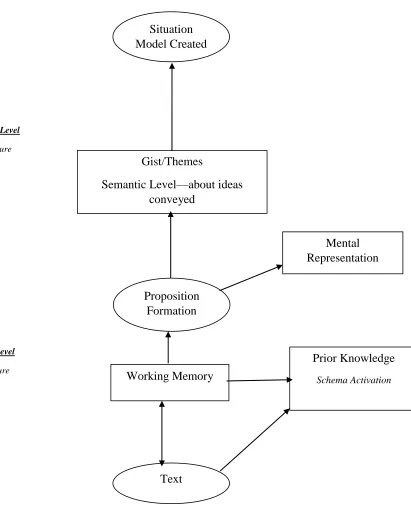
action. Figure 1 shows one conceptualization of Kintsch’s model. It should be noted that,
according to Kintsch, the creation of a situation model may occur at various times
throughout the reading process, which should not be interpreted in a hierarchical manner
Figure 1
The Reading Process based on the Construction-Integration Model
Integration Level
Conceptual Level
Macrostructure
Linguistic Level
Microstructure
Text Working Memory
Prior Knowledge
Schema Activation Proposition
Formation Gist/Themes
Semantic Level—about ideas conveyed
Mental Representation Situation
The semantic structure of discourse, or text, has two levels: the microstructure and
macrostructure. According to the theory, during the initial reading process, a reader looks
at the surface structure, or words on a page, of the text, which can be broken down into
propositions (i.e., idea units or concepts) that are connected to subsequent propositions.
This process happens at the microlevel. Some of the relationships between propositions
are explicitly stated while others are inferred as the reader interprets the text by activating
their prior knowledge of the topic. At the macrolevel, the reader condenses the text into
its salient parts and focuses on the gist of the text. This process requires the reader to
activate current content knowledge as well as make inferences if the meaning is not
implicit.
It should be noted that Kintsch and van Dijk’s model refers to readers who have
automatized word recognition, but they posit that their model does have implications for
readers who have difficulty decoding text. If the text is difficult for the reader, then he or
she will have to work harder to comprehend, which impacts comprehension and strains
working memory.
The CI model employs both bottom-up and top-down cognitive processes to
comprehend text, which are needed for perception, problem solving, and comprehension.
The interaction between these two processes is what fosters comprehension. The initial
stages of reading activate the bottom-up processes when a reader looks at the sensory
input or words on the page and decodes them. After decoding the words, a reader relies
upon lexical knowledge to understand what each word means (Taylor, Mraz, Nichols,
Rickelman, & Wood, 2009). For instance, the word “bank” may convey several
something, typically in a row as in a row of elevators. In each of these instances, the
reader not only reads the word, but must quickly access his knowledge about the word
and apply the correct meaning to the current context (Kintsch, 2013). When reading a
challenging text, one where a reader struggles to decode or define words, the reader
engages in problem solving through either top-down or bottom-up processes to
understand what is being read.
Top-down processes are engaged after words have been decoded, which requires
activation of prior knowledge of the words themselves or the concepts they represent.
Both of these processes are integral to reading comprehension and require both
perception to identify words and analysis of the semantic structure of the text. For
instance, in the sentence: Janet helped Laura to buy a coat, the reader looks for
propositions (a bottom-up process) that might have multiple meanings (e.g., buy also
means purchase). Prior knowledge, vocabulary, and the reader’s experience are engaged
(a top-down process) to help the reader determine appropriate meaning of the word and
context. Schema activation only considers the correct meaning of the word while using
context allows the reader to eliminate incorrect meanings. For typical readers, this
process is effortless. According to Kintsch, this process should be automatic and
seamless. When it is not, students will struggle to comprehend what they have read.
For students with disabilities, reading comprehension requires ongoing problem
solving during reading, which taxes working memory and can frustrate the reader.
Research has shown that many students with disabilities have inaccurate word
recognition and decoding skills, which can also impact reading comprehension (Allen,
2003). Word recognition requires the reader to look at visual stimuli and perceive what it
says based on the phonemes within the word. Kintsch states word length may also impact
a reader’s ability to read and comprehend the text. Non-proficient readers often struggle
to read single-syllable words, and as multi-syllabic words are introduced the struggle
increases. All these factors may singularly, or in combination, impact reading
comprehension.
Context, which acts as a filter that allows the reader to sift through appropriate
word meanings that fit the context while restraining meanings that do not fit, is another
factor that affects reading comprehension. Inference is actively engaged during these
analytical processes (i.e., bottom up and top down) to allow the reader to use general and
prior knowledge to aid comprehension. Macro-operators allow the reader to understand
the gist, and, lastly, the reader uses spatial imagery to imagine what something is like
when given a verbal description. These cognitive processes require the reader to
continually monitor and analyze as they read.
Students use a variety of reading strategies to analyze and comprehend what they
are reading, which include summarization, inference, and prediction. Reading strategies
allow struggling readers to actively engage with the text and aid in comprehension
(Fritschmann, Deshler, & Schumaker, 2007; Swanson, Edmonds, Hairrell, Vaughn, &
Simmons, 2011). Kintsch (1994) asserts that to understand text, a reader uses information
in novel ways, and they also summarize and make inferences from the text. For instance,
when reading a historical biography, a student could relate the experiences of the author
to the present day indicating an understanding of the similarity between both settings.
ability to make inferences about what was read) (Kintsch, 1994). When reading strategies
are used consistently by readers, reading comprehension improves (Antoniou &
Souvignier, 2007).
During reading, words and phrases are encoded allowing the reader to make
perceptual, verbal, and semantic mental representations about what he reads. Kintsch
(2013) asserts that to comprehend text, a reader needs to create a mental representation of
what was read, which is dependent upon the goals, interests, and experience of the reader,
and based upon the reader’s lexical and background knowledge. One type of mental
representation is the situation model. Kintsch describes the situation model as a
mechanism that connects a reader’s prior knowledge to new knowledge, and it allows the
reader to create a mental representation of the situation described in the text. Since a
reader’s prior knowledge is used to create the situation model, a reader is able to retrieve
the information from long-term memory to use in new situations enabling deep
understanding (Kintsch, 2005).
Struggling readers often become disengaged, which impedes their ability to create
a situation model, and therefore, inhibits comprehension. While Kintsch acknowledges
that reader motivation is another aspect of reading comprehension, others have provided
a more thorough understanding of the affect of student motivation on reading.
Guthrie, for example, states that reading is linked to motivation; in fact, he states
that reading interest is a predictor of reading comprehension (2008). Reading
engagement, which is driven by a student’s intrinsic motivation-to-read, has been
positively linked to academic achievement. In 2003, a survey of students in grade 12
that they do not read for school on a daily basis, 69% stated they almost never read for
enjoyment, and 66% stated that reading is not a favorite activity. An international study
conducted in 2000, polled 15 year-old students who were asked to quantify how much
time they spent reading for enjoyment, the types of materials they read, and their interest
in reading. Of all the students polled, those from the United States were ranked 24 out of
28 countries on student’s engagement and motivation-to-read indicating that students in
the United States, on average, do not read for pleasure compared to other countries in the
world. Since learning is a process that requires active engagement, without some interest
in the topic, it is difficult for the learner to remain focused long enough to learn.
For SWD, lack of motivation-to-read is often based on poor reading ability
(Melekoglu & Wilkerson, 2013). The issue of motivation is compounded for secondary
students who are required to read a variety of expository content (i.e., science social
studies), and coupled with these reading demands, secondary students lose interest in
improving their reading. However, the cyclical relationship between motivation and
reading ability is challenging for teachers of secondary students. As reading ability
improves, Melekoglu and Wilkerson (2013) posit, so too will motivation to read.
Additionally, as reading skills improved, positive feelings toward reading increased,
which in turn enhanced students’ self-concept as reader. Therefore, secondary students
require an increase in basic reading skills before a boost in reading motivation can occur.
Kintsch and Kintsch (2005) note that there are both learner and text factors that
impede reading comprehension, which teachers can mitigate by teaching reading
strategies. For instance, using descriptive words to help students form mental
have read in their own words. Teaching students to monitor their own understanding as
they are reading is another strategy that can aid comprehension. Further they assert that
text complexity also may impede a student’s understanding. Text that is easy to read and
very explicit does not require the reader to form mental representations or situation
models where they connect what they read to prior knowledge and therefore the reader
does not have a deep understanding of the content (Kintsch & Kintsch, 2005). For SWD,
with poor decoding skills, comprehension becomes even more problematic. Reading
becomes an endeavor of problem solving where the reader must spend energy in reading
words which impedes activation of prior knowledge and adversely affects motivation.
Kintsch’s CI model provides a basis to the study because it identifies key
variables needed to successfully comprehend text. These key variables (i.e., working
memory, vocabulary, prior knowledge, word recognition, reading strategies, and
motivation-to-read) will be examined in this study to identify the hierarchical
relationships between them, which has practical implications for the reading
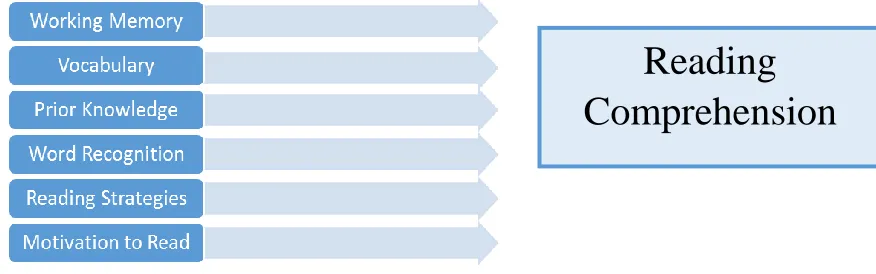
comprehension of secondary SWD. In summary, the CI Model of Reading is a cognitive
processing model, which is a conceptual model of how reading comprehension occurs.
The present study will use a statistical model to determine the relative importance of a
variety of cognitive and affective factors to explain reading comprehension (see Figure
2). While this study will not test Kintsch’s model directly, it will test the linkages
Figure 2
Predictor Variables and Dependent Variable of the Study
Background and Need
The number of children affected with reading deficits varies depending upon the
sample. The NICHHD conducted research during the past 30 years with over 34,000
children and found that approximately 20% have significant reading disabilities. During
annual standardized assessments to quantify the progress of American school children in
various content areas, the United States Department of Education revealed that America’s
school children read significantly below the expected proficient level. According to
recent assessment results, school children in grades 4, 8, and 12 have not reached reading
proficiency (National Center of Educational Statistics, 2009).
NCES (2009) results revealed that only 39% of 12th-grade students without
disabilities read at or above the proficient level, and only 10% of students with
disabilities read at this same level. Many secondary students with disabilities read
markedly below grade level (i.e., three or more years behind their peers), which impacts
their current and future academic progress as well as employment options (National
Institute for Literacy, 2010; U.S. Department of Education, 2003). Secondary students
who are non-proficient readers are unable to read the core curriculum thereby interfering
Reading
with content knowledge acquisition. Lack of content knowledge transcends the classroom
and negatively impacts standardized tests scores of both state standards and high school
exit exams (Fritschmann, Deshler, & Schumaker, 2007).
According to the California Department of Education, approximately 83% of 10th
grade students without disabilities who took the California High School Exit Exam in
2013 passed it compared to 40% of 10th grade students with disabilities. These reading
difficulties transcend high school and persist into adulthood where the median age of
adults who enroll in adult literacy programs is 31 years with the majority between the
ages of 16 and 24 years (Mellard & Patterson, 2008).
Compounding these deficits, secondary students infrequently use word analysis
strategies and rely heavily on visual memory or context clues to comprehend (Applegate
et al., 2009; Archer et al., 2003; Moats, 2001). At the same time students fail to use
reading strategies which can help aid reading comprehension (Jitendra & Gajria, 2011).
Denton et al. (2011) posit that reading instruction for secondary students with reading
deficits requires teaching in word analysis and reading comprehension that would include
instruction in reading strategies to increase reading comprehension.
Reading comprehension has also been shown to improve when students have an
expansive understanding of words—both functional and content-area vocabulary (Kamil,
et al., 2008; Kintsch & Mangalath, 2011). Reading requires students to read fluently as
well as understand the meaning of words. If either of these skills are lacking,
comprehension diminishes. There is strong evidence to support explicit vocabulary
instruction as a means to increase reading comprehension, which is needed in all
words before they are able to understand what they mean (Ebbers & Denton, 2008).
Many students with disabilities tend to shy away from reading, which exacerbates this
problem.
To improve reading, students not only need to read, but they also need to believe
that they have the reading ability that will allow them to understand what they have read
(Berkeley, Mastropieri, & Scruggs, 2011; Bohn-Gettler & Rapp, 2011; Deshler, Hock, &
Catts, 2006). Struggling readers, however, often do not read for pleasure and avoid
reading whenever possible. This problem hinders reading improvement and causes an
ever-widening gap in reading achievement between students who read for pleasure and
those who do not (Guthrie & Wigfield, 2000; Guthrie, 2008; Solheim, 2011).
Reading failure is not a new phenomenon, and research into the complexity of
reading has been ongoing for many years (Cattell, 1886; Snow, Burns, & Griffin, 1998;
Thorndike, 1917; Watson, Gable, Gear, & Hughes, 2012). These early researchers
acknowledged the complexity of reading and sought to understand the different processes
involved in reading. Cattell (1886), for instance, looked at the amount of time it took a
reader to recognize stimuli (i.e., letters in a revolving drum) as a means of understanding
the mental processes involved in reading.
In 1917, Edward Thorndike noted that “reading is a very elaborate procedure” (p.
323). His assertions are no less true today. Reading requires the ability to decode words
or phrases and make meaning from those individual words and phrases. This process
requires explicit instruction, practice, feedback from the teacher, and more practice to
become a proficient reader. Prior to Thorndike’s assertions about the reading process, Dr.
unable to read. Earlier researchers (i.e., Dejerne, 1891) made connections between lack of
reading ability and the brain (Lyon et al., 2003). In 1925, physician Samuel Orton began
working with children who could not read. At the time, the students’ teachers indicated
that the children were “retarded” because they were unable to read. Orton conducted
extensive research in the areas of learning disabilities and dyslexia, a neurobiological
disorder that impacts accurate and fluent word recognition and spelling. These deficits
also impact reading comprehension (Allen, 2010).
Beyond these early efforts, the National Institute of Child Health and Human
Development (NICHHD) conducted research beginning in the 1960s to find out why
America’s children struggle to read. Specifically, they sought to uncover: (a) How
children learn to read? (b) Why some children and adults are unable to learn to read? (c)
What instructional practices should be used to help children learn to read? The results
from a longitudinal study, which consisted of 41 research sites throughout the United
States, were released in 1994. Several key factors were revealed, which include: (a)
reading is not a natural process, (b) phonological processing (i.e., phonemic awareness) is
an essential skill needed to read, (c) accurate, fluent, automatic decoding is essential to
fluent reading, and (d) laborious decoding over-utilizes memory stores and undermines
reading comprehension. Some key factors were found to be essential to the reading
process: activating background knowledge, vocabulary, summarizing, predicting, and
clarifying, and appropriate instruction and reading practice (Lyon, 1999).
The field of reading has expanded over the past forty years. In 1997, Congress
commissioned key researchers in the field of reading (e.g., Marilyn Adams, Sally
including the effectiveness of various approaches of teaching children to read” (National
Reading Panel [NRP], p. 1-1, 2000). This report became an essential tool for instructional
practices in American schools. While this report is cited extensively on the constructs
needed to teach reading (i.e., phonemic awareness, phonics, fluency, vocabulary, and
comprehension), the challenges of learning to read were not first identified in this report
(Duke & Pearson, 2002; Torgeson, 2002; Camilli & Wolfe, 2004).
Much of the research on reading comprehension has at most looked at several of
the six variables included in this study, which is the main reason for the design of this
current study. However one study, Swanson and Ashbaker (2000), suggests that both
working and short term memory contribute unique variance to both reading
comprehension and word recognition.
While the similarities in the Swanson and Ashbaker study included similar
variables (i.e., WM, reading comprehension, word recognition), inclusion of secondary
SWD, and regression analyses (albeit hierarchical versus multiple regression), there are
also several differences. Specifically, there are three additional cognitive variables in the
current study (i.e., vocabulary, prior knowledge, and reading strategies) and the inclusion
of an affective variable (i.e., motivation to read). No other studies were found that
included these specific variables, which supports the need for the present study.
Research Questions
The study will address the following research questions:
1. What is the relative importance of motivation-to-read to the reading comprehension of
2. What is the relative importance of working memory, vocabulary, prior knowledge,
word recognition, and reading strategies to the reading comprehension for secondary
students with disabilities?
3. What is the relative importance of working memory, vocabulary, prior knowledge,
word recognition, reading strategies, and motivation to the reading comprehension for
secondary students with disabilities?
Definition of Terms
Auditory Processing Disorder is a disorder that makes discriminating auditory stimuli
difficult. A person with an auditory processing disorder may struggle to process
information presented aurally, have poor memory skills, or have difficulty with reading,
comprehension, spelling, and vocabulary (NIDCD, 2004).
Learning Disability is a general term used to describe disorders that cause difficulties for
a person to “…acquire and use listening, speaking, reading, writing, reasoning and
mathematics abilities, or of social skills.” (Birsh, 2011). Learning disabilities are unique
to each individual and are due to variations in how a person’s brain processes information
(NICHCY, 2011).
Phonemic Awareness is the ability to aurally recognize and manipulate phonemes, which
are the smallest units of sound within words (i.e., /c/, /a/, /t/ together make the word
“cat”). Students must rapidly manipulate these sounds, which will allow students to
apply this knowledge when they begin phonics instruction. Phonemic awareness is the
first and most important aspect of reading acquisition (Uhry, 2002).
Phonics is the association between letter sounds-symbols. To read fluently, students must
Prior Knowledge is defined as a student’s content knowledge related to the domain (i.e.,
math, science, and social studies) studied prior to direct instruction from the teacher
(Gurlitt & Renkl, 2010).
Reading Comprehension is the ability to gain meaning from what is read. Reading
comprehension requires various reading skills (i.e., word recognition, fluency, lexical
knowledge, pre-existing knowledge) to be undertaken rapidly so that the reader may gain
knowledge from text (Pressley, 2000; Birsch, 2011).
Reading Disability often synonymously used with dyslexia. According to the
International Dyslexia Association (2002):
Dyslexiais a specific learning disability that is neurological in origin. It is characterized
by difficulties with accurate and/or fluent word recognition and by poor spelling and
decoding abilities. These difficulties typically result from a deficit in the phonological
component of language that is often unexpected in relation to other cognitive abilities and
the provision of effective classroom instruction. Secondary consequences may include
problems in reading comprehension and reduced reading experience that can impede the
growth of vocabulary and background knowledge.
Reading Strategies are strategies that good readers use while reading such as predicting,
inferring, and summarizing. For instance, a reader might look at the title of a story and
predict what the story will be about or they may activate their own knowledge about a
topic they are reading. During reading instruction, teachers may explicitly teach strategies
to increase a students’ reading comprehension (i.e., summarizing, visualizing, and asking
Self-efficacy is a person’s belief about their ability to complete a task or fulfill a goal.
Bandura posited that a person learns by observing others, and these observations form the
basis of how behaviors should be conducted. A person’s self-efficacy is then guided by
their own beliefs about how effective they are in a given situation and about how
effective others are in the same situation. In the case of reading, if a person is unable to
read proficiently while others around them can, over time their beliefs in their ability to
read will be negatively impacted (Grusec, 1992; Solheim, 2011).
Working Memory is defined as a cognitive processing store with limited capacity. It
provides resources to process information while retrieving the same or different
information (Swanson, Zheng, & Jerman, 2009). For instance, remembering a person’s
CHAPTER TWO
LITERATURE REVIEW
Comprehension is the main goal when reading. For many students with
disabilities, reading is a skill that eludes them for a variety of reasons. Cognitive
processes such as working memory and phonological processing can account for some of
the variability in reading comprehension. These processes allow the reader to not only
decode words but access memory “stores” to understand written text. Readers also rely
on lexical knowledge and reading strategies to comprehend the specific words they have
read. Additionally, a reader’s motivation to can influence reading comprehension.
Reading is essential not only to school success but for post-secondary options (e.g.,
getting a job or going to college). Understanding which factors are most important to
reading comprehension is vital to inform instructional practices so that students with
disabilities are able to make academic progress that will ensure they have avenues for
post-secondary success.
This chapter reviews the literature for the proposed study of the relationship
between working memory, vocabulary, prior knowledge, word recognition, reading
strategies, and motivation-to-read and reading comprehension for secondary students
with disabilities (SWD). The first section examines how working memory affects reading
comprehension for SWD, while the second section looks at the function of vocabulary
toward reading comprehension. The third section explores the role of prior knowledge in
reading comprehension, and the fourth section of this review investigates the importance
of word recognition on reading comprehension. The fifth section reviews the role of
motivation-to-read has on reading comprehension. Kintsch’s Construction Integration
Model of Reading is a well-developed theory of comprehension; consequently, several of
the studies reviewed use Kintsch’s CI model as the theoretical framework for their
research. The chapter concludes with a summary of the factors and their importance to
the proposed study.
Working Memory
There is a substantial amount of research on the relationship between working
memory and reading comprehension for students with disabilities (Alloway, Gathercole,
Kirkwood, & Elliott, 2009). Working memory (WM) has been described as the ability to
store information temporarily while manipulating information needed to complete
complex cognitive tasks such as learning, reasoning, and comprehending. Swanson,
Zheng, and Jerman (2009) explain that individuals performing WM tasks must remember
some parts of the required tasks while other tasks are inhibited, or ignored, as they
complete task-related processes (e.g., remembering a person’s address while hearing
directions on how find the person’s house). A correlation exists between WM, which
includes phonological loop capacity (i.e., the part of WM that processes spoken and
written information), and reading and vocabulary acquisition.
The first study on the role of WM in reading comprehension that will be reviewed
is that of Christopher et al., (2012) who examined the relationship between processing
and naming speed to word reading and reading comprehension. Christopher et al. tested
the amount of shared and independent variance between word reading and
comprehension in relation to different cognitive processes. The authors examined
matured. The sample was split into two distinct age groups to take into account the shift
in reading focus that occurs in grade four from learning to read to reading to learn. Four
cognitive abilities (working memory, inhibition, processing speed, and naming speed)
were investigated in this study due to the research that supports their roles in word
reading and reading comprehension. The study consisted of 483 participants (253 boys,
230 girls) aged eight to sixteen who were divided into two groups (i.e., 8 -10 year olds
and 11 – 16 year olds). Data were collected from an ongoing twin study from the
Colorado Learning Disability Research Center. The sample included 128 students
(26.5%) who had a history of reading disability and 93 (19.3%) who had a history of
Attention Deficit Hyperactivity Disorder (ADHD). Of these students, 38 were identified
as having both a reading disability and ADHD.
Participants were assessed on the constructs of WM, inhibition, processing speed,
and listening and reading comprehension. Working Memory was measured with the
WISC-R or WISC-III digit span, sentence span, and counting span subtests. Inhibition
was measured with Continuous Performance Test (CPT) in which students watch a series
of numbers flashed on a screen, and pressed a button when they saw the target numbers.
The Stop-signal reaction time test (SSRT), where students pressed either an “X” or an
“O” as quickly as possible when the target letter flashed on the screen was also
administered. To test processing speed, the following subtests of the Colorado Perceptual
Speed (CPS) were used: (a) Test 1, (b) Test 2, and (c) ETS identical pictures. Participants
had to visually find a targeted series of letters and pictures. The Rapid Automatized
Naming (RAN) test was used to assess RAN. Students had to name as many colors and
Woodcock-Johnson (WJ) oral comprehension, Qualitative Reading Inventory 3 (QRI),
and the Barnes KNOW-IT. In the WJ oral comprehension task, students listen to
sentences and short passages and answer follow up questions. The Barnes KNOW-IT test
begins by teaching 20 facts to students about a fictitious planet. Students then listened to
six episodes about two children who visit the planet. Lastly, students answer 18
comprehension questions. Reading comprehension was measured with several
instruments: (a) WJ passage comprehension, (b) QRI, (c) Gray Oral Reading Test-3
(GORT-3), and (d) Peabody Individual Achievement Test (PIAT) comprehension. In
each of these tests, students read passages and answer questions to measure
comprehension of the passage. The PIAT word recognition, PIAT spelling, and the
Time-limited oral reading of single words were used to measure word reading. For the PIAT
word-recognition test, students read words of varying lengths and on the spelling test,
they answered multiple-choice questions to test spelling recognition. For the
Time-limited oral reading test, students read a list of 182 progressively difficult words on a
computer screen and responded to the correct one within two seconds.
Confirmatory Factor Analysis (CFA) was used to examine the interrelationship
between word reading, listening comprehension, and reading comprehension across the
two age groups. Additionally, the study focused on the relationship and age invariance
for the four cognitive ability factors (WM, inhibition, processing speed, and naming
speed) as well as a path analysis between the cognitive and reading factors. From the four
factors, additional CFA was conducted and the two comprehension variables loaded onto
the reading comprehension and word reading latent factors. The CFA went through
word reading. The relationship between the two factors was .59. Correlation between the
latent variables remained static across the age groups suggesting that increased reading
comprehension demands in grade four may be explained by increased academic rigor
rather than a core relationship between the factors.
Further findings suggest that WM predicts both comprehension and word reading
even after controlling for the cognitive processes. The authors explain this finding by
stating that reading of words and longer passages requires the reader to actively engage in
the reading process, logically manipulate information, and access stored orthographic
information. The study’s findings suggest that WM independently predicts both reading
factors and WM is shared between both word reading and comprehension.
Inhibition and naming speed did not predict word reading or reading
comprehension (Christopher et al., 2012). They posit that one interpretation for this
phenomena could be that general cognitive ability incorporates inhibition, negating any
variance. Overall, their findings suggest that the ability to efficiently manipulate and keep
information available in working memory and quickly process visual information are
integral to comprehension and word reading.
One limitation of their study is that the participants were part of a larger twin
study. It is possible that some environmental factors might have impacted the outcome.
For instance, there is a correlation between time spent reading and comprehension (Cain
& Oakhill, 2011). Children living in the same home might have the same reading habits
simply because they live together. In a home where reading and books are a focus,
students are exposed to more print and therefore are more likely to read for pleasure,
to this study is that all achievement measures (with the exception of the RAN) were
language-based assessments, which in essence are measuring similar constructs. If a
student does poorly on verbal ability, that deficit could carry over to additional measures
of word reading and comprehension. The purpose of the original study was the etiology
of reading disability and ADHD, and all participants fit this profile. Some of the results
could be reflective of the biological issues inherent to the children.
The work of Christopher et al. (2012) is related to the proposed study in that both
studies examine the relationship of WM and word recognition to reading comprehension.
Through CFA, the findings suggest that working memory is a predictor of both word
recognition and comprehension. The proposed study will also employ CFA to analyze the
relationships between the predictor variables. While some of the students in the proposed
study will have reading disabilities and ADHD, not all of them will. Additionally, all
students are be high school students rather than a mixture of both elementary and
middle/high school students. In the proposed study, mathematics achievement measures
will be included so that participants’ general knowledge can be evaluated.
In a related study, Swanson and Ashbaker (2000) studied the relationship between
WM, short term memory (STM), and articulatory speed for both skilled and less skilled
readers with learning disabilities (LD). The authors indicate the differences between
readers with LD and students without LD are often attributed to WM; however, no
consensus exists about the specific aspects of WM that are influenced by deficient
reading ability.
In their study, Swanson and Ashbaker (2000) conducted two separate experiments