Available online on 15.07.2014 at http://jddtonline.info
Journal of Drug Delivery and Therapeutics
Open access to Pharmaceutical and Medical research
© 2014, publisher and licensee JDDT, This is an Open Access article which permits unrestricted noncommercial use, provided the original work is properly cited
RESEARCH ARTICLE
DRUG LOADING AND RELEASE PROPERTIES OF IONEXCHANGE RESIN
COMPLEXES WHICH PREPARED BY BATCH PROCESS
*Sharma Vijay, Dr. Chauhan C.S., Deora A.S.
B. N. College of Pharmacy, Udaipur, Rajasthan, India
INTRODUCTION
Ion-exchange can be defined as an electrostatic interaction of ions between ions in solution and ion-exchange resins without significant change in the structure and properties of the resins1.The ionic interactions are strongly dependent on the pH and the competing ions in the reaction medium. If the medium has many ionic species, it may decrease the electrostatic interaction between the resin and the ionic drug due to shielding and competitive binding effect. However, the interaction can be exploited in oral drug delivery since the resin can carry the drug and release it in the gastrointestinal (GI) tract due to the pH change or the presence of competing ions2. The ion-exchange resins can be synthesized or purchased depending on their applications. Generally, exchange resins for ion-exchange chromatography and deionization of water are suitable ones for the purpose of drug delivery systems. Many studies have shown that ion-exchange resins can have a good role as drug delivery systems 3, 4, 5, 6.
First of all, in order to be loaded in the ion-exchange resin, a drug needs to have charged groups. Generally, the loading is accomplished using two well-known methods. The one is a batch method, and the other is a column method 7, 8. In the batch method, a specific amount of resin is added to a drug solution and mixed until equilibrium is obtained. In the column method, a concentrated drug solution is passed through a resin-packed column until the effluent concentration is the same as the eluent concentration.
For the efficient drug loading, it is important to know the time it takes to reach equilibrium and how much drug will be loaded into the resin, which depends on
resin-type and loading method. The time to reach equilibrium and drug loading are dependent on many variables, such as the molecular weight and charge intensity of both the drug and resin, degree of cross linking and particle size of the resin, nature of the solvent and mixing conditions. If the molecules diffusing into ion-exchange particles are large or if the polymers in the resin are highly cross linked, it will take more time to reach the equilibrium condition. Particle size is another important factor, which can influence the time required to establish equilibrium conditions. Fine particles have more surface area and less internal volume for ions to diffuse, and so less time might be required to reach equilibrium.
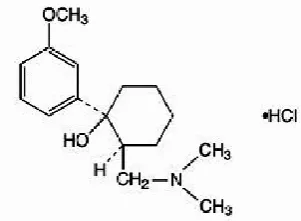
Figure 1: Molecular structure of Tramadol hydrochloride
* Corresponding Author Vijay Sharma* B. N. College of Pharmacy, Udaipur, Rajasthan Contact: +91-9929493007, Email: [email protected] ABSTRACT:
Complexes of ion-exchange resins and Tramadol hydrochloride (TmH), a model drug, were prepared using a batch method with different functional groups, ion-exchange capacity, degree of cross linking, and resin particle size. Drug loading efficiency, release profiles, and scanning electron micrographs were also investigated. Most of the functional groups of resins were loaded with TmH after the completion of a double batch method and it was recommended for drug loading into the ion -exchange resin. Using a batch method, drug loading could be monitored by simply measuring changes in the pH of the reaction medium since as complex formation reached completion, the pH returned to the initial pH of the eluent due to the limited amount of functional groups available for the exchange. TmH could be loaded up to the ratio of 1 (drug): 1 (resin), depending on the physicochemical properties of the resin. As the cross linking ratio and particle size increased, the drug loading and release rate decreased due to the reduced effective diffusion coefficient and surface area.
The ion-exchange resins to test in this study are cross linked gel type resins and their release kinetics is controlled mainly by drug diffusion through the gel. It has been reported that the kinetics of drug release from drug/resin complexes are dependent upon the amine moieties of the drugs used, such as NH2, –NH–, –N–, and –N+–; and the order of decreasing complex strength among the amine drugs follows: –N– >–NH–>NH29.
In this experiment, Tramadol hydrochloride was selected as a model drug and batch method was investigated to prepare drug/resin complexes to find the best preparation method for the complex preparation. Ion-exchange resins with different particle sizes, various degrees of cross linking, and different functional groups were also examined to optimize drug/resin complexes. Drug release kinetics of the resin complexes was evaluated using Boyd model to get information on the rate limiting step.
MATERIALS AND METHODS Materials
Tramadol hydrochloride, a model drug, was obtained from the IPCA laboratories Ltd. Mumbai Fig. 1 shows the molecular structure of Tramadol hydrochloride (TmH). Ion-exchange resins (Indion 224, Indion 244 Indion 254 Indion 284 Indion 224 polystyrene sulfonate was purchased from the ION EXCHANGE Pvt. Ltd. Mumbai.
Ion exchange resins are a cation-exchange resin with a cation exchange capacity of 4.3mequiv./g and a particle size mostly less than 1.3mm. All the resins were purified by rinsing three times with distilled water, one times with methanol, one time with benzene and then two times with distilled water again. Each treatment takes at least 6 h by a batch process. After filtration, the resin was dried in an oven.
Analysis of Tramadol Hydrochloride Determination of Melting Point:-
Melting point was determined by small amount of Tramadol hydrochloride in capillary tube closed at one end. The capillary tube was placed in an electrically operated digital melting point apparatus and the temperature at which the drug melts was recorded. This was performed thrice and average value was noted. DSC was used to determine the melting point of the Tramadol hydrochloride sample. The DSC analysis was carried out with Shimadzu DSC 60 thermal analyzer at the heating flow rate of 50 C /minute between the ranges 50-3000 C under static air using aluminium pans.
Solubility:-
The solubility of Tramadol hydrochloride was
determined in different solvents like distilled water.0.1 N HCl, ethanol & various pH solutions. An excess quantity of the drug was added in 10 ml of each solvent in screw capped glass test tubes and shaken or 12 hours at room temperature. The solution was filtered, diluted and the solubility was determined by spectrophotometry.
Partition coefficient:
The partition coefficient study was performed using n-octanol as oil phase and distilled water as aqueous phase. The two phases were mixed in an equal quantity and were saturated with each other on a mechanical water bath shaker at 320 C for 24 hrs. The saturated phase was separated. Each volume (10 ml each) of two phases was taken in a separating funnel and, this mixture 100 mg of weighed amount of drug was added. The separating tube was shaken for 24 hrs. to complete partitioning. The two phases were separated by separating funnel. And they were analyzed for respective drug contents. The partition coefficient of drug Ko/w was calculated using following formula.
Ko/w = concentration in octanol concentration in distilled water
Preliminary Evaluation of Resins Evaluation of physical properties
The size of cationic Ion Exchange Resins was determined by microscopic method. Water absorption was obtained by keeping 500 mg of resin in contact with 1 ml of water in a petridish. The time required for complete water absorption was recorded.
Effect of resin activation
:-To study the effect of method of resin activation on the complexation of drug with using the resins were activated by different methods. Resin 200 mg placed on a whatmann filter paper in a funnel, washed with deionized water and subsequently with 1N HCl 100 ml. The resin was rewashed with water until neutral pH was reached. Similarly, alkali activation of resin was performed by placing the resin in 1N NaOH solution. Finally resins were also activated with combined treatment of 1N HCl and 1N NaOH solutions.
Preparation of Tramadol HCl-Loaded Resinate Beads
The different types of resins were purified by rinsing two times with distilled water, one times with methanol, one time with benzene and then two times with distilled water again. Each treatment takes at least 6 h by a batch process. After filtration, the resin was dried in an oven at 40 ◦C for 24 h10. The TmH–resinate beads were prepared by a batch process, using the method described by Jeong
and Park (2008). The previously purified resin particles
(0.95 g dry weight) were dispersed in a 1.0 % (w/v) drug solution (100 ml) under magnetic stirring at room temperature for 5h (single batch).. In order to investigate how quickly equilibrium could be reached, 0.1mL of supernatant was collected at predetermined intervals during complex formation at room temperature, diluted with water, and then the drug amount was quantified spectrophotometrically at λmax 271 nm. The drug– resinate beads were separated from the supernatant by filtration, washed with deionized water to remove any uncomplexed drug, and then dried in an oven at 40 ◦C for 24 h 10.
Evaluation of Drug Resin Beads
DSC was used to determine the melting point and to determine the molecular properties of Drug resin complex of the sample. The DSC analysis was carried out with Shimadzu DSC 60 thermal analyzer at the heating flow rate of 50 C /minute between the ranges 50-3000 C under static air using aluminum pans.
FT- IR of Tramadol HCl Resinate Beads
The FT-IR analysis of the Drug and Dug resin complex sample were carried out for qualitative compound identification and compatibility between Tramadol hydrochloride and the selected resins .The pure drug and drug with resins were scanned separately. Potassium bromide was mixed with drug and resins in 9:1 ratio and the spectra was taken over a wavelength of 4000 cm-1 -400 cm-1 . FT-IR spectrum of Tramadol hydrochloride was compared with FT-IR spectra with resins.
Study of the effect of resin properties on in vitro release of Tramadol HCl from drug resinate beads
Drug release from different drug–resinate beads (Indion224, Indion244, Indion 254, Indion 284) was conducted according to USP 24 dissolution apparatus II (paddle method). The dissolution media were 900 ml distilled water and maintained at 37±1 ◦C. Rotation speed was 50±1 rpm. An accurate weight of the Drug resin complex, equivalent to 100 mg of Tramadol hydrochloride was added in dissolution medium while the solution was agitated using the paddle. A 1 ml of sample was collected and replaced with fresh medium at appropriate interval. An absorbance of collected sample was measured by UV spectrophotometer at 271 nm.
Scanning electron microscopy (SEM)
Morphological characterization of the microspheres was carried using scanning electron microscopy (SEM‐S‐3 700N, SHIMADZU). For SEM the double‐sided sticking tape, and coated with gold film (thickness 200nm) under the reduced pressure (0.001torr).
RESULTS AND DISCUSSION Determination of Melting Point:-
Melting point of Tramadol hydrochloride was
determined by a capillary tube method. The capillary tube was placed in an electrically operated digital
melting point apparatus and the temperature at which the drug melts was recorded. This was performed thrice and average value was found to be 183.0±0.6. This result was in conformation to the standard text. The DSC studies also revealed that melting point at 184.0.
Solubility:-The solubility of Tramadol hydrochloride was
determined in different solvents. The solution was filtered, diluted and the solubility was determined by spectrophotometrically and the observation is shown in Table: 2, Table 4.
Partition Coefficient:-
The partition coefficient was determined by the shake flask or tube method and measuring the distribution of the solute is by UV Spectroscopy.
Ko/w = concentration in octanol concentration in distilled water
Ko/w= 1.35 in distilled water
FT-IR Studies
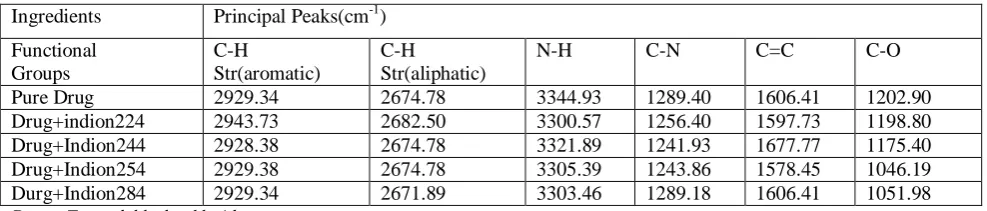
As described in the methodology section the FT-IR studies were carried out for pure drug and along with ion exchange resins. They are summarized as follows. The FT-IR spectra of Tramadol hydrochloride (fig-1)
exhibited peaks at 2929.34cm-1 (C-H aromatic
stretching), 2674.78 cm-1 (C-H aliphatic stretching), 3344.93 cm-1 (N-H amide bending), 1289.40 cm-1 (C-N bending) , 1606.41 cm-1 (C=C group), 1202.90(C-O
group).Similarly FT-IR spectra of Tramadol
hydrochloride in combination with ion exchange resins showed in figure 2 to 5. The FT IR spectra of solid drug: resin complex of Tramadol hydrochloride with different ion exchange resins indicated that the NH2 group of drug interacts with SO3H group of different resins (Indion 224, Indion244, Indion254, and Indion284). This is confirmed by spectral analysis. Significant reduction in the intensity of distinctive peaks of drug demonstrates the formation of complex between drug and the resin molecule. The peaks are given in the Table 1 can be considered as characteristic peaks of the Tramadol hydrochloride. This indicates that there is interaction between Tramadol hydrochloride and different resins and the drug was complexed with the resins.
Table 1 Data obtained for FT-IR spectra of Tramadol HCl along with ion exchange resins
Drug =Tramadol hydrochloride
Ingredients Principal Peaks(cm-1)
Functional Groups
C-H
Str(aromatic)
C-H
Str(aliphatic)
N-H C-N C=C C-O
Pure Drug 2929.34 2674.78 3344.93 1289.40 1606.41 1202.90
Drug+indion224 2943.73 2682.50 3300.57 1256.40 1597.73 1198.80
Drug+Indion244 2928.38 2674.78 3321.89 1241.93 1677.77 1175.40
Drug+Indion254 2929.38 2674.78 3305.39 1243.86 1578.45 1046.19
The FTIR and solubility studies suggests that TmH exists in the protonated drug ion which can displace the hydrogen counter ion (H+) at the sulfonic acid functional groups on the IER preparation.
Re–SO3−H+ + BH+ → Re–SO3−BH+ + H+
Differential Scanning Calorimetry (DSC) Study
DSC studies for pure drug, selected ion exchange resin and drug resinate beads were carried out. The thermogram of pure drug, ion exchange resin (Indion 244) and drug resinate beads (Tramadol +Indion 244) is shown in the figures 6, 7and 8 respectively. Thermogram of pure drug, presenting in the figure 6 indicate that melting of the drug is at 184.790C. In the figure 7 indicates that the melting of the ion exchange resin (Indion 244) without drug has taken place at 168.790C. The thermogram of DRC, presented in figure 8 indicates that the melting of DRC (Tramadol +Indion 244) has taken place at 175.880C. It could because the resins have undergone melt at 168.790C. Before the resin completely melts, the drug might have started melting giving the broad peak that is 175.880C.Further no more peaks were found in the figure 8.
Preliminary Evaluation of Resins Evaluation of physical properties
The size of cationic Ion Exchange Resins was determined by microscopic method. The size of resins particles of Indion 284, Indion 254 was found to be ≤150 µm, which is in confirmation with that reported in the literature. Similarly the particle size of Indion 224 and Indion 244 were also found to be within the range reported in the literature. The water uptake time of resins were found to be 43 to 67 seconds. The result shows that Ion Exchange Resins beings highly porous and even though insoluble in water are capable of hydration. The results were shown in Table 3. The swelling time of selected IER was found to be directly proportionally to the particle size of the resins.
Effect of resin activation
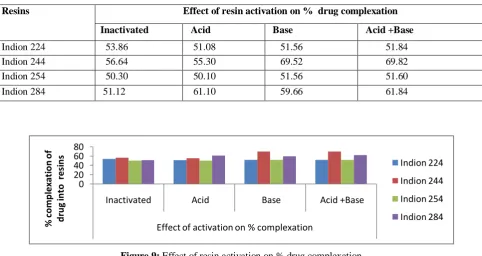
To study the effect of pH of the activation medium of IER on percentage drug loading (single batch method), the resin were activated in the different pH environment (the result are reported in table 5and figure 9). It was found that highest drug loading was obtained in the resin treated with acid alkali combination. This study also revealed that highest complexation was achieved with Indion 244 IER.
Effect of resin particle size and degree of cross linking on the loading equilibrium time:
Resins of various particle sizes and degrees of cross linking were used to investigate their effect on the equilibrium time. The weight ratio between the drug and resin was 1:1 for the loading. Fig. 10 shows the equilibrium profiles of drug loading onto different ion exchange resins. The loading of Tramadol hydrochloride in all the selected resins was more than 50%. The equilibrium time was approximately 120 min for Indion 244 and Indion 224. However it was 60 min in case of Indion 254 and Indion 284. The difference in
equilibrium time obtained was due to the influence of the degree of cross-linking and the particle size of the resins. The particle size distribution of Indion224 is 0.2-1.2 mm, Indion 284 is≤ 0.15 mm Indion 254 is≤0.15 mm, and Indion 244 is 0.2-1.2 mm. Coarse particles have smaller surface area than fine particles and greater internal volume for ions to diffuse, so moretime can be required to establish equilibrium. Resins with lower degree of cross linking reached equilibrium faster than resins with higher one having the same particle size. It is obvious that the amount of TmH remaining is greater in case of Indion 244 thanIndion 284. When an ion-exchange resin is highly cross linked, the diffusion of various ions can be impeded, and this will slightly increase the time required to reach equilibrium and reduce the amount of drug loaded onto IER.
Effect of resin particle size and degree of cross linking on the in vitro release of TmH from drug resinate beads:
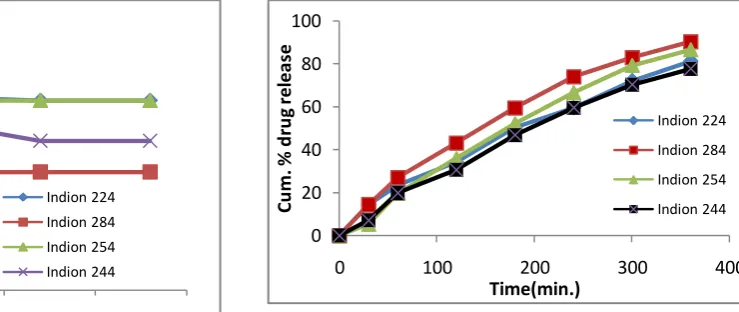
Fine particles have more surface area than coarse particles and less internal volume for ions to diffuse, so less time can be required to establish equilibrium. Similarly, desorption of bound drug from the complex will be faster in fine particles. Fig. 11 shows the release profiles of TmH from drug–resinate beads with different particle size resins (Indion 224 is 0.2-1.2mm, Indion 284 is ≤0.15 mm Indion 254 is≤0.15 mm, and Indion 244 is 0.2-1.2.) It is obvious that the higher degree of cross linking of resins, the slower the release of the drug. Statistical analysis revealed that TmH–resinate with Indion 284 showed significantly faster drug release (34.24, 73.96, and 90.33%), compared to TmH–resinate with Indion 244 resinate (30.63, 59.51, and 77.66%) after 2, 4, and 6 h, respectively This may be attributed to the swelling properties of the resin. The higher degree of cross linking resins swell less than the lower ones, and hence is more resistant to diffusion of drug molecule throughout the resin particle. Results also showed that decreasing the particle size results in a faster drug release. This is attributed to the greater surface area exposed to the dissolution medium, which facilitates the exchange process.
Based on the above results, we decided to prepare drug resin microcapsules of TmH that approach the zero order kinetics for once daily administration and prevent brust release. The drug resin complex with Indion 244 was selected as highest drug binding of 69.82% and the desired slow release of drug was observed with resinate of drug with Indion 244 was selected to be microencapsulation in order to achieve the targeted controlled release effect.
The In vitro release kinetics as presented in Table 6 suggests that drug release from resinates of Indion 224, Indion 254, Indion 244 follows zero order kinetics, however the release of the drug from resinate of Indion 284 follows first order kinetics. These conclusions are based on Co-relation coefficient of linear relationship.
CONCLUSIONS
ion-exchange capacity, degree of cross linking, and resin particle size. Most of the functional groups of the resins were loaded with TmH after the completion of a single batch method and it was recommended for the drug loading into the ion-exchange resin. When a batch method was applied, simply measuring changes in the pH of the reaction medium could monitor drug loading, because as complex formation reached completion, the pH returned to the initial pH of the eluent. TmH could be loaded up to the ratio of 2 (drug): 1 (resin), depending on the physicochemical properties of the resin. As the cross
linking ratio and particle size increased, the drug loading and release rate decreased due to the reduced effective diffusion coefficient and surface area. Fine particles required less time to establish equilibrium because of more surface area and less internal volume for ions to diffuse. Similarly, desorption of bound drug from the complex was faster in fine particles. Moreover, when an ion exchange resin is highly cross linked, the diffusion of various ions was impeded, and this increased the time to equilibrium and reduced the amount of loaded drug.
Figure 1: FT- IR spectra of Tramadol hydrochloride drug
Figure 2: FT- IR spectra of Tramadol hydrochloride drug+Indion224
Figure 4: FT-IR spectra of Tramadol hydrochloride drug+Indion 254
Figure 5: FT IR spectra of Tramadol hydrochloride drug+Indion 284
Figure 6: DSC thermogram of Tramadol hydrochloride
Figure 7: DSC thermogram of Indion 244
Table 2: Solubility of Tramadol hydrochloride in different solvents
Table 3: Evaluation of Physical Properties of Cationic Ion Exchange Resins
Table 4: Solubility profile of Tramadol hydrochloride in pH solutions
Table 5: Effect of resin activation on % drug complexation by single batch method
Figure 9: Effect of resin activation on % drug complexation 0
20 40 60 80
Inactivated Acid Base Acid +Base
Effect of activation on % complexation
%
c
o
m
p
le
xa
ti
o
n
o
f
d
ru
g
in
to
res
in
s
Indion 224
Indion 244
Indion 254
Indion 284
S.No. Solvents Solubility(mg/ml)
1 Water 64.76
2 0.1 N HCl 64.58
3 Methanol 68.00
Resins Particle Size (mm)
Swelling time (seconds)
Indion 224 0.2-1.2 61±6
Indion 284 ≤0.15 45±3
Indion 254 ≤0.15 43±7
Indion 244 0.3-1.2 67±5
S.No Solvents Solubility(mg/ml)
1 pH 1.2 64.58
2 pH 2.2 66.14
3 pH 4.2 68.00
4 pH 6.0 61.96
5 pH 6.4 63.78
6 pH 6.8 64.14
7 pH 7.4 64.90
Resins Effect of resin activation on % drug complexation Inactivated Acid Base Acid +Base
Indion 224 53.86 51.08 51.56 51.84
Indion 244 56.64 55.30 69.52 69.82
Indion 254 50.30 50.10 51.56 51.60
Figure 10: Equilibrium profile of drug loading onto different ion exchange resins
Figure 11: Effect of resin particle size and degree of cross linking on the in vitro release of TmH from drug
resinate beads.
Table 6: In Vitro Release Kinetics of Drug from different resinate
REFERENCES:
1. Anand V, Kandarapu R and Garg, S, Ion-exchange resins: carrying drug delivery forward. Drug Discov. Today 2001; 6, 905–914.
2. Kim, CJ, Ion Exchange Resin Drug Delivery Systems. Technomic Publishing Company, Inc., Lancaster/ Pennsylvania. 2000:
3. Motycka S and Nairn JG. Influence of wax coatings on release rate of anions from ion-exchange resin beads. J. Pharm. Sci. 1978: 67, 500–503.
4. Motycka S and Nairn JG. Preparation and evaluation of microencapsulated ion exchange resin beads. J. Pharm. Sci. 1979: 68, 211–215.
5. Motycka S, Nairn, JG. Preparation and evaluation of microencapsulated and coated ion-exchange resin beads containing theophylline. J.Pharm. Sci. 1985; 74, 643–646. 6. Raghunathan Y, Amsel L, Hinsvark O, Bryant W. Sustained
-release drug delivery system. Part I. Coated ion-exchange resin system for phenyl propanolamine and other drugs. J. Pharm. Sci. 1981; 70, 379–384.
7. Borodkin S and Sundberg DP, Polycarboxylic acid ion-exchange resin adsorbates for taste coverage in chewable tablets. J. Pharm. Sci. 1971: 60, 1523–1527.
8. Zhang ZY, Ping QN and Xiao B. Microencapsulation and characterization of tramadol–resin complexes. J. Control. Release.2000; 66, 107–113.
9. Borodkin S and Yunker MH. Interaction of amine drugs with a polycarboxylic acid ion-exchange resin. J. Pharm. Sci. 1970; 59, 481–486.
10. Jeong SH, Haddish NB, Haghighi K and Park K. Drug release properties of polymer coated ion-exchange resin complexes: experimental and theoretical evaluation. J. Pharm. Sci. 2007; 96, 618–632.
11. Atyabi F, Sharma HL., Controlled drug release from coated floating ion exchange resin beads. J. Control. Release 1996; 42: 25–28.
12. Boyd GE, Adamson AW and Myers JR. The exchange adsorption of ions from aqueous solutions by organic zeolites II. Kinetics. J. Am. Chem. Soc. 1947; 69, 2836–2848. 13. Holl W and Sontheimer H. Ion exchange kinetics of the
protonation of weak acid ion exchange resins. Chem. Eng. Sci. 1977: 32, 755–762.
14. Ichikawa H, Fujioka K, Adeyeye MC and Fukumori Y. Use of ion-exchange resins to prepare 100 mm-sized microcapsules with prolonged drug-release by the Wurster process. Int. J. Pharm. 2001; 216, 67–76.
15. Irwin WJ, Belaid KA and Alpar HO. Drug-delivery by ion-exchange. Part IV: Coated resinate complexes of ester prodrugs of propranolol. Drug Dev. Ind. Pharm. 1988; 14, 1307–1325.
16. Kim CJ. Application of shrinking-core model for ionization of hydrophobic ionic beads. Drug Dev. Ind. Pharm. 1996;22, 307–311.
17. Pongpaibul Y, Sayed HAM and Whitworth CW. Effect of process variables on drug release from microparticles containing a drug–resin complex. Drug Dev. Ind. Pharm. 1989; 15, 2547–2558.
18. Reichenberg D. Properties of ion-exchange resins in relation to their structure. Part III. Kinetics of exchange. J. Am. Chem. Soc. 1953; 75, 589–597.
19. Selim MS and Seagrave RC. Solution of moving-boundary transport problems in finite media by integral transforms. Part II. Problems with a cylindrical or spherical moving boundary. Ind. Eng. Chem. Fundam. 1973;12, 9–13.
20. Selim MS, Seagrave RC. Solution of moving-boundary transport problems infinite media by integral transforms. Part III. The elution kinetics of the copper ammine complex from a cation-exchange resin. Ind. Eng. Chem. Fundam. 1973;12, 14–17.
21. Sprockel OL and Price JC. Development of an emulsion-solvent evaporation technique for microencapsulation of drug–resin complexes. Drug Dev. Ind. Pharm. 1990; 16, 361– 376. 0 10 20 30 40 50 60 70
0 50 100 150 200
% Tm H r e m ai n in g Time(min) Indion 224 Indion 284 Indion 254 Indion 244 0 20 40 60 80 100
0 100 200 300 400
C u m . % d ru g rel ea se Time(min.) Indion 224 Indion 284 Indion 254 Indion 244 Resins
Zero order First order Higuchi Korsemeyer peppas K0 R2 K1 R2 KH R2 ‘n’ R2
INDION 224 0.307 0.983 0.0445 0.981 3.540 0.973 0.697 0.996
INDION 244 0.254 0.986 0.0452 0.971 3.165 0.955 0.927 0.981
INDION 254 0.351 0.984 0.0433 0.959 4.118 0.973 0.740 0.969