Downloaded from: http://insight.cumbria.ac.uk/id/eprint/1373/
Usage of any items from the University of Cumbria’s institutional repository ‘Insight’ must conform to the following fair usage guidelines.
Any item and its associated metadata held in the University of Cumbria’s institutional repository Insight (unless stated otherwise on the metadata record) may be copied, displayed or performed, and stored in line with the JISC fair dealing guidelines (available here) for educational and notforprofit activities
provided that
• the authors, title and full bibliographic details of the item are cited clearly when any part of the work is referred to verbally or in the written form
• a hyperlink/URL to the original Insight record of that item is included in any citations of the work • the content is not changed in any way
• all files required for usage of the item are kept together with the main item file. You may not
• sell any part of an item
• refer to any part of an item without citation
• amend any item or contextualise it in a way that will impugn the creator’s reputation • remove or alter the copyright statement on an item.
The full policy can be found here.
Final author draft only. The copyedited article may differ from this manuscript version.
The details of the article are as follows:
Donovan, T., Crawford., T., & Litchfield, D. (2012). Negative priming for target selection with
saccadic eye movements. Experimental Brain Research, 222, 483-494.
Running Head: Negative priming for saccadic target selection
Negative priming for target selection with saccadic eye movements
Tim Donovan,*1, 2 Trevor J. Crawford,2 Damien Litchfield1, 2
1
Health & Medical Sciences, University of Cumbria, UK
2
Department of Psychology. Centres of Human Learning and Development & Aging
Research, Lancaster University, UK
____________________________
*Corresponding author:
Health & Medical Sciences, University of Cumbria, Lancaster, LA1 3JD
Email: [email protected]
Abstract
We conducted a series of experiments to determine whether negative priming is used in the
process of target selection for a saccadic eye movement. The key questions addressed the
circumstances in which the negative priming of an object takes place, and the distinction
between spatial and object-based effects. Experiment 1 revealed that after fixating a target
(cricket ball) amongst an array of semantically-related distracters, saccadic eye movements in a
subsequent display were faster to the target than to distracters or new objects, irrespective of
location. The main finding was that of the facilitation of a recent target, and not the inhibition of
a recent distracter or location. Experiment 2 replicated this finding by using silhouettes of objects
for selection that based on feature shape. Error rates were associated with distracters with high
target-shape similarity therefore Experiment 3 presented silhouettes of animals using a
distracters with low target-shape similarity. The pattern of results was similar to that of
Experiment 2, with clear evidence of target facilitation rather than inhibition of distracters.
Experiment 4 and 5 introduced a distractor together with the target into the probe display, to
generate competitive selection in the probe condition. In these circumstances clear evidence of
spatial inhibition at the location of the previous distractors emerged. We discuss the implications
for our understanding of selective attention and consider why it is essential to supplement
response time data with the analysis of eye movement behaviour in spatial negative priming
paradigms.
Keywords: negative priming, saccadic eye movements, attention, inhibition, visual search, target
Negative priming for target selection with saccadic eye movements
When we conduct a visual search of the environment to locate an object, such as a specific
pair of shoes in a shoe shop or the face of a friend in a crowd, this requires the precise control of
the eyes and presumably the suppression of interference from the irrelevant distractors. But is a
disracter activately suppressed for a saccadic eye movement and if so, which of its properties?
The negative priming paradigm has been extensively used to explore some of the key cognitive
processes that include the active inhibition of an irrelevant distracter (for review, see Tipper,
2001). Negative priming has been demonstrated across a range of paradigms that have included
various stimulus domains such as location (Tipper, Weaver, & Houghton, 1994), words (Malley
& Strayer, 1995), objects (Tipper & Driver, 1988) and the individual features of
multidimensional visual objects (Fanini, Nobre & Chelazzi, 2006). In our previous work a
negative priming task was used to provide insight into the role of spatial location priming in the
control of saccadic eye movements (Crawford, Hill, & Higham, 2005). Although the processing
of the location of an object appears to be obligatory (e.g., Chen & Cave, 2006), attention to
location is just one of several ways in which object selection can be based. Müller, von
Mühlenen, & Geyer, (2007) have shown a dissociation between target selection (which they
argued was based on location information) and distracter inhibition (which they argued was
object based). The aim of the current experiments was to establish whether negative priming
plays a role in saccade target selection to realistic objects and to distinguish between the
processing of distracter location and identity. It is critical for our understanding of the underlying
mechanisms, to determine the boundary conditions in relation to the negative spatial priming
display, which in our experiments consists of a target and two distracters. Participants are
required to attend to the target and to ignore the distracters. In the second display, termed the
‘probe’ display, the target can appear at the previous location of the target, the location of the
distracters or at a new location. Response times are typically slowed on trials in which the target
appears in the location of a previously ignored distracter. It is in this ‘ignored repetition’
condition, that response times are increased relative to other conditions (Tipper, 2001).
There have been few negative priming experiments using saccadic eye movements, which is
surprising as eye movements and attention are so closely linked (Belopolsky & Theeuwes,
2009). Building on our previous research on inhibition of distracters and location (Crawford et
al., 2005), we examine whether such effects emerge with realistic objects. In the present study
we measured the saccadic reaction time (SRT), the delay between the appearance of a target in
the probe display and the time the eyes start to move towards the target. The frequent use of
abstract stimuli should be extended to realistic objects, in order to formulate ecologically valid
inferences on the operating principles of human selective attention. Therefore the stimuli used in
the present study are depictions of real objects selected within semantic categories (sport/animal)
of various cricket items and animals respectively. In the first experiment greyscale images of the
cricket items were used; in the second, silhouettes of the cricket items; and in the third
experiment silhouettes of animals. These series of experiments allowed us to explore the effects
of low-level factors such as shape and the type of object on the spatial priming of objects. In
Experiments 4 and 5 we investigate the impact on saccadic priming of a distracter presented
Experiment 1
Methods
Participants
Twelve participants (11 female, mean age = 19yrs) were naive to the aims of the experiment
and had normal or corrected visual acuity (assessed with the Snellen chart). No participant had
consumed any alcohol in the 12-h preceding the experiment or taken nicotine in the hour prior to
testing. None of the participants had a history of mental health problems and none were currently
taking any form of medication. Participants were screened in this manner for all experiments.
The study was approved by the Lancaster University departmental ethical research committee.
Apparatus and stimuli
All stimuli were presented on a 19” CRT monitor (60 Hz) and eye movements were recorded
with an EyeLink II Tracker (head mounted, 500Hz temporal resolution, 0.5 degrees spatial
resolution). The stimuli consisted of 4 greyscale images of items relating to cricket: a ball, a set
of wickets, a bat and a hat. Objects were displayed on a white background and had average size
of 1.44° x 2.44° and were positioned 5° away from the centre of the screen. There were 360 trials
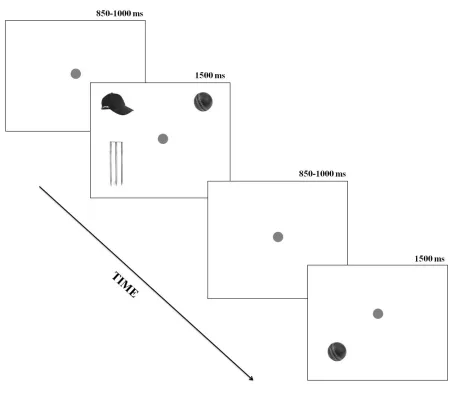
with each trial consisting of a prime and probe. Each trial began with a central fixation point.
After 850ms or 1000ms the prime display appeared for 1500ms. In the prime display the target
(i.e. ball) was presented together with 2 of 3 possible distracters (bat, hat and wicket) in a regular
spatial arrangement (see Figure 1). A fixation point was then displayed for a random period
between 850ms and 1000ms followed by the probe display for 1500ms. In the probe display a
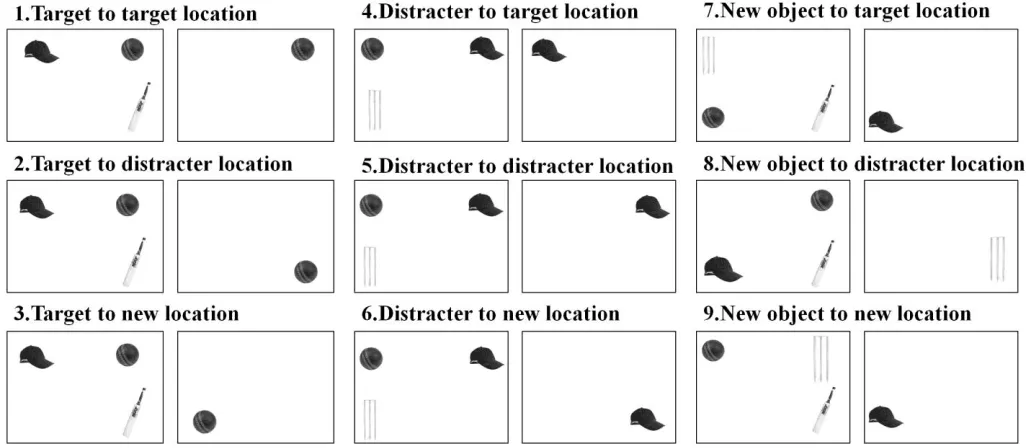
lone object (ball, bat, hat, or wicket) was presented either at the location of the prime display
conditions where the previous target from the prime display, a previous distracter or a ‘new’
distracter not used in the prime, was the lone item (see Figure 2 for full description of
conditions). We simplified the task by using a single object in the probe display as the negative
priming effect is obtained even if a distracter is not presented (e.g. Milliken, Tipper, Houghton &
Lupianez, 2000). The 9 trial conditions were randomly presented in 10 blocks of 36 trials each.
Within each block there was an equal proportion of each trial type. There were an equal number
of target presentations at each of the 4 locations in the prime and probe, and an equal number of
presentations of each of the distracters as targets in the probe.
<< Insert Figure 1 about here >>
Procedure
The experiment was conducted at the Department of Psychology at Lancaster University.
Participants were seated 60cm from the display and were instructed to fixate the target in the
prime display while ignoring the distracters, and to fixate the lone item in the probe display as
quickly as possible. They were given 10 practice trials and at the start of each block a 9 point
calibration was conducted. Participants were encouraged to have a break between blocks if they
were having difficulty maintaining concentration.
Results and discussion
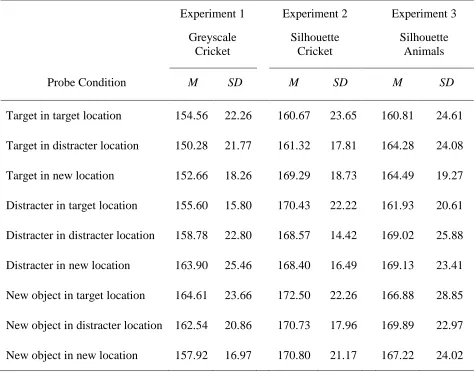
Trials with saccades faster than 80ms and slower than 500ms were discarded (see Table 1).
Trials where the participant made saccades towards distracter items rather than the target in the
prime trial were excluded and analysed separately. A two-way repeated measures analysis of
variance (ANOVA) was carried out with stimulus type (target, distracter, new object) and
location (target location, distracter location, new location) as within-subject factors. There was a
significant main effect of stimulus type (F(2, 22) = 21.18, p < .001, ηp2 = .69).
Bonferroni-corrected comparisons revealed that when the prime target (ball) was the probe target, SRTs (M
= 152 ms) were significantly faster than for a probe target that was a previous distracter (M =
159 ms) or a for a new object (M = 162 ms) (both ps < .001). However, there was no difference
in SRTs when the target was a recent distracter or a new object (p > .49). There was no effect of
location (F(2, 22) = 0.23, p = .79, ηp2 = .02). Thus SRT was not dependent on whether the probe
object was presented at a previously occupied location of a target, distracter or a new location.
There was however a significant interaction between stimulus type x location (F (4, 44) = 3.18, p
= .022, ηp2 = .22), this was due to the faster response to new objects in new locations.
Overall incorrect fixations were directed to distracters in 25% of the prime trials. Of these the
hat was fixated in 87% of trials where it was present as a distracter. Attention was clearly
captured by the hat distracter which has a relatively high similarity in shape to the ball target (see
Figure 3 for an example). However, whilst structural similarity of objects can influence visual
attention, structural similarity does not necessarily underpin negative priming (Tipper, 1988).
These results demonstrated no evidence that the location of a recent distracter provides a source
of an inhibition for selective attention with objects from the same semantic category. It seems
negative priming paradigm where the target appears in the location of a distracter, this would
constitute an ignored repetition trial, and where the target appears in another location would be a
control trial. A study by Amso and Johnson (2005) found spatial negative priming in children
and adults based on saccadic latency. However, in the latter study a single distracter was used
and there was a clear difference in salience between the target and distracter; whereas the target
was a colourful animated image the distracter was always a grey diamond. In the current
experiment there was no significant difference in SRT between these displays. Since SRTs to the
target were faster in all conditions in comparison to saccades to a previous distracter, it is likely
that this facilitation is due to positive priming or a preview benefit.
<< Insert Figure 3 about here >>
Experiment 2
Although the location of a recent distracter is inhibited when using simple stimuli (e.g.,
Crawford et al., 2005), Experiment 1 did not find this effect with realistic objects. However, the
display items contained detailed visual information that would greatly enhance the identification
of the objects. It was possible that when object identity is enriched the spatial location of the
distracters may not be prioritized for saccadic eye movements, yielding neglible effects on
negative priming. In the current experiment we eliminated much of the visual content of the
display by using object silhouettes to determine whether this would enhance the processing of
the distracter locations. Thus in Experiment 2 we addressed the following question: When shape
information becomes the major discriminating feature and the principal basis for object identity
Method
The stimuli used in Experiment 1 were converted into silhouettes with Adobe Photoshop
(version 10). Twelve participants (6 female, mean age = 21yrs) were naive to the aims of the
experiment and had normal or corrected visual acuity (assessed with the Snellen chart). For this
experiment eye movements were recorded with EyeLink 1000 Tracker (1000 Hz temporal
resolution, 0.01° spatial resolution) using a chin support. The procedure and timings of the
stimuli were identical to Experiment 1.
Results and Discussion
Trials with saccades faster than 80ms and slower than 500ms were discarded (see Table 1).
Trials where the participants made saccades towards a distracter item, rather than the target in the
prime display, were excluded and analysed separately. A two-way repeated measures ANOVA
showed a significant main effect of stimulus type (F(2, 22) = 4.34, p = .026, ηp2 = .28). However,
Bonferroni-corrected comparisons indicated that when the probe target was the previous prime
target (ball) (M = 163 ms) there was only a trend for SRTs to be faster than when the probe target
was a previous distracter (M = 169 ms) (p < .072) or a new object (M = 171 ms) (p < .078).
There was no difference in SRTs depending on whether the probe target was a recent distracter
or a new object (p = .99). Moreover, there was no effect of location (F(2,22) = 0.66, p = .52, ηp2
= .06). SRT was not reliably influenced according to whether the probe stimulus was presented
at the previous location of the target, distracter or new location. In addition, there was no
Overall incorrect fixations were directed to a distracters in 19% of the prime trials. Of these
the hat was fixated in 81% of trials where it was present as a distracter. The results of
Experiment 2 were consistent with Experiment 1. Despite the fact that the object stimuli were
presented as silhouettes the reduction in visual detail did not cause attention to be allocated on
the basis of location rather than object identity. Instead, reducing visual information in this way
reduced the facilitatory effects of eye movements to a previously attended target.
<< Insert Table 1 about here >>
Experiment 3
Experiment 1 and 2 detected no evidence of distractor inhibition of spatial location or object
identity in the saccadic negative priming using realistic objects. The analysis of misdirected
saccades in the prime displays, demonstrated a clear example of an interaction based on visual
similarity between a target and a distractor (we detected a high proportion of misdirected
saccades to the hat distracter, rather than the ball target). In addition to target-distracter
interaction based on visual similarity, previous work has shown there is also an interaction
amongst visually presented stimuli at the semantic level (see Moores et al. 2003). The current
experiment examined whether there might also be a semantic interaction between members of an
arguably more familiar semantic category (animals), and to better control the visual similarity
between targets and distracters. Given our predisposition to rapidly process animals (Thorpe,
Gegenfurtner, Fabre-Thorpe, & Bulthoff, 2001) would this semantic category be more likely to
generate inhibition when presented as distractors in the context of a negative priming task?
served as the target (see Figure 4). In experiments 1 and 2 the hat appeared to be the only
competing distracter, with most errors made to the hat even though semantically ball and bat are
more closely related. Semantically, cat and mouse are often associated together, but the
distracters do not share many common shape features, and therefore any issues of visual
similarity should be diminished. This reduction in visual similarity may be a condition for
negative spatial priming to emerge for saccadic eye movements to objects.
<< Insert Figure 4 about here >>
Method
The method for this experiment was essentially identical to Experiment 2. Ten participants (7
female, mean age 26) were naive to the aims of the experiment and had normal or corrected
visual acuity (assessed with the Snellen chart). For this experiment eye movements were
recorded with an EyeLink 1000 Tracker (1000Hz) temporal resolution, 0.01° spatial resolution)
using a chin support. The animal silhouettes had an average size of 2.13° x 2.06°. The procedure
and timings were identical to Experiment 1 and 2.
Results and Discussion
Trials with saccade latencies that were faster than 80ms and slower than 500ms were
discarded (see Table 1). Trials where the participants generated a saccade toward one of the
distracters rather than the target in the prime display were excluded and analysed separately. A
two-way repeated measures ANOVA showed a significant main effect of stimulus type (F(2, 18)
object was the previous (prime) target SRTs (M = 163 ms) were significantly faster than when
the probe target was a previous distracter (M = 166 ms) (p = .042) and approached significance
when compared with a new object (M = 167 ms) (p = .097). There was no difference in SRTs
based on whether the probe target was a recent distracter or a new object (p = .99). Moreover,
once again there was no effect of location (F(2, 18) = 1.66, p = .22, ηp2 = .16), the specific
location of the probe stimulus yielded no reliable differences in reaction times regardless of
whether the probe was presented at the location of the previous target, distracter or new object.
In addition there was no significant interaction between stimulus type x location (F(4, 36) = 0.46,
p = .76, ηp2 = .05).
Overall incorrect fixations directed to the distracters comprised 40% of the prime trials. Of
these 28% of the errors were to the deer, 39% to the cat, and 33% to the owl. The fact that there
was a higher error rate in Experiment 3 (40%) compared to Experiment 1 (25%), and Experiment
2 (19%) suggests that it was more difficult for participants to make a saccade towards the target
and to ignore the distracters on the basis of shape information alone.
The results of this experiment are consistent with the previous experiments. There was clear
evidence of facilitation emerging from the probe target with no evidence of inhibition at a
distracter location. In order to increase power of the analyses, given that we found no evidence of
inhibition in any of the experiments, we conducted a three-way mixed ANOVA across the three
experiments with experiment (greyscale, silhouette, animal), as between subject factors and
stimulus type (target, distracter, new object) and location (target location, distracter location, new
location) as within-subject factors. The mean SRTs across experiments were not significantly
different (F(2, 31) = 0.88 p = 0.43, ηp2 = .05). There was a main effect of the stimulus type in the
159 ms) compared to the distracter (M = 165 ms) and new object (M = 167 ms) (both ps <.001).
However, there was still no effect of location (F(2, 62) =0.85, p = .43, ηp2 = .02) and no
interactions (all ps >.098, all ηp2 < 0.07).
The combined data from the 3 experiments were also analysed separately for those trials in
which the target was not correctly located and fixated in the prime display. There was no
significant difference in error SRTs across experiments (F(2, 31) 0.27 p = 0.76, ηp2 = .02), but
there was a significant effect of stimulus type (F(2, 62) = 11.46, p < .001, ηp2 = .27). Saccades
towards new objects (M = 167ms) were slower than to previous target objects (M = 157ms) (p <
.001) or recent distracters (M = 161ms) (p < .028). In contrast to the correctly fixated data, there
was a marginally significant effect of location (F(2, 62) = 3.05, p = .054, ηp2 = .09), but there
were no interactions (all ps > .116, all ηp2 < .11). Bonferroni-corrected comparisons revealed that
when participants erroneously generated a saccade to a distracter, saccades to subsequent probe
objects at the location of the recent distracter were faster (M = 159ms) than the probe objects at
the recent target location (M = 164ms) (p = .041) but not a new object location (M = 162ms) (p =
.73). These results are interesting as these were error trials where the target was not correctly
fixated in the prime trial. Correct fixation of the target in the prime trials enhances performance
when fixating the target in the probe trials. However, when there is an error in locating the target
in the prime trial, the distracter item is foveated and this facilitates saccade eye movements
towards probes that subsequently appear at this location. Note that it would not be possible to
make this distinction in a negative spatial priming task in which manual reaction times (in the
absence of eye-tracking) was used as the sole dependent measure, as the precise location and
Experiment 4
The previous reported experiments above were designed to determine the role of negative
priming in saccade target selection and to dissociate object and spatial based processing in the
saccadic negative priming task. These experiments have reported a facilitation of the target
object that was presented in the prime display, but there was no evidence of spatial negative
priming for realistic objects. This was surprising given our previous evidence of spatial negative
priming for saccadic eye movements to colour LEDs (Crawford et al, 2005). One common
feature of the current experiments was the presentation of a single object (target, distracter or
new object) in the probe display. This was a reasonable procedure given the extensive previous
evidence that negative priming with eye-movement and manual responses is often evident with a
single item in the probe display, and that a distracter is not essential for the negative priming
effect to emerge (Milliken, Tipper, Houghton & Lupianez, 2000; Crawford et al, 2005; Chao
2009, 2011). Within the context of eye-tracking studies a single item in the probe display enables
automatic responses and eliminates any confusion about which target or distracter object is to be
selected for the saccade. However, it was possible that the relatively fast response times in
Experiments 1-3 reflected a rapid low-level process, that left little scope for negative priming to
emerge. Could the rapid speed of target detection in the probe trials, have minimized any effects
of negative priming? To address this issue, we introduced an additional selective attention
component by adding a distracter to the probe display. The aim was to determine whether
competitive selection in the probe display would give rise to negative priming that was absent in
the previous experiments.
This experiment used the silhouette objects from Experiment 2. Eleven participants (7
female, mean age = 33 yrs) were tested who were naïve to the aims of the experiment and had
normal or corrected visual acuity (assessed with the Snellen chart). Eye movements were
recorded with an EyeLink 1000 eye-tracker using a chin support.
Apparatus and stimuli
The stimuli consisted of 4 silhouette images of items relating to cricket that were used in
Experiment 2, a ball, a set of wickets, a bat and a hat. There were 288 trials with each trial
consisting of a prime and probe. Timings and procedures were identical to Experiment 2 with the
exception that the cricket ball was employed as the target across all trials and within all displays.
In the probe display the ball was presented either as a lone object (i.e no distracter), or in the
presence of previously presented distracter (bat, hat, or wicket). We ensured that the distracter in
the probe display only appeared at either the same distracter location, or the alternate distracter
location. Thus the distracters was never presented in a new location, or the location of the target
in the prime display. The target object was presented either at the location of the prime display
target, or the location of a previous distracter. The 4 trial conditions were randomly presented in
8 blocks of 36 trials each. Within each block there was an equal proportion of each trial type.
There were an equal number of target presentations at each of the 4 locations in the prime and
probe, and an equal number of presentations of each of the distracters in the prime and probe
Procedure
Eye movements were calibrated using a nine-point calibration. Following 8 practice trials
participants underwent 8 blocks of 36 trials in which location and distracters were completely
counterbalanced. Participants were seated 60cm from the display and were instructed to fixate
the target (ball) in the prime display while ignoring the distracters, and again to fixate the target
(ball) in the probe display as quickly as possible and ignore any distracters if present. At the start
of each block a 9-point calibration was carried out, if necessary. Participants were encouraged to
have a break between blocks if they were having difficulty maintaining concentration.
Results and discussion
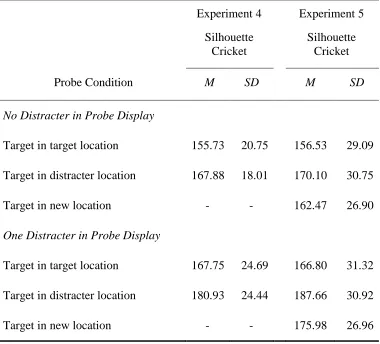
Trials with saccades faster than 80ms and slower than 500ms were discarded (see Table 2).
Trials where the participants incorrectly directed saccades towards a distracter rather than the
target in the prime trial were excluded and analysed separately. A two-way repeated measures
ANOVA was carried out with distracter (no distracter, one distracter) and target location (target
location, distracter location) as within-subject factors. This revealed a main effect of distracter
presence (F(1, 10) = 20.83, p <.001, ηp2 = .68), with longer SRTs (M = 174 ms) when the probe
display included a distracter compared to the target in isolation condition (M = 162 ms). There
was also a main effect of target F(1, 10) = 10.45, p = .016, ηp2 = .51) but no signifcant interaction
(F(1, 10) = 1.20, p = .736, ηp2 = .01). When the target object was presented at a location of a
previous distracter, SRTs (M = 174 ms) were significantly slower in comparison to a target at the
previous target location (M = 162 ms).
The number of trials in which distracters were erroneously fixated before the target only
low error rates is consistent with Experiment 2. In terms of the most salient distracter, however,
the majority of these errors in both displays were due to the hat (62% from the prime, 52% from
the probe), with the bat (22% from the prime, 23% from the probe), and wicket (16% from the
prime, 24% from the probe) misdirecting much fewer eye movements.
<< Insert Table 2 about here >>
Evidence of spatial negative priming for saccadic eye movement failed to emerge in
Experiments 1-3. Negative priming for identity can be eliminated, or even reversed, in the
absence of a probe distracter (Tipper & Cranston, 1985). However, little is known about spatial
negative priming in the context of saccadic eye movements to realistic objects. Therefore the
current experiment examined the spatial effect of a target presented together with a distracter in
the probe display. Given the previous demonstration that the location of a recent distracter is
inhibited in a saccadic negative priming task (Crawford et al., 2005) we focused on the spatial
effects of the distracter, rather than attempting to control both object identity and location. The
findings revealed there was an increase in saccadic reaction times of target-distracter trials over
target-target trials, despite no general increase in the mean saccade latencies across the other
conditions in comparison to the previous experiments.
Experiment 5
In Experiments 1-3, negative priming of objects showed no evidence of inhibition of spatial
target + distractor) to the probe display, and revealed an increase in saccadic reaction times in
Target to Distracter Location trials over Target to Target Location trials. Overall saccade
latencies were not substantially increased in comparison to previous experiments showing that
the absence of negative priming cannot be attributed to a floor effect of the reaction times.
However, the source of the differential effects remained unclear. There are 2 possible sources:
the difference in response time could be due to a facilitation of the target location or inhibition at
the location of the distractors. In the current experiment we locate this source by including a
third condition, in which the target in the probe display could appear at a new location. This
provides a critical baseline condition baseline condition, to clarify the spatial effect on saccadic
eye movements.
Method
This experiment was identical to Experiment 4, with the addition of a further 2 conditions:
Target to New Location with a distractor, Target to New Location with no distrator in the probe
display. This prime display was unchanged from Experiment 4. Thus the complete experiment
consisted of a set of Target to Target, Target to Distracter and Target to New Location Trials.
Eleven participants (7 female, mean age = 32 yrs) were naive to the aims of the experiment and
had normal or corrected visual acuity (assessed with the Snellen chart). Eye movements were
recorded with an EyeLink 1000 eye-tracker using a chin support.
Apparatus and stimuli
The stimuli consisted of 4 silhouette images of items relating to cricket that were used in
procedures were identical to Experiment 4. The 6 trial conditions were randomly presented in 12
blocks of 36 trials each. Within each block there was an equal proportion of each trial type.
There were an equal number of target presentations at each of the 4 locations in the prime and
probe, and an equal number of presentations of each of the distracters in the prime and probe
displays.
Procedure
Eye movements were calibrated. Following 8 practice trials participants underwent 12 blocks
of 36 trials in which location and distracters were completely counterbalanced. Participants were
seated 60cm from the display and were instructed to fixate the target (ball) in the prime display
while ignoring the distracters, and again to fixate the target (ball) in the probe display as quickly
as possible and ignore any distracters if present.
Results and discussion
Trials with saccades faster than 80ms and slower than 500ms were discarded (see Table 2).
Trials where the participants made saccades towards distracter items rather than the target in the
prime trial were excluded and analysed separately. A two-way repeated measures ANOVA was
carried out with distracter (no distracter, one distracter) and target location (target location,
distracter location, new location) as within-subject factors and showed a main effect of distracter
(F(1, 10) = 49.08, p <.001, ηp2 = .83), with longer SRTs (M = 177 ms) when the probe display
included a distracter than when the target was presented in isolation (M = 163 ms). There was
approached significance (F(1, 10) = 2.96, p = .075, ηp2 = .23). Bonferroni-corrected comparisons
indicated that when the prime target object was presented at a previous distracter location the
SRTs (M = 179 ms) were significantly slower in comparison to the target object presented at the
previous target location (M = 162 ms) or a new location, (M = 169 ms) (both ps < .001).
Critically, there was no difference in SRTs based on whether the probe target was appeared in
the previous target location or a new location (p = .140). Therefore these effects are consistent
with an effect of distracter inhibition, rather than target facilitation.
Once again the number of trials in which distracters were erroneously fixated before the
target only accounted for 17% of trials (15% from the prime display; 2% from the probe
display), which is consistent with Experiments 2 and 4. The majority of these errors in both
displays were due to the hat (71% from the prime, 63% from the probe), with the bat (17% from
the prime, 23% from the probe), and wicket (13% from the prime, 14% from the probe)
misdirecting much fewer eye movements.
In this experiment we explored the impact of a probe distracter on target selection for saccadic
eye movements using a spatial negative priming paradigm. Experiment 4 and 5 revealed spatially
contingent effects of the probe, that strongly resembled negative priming.The reaction times for
the equivalent condition in Experiment 2 are shown for the Silhouette cricket items in Table 1 for
the two conditions ‘Target in target location’ (M =160.67 ms) and ‘target in distracter location’
(M = 161.32 ms). Our previous analyses showed that there was essentially no difference in these
RTs. In contrast there was a clear significant difference in the equivalent conditions in the
current Experiments 4 and 5. What might account for the difference in equivalent conditions in
speed of the saccadic reaction times, if anything the saccades were generally of shorter latency in
the Experiment 4. We return to this issue below.
General Discussion
Previous oculomotor research using simple stimuli, revealed interference of a distracter as
measured by an increase in SRTs (Theeuwes, Kramer, Hahn, Irwin & Zelinsky, 1999) and a
measure of the curvature of trajectory of a saccade away from a distracter (McSorley,
Cruickshank & Inman, 2009). A previous eye tracking study by Crawford et al. (2005) using an
array of coloured LEDs as stimuli, clearly demonstrated a significant increase in SRTs when a
target was presented at the location of a recent distracter. However, with displays of realistic
objects in Experiments 1-3 there was no evidence that inhibition emerged from the spatial
co-ordinates of a distracter. When the cricket objects were presented as silhouettes in Experiment 2
the pattern of results were similar to that of the greyscale images in Experiment 1. Aside from
other visual features such as colour, brightness and texture, the recognition of an object can be
obtained by extracting shape information (Brodie, Wallace & Sharrat, 1991). Nevertheless, even
when shape was the primary feature available for object recogntion, and visual similarity was
reduced (Experiment 3), location did not emerge as a source of inhibition in Experiments 1-3.
Instead, these results demonstrated enhanced performance in terms of SRTs to the prime target
object irrespective of its location in a subsequent display. This enhanced target detection may be
a form of object priming, as a consequence of accurate fixation of the target in the prime display.
The relatively high percentage of saccades to the visually salient hat distracter suggests that
In the present experiments the instructions were simple and explicit. In the prime display the
target (i.e ball/mouse) should be fixated and the distracters should be ignored. Yet, there were
frequent instances of misdirected saccades towards a distracters, indicative of a conflict between
the top-down goal of the target search, for the cricket ball, and the bottom up saliency of the
visual distracters. Although with real objects top-down control is prioritized, in some
circumstances, salient distracters can override top down control and capture attention (Chen &
Zelinsky, 2006), particularly if their onset is sudden (Krueger, et al., 2007). In Experiments 1 and
2 the hat was the most salient distracter, as it shared a similar shape to the target, in this case the
ball. The effect of target-distracter similarity on attentional capture has also been reported in
other studies. For example, Mulckhuyse, Van der Stigchel & Theeuwes (2009) used saccade
trajectory deviations to determine the time course of oculomotor competition between bottom-up
and top down selection processes. They found that saccadic deviations were modulated by the
similarity of target distracter similarity. When the target and distracter are dissimilar suppression
of the distracter and selection is more rapid and successful, as revealed by earlier deviations of
the saccade away from the distracter. When distracter and target share common features selection
is more difficult and the saccade deviation from the distracter is relatively late. The
target-distractor similarity effects are consistent with the high proportion of misdirected saccades to the
hat in Experiments 1 and 2.
Although there was overall, a higher percentage of errors compared to the previous 2
experiments, the effect of distracter saliency was not clear in Experiment 3, where no single
distracter shared distinct overlapping features with the target. The increase in the proportion of
misdirected saccades in Experiment 3, presumably reflected the greater difficult in the distracter
rapidly corrected to refixate the target. Occasionally saccades were generated towards
intermediate locations between the target and distracter in a similar way to the centre of gravity
effect (Findlay, Brogan & Wenban-Smith, 1993), though these were rare observations.
We return to the issue raised at the end of the previous section. Experiments 4 and 5 revealed
that saccadic negative priming with displays of realistic objects recovers when a distracter is
allowed to appear in the probe display together with the target. There is evidence from previous
work that a distracter presence on probe trials can have a critical effect on negative priming. Guy
et al., (2004) have argued that spatial negative priming is subject to what has been termed
‘selection-state dependency’. In essence, this proposes that the presentation of a target and
distracter in the prime display is associated with active inhibition at the location of the distracter.
When the target is presented at the previous location of a distracter, the target will be temporarily
associated with the distracter (since it shares the same location ‘tag’). Additional time will be
required for the target activity to rise to activation threshold thus causing slowing in reaction
times. However, the slowing is critically dependent on the resolution of competitive activity
between the target and the distractor. In the absence of the distracter on the probe trial, there is
no competition to resolve, and therefore no slowing of reaction times (i.e. negative priming)
(Houghton and Tipper, 1994). However, research subsequent to the Houghton and Tipper (1994)
model has produced a more mixed picture with regards to whether or not a probe distracter is
required for negative priming. Guy et al., (2004 p5) observed that the predictability of the
distracter presence may be critical to the generation of negative priming. When the probe
distracter is predictably absent on every trial (as in our Experiment 2), spatial negative priming
may be eliminated (Buckolz et al, 2002; Tipper et al 1990 Experiment 5). In contrast, when the
in Experiment 4 and 5), spatial negative priming is observed (Buckolz et al, 2002; Christie and
Klein, 2001; Neill et al. 1994). Thus, under these conditions it appears that the selection-state
may be critical for spatial negative priming. Experiment 4 & 5 demonstrated that the negative
spatial priming recovered with inclusion of a distractor. The findings have important general
implications for our understanding of saccade target selection in various contexts. Experiment 5
demonstrated that the difference in saccadic responses to the target in the probe display were due
to inhibition (or interference) at the location of distracter, as opposed to faciliation at the target
location. Clearly under certain displays saccade target selection incorporates the dual process of
target detection and distractor suppression.
There are also important implications for the role of spatial negative priming in target
selection for saccadic eye movements to realistic vs abstract items. With realistic stimuli it
appears that the internal representation of a saccade target is primarily based on the properties of
the target itself, including the identity. A saccadic eye movement is generated more quickly
when the target in the prime display is presented as the target again in the probe display,
regardless of its location. However, when a competing distracter is likely to appear together with
the probe target, inhibition at the location of the distracter may also contribute to target selection
for a saccade which we can detect with the spatial negative priming task.
Many studies of negative spatial priming have not taken into account whether or not the
target, or a distracter was fixated in the prime display. Our analyses revealed that this factor can
have a critical effect on target and distracter priming. We separated out probe trials where the
target was correctly fixated from the trials on which the distracter was fixated. The findings
revealed that the trials on which the prime target was correctly fixated yielded faster saccades to
fixated resulted in faster saccades when the prime target was presented at the location of the
distracter. In one sense these observations are complementary, if we assume that the fixated item
in the prime display becomes the effective target for that trial. None-the-less the interpretation of
studies will be clouded if the analyses fail to register the ‘item’ that is actually fixated in the
prime display. Therefore it is important to ascertain whether or not the target or distracter is
fixated in the prime display as these have different outcomes on the response to the probe
display. Eye tracking allows the distinction to be made between those trials where attention has
been ‘caught’ by distracter items before fixating the target, and those trials where eye
movements to distracters are effectively suppressed, and making this distinction has implications
for the processing of information in the subsequent probe trial. The use of eye tracking in the
negative priming paradigm can help to resolve an important issue highlighted by Christie and
Klein (2008) who argue that an alternative explanation for negative priming from distracters
could be attributed to to inhibition-of-return, as the distracter may have been attended to in the
prime display. In the current experiments any prime trial where the target is not fixated and/or a
distracter is fixated is discarded ensuring overt attention is only allocated to the target. Thus, we
can distinguish the trials on which overt attention returns to the previous location from those
trials in which attention is switched to a new location.
This study revealed the influences of both top-down and bottom-up influences on attentional
selection. Saccades that were correctly directed to the target in the prime display, reveals the role
of top-down control since the ‘target’ was specified in advanced and remained constant
throughout all trials. Bottom-up attentional salience capture was revealed by misdirected
saccades to a distracter, in particular distracters whose features strongly overlapped with the
distracters. Thus, even these misdirected saccades revealed the influence of top-down attentional
Acknowledgements:
The authors would like to express their gratitude to the reviewer for suggestions regarding
Experiments 4 & 5, to Steve Higham for help in experimental programming and data collection,
References
Amso D, Johnson SP (2005) Selection and inhibition in infancy: evidence from the spatial
negative priming paradigm. Cognition 95(2): B27-36.
Belopolsky AV, Theeuwes J (2009) When are attention and saccade preparation dissociated?
Psychological Science 20(11): 1340-1347.
Brodie EE, Wallace AM, Sharrat B (1991) Effect of surface characteristics and style of
production on naming and verification of pictorial stimuli. The American Journal of
Psychology 104(4): 517-545.
Buckolz, E., Boulougouris, A., & Khan, M. (2002). The influence of probe-trial selection
requirements on the location negative priming effect. Canadian Journal of Experimental
Psychology 56: 274-283.
Chao, H.-F. (2009). Revisiting the role of probe distractors in negative priming: Location
negative priming is observed when probe distracters are consistently absent. Attention
Perception & Psychophysics 71: 1072-1082.
Chao, H.-F. (2011). Target-to-Target Repitions Cost and Location Negative Priming Are
Dissociable: Evidence for Different Mechanisms. Journal of Experimental Psychology:
Human Perception and Performance 37(4): 1074-1082.
Chen X, Zelinsky GJ (2006) Real-world visual search is dominated by top-down guidance.
Vision Research 46(24): 4118-4133.
Chen Z, Cave KR (2006) When does visual attention select all features of a distracter? Journal of
Experimental Psychology: Human Perception and Performance 32(6): 1452-1464.
Christie, J., & Klein, R. M. (2001). Negative priming for spatial location? Canadian Journal of
Christie JJ, Klein RM (2008) On finding negative priming from distracters. Psychonomic
Bulletin & Review 15(4): 866-873.
Crawford TJ, Hill S, Highham S (2005) The inhibitory effect of a recent distracter. Vision
research 45(27): 3365-3378.
Fanini A, Nobre AC, Chelazzi L (2006) Selecting and ignoring the component features of a
visual object: A negative priming paradigm. Visual Cognition 14(4-8): 584-618.
Findlay JM, Brogan D, Wenban-Smith MG (1993) The spatial signal for saccadic eye
movements emphasizes visual boundaries. Perception & Psychophysics 53(6): 633-641.
Krueger F, Fischer R, Heinecke A, Hagendorf H (2007) An fMRI investigation into the neural
mechanisms of spatial attentional selection in a location-based negative priming task. Brain
Research 1174: 110-119.
Malley GB, Strayer DL (1995) Effect of stimulus repetition on positive and negative identity
priming. Perception & Psychophysics 57(5): 657-667.
McSoreley E, Cruickshank AG, Inman LA (2009) The development of the spatial extent of
oculomotor inhibition. Brain Research 1298: 92-98.
Milliken B, Joordens S, Merikle PM, Seiffert AE (1998) Selective attention: a reevaluation of the
implications of negative priming. Psychological Revie, 105(2): 203-229.
Milliken B, Tipper SP, Houghton G, Lupianez J (2000) Attending, ignoring, and repetition: on
the relation between negative priming and inhibition of return. Perception & Psychophysics
62(6): 1280-1296.
Moores, E, Laiti, L and Chelazzi, L. (2003). Associative knowledge controls deployment of
Mulckhuyse M, Van der Stigchel S, Theeuwes J (2009) Early and late modulation of saccade
deviations by target distracter similarity. Journal of Neurophysiology 102(3): 1451-1458.
Müller HJ, von Mühlenen A, Geyer T (2007) Top-down inhibition of search distracters in
parallel visual search. Perception & Psychophysics 69(8): 1373-1388.
Neill, W. T., Terry, K. M., & Valdes, L. A. (1994). Negative priming without probe selection.
Psychonomic Bulletin & Review 1: 119-121.
Neill, W. T. (1997). Episodic retrieval in negative priming and repetition priming. Journal of
Experimental Psychology: Learning, Memory and Cognition 6: 1291–1305.
Neill WT (1997)Episodic retrieval in negative priming and repetition priming. Journal of
Experimental Psychology: Learning, Memory and Cognitio, 6: 1291–1305.
Park J, Kanwisher N (1994) Negative priming for spatial locations: identity mismatching, not
distracter inhibition. Journal of Experimental Psychology: Human Perception and
Performance 20(3): 613-623.
Theeuwes J, Kramer AF, Hahn S, Irwin DE, Zelinsky GJ (1999) Influence of attentional capture
on oculomotor control. Journal of Experimental Psychology: Human Perception and
Performance 25(6): 1595-1608.
Thorpe, S.J., Gegenfurtner, K.R., Fabre-Thorpe, M. & Bulthoff, H.H. (2001). Detection of
animals in natural images using far peripheral vision. The European Journal of Neuroscience
14(5): 869-876
Tipper SP. Brehaut, J. C., & Driver, J. (1990). Selection of moving and static objects for the
control of spatially directed action. Journal of Experimental Psychology: Human Perception
Tipper SP (2001) Does negative priming reflect inhibitory mechanisms? A review and
integration of conflicting views. The Quarterly Journal of Experimental Psychology 54(A):
321-343.
Tipper SP, Cranston M (1985) Selective attention and priming: Inhibitory and facilitatory effects
of ignored primes. Quarterly Journal of Experimental Psychology 37A: 591–611.
Tipper SP, Driver J (1988) Negative priming between pictures and words in a selective attention
task: evidence for semantic processing of ignored stimuli. Memory & Cognition 16(1): 64-70.
Tipper SP, Weaver B, Houghton G (1994) Behavioural goals determine inhibitory mechanisms
Figure 1. The sequence and timings of the eye movement displays in Experiments 1-3. The ball
Figure 3. Example of the Hat distracter competing for the first saccadic eye movement to target
Table 1.
Mean (and standard deviation) saccadic reaction times towards the probe object based on stimuli type and location across Experiments 1-3
Experiment 1
Greyscale Cricket
Experiment 2
Silhouette Cricket
Experiment 3
Silhouette Animals
Probe Condition M SD M SD M SD
Target in target location 154.56 22.26 160.67 23.65 160.81 24.61
Target in distracter location 150.28 21.77 161.32 17.81 164.28 24.08
Target in new location 152.66 18.26 169.29 18.73 164.49 19.27
Distracter in target location 155.60 15.80 170.43 22.22 161.93 20.61
Distracter in distracter location 158.78 22.80 168.57 14.42 169.02 25.88
Distracter in new location 163.90 25.46 168.40 16.49 169.13 23.41
New object in target location 164.61 23.66 172.50 22.26 166.88 28.85
New object in distracter location 162.54 20.86 170.73 17.96 169.89 22.97
Table 2.
Mean (and standard deviation) saccadic reaction times towards the probe object based on target location and the presence of a distracter in the probe display in Experiments 4 and 5
Experiment 4
Silhouette Cricket
Experiment 5
Silhouette Cricket
Probe Condition M SD M SD
No Distracter in Probe Display
Target in target location 155.73 20.75 156.53 29.09
Target in distracter location 167.88 18.01 170.10 30.75
Target in new location - - 162.47 26.90
One Distracter in Probe Display
Target in target location 167.75 24.69 166.80 31.32
Target in distracter location 180.93 24.44 187.66 30.92