Mobile Agent Group Communication
Ensuring Reliability and Totally-ordered Delivery
Jinho Ahn1
Department of Computer Science, Kyonggi University
Iuidong, Yeongtonggu, Suwon-si Gyeonggi-do 443-760, Republic of Korea [email protected]
Abstract. In this paper, an atomic mobile agent group communication protocol is designed to have the following beneficial features. The proto-col enables each agent to adaptively choose a small number of forwarders among its visiting nodes based on its decision. Also, it replicates paths on which messages should be transmitted to their targeting mobile agents in an effective manner. The mobile agent group location cache each sending agent keeps in our protocol can considerably speed up message delivery to a group of agents and lower message forwarding load imposing on for-warders. Furthermore, it allows messages destined to a group of agents to be reliably delivered to all surviving agents in the same order despite their mobility andF forwarders’ failures unlike the other existing ones. Simulation results indicate that our protocol considerably performs bet-ter than the existing one in bet-terms of message delivery time and location information management overhead.
Keywords:mobile agent, group communication, scalability, reliability, totally-ordered delivery.
1.
Introduction
Mobile agent is an autonomous and independent software program to satisfy the corresponding user’s goal on behalf of the user while visiting various target nodes through a network [1], [4], [5], [8], [16]. This mobile agent technology has several advantages such as reduction of network traffic, overcoming of network delay, enabling asynchronous execution and enhancement of dynamic adapt-ability [4], [5], [8]. Thanks to these desirable features, this technology is very widely used in distributed systems.
However, as the size of these fields is rapidly increasing, several research issues related to the mobile agent technology such as communication, secu-rity, dynamic adaptation, etc., should be reconsidered to be suitable for their scale. Among them, it is the most important issue to enhance the performance of the agent communication in Internet-scale infrastructures. For this purpose, some effective and efficient inter-agent communication protocols are required in distributed agent-based systems.
and reliable message delivery to mobile agents despite their migrations. How-ever, as community-based computing has prevailed as a general model of cur-rent and future generation computing, group-based communication is becoming an essential building block for this computing. Thus, the inter-agent communi-cation protocols for mobile agents also require the third feature, agent group communication. Furthermore, as atomic group communication semantics pro-viding both agent group communication reliability and totally ordered message delivery is becoming an essential demand for many P2P-based group applica-tions such as P2P file replication for high assurance, multimedia games, video conferencing, message-based social networking, etc. [6], [15], it should been considered in this literature. In here, totally ordered message delivery ensures that messages sent to a set of group members are delivered by all those mem-bers in the same order. But, to the best of our knowledge, among the existing protocols, there is no one addressing the important three issues harmoniously due to their respective limitations. Apart from these previous works, several multi-cast protocols considering node mobility being developed in Mobile IP fields [15] may be applied for mobile agent group communications. However, as they are designed for supporting the transparent sub-net change of a mobile node, they are not appropriate for handling the migration of a group of software agents from one computer to another because of their different characteristics. In this paper, we propose an atomic mobile agent group communication pro-tocol to achieve all the requirements mentioned above. This propro-tocol improves scalability by enabling each mobile agent to choose only a few among its visit-ing nodes as agent location manager dependvisit-ing on its preferred policies such as location updating and message delivery costs, security, network latency and topology, inter-agent communication patterns, etc.. Second, to guarantee agent communication reliability despite agent location managers’ failures, it allows each mobile agent’s location information to be replicated in an effective way to preserve its scalability to a maximum. Also, it has messages destined to an agent group to be reliably delivered to its surviving group members in the same order. Lastly, each sending agent’s agent group location cache significantly al-lows message delivery time to the targeted mobile agents to be shortened and message forwarding load imposing on agent location managers to decrease.
The rest of the paper is organized as follows. In section 2, we describe the distributed agent-based system model assumed and in section 3, review related works. Sections 4 and 5 present an atomic mobile agent group communication protocol and prove its correctness. In sections 6 and 7, we show simulation results and conclude this paper.
2.
System Model
provides a uniform set of services through which visiting agents can access its local resources in a limited way regardless of their locations. An agent is ini-tially created on a service node, calledhome nodeof the agent, and is given a unique identifier within the node. So, each agent can be identified as a globally unique object in the system by using the combination of its local identifier and the identifier of its home node. When an agent migrates in the system, its code and state information are captured and then transferred to the next node. After arriving at the node, the mobile agent resumes and performs its task, if needed, by interacting with other agents. In order to perform an assigned task on be-half of a user, a mobile agentAIDexecutes on a sequence ofl(l >1)service nodes according to its itinerary,IAID=[DNhome, DN1,· · ·, DN(l−1)], which may
be statically determined before the mobile agent is created on its home node or dynamically while progressing its execution. It is assumed that communication channels support standard asynchronous message passing with the reliable FIFO ordering property and are immune to partitioning. Mobile agents can mi-grate and messages be passed along these channels. Finally, we assume that service nodes and mobile agents crash based on the fail-stop model, in which they lose contents in their volatile memories and stop their executions [14].
3.
Related Work
Broadcast-based protocol [12] guarantees transparent and reliable inter-agent communication and can also provide multicast communication to a set of agents. But, to locate the message destination, the protocol has to contact every vis-iting node in the network. Thus, its large traffic overhead makes broadcasts impractical in large-scale distributed agent systems.
In home-based protocol [9] inspired by Mobile IP [13], every mobile agent has a home node and should register its current location with the home node whenever it moves. Thus, when some messages are sent to a mobile agent currently located at a foreign node, the messages are first directed to its home node, which forwards them to the agent. This protocol is simple to implement and results in little mobile agent locating overhead. However, it is unsuitable for highly mobile agents in distributed agent based systems because every agent location updating and message delivery are all performed around the home node, which introduces centralization. Additionally, in the distributed agent-based systems, the home node may be disconnected from the network.
agents leads to the length of their chains of pointers being rapidly increasing, its message forwarding overhead may be significantly larger. Furthermore, the number of forwarding pointers each service node needs to keep on its storage may exponentially increase if a large number of mobile agents are running in the systems. In a previous work [10], a type of update message calledinf orm
message was introduced to include an agent’s current location for shortening the length of trails of forwarding pointers. In this case, a node that receives the message is allowed to update its table if the received information is more recent than the one it had. However, it introduces no concrete and efficient solutions for this purpose, for example, when update messages should be sent, and which node they should be sent to. To consider failures of forwarders, a fault-tolerant directory service for mobile agents using redundancy of forwarding pointers [11] was proposed.
Mailbox-based protocol [3] was proposed to provide location-independent reliable message delivery. It allows messages to be forwarded at most once be-fore they are delivered to their receiving agents. Also, the movement of agents can be separated from that of their mailboxes by determining autonomously whether each mailbox is migrated to its owner agent. However, uncertainty of message delivery to mailboxes may result in useless early pollings. On the other hand, even if urgent messages are forwarded to a mailbox on time, they can be delivered to its corresponding agent very late depending on the agent’s polling time. Moreover, whenever each mailbox moves, its new location information should be broadcasted to every node which the mailbox has visited. This may incur high traffic overhead if assuming most agents are highly mobile.
All the above stated protocols haven’t ever consider reliable agent group communication with atomic message delivery order.
4.
The Proposed Protocol
4.1. Location Updating Operation
• LCInf oα: It is the location information of agent α consisting of two fields,
l locatorsandagent t.l locatorsis a set of identifiers of agentα’s live locators.
agent tis the timestamp associated with agentα. Its value increments by one whenever the agent moves to a new node. Thus, when agentαmigrates to a new node, it should inform only locators of the agent in l locators of both its new location andagent tso that the locaters can locate the agent.
Each forwarderNi has to maintain the following agent location information
on its storage.
•N extF wdrsi: It is a vector which maintains the location information of every
mobile agent which is not currently running onNi, but whichNi is a forwarder
of. Its element consists of six fields, agent id, l nextf wdrs, c node, agent t,
manage f, migrate f and msg Q. l nextf wdrs is a set of identifiers of the nodes which Ni thinks are the locators of agent agent id. If node Ni is the
agent’s current locator, this field is set to a empty set. In this case, the third field
c nodecontains the identifier of the node where the agent is currently running. Otherwise, the field c node’s value isn’t used for message forwarding. agent t
is the timestamp associated with the agent when being located at the latest among the nodes inl nextf wdrs. It is used for avoiding updating recent loca-tion informaloca-tion by older informaloca-tion [10].manage f is a bit flag indicating ifNi
is a locator of agent agent idor not. In the first case, its value is set to true
and otherwise,f alse.migrate f is a bit flag designating if the agent is currently moving to another node(=true) or not(=f alse).msg Qis a message queue for buffering all the messages destined to agentAIDon its migration. Its element consists of two fields, a messagemand the source node ID of the message,
SID.
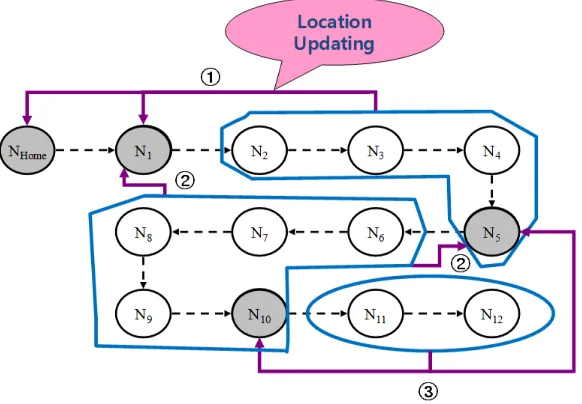
Then, we assume that the value ofF is 1 in all examples shown later for ex-plaining. First, let us see how to perform failure-free operations of the algorithm using Fig. 1. In this figure, each circle stands for a service node and an agent
αis going to travel from its home to another 12 nodes in order. Also, each gray shaded circle stands for a forwarder of the agent. Initially, when the agent is cre-ated, its home node becomes the first forwarder and locator of the agent. Unlike the previous forwarding pointer-based protocols [10], [11], our protocol allows each agent to select only a few among its visiting nodes as its forwarders de-pending on its decision. In this example, when the agent is migrating from node
N1to nodeN2, it forcesN1to be its next forwarder. In this case, bothNhomeand
N1 become agentα’s two locators. Afterwards in our protocol, agentαshould register its location with its current locatorsNhome and N1 on every migration until it decides its new forwarder. When the agent is going toN6, it determines thatN5is a proper node as its next forwarder. Then,N5informsNhomethat both
Fig. 1.An illustration of our location updating procedure on locators
In this way, our algorithm can control adaptively the tradeoff between location updating and message delivery costs depending on agent’s preferences.
4.2. Atomic Message Delivery Operation to Mobile Agent Groups
To ensure messages to a mobile agent group be reliably delivered to all the live members of the group in the same order, our protocol requires the following data structures for sending or receiving agents. First, every agentαin a group
gshould keep the following membership information.
•GM Inf og,α: a table for saving location information of the other agents which
are members of agent groupg. Its element is a tuple (agent id,l f wdrs).l f wrdrs
is a set of identifiers of every other agentagent id’s most recent forwarders. Ini-tially,agent id’s most recent forwarder is set to its home node inl f wdrs.
Each sending agentβ has to maintain the following mobile agent location cache.
•GM Cacheβ: It is a table which temporarily keeps location information of each
mobile agent which agent β communicates with. Its element consists of four fields, group id, agent id, l f wdrs and agent t.l f wdrs is a set of identifiers of the nodes which agent β guesses are locators of agentagent id in group
l f wdrs, the messages are sent to the home node of agentagent id.agent tis the timestamp assigned to agentagent id when the agent registered with the latest among all locators inl f wdrs.
In our protocol, among mobile agents in a group, a group leader is selected and determines the order of each received message. If a sending agentβ is attempting to transmit a message mto a group g, it broadcasts the message to the latest forwarder γ of every member agent α of group g by consulting
GM Cacheβ. Then, messagemcan be routed fromγto a live locator of agent
αand then arrive at the node where agentαis currently running. At this time, delivering the message to agent α’s application should be delayed until the message order is determined in the group. When the group leader receives the message, it assigns a sequence number to the message and informs the other members of the number based on its GM Inf og,leader. If a memberαdetects
missing an message sent to its group occurring from its sender’s failure when the agent has obtained the delivery order of the message from its group leader, it has to solicit the leader to retransmit the message. Afterwards, each mem-ber agent can deliver the message to the corresponding application in order. In this case, the agent must delay executing all the output commit actions[7] depending on the messages delivered until the group agreement on their deliv-ery orders is completed. Additionally, it should keep both the identifier and the delivery sequence number of the message with itself into its buffer and acknowl-edges the number assignment to the group leader. Then, the leader notifies its live members of the group agreement on the message delivery order. After re-ceiving the global commitment from the leader, each non-faulty member can purge the information for the multicast message from its buffer.
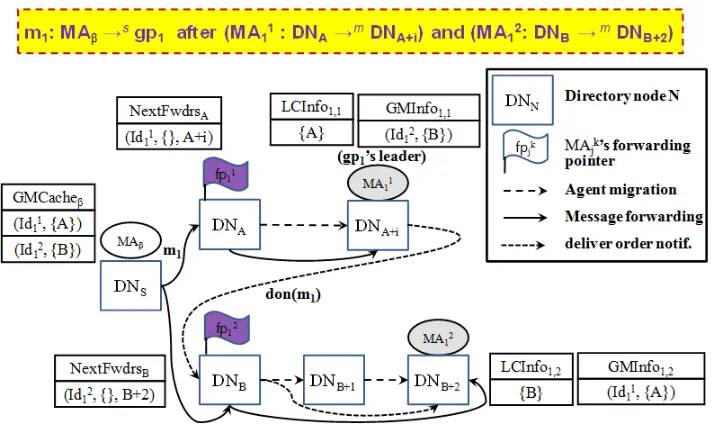
Let us illustrate how our atomic message delivery algorithm based on the fault-tolerant location updating algorithm mentioned in section 4.1 satisfies our goal using three examples. In Fig. 2, there is a mobile agent group gp1 con-sisting of two agentsM A1
1andM A21, which move from their home nodesDNA
and DNB to new nodes DNA+i and DNB+2 according to their itineraries. In this case, agentsM A11’s andM A21’s first locators becomeDNA andDNB
re-spectively, which manage the current location information of the two agents inN extF wdrsA and N extF wdrsB. Also, suppose that the first agent M A11 is the groupgp1’s leader. Each agent has to maintain the location information of the other agent members in its group like GM Inf o1,1 andGM Inf o1,2.
After-wards, a sending agentM Aβon nodeDNS attempts to send a messagem1to groupgp1. In our protocol, each sending agent keeps an agent group location information cache to accelerate message delivery to its frequently communi-cating agent or agent group. The cache is initially set to record each agent’s home node information in its corresponding element likeGM Cacheβ. Thus, in
this case, as the sending agent has no short-cut information to agent mem-bers of groupgp1, it sends the message to their respective home nodesDNA
andDNB, which forward the message to their corresponding agents by looking
Fig. 2.In case agent M Aβ sends a messagem1 to groupgp1 after two agentsM A11
andM A21ingp1moved to nodesDNA+iandDNB+2respectively
shouldn’t deliver it to the corresponding application until its group leader noti-fies itself of the global sequence number of the message to ensure the atomic message delivery condition. So, the group leaderM A1
1increases the global se-quence number by one and informs the other agent members of the number by sending a control messagedon(m1)with it based on its membership informa-tionGM Inf o1,1. Then, the control message is transmitted to agentM A21via its current locatorDNB allowing the messagem1 to be delivered to the applica-tion. Hereafter, although the following procedure isn’t drawn in this figure, the global agreement on the message delivery order should be reached and then notified its live members.
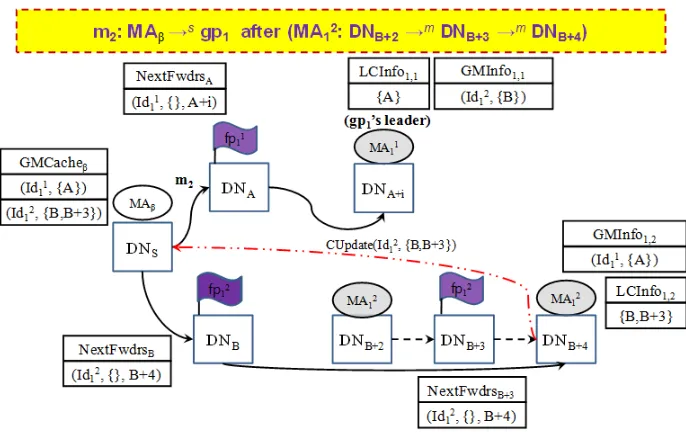
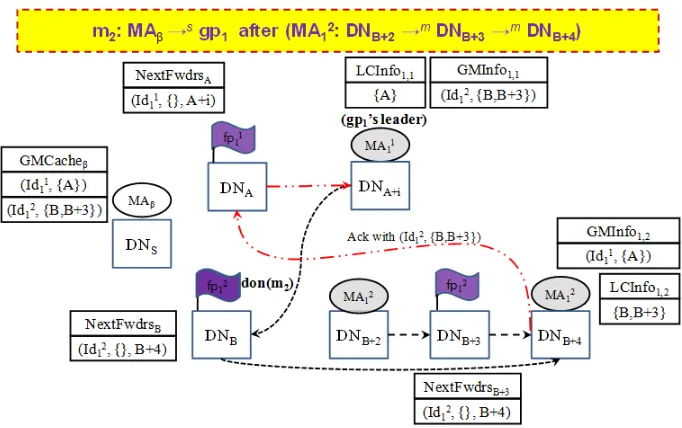
Fig. 3 and 4 show an example that the second agentM A21migrates to new nodesDNB+3 andDNB+4 in order before the sending agentM Aβ are going
to send another message m2 to group gp1. In this example, as M A21 moves from DNB+3 to DNB+4, it decides DNB+3 is a proper node as its new loca-tor. From this time, M A2
1 will directly be located by both DNB and DNB+3.
Then, the message m2 can be forwarded to all the agent members of group
gp1in the same way as mentioned above. But, in Fig. 3, asM A2
1can recognize the sending agent didn’t have the new locator’s information, it informs M Aβ
of the information by sending a message CU pdate including its two locators’ information for considering locator’s failure. In this case,M Aβupdates the
sec-ond agent’s locators information on its location cacheGM Cacheβ. Afterwards,
mes-Fig. 3.In case M Aβ sends a messagem2 togp1 afterM A21 has migrated toDNB+3
andDNB+4in order
sages can be forwarded directly to the new locator closer to the second agent by consulting the cache, causing message delivery to be accelerated. When
M A2
1 receives a control message don(m2) from its group leader M A11 like in Fig. 4, it can update the leader on its new locator assignment when returning an acknowledgement about the message delivery number to the leader.
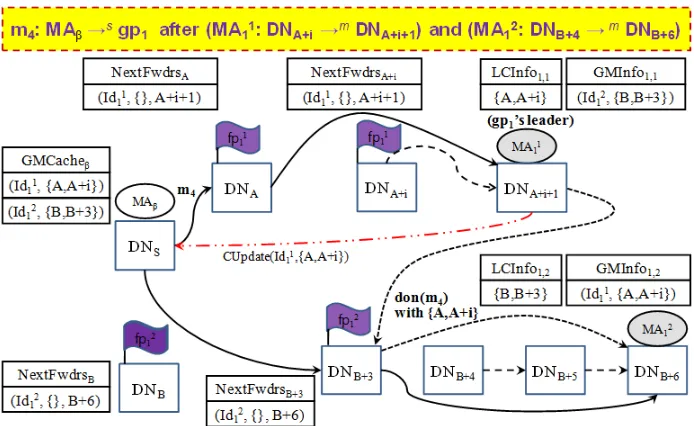
Fig. 5 illustrates how the group leaderM A11 updates sending agents like
M Aβ and its own agent members likeM A21on its new locator selection during its migration. In this example,DNA+i becomes the leader’s second locator. In
this case, as a new messagem4is first forwarded byDNAtoM A11,M A11 noti-fiesM Aβ of its two locators information on a control messageCU pdate. Also,
whenM A1
1 informsM A21 ofm4’s delivery number, its two locators information in messagedon(m4)can be reflected onM A21’s membership tableGM Inf o1,2.
4.3. Recovery Operation
Fig. 4.In case M Aβ sends a messagem2 togp1 afterM A21 has migrated toDNB+3
andDNB+4in order(continued)
number of messages destined to their group. Then, the leader should force the other live agent members to receive the global delivery sequence numbers of all the messages which it has delivered, but they haven’t yet, and deliver the messages in the same order. Afterwards, the following acknowledgement and global commitment procedures mentioned in section 4.2 are performed.
5.
Correctness
This section proves liveness and safety of our proposed mobile agent group communication protocol using 5 lemmas.
5.1. Liveness
This section shows our protocol ensure validity and agreement properties in order.
Definition 1. M sgP assingRouteT oM A(msg, AIDT, AIDS)is a sequence <
DNi, DNi+1, ..., DNn>of forwarders of the target mobile agentAIDT
consti-tuting a route with no cycle for transmitting a messagemsg from the sending mobile agentAIDS to DNn in our protocol. In here, the last forwarderDNn is
the only live locator of agent AIDT in M sgP assingRouteT oM A(msg, AIDT,
Fig. 5. In case M Aβ sends a messagem4 to gp1 afterM A11 and M A21 have visited DNA+i+1andDNB+6respectively
For any node pair,DNαandDNβ, in the route (i ≤α < β ≤n), agentAIDT
has visitedDNαbeforeDNβ.
Lemma 1. If more thanF forwarders for any target mobile agentAIDT have
been created in our protocol, M sgP assingRouteT oM A(msg, AIDT, AIDS)is
always made even in case ofF failures of its forwarders.
Proof. We prove this lemma by contradiction. Assume that our protocol may not make a routeM sgP assingRouteT oM A(msg, AIDT, AIDS)ifFforwarders
or fewer crash. This assumption means there exists one forwarder DNϵ, not
locator, that cannot progress sending msg to its immediate successor from
AIDS any longer. However, according to our protocol, the second element of
N extF wdrsDNϵ,l nextf wdrs, contains identifiers of itsF+1 immediate
succes-sors. So, even if, among them,F successors fail,DNϵcan forwardmsgto the
only live oneDNϵ+1. As no more failures of forwarders will occur later,msgcan
be eventually delivered to the last forwarderDNn fromDNϵ+1.
Therefore, the route M sgP assingRouteT oM A(msg, AIDT, AIDS) made by
our protocol exists even in case of F failures. This contradicts the
hypothe-sis.
Lemma 2. If an agentδsends a messagemto any memberµof mobile agent groupgpi in our protocol, the message is eventually delivered to the member
Proof.Suppose that the messagemshould be delivered to the agentµ, and the sender agentδand the receiver agentµare currently running on nodesDNα
andDNβ respectively. WhenDNα attempts to send the message to agentµ,
DNαfirst looks up the address of the most recent forwarder forµfrom its agent
location cacheGM Cacheα. If there is the address in the cache,DNαsends the
message to this address. Otherwise, it obtains the address of µ’s home node fromµ’s identifier and then sends the message to the address. In both cases, suppose the forwarder is denoted by DNγ. The proof proceeds by induction
on the number of all the forwarders∈M sgP assingRouteT oM A(msg, µ, δ), de-noted by|M sgP assingRouteT oM A(msg, µ, δ)|.
[Base case]
In this case,DNγ is the locator of agentµ. Therefore, the following two cases
should be considered.
Case 1:γ=β.
In this case,DNβcan findµ’s location informationefrom a list of agents running
onDNβ. There are two subcases considered.
Case 1.1:e.migrate f = 0.
In this case, the messagemsg is trivially delivered toµbecauseµis currently running on nodeDNβ.
Case 1.2:e.migrate f = 1.
In this case, agentµattempts to move to another nodeDNτ. Thus, the
mes-sage is saved on µ’s message queue e.msg Q in N extF wdrsDNγ until the
movement process is completed. After agentµhas migrated toDNτ, the
mes-sage can be correctly delivered to µfrom its queue on DNγ when the agent
resumes its execution on the nodeDNτ.
Case 2:γ < β.
In this case,DNγ looks upµ’s location informationefromN extF wdrsγ. Then,
it checks the value of a flag variablee.migrate f. There are two subcases ac-cording to the value.
Case 2.1:e.migrate f = 0.
In this case, the message is sent directly toDNβ. Then, the subsequent
pro-cedure is performed like in case 1.1. Therefore, µ can correctly receive the message.
Case 2.2:e.migrate f = 1.
In this case, agent µ is migrating to another node DNτ. Thus, the message
is buffered into µ’s message queue e.msg Q inN extF wdrsγ until the
move-ment process is completed. After the migration, the value of a flag variable
e.migrate f changes to0 and then the message recorded in the queue is for-warded toDNτ. Therefore, the message can be correctly delivered toµ.
[Induction hypothesis]
We assume that the lemma is true for the messagemsgin case that|M sgP assingRouteT oM A
(msg, µ, δ)|=k.
[Induction step]
After the message has been safely routed to thek-th forwarderDNωby
Then, it forwards the message to the (k+1)-th forwarderDNϵ, which is the
loca-tor of agentµ. The following case is similar to the base case mentioned above. Therefore, the message can be correctly delivered toµ.
By induction, our protocol enables the messagemsent from the senderδto be correctly delivered to any member µof the agent groupgpi despite its
move-ments.
Lemma 3. Our protocol terminates within a finite time.
Proof.There are two cases there may occur blocking in our protocol.
Case 1: agents migrate to another nodes or some of forwarders fail. For this case, lemmas 1 and 2 proved that there is no blocking involved.
Case 2: the group leaderlcurof a mobile agent groupgpifails.
In this case, a new group leader lnew having the most recent message mlast
whose delivery order is assigned bylcuris elected among the other group
mem-bers and takes overlcur’s role. Assumelvalis the value of the delivery order of
mlastthat has been delivered bylnewbeforelcur’s failure. For ensuring liveness
of our recovery procedure, it should be shown that every live group member can deliver and acknowledge all the messages whose receipt order is less than or equal tolvalafter the procedure completed. According to the recovery pro-cedure, all the messages for which global commitment procedures terminated have already been purged from every group member’s buffer. The remaining messages with the delivery order up tolvaland their orders must be available in at leastlnew’s buffer because they are unable to be removed until the global
group agreement on their corresponding delivery orders has been completed. Thus, our recovery procedure enables every live group member to deliver them in order.
Therefore, our protocol terminates within a finite time.
5.2. Safety
This section shows our protocol ensure atomicity and total order properties in order.
Lemma 4. If a memberµin a mobile agent groupgpi delivers a messagem
and begins executing any output commit action depending onm,mis delivered by every live group member despiteµ’s future failures.
Proof. We prove this lemma by contradiction. Assume that our protocol dis-ables some agent members from deliveringm even ifµstarts performing any output commit action occurring after having deliveredmbeforeµ’s failure. This assumption means there are one or more live agents that may not deliver m
after the global group agreement on m’s delivery order has been completed. However, the agreement finalization should occur only after every live agent in groupgpi includingµhas received m’s delivery sequence order number from
Lemma 5. All live agent members of a mobile agent group deliver each mes-sage destined to the group in the same order.
Proof. We prove this lemma by contradiction. Assume that our protocol may not satisfy totally-ordered delivery condition in some cases. This assumption means there are one or more messages, denoted by DISORDERED, that live members of a mobile agent group gpi has delivered in different orders in
our protocol. There are two cases to be considered.
Case 1: the group leaderlcurofgpiis alive.
In this case, no message in DISORDERED may exist because every mes-sage destined togpi is always ordered only by the group leader during
failure-free operation.
Case 2: the group leaderlcurofgpifails.
In this case, a new group leaderlnewhaving the most recent message whose
delivery order is assigned bylcur is elected among the other group members
and takes overlcur’s role. Suppose thatackedis the value of the last message
to gpi delivered and acknowledged by all the group members including lnew
before lcur’s failure. Thus, the order of every message whose delivery order
is less than or equal to ackedis uniquely assigned by lcur. Secondly, assume
nackedis the value of the delivery order of the most recent message that has been delivered bylnew, but not acknowledged by all the group members before
lnewbecomes the group leader. All the messages with the delivery order up to
nackedare sequenced only bylcur and can be recovered bylnewlike in lemma
3. Additionally, no message with the delivery order larger than nacked might have been delivered by any live group member. Thereafter, lnew defines the
delivery order of all the messages whose order is greater thannacked.
Therefore, our protocol can guarantee totally-ordered delivery semantics in all the cases. This contradicts the hypothesis.
6.
Simulation
Hereafter, our protocol’s effectiveness will be analyzed with respect to message delivery time and location management overhead using a discrete-event simu-lation language [2]. The counterpart evaluated with ours is the representative faut-tolerant forwarding pointer-based protocol [11], having no agent group sup-port functionality like the other existing ones and sending a message destined to an agent group to each member of the group using its uni-cast primitive. For fair comparisons, this protocol is modified to be capable of ensuring totally-ordered and reliable message delivery like ours. The two compared protocols are each abbreviated by MAGCP(Mobile Agent Group Communication Proto-col) and MFPP(Moreau’s Forwarding Pointer-based ProtoProto-col) [11] in order. The number of node failures,F, they should both tolerate is set to 1, i.e., two loca-tors of each agent should exist. For this evaluation, two following performance indices should be explained. The one is LTMDtime, the average latency of
message is actually delivered to all group members. The other is LInfono, the
average number of agent location entries that each service node keeps on its storage. A simulated system is composed of 100 nodes each associated with a coordinate(x, y). They are all interconnected with each other. Any two adjacent nodes are connected with a LAN link having a bandwidth of 100 Mbps. For sim-plicity of this simulation, we assume that both bandwidth and propagation delay between any pair of nodes are proportional to their distance. In our simulation environment, there are several important simulation parameters as follows. The first is Setsnd, the set of nodes being capable of sending messages to a mobile
agent group. Nodes in the set are uniformly distributed along the entire net-work. The second is LChgthrd, the threshold which is required when a mobile
agent decides whether the current locator of the agent should be changed. If a randomly generated probability variableδfor an agentmais greater than its threshold LChgthrd when the agent attempts to migrate to another node, the
next node becomes the locator of the agent. In this simulation, it is assumed that the threshold LChgthrd is determined when its agent is created and isn’t
changed during the entire life cycle of its agent any more. The third is Staytime,
the mean time elapsed when a mobile agent stays at a node for performing its task, following an exponential distribution. The last simulation parameter is MAGroupSizeno, the total number of agents created in the system and joining a
mobile agent group. Also, the size of each application message transmitted be-tween any two agents ranges from 512 bytes to 1 kbytes and the size of each control message for the inter-agent communication is 128 bytes. In addition, messages to the agent group are sent to the network with a interval following an exponential distribution with a mean Tms=100ms. All experimental results
shown in this simulation are all averages over a number of trials.
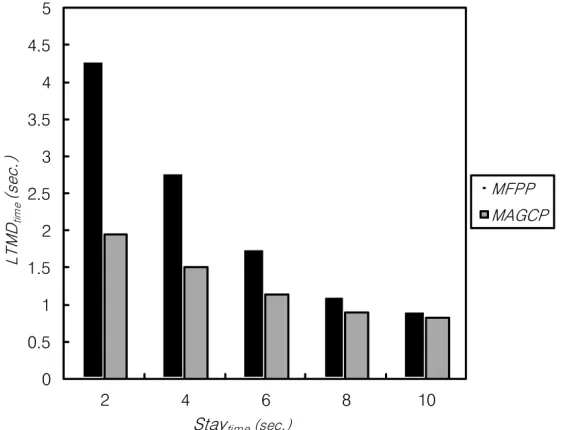
Fig. 6 shows the average message delivery time, LTMDtime, for the two
protocols, MFPP and MAGCP, for the specified range of the Staytime in case
MAGroupSizeno is 200 and Setsnd is 3. In this figure, as their Staytimes
de-crease, their LTMDtimes are contrarily becoming longer. This phenomenon
re-sults from the reason that short mobile agent’s stay period has length of the path for forwarding messages to the agent become longer. However, this figure indicates our protocol MAGCP reduces about 11.8-54.6% of LTMDtime
com-pared with MFPP. The first reason is that MAGCP allows each agent to choose the smaller number of message forwarders among all of its visiting nodes unlike MFPP. The second reason is that sender’s mobile agent group location cache of MAGCP may significantly accelerate the speed of message delivery to each agent member. In particular, as Staytimeis shorter, this figure demonstrates that
higher performance improvement in the message delivery time may be obtained from these desirable features of MAGCP.
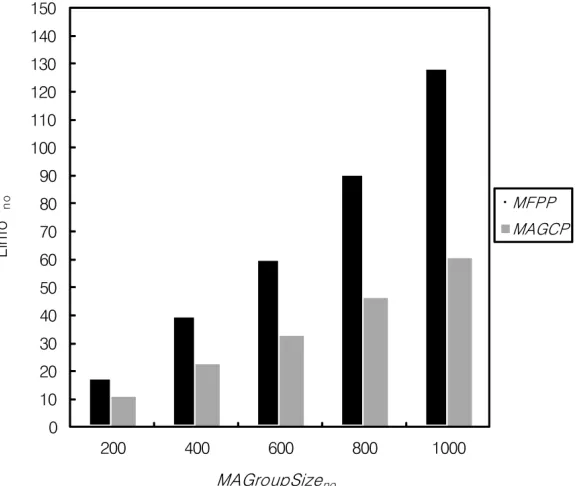
Fig. 7 shows the amount of agent location information kept by each ser-vice node, LInfono, for the two protocols with varying MAGroupSizeno in case
Staytime is 4 seconds and Setsnd is 3. As MAGroupSizeno becomes bigger,
their LInfonos are also increasing. This outcome arises from the reason that the
location entries each node should keep on its storage. But, this simulation re-sults indicate MAGCP reduces about 38-52%of LInfono compared with MFPP.
Especially, as MAGroupSizeno grows larger, the increasing rate of MAGCP’s
LInfonois stepping up at a much lower speed compared with MFPP’s.
Fig. 6.Message delivery time
7.
Conclusion
Fig. 7.Location management overhead
time to the targeted mobile agents to be shortened and message forwarding load imposing on agent location managers to decrease.
Acknowledgments.This work was supported by Kyonggi University Research Grant 2010(Project Number: 2010-003).
References
1. Ahn, J.: Lightweight Fault-tolerance Mechanism for Distributed Mobile Agent-based Monitoring. In Proceedings of the 6th IEEE Conference on Consumer Com-munications and Networking Conference. IEEE Press, Las Vegas, NV, USA, 1232-1236. (2009)
2. Bagrodia, R., Meyer, R., Takai, M., Chen, Y., Zeng, X., Martin, J., Song, H.: Parsec: A Parallel Simulation Environments for Complex Systems. IEEE Computer, Vol. 31, No. 10, 77-85. (1998)
3. Cao, J., Feng, X., Lu, J., Das, S.: Mailbox-based scheme for mobile agent commu-nications. IEEE Computer, Vol. 35, No. 9, 54-60. (2002)
5. Cooper, C., Klasing, R., Radzik, T.: Locating and repairing faults in a network with mobile agents. Theoretical Computer Science, Vol. 411, No. 14-15, 1638-1647. (2010)
6. Defago, X., Schiper, A., Urban., P.: Total Order Broadcast and Multicast Algo-rithms: Taxonomy and Survey. ACM Computing Surveys, Vol. 36, No. 4, 372-421. (2004)
7. Elnozahy, E. N., Alvisi, L., Wang, Y. M., Johnson, D. B.: A Survey of Rollback-Recovery Protocols in Message-Passing Systems. ACM Computing Surveys, Vol. 34, No. 3, 375-408. (2002)
8. Lin, K., Chen, M., Zeadally, S., Rodrigues, J.: Balancing energy consumption with mobile agents in wireless sensor networks. Future Generation Computer Systems, Vol. 28, No. 2, 446-456. (2012)
9. Milojicic, D., Breugst, M., Busse, I., Campbell, J., Covaci, S., Friedman, B., Kosaka, K., Lange, D., Ono, K., Oshima, M., Tham, C., Virdhagriswaran, S., White, J.: MASIF: The OMG Mobile Agent System Interoperability Facility. In: Rothermel, K., Hohl, F. (eds.): Mobile Agents. Lecture Notes in Computer Science, Vol. 1477. Springer-Verlag, Berlin Heidelberg New York, 50-67. (1998)
10. Moreau, L.: Distributed Directory Service and Message Router for Mobile Agents. Science of Computer Programming, Vol. 39, No. 2-3, 249-272. (2001)
11. Moreau, L.; A Fault-Tolerant Directory Service for Mobile Agents based on For-warding Pointers. In Proceedings of the 17th ACM Symposium on Applied Com-puting. ACM New York, Madrid, Spain, 93-100. (2002)
12. Murphy, A. L., and Picco, G. P.: Reliable Communication for Highly Mobile Agents. Journal of Autonomous Agents and Multi-Agent Systems, Vol. 5, No. 1, 81-100. (2002)
13. Perkins, C.: IP Mobility Support for IPv4, RFC 3344, (2002)
14. Schlichting, R. D., Schneider, F. B.: Fail-stop processors: an approach to design-ing fault-tolerant distributed computdesign-ing systems. ACM Transactions on Computer Systems, Vol. 1, No. 3, 222-238. (1985)
15. Schmidt, T. C., Wahlisch, M., Fairhurst, G.: Multicast Mobility in MIPv6: Problem Statement and Brief Survey. IRTF Internet Draft, No. 08, (2009).
16. Su, C., Wu, C.: JADE implemented mobile multi-agent based, distributed informa-tion platform for pervasive healthcare monitoring. Applied Soft Computing, Vol. 11, No. 1, 315-325. (2011)
Jinho Ahn received his B.S., M.S. and Ph.D. degrees in Computer Science and Engineering from Korea University, Republic of Korea, in 1997, 1999 and 2003, respectively. He has been an associate professor in Department of Computer Science, Kyonggi University since 2003. He has published more than 70 papers in refereed journals and conference proceedings and served as program or or-ganizing committee member or session chair in several domestic/international conferences and editor-in-chief of journal of Korean Institute of Information Technology and editorial board member of journal of Korean Society for In-ternet Information. His research interests include distributed computing, fault-tolerance, sensor networks and mobile agent systems.