
Software Testing Optimization by Advanced
Quantitative Defect Management
Ljubomir Lazić
State University of Novi Pazar, Vuka Karadzica bb, 36 300 Novi Pazar, Serbia
Abstract. Software testing provides a means to reduce errors, cut maintenance and overall software costs. Numerous software development and testing methodologies, tools, and techniques have emerged over the last few decades promising to enhance software quality. While it can be argued that there has been some improvement it is apparent that many of the techniques and tools are isolated to a specific lifecycle phase or functional area. This paper presents a set of best practice models and techniques integrated in optimized and quantitatively managed software testing process (OptimalSQM), expanding testing throughout the SDLC. Further, we explained how can Quantitative Defect Management Model be enhanced to be practically useful for determining which activities need to be addressed to improve the degree of early and cost-effective software fault detection with assured confidence is proposed. To enable software designers to achieve a higher quality for their design, a better insight into quality predictions for their design choices, test plans improvement using Simulated Defect Removal Cost Savings model is offered in this paper.
Keywords: Software Testing; Defect Management; Optimization.
1.
Introduction
This paper presents some research results of ongoing project [5-7]1, designed to study software defect data as a means toward identifying where resources should be allocated most effectively to provide the highest quality of software product while reducing the overall cost of software testing. The software development industry spends more than half of its budget on maintenance related activities. Software testing provides a means to reduce errors, cut maintenance and overall software costs. The importance of software testing has been emphasized more and more, as the quality of software affects its
benefit to companies significantly [1-4]. The identification and removal of software defects constitutes the basis of the software testing process a fact which inevitably places increased emphasis on defect related software measurements. Early in the history of software development, testing was confined to testing the finished code, but, testing is more of a quality control mechanism. Avoidable rework consumes a large part of development projects, i.e. 20-80 percent depending on the maturity of the organization and the complexity of the products [9]. High amounts of avoidable rework commonly occur when having many faults left to correct in late stages of a project. In fact, research studies indicate that the cost of rework could be decreased by up to 50 percent by finding more faults earlier [2, 5, 9]. Numerous software development and testing methodologies, tools, and techniques have emerged over the last few decades promising to enhance software quality. While it can be argued that there has been some improvement it is apparent that many of the techniques and tools are isolated to a specific lifecycle phase or functional area.
This paper focuses on software testing and the measurements which allow for the quantitative evaluation of this critical software development process. The software testing process requires practical measurements for the quantification of all software testing phases. Software product quality and software testing process (STP) improvement commence with addressing the testing process in a quantitative manner [7]. The continuous monitoring of the testing process allows for establishing an adequate level of confidence for the release of software products and for the quantification of software risks, elements which traditionally have plagued the software industry. The mechanism for this study is development of a series of simulation models to improve STP [7,8].
In this paper, Quality and Efficiency in Software Testing by our OptimalSQM framework is described and its components defined and exemplified. It also discusses practical applications of OptimalSQM and research model for investigating its antecedents and impacts is presented. OptimalSQM provide alignment between testing and development which has been raised as an issue for successful systems development. Missing however have been actionable how to methodologies for assessing and enhancing such alignment [12,13,16]. This paper attempts to fill this gap by describing a systematic methodology, a development-testing alignment (DTA) methodology which posits that such alignment leads to beneficial effects such as lower costs and shorter time of development, greater system quality, fewer errors and a better relationship between the corporate IT units.
scenarios at various abstraction levels of the SUT to manage stable (predictable and controllable) software testing process at lowest risk, at an affordable price and time.
To enable software designers to achieve a higher quality for their design, a better insight into quality predictions for their design choices, test plans improvement using Simulated Defect Removal Cost Savings model is offered in this paper. Much rather we aim to define a simulation method with which it is possible to assist the test manager in evaluating test plan alternatives and adjusting test process improvement decisions in a systematic manner.
2.
Need for Research
Cost to an organization (both in dollars and in image) is significant when software defects are identified after installation at a client site. This project intends to identify areas where improvements in software testing resource allocations would provide added value to the organization.
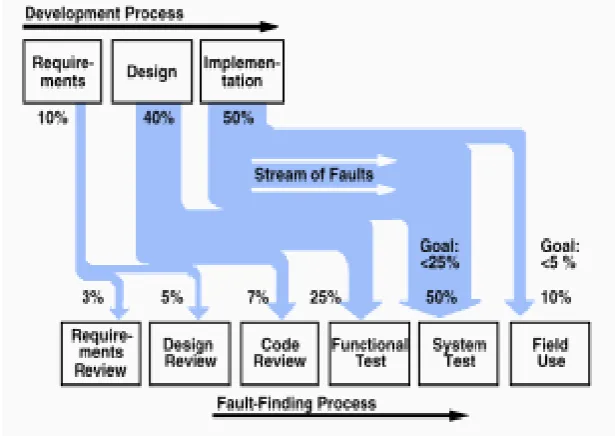
Fig. 1. Average Cost Of Defect Removal [10]
development and testing functions. The paper therefore decomposes DT alignment into a series of aspects for the purpose of assessing and analyzing each of the construct. These aspects are drawn from the overarching framework developed initially from prior literature [8,16]. The DTA methodology will allow IT managers to improve the effectiveness of testing and development by both synergistically integrating testing in the development process and by aligning the testing and development units in terms of strategy and execution capability.
Fig. 2. Alignment model for testing and development (adapted from [13])
To summarize, the purpose of this research is to increase software quality and reduce overall costs of software testing by focusing resources where they provide the most value. According to Gartner [14], on average, 7% of software functionality that was paid for is actually used, while 85% of IT projects failing to meet objectives (32% being cancelled outright). Dhaliwal and Onita [13] posit that many of these development failures are a result of poorly executed development process. These employ either inadequate development models or flawed implementation due, in part, to the lack of proper testing and effective collaborative mechanisms between testers and developers. These issues have not yet found a proper solution, due, in part, to a lack of a methodology that would allow the analysis and correction of software development processes. A review of the testing and development literature reveals that relations between the development and testing functions are lacking for projects of medium and large magnitude, where testing is separate from the development activities [12,15].
2.1. Research Questions
Based on the outcome of the evaluation of related work conducted in the previous subsection, the our project has identified some challenges to address. The challenges can be broken down into five sub-questions to address in this paper. The initial main research question that was posed for the complete research in this project was:
RQ1 or Main Research Question: How can software testing be performed efficiently and effectively i.e. Optimal, that is, do we have a framework model targeted specific software testing domains or problem classes described below in RQ2 to RQ5?
To be able to address the main research question several other research questions needed to be answered first (RQ2–RQ5). The first question that needed an answer, after the main research question was formulated, was:
RQ2: Which metric or set of metrics can assess effectiveness of test detecting techniques and what is the potential in combining different software testing techniques with respect to effectiveness (and to some extent efficiency)?
RQ3: Which metric or set of metrics can identify and prioritize software quality attributes, can assess cost of software quality management process in a specific project i.e. how to optimize software quality to pay off investment in STP improvement (ROI)?
To enable software designers to achieve a higher quality for their design, a better insight into quality predictions for their design choices that evolved to the RQ4:
RQ4: Which metric or set of metrics can identify and prioritize improvements to achieve early and cost-effective software fault detection, can assess the improvements potential of improving the degree of early and cost-effective software fault detection?
A systematic model which enables to minimize the cost of switching between test plan alternatives, when the current choice cannot fulfill the quality constraints, is proposed in this paper as one answer to the RQ4. This is main concern and contribution of this paper which is described in Section 5. New kinds of STP improvement is introduced and hence indirectly led to Research Question 5:
RQ5: How should a software development organization apply the metric(s) suggested above for assessing ongoing and finished projects with an Dynamic Control Model view i.e. What are optimality and stability criteria of very complex STP dynamics problem control?
Section 5 explain how can Quantitative Defect Management (QDM) Model be enhanced (as one solution to RQ4) to be practically useful for determining which activities need to be addressed to improve the degree of early and cost-effective software fault detection with assured confidence, optimality and stability criteria of very complex STP dynamics problem control which is partially solved in our paper [19].
3.
Integrated, quantitatively managed and optimized
software testing process - OptimalSQM solution
When design and testing activities are not coupled, the information testing provides on product design is delivered at a wrong point in the process. This late information is either not useful any more or shows design problems too late, causing undesired late rework. Thus, iteration cycles should be kept short and rapid.
To address the research questions stated above, multiple studies have been conducted [5-8] about alignment between the development and testing functions which can be defined as the strategic and operational fit between the development and testing functions on components of strategy and capabilities [13-16]. Since systems development as well as systems testing is integral parts of the corporate technology acquisition strategy, they too have to be aligned to ensure business success. In many organizations, there is a gap, or misalignment, at the strategic and/or execution level, between the development and testing groups as well as between individual testers and developers. To correct these misalignments, this paper proposes a methodology, grouped under the DTA model [13] that draws upon the strategic alignment model initially proposed in [16]. This DTA model focuses on the fit between the development and testing functions. A high level of integration of business and IT plans facilitates communication and collaboration [16]. Integration represents the level of linkage between development and testing, while correspondence represents how closely their capabilities mirror and complement each other. Varying levels of alignment can either promote or hinder integration and correspondence. This is a common characteristic of all alignment models in the literature as verified by Dhaliwal, J. and Onita C. in their work [13]. Figure 2 details the key structural and flow components of the DT alignment model for development and testing within the corporate IT unit. This model decomposes the alignment of the development and testing functions along three key flow dimensions: 1) strategic alignment, 2) capabilities alignment, and 3) strategy-execution alignment.
3.1. Integrated and Optimized Software Testing Process (IOSTP) framework - OptimalSQM solution
To answer the main research question (RQ1) we applied DTA model, described above, in OptimalSQM framework which combine best practice from Design of Experiments, Modeling & Simulation, integrated practical software measurement, Six Sigma strategy, Earned (Economic) Value Management (EVM) and Risk Management (RM) methodology through simulation-based software testing scenarios at various abstraction levels of the software under test (SUT) to manage stable (predictable and controllable) software testing process at lowest risk, at an affordable price and time [8,9], [17,18] as depicted in Fig. 3. Unlike conventional approaches to software testing (e.g. structural and functional testing) which are applied to the software under test without an explicit optimization goal, the IOSTP with embedded Risk Based Optimized STP (RBOSTP) approach designs an optimal testing strategy to achieve an explicit optimization goal, given a priori [8,17]. This leads to an adaptive software testing strategy. A non-adaptive software testing strategy specifies what test suite or what next test case should be generated, e.g. random testing methods, whereas an adaptive software testing strategy specifies what testing policy should be employed next and thus, in turn, what test suite or test case should be generated next in accordance with the new testing policy to maximize test activity efficacy and efficiency subject to time-schedule and budget constraints.
Fig. 3. Integrated and optimized software testing process (IOSTP) framework, core of OptimalSQM framework [17]
The main components of IOSTP with embedded RBOSTP approach to STP:
Integrate testing into the entire development process
Implement test planning early in the life cycle via Simulation based assessment of test scenarios
Automate testing, where practical to increase testing efficiency Measure and manage testing process to maximize risk reduction
Exploit Design of Experiments techniques (optimized design plans, Orthogonal Arrays etc.)
Apply Modeling and Simulation combined with Prototyping
Continually improve testing process by pro-active, preventive (failure mode analysis) Six Sigma DMAIC model
Continually monitor Cost-Performance Trade-Offs (Risk-based Optimization model, Economic Value and ROI driven STP).
In order to significantly improve software testing efficiency and effectiveness for the detection and removal of requirements and design defects in our framework of IOSTP, during 3 years of the IOSTP framework deployment to STP of embedded-software critical system such as Automated Target Tracking Radar System (ATTRS) [17], we calculated overall value returned on each dollar invested i.e. ROI of 100:1 .
4.
Optimum DDTs combination selection and optimization
study in OptimalSQM
The research question - RQ2 divided the research, as presented in this paper, into two areas covering effectiveness in software testing techniques (defect detection techniques – DDT) and efficiency in software testing with development-testing alignment (DTA) methodology [5-9]. Such alignment leads to beneficial effects such as lower costs and shorter time of development, greater system quality, fewer errors and a better relationship between the corporate IT unit and customers in business functions who have commissioned new systems. To begin with RQ2, the research aimed at exploring the factor of defect detection and removing effectiveness (DRE) during SDLC is answered in our work [6]. Here is brief description of main ideas of RQ2 answer.
4.1. Statement Of the Problem - Defect removal effectiveness
DRE = E/(E+D) (1) Where E is the number of errors found before delivery to the end user, and
D is the number of errors found after delivery. The goal is to have DRE close to 100%. The same approach is applied to every test phase denoted wit i as shown on Fig. 4:
DREi = Ei / ( Ei+ Ei+1) (2)
Where Ei is the number of errors found in a software engineering activity i, and Ei+1 is the number of errors that were traceable to errors that were not discovered in software engineering activity i. The goal is to have this DREi approach to 100% as well i.e., errors are filtered out before they reach the next activity. Projects that use the same team and the same development processes can reasonably expect that the DRE from one project to the next are similar. For example, if on the previous project, you removed 80% of the possible requirements defects using inspections, then you can expect to remove ~80% on the next project. Or if you know that your historical data shows that you typically remove 90% before shipment, and for this project, you‟ve used the same process, met the same kind of release criteria, and have found 400 defects so far, then there probably are ~50 defects that you will find after you release. How to combine Defect Detection Technique to achieve high DRE, let say >85%, as a threshold for IOSTP required effectiveness [2-5], is explained in this section, which describe optimum combination of software defect detection techniques choices.
Note that the defects discussed in this section include all severity levels, ranging from severity 1: activity stoppers, down to severity 4. Obviously, it is important to measure defect severity levels as well as recording numbers of defects.
4.2. The optimum combination of software defect detection techniques choices determination
Planning, managing, executing, and documenting testing as a key process activity during all stages of development is an incredibly difficult process. There is strong demand for software testing effectiveness and efficiency increases. Software/System testing effectiveness is mainly measured by percentage of defect detection and defect leakage (containment), i.e. late defect discovery. Software testing efficiency is mainly measured by dollars spent per defect found and hours spent per defect found. The first step of test strategy definition is to decide what to test in the SDP process as described in [3,20,23]. The requirements verification matrix method supports this goal by cross-referencing each product requirement with suitable verification methods (inspection, analysis, demonstration, or test), verification classes (design proof, first article, or production), and special verification procedures (e.g., Failure Mode and Effect Analysis, Design of Experiments, Finite Element Method, etc.). Product requirements with high priority are the critical requirements, where test planning has to concentrate its resources.
The process is a building block approach designed to build upon the strengths and minimize the weakness of each testing technique and available resources. Main task was to develop a versatile optimization model [8] for assessing the cost, duration and effectiveness of alternative test scenario through feasible series of experiments: software test method, field test, through simulation, or through a combination, which represent sequence of test events.
Such scenarios are invaluable for determining where testing resources should be spent at the beginning of software development project. With an optimized testing solution, you can create what-if scenarios to help users understand the impact of changing risks, cycle attributes and requirements as priorities change. This insight proves invaluable when a testing organization is trying to determine the best way to balance quality with cost and schedule. By understanding the impact of different factors on testing, IT managers can identify the right balance.
against desired confidence levels and the limitations of both the resources and the analysis methods.
Our study [6] focuses on rapid multidisciplinary analysis and evaluation-on-a-DRE maximum-basis for DDT combination choices selection for each test phase activities in an traditional SDP i.e. P1- software requirement, P2- High level design, P3- Low Level Design, P4- code under test, P5- integration test, P6- system under test and finally P7- Acceptance test. Recall section 4, in our work [6], for Different Defect Detection Strategy and Techniques options, together with critical STP variables performance characteristics (e.g. DRE, cost, duration), in which we are studied to optimize design, development, test and evaluation cost using orthogonal arrays for computer experiments. The optimum combination of software defect detection techniques choices were determined applying orthogonal arrays constructed for post mortem designed experiment with collected defect data of a real project. First, we applied adapted Borda voting method, on similar way, to rank all used Defect Detection Techniques through software development life cycle from most-to-least performance and quality characteristics of DDT in revealing software faults (bugs, errors). In this way we reduced huge possible number of DDTs, in particular, the DDT with the highest Borda Count is the best DDT according to testers Performance and Quality multi-criteria assessment [6], the DDT with the second highest count is the next DDT with highest score, and so forth to only three most ranked DDT. According to testers assessment of 5 most frequently used DDT in IOSTP [6,]: DDT1= Inspection – DBR, DDT2= PBR, DDT3= CEG+BOR+MI, DDT4= M&S, DDT5= Hybrid (Category Partition, Boundary value analysis, Path testing etc.) three of DDTs have the highest rank 0 i.e. DDT1=DDT2=DDT4=0, then DDT3= CEG+BOR+MI is next ranked and the last was DDT5. Because of that we will group those three DDT with highest rank 0, call them Static Test Techniques – TT1 and treat all three DDTs as one factor in optimization experiment applying Orthogonal Arrays as Optimization Strategy. Next high Borda ranked DDT4= CEG+BOR+MI we designate with TT2 and the last ranked DDT5 as TT3.
As the next step, least squares regression analysis is used to fit the second order approximation model given by equation (3) to the DRE data in terms of the seven design variables Pi , i=1 to 7. This parametric model accounts for the response surface curvature (square terms) and two factor interactions (cross terms):
DRE (%) = 111.71 - 2.58 *P1 + 1.22*P2 -1.95*P3 - 7.61*P4 - 0.69*P5 + 0.94*P6 -13.04*P7 - 0.36*P22 + 1.46*P42 + 0.79*P52 - 0.36P62 + 3.15*P72
(3)
Note that, in this response surface approximation model, the parameter values for Pi design variables are restricted to 1 (TT1), or 2 (TT2), or 3 (TT3). In Table 1, a Maximum DRE (%) value and corresponding Test Techniques choices (TT1,TT2 and TT2) per test phase solution is given.
Table 1. Maximum DRE (%) value and corresponding Test Techniques choices per test phase solution [6, page 1335]
P1 P2 P3 P4 P5 P6 P7 DRE [%] TT1 TT2 TT1 TT1 TT3 TT2 TT2 94.3
At these levels, the IOSTP DRE was predicted to be 94.03 % using a second order prediction model (3). As a next step, a verification analysis was performed. The DRE (%) of an IOSTP calculated from these test techniques choices, according to the post-mortem real project data using optimized DDT choices from Table 1, we computed DRE (%) to be 93.43 % . Difference is 0.6%=94.03%-93.43% that is acceptable to validate our prediction model for DRE (%) in equation (3) for optimal DDT combination choice given in Table 1.
Optimal combination of DDT choices per phase P given in Table 1 made increase of about 6 %, compared to un-optimized DDTs combination per each test phase we used in our real project in which we achieved DRE of 87.43 % in our case study.
5.
Advanced Quantitative Defect Management (AQDM)
Model
quality attributes, can assess cost of software quality management process in a specific project i.e. how to optimize software quality?
In our work [19] we proposed a model that traces design decisions and the possible alternatives. With this model it is possible to minimize the cost of switching between design alternatives, when the current choice cannot fulfill the quality constraints.
5.1. Faults-Slip-Through (FST) Model
The partial answer to RQ5 can be found in our work [19], too. In this section we explain how can Quantitative Defect Management (QDM) Model be enhanced (as answer to RQ4) to be practically useful for determining which activities need to be addressed to improve the degree of early and cost-effective software fault detection with assured confidence.
The main objective of the case study presented in this section was to investigate how fault statistics could be used for removing unnecessary rework in the software development process. This was achieved through a measure called Faults-Slip-Through (FST) [9, Section 2], i.e. the measure tells which faults that would have been more cost-effective to find in earlier phases.
5.2. The defect containment measure
An error in an activity of development phase Pi (i=1 to N) is made that causes a failure (see Fig. 10-13). The failure leads to a reported anomaly. When the reported anomaly is analyzed, the fault(s) causing the failure is found and corrected. Rework is about revising an existing piece of software or related artifact. Therefore, a typical rework activity is to correct reported anomalies. Rework can be divided into two primary types of corrective work [9]:
Avoidable rework is work that would not have been needed if the
previous work would have been correct, complete, and consistent. Such rework consists of the effort spent on detecting and fixing software difficulties that could have been discovered earlier or avoided altogether [2,5].
Unavoidable rework is work that could not have been avoided because
the developers were not aware of or could not foresee the change when developing the software, e.g. changed user requirements or environmental constraints [9].
This section describes the selected method for how to achieve the objectives stated in the previous section. The method can be divided into the following three steps:
1. Determine which faults that should have been avoided or at least found earlier,
3. Determine the improvement potential from the results in (1) and (2). The three sub-sections below describe how to perform each of the three steps.
5.3. The raw defect containment data
This section is dedicated to a model for assessing a plan for SQA defect-removal effectiveness and cost. The model, a multiple filtering model as shown on Fig. 4, is based on data acquired from a survey of defect origins, percentages of defect removal achieved by various quality assurance activities, and the defect-removal costs incurred at the various development phases. The model enables quantitative comparison of quality assurance policies as realized in quality assurance plans. The application of the proposed model is based on three types of data, described under the following headings from [1, pages 135-142].
5.4. Defects removal improvement potential
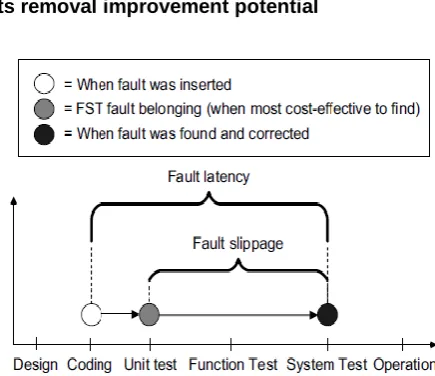
Fig. 5. Example of Fault Latency and FST
should be found in which phase. To be able to specify this, the organization must first determine what should be tested in which phase. Therefore, this can be seen as test strategy work. Thus, experienced developers, testers and managers should be involved in the creation of the definition. The results of the case study in Section 5.5 further exemplify how to create such a definition.
When having all the faults categorized, the next step is to estimate the cost of finding faults in different phases. From the measure, the improvement potential of different parts of the development process is estimated by calculating the cost of the faults that slipped through the phase where they should have been found (see Fig. 12 and 13 below). The usefulness of the method was demonstrated by applying it on two completed development projects [1] and [2]. The results determined that the implementation phase had the largest improvement potential since it caused the largest FST cost to later phases, i.e. from 56 to 87 percent of the total improvement potential in the two studied project scenarios. It is assumed that the filtering effectiveness of accumulated defects of each quality assurance activity is not less than 40% (i.e., an activity removes at least 40% of the incoming defects). Typical average defect filtering effectiveness rates for the various quality assurance activities, by development phase, based on Galin, D. [1] and 11. Boehm, B. et al [11], are listed in Table 2.
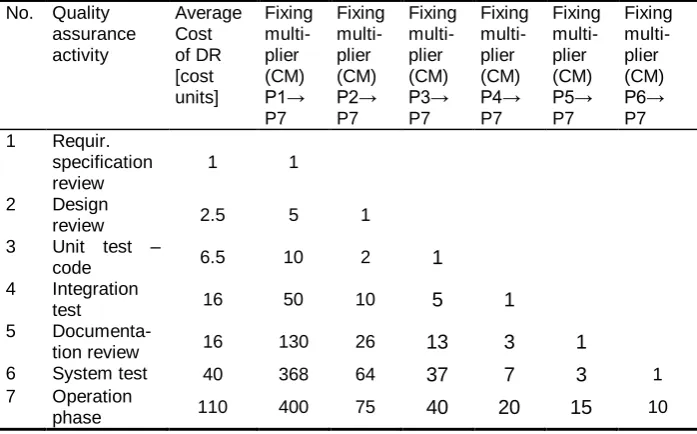
Data collected about development project costs show that the cost of removal of detected defects varies by development phase, while costs rise substantially as the development process proceeds. For example, removal of a design defect detected in the design phase may require an investment of 2.5 working days; removal of the same defect may require 40 working days during the acceptance tests. Estimates of effectiveness of software quality assurance tools and relative costs of defect removal are provided by McConnell [10]. Although defect removal data are quite rare, professionals agree that the proportional costs of defect removal have remained constant since the surveys conducted in the 1970s and 1980s. Instead of average per phase defect removal cost we propose average relative defect-removal costs injected in phase Pi (i=1 to 7) and detected and removed latter in downstream phases Pj,j>i up to the operation phase (j=7) as shown in Table 3.
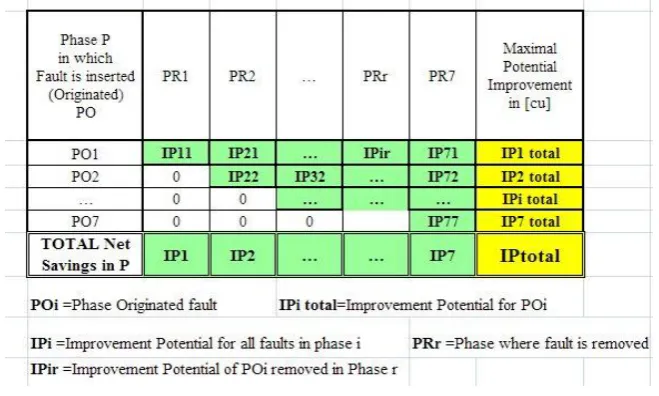
The improvement potential (IP) is determined by calculating the difference between the cost of faults in relation to what the fault cost would have been if none of them would have had slipped through the phase where they were supposed to be found. Figure 6. provides the elements of matrix, with corresponding formulas, for making such a calculation and the improvement potential can be calculated in a two-dimensional matrix. The formulae for calculating the improvement potential for each cell IPir is:
) , ( * ) , ( _ _ _ ) , ( * ) , ( _ _
_ faults in Pi r AverCDR r i No faults in Pi r AverCDR i i No
IPir
for i=1 to 7, and r i correspond to a cell in phase removed/originated matrix.
AverCDR(r,i) is average cost of faults originated in i and removed in r as
corresponding row/column. In order to demonstrate how to use and interpret the matrix, Figure 12 provides an example calculation by applying the previous formula on the values in the table in the Fig. 10. The most interesting cells are those in the rightmost column that summarizes the total cost of faults in relation to fault belonging and the bottom row that summarizes the total unnecessary cost of faults in relation to phase found. For example, the largest improvement potential is in the LL Design test phase, i.e. the phase triggered 30661 [cu] of unnecessary costs in later phases due to a large FST from faults injected in Requirement phase. Therefore, the primary usage of the values is to serve as input to an expected ROI calculation when prioritizing possible improvement actions according to formula:
ROI= (CostToFixOld - CostToFixNew) /CostToFixOld=39.2%.
5.5. Qunatitative Defect Removal Model
The model is based on the following assumptions:
■ The development process is linear and sequential, following the waterfall model of CMM Level 5. Software size is aproximately 100FP (1 injected defect/FP) i.e. for Java implementation about 50KLOC of source code [4].
Fig. 6. Matrix Formula for Calculation of Improvement Potential
■ A number of “new” defects are introduced in each development phase. For their distributions, see Fig. 8 and 9.
30, and the filtering efficiency is 60%, then 18 defects will beremoved, while 12 defects will remain and pass to be detected by the next quality assurance activity. Typical filtering effectiveness rates for the Standard quality assurance activities are shown in Table 2.
Table 2. Average filtering (defect removal - DR) effectiveness by Standard quality assurance activities plan, adapted from [1, pages 136-138]
No. Quality assurance activity Defect removal effectiveness
Average Cost of removing a detected defect (cost units) 1 Requirement specification review 50% 1
2 Design review 50% 2.5
3 Unit test – code 50% 6.5
4 Integration test 50% 16
5 Documentation review 50% 16
6 System test 50% 40
7 Operation phase 100% 110
■ At each phase, the incoming defects are the sum of defects not removed by the former quality assurance activity together with the “new” defects introduced (created) in the current development phase.
■ The cost of defect removal is calculated for each quality assurance activity by multiplying the number of defects removed by the relative cost of removing a defect (see Table 3, 3rd column).
■ The remaining defects, unfortunately passed to the customer, will be detected by him or her. In these circumstances, full removal entails the heaviest of defect-removal costs. In this model, each of the quality assurance activities is represented by a filter unit, as shown for Design in Fig. 7. The model presents the following quantities:
■ POD = Phase Originated Defects (from Fig. 8)
■ PD = Passed Defects (from former phase or former quality assurance activity)
■ %FE = % of Filtering Effectiveness (also termed % screening effectiveness) (from Table 2)
■ RD = Removed Defects
■ CDR = Average Cost of Defect Removal (from Table 2) ■ TRC = Total Removal Cost: TRC = RD ×CDR.
Table 3. Representative average relative defect-removal costs and fixing multiplier because FST
No. Quality assurance activity Average Cost of DR [cost units] Fixing multi-plier (CM) P1→ P7 Fixing multi-plier (CM) P2→ P7 Fixing multi-plier (CM) P3→ P7 Fixing multi-plier (CM) P4→ P7 Fixing multi-plier (CM) P5→ P7 Fixing multi-plier (CM) P6→ P7 1 Requir.
specification review
1 1
2 Design
review 2.5 5 1
3 Unit test –
code 6.5 10 2 1
4 Integration
test 16 50 10 5 1
5
Documenta-tion review 16 130 26 13 3 1
6 System test 40 368 64 37 7 3 1
7 Operation
phase 110 400 75 40 20 15 10
A comprehensive quality assurance (QA) plan (“comprehensive defects filtering system”) achieves the following:
(1) Adds two quality assurance activities, so that the two are performed in the design phase as well as in the coding phase;
(2) Improves the “filtering” effectiveness of other quality assurance activities. The comprehensive quality assurance plan can be characterized as shown in Table 4.
The main conclusions drawn from the comparison are:
(1) The standard plan successfully removes only 57.6% (28.8 defects out of 50) of the defects originated in the requirements and design phase, compared to 92.0% (46 defects out of 50) for the comprehensive plan, before coding begins.
(2) The comprehensive plan, as a whole, is much more economical than the standard plan as it saves 41% of total resources invested in defect removal, compared to the standard plan.
(3) Compared to the standard plan, the comprehensive plan makes a greater contribution to customer satisfaction by drastically reducing the rate of defects detected during regular operations (from 6.9 % to 3 %).
process-oriented illustration of the comprehensive quality assurance plan and model of the process of removing 100 defects is provided in Fig. 9. A comparison of the outcomes of the standard software quality plan versus the comprehensive plan is revealing as shown in Table 5.
Fig. 7. A filter unit for defect-removal effectiveness: example (100 defects) from [1]
Table 4. Average filtering (defect removal) effectiveness by Comprehensive quality assurance activities plan [1, page 140]
No. Quality assurance activity Defect removal effectiveness
Cost in [cu] of removing a detected defect 1 Requirement specification review 60% 1
2 Design inspection 70% 2.5
3 Design review 60% 2.5
4 Code inspection 70% 6.5
5 Unit test – code 40% 6.5
6 Integration test 60% 16
7 Documentation review 60% 16
8 System test 60% 40
Table 5. Comparison of the standard and comprehensive QA plans [1, page 142] No. Quality assurance
activity
Standad plan Comprehensive plan
Percentage of removed defects Cost of removing a detected defect (cost units) Percentage of removed defects Cost of removing a detected defect (cost units) 1 Requirement
specification review
7.5% 7.5 9% 9
2 Design inspection - - 28.7% 71.8
3 Design review 21.3% 53.2 7.4% 18.5
4 Code inspection - - 24.4% 158.6
5 Unit test – code 25..6% 166.4 4.2% 27.3 6 Integration test 17.8% 284.8 9.8% 156.8 7 Documentation
review 13.9% 222.4 9.9% 158.4
8 System test 7.0% 280 4% 160
Total for internal
QA activities 93.1% 1014.3 97.4% 760.4
Defects detected
during operation 6.9% 759 2.6% 286
Total 100.0% 1773.3 100.0% 1046.4
5.6. Simulation results of AQDM improvement
Unlike conventional approaches to software testing which are applied to the software under test without an explicit optimization goal, as described above, the OptimalSQM approach designs an optimal testing strategy to achieve an explicit optimization goal, given a priori [5,6]. Improvement of original project data from [2] given in Fig. 10 (Note: original Defect Removal Efficiency [%], shown on Fig. 11 is less then Standard quality assurance activities plan, Scenario 1 in Table 2).
Fig. 9. DRE of Comprehensive QA plan and model of the process of removing 100 defects [1]
The Simulated Defect Removal Cost Savings model, uses net savings approach that is calculated using this formula:
) (
* 1
1 Pr Pr
1 r r r r
r
r FST CM CM
IP
NS ,
r=1..6.
For the given large (~11300 FP, Java implementation about 600KLOC of source code) project example from [2], and for original data of process defect removal effectiveness given in Fig. 11, and simulated calculations of two Scenarios 1 and 2 are shown in Fig. 12, Fig.13 and Fig. 14.
Fig. 10. Original Software Process Defect Containment Matrix [2]
Fig. 12. Matrix with Calculation of Improvement Potential for Scenario 1
Fig. 13. Calculated Defect Containment Percentage Matrix – for original and anlized
Fig. 14. Graph with calculation of Improvement Potential in [cu] for Scenario 1 and 2 We described ind this section, as answer to the RQ4 and RQ5, a Software Quality Optimization strategy of OptimalSQM framework, which is a continuous, iterative process throughout the application lifecycle resulting in zero-defect software that delivers value from the moment it goes live, with Simulated Defect Removal Cost Savings model.
6.
Conclusion
designers to achieve a higher quality for their design, a better insight into quality predictions for their design choices, test plans improvement using Simulated Defect Removal Cost Savings model is offered in paper.
Finally, this paper presents and validates a method for measuring the efficiency of the software test process to achieve early and cost-effective software fault detection. That is, it determines how fault statistics can be used for assessing a test process and then quantify the improvement potential of changing the process. The described method assesses a software development organization through the following three steps:
1. Determine which faults that could have been avoided or at least found earlier, i.e. FST.
2. Determine the average cost of faults found in different phases. 3. Determine the improvement potential from the metrics obtained in (1)
and (2), i.e. measure the cost of not finding the faults in the right phase.
The practical applicability of the method was determined by applying it on two industrial software development projects. In the studied projects, potential improvements were foremost identified in the the largest improvement potential is in the LL Design test phase, i.e. the phase triggered 30661 [cu]
of unnecessary costs in later phases due to a large FST from faults injected in Requirement phase. Therefore, the primary usage of the values is to serve as input to an expected ROI calculation according to given formula, when prioritizing possible improvement actions we can improve DRE cost for ROI=39.2%. That is, the LL Design phase inserted, or did not capture faults present at least, too many faults that slipped through to later phases.
References
1. Galin, D.: Software Quality Assurance:From theory to implementation, Pearson Education Limited, ISBN 0201 70945 7, pp. 135-142. ( 2004)
2. Frost and, A., Campo,M.: Advancing Defect Containment to Quantitative Defect Man, CrossTalk, December. pp. 24-28, (2007)
3. Lim, S. So, Y, Cha, S. D. and Kwon, Y. R.: “An Empirical Study on Software Error Detection: Voting, Instrumentation, and Fagan Inspection,” Proceedings of the Asia-Pacific Software Engineering Conference, IEEE Computer Society Press, Dec. (1995)
4. Jones, C.: Estimating Software Costs. 2nd edition. McGraw-Hill, New York.(2007)
5. Lazić, Lj.,Mastorakis, N.:Cost Effective Software Test Metrics, WSEAS TRANSACTIONS on COMPUTERS , Issue 6, Volume 7, June. pp. 599-619, (2008)
6. Lazić, Lj., Mastorakis, N.:Orthogonal Array application for optimal combination of software defect detection techniques choices, WSEAS TRANSACTIONS on COMPUTERS, Issue 8, Volume 7, pp.1319-1336, August.(2008)
CONTROL, MODELLING & SIMULATION (ACMOS'09), Istanbul, Turkey, May 30,pp. 280-287, June 1.(2009)
8. Lazić, Lj.: The Integrated and Optimized Software Testing Process. PhD Thesis, School of Electrical Engineering, Belgrade, Serbia.( 2007)
9. Lars-Ola D.: Early and Cost-Effective Software Fault Detection, PhD Thesis, Blekinge Institute of Technology, SWEDEN, Section 2.(2007)
10. McConnell, S. :Professional Software Development, Addison Wesley, ISBN 0-321-19367-9.(2004)
11. Boehm, B. , Abts, C., Brown, A., Chulani,S., Clark, B.,Horowitz,E., Madachy,R., D. Reifer,D., Steece,B.: Software Cost Estimation with COCOMO II, Prentice Hall.(2000)
12. Cohen, C. F., Birkin, S. J., Garfield, M. J. and Webb, H. W.:Management Conflict in Software Testing. Communications of the ACM, 47(1),pp. 76-81. (2004)
13. Dhaliwal, J., Onita C., A framework for aligning Testing and Development, Proceedings of the Workshop on Advances & Innovations in Systems Testing. (2007)
14. Hunter and Blosch:Managing the New IT Risks”. Gartner.(2003)
15. Pettichord, B. :Testers and Developers Think Differently: Understanding and Utilizing the Diverse Traits of Key Players on your Team. Software Testing & Quality Engineering, 2(1), pp. 42-45. (2000)
16. Sabherwal, Hirschheim and Goles:Information systems – business strategy alignment: The dynamics of alignment: Insights form a punctuated equilibrium model. Strategic information management: Challenges and strategies in managing information systems, (Galliers and Leidner, Eds), Butterworh-Heinemann, Oxford pp 311-346. (2003)
17. Lazić Lj., Velasević, D.:Applying simulation and design of experiments to the embedded software testing process. STVR, Volume 14, Issue 4, John Willey & Sons, Ltd., p257-282. (2004)
18. Popovic S, and Lazic, Lj.:Orthogonal Array And Virtualization As A Method For Improvement Configuration Testing, Proceedings of 1st IEEE Eastern European Regional Conference on the Engineering of Computer Based Systems - ECBS-EERC 2009, Novi Sad, pp.148-149. (2009)
19. Lazić, Lj. , Kolašinac, A., Avdić, Dž.:The Software Quality Economics Model for Software Project Optimization. WSEAS TRANSACTIONS on COMPUTERS, Issue 1, Volume 8, pp.21-47.(January 2009)
20. Morasca, S., Serra-Capizzano, S.: On the analytical comparison of testing techniques. In: International Symposium on Software Testing and Analysis (ISSTA „04). Association for Computing Machinery, Boston, Massachusetts, USA, pp. 154–164. (2004)
21. Houston, D., Keats, B.:Cost of Software Quality: A Means of Promoting Software Process Improvement, Quality Engineering, 10:3, pp. 563-573, March. (1998)
22. Müller, M.:About the Return on Investment of Test-Driven Development", ICSE'03, Portland, Oregon. (2003)
23. Chen, T., Kuo, F, Merkel,R.: On the statistical properties of testing effectiveness measures. The Journal of Systems and Software 79,pp. 591–601. (2006) 24. Wang, Q. et al.:Estimating Fixing Effort and Schedule based on Defect
Ljubomir Lazić is an assistant professor of software engineering and computer science at State University of Novi Pazar, Serbia. He received the Ph.D. degree in electrotechnics from School of Electrical Engineering, Belgrade University in 2007. He was a Post-Doctoral Researcher at The WSEAS (The World Scientific and Engineering Academy and Society) of computer science from 2009 to 2010. So far, he has authored over 50 research papers. His current research interests are optimal software project management.
![Fig. 1. Average Cost Of Defect Removal [10]](https://thumb-us.123doks.com/thumbv2/123dok_us/1182932.1620984/3.595.178.416.375.580/fig-average-cost-defect-removal.webp)
![Fig. 2. Alignment model for testing and development (adapted from [13])](https://thumb-us.123doks.com/thumbv2/123dok_us/1182932.1620984/4.595.133.471.244.521/fig-alignment-model-testing-development-adapted.webp)
![Fig. 3. Integrated and optimized software testing process (IOSTP) framework, core of OptimalSQM framework [17]](https://thumb-us.123doks.com/thumbv2/123dok_us/1182932.1620984/8.595.209.389.427.590/integrated-optimized-software-testing-process-framework-optimalsqm-framework.webp)
![Table 2. Average filtering (defect removal - DR) effectiveness by Standard quality assurance activities plan, adapted from [1, pages 136-138]](https://thumb-us.123doks.com/thumbv2/123dok_us/1182932.1620984/18.595.123.472.239.371/average-filtering-removal-effectiveness-standard-quality-assurance-activities.webp)
![Table 4. Average filtering (defect removal) effectiveness by Comprehensive quality assurance activities plan [1, page 140]](https://thumb-us.123doks.com/thumbv2/123dok_us/1182932.1620984/20.595.169.432.212.422/average-filtering-removal-effectiveness-comprehensive-quality-assurance-activities.webp)
![Table 5. Comparison of the standard and comprehensive QA plans [1, page 142]](https://thumb-us.123doks.com/thumbv2/123dok_us/1182932.1620984/21.595.123.486.178.462/table-comparison-standard-comprehensive-qa-plans-page.webp)
