Sequential-ring Model for Elevator Group Control
Aljoša Vodopija1,2, Jörg Stork3, Thomas Bartz-Beielstein3, Bogdan Filipic1,2 1Department of Intelligent Systems, Jozef Stefan Institute, Jamova cesta 39
SI-1000 Ljubljana, Slovenia
aljosa.vodopija
2Jozef Stefan International Postgraduate School, Jamova cesta 39
SI-1000 Ljubljana, Slovenia
3TH Köln, Institute of Data Science, Engineering, and Analytics, Steinmüllerallee 1
D-51643 Gummersbach, Germany
joerg.stork, [email protected]
ABSTRACT: The relevant control strategy for the elevator group controller (EGC) is a complex optimization issue with several objectives. We in this paper have proposed the sequential-ring (S-Ring) model of EGC systems and a biobjective formulation of the EGC optimization problem. Unlike the previous work, we use true multiobjective optimizers in solving this problem. The testing on three real-world elevator systems has revealed the possible trade-os between the objectives and offer a valuable insight into the problem.
Keywords: Elevator Group Control, S-Ring, Perceptron, Multiobjective Optimization, NSGA-II, DEMO
Received: 12 June 2018, Revised 20 July 2018, Accepted 28 July 2018
© 2018 DLINE. All Rights Reserved
1. Introduction
While EGC optimization problems are widely discussed and known for involving conflicting objectives, they are seldom solved with true multiobjective optimization. Hakonen et al. [3] utilize a set of objectives, such as the customer waiting time, the ride time, and the total number of elevator stops, but combine them linearly into a single objective. Tyni and Ylinen [7] use a weighted aggregation method to optimize the landing call waiting time and energy consumption with an evolutionary algorithm in a real-time environment. In Sahin et al. [6], a real-real-time monitoring system is installed to reduce the number of redundant stops, and improve passenger comfort and energy consumption. In [1], an approximation model for EGC systems, the so-called sequential ring (S-Ring) [4], is used to benchmark single-objective heuristics. Using the S-Ring model, it is possible to retain a high level of complexity and optimize an EGC control strategy using modern heuristics with a high number of strategy evaluations, while keeping a feasible computational load.
In this paper, we utilize the S-Ring model of EGC systems and propose a biobjective formulation of the EGC optimization problem. In this formulation, the objectives are normalized to allow for comparison of results for elevator systems of various configurations. As opposed to previous work, we apply true multiobjective optimizers capable of finding approximations for Pareto-optimal solutions that represent tradeo s between the objectives. Specifically, we use two multiobjective evolutionary algorithms (MOEAs) and demonstrate their performance in optimizing EGC for three real-world elevator systems.
The paper is further organized as follows. Section 2 introduces the S-Ring model, explains its elements and illustrates it with an example. Section 3 provides the optimization problem formulation. In Section 4, numerical experiments on the three test elevator systems and the results are presented. Section 5 concludes the paper by summarizing the study and planning future work.
2. S-ring Model of Elevator Group Control
The S-Ring is a discrete, nontrivial event system to optimize and benchmark control strategies without the need to use expensive EGC simulators [4]. It focuses on modeling the operation of an elevator system, i.e., handling the passenger traffic and serving passengers in the fastest and most comfortable way. We adapted the S-Ring model to feature two service quality related objectives as described in Section 3.
In general, the S-Ring consists of three key elements:
• The deterministic state-space representation of the elevator control inputs for the customers ciand elevator cars si, i = {1,...,
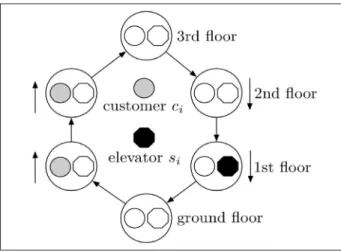
Ns}, where Ns = 2n− 2 is the number of states, while n is the number of floors. Figure 1 shows an example of this state-space representation. The size of the S-Ring depends on the number of floors n, and the number of active elevator states is equal to the number of elevator cars m. The number of currently active customer states is influenced by the probability of a new arriving customer, p.
Figure 1. S-Ring: No waiting customer at the ground and floor (\0"), two customers who want to go up on the first and second floor (\1,1"), and no customers who want to go down on the third, second and first floor (\0,0,0"). By combining these information we obtain the following state vector for waiting customers: (0,1,1,0,0,0). The state vector for the elevator is
• The state transition table, which is explained in detail by Markon [4], defines fixed and dynamic rules for a transition in the current position of the S-Ring. If no fixed rule is triggered, the dynamic rules decide how the state transition is performed. They are established by a control policy.
• The control policy π can be realized by a lookup table, but as its size grows exponentially with n, it is maintained by a perceptron with a weight vector of length ⎮w⎮ = 2Ns. The perceptron represents the most elementary implementation of neural network (NN). For a given setup of n, m and p the objectives are only influenced by the weight vector w of the NN controller and the number of state transition steps, Nt. At each state, it is first checked whether a new customer arrived. Next, if the current state is an active elevator state, the controller determines whether the elevator car stops or continues to the next state. Finally, the indication of the customer active state is updated depending on whether or not the customers were served.
Due to its low computational costs, the S-Ring can quickly evaluate a broad variety of EGC instances as benchmarks for the proposed multiobjective optimization approach.
3. Optimization Problem Formulation
In this work, we deal with two EGC objectives that are often studied in the literature and both need to be minimized: i) the average number of states with waiting customers, and ii) the total number of elevator stops [3, 6, 7]. In contrast to previous publications, we do not combine the objectives into a single function, but adopt the multiobjective perspective. Moreover, to make it possible to compare the performance of elevator systems of various configurations (determined by the number of floors n and the number of elevator cars m), we consider normalized objective function values.
The first objective (h1) is the proportion of states with waiting customers. It is expressed as the average number of states with waiting customers, Mw, divided by the number of all states, Ns:
The second objective (h2) is the proportion of elevator stops. It is equal to the total number of elevator stops, Mt, divided by the maximum possible number of elevator stops. The latter can be calculated as the number of elevator cars m multiplied by the number of EGC simulation cycles, which is in turn equal to the number of state transition steps, Nt, divided by the number of states, Ns, therefore
Intuitively, the customers’ discomfort with long waiting times and long riding times due to many elevator stops does not increase linearly with time, but more drastically. To model this effect, we have additionally modified the original objectives as
f1 = hα1 and f2 = hβ2
where α, β ∈ [1, 2] are the objective function coefficients. The choice of their values is subjective, but the idea is to reflect the elevator system characteristics and the customer preferences.
The control policy π is represented by a perceptron as π (x) = (wTx), where x is a binary input vector, i.e., a concatenation of the
waiting customer and the elevator car state vectors of total length equal to 2(2n− 2) = 4(n− 1), θ is the Heaviside function, and w a vector of perceptron weights from W = [-1, 1]4(n − 1). In this framework, the policy π is defined by the weight vector w only.
Therefore, the decision space of the EGC optimization problem as defined here is equal to W.
4. Experiments and Results
The multiobjective optimization of EGC was experimentally evaluated on three test problems reflecting the characteristics of
real-h1 = NMw
s
(1)
h2 = Mt
mMt/Ns (2)
world elevator systems operating in various buildings in Ljubljana, Slovenia. They are as follows.
• S1: This system operates in a parking building (\Parking garage —Sentpeter”) situated in the city center. Intensive passenger traffic can be observed in the building on workdays.
• S2: This is an elevator system installed in a typical residential building in the densely populated neighborhood (\Nove Fu— zine”) in the eastern part of Ljubljana. Here the traffic intensity alternates between high (e.g., early in the morning) and low (e.g., at midday).
• S3: This is the elevator system in the\Crystal Palace”, a skyscraper situated in the north-western area of the city. With its 89 meters it is currently the tallest building in Slovenia. As an office building it has low passenger traffic.
The characteristics of these elevator systems are summarized in Table 1.
System n m p ααααα βββββ Ns
S1 7 2 0.6 1.0 1.5 12
S2 13 2 0.3 1.4 1.8 24
S3 21 4 0.2 1.5 1.5 40
Table 1. Characteristics of the test elevator systems: number of floors n, number of elevator cars m, probability of new arriving customer p, objective function coefficients α and β, number of states in the S-Ring representation Ns
Based on the multiobjective formulation of the EGC optimization problem, the experimental evaluation aimed at finding sets of trade-o solutions representing approximations for Pareto fronts. For this purpose we used two well known MOEAs: Nondominated Sorting Genetic Algorithm II (NSGA-II) [2] and Differential Evolution for Multiobjective Optimization (DEMO) [5]. The algorithms were assessed from the point of view of both effectiveness (quality of results) and efficiency (spent computational resources).
The experimental setup was defined in the following way. Both algorithms were run with populations of 100 solutions for 100 generations. Specifically, in NSGA-II, the crossover probability was set to 0.7 and the mutation probability to 0.2, while DEMO was run using the SPEA selection procedure, the crossover probability of 0.3 and the scaling factor of 0.5. On each test problem every MOEA was run 30 times, each time with a new randomly initialized population.
Population members were the perceptron weight vectors of length 2Ns = 4(n−1). Each solution was evaluated through a computer simulation of the perceptron EGC during which the values of objectives f1 and f2 were calculated. The simulation was performed for a predefined number of simulation cycles which was 100.000 for all test problems. As a consequence, the number of state transition steps was equal to Nt = 100:000Ns.
The quality of results of an algorithm run was measured with the hypervolume of the Pareto front approximation found in that run. Given f1, f2∈ [0, 1], the reference point for hypervolume calculations was set to (1:1; 1:1)T. As the computational efficiency
measure the execution time of algorithm runs was recorded. The experiments were run on a 3.50 GHz Intel(R) Xeon(R) E5-2637V4 CPU with 64 GB RAM.
The hypervolume and execution time results are shown in Table 2, both averaged over 30 runs of every MOEA on each test problem. From these results it is evident that regardless of the elevator system, the hypervolumes obtained with NSGA-II and DEMO are very similar. Standard deviations for both optimizers are small (less than 10-3), indicating robust and repeatable
algorithm behavior on all three elevator systems. Similarly, small deviations are present for execution times no matter which MOEA is used to produce approximations for Pareto fronts.
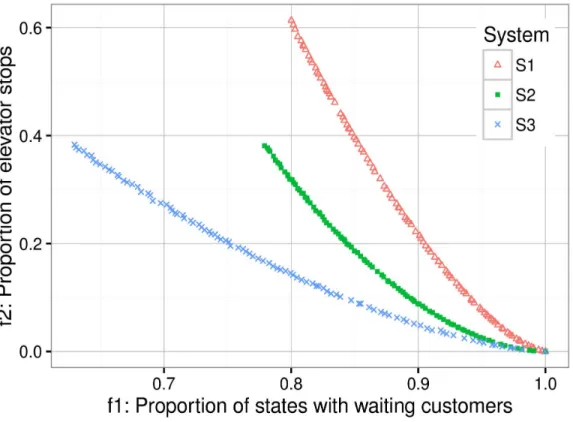
obtain well-distributed and very similar sets of solutions. The best solutions with respect to both objectives were found for system S3. This was expected since S3 has more elevator cars and a lower probability of new customer arrivals than S1 and S2.
Figure 2. Pareto front approximations for the test elevator systems produced by NSGA-II
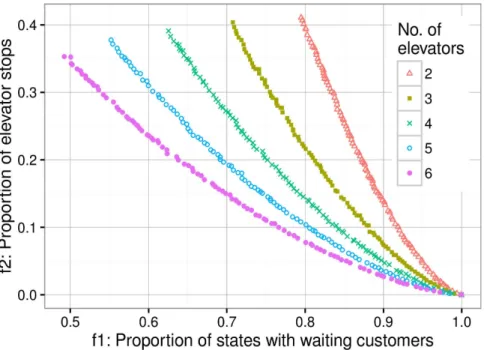
An additional experiment was devoted to the analysis of hypothetical variants of system S3 with various numbers of elevator cars. While S3 has its fixed configuration, such a study is relevant for designing elevator systems for new buildings and assessing potential configurations.
Pareto front approximations obtained with NSGA-II for variants of S3 with 2, 3, 4, 5 and 6 elevator cars are presented in Figure 4. The figure clearly shows how the number of cars affects the trade-o EGC policies. Higher number of cars implies policies that can reduce the proportion of states with waiting customers and the proportion of elevator stops simultaneously. For example, in the case of only 2 elevator cars the lowest value of objective f1 is about 0.8, while with 6 elevator cars it can be reduced to 0.5. However, one should be careful in comparing the results with respect to f2, since the maximum possible number of elevator stops increases with the number of elevator cars. Nevertheless, these results allow for better problem understanding and are insightful to various stakeholders involved in deciding on elevator system configurations, ranging from EGC designers to investors.
5. Conclusions
We studied the optimization of EGC needed in the design and operation of multi-car elevator systems. Utilizing the SRing model of EGC systems, we proposed a biobjective formulation of the EGC optimization problem that takes into account the proportion of states with waiting customers and the proportion of elevator stops, both subject to minimization. In this formulation, the objectives are normalized to support comparative empirical studies on elevator systems with various numbers of floors and elevator cars.
NSGA-II DEMO
Hypervolume Time [min] Hypervolume Time [min]
S1 0.28066 ± 0.00005 38 ± 1 0.28069 ± 0.00005 28 ± 1
S2 0.32455 ± 0.00016 147 ± 1 0.32450 ± 0.00014 128 ± 1
S3 0.46506 ± 0.00081 398 ± 2 0.46543 ± 0.00037 401 ± 2
Elevator system
Table 2. Average hypervolume and average execution time for both optimizers on the test elevator systems
As opposed to previous work, we applied true multiobjective optimizers capable of finding approximations of Paretooptimal solutions. The results of two MOEAs for three real world elevator systems were comparable regarding both the quality and execution time. They revealed the nondominated sets of trade-o control policies for the considered elevator systems. Moreover, we demonstrated how the approach can be used to support the elevator system configuring at the design stage.
In the future we plan to further assess the resulting elevator control policies through a comparison with the results of single-objective optimization and investigate the scalability of the applied optimization methodology. We will also analyze the produced trade-o solutions in the design space, and deal with alternative, potentially more transparent policy implementations.
Acknowledgments
This work is part of a project that has received funding from the European Union’s Horizon 2020 research and innovation programme under grant agreement no. 692286. We acknowledge financial support from the Slovenian Research Agency (young researcher programme and research core funding no. P2-0209).
References
[1] Bartz-Beielstein, T., Preuss, M., Markon, S. (2005). Validation and optimization of an elevator simulation model with modern search heuristics. In: Metaheuristics: Progress as Real Problem Solvers, p. 109-128. Springer.
[2] Deb, K., Pratap, A., Agarwal, S., Meyarivan, T. (2002). A fast and elitist multiobjective genetic algorithm: NSGA-II. IEEE Transactions on Evolutionary Computation, 6 (2) 182-197.
[3] Hakonen, H. M., Rong, A., Lahdelma, R. (2004). Multiobjective optimization in elevator group control. In: P. Neittaanmnaki, T. Rossi, S. Korotov, E. O~nate, J. P–eriaux, and D. Knnorzer, editors, European Congress on Computational Methods in Applied Sciences and Engineering, ECCOMAS 2004, Jyvnaskylna, 2004. 17 p.
[4] Markon, S. (2015). A solvable simplified model for elevator group control studies. In: 2015 IEEE 4th Global Conference on Consumer Electronics (GCCE), p. 56-60.
[5] Robic, T., Filipic, B. (2005). DEMO: Differential evolution for multiobjective optimization. In: C. A. Coello Coello, A. Hern– andez Aguirre, and E. Zitzler, editors, Proceedings of the Third International Conference on Evolutionary Multi-Criterion Optimization, EMO 2005, Guanajuato, Mexico, volume 3410 of Lecture Notes in Computer Science, p. 520-533. Springer. [6] Sahin, Y. G., Uzunbayir, S., Akcay, B., Yildiz, E. (2013). Real-time monitoring of elevators to reduce redundant stops and energy wastage. In: Proceedings of the 2013 International Conference on Systems, Control and Informatics, p. 264-269.