Original Article
Effect of Storage Period on Dimensional Stability of Alginplus
and Hydrogum 5
Shima Aalaei 1, Rohollah Ganj-Khanloo 2, Fatemeh Gholami 1
1 Assistant Professor, Department of Prosthodontics, Dental Caries Prevention Research Center, Qazvin University of Medical Sciences,
Qazvin, Iran
2
Private Practice, Zanjan, Iran
Abstract
Objectives: This study aimed to evaluate the effect of storage period on dimensional
stability of Alginplus and Hydrogum 5.
Materials and Methods: In this in vitro experimental study, 60 impressions were taken of
an upper jaw typodont, including 10 impressions for each storage period to be tested (12 minutes, 24 and 120 hours) for each type of alginate. Then, the impressions were stored in an incubator with stable temperature and humidity, and poured using a type III dental stone. Subsequently, the mesiodistal dimension, occlusogingival height, and interarch distance were measured using a digital caliper with an accuracy of 0.01mm. The data were analyzed using ANOVA and t-test (P<0.05).
Results: Alginplus and Hydrogum 5 impressions were not significantly different from the
master model after 12 minutes and 24 hours in terms of dimensions (P>0.05). After 120 hours, all dimensions measured on casts were significantly different from those measured on the master model, except for the mesiodistal dimension of the Hydrogum 5 impressions.
Conclusions: At a consistent temperature and humidity, the Alginplus and Hydrogum 5
impressions were dimensionally stable for at least 24 hours.
Keywords: Dimensional Measurement Accuracy; Dental Impression Materials; Alginic
Acid
Journal of Dentistry, Tehran University of Medical Sciences, Tehran, Iran (2017; Vol. 14, No.1)
Corresponding author:
F. Gholami, Departement of Prosthodontics, Dental Caries Prevention Research Center, Qazvin University of Medical Sciences, Qazvin, Iran
Received: 20 September 2016 Accepted: 7 December 2016
INTRODUCTION
Manufacturers have made attempts to synthesize stable alginate products allowing delayed pouring of casts [1], which is inevitable in most clinical situations [2]. Alginate is one of the most commonly used impression materials. It was introduced to dentistry after World War II [3]. This material is simple to use, while offering
patient comfort, and requires minimal
equipment. Alginate is used to obtain primary and final casts in fabrication of partial dentures and in orthodontic treatments. It is also used to obtain diagnostic casts and opposing casts, in temporary restorations and for fabrication of trays for prosthetic treatments and fluoride therapy [4]. However, this impression material
undergoes considerable and unacceptable
dimensional changes over long periods of time. Alginate impression materials have low volume
stability, since they first undergo expansion, and then shrink over time [5]. In addition, hydrocolloid impression materials develop syneresis and imbibition, which cause water depletion and dimensional changes [6,7].
Hydrogum 5 (Zhermack S.p.a., Badia Polesine, Rovigo, Italy) have become popular in recent years. The manufacturers of these products claim that they can be preserved in appropriate conditions for as long as five days. The suggested
appropriate time for pouring alginate
impressions is 12 minutes [1,12]. In many clinical situations, alginate impressions are sent to the laboratory after 24 hours [2,12,13]; however, it has been claimed that this period can be extended to five days with the use of new alginate products [2]. With this in mind, the present study aimed to evaluate the dimensional stability of alginate impression materials over different lengths of time (12 minutes, 24 hours and 120 hours).
MATERIALS AND METHODS
Impression materials and casting:
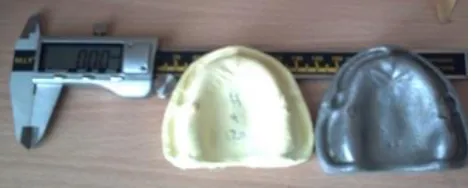
In this in vitro experimental observational study, 60 casts made by pouring Alginplus and Hydrogum 5 impression materials (30 of each material) were evaluated. Each impression material was studied after 12 minutes, 24 hours and 120 hours. Impressions were poured with dental stone, and their dimensions were measured using digital calipers. A master model served as the control group. An edentulous maxillary dental model (Typodont; Nissin Dental Products Inc., Kyoto, Japan) with three cubic stainless steel indices in the left first and second premolar positions and the right first premolar position was prepared using a miller (Fig. 1). These indices served as the reference points for the measurements.
Fig. 1: Maxillary Typodont and cast and digital caliper
Some parallel grooves were created in the mesial surface of the first index and the distal surface of the second index on the left, and palatal surface of the first left and right indices for exact measurements. All impressions were made using 10 perforated stainless steel dental trays (Takson Co., Tehran, Iran). These trays had two metal frameworks which were fixed to the above-mentioned prepared grooves in the model. Appropriate amounts of each impression material were mixed as follows:
Alginplus: A total of 19g of powder (Major
Prodotti Dentari S.p.a., Moncalieri, Italy) was added to 40mL of pure water, with a mixing time of less than 35 seconds, and a working time of two minutes.
Hydrogum 5: A total of 30g of powder
(Zhermack S.p.a., Badia Polesine, Rovigo, Italy) was added to 50mL of pure water, with a mixing time of less than 30 seconds, and a working time of 65 seconds.
Alginate glue (Fix Adhesive Spray; Dentsply, Rome, Italy) was used, and the impression was taken one minute after it dried. After taking 10 alginate impressions, and 12 minutes of preservation, the impressions were poured. For pouring, 100g of dental stone (natural stone, yellow gypsum; Ernst Hinrichs Dental GmbH, Goslar, Germany) was mixed with 30mL of
water according to the manufacturer’s
Dimensional measurements:
The mesiodistal dimension, occlusogingival height and interarch distance on the master model and prepared casts were measured 24 hours after the casts were separated from the impressions. The mesiodistal size was the distance from the mesial groove of the left first premolar index to the distal groove of the second premolar index on the same side. The height of the index placed in the left first premolar site was considered as the occlusogingival height, while the interarch distance was determined by measuring the distance between the palatal groove of the indices of the first premolars on the left and right sides. These measurements were made 10 times by two independent experts who were blinded to the alginate type, using an electronic digital caliper
(Minova, Tianjin, China) with 0.01mm
precision. The intra-examiner and inter-examiner agreements were calculated to be 0.46 and 0.27, respectively.
Statistical analysis:
The normality of the data for the parameters of this study was checked using the Kolmogorov-Smirnov test. Two-way ANOVA was used to evaluate the cumulative effects of the time and alginate type on the dimensional stability of the impressions. In cases in which the test results
indicated statistical significance, one-way
ANOVA was used to evaluate the significance of the differences among the three study groups for each alginate type for different time periods (12 minutes, 24 hours and 120 hours). The Bonferroni test was used for pairwise comparisons of the different time periods for each alginate type.
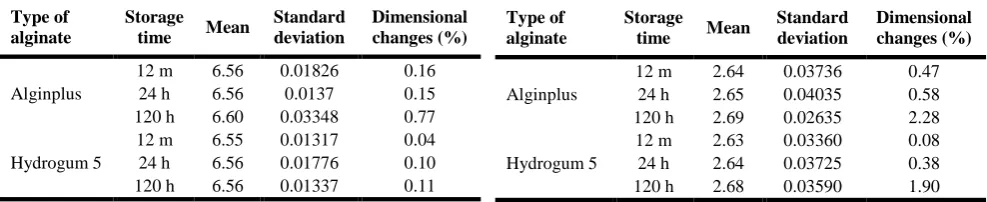
Table 1: Mesiodistal measurements made on casts produced from the understudy alginates following different storage times
Type of alginate
Storage
time Mean
Standard deviation
Dimensional changes (%)
Alginplus
12 m 6.56 0.01826 0.16
24 h 6.56 0.0137 0.15
120 h 6.60 0.03348 0.77
Hydrogum 5
12 m 6.55 0.01317 0.04
24 h 6.56 0.01776 0.10
120 h 6.56 0.01337 0.11
T-test was used to compare the two alginate types and their differences with the original model for each time period. Statistical significance was set at P<0.05.
RESULTS
Based on the results of two-way ANOVA, the effect of alginate type, storage time, and their interaction effect on each dimension were statistically significant (P<0.05). In the original model, the mesiodistal dimension was 6.55mm. One-way ANOVA showed that the mean mesiodistal dimension of impressions made with Alginplus was different in different storage times
(P=0.005); however, in Hydrogum 5
impressions, the the mean of mesiodistal size was not different (P=0.26). In Alginplus impressions, the difference in mesiodistal dimensions was not significant after 12 minutes and 24 hours of storage (P=0.9). However, after 120 hours, the difference in mesiodistal dimensions was significant compared to that after other storage periods (P=0.003 for 12 minutes of storage, P=0.003 for 24 hours of storage). Tables 1 to 3 show the percentage of changes in different dimensions in each alginate type after different storage times. In the original model, the occlusogingival height was 2.63mm. Based on the results of one-way ANOVA, the occlusogingival height was different between the two alginate types after different storage times (P=0.008 for Alginplus, P=0.009 for Hydrogum 5). Based on the Bonferroni test, the differences in occlusogingival heights after 12 minutes and 24 hours of storage were not significant in the two alginate types (P=0.57 for Alginplus, P=0.53 for
Table 2: Occlusogingival height measurements on casts prod-uced from understudy alginates following different storage times
Type of alginate
Storage
time Mean
Standard deviation
Dimensional changes (%)
Alginplus
12 m 2.64 0.03736 0.47
24 h 2.65 0.04035 0.58
120 h 2.69 0.02635 2.28
Hydrogum 5
12 m 2.63 0.03360 0.08
24 h 2.64 0.03725 0.38
Table 3: Inter-arch distance measurements made on casts produced from the understudy alginates following different storage times
Type of alginate
Storage
time Mean
Standard deviation
Dimensional changes (%)
Alginplus
12 m 39.30 0.02558 0.00
24 h 39.30 0.03327 0.00
120 h 39.34 0.03779 0.12
Hydrogum 5
12 m 39.31 0.05662 0.04
24 h 39.30 0.10619 0.00
120 h 39.39 0.06485 0.22
Hydrogum 5); but, after 120 hours, the differences with other storage times were significant in both alginate types (P=0.002 and P=0.017 for Alginplus,
P=0.004 and P=0.025 for Hydrogum 5,
respectively). In the main model, the interarch distance was 33.30mm. Based on the results of one-way ANOVA, the interarch distances in both alginate types were different after different storage times (P=0.013 in Alginplus, P=0.032 in Hydrogum 5). The differences in the interarch distances in the two alginates were not significant after 12 minutes and 24 hours of storage based on the Bonferroni test (P=0.9 in Alginplus, P=0.79 in Hydrogum 5); however, after 120 hours, the differences were significant with other storage times (P=0.012 and P=0.021 in Alginplus, P=0.008 and P=0.032 in Hydrogum 5, respectively).
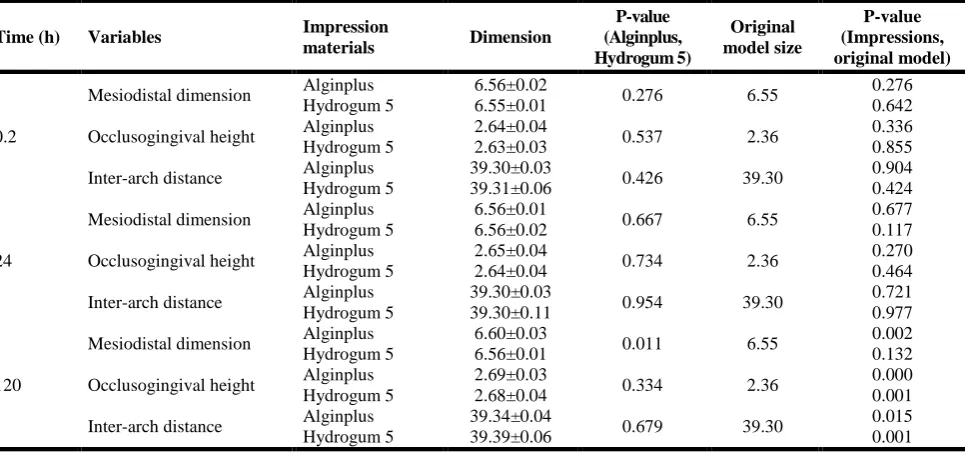
After 120 hours, all three dimensions in both alginate types exhibited significant differences with the main model, except for the mesiodistal dimension in Hydrogum 5 at 120 hours (P=0.132, Table 4). Based on the results of t-test, there were no significant differences between the two alginate types in different dimensions and different storage times (Table 4), except for the mediastinal dimension at 120 hours.
DISCUSSION
Based on the results of the present study, Alginplus and Hydrogum 5 can preserve their dimensional stability for up to 24 hours, but not 120 hours. In our study, the dimensions of Hydrogum 5 were more stable than those of Alginplus. The water content of the material is a key factor in this regard [14]; the ability to preserve water probably affects the dimensional stability [4]. The water content of Hydrogum 5 is less than that of Alginplus, thus, the former is better capable to preserve water. With regard to alginate impressions, first shrinkage occurs during the setting reactions, even if the material is in contact with the saliva during this process [13,15]. Then, imbibition occurs if it is in contact with moisture, resulting in expansion of impression.
Table 4: Comparison of the mean mesiodistal dimension, occlusogingival height, and inter-arch distance of the casts prepared from Alginplus and Hydrogum 5 impression materials after different storage times with each other and the original model
Time (h) Variables Impression
materials Dimension
P-value (Alginplus, Hydrogum 5)
Original model size
P-value (Impressions, original model)
0.2
Mesiodistal dimension Alginplus 6.56±0.02 0.276 6.55 0.276
Hydrogum 5 6.55±0.01 0.642
Occlusogingival height Alginplus 2.64±0.04 0.537 2.36 0.336
Hydrogum 5 2.63±0.03 0.855
Inter-arch distance Alginplus 39.30±0.03 0.426 39.30 0.904
Hydrogum 5 39.31±0.06 0.424
24
Mesiodistal dimension Alginplus 6.56±0.01 0.667 6.55 0.677
Hydrogum 5 6.56±0.02 0.117
Occlusogingival height Alginplus 2.65±0.04 0.734 2.36 0.270
Hydrogum 5 2.64±0.04 0.464
Inter-arch distance Alginplus 39.30±0.03 0.954 39.30 0.721
Hydrogum 5 39.30±0.11 0.977
120
Mesiodistal dimension Alginplus 6.60±0.03 0.011 6.55 0.002
Hydrogum 5 6.56±0.01 0.132
Occlusogingival height Alginplus 2.69±0.03 0.334 2.36 0.000
Hydrogum 5 2.68±0.04 0.001
Inter-arch distance Alginplus 39.34±0.04 0.679 39.30 0.015
If there is contact with air, syneresis as well as evaporation occur; however, the effect of syneresis is stronger than that of evaporation [16].
Syneresis occurs toward the tray, especially if alginate tray adhesive is used, resulting in enlargement of the die in the cast [17,18]. This is probably why the height of index increased in the current study; however, in the maxilla in the palatal area, shrinkage occurs towards the bulk of the material in the palate [19,20], resulting in a smaller interarch dimension [17,18]. There was a decrease in the interarch distance of impressions, which was compensated for by the setting expansion of gypsum, to some extent [17]. It is likely that the magnitude of change is lower in this dimension than that in other two dimensions. Thus, it might have been equal to that in the original model at 12 minutes and 24 hours. The magnitude of interarch dimension change at 120 hours was lower than that in occlusogingival height and a little more than that of mesiodistal dimension (0.01%). The setting expansion of gypsum possibly explains why the distance was not negative. According to a study by Atashrazm et al, [15] reducing the expansion of plaster resulted in a negative distance, confirming this theory. Therefore, there is shrinkage towards the palate in the maxilla, which should be corrected by modifying the tray and decreasing the thickness of the impression material in this area [17]. Since the current study used a prefabricated tray, the alginate was thick on the palate, but these changes occur less frequently in studies using special trays with an adjusted distance in the palate.
It is recommended to store the impressions in an environment with 100% relative humidity in order to prevent evaporation and syneresis [2]. In many studies, storage in a wet towel has been suggested, so that imbibition would compensate for the setting expansion [21-24]. However, in this condition, it seems that shrinkage is not uniformly distributed in all areas [24]; therefore,
them in a condition close to a vacuum state, and type of plaster.
Because there are no undercuts during impression taking for a fixed prosthesis on the abutment teeth only, and since the accuracy of alginate is not suitable for recording the details and finish line for marginal adaptation in fixed prostheses [14], the results of studies in which the models are dentate can be more applicable to the clinical situations [17].
In studies by Atashrazm et al, [15] and Sedda et al, [4] Hydrogum 5 impressions preserved the dimensional stability better than the other
impression materials. In Hydrogum 5
impressions, the dimensional stability was preserved at an acceptable level for up to 120 hours, which does not agree with the findings of our study. Sedda et al. [4] used special trays, employed a different method to mix the impression materials, kept the impressions in a humid plastic bag without a napkin, used a different type of plaster, and used a different plaster mixing method. In addition, the measurements were only performed in horizontal dimensions. In the study by Atashrazm et al, [15] the special tray and type of plaster were different from those of the current study, and they compensated 8% of dimensional changes by plaster expansion.
Many factors contributed to differences in the results, including the type of dental stone used [28], the jaw model of the study, the depth of the palate in the maxillary models, the distance between the tray and the model, presence of teeth and tissue undercuts, and the method used to store the impression and mixing materials. In the study by Mosharraf et al, [24] which was consistent with the present study, the extent of the changes in the dimensional stability of Hydrogum 5 impression was not acceptable at 120 hours. In our study, Hydrogum 5 impressions had acceptable dimensional changes after 48 and 72 hours of storage. In addition, the maximum and minimum changes were observed in the
height and distance between the dies, while method of impression storage and use of model were similar to those in our study.
Reddy et al. [29] studied two types of regular alginate, while considering the dimensional changes at two, 24, and 120 hours of storage. They reported that the difference between the impressions and the original model regarding the dimensional changes was insignificant after two hours and significant after 24 and 120 hours. A model with teeth was used in their study, and the
impressions were disinfected using 2%
glutaraldehyde. To mix the impression materials, an auto-mixer was used and the impressions were kept in sealed plastic bags; therefore, there were differences between their methodology and ours. More importantly, the alginates used in their studies were different from those in our study. In their study, similar to the current study, the
dimensions increased, while maximum
significant increase was observed at 120 hours. In the study by Todd et al, [30] dimensional changes were compared among four alginate types, and the results indicated that the differences between the impressions and the original model were significant in all four types after 120 hours. Only one type of alginate (Kromopan) retained its dimensional stability after 24 hours. Inconsistent with the results of the current study, the three other alginates showed significant dimensional changes after 24 hours. Dimensional changes after 24 and 120 hours of storage were insignificant. Of course, the alginates and the method used were different from those of the current study. They used a standard die, and only the horizontal dimensions were measured. In addition, the measurements were made on impressions, not a plaster model. The special tray was made using a 1.5-inch distance, without holes, and separating material (spacer) was used on the die.
et al. [31] evaluated the dimensional changes of alginate after 12, 24, 36, and 48 hours of storage, and reported acceptable dimensional stability after 24 and 36 hours. Jinang et al, [32] also compared the dimensional changes in regular alginates using this method, and there was a significant difference between this method and the cast preparation method. The impression was made of patient’s mouth, so there was no need to make a cast, and the measurements were made on the same impression after different time periods. However, the results of Todd et al. [30] were similar to those of the current study, and no significant dimensional changes were noted after 24 hours, while the dimensions of the cast increased and the impression shrank over time. The results of Jiang et al. [32] were completely different from those of the current study, which was predictable with regard to different methods of storage of impressions at room temperature without coverage.
It should be noted that clinical dimensional changes of 0.1-0.8mm [26,33] and 100-500µm [13,17] are acceptable for alginates, and since the changes in the alginates evaluated in the present study were in the above-mentioned ranges, these materials can be used in the clinical setting, and can be preserved for up to 120 hours. Almost all studies previously conducted have confirmed that the rate of dimensional changes depends on the time and type of material [4,12,14,15]. While manufacturers provide little information about the formulation of alginates [4], these changes cannot be evaluated based on chemical formulation [4]; however, it is noteworthy that in studies similar to the current study, the dimensional changes in the impressions were clinically acceptable after four or five days [19,34-37].
Since tissue undercuts of jaw models are usually much less than those in the oral cavity [4], and our study used parallel side dies without undercuts, impression distortion in the clinical setting is probably greater than that in our study.
In the mandible, in vitro and in vivo impressions are more different, since a distortion occurs in the impression at the time of mouth opening during impression taking, with a range of 0-0.5mm [21]. In impressions of the mandible, there is usually a decrease in the interarch distance due to the shrinkage of the impression material towards the tray [22], which increases in the clinical setting due to distortion of impression.
Our study had some limitations. First, no disinfectants were used, since disinfectants result in a decrease in dimensional changes [38]. In addition, there were no undercuts and no saliva, which are present in the clinical setting [4]. Based on the findings of a study by Kulkarmi and Thombare [13], temperature does not affect alginates up to 25°C; however, the oral cavity temperature is 37°C, and it is suggested that temperature must be taken into account in future studies. Moreover, the measuring tool was accurate up to 0.1mm, which was acceptable considering the clinically acceptable dimensional changes of 0.1-0.8mm [39].
CONCLUSION
Based on the results of this study, the impression materials used (i.e., Alginplus and Hydrogum 5) do not significantly differ in terms of dimensional stability, and thus, they can be used whenever a long time interval between impression taking and pouring is required. However, further research is needed to study the dimensional stability of these impression materials in clinical situations.
REFERENCES
1- Alruthea MS. Evaluation of dimensional accuracy material with immediate and delayed pouring. Life Sci J. 2014;11(10):1075-9.
properties of light-curing and self-curing dental impression materials. J Formos Med Assoc. 1994 Apr;93(4):294-9.
4- Sedda M, Casarotto A, Raustia A, Borracchini A. Effect of storage time on the accuracy of casts made from different irreversible hydrocolloids. J Contemp Dent Pract. 2008 May;9(4):59-66.
5- Olvera N, Jones JD. Alternatives to traditional complete dentures. Dent Clin North Am. 2014 Jan;58(1):91-102.
6- Rudd KD, Morrow RM, Strunk RR. Accurate alginate impressions. J Prosthet Dent. 1969 Sep;22 (3):294-300.
7- Schleier PE, Gardner FM, Nelson SK, Pashley DH. The effect of storage time on the accuracy and dimensional stability of reversible hydrocolloid impression material. J Prosthet Dent. 2001 Sep;86(3): 244-50.
8- Farzin M, Panahandeh H. Effect of pouring time and storage temperature on dimensional stability of casts made from irreversible hydrocolloid. J Dent (Tehran). 2010 Fall;7(4):179-84.
9- Phoenix RD, Cagna DR, De Freest CF. Stewart's clinical removable partial prosthodontics, Chicago, Quintessence, 2012:133-49.
10- Hollenback, GM. A study of the physical properties of elastic impression materials (the linear and over-all accuracy of reversible and irreversible hydrocolloids) Part IV. J. South Calif. St. Dent. Assoc. 1963 Nov;31:204-6.
11- Christensen GJ. Marginal fit of gold inlay castings. J Prosthet Dent. 1966 Mar 1;16(2):297-305. 12- Mehraban Jahromi S, Yeganeh T, Atashrazm P, Mobayeni MR, Tamizi M, Nematollahi F.Comparing the effect of storage time on dimensional changes of two alginate impression materials (Golchay & Bayer). Res Dent Sci. 2014 Oct;11(3):136-41. 13- Kulkarni MM, Thombare RU. Dimensional Changes of Alginate Dental Impression Materials-An Invitro Study. Journal of clinical and diagnostic research: JCDR. 2015 Aug;9(8):ZC98-102.
14- Rohanian A, Ommati Shabestari G, Zeighami S, Samadi MJ, Shamshiri AR. Effect of storage time of extended-pour and conventional alginate impressions
on dimensional accuracy of casts. J Dent (Tehran). 2014 Nov;11(6):655-64.
15- Atashrazm P, Tamizi M, Jahromi SM,
Nematollahi F, Heidari A, Jalalian S. The effect of time storage on the dimensional changes of hydrogam 5 alginate. J Res Dent Sci. 2013 Apr; 10(1):17-21. 16- Hiraguchi H, Kaketani M, Hirose H, Yoneyama T. The influence of storing alginate impressions sprayed with disinfectant on dimensional accuracy and deformation of maxillary edentulous stone models. Dent Mater. 2010 May;29(3):309-15. 17- Wadhwa SS, Mehta R, Duggal N, Vasudeva K. The effect of pouring time on the dimensional accuracy of casts made from different irreversible hydrocolloid impression materials. Contemp Clin Dent. 2013 Jul;4(3):313-8.
18- Aoyama N, Hayakawa I, Akiba N, Minakuchi S. Effect of high-molecular-weight sodium alginate on the viscosity and characteristics of alginate impression materials. Prosthodont Res Pract. 2007;6(4):239-45.
19- Imbery TA, Nehring J, Janus C, Moon PC. Accuracy and dimensional stability of extended-pour and conventional alginate impression materials. J Am Dent Assoc. 2010 Jan;141(1):32-9.
20- Rudd KD, Morrow RM, Strunk RR. Accurate alginate impressions. J Prosthet Dent. 1969 Sep;22 (3):294-300.
21- Johnson GH, Chellis KD, Gordon GE, Lepe X. Dimensional stability and detail reproduction of irreversible hydrocolloid and elastomeric impressions disinfected by immersion. J Prosthet Dent. 1998 Apr;79(4):446-53.
22- Skinner EW, Hobilt NE. A study of the accuracy of hydrocolloid impressions. J Prosthet Dent. 1956 Jan;6(1):80-6.
23- Bayindir F, Yanikoğlu N, Duymuş Z. Thermal and pH changes, and dimensional stability in irreversible hydrocolloid impression material during setting. Dent Mater. 2002 Jun;21(2):200-9.
25- Donovan TE, Chee WW. A review of contemporary impression materials and techniques. Dent Clin North Am. 2004 Apr 30;48(2):445-70. 26- Atashrazm P, Valaee N, Mobini M R, Zamani Alavijeh L. Comparison of the Dimensional Changes of Ariadent and Bayer Alginate Impression Materials (Invitro). J Res Dent Sci. 2012 Feb;8(4):168-74. 27- Fonte-Boa J, Lanza MD, da Cunha Peixoto RT, Drummond AF, de Sousa EL. Dimensional analysis of alginate molds after storage. Arq Odontol, Belo Horizonte. 2016 Jun;52(2):117-122.
28- Saito S, Ichimaru T, Araki Y. Factors affecting dimensional in stability of alginate impressions during immersion in the fixing and disinfectant solutions. Dent Mater. 1998 Dec;17(4):294-300. 29- Reddy CG, Gujjari AK, Shambhu HS. Influence of long term storage on the linear dimensional accuracy of improved alginate impressions-an in vitro study. TPDI. 2010;1(2):34-37.
30- Todd JA, Oesterle LJ, Newman SM, Shellhart WC. Dimensional changes of extended-pour alginate impression materials. Am J Orthod Dentofacial Orthop. 2013 Apr;143(4 Suppl):S55-63.
31- Lee SM, Hou Y, Cho JH, Hwang HS.
Dimensional accuracy of digital dental models from cone-beam computed tomography scans of alginate impressions according to time elapsed after the impressions. Am J Orthod Dentofacial Orthop. 2016 Feb;149(2):287-94.
32- Jiang T, Lee SM, Hou Y, Chang X, Hwang HS. Evaluation of digital dental models obtained from dental cone-beam computed tomography scan of alginate impressions. Korean J Orthod. 2016 May;46 (3):129-36.
33- Rodrigues SB, Augusto CR, Leitune VC, Samuel SM, Collares FM. Influence of delayed pouring on irreversible hydrocolloid properties. Braz Oral Res. 2012 Oct;26(5):404-9.
34- Torassian G, Kau CH, English JD, Powers J, Bussa HI, Marie Salas-Lopez A, et al. Digital models vs plaster models using alginate and alginate substitute materials. Angle Orthod. 2010 Jul;80(4): 474-81.
35- Alcan T, Ceylanoğlu C, Baysal B. The relationship between digital model accuracy and time-dependent deformation of alginate impressions. Angle Orthod. 2009 Jan;79(1):30-6.
36- Walker MP, Burckhard J, Mitts DA, Williams KB. Dimensional change over time of extended-storage alginate impression materials. Angle Orthod. 2010 Nov;80(6):1110-5.
37- Eriksson A, Ockert-Eriksson G, Lockowandt P. Accuracy of irreversible hydrocolloids (alginates) for fixed prosthodontics. A comparison between irreversible hydrocolloid, reversible hydrocolloid, and addition silicone for use in the syringe-tray technique. Eur J Oral Sci. 1998 Apr;106(2p1):651-60.
38- Taylor RL, Wright PS, Maryan C. Disinfection procedures: their effect on the dimensional accuracy and surface quality of irreversible hydrocolloid impression materials and gypsum casts. Dent Mater. 2002 Mar;18(2):103-10.