Thomason, J.L. and Ali, J.Z. and Anderson, John (2010) Effects of hydrolysis ageing on the
performance and dimensional stability of glass-fiber reinforced polyamide 66. In: 68th Annual
Technical Conference and Exhibition, ANTEC 2010, 16-20 June 2010, Orlando, Florida.
http://
strathprints
.strath.ac.uk/20623/
Strathprints is designed to allow users to access the research output of the University
of Strathclyde. Copyright © and Moral Rights for the papers on this site are retained
by the individual authors and/or other copyright owners. You may not engage in
further distribution of the material for any profitmaking activities or any commercial
gain. You may freely distribute both the url (
http://
strathprints
.strath.ac.uk
) and the
content of this paper for research or study, educational, or not-for-profit purposes
without prior permission or charge. You may freely distribute the url
(
http://
strathprints
.strath.ac.uk
) of the Strathprints website.
EFFECTS OF HYDROLYSIS AGEING ON THE PERFORMANCE AND
DIMENSIONAL STABILITY OF GLASS-FIBER REINFORCED POLYAMIDE 66
James L. Thomason, Jahan Z. Ali and John Anderson,
University of Strathclyde, Department of Mechanical Engineering, Glasgow, UK
Abstract
Results of an in-depth study of hydrolysis testing on the mechanical performance, weight change, and dimensional stability of injection moulded glass-fiber reinforced polyamide 66 automotive composites are presented. Composite and resin samples have been characterised after conditioning in water-glycol mixtures at 70°C, 120°C and 150°C for a range of times up to 1000 hours. The results reveal that hydrothermal ageing results in significant changes in the mechanical performance, weight, and dimensions of these materials. Mechanical performance after conditioning at different temperatures could be superimposed when considered as a function of the level of fluid absorbed by the composite matrix.
Introduction
Glass fiber reinforced polyamides, such as polyamide 6 and 66, are excellent composite materials in terms of their high levels of mechanical performance and temperature resistance. However, the mechanical properties of polyamide based composites decrease markedly upon absorption of water and other polar fluids. The mechanical performance of these composites in a hydrothermal environment results from a combination of the fiber and matrix properties and the ability to transfer stresses across the fiber-matrix interface. Variables such as the fiber content, diameter, orientation and the interfacial strength are of prime importance to the final balance of properties exhibited by injection molded thermoplastic composites [1-5]. Short fiber reinforced thermoplastics have been used in the automotive industry for many years and there has recently been a strong growth in the use of polyamide based materials in under-the-hood applications [6]. These applications place stringent requirements on such materials in terms of dimensional stability and mechanical, temperature and chemical resistance. There has been a rapid increase in the number of molded composites exposed to engine coolant at high temperatures [7-10] and this has led to a need for an improvement in our understanding of the performance of glass-reinforced-polyamide under such conditions.
Typical testing for these applications involves measurement of mechanical properties before and after conditioning of the test material in model coolant fluids for a fixed time, up to 3000 hours, at temperatures in the
100-150°C range [10]. It is not always easy to obtain a good understanding of the structure-performance relationships of a material from such snapshots of performance taken at a single condition. However, it has been known for sometime within the industry that the chemical nature of the glass fiber sizing can have a strong influence on the retention of some mechanical properties of composites exposed to such hydrothermal conditioning. It is also well known that polyamide materials absorb relatively high levels of moisture when exposed to hydrothermal conditioning in water and that this can cause significant dimensional changes [11-17]. Despite this, and the fact that such hydrothermal testing has become commonplace for under-the-hood applications, there has been little systematic investigation of dimensional change of glass-fiber reinforced polyamide composites during such conditioning in coolant fluid. Thomason [17] has recently reviewed the mechanical performance and dimensional changes observed in glass fiber reinforced polyamide 66 during conditioning in coolant fluid at 120°C and 150°C. A rapid reduction was observed in both the modulus and strength of these composites and the matrix polymer in the initial stage of conditioning. However, unnotched impact was seen to initially increase significantly. Due to the rapid rate of fluid absorption and dimensional change at these high temperatures it was not possible to examine these effects in detail. The weight and dimensional changes in these materials during condition at lower temperatures (70°C) has recently been reported [18]. This paper presents the results of a study of the changes in the thermo-mechanical performance of injection molded glass reinforced polyamide 66 composites during hydrothermal conditioning in model coolant fluid. Composites have been prepared using two chopped glass products where one contains a sizing system which has been optimised to improve the performance of composites subjected to hydrothermal treatments. To enable study of the initial stages of the process the conditioning temperature has been limited to 70°C for a range of conditioning times up to 400 hours. Data on the changes in the thermal and mechanical performance of these composites are presented and discussed in this paper.
The injection molded polymer and composite bars for this study were supplied by the 3B fibreglass company. The polyamide 66 (PA66) used was DuPont Zytel 101. Composite samples with 30% weight fiber content were produced using this polymer and two chopped AdvantexTM E-glass products. AdvantexTM is a boron free E-glass formulation. These products were chopped to a length of 4 mm and the individual fibers had a nominal average diameter of 10 μm. Both samples were coated with sizings which are designed for polyamide reinforcement. DS1143 is a typical sizing designed to maximise the “dry as molded” (DaM) performance of glass reinforced polyamides. The main ingredients of such sizings are typically aminosilane coupling agent and a commercial polyurethane dispersion [19,20]. DS1110 sizing contains extra components which enhance the retention of composite mechanical properties in elevated temperature hydrolytic environments [21-23]. Three series of samples were molded, series A using DS1143 glass, series B using DS1110 glass, and series R containing only the PA66 resin. The glass and polymer were compounded on a twin screw extruder and injection molded to produce end-gated rectangular bars of with nominal dimensions 80x10x4 mm.
The test bars for this study were received vacuum packed in a DaM state. On removal from the packaging all samples were weighed and their three dimensions recorded at room temperature prior to conditioning. A micrometer with an operating range between 0-50mm ± 0.005mm was used in order to measure the width and the thickness of the test samples. It is well known that the cross section of injection molded samples may not be exactly rectangular and it was noted that the recorded dimension varied slightly dependent on where the measurement was taken. To ensure consistency measurements were therefore taken at the exact centre of each sample, as per ISO 179. The sample bars length exceeded the range of the micrometer and so the length of the test samples was measured using a Vernier calliper with an accuracy of ±0.01 mm was used. A digital balance with an operating range between 0-20 g ± 0.0001 g was used to measure sample weights. Each data point presented is the average of measurements on seven individual samples. Since these samples were subsequently used for impact testing this means that each data point for each conditioning time was obtained on a different set of seven samples. Hydrolysis conditioning took place in a temperature controlled bath with samples fully immersed in a 50:50 mixture of glycol and water (GW) at 70°C. Samples were stacked vertically and individually in a specially constructed rack such that the fluid had access to all surfaces of each sample. Conditioning times were chosen in the range 0-400 hrs. On removal from the conditioning container surface fluid was removed from the samples with tissue and then they
were again weighed and their dimensions recorded. These samples were then equilibrated at room temperature in a GW mixture for 24 hours after which they were again weighed and measured and then transferred immediately to the impact tester. Unnotched Charpy impact properties were measured on seven specimens in accordance with the procedures in ISO179-1 using a Tinius Olsen model IT503 Impact Tester set up with a 6.35J pendulum capacity. DMA measurements were made using a Polymer Laboratories Dynamic Mechanical Thermal Analyser MKIII, at a frequency of 1 Hz, a strain of x 4, scanning rate of 4°C per minute and the samples were clamped with a torque of 40 Nm. Knife edged clamping was employed, using a frame which gave a sample length of 12 mm. Bending modulus and tanδ were studied through a temperature range of –100°C to 150°C.
Results and Discussion
fibers reduces the ability of the polyamide matrix to absorb the same level of fluid that is absorbed by the polymer in an unrestrained environment. It can also be seen in Figure 1 that there is no significant difference between the absorption results obtained with two composite systems A and B at this conditioning temperature.
In fluid absorption experiments in polymers, plate-shaped samples are generally preferred so that the fluid absorption is mainly determined by the uptake through the two broad faces of the plate. In this situation diffusion is approximated to occur in one direction only. Consequently, if fluid uptake is determined by classical Fickian diffusion, the fluid concentration can be approximated by the well known solution for diffusion in an infinite plate, which yields a linear increase in the weight increase of the sample with t1/2 over the initial part of the experiment. However, when samples with different shapes are employed then corrections have to be made for edge effects where the sample weight is also increased by fluid uptake via the other available surfaces of a rectanguloid specimen. The necessary correction factors for such edge effects in samples of the dimensions used in this study have recently been reviewed [18]. If moisture uptake is determined by classical 1D Fickian diffusion, for diffusion in an infinite plate the moisture concentration then the mass of fluid adsorbed in time t, M(t), as a fraction of the final equilibrium of Me is given by [24]
(
)
(
)
∑
= − ⎥ ⎥ ⎦ ⎤ ⎢ ⎢ ⎣ ⎡ ⎟⎟ ⎠ ⎞ ⎜⎜ ⎝ ⎛ + − + − = 0 2 2 2 22 2 1 exp 2 1
8 1 ) ( n x e a t D n n M t M π π (1)
where Dx is the diffusivity in the x direction and a is the thickness in the x direction. When Dxt << 0.05a2 equation 1 can be reduced to
2 / 1 2 2 / 1
4
)
(
⎟
⎠
⎞
⎜
⎝
⎛
=
a
t
D
M
t
M
xe
π
(2)and thus the diffusivity can be obtained from the initial linear portion of the absorption curve and the final equilibrium absorption level. In the case of fluid adsorption into a real 3-dimensional monolithic rectanguloid of dimensions a,b,c in the x,y,z directions where Dc=Dx=Dy=Dz an edge correction factor f can [18,25] be introduced into equation 1 to give the effective diffusion coefficient
c eff
f
D
D
=
2(3)
bc
a
c
a
b
a
f
=
1
+
0
.
54
+
0
.
54
+
0
.
33
2(4)
Using the dimensions a, b, c of the samples in this study results in a value of f=1.212. Using the above analysis and the initial slopes taken from the first data
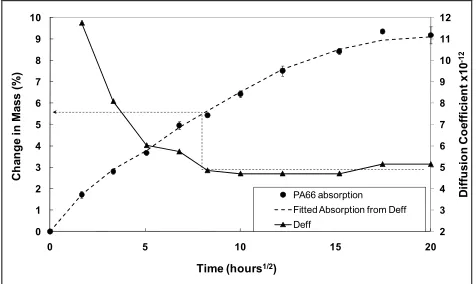
points in Figure 1 results in values of Deff= 12.0 x10⁻¹² m2/s for the PA66 polymer and 10.4x10⁻¹² m2/s for the composites, which is in reasonable agreement with the values reported by Ishak and Berry [12]. However, given the apparent curvature of lines in Figure 1 it was also decided to fit the full curves using equation 1. The results of this exercise gave a better fit over a greater proportion of the curve is obtained using a value of Deff=5.3 x10⁻¹² m2/s or D
c=3.6 x10⁻¹² m2/s for both polymer and composites. It was recently proposed [18] that these psuedo-Fickian effects could be explained by time dependent changes in Dc caused by changes in polymer crystallinity caused by the elevated temperature hydrolytic environment. This is shown in Figure 2 which shows the values of time dependent diffusion coefficient required to obtain a predicted weight gain which matches the experimentally observed values. In terms of later discussion, it should be noted in Figure 2 that the required value of time dependent diffusion coefficient reaches an approximately constant value after the polymer has absorbed 5-6% wt. of the GW fluid.
composites correlates well with that of the polymer. Up to approximately 4% fluid uptake the impact performance decreases. When the level of absorbed fluid exceeds approximately 5-6% there is clear evidence of a change in impact performance with a sharp increase in both the polymer and composite impact strength. From a study of the viscoelastic behaviour of PA66 during condition in water at 60°C it has been suggested that a large scale change in the molecular structure of injection molded PA66 takes place when the level of absorbed water exceeds 5% wt [26]. It is certainly an interesting correlation that the results on impact performance in this work also show an abrupt change in performance at approximately the same level of GW absorption.
The hydrolysis conditioning also resulted in significant changes in the dimensions of the polymer and composite samples [18]. The volume swelling of the polymer and composite samples after 70°C GW conditioning and equilibration at 23°C prior to impact testing is presented as a function of the polymer/matrix mass change in Figure 5. Both polymer and composite samples exhibit a linear relationship between the volumetric swelling and the mass of adsorbed fluid. However, there is clear evidence in the data in Figure 5 of a step increase in this relationship which occurs at approximately 6% fluid absorption in both the polymer and the composite matrix. Consequently, we have two independent measurements (Charpy impact and dimensional change) which appear to indicate some abrupt change taking place in the PA66 when the GW absorption level exceeds 5-6% wt. at 70°C. One possible explanation of this phenomenon is analogous to the Brill transition [27] which is well known in PA66. This is a broad transition of the crystal structure reported in dry PA66 between 160°C and 200°C but which has been observed to start as low as 80°C [28] and which is accompanied by changes in the thermal and mechanical properties [29]. This transition is observed crystallographically as a gradual transformation from the diffraction patterns with triclinic to pseudo-hexagonal symmetry, accompanied by a significant increase in volume [30] which is thought to contribute significantly to the relatively high level of thermal expansion observed in PA66 in this temperature range. The Brill transition has been considerably studied in dry PA66 and other polyamides as a function of temperature, however, there is relatively little published on the effect of moisture. It has been reported [29] that the presence of moisture causes the Brill transition to occur at lower temperature. Changes in lamellar structure of PA6 and PA66 during hot GW absorption have been studied using small-angle neutron scattering [31]. It was reported that structural changes in polyamides are more severe with glycol than water alone and reported a significant reduction in the Brill transition temperature. In general it has been shown
that the structure and crystallinity of polyamides can be radically altered by conditioning at elevated temperature and that these changes are accelerated in the presence of moisture [18]. Further direct investigation of changes to the crystal structure of PA66 undergoing hot GW conditioning could provide more insight into the abrupt change in volume observed in Figure 5.
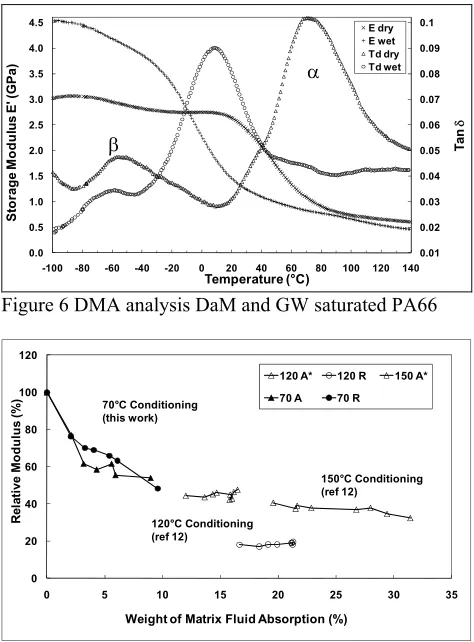
Figure 6 shows the variation of the storage modulus and damping (tanδ) with temperature for dry-as-molded and fully GW saturated PA66 samples. The tanδ curves of the DaM sample exhibited two distinct peaks, labelled α
and β, at about +71°C and -54°C respectively. It is well accepted that the α peak is associated with the motion of the longer chain segments in the amorphous sections of the polymer [26,32]. However, the β peak has been associated with both the presence of water and also with structural characteristics which are present in quenched samples but not in slow-cooled or annealed samples [32]. Since these samples had been stored in a desiccated atmosphere since molding and the surface layers of injection molded materials are most certainly quenched it might be concluded that the second of these two explanations may be correct in this case. However, it should also be noted that the bending mode of deformation used in this case would also preferentially probe the surface layer of the sample. Dry polyamides absorb moisture very rapidly in the surface layer and the exposure to a normal laboratory atmosphere during sample preparation, dimension measurement and loading into the DMA instrument may have allowed enough moisture absorption into the sample to produce the β
peak. The position of the α and β peaks for the DaM PA66 is well in line with the results of other published results [26,32,33] especially when taking into account that thermal analysis data on transition temperatures is always dependent on instrument, deformation mode, sample dimensions and thermal history and heating rate. The room temperature level of storage modulus for the DaM PA66 polymer (2.6 GPa) also agrees well with the value of Young’s Modulus obtained on almost identical materials using standard tensile testing [3]. The curves in Figure 6 for the GW saturated polymer sample indicate the strong effect on the thermo-mechanical properties of PA66 caused by GW fluid absorption. Both α and β
peaks are shifted to lower temperature, the α peak shows a greater shift of approximately 63°C to 8°C whereas the
β peak shifts by only 6°C to -60°C. The storage modulus curves indicate a strong plasticisation of the polymer at room temperature. However there is an anti-plasticisation of the polymer at sub-ambient temperatures.
conditioning of the test material in model coolant fluids for a fixed time at temperatures in the 100-150°C range. In a previous report it was suggested that the results of mechanical property testing such as unnotched impact measured after different conditioning times and temperatures may be better understood when considered as a function of the level of fluid absorption and/or swelling obtained at any individual condition [17]. This possibility is examined further in Figures 7 and 8. These two figures present the mechanical performance of PA66 polymer and composites as a function of the level of fluid absorbed by the polymer (i.e. in the composites, the absorption level is normalised to the polymer content). Data from this work obtained in GW mixtures at 70°C are compared with previously published [17] values obtained at 120°C and 150°C. The materials used in the previous report were based on the same grade of PA66, composite A* contained Owens Corning 123D chopped glass (a similar DaM optimized product) and composite B* contained Owens Corning 173X chopped glass (an older hydolysis resistance optimized product). In Figure 7 the results for Young’s modulus are presented, where the values have been normalised to the appropriate DaM value to eliminate small differences in testing conditions. The three groups of data in the Figure represent the different conditioning times at each temperature. It can be seen that there appears to be a good correlation between the trends observed in Young’s modulus for both polymer and composite samples conditioned at three different temperatures when the data is considered in terms of the level of fluid uptake in the polymer (or composite matrix). The Young’s modulus of these materials appears to decrease in a continuous manner with the increasing level of fluid uptake.
Figure 8 presents data for unnotched impact in a similar manner. Although the overall trend for unnotched impact is more complex than for Young’s modulus it is clear that the data from the three conditioning temperatures do appear to fit well with each other. In particular the apparent peak in unnotched impact observed in the data from this work in Figure 3 is well confirmed when considered in reference to the results from higher temperature conditioning which appears to fit well with the reduction in impact observed as the level of fluid uptake is increased past the peak impact level of 7-8% fluid uptake. A further point to note in Figure 8 is the influence of the glass fiber sizing on the unnotched impact performance at different levels of fluid uptake. At short conditioning times (and/or low conditioning temperatures) the normalised data for composites A and B show little significant difference in relative performance. The influence of the hydrolysis resistance optimised sizing only begins to become apparent at conditions which result in a fluid uptake of greater than 5% weight. This difference appears to become greater in the range
5-20% fluid uptake. However, under extreme conditioning (longer times at high temperatures) the influence of the fiber sizing is reduced as the unnotched impact of all composites falls to a very low level. Overall, these results would seem to offer the possibility of predicting performance at any conditioning time and temperature from data obtained under different conditions. This is an area which requires further investigation.
Conclusions
This study of injection molded glass-fiber reinforced polyamide 66 composites has revealed that hydrothermal conditioning in water-glycol mixtures results in significant changes in the weight, dimensions, and thermo-mechanical performance of these materials. All materials showed a weight increase due to hydrothermal conditioning at 70°C which was typical of a pseudo-Fickian diffusion process. It was noted that the presence of the glass fibers reduced the fluid uptake by an amount significantly greater than would be expected from a simple scaling with the polymer content of the composites. DMA analysis indicated a large reduction in glass transition temperature of the PA66 after saturation in glycol-water mixtures. Glycol-water absorption caused a significant reduction in the DMA storage modulus in the 0-40°C range. However, the sub-ambient storage modulus was significantly increased by fluid absorption. The modulus of the conditioned polymer and composite samples decreased continuously with increasing condition time and fluid absorption levels. The unnotched Charpy impact performance exhibited more complicated trends. Initially the impact strength fell with increasing conditioning time but after approximately 25 hours went through a sharp rise reaching a maximum level approximately 40% above the DaM values. Further increase in conditioning time was followed by a gradual decrease in impact performance. When compared to mechanical performance after conditioning at 120°C and 150°C these data appeared to form continuous performance curves when considered as a function of the level of adsorbed fluid in the composite matrix.
Acknowledgement
The author gratefully acknowledges the support of 3B Fiberglass, Battice, Belgium with the preparation and molding of the materials used in this study.
References
2. Hassan A, Yahya R, Yahaya AH, Tahir ARM, Hornsby PR., J.Reinforced Plastics and Composites 2004;23:969-986.
3. Thomason JL., Polym.Composites 2006:27:552-562. 4. Thomason JL., Polym.Composites 2007:27:331-343. 5. Mouhmid B, Imad A, Benseddiq N, Benmedakhène
S, Maazouz A., Polymer Testing 2006;25:544-552. 6. Carlson E, Nelson K., Automotive Engineering
1996;104:84-89.
7. Harrison AR. Automotive Composite Components, Chapter 11 in Integrated Design and Manufacture Using Fiber-reinforced Polymeric Composites. Eds. Owen MJ. Middleton V. Woodhead Publishing, 2000.
8. Rudd CD., Rapra Review Reports Volume 11, number 6, 2000, p12.
9. Page IB. Rapra Review Reports Volume 11, number 1, 2000, p 13.
10. Gavenonis J, McIlvaine JE., SAE Technical Paper Series, 2009, 2009-01-1297.
11. Valentin D, Paray F, Guetta B. , J.Mater.Sci. 1987;22:46-56.
12. Mohd Ishak ZA, Berry JP, J.Appl.Polym.Sci. 1991;54:2145-2155.
13. Takeda N, Song D, Nakata K., Adv. Composite Mater. 1996;5:201-212.
14. Bergeret A, Pires I, Foulc MP, Abadie B, Ferry L, Crespy A, Polym Testing 2001;20:753-763.
15. Jia N, Fraenkel HA, Kagan VA., J.Reinforced Plastics and Composites 2004;23:729-737.
16. I. Carrascal, J.A. Casado, J.A. Polanco, F. Gutiérrez-Solana, Polymer Composites 2005;26:580-586. 17. Thomason JL. , Polym.Composites 2007:27:344-354. 18. Thomason JL and Ali JZ. , Composites Part A
2009;40:623-634.
19. Coakley TA, Rubadue JE, Forman CE, Schweizer RA. United States Patent 4,255,317 (1981)
20. Thomason JL, Adzima LJ. , Composites Part A 2001;32:313-321.
21. Cossement M, Masson N, Piret W. United States Patent 5,236,982 (1993)
22. Masson N, Henrion JM, Thomason JL, Adzima LJ, Cheney TL, Piret W, Cossement M. United States Patent 6,365,272 (2002)
23. Cossement M, Henrion JM. United States Patent Application 20070154697 (2007)
24. Crank J, Park GS. (eds) Diffusion in Polymers, Academic Press, New York, 1968
25. Starink MJ, Starink LMP, Chambers AR. , J.Mater.Sci. 2002;37;287-294.
26. Valle´S-Lluch A, Camacho W, Ribes-Greus A, Karlsson S. , J.Appl.Polym.Sci. 2002;85: 2211–2218. 27. Brill R. J Prakt Chem 1942:161;49-64.
28. Murthy NS, Curran SA, Aharoni SM and Minor H. ,Macromolecules 1991;24:3215-3220.
29. Xenopoulos A and Clark ES. Chapter 5 Nylon plastics handbook, Kohan MI, Editor Hanser Gardener, Cincinnati (1995).
30. Starkweather HW and Jones GA. , J.Polym.Sci. Polym.Phys.Ed. 81;19:467
31. Murthy NS, Akkapeddi MK, and Orts W. , Macromolecules 1998;1:142-152
32. Starkweather HW. Chapter 6 Nylon plastics handbook, Kohan MI, Editor Hanser Gardener, Cincinnati (1995).
33. Klein N, Marom G, Pegoretti A and Migliaresi C. , Composites 1995;26:707-712.
Key Words: glassfiber, nylon, polyamide, hydrolysis, coolant, glycol, automotive, injection molding.
0 1 2 3 4 5 6 7 8 9 10
0 5 10 15 20
Time (hours1/2 )
Chang
e i
n
Mass
(%)
System A System B Polymer Composite Matrix
[image:7.612.320.553.273.412.2]70°C Data
Figure 1 Weight gain of polymer, composites, and composite matrix versus conditioning time at 70°C
2 3 4 5 6 7 8 9 10 11 12
0 1 2 3 4 5 6 7 8 9 10
0 5 10 15 20
D
iff
u
sio
n C
o
ef
fic
ie
n
t
x1
0
-1
2
C
h
an
ge
in
M
as
s
(%
)
Time (hours1/2)
PA66 absorption Fitted Absorption from Deff Deff
[image:7.612.319.557.461.603.2]0.01 0.02 0.03 0.04 0.05 0.06 0.07 0.08 0.09 0.1 0.0 0.5 1.0 1.5 2.0 2.5 3.0 3.5 4.0 4.5
-100 -80 -60 -40 -20 0 20 40 60 80 100 120 140
Ta n δ St o rag e M o d u lu s E' (G Pa) Temperature (°C) E dry E wet Td dry Td wet 0 20 40 60 80 100 120 140 160
0 2 4 6 8 10 12 14 16 18 20
Time (hours1/2 ) C h a rpy Un no tc he d Imp ac t ( kJ /m^ 2 ) System A System B Polymer α β
Figure 3 Unnotched Charpy impact versus conditioning
time at 70°C Figure 6 DMA analysis DaM and GW saturated PA66
40 60 80 100 120
0 2 4 6 8
C ha rpy U nn otc h ed Im pa ct ( kJ /m ^ 2)
Polymer/Matrix Weight Increase (%)
10 System A System B Polymer 0 20 40 60 80 100 120
0 5 10 15 20 25 30 35
R el at iv e M odulus (% )
Weight of Matrix Fluid Absorption (%)
120 A* 120 R 150 A* 70 A 70 R
[image:8.612.319.556.70.391.2]70°C Conditioning (this work) 120°C Conditioning (ref 12) 150°C Conditioning (ref 12)
Figure 7 Relative modulus versus GW fluid absorption at different temperatures
Figure 4 Unnotched Charpy impact versus polymer/matrix weight increase
0 2 4 6 8
0 2 4 6 8
C h a n g e in V o lu m e ( % )
Change in Mass (%)
10 System A System B Polymer 0 20 40 60 80 100 120 140 160
0 5 10 15 20 25 30 35
R ela ti ve U nnot ch ed Im pa ct ( % )
Weight of Matrix Fluid Absorption (%)
120 B* 120 A*
150 B* 150 A*
70 A 70 B 70°C Conditioning (this work) 120°C Conditioning (ref 12) 150°C Conditioning (ref 12)
Figure 8 Relative unnotched impact versus GW fluid absorption at different temperatures
[image:8.612.58.292.71.215.2] [image:8.612.55.300.261.583.2]