R E S E A R C H A R T I C L E
Open Access
Communication training for advanced medical
students improves information recall of medical
laypersons in simulated informed consent
talks
–
a randomized controlled trial
Anne Werner
1, Friederike Holderried
2, Norbert Schäffeler
1, Peter Weyrich
3, Reimer Riessen
4, Stephan Zipfel
1and Nora Celebi
3*Abstract
Background:Informed consent talks are mandatory before invasive interventions. However, the patients’
information recall has been shown to be rather poor. We investigated, whether medical laypersons recalled more information items from a simulated informed consent talk after advanced medical students participated in a communication training aiming to reduce a layperson’s cognitive load.
Methods:Using a randomized, controlled, prospective cross-over-design, 30 5th and 6th year medical students were randomized into two groups. One group received communication training, followed by a comparison intervention (early intervention group, EI); the other group first received the comparison intervention and then communication training (late intervention group, LI). Before and after the
interventions, the 30 medical students performed simulated informed consent talks with 30 blinded medical laypersons using a standardized set of information. We then recorded the number of information items the medical laypersons recalled.
Results: After the communication training both groups of medical laypersons recalled significantly more information items (EI: 41 ± 9% vs. 23 ± 9%, p < .0001, LI 49 ± 10% vs. 35 ± 6%, p < .0001). After the
comparison intervention the improvement was modest and significant only in the LI (EI: 42 ± 9% vs. 40 ± 9%, p = .41, LI 35 ± 6% vs. 29 ± 9%, p = .016).
Conclusion: Short communication training for advanced medical students improves information recall of medical laypersons in simulated informed consent talks.
Keywords: Medical student, Medical layperson, Informed consent talk, Communication training, Cognitive load
Background
Pre-interventional informed consent talks (ICT) are a crucial component in patient management. They are mandatory for most invasive therapeutic and diagnostic procedures. The elements of adequate informed consent include disclosure, understanding, decision-making
ca-pacity, and voluntary participation [1]. Technically, every intervention constitutes bodily harm and requires the patient’s permission (“informed consent”) [2]. Informed consent aims at enabling patients to make autonomous decisions about a medical procedure and prevent poten-tial harm, though in clinical practice, the main emphasis is on the doctors’ legal protection rather than ensuring the patient’s understanding [3,4]. A good understanding of the planned procedure with all its implications is needed in order to enable the patient to give consent in an informed way [2]. However, several studies have shown a * Correspondence:Nora. [email protected]
3Department for Internal Medicine IV, Endocrinology, Diabetology,
Nephrology, Angiology and Clinical Chemistry, University Hospital of Tübingen, Otfried-Müller-Str. 10, 72076 Tübingen, Germany Full list of author information is available at the end of the article
poor recall of facts conveyed during the informed consent talks, especially in medical laypersons [5-7]. Furthermore, comprehension of risks and benefits has been shown to
be relatively poor – in research conditions as well as
clinical settings - and there is a clear discrepancy be-tween the patients’ perception of their level of under-standing and the actual knowledge they show when tested [8-10]. Laypersons have a particular difficulty es-timating the single event probability in relation to their own case [11].
A substantial amount of research has been done on informed consent in clinical trials [6,12]. A systematic re-view by Flory and colleagues showed that most studies fo-cused on factors concerning the patients, like age and literacy. A lower educational background was clearly asso-ciated with less comprehension; gender had no influence on the ability to understand; and age had inconsistent effects, with some studies pointing toward a reduction of understanding in patients older than 50 [13]. Surprisingly little has been written about interventions that improve patients’understanding (e.g. additional audiotapes, a sum-marizing letter, question prompt sheets) and the results are not consistent according to a review by van der Meulen et al. [14]. Investigations concerning communication train-ing for doctors conducttrain-ing the ICTs are scarce. Brown and colleagues designed a communication training for onco-logists seeking informed consent for clinical trials, which had a limited success since the patients only showed more positive attitude but did not recall more information from the talks [15].
To our knowledge, factors regarding the person conducting the ICT have been mostly neglected. This seems surprising, as another explanation for poor recall in patients could be the fact that doctors are poorly trained to perform these talks. Nückles et al. used infor-mation technology specialists to show that sensitization of experts to the layperson’s knowledge-level improves the efficacy of their communication [16]. It is well known that patients’ reactions are linked to doctors’communication strategies. Patients were more likely to join clinical trials, if their doctor described the study benefits and side effects properly [17]. Strategies to improve talks have been developed in other fields of medicine, where precise infor-mation delivery is crucial (i.e. breaking bad news) [18]. Appropriate ICT training is not always available. Further-more, it is still common practice to require newly grad-uated junior doctors, who lack experience in explaining the procedure, to conduct ICTs [19].
From a didactical point of view, an ICT with a medical layperson is a short, very dense lecture regarding an un-familiar topic that usually has to be learned in stressful circumstances. As literature shows, understanding of com-plex tasks can be improved by using certain techniques that reduce the cognitive load [20].
According to the cognitive load theory, new informa-tion is processed in the working memory, which has a limited capacity. It can hold up to 5–9 new pieces of in-formation for about 20 seconds. Thus, cognitive over-load prevents learning [20]. Cognitive over-load comprises three components:
i) Intrinsic cognitive load, which is mainly determined by the complexity of the topic to be learned and the interactivity of its information items,
ii) The extrinsic cognitive load, which is determined by the way information is presented, and
iii) The germane cognitive load, which is the effort involved in the actual learning process [20].
The intrinsic cognitive load in the ICTs is usually determined by the procedure and therefore a reduction in the intrinsic cognitive load without jeopardizing the information content of the ICT can only be done to a limited extent. The main effort should be focused on optimization of the extrinsic cognitive load with indirect reduction of the intrinsic cognitive load, and simultan-eous preservation of the actual content.
Based on these principles, we conducted a randomized controlled cross-over study. We investigated, whether a short communication training that focused on teaching
advanced medical students how to reduce a layperson’s
cognitive load improves a medical laypersons’
informa-tion recall in a simulated informed consent talk.
Methods Pilot study
We conducted a pilot study with 9 final-year medical students in order to estimate the sample size. The ap-propriate sample size was calculated using nQuery 7.0 (Statistical Solutions, Saugus, MA, U.S.A.). A sample size of at least 12 students in each group would allow the desired detection of 15% improvement in number of remembered information items (three or more) with a power of 0.8 and a significance level of 0.05.
Study design
We conducted a prospective randomized controlled cross-over study.
A total of 30 advanced medical students (5th and 6th year) with limited experience and no specific training in informed consent talks (ICT) were asked to perform ICTs with 30 volunteer healthy medical laypersons.
the communication training. The medical students, me-dical laypersons and the three different cases for the ICT were arranged so that every student met with three dif-ferent medical laypersons, explaining each case once. The study was conducted as follows:
- On the day of the study, the medical students received a brief introduction to the study without disclosure of the study question. Meanwhile, the medical laypersons were instructed on their role during the encounter.
- The medical students conducted the first ICT (ICT1)
without any further preparation. Each ICT lasted 15 minutes and the students were asked to convey a standardized set of 20 information items.
- After that, the medical students received their first training session, either the communication training or the comparison intervention, according to their randomization group. Both classes lasted 30 minutes and were taught by different instructors. Meanwhile the medical laypersons wrote down what they remembered from the first ICT (free text).
- Then the medical students conducted the second ICT (ICT2) that involved a different case and a new medical
layperson,
- The next step was the second teaching session. The EI-group now had the class on ECG-interpretation, while the LI-group group received the communication training. Meanwhile the medical laypersons wrote down what they remembered from their second ICT. - Finally, all students conducted their last ICT (ICT3)
dealing with the third case and a third medical layperson. One more time, medical layperson wrote down everything they could remember immediately after the ICT.
The cases were permutated and served as first, second or third ICT equally often. Two blinded raters used a checklist to identify the standardized information. The study design is illustrated in Figure 1.
The medical students were blinded to the study ques-tion; the medical laypersons were blinded to both the
study question and the intervention. The dependent variable was the number of information items written down by the medical laypersons. Based on consent of two experienced physicians, we considered the recollec-tion of three addirecollec-tional details (15% of the informarecollec-tion) as clinically relevant and thus as the smallest meaningful difference.
Medical laypersons
The 30 medical laypersons were volunteers who received a small financial compensation. Inclusion criteria in-cluded an age between 35 and 70 years, reflecting the age group likely to undergo the procedures of the ICTs, and fluency in German. Volunteers were excluded if they or their close relatives suffered from major illness, had surgeries within the last 3 years, or had an occupation in the medical or medically related field (e.g. biology, neuroscience) in order to limit their level of medical knowledge. All volunteers received preparation materials before the study. As the content of our ICTs was not the medical condition itself, but the consequently necessary surgical procedure, the volunteers received some basic information about their alleged underlying diseases. Additionally, they received role instructions including a request to ask questions based on their understanding, but not to dominate the talks, as we wanted to allow students to structure their talks as learned and establish similar conditions for all students. They were randomly assigned to the randomized student groups and the order of the permutated cases.
Medical students
A total of 120 5th and 6th year medical students were asked to participate in the study during a lecture. The students, who declined to participate in the study, were not required to provide a reason. The study was con-ducted during instruction-free time. The tudents gave written informed consent. All participating students had taken mandatory courses in communication, which in-cluded lectures and seminars on history taking and
“breaking bad news”, role-plays and encounters with
both standardized and real patients (a total of six hours). A total of 30 students agreed to participate and were randomized to either the early or the late intervention group (EI vs. LI). They, too, received a small financial compensation. One week before the study the medical students received written information about the study and were familiarized with the medical conditions used in the cases. They received modified versions of the informed consent forms commonly used in German hospitals with a standardized set of information items. All students were randomly assigned to the teaching sequence, the order of cases and patients to be en-countered.
ICT1– X – ICT2– C – ICT3 early intervention group, EI
R
ICT1– C – ICT2– X – ICT3 late intervention group, LI
Figure 1Study design.R: Randomization of 30 5th and 6th year
Cases
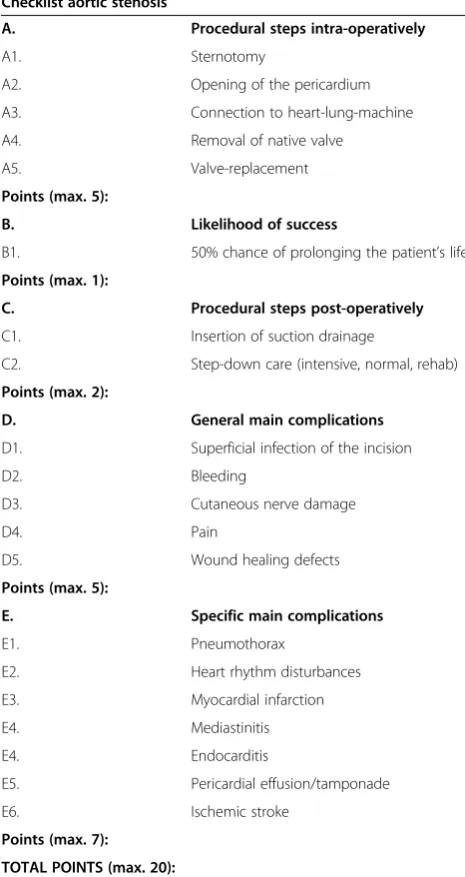
We chose three different cases: severe aortic valve defect, kidney cancer, and pancreatic tumor. All three conditions were designed to be at a stage, which required a surgical intervention, which was supposed to be the content of the ICTs. We chose rather complex procedures in order to have 20 different standardized information items that had to be remembered per case. Two clinical experts confirmed that the chosen cases were appropriate for our study purpose. The cases were constructed in such a way that they all had the same amount of information items (n = 20), which we equaled to intrinsic cognitive load. These were grouped into standardized procedural steps for the operation itself (n = 5), the likelihood of success (n = 1), general (n = 5) and specific (n = 7) complications, and the necessary follow-up treatment (n = 2). An ex-ample is shown in Table 1.
Interventions
The intervention comprised a 30-minute communica-tion training, in which the medical students were in-troduced to several strategies and techniques, based on
Brown’s framework for collaborative decision-making
(BFCDM), Paterick’s ideal statute (PIS) and Baile’s
SPIKES-protocol (BSP) [21-23]. The lecture comprised the following: a role play with an exceptionally bad ex-ample of an informed consent talk, then an interactive brainstorming session on what contributes to and
hin-ders a medical laypersons’comprehension, a short
lec-ture on the theory, and a role play with an appropriate informed consent talk. Main aspects of the theoretical input included
i) Setting the conditions in advance, e.g. sitting position (BSP),
ii) Assessing what the patient already knows and how much additional information is wanted followed by the description of the procedure, its risks and possible alternatives (BSP, BFCDM, PIS),
iii) Using easy and understandable language adapted to the patient’s level (BSP),
iv) Active encouragement to ask questions (BSP, BFCDM),
v) Making use of the available information sheets for medical procedures.
vi) Reducing the amount of information by clustering the facts (BSP). For example, combining each operative step with its possible complication.
At the end of each thematic teaching subunit, students applied cognitive load reduction techniques in prepar-ation for their next ICT. They drafted elements of the informed consent talks and received feedback on their performance from fellow students and the instructors.
The comparison intervention was a 30-minute inter-active class on ECG interpretation. No communication training was given in order to control for the Hawthorne effect and to blind the medical laypersons.
Assessment
After the simulated informed consent talks, the medical laypersons were asked to record on a blank sheet of paper, what they recalled from the simulated informed consent talks. The same strategy was used by Fortun et al. in their study on information recall, but since we standardized our ICTs with only 20 information items in
Table 1 Example of a checklist
Checklist aortic stenosis
A. Procedural steps intra-operatively
A1. Sternotomy
A2. Opening of the pericardium
A3. Connection to heart-lung-machine
A4. Removal of native valve
A5. Valve-replacement
Points (max. 5):
B. Likelihood of success
B1. 50% chance of prolonging the patient’s life
Points (max. 1):
C. Procedural steps post-operatively
C1. Insertion of suction drainage
C2. Step-down care (intensive, normal, rehab)
Points (max. 2):
D. General main complications
D1. Superficial infection of the incision
D2. Bleeding
D3. Cutaneous nerve damage
D4. Pain
D5. Wound healing defects
Points (max. 5):
E. Specific main complications
E1. Pneumothorax
E2. Heart rhythm disturbances
E3. Myocardial infarction
E4. Mediastinitis
E4. Endocarditis
E5. Pericardial effusion/tamponade
E6. Ischemic stroke
Points (max. 7):
TOTAL POINTS (max. 20):
contrast to the 13-page information sheet in Fortun’s study, no prompts were given [5].
Statistics
We used JMP 9.0 (SAS Institute Inc, Cary, NC, USA), nQuery 7.0 (Statistical Solutions, Saugus, MA, U.S.A.) and SPSS 19.0 (SPSS Inc., Chicago, IL, USA) to compute the results. Calculations were based on the mean of the raters’ evaluations. We compared the results of the recall-tests using Student’s t-test for matched pairs. The interrater-reliability was calculated as proposed by Shrout and Fleiss [24]. An improvement of 15% in number of remembered information items (three or more) was considered to be clinically significant.
Ethics
The study protocol was approved by the local ethics committee, decision number 488/2010A. The study was conducted in accordance to the declaration of Helsinki, revised form, Seoul 2008. All participants (medical lay-persons and medical students) gave written informed consent. Study participation was voluntary. Both medical students and medical laypersons received a small finan-cial compensation.
Results
One set of data had to be excluded due to missing data since the medical layperson only recorded, whether she enjoyed the talk, not what she remembered. Two ex-perienced physicians acted as raters, the interrater-reliability was 0.8.
The characteristics of the medical students and med-ical laypersons are shown in tables 2 and 3. Previous ICT experience had no measurable effect on the infor-mation recall of the medical laypersons.
In both groups the medical laypersons recalled signifi-cantly more items after the medical students received the communication training (EI group: 41 ± 9% vs. 23 ± 9%, p < .0001, LI group 49 ± 10% vs. 35 ± 6%, p < .0001). After the comparison intervention the gain in recalled informa-tion items was modest in both the EI and LI groups, and it was significant only in the LI group (EI group: 42 ± 9% vs. 40 ± 9%, p = .41, LI group 35 ± 6% vs. 29 ± 9%, p = .016) (see Figure 2).
Discussion
In our study a short communication training for advanced medical students focusing on strategies that reduce cogni-tive load significantly improved recall of information by medical laypersons after a simulated informed consent talk (ICT).
While the investigations of previous studies on informed consent talks concentrated mostly on factors regarding the patients, our study implicates that there is potential in
improving the efficacy of informed consent talks by using interventions for the physicians conducting ICTs.
Other studies focusing on optimizing the ICTs used
much longer communication teachings lasting 2–5 days
to improve their participants’abilities [25,26]. Flory and colleagues concluded that besides using a standard pro-cess for informed consent, the personal contact with a qualified staff seems to be the best approach to secure as much comprehension by the patients as possible [13]. The fact that a very short intervention had a measurable effect in our study could be attributed to the fact that we approached medical students, who up to this point have not really practiced ICTs so that they were still very susceptible to even little teaching input. After the com-parison intervention there was a small improvement in the late intervention group. This could be attributed to an unspecific training effect of either the medical stu-dents or the medical laypersons, since the medical lay-persons listened to three ICTs. It is likely that practice, even without specific training for medical students/ physicians conducting the ICTs, improves the efficacy of the ICTs. In our study, we asked the medical students about their specific experience with ICTs but could not find an effect on the recall of information items in the medical laypersons. Our study was not designed to show this effect, so this question should be addressed by a dif-ferently designed study.
Table 2 Characteristics of medical students
Early intervention group (EI)
Late intervention group (LI)
p
Age 26 ± 6 years 24 ± 2 years .11
Mean + SD
Gender 4 male, 8 male, .10
10 female 7 female
Previous training
Paramedic (n = 1) Nurse (n = 2) .43
Economics (n = 1)
Clinical experience
12 5th year 15 5thyear .01
2 6th year
Mean + SD 17 ± 3 weeks of clerkships
15 ± 5 weeks of clerkships
ICTs attended .29
Mean + SD 6.6 ± 9.4 12.8 ± 24.8
ICTs conducted
.48
Mean + SD 1.1 ± 1.7 1.3 ± 2.0
There are several limitations to our study. We used la-boratory conditions in order to standardize possible con-founders and the intrinsic cognitive load. Thus, the medical laypersons in our study were somewhat younger than typical patients suffering from the diseases. They were not in distress and not emotionally involved. It is well-known that emotional factors have a serious influ-ence on the perception of situations and the actual emo-tional load of a real situation might reduce the amount of remembered details [27]. However, one would expect
that fear and emotional distress affected mainly germane cognitive load, so that optimizing the extrinsic and in-trinsic cognitive loads is of even more importance. Al-though the communication training aimed at teaching medical students how to reduce a cognitive load, we did not measure layperson’s cognitive load, but the “hard
outcome”, the number of information items recalled
after the simulated informed consent talks. Furthermore, despite the standardized setting of this study, we can-not exclude confounders. There is the possibility of a
Table 3 Characteristics of the medical laypersons
Early intervention group (EI) Late intervention group (LI) p
Gender 9 female, 6 male 8 female, 7 male .53
Education 4 academic, 11 non-academic 6 academic, 9 non-academic .16
Age + SD 46 ± 10 years 49 ± 7 years .18
Characteristics of the medical laypersons. Early intervention group: the medical laypersons received simulated informed consent talks by medical students, who had a communication training first and a comparison intervention after. Late intervention group: the medical laypersons received simulated informed consent talks by medical students, who had a comparison intervention first and a communication training after. The p-values were calculated using the Chi Square test.
70
60
50
40
30
20
10
0
*
* 70
60
50
40
30
20
10
0
Intervention Control
for the medical students
Intervention Control
for the medical students
O1 O2 O3
EI group
O1 O2 O3
LI group
Items recalled by the medical laypersons
[percent], mean and SD
*
Items recalled by the medical laypersons
[percent], mean and SD
a
b
Figure 2Items recalled by the medical laypersons after a simulated informed consent talk with an advanced medical student before
and after a communication training that taught the students to reduce the layperson’s cognitive load and a comparison intervention on ECG interpretation, respectively. a: EI: Early intervention group, the medical students received first the communication training, then the comparison intervention.b: LI: late intervention group: the medical students received first the comparison intervention, then the
selection bias. We actively encouraged all regular students to take part in our study. Nonetheless, we cannot rule out that only students who were aware of their own li-mitations and consequently were more susceptible to even short training sessions agreed to participate in our study. On the other hand, it is equally possible that only very motivated students participated, thus their performance was above average. The students were not blinded to the intervention, the comparison-intervention served as blinding for the medical laypersons. In addition, the nov-elty effect of cases could play a role in performance. By fa-miliarizing the students with the cases prior to the actual study, we tried to reduce the possibility of this effect. Fi-nally, although two expert reviewers considered the used cases equally relevant and difficult, an (un-)equivalence of the cases used cannot be excluded completely. In order to control for this bias, we arranged them in a Latin-square design (Cheart–Ckidney–Cpancreas,Cpancreas–Cheart–Ckidney, Ckidney–Cpancreas–Cheart) so that each case was equally distributed in position. Finally, we can’t exclude the possi-bility that the medical laypersons looked up the content of the planned operations before the study, even though they all signed an agreement not to.
Despite these possible restrictions we conclude that a specific training in conducting ICTs for advanced ical students improves the recall of information of med-ical laypersons and thus may enhance patient safety as more informed patients are better able to actively par-ticipate in the treatment process. Further studies need to address the transferability into daily clinical routine with doctors and actual patients to see how the findings hold up in real life situations.
Conclusion
Communication training for advanced medical students can improve the information recall of medical laypersons in simulated informed consent talks.
Competing interests
The authors declare that they have no competing interests.
Authors’contributors
AW and NC were responsible for the study design, data analysis and drafting the manuscript. FH and SZ contributed significantly to the study design and critically revised the manuscript. NS performed the statistical analysis and critically revised the manuscript. PW and RR instructed the students and critically revised the manuscript. All authors approved the final manuscript.
Acknowledgments
We thank the Swiss“Master of Medical Education”program for the valuable contributions to the study design. Many thanks to the excellent proof reading of Yelena Fenik, our native speaker.
Author details
1Department for Internal Medicine VI, Psychosomatic Medicine, University
Hospital of Tübingen, Osianderstr. 5, 72076 Tübingen, Germany.2Office of the Dean of student affairs, Medical Faculty, University of Tübingen, Geisweg 5, 72076 Tübingen, Germany.3Department for Internal Medicine IV, Endocrinology, Diabetology, Nephrology, Angiology and Clinical Chemistry,
University Hospital of Tübingen, Otfried-Müller-Str. 10, 72076 Tübingen, Germany.4Medical Intensive Care Unit, University Hospital of Tübingen, Otfried-Müller-Str. 10, 72076 Tübingen, Germany.
Received: 17 September 2012 Accepted: 16 January 2013 Published: 1 February 2013
References
1. Meisel A, Roth LH, Lidz CW:Toward a model of the legal doctrine of informed consent.Am J Psychiatry1977,134(3):285–289.
2. Cahana A, Hurst SA:Voluntary informed consent in research and clinical care: an update.Pain Pract2008,8(6):446–451.
3. Jefford M, Moore R:Improvement of informed consent and the quality of consent documents.Lancet Oncol2008,9(5):485–493.
4. Brody BA, McCullough LB, Sharp RR:Consensus and controversy in clinical research ethics.Jama2005,294(11):1411–1414.
5. Fortun P, West J, Chalkley L, Shonde A, Hawkey C:Recall of informed consent information by healthy volunteers in clinical trials.QJM2008,
101(8):625–629.
6. Lavelle-Jones C, Byrne DJ, Rice P, Cuschieri A:Factors affecting quality of informed consent.BMJ1993,306(6882):885–890.
7. Mark JS, Spiro H:Informed consent for colonoscopy. A prospective study.
Arch Intern Med1990,150(4):777–780.
8. Sugarman J, McCrory DC, Hubal RC:Getting meaningful informed consent from older adults: a structured literature review of empirical research.
J Am Geriatr Soc1998,46(4):517–524.
9. Falagas ME, Korbila IP, Giannopoulou KP, Kondilis BK, Peppas G:Informed consent: how much and what do patients understand?Am J Surg2009,
198(3):420–435.
10. Joffe S, Cook EF, Cleary PD, Clark JW, Weeks JC:Quality of informed consent: a new measure of understanding among research subjects.
J Natl Cancer Inst2001,93(2):139–147.
11. Gigerenzer G, Galesic M:Why do single event probabilities confuse patients?BMJ,344:e245.
12. Segelov E, Tattersall MH, Coates AS:Redressing the balance–the ethics of not entering an eligible patient on a randomised clinical trial.Ann Oncol 1992,3(2):103–105.
13. Flory J, Emanuel E:Interventions to improve research participants’ understanding in informed consent for research: a systematic review.
Jama2004,292(13):1593–1601.
14. van der Meulen N, Jansen J, van Dulmen S, Bensing J, van Weert J:
Interventions to improve recall of medical information in cancer patients: a systematic review of the literature.Psychooncology2008,
17(9):857–868.
15. Brown RF, Butow PN, Boyle F, Tattersall MH:Seeking informed consent to cancer clinical trials; evaluating the efficacy of doctor communication skills training.Psychooncology2007,16(6):507–516.
16. Nuckles M, Wittwer J, Renkl A:Information about a layperson’s knowledge supports experts in giving effective and efficient online advice to laypersons.J Exp Psychol Appl2005,11(4):219–236.
17. Albrecht TL, Blanchard C, Ruckdeschel JC, Coovert M, Strongbow R:
Strategic physician communication and oncology clinical trials.J Clin Oncol1999,17(10):3324–3332.
18. Rosenbaum ME, Ferguson KJ, Lobas JG:Teaching medical students and residents skills for delivering bad news: a review of strategies.Acad Med 2004,79(2):107–117.
19. Schenker Y, Fernandez A, Sudore R, Schillinger D:Interventions to improve patient comprehension in informed consent for medical and surgical procedures: a systematic review.Med Decis Making2011,31(1):151–173. 20. van Merrienboer JJ, Sweller J:Cognitive load theory in health professional
education: design principles and strategies.Med Educ2010,44(1):85–93. 21. Paterick TJ, Carson GV, Allen MC, Paterick TE:Medical informed consent:
general considerations for physicians.Mayo Clin Proc2008,83(3):313–319. 22. Brown RF, Butow PN, Butt DG, Moore AR, Tattersall MH:Developing ethical strategies to assist oncologists in seeking informed consent to cancer clinical trials.Soc Sci Med2004,58(2):379–390.
23. Baile WF, Buckman R, Lenzi R, Glober G, Beale EA, Kudelka AP:SPIKES-A six-step protocol for delivering bad news: application to the patient with cancer.Oncologist2000,5(4):302–311.
25. Baile WF, Lenzi R, Kudelka AP, Maguire P, Novack D, Goldstein M, Myers EG, Bast RC Jr:Improving physician-patient communication in cancer care: outcome of a workshop for oncologists.J Cancer Educ1997,
12(3):166–173.
26. Jenkins V, Fallowfield L:Can communication skills training alter physicians’beliefs and behavior in clinics?J Clin Oncol2002,
20(3):765–769.
27. Lloyd AJ:The extent of patients’understanding of the risk of treatments.
Qual Health Care2001,10(Suppl 1):i14–i18.
doi:10.1186/1472-6920-13-15
Cite this article as:Werneret al.:Communication training for advanced
medical students improves information recall of medical laypersons in simulated informed consent
talks–a randomized controlled trial.BMC Medical Education201313:15.
Submit your next manuscript to BioMed Central and take full advantage of:
• Convenient online submission
• Thorough peer review
• No space constraints or color figure charges
• Immediate publication on acceptance
• Inclusion in PubMed, CAS, Scopus and Google Scholar
• Research which is freely available for redistribution