R E S E A R C H A R T I C L E
Open Access
Effect of the conditional cash transfer program
Oportunidades
on vaccination coverage in older
Mexican people
Aarón Salinas-Rodríguez
†and Betty Soledad Manrique-Espinoza
*†Abstract
Background:Immunization is one of the most effective ways of preventing illness, disability and death from infectious diseases for older people. However, worldwide immunization rates are still low, particularly for the most vulnerable groups within the elderly population. The objective of this study was to estimate the effect of the Oportunidades-an incentive-based poverty alleviation program- on vaccination coverage for poor and rural older people in Mexico.
Methods:Cross-sectional study, based on2007 Oportunidades Evaluation Survey, conducted in low-income households from 741 rural communities (localities with <2,500 inhabitants) of 13 Mexican states. Vaccination coverage was defined according to three individual vaccines: tetanus, influenza and pneumococcal, and for complete vaccination schedule. Propensity score matching and linear probability model were used in order to estimate theOportunidadeseffect.
Results:12,146 older people were interviewed, and 7% presented cognitive impairment. Among remaining, 4,628 were matched. Low coverage rates were observed for the vaccines analyzed. ForOportunidadesand non-Oportunidades populations were 46% and 41% for influenza, 52% and 45% for pneumococcal disease, and 79% and 71% for tetanus, respectively.Oportunidadeseffect was significant in increasing the proportion of older people vaccinated: for complete schedule 5.5% (CI95%2.8-8.3), for influenza 6.9% (CI95%3.8-9.6), for pneumococcal 7.2% (CI95%4.3-10.2), and for tetanus 6.6% (CI95%4.1-9.2).
Conclusions:The results of this study extend the evidence on the effect that conditional transfer programs exert on health indicators. In particular,Oportunidadesincreased vaccination rates in the population of older people. There is a need to continue raising vaccination rates, however, particularly for the most vulnerable older people.
Keywords:Older people, Vaccination coverage, Conditional cash transfer, Propensity score matching
Background
The current concept of immunization for older people (OP) can be traced back to at least 40 years, when the first influenza vaccination was recommended [1]. How-ever, a renewed interest in this and other vaccines for the high-risk elderly population group has been ob-served lately. Recent concern stems from three decisive factors: (1) the increasing number of OP in contempor-ary societies, (2) the high risk of complications and
mortality linked to viral influenza and tetanus infections, and (3) the fact that complications caused by these infec-tions can be successfully reduced through immunization. While the basic OP vaccination schedule is characterized by diversity [1,2], most efforts involve vaccines that counterbalance effectiveness with low risk profiles, and recommendations center mainly on a combination of three: tetanus-diphtheria toxoid, influenza and pneumo-coccal vaccines.
Tetanus-diphtheria toxoid
Despite its limited number of cases, tetanus continues to be one of the leading causes of various health problems
* Correspondence:[email protected]
†Equal contributors
Center for Evaluation Research and Surveys, National Institute of Public Health, Cuernavaca, Morelos, Mexico
among OP. In 2008, there were 122 cases reported in Mexico of tetanus-diphtheria. From these, 23% pertained to this group with a case-fatality rate of approximately 51% [3]. Evidence indicates that 60% of the reported cases that year occurred after a wound caused by a fall or injury, events which are recurrent among OP. Add-itionally, approximately 30% of the cases were associated with chronic wounds or underlying medical conditions, such as skin ulcers, abscesses, or gangrene [3].
Influenza and pneumococcal disease
Influenza is a major communicable disease among OP, par-ticularly among those with chronic respiratory and cardiac conditions. During 2008, older adults aged 65 years and above accounted for 16% of hospitalizations and 63% of the deaths attributable to influenza- and pneumococcal-associated infections in Mexico, from a total of 129,282 hospitalizations reported that year [3]. In fact, the esti-mated influenza-associated mortality rates during epi-demics are within a range of 15/100,000 among OP without high-risk conditions and 400/100,000 among those with one or more high-risk conditions, such as diabetes and chronic pulmonary disease [3].
Pneumococcal pneumonia among OP is two times more frequent than the overall incidence of pneumococ-cal pneumonia in Mexico [3]. Additionally, infectious diseases, particularly influenza and pneumonia, are among the leading causes of death among OP both in Mexico and worldwide [2-6]. This problem is particu-larly relevant in designing interventions targeting OP, as the presence of infectious diseases can precipitate the functional impairment process in OP.
Given that many of these diseases are preventable by effective vaccination, high infectious disease burdens and consequent morbidity and mortality among the OP is unwarranted. In fact, many studies have demonstrated that immunization is one of the most effective ways of preventing illness, disability and death from infectious diseases [7-16]. The World Health Organization esti-mates that OP vaccination reduces the risk of serious complications or death by 70% to 85% [17]. However, despite strong recommendations for influenza and pneumococcal vaccinations, immunization rates are still low globally. Although coverage is gradually increasing in several countries, it is still suboptimal, especially for pneumococcal vaccinations and among some minority groups [5,6,18,19]. Again, this indicates that insufficient vaccination coverage is common among vulnerable OP populations, particularly among the poor ones.
Conditional cash transfer program Oportunidades
Conditional cash transfer (CCT) programs are one of the most promising approaches to reducing extreme poverty
[20-22]. Originally called Progresa, Oportunidadesbegan in 1997 as a national CCT program intended to reduce extreme poverty in Mexico, and now is one of the largest CCT programs in the world. The government initially targeted rural areas and then extended the Program to urban areas. Currently,Oportunidadeshas enrolled nearly five million families in all 32 states nationwide.
Oportunidadesprovides cash transfers to poor families contingent on their adherence to activities determined by the program, such as: a) school enrolment of children age 6–16; b) attendance by an adult at a monthly health seminar and, c) compliance by all family members to schedule preventive health check-ups. These preventive medical checkups are expected to promote health and welfare to its beneficiaries. This means that each and every one of the residents of the beneficiary household must comply with doctor visits. Depending on the age of the home dweller, these visits are programmed differ-ently. For older adults, these visits should be carried out once every six months. To ensure the compliance of beneficiary households, medical service providers verify the completion of the required health care visits.
The process by whichOportunidadesselects households that receive the benefits of the program is described in de-tail in the literature [23], so we will only mention it here in summary. The program was implemented based on a very detailed targeting process aimed at reaching the poorest population in rural areas and avoiding local polit-ical influence in designating program beneficiaries.
Targeting of poor households was implemented cen-trally at theOportunidadesheadquarters in Mexico City and entailed three stages. First, all localities in the coun-try were ranked using a “marginality index” constructed from 1990 National Census data; this index was strati-fied into five categories and localities in the bottom cat-egories (high and very high levels of marginality) are pre-selected to be part of the program. Out of 200,151 localities in Mexico, 76,098 rural localities (14.8 million people) were identified in 1997 as having high or very high marginality levels and thus pre-selected for the program.
overcrowding index (persons per bedroom), the sex, age and schooling of the household head, the number of children, dwelling characteristics such as dirt floor, bath-room with running water, and access to electricity; and possession of durable goods such as a gas stove, a re-frigerator, a washing machine and a vehicle. These char-acteristics were used to compute the discriminant score that separated eligible and non-eligible households in the selected localities.
In stage three, the list of potential beneficiaries of the pro-gram was presented to a community assembly where the composition of the list was reviewed; if the assembly rejected a household in the list or an omitted household was alleged to be poor, an administrative process was implemented and the central office delivered a final decision [23].
Once households have been selected -and with the pur-pose to promote health and welfare of its
beneficiaries-Oportunidades provides for free the Basic Package of Health Services (Paquete Básico de Servicios de Salud). This package is designed to meet the health needs of each population group (children under five, women of child-bearing age, older people, etc.). For older people, the pack-age includes the following services: health promotion, nutrition, prevention and control of diseases, sexual and reproductive health, and vaccination schedule. For the present evaluation, our main reference for proper proce-dures regarding the provision of health services to OP was derived from the Oportunidades Program Rules of Op-eration published in 2007 [24] which is based in the Official Mexican Rule for vaccination schedules [25]. Both focus their basic OP vaccination schedules on tetanus-diphtheria, influenza and pneumococcal immunization.
Based on information from the OP vaccination sched-ule provided by the program, the objective of this study was to estimate the effect ofOportunidades on the vac-cination coverage for poor and rural OP in Mexico. Our central hypothesis was that the effect of Oportunidades
on EP vaccination coverage could reside in the prevent-ive checkups that the program has made mandatory for program eligibility.
Methods
Design and sampling
As part of its monitoring and evaluation efforts, the
Oportunidades program has been conducting evaluation surveys since it was established in 1997. After ten years of formal evaluation in rural areas of Mexico, the pro-gram carried out the survey Encuesta de Evaluación de los Hogares Rurales 2007 (ENCEL-2007), including, for the first time, a specific module for collecting data on the sociodemographic characteristics, the health status and the living conditions of OP beneficiaries in Mexico. Within this survey, the term older people referred to in-dividuals aged 65 years and over. Information was also
gathered on their household demographic, social and economic characteristics. Both datasets (individual older people and household levels) served to analyze the effect of Oportunidades on OP vaccination coverage as de-scribed in more detail later in the statistical analysis section.
Data collection and measures
Data was collected through household interviews conducted by trained personnel from the National Institute of Public Health (Instituto Nacional de Salud Pública, INSP) of Mexico using standardized survey materials. Interviewers, who were neither detailed on the study’s objectives or hy-potheses nor given any questions on program participation, assumed that the study was aimed at evaluating the overall living conditions of OP. All households in the communities visited were surveyed, and those with at least one resident aged 65 years and above were included in the study. Every OP dwelling in these households were interviewed. We used an adapted version of Folstein’sMini-Mental Statetest [26] to identify those who could not respond because of cogni-tive impairment.
In the case of cognitive impairment, a proxy, defined as the OP’s caregiver, was asked to respond to the ques-tionnaire for the elderly individual, provided that the caregiver was explicitly recognized by the OP as his/her caregiver. Caregivers were also designated as proxies in the case of visual or hearing impairment or any disability which could have prevented the OP from taking the
Mini-Mental Statetest.
Outcomes
The dependent variable selected for the study was the OP self-reported immunization status regarding tetanus, influenza and pneumococcal vaccines. Based on the Of-ficial Mexican Norm for vaccination schedules [25], three dichotomous variables were defined. Regarding tet-anus and pneumococcal disease, the variable equaled one when the OP had been vaccinated at least once in the past five years, and zero, otherwise. As for influenza, the variable equaled one when the OP had been vacci-nated in the past 12 months. These three dichotomous variables were analyzed separately. Another dichotom-ous variable was created which equaled one if the OP had received the vaccination complete schedule (three vaccines), and zero, otherwise.
Treatment variable
Covariates
On reviewing literature [27-32] in search of covariates, the following main determinants were identified for OP vaccination: sex, age, functional dependence, chronic disease, paid employment, marital status, educational level, health insurance, socioeconomic level and access to health services. Relevant data was obtained under
ENCEL-2007, as it included a household-level question-naire apart from the one applied at the individual level to OP. The survey also included a community-level questionnaire on access to health services that provided the following information: the density of nurses, physi-cians and health units, and the travel time (hours) to the nearest health unit. Both were incorporated into the statistical models to estimate the effect ofOportunidades
on OP vaccination coverage. Lastly, socio-economic community development data was obtained from a widely used index in Mexico: themarginalization index, which was designed and rendered operational by the Na-tional Population Council [33].
Statistical analysis Propensity score matching
Being the first time that data was gathered specifically on OP within the states constituting the original
Oportunidades evaluation design, the study relied on cross-sectional information, with consequent limita-tions in its capacity to assess the program’s causal ef-fects. However, it was possible to estimate the effect of the program on the basis of information fromOportunidades
beneficiary and non-beneficiary households. WithENCEL
-2007having been implemented throughout the households of the communities visited, it was possible to identify which OP belonged to beneficiary households and which OP did not within the same communities. Once this iden-tification step was completed, the intervention sample was established as the group of OP residing inOportunidades
beneficiary households, and the control sample as those residing in non-beneficiary households.
It is important to note that this definition of the con-trol group was necessary because of the original evalu-ation design of Oportunidades. Original design did not include the population of older adults as an interest group in which to evaluateOportunidadeseffect, so that a module to measure the specific health issues of the older people was not included in any of the previous evaluation surveys, until 2007. In this sense, the strategy used in this study was to identify the households that were in 2007 currently receiving program benefits, and within the same localities identify households at the time that were not beneficiaries of the program. In such a way, that the intervention and control groups were de-fined according to the status of membership in the pro-gram they had during the fieldwork ENCEL 2007.
Given the probable incidence of numerous heteroge-neous characteristics among the two groups, particularly in regards to their affiliation toOportunidades, the study ap-plied thePropensity Score Matchingtechnique [34] to esti-mate the impact of the program on OP vaccination coverage. We first constructed a propensity score that esti-mated the probability of enrollment in the Oportunidades program given a set of predictors, and we then created a control group (not-enrolled) and a treatment group (en-rolled) having similar propensity scores. We used a logistic regression model to estimate the conditional probability of
Oportunidades enrollment given a set of covariates, and the caliper matching algorithm allowed us to match, one-to-one, enrolled and not-enrolled EP with similar propen-sity scores [35,36].
To ensure comparability, we tested the balancing prop-erty on pre-treatment covariates between Oportunidades
enrollees and people not enrolled in the program [37]. We followed the algorithm suggested by Dehejia and Wahba [38,39] to find the best model specification. The method involved the use of different specifications until we obtained a balanced distribution of the following covari-ates at the individual, household and community levels: health insurance, possession of five items within the household (TV, refrigerator, gas stove, automobile, stereo, and dirt floor), household with children≤13 years, house-hold crowd index, education level of househouse-hold head, and community deprivation index. Furthermore, we estimated the percent balance of improvement between treated and control groups, which is defined as 100((|a|−|b|)/|a|), where ais the balance before and b is the balance after matching. Prior research indicated that these matching procedures lead to results similar to those obtained under the randomized experimental design built into the first stage of theOportunidadesprogram [40].
For each of the three dependent variables selected for the study (tetanus, influenza and pneumococcal vaccin-ation) and for the dichotomous variable that defines the complete schedule vaccination, we used a separate linear probability models [41], which produces results compar-able to those obtained under the logit orprobit models, alternate procedures for analyzing dichotomous vari-ables. The linear probability model provides the advan-tage that its coefficients can be directly interpreted in terms of a change in the probability of the event of inter-est caused by the exposure variable. As the standard error estimators under the linear probability model are heteroskedastic we used robust standard errors [42]. All analyses were performed under the statistical packages R 2.15 [43] and Stata 12.0 [44].
Ethical review
Salud Pública) approved the Oportunidades evaluation. Participants received a detailed explanation of the proce-dures and signed an informed consent declaration before data collection occurred.
Results
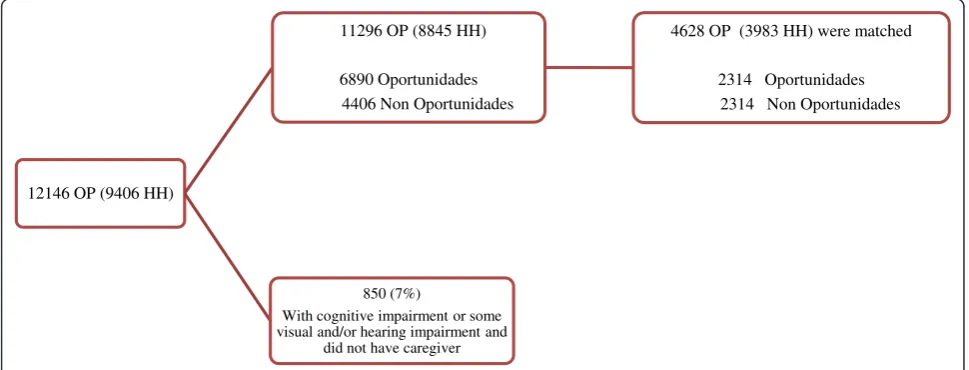
A total of 741 rural communities were visited within 13 states in Mexico. In these communities, was carried out a census of all households, and we identified 42,800 house-holds, for which we obtained a response rate of 91.3%, which means that 44,000 households were surveyed; and of these, 9,406 included at least one OP. In these house-holds each and every one of the OP over 65 years was interviewed. Altogether, 12,146 OP were interviewed, of whom 7% (850 OP) were excluded because they displayed cognitive impairment or other disabilities and did not have caregivers. From the remaining, 4628 were matched (Figure 1).
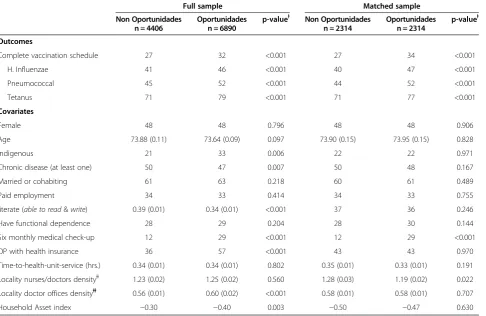
Table 1 contains OP, household and also some com-munity characteristics. Overall, the data reveals a mar-ginal and vulnerable population with low vaccination coverage rates and a high prevalence of functional de-pendence, chronic illnesses and illiteracy. It also indi-cates acute poverty and low medical insurance levels. Table 1 also shows data for full sample and the matched sample.
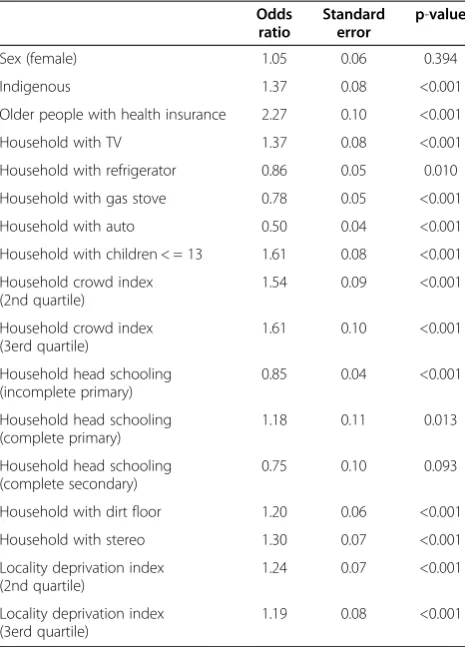
Table 2 shows the results of the logistic regression model to predict affiliation to the program. In general, all variables used were significant (except for OP sex), especially those related to the household assets and demographic structure. Once we estimated the propen-sity score, we used caliper algorithm (distance = 0.0001) to match one OP residing in an Oportunidades house-hold beneficiary with one OP in a non-beneficiary household. The results of the matching process were
rigorously evaluated to ensure homogeneity in the ob-served characteristics, except, of course, regarding program participation. In the matched samples, the differences be-tween both groups were considerably smaller for most of the variables. In fact, there were no significant differences for variables at each of the seven propensity score blocks evaluated. In Additional file 1: Table S1a shows balance be-fore and after matching as well as the percent balance of improvement between treated and control groups, mean-while Additional file 1: Figure S1a shows the propensity score distribution before and after matching.
Vaccination coverage among Oportunidades and
non-Oportunidades populations amounted to 46% and 41% for influenza, 52% and 45% for pneumococcal disease, and 79% and 71% for tetanus, respectively for all sam-ples. Similar numbers were observed for the matching sample (Table 1). After controlling for covariates, results indicate that Oportunidades exerts a significant and positive impact on the immunization of OP program beneficiaries. An effect of 0.069 (CI95%: 0.038, 0.096; p< 0.001) was observed on the influenza vaccine. Under the aforementioned linear probability model, this means that influenza immunization coverage was almost 7% higher among Oportunidades OP benefi-ciaries than among OP non-benefibenefi-ciaries. Pneumo-coccal and tetanus vaccine results were analogous with coefficient values of 0.072 (CI95%: 0.043, 0.102;p< 0.001)
and 0.066 (CI95%: 0.041, 0.092, p< 0.001), respectively.
Lastly, the program increased the probability of receiving the complete vaccination schedule (coefficient = 0.055, CI95%: 0.028, 0.082;p< 0.001) (Table 3).
Sensitivity analysis
In order to check the robustness of our results, we have carried out a number of alternative analyzes in
12146 OP (9406 HH)
11296 OP (8845 HH)
6890 Oportunidades 4406 Non Oportunidades
4628 OP (3983 HH) were matched
2314 Oportunidades 2314 Non Oportunidades
850 (7%)
With cognitive impairment or some visual and/or hearing impairment and
did not have caregiver
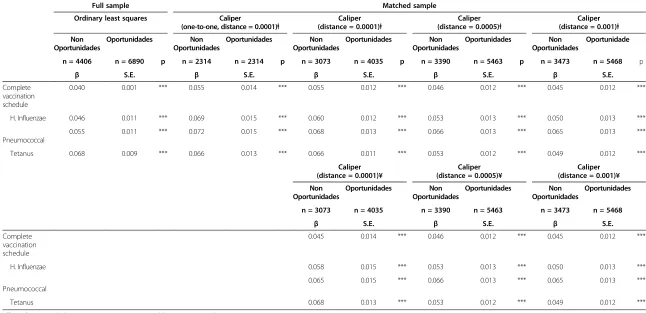
which we modified the distance within the caliper al-gorithm. Originally we used a distance = 0.0001, and one control for each treated unit. In subsequent ana-lyzes, we specified three different distances (0.0001, 0.0005, and 0.001) and a different number of treated and control units. These same analyzes were repeated using different ways to sort our observations. First or-dering observations according to the unique identifier of household used in the survey, and second according to the household assets index. The results of these analyzes are shown in Table 4. In general, the
esti-mate of the Oportunidades effect does not show
great variations, and in all cases it is highly signifi-cant for complete vaccination schedule and for each of the three individual vaccines.
Discussion
Since late 1990, CCT programs have been implemented and evaluated in Latin America and the Caribbean. The main feature of such programs is the provision of mon-etary support and investment in human capital, and in return the beneficiaries must meet certain actions that
promote good health and nutrition, and increase their educational levels.
Much of the empirical support on the impact of CCT programs on health and nutrition comes from studies evaluating Oportunidades. However, several systematic reviews on the impact of CCT programs, have found an increase in the use of health services for diverse popula-tions (prenatal, children <5 years, children 6–17 years and adults≥18 years), and a decrease on diarrhea in children, and the percentage of mothers who reported illness in children [45,46].
In another vein, the impact of CCT programs on the prevalence of vaccination has been studied primarily in children. For example, the Familias en Acciónprogram (Colombia) increased the probability that children have complied with the DPT vaccination schedule [47], while theAsignación Familiarprogram (Honduras) showed an increase in immunization coverage of DPT-Pentavalent in children less than three years [48]. Meanwhile, the
Red de Protección Social (Nicaragüa) led to large in-creases in complete schedule vaccination coverage [49]. Finally, the Oportunidades program showed a positive
Table 1 Descriptive characteristics for full sample and matched sample
Full sample Matched sample
Non Oportunidades n = 4406
Oportunidades n = 6890
p-valueⱡ Non Oportunidades n = 2314
Oportunidades n = 2314
p-valueⱡ
Outcomes
Complete vaccination schedule 27 32 <0.001 27 34 <0.001
H. Influenzae 41 46 <0.001 40 47 <0.001
Pneumococcal 45 52 <0.001 44 52 <0.001
Tetanus 71 79 <0.001 71 77 <0.001
Covariates
Female 48 48 0.796 48 48 0.906
Age 73.88 (0.11) 73.64 (0.09) 0.097 73.90 (0.15) 73.95 (0.15) 0.828
Indigenous 21 33 0.006 22 22 0.971
Chronic disease (at least one) 50 47 0.007 50 48 0.167
Married or cohabiting 61 63 0.218 60 61 0.489
Paid employment 34 33 0.414 34 33 0.755
literate (able to read&write) 0.39 (0.01) 0.34 (0.01) <0.001 37 36 0.246
Have functional dependence 28 29 0.204 28 30 0.144
Six monthly medical check-up 12 29 <0.001 12 29 <0.001
OP with health insurance 36 57 <0.001 43 43 0.970
Time-to-health-unit-service (hrs.) 0.34 (0.01) 0.34 (0.01) 0.802 0.35 (0.01) 0.33 (0.01) 0.191
Locality nurses/doctors densityⱡⱡ 1.23 (0.02) 1.25 (0.02) 0.560 1.28 (0.03) 1.19 (0.02) 0.022 Locality doctor offices densityⱡⱡ 0.56 (0.01) 0.60 (0.02) <0.001 0.58 (0.01) 0.58 (0.01) 0.707
Household Asset index −0.30 −0.40 0.003 −0.50 −0.47 0.630
Cells are percentages or means. Standard errors in parenthesis.
ⱡⱡNumber per 1000 inhabitants.
effect on the application of BCG in children aged 12–23 months and an increase in vaccination coverage against measles in children 12–23 months [50].
Our study, on the other hand, is part of the global evaluation of the Oportunidades program and is based on a large sample of poor and rural elderly persons. To the best of our knowledge, it constitutes the first empir-ical effort aimed at investigating the association between CCT program participation and vaccination coverage for OP. According to the results, the participation of house-holds with OP enrolled inOportunidades, one of the lar-gest CCT programs in the world, entailed a significant increase in the immunization coverage for the elderly
with regard to tetanus, pneumococcal and influenza vac-cines, and the complete vaccination schedule. It should be noted, however, that the immunization rates for this population continue to lag, particularly when com-pared to the standards established under the 2007– 2012 Mexican National Health Plan [51], where a goal of at least 85% coverage was set for the basic OP vac-cination schedule.
With respect to the hypothesis of our study, we be-lieve that the program's effect is not only due to the mandatory six-monthly check-ups for the OP, but could be related to the fact that beneficiaries of the program have experienced a learning process regarding the use of services health, and the benefits that entails for health [52].
Additionally, the results of this study support the mounting evidence on the short-term benefits of CCT programs for various health indicators in low- and middle-income countries [21,53-55]. However, an im-portant aspect that is omitted from the literature and should be addressed by future research is an analysis in-vestigating the factors mediating the relationship between
Oportunidades program participation and vaccination coverage specifically and access to health services for the OP population in general. For instance, it is important to determine what roles other government institutions in Mexico (Ministry of Health and the National Institute of Older Adults) play in vaccination coverage. Further, be-yond overall program participation, it is important for fu-ture research to identify specifically how the obligatory medical checkups required by Oportunidades affect vaccination.
Our results suggest that interventions to increase household income could increase vaccination coverage among OP. This could be an argument to promote inter-ventions consisting in conditional cash transfers or non-contributory pension schemes for OP, which is expected to increase older people’s economic and physical auton-omy. Autonomy is an essential component of older peo-ple’s well-being, to the extent that the World Health Organization in its Active ageing [56] policy proposes that it should be considered a key element of programs aimed at this population group.
Several limitations can be noted in our study. First, despite the rigorous matching methods applied to minimize the possibility of an OP selection bias regard-ing program participation, the causal inferences in the conclusions are not as powerful as they would have been had the study been executed under a purely experimen-tal design. Notwithstanding, it is worth mentioning that another Oportunidades study with a methodology com-parable to ours confirmed that analogous results are obtained under a quasi-experimental and a wholly ex-perimental approach [40].
Table 3 Effect ofOportunidadeson vaccination coverage in older Mexican people
Coefficient Standard error p-value
Complete vaccination schedule 0.055 0.014 <0.001
H. Influenzae 0.069 0.015 <0.001
Pneumococcal 0.072 0.015 <0.001
Tetanus 0.066 0.013 <0.001
Adjusted for covariates in Table1.
Table 2 Logistic regression model to predict affiliation to
Oportunidadesprogram
Odds ratio
Standard error
p-value
Sex (female) 1.05 0.06 0.394
Indigenous 1.37 0.08 <0.001
Older people with health insurance 2.27 0.10 <0.001
Household with TV 1.37 0.08 <0.001
Household with refrigerator 0.86 0.05 0.010
Household with gas stove 0.78 0.05 <0.001
Household with auto 0.50 0.04 <0.001
Household with children < = 13 1.61 0.08 <0.001
Household crowd index (2nd quartile)
1.54 0.09 <0.001
Household crowd index (3erd quartile)
1.61 0.10 <0.001
Household head schooling (incomplete primary)
0.85 0.04 <0.001
Household head schooling (complete primary)
1.18 0.11 0.013
Household head schooling (complete secondary)
0.75 0.10 0.093
Household with dirt floor 1.20 0.06 <0.001
Household with stereo 1.30 0.07 <0.001
Locality deprivation index (2nd quartile)
1.24 0.07 <0.001
Locality deprivation index (3erd quartile)
Table 4 Sensitivity analysis
Full sample Matched sample
Ordinary least squares Caliper
(one-to-one, distance = 0.0001)ⱡ
Caliper (distance = 0.0001)ⱡ
Caliper (distance = 0.0005)ⱡ
Caliper (distance = 0.001)ⱡ
Non Oportunidades
Oportunidades Non
Oportunidades
Oportunidades Non
Oportunidades
Oportunidades Non
Oportunidades
Oportunidades Non
Oportunidades
Oportunidade
n = 4406 n = 6890 p n = 2314 n = 2314 p n = 3073 n = 4035 p n = 3390 n = 5463 p n = 3473 n = 5468 p
β S.E. β S.E. β S.E. β S.E. β S.E.
Complete vaccination schedule
0.040 0.001 *** 0.055 0.014 *** 0.055 0.012 *** 0.046 0.012 *** 0.045 0.012 ***
H. Influenzae 0.046 0.011 *** 0.069 0.015 *** 0.060 0.012 *** 0.053 0.013 *** 0.050 0.013 ***
Pneumococcal
0.055 0.011 *** 0.072 0.015 *** 0.068 0.013 *** 0.066 0.013 *** 0.065 0.013 ***
Tetanus 0.068 0.009 *** 0.066 0.013 *** 0.066 0.011 *** 0.053 0.012 *** 0.049 0.012 ***
Caliper (distance = 0.0001)¥
Caliper (distance = 0.0005)¥
Caliper (distance = 0.001)¥
Non Oportunidades
Oportunidades Non
Oportunidades
Oportunidades Non
Oportunidades
Oportunidades
n = 3073 n = 4035 n = 3390 n = 5463 n = 3473 n = 5468
β S.E. β S.E. β S.E.
Complete vaccination schedule
0.045 0.014 *** 0.046 0.012 *** 0.045 0.012 ***
H. Influenzae 0.058 0.015 *** 0.053 0.013 *** 0.050 0.013 ***
Pneumococcal
0.065 0.015 *** 0.066 0.013 *** 0.065 0.013 ***
Tetanus 0.068 0.013 *** 0.053 0.012 *** 0.049 0.012 ***
Effect ofOportunidadeson vaccination coverage in older Mexican people. Adjusted for covariates in Table1.
ⱡObservations sort by unique household/individual identifier. ¥ Observations sort by household assets index.
ríguez
and
Manrique-Espinoza
BMC
Internationa
l
Health
and
Human
Rights
2013,
13
:30
Page
8
o
f
1
0
ntral.com/1
472-698X/13
Second, the study should be considered as a conserva-tive estimate of program effects. Seeking to minimize se-lection bias, the original sample size and, consequently, the power of the study were cut down. Nonetheless, the final matched sample size (2314 OP in each group,
Oportunidades and Non-Oportunidades) allowed for detecting differences of up to 3.5 percentage points with a power of 90%.
Third, the self-reported vaccination status by the OP or his/her caregiver was estimated as the measure of the outcome variable. Again, while some studies have dem-onstrated the validity of self-report vaccination among various OP populations [57-59], the question arises as to whether these study populations were rural and ex-tremely poor as well. A study should therefore be conducted to verify if the validity of self-reporting re-mains applicable in our case.
Fourth, the data associated with the Oportunidades
evaluation study in rural areas of Mexico was collected in 2007, just two years before the 2009 H1N1 influenza pandemic, which changed the public awareness of vac-cination and the health literacy. In fact, for example, Mexico now has the highest rate of vaccination against influenza among OECD countries [60]. The implications of this for our evaluation results are not clear; but the program impact may be even greater since the program's beneficiaries, mostly poor, have been a target population to which efforts have been directed to increase vaccin-ation coverage against influenza.
Lastly, although the safety, effectiveness and cost-effectiveness of OP vaccination schedules have been documented [61], the direct and significant impact of vaccination on specific OP physical health indicators is still pending analysis.
Conclusions
The program of conditional cash transferOportunidades
has an important effect in increasing vaccination rates in older people residing in rural areas of Mexico.
Additional file
Additional file 1:Estimation and evaluation of the propensity score. Table 1a. Distribution of variables before and after matching. Figure 1a. Propensity score distribution before and after matching.
Competing interests
The authors declare that they have no competing interests.
Authors’contributions
ASR BME had overall responsibility for the project and drafted the manuscript. ASR and BME participated in all phases of the design and implementation and were responsible for the design of survey questionnaires. ASR conducted the data analysis. All authors read and approved the final manuscript.
Acknowledgements
This work was supported by the Mexican Ministry of Social Development, represented byOportunidades. The elaboration of the study results required additional work by the authors. Lastly, the views expressed in this paper do not represent the official position of any of the institutions that funded or facilitated the evaluation.
Received: 8 February 2013 Accepted: 28 June 2013 Published: 8 July 2013
References
1. Bentley DW:Immunizations in the elderly.Bul NY Acad Med1987,63:533–551. 2. Bader MS:Immunization for the Elderly.Am J Med Sci2007,334:481–486. 3. Sistema Nacional de Información en Salud.http://www.sinais.salud.gob.mx/
basesdedatos/index.html.
4. Zimmerman RK, Santibanez TA, Fine MJ, Janosky JE, Nowalk MP, Bardella IJ, Raymund M, Wilson SA:Barriers and facilitators of pneumococcal vaccination among the elderly.Vaccine2003,21:1510–1517. 5. Endrich MM, Blank PR, Szucs TD:Influenza vaccination uptake and
socioeconomic determinants in 11 European countries.Vaccine2009, 27:4018–4024.
6. Blank PR, Matthias SM, Szucs TD:Influenza vaccination coverage rates in five European countries during season 2006/07 and trends over six consecutive seasons.BMC Publ Health2008,8:272.
7. Gaughran F, Walwyn R, Lambkin-Williams R, Whelan P, Chatterton K, Oxford J, Macdonald A:Flu: effect of vaccine in elderly care home residents: a randomized trial.J Am Geriatr Soc2007,55:1912–1920.
8. Lemaitre M, Meret T, Rothan-Tondeur M, Belmin J, Lejonc JL, Luquel L, Piette F, Salom M, Verny M, Vetel JM, Veyssier P, Carrat F:Effect of influenza vaccination of nursing home staff on mortality of residents: a cluster-randomized trial.J Am Geriatr Soc2009,57:1580–1586.
9. Shapiro ED, Clemens JD:A controlled evaluation of the protective efficacy of pneumococcal vaccine for patients at high risk of serious
pneumococcal infections.Ann Intern Med1984,101:325–330. 10. Butler JC, Breiman RF, Campbell JF, Lipman HB, Broome CV, Facklam RR:
Pneumococcal polysaccharide vaccine efficacy: an evaluation of current recommendations.JAMA1993,270:1826–1831.
11. Farr BM, Johnston BL, Cobb DK, Fisch MJ, Germanson TP, Adal KA, Anglim AM:Preventing pneumococcal bacteremia in patients at risk: results of a matched case–control study.Arch Intern Med1995,155:2336–2340. 12. Shapiro ED, Berg AT, Austrian R, Schroeder D, Parcells V, Margolis A, Adair
RK, Clemens JD:The protective efficacy of polyvalent pneumococcal polysaccharide vaccine.N Engl J Med1991,325:1453–1460.
13. McElhaney JE:Influenza vaccine responses in older adults.Ageing Res Rev2011, 10:379–388.
14. Lang PO, Govind S, Mitchell WA, Siegrist CA, Aspinall R:Vaccine effectiveness in older individuals: what has been learned from the influenza-vaccine experience.Ageing Res Rev2011,10:389–395. 15. Monto AS, Ansaldi F, Aspinall R, McElhaney JE, Montaño LF, Nichol KL,
Puig-Barberá J, Stephenson I:Influenza control in the 21st century: Optimizing protection of older adults.Vaccine2009,27:5043–5053.
16. Deans GD, Stiver HG, McElhaney JE:Influenza vaccines provide diminished protection but are cost-saving in older adults.J Intern Med2010,267:220–227. 17. World Health Organization:Influenza vaccines. WHO position paper.Wkly
Epidemiol Rec2002,77:230–234.
18. Holm MV, Blank PR, Szucs TD:Trends in influenza vaccination coverage rates in Germany over five seasons from 2001 to 2006.BMC Infect Dis2007,7:144. 19. Müller D, Szucs TD:Influenza vaccination coverage rates in 5 European
countries: a population-based cross-sectional analysis of the seasons 02/ 03, 03/04 and 04/05.Infection2007,35:308–319.
20. de Janvry A, Sadoulet E:Making conditional cash transfer programs more efficient: designing for maximum effect of the conditionality.World Bank Econ Rev2006,20:1–29.
21. Rawlings LB, Rubio GM:Evaluating the impact of conditional cash transfer programs: lessons from Latin America.World Bank Res Obs2005,20:29–55. 22. Heinrich CJ:Demand and supply-side determinants of conditional cash
transfer program effectiveness.World Dev2007,35:121–143.
http://oportunidades.gob.mx:8010/es/wersd53465sdg1/docs/2000/ ifpri_2000_skoufias_target.pdf.
24. Agreement whereby the Operational Rules of the Oportunidades Human Development Program are issued for Fiscal Year 2007.http://www. oportunidades.gob.mx/Portal/work/sites/Web/resources/ArchivoContent/ 715/Reglas_de_Operacion_Oportunidades_2007_LINKS_MAYO_9.pdf. 25. Official Mexican Norm NOM-036-SSA2-2002. Disease Prevention and Control.
Administration of vaccines, toxoids, immune saline solutions, antitoxins and immunoglobulin in humans.http://www.salud.gob.mx/unidades/cdi/nom/ 036ssa202.html.
26. Folstein MF, Folstein SE, McHugh PR:"Mini-mental state". A practical method for grading the cognitive state of patients for the clinician.J Psychiatr Res1975,2:189–198.
27. Kohlhammer Y, Schnoor M, Schwartz M, Raspe H, Schäfer T:Determinants of influenza and pneumococcal vaccination in elderly people: a systematic review.Public Health2007,121:742–751.
28. Opstelten W, Hak E, Verheij TJ, van Essen GA:Introducing a Pneumococcal Vaccine to an Existing Influenza Immunization Program: Vaccination Rates and Predictors of Noncompliance.Am J Med2001,111:474–479. 29. Johnson DR, Nichol KL, Lipczynski K:Barriers to adult immunization.Am J
Med2008,121:S28–S35.
30. Davis JW, Fujimoto RY, Chan H, Juarez DT:Factors affecting the influenza vaccination of high risk adults in Hawai'i.Hawaii Med J2009,68:50–54. 31. High KP:Overcoming barriers to adult immunization.J Am Osteopath
Assoc2009,109:S25–S28.
32. Nowalk MP, Zimmerman RK, Tabbarah M, Raymund M, Jewell IK: Determinants of adult vaccination at inner-city health centers: a descriptive study.BMC Fam Pract2006,7:2.
33. CONAPO.Índices de Marginación, 2005. http://www.conapo.gob.mx/es/ CONAPO/Indices_de_marginacion_2005_.
34. Abadie A, Imbens G:Large sample properties of matching estimators for average treatment effects.Econometrica2006,74:235–267.
35. Becker S, Ichino A:The estimation of average treatment effects based on propensity scores.Stata J2002,2:358–377.
36. Leuven E, Sianesi B:Psmatch2: Stata module to perform full Mahalanobis and propensity score matching, common support graphing, and covariate imbalance testing.http://ideas.repec.org/c/boc/bocode/s432001.html. 37. Rosenbaum P, Rubin D:The central role of the propensity score in observational studies for causal effects.Biometrika1983,70:41–55. 38. Dehejia RH, Wahba S:Causal effects in nonexperimental studies: re-evaluating
the evaluation of training programs.J Am Stat Assoc1999,94:1053–1062. 39. Dehejia RH, Wahba S:Propensity score-matching methods for
nonexperimental causal studies.Rev Econ Stat2002,84:151–161. 40. Diaz JJ, Handa S:An assessment of propensity score matching as a
nonexperimental impact estimator: evidence from Mexico’s PROGRESA program.J Hum Resour2006,61:319–345.
41. Agresti A:Categorical Data Analysis.New Jersey: Wiley; 2002.
42. White HA:Heteroskedasticity-Consistent Covariance Matrix Estimator and a Direct Test for Heteroskedasticity.Econometrica1980,48:817–838. 43. R Development Core Team:R: A language and environment for statistical
computing.Vienna, Austria: R Foundation for Statistical Computing; 2012. http://www.R-project.org/. ISBN 3-900051-07-0.
44. StataCorp:Stata Statistical Software: Release 12.College Station, TX: StataCorp LP; 2011.
45. Gaarder M, Glassman A, Todd J:Conditional cash transfers and health: unpacking the causal chain.Journal of Development Effectiveness2010,2:6–50. 46. Lagarde M, Haines A, Palmer N:The impact of conditional cash transfers
on health outcomes and use of health services in low and middle income countries.Cochrane Database Syst Rev2009,4, CD008137. 47. Attanasio O, Gómez LC, Heredia P, Vera-Hernandez M:The short term impact
of a conditional cash subsidy on child health and nutrition in Colombia.
http://www.ifs.org.uk/publications/3503.
48. Morris SS, Flores R, Olinto P, Medina JM:Monetary incentives in primary health care and effects on use and coverage of preventive health care interventions in rural Honduras: cluster randomised trial.Lancet2004, 364:2030–2037.
49. Barham T, Maluccio J:Eradicating Disease: The Effect of Conditional Cash Transfers on Vaccination Coverage in Nicaragua.J Health Econ2009, 38:611–621.
50. Barham T, Brenzel L, Maluccio JÁ:Beyond 80 %: Are There New Ways of Increasing Vaccination Coverage–Evaluation of CCT Programs in Mexico and
Nicaragua. Health, Nutrition and Population Discussion Paper.Washington D. C: World Bank; 2007.
51. National Health Program 2007–2012. For health in Mexico: Constructing alliances for improving health. (Por un México sano: construyendo alianzas para una mejor salud).http://www.geriatria.salud.gob.mx/descargas/programa_nacional_salud. pdf.
52. Sosa-Rubí SG, Walker D, Serván E, Bautista-Arredondo S:Learning effect of a conditional cash transfer programme on poor rural women’s selection of delivery care in Mexico.Health Policy Plan2011,26:496–507. 53. Lagarde M, Haines A, Palmer N:Conditional cash transfers for improving
uptake of health interventions in low- and middle-income countries: a systematic review.JAMA2007,298:1900–1910.
54. Fernald LCH, Gertler PG, Neufeld LM:Role of cash in conditional cash transfer programmes for child health, growth, and development: an analysis of Mexico'sOportunidades.Lancet2008,371:828–837. 55. Kenji S:Conditional cash transfer: a magic bullet for health?Lancet2008,
371:789–791.
56. World Health Organization:Active ageing. A policy framework. InPaper presented at the Second United Nations Assembly on Aging, Madrid, España, April 2002.http://whqlibdoc.who.int/hq/2002/WHO_NMH_NPH_02.8.pdf. 57. Mac Donald R, Baken L, Nelson A, Nichol KL:Validation of Self-Report of
Influenza and Pneumococcal Vaccination Status in Elderly Outpatients.
Am J Prev Med1996,16:173–177.
58. Skull SA, Andrews RM, Byrnes GB, Kelly HA, Nolan TM, Brown GV, Campbell DA:Validity of self-reported influenza and pneumococcal vaccination status among a cohort of hospitalized elderly inpatients.Vaccine2007, 25:4774–4783.
59. Bayas JM, Izquierdo C, Ruiz L, Sintes X, Sousa D, Celorrio JM, Varona W, Carratalá J, Nebot M, Batalla J, Sugrañes S, Manzur A, Terren A, García C, Clemente E, Rivera S, Justo I, Arévalo A, Salleras L, Domínguez A:Validity of self-reported pneumococcal vaccination status in the elderly in Spain.
Vaccine2009,27:4560–4564.
60. Health at a Glance 2011: OECD Indicators. http://www.oecd.org/els/health-systems/49105858.pdf.
61. Jefferson T, Rivetti D, Rivveti A, Rudin M, Di pietrantonj C, Demicheli V: Efficacy and effectiveness of influenza vaccines in elderly people: a systematic review.Lancet2005,366:1165–1174.
doi:10.1186/1472-698X-13-30
Cite this article as:Salinas-Rodríguez and Manrique-Espinoza:Effect of the conditional cash transfer programOportunidadeson vaccination coverage in older Mexican people.BMC International Health and Human Rights201313:30.
Submit your next manuscript to BioMed Central and take full advantage of:
• Convenient online submission
• Thorough peer review
• No space constraints or color figure charges
• Immediate publication on acceptance
• Inclusion in PubMed, CAS, Scopus and Google Scholar
• Research which is freely available for redistribution