*Corresponding author: [email protected] 2018 UTHM Publisher. All right reserved.
e-ISSN: 2600-7924/penerbit.uthm.edu.my/ojs/index.php/jst
Effect of Processing Temperature on Antioxidant Activity of Ficus carica
Leaves Extract
Nurlyana Bahrin
1, Norhayati Muhammad
1*, Norazlin Abdullah
1, Balkis Hj A Talip
1,
Samsiah Jusoh
2and Siew Wei Theng
11Department of Technology and Natural Resources, Faculty of Applied Sciences and Technology, Universiti
Tun Hussein Onn Malaysia, Pagoh Educational Hub, 84600 Pagoh, Muar, Johor, Malaysia.
2Rice and Industrial Crop Research Centre, Malaysian Agricultural Research and Development Institute
(MARDI), P.O. Box 12301, 50774 Kuala Lumpur, Malaysia Received 30 September 2017; accepted 27April 2018; available online 1 August 2018
1. Introduction
Ficus, the fig genus is one of the largest genera of angiosperm which consists of over 800 species of trees, epiphytes and shrubs worldwide. There are many types of species commonly found such as F. carica, F. religiosa L., F. elastic Roxb,ex Hornem (the rubber tree),
F. benghalensis (the bayan tree), F. racemose L., F. deltoidea Jack and others [1]. F. carica
is the most common fig plant among other species. Its leaves have been known for centuries of their medicinal benefits as remedy for metabolic, cardiovascular, respiratory, antispasmodic, anti-diabetic and anti-inflammatory treatment [2]. This is mainly attributed to the fact that F. carica leaves contain high phenolic compounds with antioxidant properties that are able to prevent health disorders related to oxidative stress [3].
Numerous literatures reported that dietary antioxidant protect against free radicals in the
human body [1,4]. It helps to slow down or prevent oxidation by eliminating free radical intermediates and preventing different reactions by being oxidized themselves. Lots of interest to the application of natural antioxidants in medical and food industry has been noticed due to the discovery of these bioactive compounds in food with possible antioxidant activity [5]. Solvent-extraction procedure regularly performed as a recovery of antioxidant components. However nowadays, a clear data on the extraction methodology and requirement are available although it contradicts sometimes depending on the raw materials being used [6]. According to Spigno
et al. (2007) [6], factors such as types of solvent, extraction methods, processing temperature and duration were parameters to be optimized in order to generate the highest yield of extract and of the maximum extraction quality in terms of the target compounds and antioxidant power.
Abstract: Ethanol is acknowledged as a good solvent for polyphenol extraction and is safe for human consumption. Therefore, it usually used in the extraction process of plant sample. However ethanol should be evaporated to obtain pure extract of the samples. Nevertheless, temperature involved during evaporation process would affect the antioxidant activity of the plant extract. Thus, the purpose of this study was to find out the effect of temperature used during evaporation of ethanol towards antioxidant activity of Ficus carica leaves extract. Dried powder of F. carica leaves were subjected to three sets of processing method which involve different temperatures: Set A involved maceration with 70% ethanol, followed by evaporation of ethanol in rotary evaporator at 60oC for 12 hours, set B involved maceration with 70% ethanol, followed by
evaporation of ethanol in vacuum oven at 45oC for 12 hours, while set C involved maceration with 70%
ethanol, followed by evaporation of ethanol at 25oC (room temperature) in fume chamber for 72 hours.
Antioxidant activity of extracts from each set were measured using two different in-vitro assays, including scavenging abilities on 1,1-diphenyl-2-picryl-hydrazyl (DPPH) and total phenolic content (TPC). F. carica extract from set B showed the highest antioxidant power in DPPH (3.78 mg/ml) and TPC (266.96 mg GAE/g) compared to set A and C. Thus, it can be concluded that temperature of 45oC could promote the antioxidant
activities, while high temperature would decrease the antioxidant abilities of F. carica leaves extract. Keyword: Antioxidant; ethanol; extraction; Ficus carica; temperature.
100 Alcoholic solvents have been frequently
performed to extract phenolic compounds from natural sources and was shown to give high yield of total extract [7]. Not only that, according to Pinelo et al., (2005), mixture of water and alcohol is more efficient to extract phenolic compounds compared to mono-component solvent system[8]. Besides, there was research focusing on the temperature that would affect antioxidant activity as well. According to previous study, increment in the temperature enhances antioxidant activity but beyond a certain temperature, the antioxidants could be denatured [6]. Since F. carica is popular as one of the medicinal plants with its high antioxidant activity, it is important to find out the effect of temperature used during evaporation process of ethanol towards antioxidant activity of F. carica leaves extract before it can be used effectively into nutraceuticals, pharmaceuticals or food ingredients in the future.
2. Materials and Method
Materials.F. carica dried leaves, 70% and 100% ethanol solution, 1,1-Diphenyl-2-picryl-hydrazyl (DPPH) solution, 1M Na2CO3, Folin-Ciocalteau reagent, gallic acid, weighing machine, blender, shaker, Whatman No.1 filter paper, hot plate, rotary evaporator RE301 branded BUCHI Malaysia, R-215 with vacuum pump V700 and vacuum controller V850, vacuum oven, fume chamber and spectrophotometer brand Shimadzu UV-1208, Japan.
Sample preparation. The mature sun-dried leaves of F. carica were purchased from a local fig farm, Formenniaga which was located at 12, Jalan BPP 5/4, Pusat Bandar Putra Permai 43300 Seri Kembangan, Selangor. The dried leaves were ground into powder form using a blender and kept in a sealed container until it was being used.
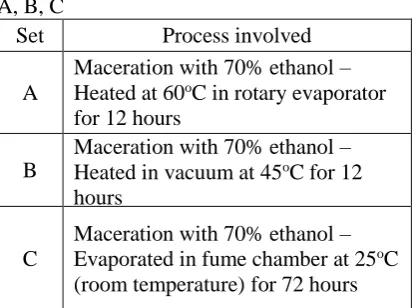
Preparation of extract. The dried powdered leaves were divided into three sets (set A, B and C) to undergo different processing temperature (Table 1). The three sets of dried F. carica leaves underwent the same type of extraction and different heating process to find out the effect of processing temperature on the antioxidant yield of F. carica pure extract.
Table 1 Processing temperature involved in set A, B, C
Set Process involved
A
Maceration with 70% ethanol – Heated at 60oC in rotary evaporator for 12 hours
B
Maceration with 70% ethanol – Heated in vacuum at 45oC for 12 hours
C
Maceration with 70% ethanol – Evaporated in fume chamber at 25oC (room temperature) for 72 hours
Extraction. The dried powdered leaves were extracted with the same method which was maceration with ethanol. In maceration extraction method, 165 g of dried powdered F. carica leaves were soaked with 70% ethanol (1:40, w/v) at 27°C for 72 hours [9]. It was agitated on a shaker with the speed of 70 rpm [10]. 70 % of ethanol was being used as it has contributed to the highest scavenging activity on DPPH radicals [11]. The extract was filtered with Whatman No. 1 filter paper and the marc was remacerated with the current solvent until it was exhausted [9]. Ethanol was fully evaporated once the volume has reduced to 30 % from the initial volume. The liquid extract was kept in refrigerator at 40C under it was being used.
Heating. The liquid extract of set A was filled into rotary evaporator RE301 branded BUCHI Malaysia, R-215 with vacuum pump V700 and vacuum controller V850 at 60oC, under reduced pressure of 175 mbar with rotation at the speed of 130 rpm to remove the ethanol completely [12]. While, the liquid extract of set B was poured into 150 ml beakers and placed into vacuum oven at 45oC. The purpose of heating procedure was to evaporate completely ethanol content in the extract so that pure extract could be obtained. However, the liquid extract of set C was poured in beakers and placed in fume chamber at room temperature (25oC) for 72 hours without any heating process.
101 DPPH assay. Determination of free radical
scavenging activity of the sample was carried out using the DPPH assay which was adopted from Mensor et al., (2001) [13]. DPPH solution was prepared by adding 5.9 mg of DPPH powder into 100ml of 100% ethanol and mixed well together. Then, the sample was diluted with 100% ethanol to final concentration of 20, 10, 5 and 2.5 mg/ml respectively. 3 ml of 5.9 mg/100 ml DPPH solution was added to 50 ul of each sample and incubated in the absence of light for 15 minutes before the absorbance was taken using spectrophotometer at 517 nm. The DPPH blank is used as control. The radical scavenging activity (Equation 1) and EC50 were calculated. The experiment was done in triplicate.
Radical Scavengers Activity (%)
= Abs DPPH-Abs sampleAbs DPPH x 100% (1)
Where:
Abs sample = absorbance of sample in ethanolic DPPH solution Abs DPPH = absorbance of DPPH solution.
TPC assay. The method used to determine the total phenolic content was adapted from Konyalιoğlu et al. (2005) [14]. 100 μl of sample was added into 2.0 ml of 1M Na2CO3. 100 μl of Folin-Ciocalteau reagent (1:1, v/v) was mixed and the solution was let to stand at room temperature within 30 minutes. The absorbance reading was taken at 750 nm in triplicate. Control sample was prepared using the same method without test compound or standard. Gallic acid was use as the standard and prepared in concentrations of 0, 20, 40, 60, 80 and 100 μg/ml. This was because gallic acid was commonly used as a reference compound. The determination of phenolic concentration is done by comparing the sample with the standard calibration curve of gallic acid. Total phenolic content value was expressed as gallic acid equivalents (mg/g).
Statistical analysis. The statistical analyses were performed by a one-way ANOVA using minitab. All the results were expressed as means ± SD. to show variations in the various experimental. Differences are considered significant when p < 0.05 [15].
3. Results and Discussions
DPPH. Table 2 shows the results of DPPH assay. From the result, set B showed the highest radical scavenges capability compared to set A and C extracts due to the temperature the extracts were subjected to in order to evaporate the ethanol (45oC for set B, 60oC for set A and 25 oC for set C). This was explained by Yi & Wetzstein (2011) [16], and supported by Pinelo
et al., (2005) [8] whose found out that temperature more than 50oC resulted in thermal degradation of phenolic compounds which leaded to decrease in antioxidant activity. This was because phenolic compounds were simply oxidized and hydrolyzed at high temperature.
However, there was also research showing that a slight increase of extraction temperature could actually contribute to higher analyte solubility by maximizing both mass transfer rate and solubility. Furthermore, the surface tension and viscosity of the ethanol solvent were reduced at elevated temperature, thus helped the solvents to improve the extraction rate by reaching the sample matrices [17]. This was able to justify the reason set B F. carica
extract underwent heating process in vacuum oven (40oC) but still retained the highest radical scavenging ability.
On the other hand, there were quite huge difference between set B and set C although set C was not going through any type of heating. This is because according to Jeong et al., (2004) [18], antioxidant activity was significantly affected by heating temperature and duration of treatment. Ethanol was chosen to be used in the extraction method as it exhibit the highest efficacy, generating greatest number of phenolic compounds, compared to other solvents.
Table 2 Antioxidant activity (EC50) of F.
carica with different extraction temperatures in DPPH radical scavenging assay
TPC. TPC results showed that total phenolic content of F. carica extract with different processing methods were arranged in the order of Set B (266.96 mg GAE/g) > Set A (119.11 mg GAE/g) > Set C (46.99 mg GAE/g)
102 (Table 3). It could be seen that 70% ethanolic
maceration methods at higher temperature in set A and B contained higher phenolic content compared to set C at room temperature. The results obtained corresponded to the literature review studied on efficiency of 70% ethanol as the solvent that always results in the maximmum extraction yield with highest presence of phytoconstituents such as saponins, carbohydrates, tannins, alkaloids and flavonoids in comparison to other solvents including water, chloroform and petroleum ether [19]. Besides, 3-O- and 5-O-caffeoylquinic acids, bergapten, quercetin 3-O-glucoside, quercetin 3-O-rutinoside, psoralen, ferulic acid and organic acids such as citric, oxalic, quinic, malic, fumaric and shikimic acids which were reportedly found abundance in F. carica leaves stated in literature review were more soluble in ethanol than in water, leading to higher phenolic content [20].
Moreover, it is believed that set B of F. carica extract contained higher phenolic compounds compared to set A and C extract due to the temperature the extracts were subjected to in order to evaporate the ethanol (45oC for set B, 60oC for set B and 25oC for set C). Most polyphenols and flavonoids were heat sensitive compounds although extraction in high temperature normally promotes mass transfer process, which led to faster extraction rate [21]. The research also indicates that set C has lesser phenolic content because it has no inclination of temperature to enhance the solubilility of solute. Pinelo. et al., (2005) [8] agreed that rising the temperature helps extraction by enhancing the diffusion coefficient and solubility of solute which resulted in higher total phenolic content in the extract. However, the phenolic compounds’ stability was affected and denaturation of the membranes occured at temperatures more than 50oC despite the positive increase in phenolic content due to a higher temperature used.
Table 3 Total phenolic content of F. carica
samples with different processing temperatures
Set Total phenolic content (mg) GAE/g
A 119.95 ± 1.17a B 266.96 ± 1.85b C 52.21 ± 0.75c
4. Conclusions
In conclusion, temperature used during processing highly affected the antioxidant activity of F. carica leaves. Results showed that maceration with 70% ethanolic extract, followed by heated in vacuum at 45oC for 12 hours had the highest antioxidant power in DPPH assay. From this study, 45oC was found to be the best processing temperature for F. carica leaves extract to retain more antioxidant properties compared to maceration with 70% ethanolic extract followed by heated in rotary evaporator at 60oC for 12 hours and maceration with 70% ethanolic extract followed by evaporation at 25oC for 72 hours in room temperature. It could be stated that temperature more than 50oC resulted in thermal degradation of phenolic compounds in the leaves and upon any inclination of temperature would not release as much as antioxidant content compared to the evaporation at 45oC.
Acknowledgment
This research was supported by Universiti Tun Hussein Onn Malaysia.
References
[1] Sirisha, N., Sreenivasulu, M., Sangeeta, K., & Chetty, C. M. (2010). “Antioxidant Properties of Ficus Species–A Review” In
International Journal of PharmTech Research, Vol. 2. No. 4 pp. 2174-2182. [2] Yang, X., Guo, J. L., Ye, J. Y., Zhang, Y. X.,
& Wang, W. (2015). “The Effects of Ficus Carica Polysaccharide on Immune Response and Expression of Some Immune-Related Genes in Grass Carp,
Ctenopharyngodon Idella” in Fish & Shellfish Immunology, Vol. 42. No. 1 pp. 132-137.
[3] Çalişkan, O., & Polat, A. A. (2011). “Phytochemical and Antioxidant Properties of Selected Fig (Ficus Carica L.) Accessions from the Eastern Mediterranean Region of Turkey” in Scientia Horticulturae, Vol. 128. No. 4 pp. 473-478.
103 [5] Turkmen, N., Sari, F., & Velioglu, Y. S.
(2005). “The Effect of Cooking Methods on Total Phenolics and Antioxidant Activity of Selected Green Vegetables” in Food Chemistry, Vol. 93. No. 4 pp. 713-718. [6] Spigno, G., Tramelli, L., & De Faveri, D.
M. (2007). “Effects of Extraction Time, Temperature and Solvent on Concentration and Antioxidant Activity of Grape Marc Phenolics” in Journal of Food Engineering, Vol. 81. No. 1 pp. 200-208.
[7] Yilmaz, Y., & Toledo, R. T. (2006). “Oxygen Radical Absorbance Capacities of Grape/Wine Industry by Products and Effect of Solvent Type on Extraction of Grape Seed Polyphenols” in Journal of Food Composition and Analysis, Vol. 19. No. 1 pp. 41-48.
[8] Pinelo, M., Rubilar, M., Jerez, M., Sineiro, J., & Núñez, M. J. (2005). “Effect of Solvent, Temperature, and Solvent-to-Solid Ratio on the Total Phenolic Content and Antiradical Activity of Extracts from Different Components of Grape Pomace” in Journal of Agricultural and Food Chemistry, Vol. 53. No. 6 pp. 2111-2117. [9] Vongsak, B., Sithisarn, P., Mangmool, S.,
Thongpraditchote, S., Wongkrajang, Y., & Gritsanapan, W. (2013). “Maximizing Total Phenolics, Total Flavonoids Contents and Antioxidant Activity of Moringa Oleifera Leaf Extract by the Appropriate Extraction Method” in Industrial Crops and Products, Vol. 44. pp. 566-571. [10] Hinneburg, I., & Neubert, R. H. (2005).
“Influence of Extraction Parameters on the Phytochemical Characteristics of Extracts from Buckwheat (Fagopyrum Esculentum) Herb” in Journal of Agricultural and Food Chemistry, Vol. 53. No. 1 pp. 3-7.
[11] Abozed, S. S., El-Kalyoubi, M., Abdelrashid, A., & Salama, M. F. (2014). “Total Phenolic Contents and Antioxidant Activities of Various Solvent Extracts from Whole Wheat and Bran” in Annals of Agricultural Science, Vol. 59.
[12] da Silva, I. A. A., da Silva, T. M. S., Camara, C. A., Queiroz, N., Magnani, M., de Novais, J. S.,de Souza, A. G. (2013). “Phenolic Profile, Antioxidant Activity and Palynological Analysis of Stingless Bee Honey from Amazonas, Northern Brazil” in Food Chemistry, Vol. 141. No. 4 pp. 3552-3558.
[13] Mensor, L. L., Menezes, F. S., Leitão, G. G., Reis, A. S., Santos, T. C. d., Coube, C. S., & Leitão, S. G. (2001). “Screening of Brazilian Plant Extracts for Antioxidant Activity by the Use of DPPH Free Radical Method” in Phytotherapy Research, Vol. 15. No. 2 pp. 127-130. [14] Konyalιoğlu, S., Sağlam, H., & Kιvçak,
B. (2005). “α-tocopherol, Flavonoid, and Phenol Contents and Antioxidant Activity of Ficus carica. Leaves” in
Pharmaceutical Biology, Vol. 43. No. 8 pp. 683-686.
[15] Ao, C., Li, A., Elzaawely, A. A., Xuan, T. D., & Tawata, S. (2008). “Evaluation of Antioxidant and Antibacterial Activities of Ficus Microcarpa L. Fil. Extract” in Food Control, Vol. 19. No. 10 pp. 940-948.
[16] Yi, W., & Wetzstein, H. Y. (2011). “Effects of Drying and Extraction Conditions on the Biochemical Activity of Selected Herbs” in Horticulture Science,Vol. 46. No. 1 pp.70-73.
[17] Dai, J., & Mumper, R. J. (2010). “Plant Phenolics: Extraction, Analysis and Their Antioxidant and Anticancer Properties” in Molecules, Vol. 15. No. 10 pp. 7313-7352.
[18] Jeong, S.-M., Kim, S.-Y., Kim, D.-R., Jo, S.-C., Nam, K., Ahn, D., & Lee, S.-C. (2004). “Effect of Heat Treatment on the Antioxidant Activity of Extracts from Citrus Peels” in Journal of Agricultural and Food Chemistry, Vol. 52. No. 11 pp. 3389-3393.
[19] Arya, V., Thakur, N., & Kashyap, C. (2012). “Preliminary Phytochemical Analysis of the Extracts of Psidium
Leaves” in Journal of Pharmacognosy and Phytochemistry, Vol. 1. No. 1 pp 1-5. [20] Mawa, S., Husain, K., & Jantan, I. (2013). “Ficus Carica L. (Moraceae): Phytochemistry, Traditional Uses and Biological Activities” in Evidence-Based Complementary and Alternative Medicine, Vol. 2013 pp 1-8.