The Influence of Nitrogen Pressure on the Structure of a-CN
xThin
Films Prepared by PLD Method
Kamal Kayed*
*Physics Department, Science Faculty, Damascus University, Syria.
Received 1 February 2018, Revised 4 July 2018, Accepted 11 July 2018
ABSTRACT
The structure of amorphous CNX thin films has a variety of chemical bond, and studies on these bonds ratios are very important because these ratios determine the appropriate technical use of these films. Therefore, this paper aim to investigate the relation between the conditions of preparation (deposition pressure) of a-CNx thin films prepared using PLD (Pulsed Laser Deposition) method and the film's structure. Results shown that the deposition pressure variation does not affect the concentration in the same manner for all bonds in the film. Moreover, the sp2 cluster size and the order degree are related to the numerical value of the deposition pressure.
Keywords: XPS Spectroscopy, Carbon Nitride; Raman Spectroscopy, Laser, Deposition.
1. INTRODUCTION
Amorphous CNX thin films are characterized by a mix of CN bonds with different patterns of sp2
and sp3 hybridization. These thin films characteristics depend mainly on the percentage of these
hybridizations [1-2]. The importance of the amorphous phase arises because synthesizing of Cubic-C3N4 phase requires applying high degrees of heat, which is not applicable for most
applications. Alternatively, amorphous CNX thin films with high content of CN bonds with SP3
hybridization can be produced instead since it have similar characteristics to the Cubic-C3N4.
Besides that, the amorphous CNX thin films does not requires high degrees of heat, instead it can
be prepared at the room temperature [1-2].
Amorphous carbon (a-C) and amorphous CNX thin films (a-CNx) garner the attention of the
scientific community [1-9] because they have very important structural properties , such as high elasticity, low friction coefficient, significant optical properties, and for its biocompatibility features. [4, 6-9]. Moreover, these thin films have a variety of uses such as optoelectronics, protective coatings, making electronic elements, capacitors, infra-red detectors and gas sensors.
In this work, we investigate how deposition parameters such as deposition pressure affect the micro structure of a-CNx thin films prepared using pulsed laser.
2. MATERIALS AND METHODS
The a-CNx thin films have been deposited onto n-type Si (100) and glass substrates. The films
were prepared using Nd:YAG pulsed laser (RD-YG-300/ λ = 1064 nm, laser flounce = 12.8 J cm
20
2). Five samples of carbon nitride thin films were prepared in an environment of pure nitrogen
(purity 99.999%). The nitrogen (N2) pressures varied from 10 to 1000 Pa. Raman spectra of the
samples were measured using a Jobin-Yvon T64000 (operating with a 514.5 nm line of argon
laser with resolution 2 cm-1). The chemical composition of the films were measured by using a
LEYBOLD LHS11 MCP- XPS spectroscopy. The SEM photos was recorded by using a JEOL-type JSM 6400F scanning electron microscopy.
3. RESULTS AND DISCUSSION
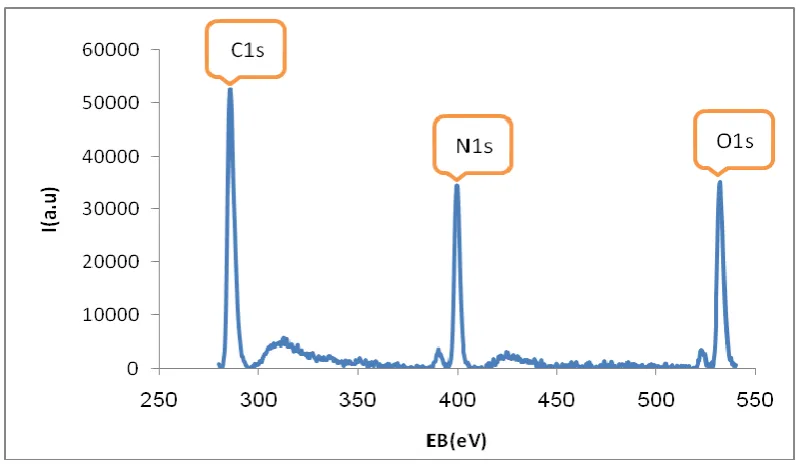
A detailed description of the spectra obtained by all used spectroscopes compressively is mentioned in our previous works [4,6-9]. Figure 1 plots XPS spectrum of the sample prepared using pressure of 100 Pa. In this figure, the peaks C1s, O1s and N1s were distinguished.
Figure 1. XPS spectrum of the sample prepared using nitrogen pressure of 100 Pa.
C(sp2)-C, C(sp2)-N and C(sp3)-N bonding ratios have been calculated for all samples. The
calculation was done using the method explained in our previous work [4]. Table 1 contains the C(sp2)-C, C(sp2)-N and C(sp3)-N bonding ratios for all sample.
Table 1 The C (sp2)-C, C (sp3)-N and C (sp2)-N bonding ratios for all samples
Pressure
(Pa) [C-C(sp2)] [C-N(sp2)] [C-N(sp3)]
10 36.496 20.045 8.461
100 27.370 23.298 11.125
300 34.259 18.696 10.350
500 47.177 21.450 7.885
1000 48.052 19.573 7.016
21
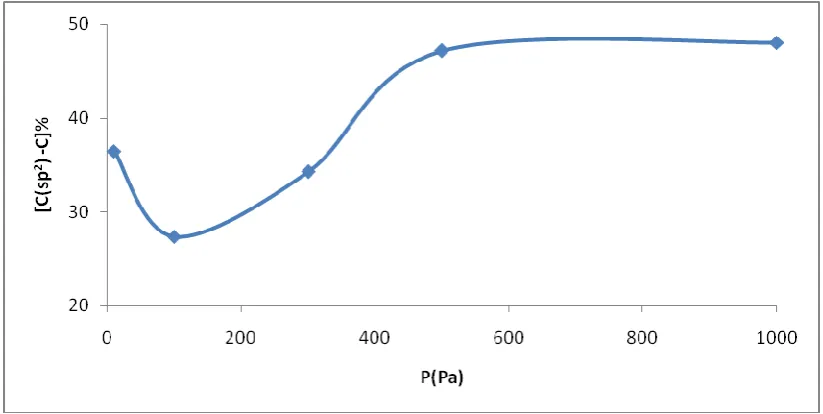
Figure 2 shows the concentration of C(sp2)-C bonds as a functions of deposition pressure. As the
pressure increases, the concentration of C(sp2)-C bonds decreases at low pressure (10–100 Pa)
and increases when moving to higher pressures. An opposite behavior can be observed in the case of C(sp3)-N bonds (refer Fig. 3).
Figure 2. The concentration of C(sp2)-C bonds as a function of deposition pressure.
Figure 3. The concentration of C(sp3)-N bonds as a function of deposition pressure.
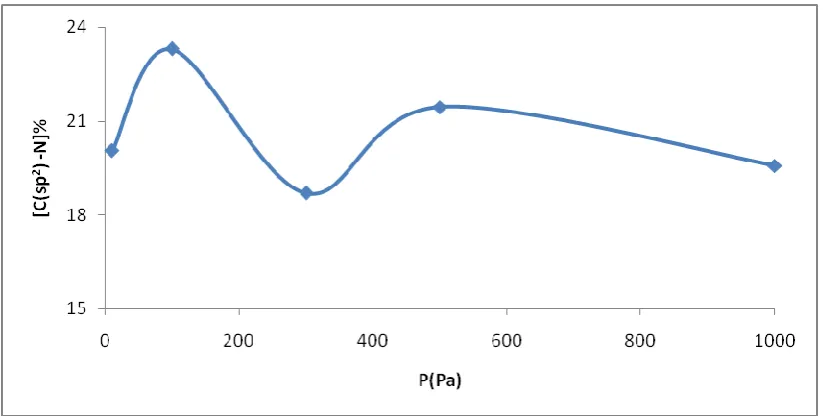
There is no specific behavior in the case of C(sp2)-N bonds (Figure 4), where the concentration
swings around an average value (approximately 21%). The decreasing concentration of C(sp2
)-N and C(sp3)-N bonds indicate that the nitrogen content in the films decreases when pressure
22
Figure 4. The concentration of C(sp2)-N bonds as a function of deposition pressure.
Results obtained from previous plot in Figure 2 until Figure 4 imply that the use of high pressures is not beneficial to the forming of each of the N–C (sp2) or N–C (sp3) bonds in the
films. This may be the result of the increased rate of inelastic collisions between ions in high pressures during the film growth process.
Comparison between the electron microscopy images (Figure 5) shows that the sp2 clusters size
increases with increasing C(sp2)-N bonds concentration and decreases with the decreasing of
these bonds. This result indicates that the C(sp2)-N bonds contribute to the formation of
sp2different configurations (hexagonal rings or chains).
Figure 5. SEM photos of the prepared films.
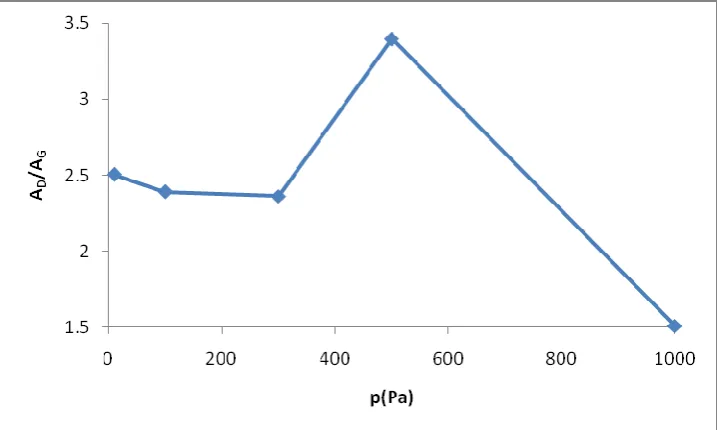
Figure 6 illustrates the order degree AD/AG as a function of nitrogen pressure. In general, the
order degree decrease as the deposition pressure increase with the exception of the case of the sample prepared at 500 Pa. The ratio AD/AG decrease indicates that the order phase (chains)
23 Figure 6. The order degree as a function of deposition pressure.
4. CONCLUSION
Amorphous CNx thin films were deposited onto unheated silicon (100) and glass substrates
using pulsed laser deposition of graphite tablets in N2 gas atmosphere. The samples were
analyzed by XPS, Raman and SEM Spectroscopes. The results showed that the nitrogen ratio decrease as the deposition pressure increases. The C (sp2)-N bonds was found to have
contributed to the formation of sp2 configurations (hexagonal rings or chains). It was found that
the order degree decreases as the deposition pressure increase in the area of low pressure. There is no obvious relationship between order degree and deposition pressure in the case of higher pressure, where the ratio of chains number to hexagonal rings number is sensitive to the numerical value of the applied pressure.
ACKNOWLEDGMENTS
We would like to thank the Director General of Syrian Atomic Energy Professor I. Othman, commission for encouragement and support; and Dr. A. Alkhawwam, and Dr. B. Abdallah for assistance.
REFERENCES
[1] I. Bertoti, T. Szorenyib, F. Antoni, E. Fogarassy, "The effect of process parameters on the chemical structure of pulsed laser deposited carbon nitride films," Diamond and Related Materials 11 (2002) 1157 –1160.
[2] SE. Rodil, "Infrared spectra of amorphous carbon based materials," Diamond & Related Materials 14, (2002)1262- 1269.
24
[4] K. Kayed, "Effect of nitrogen plasma afterglow on the (1000–1800) cm−1 band in FT-IR
spectra of amorphous carbon nitride thin films," Spectrochimica Acta Part A: Molecular and Biomolecular Spectroscopy, vol. 190, pp. 253-258, 2018.
[5] M. Aono, T. Takeno, T. Takagi, "Structural, electrical, and optical properties of amorphous carbon nitride films prepared using a hybrid deposition technique," Diamond and Related Materials 63 (2016) 120-124.
[
6
] A. Alkhawwam, B. Abdallaha, K. Kayed, K. Alshoufi, " Effect of Nitrogen Plasma Afterglow
on Amorphous Carbon Nitride Thin Films Deposited by Laser Ablation," ACTA PHYSICA
POLONICA A 120 (2011) 545-551.
[
7
] K. Kayed, Synthesis and properties of Carbon Nitride and Boron Nitride thin films prepared by different techniques, Damascus University Syria, Damascus, PhD thesis, (2010).
[8] A. Alkhawwam, C. Jama, P. Goudmand, O. Dessaux, A Achari, P. Dhamelincourt, G. Patrat, "Characterization of carbon nitride layers deposited by IR laser ablation of graphite target in a remote nitrogen plasma atmosphere: nanoparticle evidence," Thin Solid Films 408
(2002) 15-25.
[9] K. Kayed, "Effect of nitrogen plasma afterglow on the surface charge effect resulted during XPS surface analysis of amorphous carbon nitride thin films," spectrochimica Acta Part A: