INTERNATIONALJOURNAL OFINTEGRATEDENGINEERINGVOL. 11 NO. 7 (2019) 162-168
© Universiti Tun Hussein Onn Malaysia Publisher’s Office
IJIE
Journal homepage:http://penerbit.uthm.edu.my/ojs/index.php/ijie ISSN : 2229-838X e-ISSN : 2600-7916
The International
Journal of
Integrated
Engineering
Effect of SSC Loading and Calcination Temperature on The
Phase and Microstructure Formation of SSC-SDCC Cathode
Siti Fairus Mohammad
1, Sufizar Ahmad
1*, Hamimah Abdul Rahman
1,
Andanastuti Muchtar
21Faculty of Mechanical and Manufacturing Engineering, Universiti Tun Hussein Onn Malaysia, 86400 Batu Pahat,
Johor, Malaysia.
2Fuel Cell Institute, Universiti Kebangsaan Malaysia, 43600 UKM Bangi, Selangor, Malaysia
*Corresponding’s author
DOI: https://doi.org/10.30880/ijie.2019.11.07.021
Received 16 July 2019; Accepted 20 October 2019; Available online 15 November 2019
Abstract: The composite cathode, Samarium strontium cobaltite, Sm0.5Sr0.5CoO3−δ (SSC) and samarium doped
ceria, Sm0.2Ce0.8O1.9(SDC) carbonate or (SDCC) was developed and scrutinised as for potential cathode materials
in solid oxide fuel cell (SOFC) applications. The microstructural and physical characteristics of composite cathode powders have been explored in terms of SSC loading and calcination temperature. SSC-SDCC composite powders were intimately mixed by employing fast high energy ball milling (HEBM) method with three different SSC loadings which includes of 50, 60 and 70 wt. % and subjected to various calcination temperatures from 600 °C to 750 °C. Subsequently, the calcined cathode powders were then used to fabricate composite pellets using a uniaxial press and undergo sintering process at a temperature of 600 °C. Microstructural behavior of the composite cathode powders was examined using X- Ray diffraction (XRD) and Energy Dispersive X-ray Spectroscopy (EDS). The physical properties sintered composite pellets were also investigated from the observation on Scanning Electron Microscopy (SEM). All samples retained their microstructural and physical phase compatibility, with the incorporation of carbonate after various processes. The composite cathode of SSC-SDCC55 with calcination temperature at 750 ºC was chosen to be used as a potential cathode material for LTSFOC performance regarding the optimum chemical and microstructural properties.
.
Keywords:SSC, SDCC, SOFC, Composite Cathode
1. Introduction
The proliferation of energy ingesting in the world has been more imperative than the past ten years. Recent technologies of solid oxide fuel cell (SOFC) as energy are not yet fully developed to accomplish all demands that have brought many researchers in improving the SOFC components. These carry of cathode, electrolyte, and the technology of development manufacturing [1-3]. This research is piloted for the purpose of improving the cathode for the low operating temperature of solid oxide fuel cell (LTSOFC). The key function of the cathode based on an oxygen-conducting electrolyte is to facilitate the oxygen reduction reaction (ORR) subsequently extend the triple phase boundary (TPB), where the area for electrochemical reaction takes place. This will be achieved by providing additional active sites in cathode reaction regions thus promoting an enhancement on delivering current or power outputs in LTSOFC [4]. In order to ensure SOFC will operate in optimum operation, the crucial factors that affect LTSOFC performance, such as microstructural and phase stability are needed to be clearly understood. LTSOFC performance
*Corresponding author: [email protected]
SF Mohammad et al., Int. J. of Integrated Engineering Vol. 11 No. 7 (2019) p. 162-168
163
with lower polarization resistance is the foremost criteria [5]. Numerous researchers of SOFCs are more engrossed on the issues associated with operational temperature and presents significant solutions regarding cathode material selection, synthesis, and processing. The temperature within the range of 400 °C to 600 °C for operating LTSOFC has gained huge concern and interest from researchers [6-7].Currently, mixed ionic and electronic conductors (MIEC), of samarium strontium cobaltite, Sm0.5Sr0.5CoO3-δ(SSC)
perovskite oxide has been revealed as a potential cathode material because of its higher ionic electronic conductivity properties. It also exhibited extraordinary electronic conductivity compared to that of barium strontium cobalt ferrite (BSCF) that reveals virtuous catalysis for oxygen reduction and is particularly compatible with the ceria carbonate based electrolytes [8-9]. According to previous researchers, SSC based composite cathode is normally used with other ionic conducting ceria based electrolyte, such as gadolinia doped ceria (GDC) and samarium doped ceria (SDC) [10-11]. SDC as composite electrolytes has led to the incorporation of alkaline salts into SDC. This modification was scrutinized in order to develop new SDC with binary carbonate/carbonate (SDCC) that can improve the electrical performance and stability of the microstructural and physical problems. This is totally different as compared to pure SDC, especially with decreased temperature [12]. Incorporation of SDCC composite electrolytes into SSC materials will be investigated as this new cathode material is believed will enhance the electrochemical performance of LTSOFC by expecting the increase in TPB area of SSC-SDCC composite cathode. [13].
Meanwhile, prior research work revealed the presence of impurities or secondary phases from SSC such as strontium carbonate (strontionite), SrCO3,and strontium cobalt carbonate SrCoCO3 towards the structural stability and
performance of LTSOFC need to be clearly investigated [14]. Identified SSC-SDC cathodes of SOFC become unstable in reduction atmospheres, which have been affected due to the occurrence of the decomposition process of SSC to strontium oxide (SrO) and samarium oxide (Sm2O3), throughout the performance. Concerns were also expressed
towards the other crucial requirements of the composite cathode, which is the phase stability that has to be retained for long-term cell operation of LTSOFC. The previous author described that the good chemical and microstructural stability of SSC cathode were also strongly determined by the phase stability properties and the material preparation route [15]. The intensity of phase stability and performance of SSC composite cathode tended to diminish under operating and processing of cell fabrication in pure static air which lead to the formation of the secondary phase of SrCO3on SSC that may disrupt the electrochemical behavior of SSC [16].
However, other researchers revealed that the incorporation of a small amount of SrCO3, as additional phase into
the cathode system resulted in an enhancement of ORR value due to the improvement of surface exchange coefficient and electrochemical performance typically at intermediate temperature [17].The fundamental clarification on the influence of the secondary phase in terms of the microstructural and physical properties towards new cathode of SSC-SDCC needs to be investigated in detail. Therefore, systematic research has to be thoroughly conducted to clarify the influence of secondary phase on the structural and electrochemical characterization of SSC based composite cathode.
2. Materials and Method
Samarium doped ceria, Sm0.2Ce0.8O1.9(SDC) – carbonate, (SDCC) electrolyte composite powder was prepared by
incorporation of 80 wt.% of SDC powder (Kceracell, Korea) with 20 wt.% of binary carbonate of (Li0.67 Na0.33) CO3
(Sigma Aldrich, USA). The powder was ball milled in ethanol as a solvent for 24 hours before it further oven -dried, and subsequently calcined at 680°C for 1 hour in the air, to attain SDCC composite electrolyte. Three different weight ratios of 50, 60 and 70 wt. % of Samarium strontium cobaltite, Sm0.5Sr0.5CoO3−δ, (SSC) powder (Kceracell, Korea) and
SDCC powder was then ball milled for 2 hours at 550 rpm and subsequently, oven-dried for 16 hours to acquire SDCC composite cathode powder. Samples obtained are designated as SDCC55, SDCC64, and SSC-SDCC73 (“55” denotes 50 wt. % SSC and 50 % wt. % SDCC, and so on), respectively. The as-prepared composite cathode powders were subjected to undergo calcination processes with temperatures of 600°C, 650°C, 700°C and 750°C. The calcination process was controlled at a rate of 5°C/min-1for 1 hour in air to allow the carbonate to melt and
coat the composite powders. Hereafter, SSC-SDCC composite cathode pellets were fabricated via a uniaxial press using a constant pressure of 46 MPa followed with a sintering process at temperatures of 600 °C, before it can be used for further characterization.
X-ray diffractometer from Bruker D8 Advanced was used in order to observe the phase formation analysis and stability of the SSC-SDCC composite cathode powder. In this instrument, X-rays of 1.5406 Å wavelength was generated by Cu Kα sources. The X-ray diffraction data were taken at 2θangles ranging from 20°to 80°. Meanwhile, the microstructural images of the composite cathode SSC-SDCC were analyses using scanning electron microscopy-energy dispersion spectroscopy mapping (SEM-EDS mapping) (JEOL-JSM 6380LA, Japan).
3. Results and Discussions
3.1 Phase Formation Analysis
Inte n s ity (a.u) (02 0 ) (1 11 ) (20 0 ) (12 1 ) (2 20) (22 0 ) (040 ) (3 11 ) (22 2 ) (240 ) (400 ) (24 2 ) (331 ) (420 ) 3
equivalence as JCPDS75-0158 are clearly seen [9,12]. The carbonate phase from binary carbonate content (SDCC) revealed the crystallite peak of the SDC pure fluorite type structure an equivalence with pure SDC structure, as mention earlier. This implies that only SDC forms well-defined fluorite crystal structure while carbonates form amorphous structures.
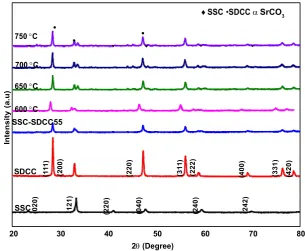
However, for SSC-SDCC composite cathode of SSC-SDCC55, SSC-SDCC64, and SSC-SDCC73 there are several peaks (Fig.1 – Fig.3) deliberately altered subsequently endure with calcination at temperatures of 600, 650, 700 and 750 ºC. They are demonstrated as in Fig. 1, a secondary phase of strontium carbonate, SrCO3was emerged from
SSC-SDCC55 composite cathode starting at 2θ about 25° up to 50º.This phase is independently increased with increased calcination temperatures. However, calcination temperature at 750 ºC, the intensity of the secondary phase nearly the smallest compared with other calcination temperatures. Similarly, observations can be experiential both from SSC-SDCC64 and SSC-SDCC73 composite cathode (Fig. 2 & Fig.3). Another significance remarks the appearances of SrCO3 phases is evidently did not dislocate the originality pattern and positions of the SSC and SDC pure crystal
structure. Thereby indicating with excellent chemical compatibility between SSC and SDCC [18-19].
Yuet al., (2016) acknowledged the presence of small content of SrCO3in the composite cathode are acceptable
and has become stimulating phenomenal. There have been a few reliable studies evidence that the existence of a small amount of SrCO3 into SSC cathode is the reinforcement and assist in the increment of conductivity throughout the
electrochemical performance of low temperature solid oxide fuel cell (LTSOFC) [17,20]. It is depicted in Fig. 4, obviously the calcination from all SSC-SDCC composite cathode at higher temperatures, 750 ºC lead to attain with the lowest intensity of SrCO3and consequently enlarge the content of the primary phase of SSC and SDC. In addition,
according to Scurtuet al.,(2013), the phase instability of SSC is commonly occurred at around calcination temperature of 600 – 800 °C in a static air atmosphere. They were stated that SrCO3 obtainable from the instability of SSC had
arisen between strontium oxide, SrO with atmospheric oxygen. Previously SrO is formed at the SSC surface due to strontium, Sr surface segregation astonishing [19]. Thus far, the intensification of the secondary phase generally affects the chemical compatibility and long term electrochemical behavior of SSC as a composite cathode.
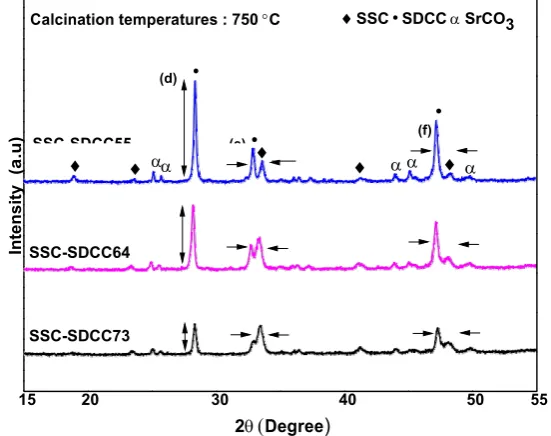
Extraction of spectra form SSC-SDCC55, SSC-SDCC64, and SSC-SDCC73 composite cathode at the highest calcination temperature, 750 ºC are displayed from 2θof 15º up to 55º (Fig. 4). From the spectra obtained, the creation of SrCO3distributed evenly for all SSC-SDCC composite cathode. From the observation, it can be strongly suggested
the composite cathode of SSC-SDCC55 pattern showed diffraction peaks of pure SSC and SDC were significantly steep, intense, and reliable. This argument confirmed the high degree of crystallinity of SSC and SDC from the obtained composite cathode powder. The electrochemical performance of LTSOFC required on stability of the phase and chemical during long-term of cell operation. Zhang et al., (2017) reported good electrochemical performance LTSOFC of SSC cathode is also strongly determined by the behavior of chemical and structural stability of the cathode [16].
•
750C •
SSC•SDCCSrCO
•
700C
650C
600C SSC-SDCC55
SDCC
SSC
20 30 40 50 60 70 80
2(Degree)
SF Mohammad et al., Int. J. of Integrated Engineering Vol. 11 No. 7 (2019) p. 162-168
165
In te nsi ty (a .u) In te nsi ty (a .u) (0 20) (1 1 1 ) (1 21) (2 00 ) (2 20) (2 20) (040 ) (31 1 ) (2 22 ) (24 0 ) (40 0 ) (24 2 ) (33 1 ) (4 20) •SSC•SDCCSrCO3
• • • • •
700C
650C
600C
SSC-SDCC64
SDCC
SSC
20 30 40 50 60 70 80
2(Degree)
Fig. 2 - X-ray diffractograms for commercial SSC, SDCC andcathode SSC-SDCC64 calcined composite
Calcination temperatures : 750C SSC•SDCCSrCO3
SSC SDCC55 (d) • (e)• • (f) SSC-SDCC64 SSC-SDCC73
15 20 30 40 50 55
2Degree)
Fig. 3 - X-ray diffractograms for enlargements spectra (selected range) of composite cathode SSC-SDCC55, SSC-SDCC64 and SSC-SDCC73 at calcination temperatures of 750 ºC
3.2 Microstructure Analysis
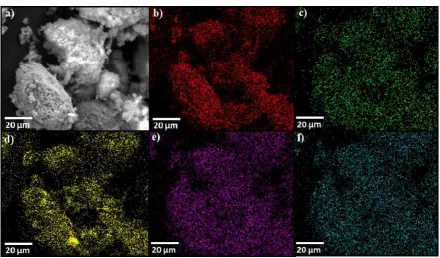
Fig. 5 - Image of SSC-SDCC55 composite cathode powder elemental distribution at a calcination temperature of 750 ºC a) Powder b) Sodium (Na) c) Cobalt (Co) d) Strontium (Sr) e) Cerium (Ce) and f) Samarium (Sm)
SF Mohammad et al., Int. J. of Integrated Engineering Vol. 11 No. 7 (2019) p. 162-168
167
previous paper [21]. Ng et al., (2016) have suggested that the porosity of the cathode within 20% to 40% is recommended for enhancement of electrochemical performance for LTSOFC [14].Nevertheless, the pellet retains with bearable porosity to be used as cathode materials. This finding also indicates that the selection range of calcination temperatures was still within the appropriate amount and remain relevant. The proper parameter chosen, such as milling parameter, calcination and sintering temperatures on the preparation of SSC-SDCC composite cathode has been intensely proven in this research paper. This argument is made as to the morphology illustrations on pellets displayed with a regular distribution and appearance of the particle [18]. Incorporation of carbonate into SSC and the mating of these materials demonstrated good microstructure pellet stability without substantial abnormal of grain growth on the pellets.
Up to the present, it is a widely held view that SSC-SDCC55 composite cathode demonstrated modestly better characteristic than SSC-SDCC64 and SSC-SDCC73. To further investigate the role of SDCC towards SSC based composite cathode, the EDS mapping image of SSC-SDCC55 powder at calcination temperature 750 ºC, taken with 10K magnification, is presented in Fig. 5 (a) – (f). From the mapping image reported, all the presence of elements studied from SSCB55 composite cathodes such as sodium (Na) , cobalt (Co), strontium (Sr), cerium (Ce), and samarium (Sm) were strongly detected. Due to the low atomic number, lithium (Li) is undetectable from the elemental mapping image taken [22-23]. Meanwhile, residual impurity patterns of the secondary phase of strontium carbonate, SrCO3were not detectable from the composite cathode powder. Table 1 was tabulated the total atomic percentages (%)
which contained in each element founded. It has been conclusively shown also the powder was distributed in a fine manner, highly inhomogeneity, and revealed loosely agglomerated pattern. From EDS mapping image proved the efficient distribution of all significant elements among the SSC-SDCC55 composite cathode powder with an elevated temperature of calcination.
Table 1: Atomic percentage (%) of each element detected from SSC-SDCC55 composite cathode
Elemen
t Atomic%
N 6.
C 28.
S 6.
10
C 34.
12 S
m
24. 58
4. Conclusions
In the present work, the effect SSC loading and calcination temperature on powder properties of SSC-SDCC composite cathode towards phase formation and physical stability were details and systematically investigated. XRD spectra composite cathode of SSC-SDCC55 revealed the high degree of crystallinity of pure SSC and SDC, with the existence of secondary phase in a small amount at the highest calcination temperature of 750 ºC. From EDS mapping, SSC-SDCC55 also discovered with good pellet elemental distribution and elevated homogenous with temperature. However, from physical studies, pellet SSC-SDCC73 showed the highest porosity characacteristic with temperature. The composite cathode of SSC-SDCC55 with the calcination temperature of 750 ºC was chosen to be used as a potential cathode material for LTSFOC electrochemical performance. This conclusion has been made regarding the optimum phase formation characteristic with excellent physical stability. However, a more detailed investigation on the influence of calcination temperatures and secondary phase throughout electrochemical impedance spectroscopy (EIS) testing will be completed in future, in order to determine the effects of secondary phase on the LTSOFC performance.
Acknowledgement
The author gratefully acknowledges dedicates to MyPhD (MyBrain 15) sponsorship from the Ministry of Education, Malaysia.
References
[1] Abdalla, A. M., Hossain, S., Azad, A. T., Petra, P. M. I., Begum, F., Eriksson, S. G., & Azad, A. K. (2018). Nanomaterials for solid oxide fuel cells: A review. Renewable and Sustainable Energy Reviews, 82, 353–368. [2] Mahato, N., Banerjee, A., Gupta, A., Omar, S., & Balani, K. (2015). Progress in Material Selection for Solid
Oxide Fuel Cell Technology: A Review. Progress in Materials Science, Vol 72, 141–337.
[5] Khan, M. A., Xu, C., Song, Z., & Raza, R. (2018). Synthesize and characterization of ceria based nano-composite materials for low temperature solid oxide fuel cell. International Journal of Hydrogen Energy, 1–8.
[6] Khan, M. A., Xu, C., Song, Z., & Raza, R. (2018). Synthesize and characterization of ceria based
nano-composite materials for low temperature solid oxide fuel cell. International Journal of Hydrogen Energy, 1–8. [7] Muhammed Ali, S. A., Rosli, R. E., Muchtar, A., Sulong, A. B., Somalu, M. R., & Majlan, E. H. (2015). Effect
of sintering temperature on surface morphology and electrical properties of samarium-doped ceria carbonate for solid oxide fuel cells. Ceramics International, 41(1), 1323–1332.
[8] Gao, K., Liu, X., Wang, Z., & Xiong, Y. (2017). A Sm0.2Ce0.8O1.9(SDC) interlayer method to prevent the
elemental interdiffusion between Sm0.5Sr0.5CoO3-δ (SSC) cathode and La0.8Sr0.2Ga0.8Mg0.2O3-δ (LSGM)
electrolyte. International Journal of Hydrogen Energy, 42(30), 19170–19177.
[9] Chang, C.-L., Hsu, C.-S., Huang, J.-B., Hsu, P.-H., & Hwang, B.-H. (2015). Preparation and characterization of SOFC cathodes made of SSC nanofibers. Journal of Alloys and Compounds, 620, 233–239.
[10] Ahn, M., Cho, J., & Lee, W. (2019). One-step fabrication of composite nanofibers for solid oxide fuel cell electrodes. Journal of Power Sources, 434(December 2018), 226749.
[11] Deng, H., Zhang, W., Wang, X., Mi, Y., Dong, W., Tan, W., & Zhu, B. (2017). An ionic conductor Ce0.8Sm0.2O2−δ (SDC) and semiconductor Sm0.5Sr0.5CoO3(SSC) composite for high performance electrolyte-free
fuel cell. International Journal of Hydrogen Energy, 42(34), 22228–22234.
[12] Rahman, H. A., Muchtar, A., Muhamad, N., & Abdullah, H. (2012). Structure and thermal properties of La0.6Sr0.4Co0.2Fe0.8O3−δ–SDC carbonate composite cathodes for intermediate- to low-temperature solid oxide fuel
cells. Ceramics International, 38(2), 1571–1576.
[13] Rahman, H. A., Agun, L., & Ahmad Shah, M. H. (2016). Ba- and La- Strontium Cobalt Ferrite Carbonate Composite as Cathode Materials for Low Temperature SOFC, Key Engineering Materials,694, 125–129.
[14] Hoa, N. K., Rahman, H. A., & Somalu, M. R. (2018). Effects of NiO loading and pre-calcination temperature on NiO-SDCC composite anode powder for low-Temperature solid oxide fuel cells. Ceramics - Silikaty, 62(1), 50– 58.
[15] Zhu, Y., Sunarso, J., Zhou, W., & Shao, Z. (2015). Probing CO2 reaction mechanisms and effects on the
SrNb0.1Co0.9−xFexO3−δcathodes for solid oxide fuel cells. Applied Catalysis B: Environmental, 172–173, 52–57.
[16] Zhang, Y., Knibbe, R., Sunarso, J., Zhong, Y., Zhou, W., Shao, Z., & Zhu, Z. (2017). Recent Progress on Advanced Materials for Solid-Oxide Fuel Cells Operating Below 500 °C. Advanced Materials, 1700132. [17] Cascos, V., Alonso, J., & Fernández-Díaz, M. (2016). Nb5+ Doped SrCoO
3−δPerovskites as Potential Cathodes
for Solid-Oxide Fuel Cells. Materials, 9(7).
[18] Scurtu, R., Somacescu, S., Calderon-Moreno, J. M., Culita, D., Bulimestru, I., Popa, N., Osiceanu, P. (2013). Nanocrystalline Sm0.5Sr0.5CoO3-δ synthesized using a chelating route for use in IT-SOFC cathodes:
Microstructure, surface chemistry and electrical conductivity. Journal of Solid State Chemistry, 210(1), 53–59. [19] Lee, S., Choi, J., & Shin, D. (2018). Microstructural stability of SSC fibrous cathode with embedded SDC
particles for solid oxide fuel cells operating on hydrogen. International Journal of Hydrogen Energy, 6–11. [20] Yu, Y., Ludwig, K. F., Gopalan, S., Pal, U. B., & Basu, S. N. (2016). Surface Segregation in Strontium Doped
Lanthanum Cobalt Ferrite : Effect of Composition and Atmospheric Carbon Dioxide Surface Segregation in Strontium Doped Lanthanum Cobalt Ferrite : Effect of Composition and Atmospheric Carbon Dioxide, Boston University,Boston.
[21] Mohammad, S. F., Ahmad, S., Rahman, H. A., Muchtar, A., & Abdallah, K. S. (2018). Morphological and Physical Behaviour on the Sm0.5Sr0.5CoO3−δ/Sm0.2Ce0.8O1.9 Incorporation with Binary Carbonate as Potential
Cathode Materials for SOFC, Key Engineering Materials, 791, 59–65.
[22] Ng, K. H., Lidiyawati, S., Somalu, M. R., Muchtar, A., & Rahman, H. A. (2016). Influence of Calcination on the Properties of Nickel Oxide-Samarium Doped Ceria Carbonate (NiO-SDCC) Composite Anodes. Procedia Chemistry, 19(May), 267–274.