Copyright © 1997, American Society for Microbiology
Characterization of Group A Streptococcus Strains Recovered
from Mexican Children with Pharyngitis by Automated DNA
Sequencing of Virulence-Related Genes: Unexpectedly
Large Variation in the Gene (sic) Encoding a
Complement-Inhibiting Protein
LUIS M. PEREA MEJIA,1KATHRYN E. STOCKBAUER,2XI PAN,2
ALEJANDRO CRAVIOTO,1ANDJAMES M. MUSSER2*
Departamento de Salud Pu´blica, Facultad de Medicina, Universidad Nacional Auto´noma de Me´xico, Ciudad Universitaria, D.F., Mexico,1and Section of Molecular Pathobiology,
Department of Pathology, Baylor College of Medicine, Houston, Texas2
Received 10 June 1997/Accepted 28 August 1997
Sequence variation was studied in several target genes in 54 strains of group A Streptococcus (GAS) cultured from children with pharyngitis in Mexico City. Although 16 distinct emm alleles were identified, only 4 had not been previously described. Virtually all bacteria (31 of 33 [94%] with the streptococcal pyrogenic exotoxin gene (speA) had emm1-related, emm3, or emm6 alleles. The gene (sic) encoding an extracellular GAS protein that inhibits complement function was unusually variable among isolates with the emm1 family of alleles, with a total of seven variants identified. The data suggest that many GAS strains infecting Mexican children are genetically similar to organisms commonly encountered in the United States and western Europe. Sequence variation in the sic gene is useful for rapid differentiation among GAS isolates with the emm1 family of alleles.
Group A Streptococcus (GAS) strains remain an important cause of human morbidity and mortality worldwide (26). The recent resurgence of GAS infections in the United States, Europe, and elsewhere (6, 19, 20, 22, 23) has stimulated re-newed interest in the molecular epidemiology and virulence gene variation of this pathogen. Historically, strains have been subdivided based on serologic reactivity of the M protein, an
a-helical coiled-coil protein that projects outward from the bacterial cell wall (9). M protein is antiphagocytic and is an important GAS virulence factor (9). Serological studies have identified more than 100 distinct M protein serotypes among GAS strains recovered from healthy carriers and diseased hu-mans. The molecular basis of M protein serologic diversity is due to sequence variation occurring in the hypervariable amino terminus part of the molecule. In 1994, Whatmore et al. (38) reported the DNA sequences of the region of the emm gene encoding the part of the M protein conferring serotype spec-ificity. The same year, automated DNA sequencing of a hy-pervariable region of the streptokinase gene was used as a molecular epidemiologic tool to rapidly and unambiguously determine GAS strain relationships in a putative outbreak of invasive disease (24). Subsequent studies (5, 7, 36, 37) demon-strated that sequencing of the hypervariable region of emm could also be used to delineate strain relationships in invasive disease case clusters. Recently, the emm sequencing approach has been extended to analyze GAS isolates recovered during longitudinal surveys of invasive disease episodes in specific geographic areas (4).
The results of serologic studies conducted with anti-M pro-tein antisera have shown that a large percentage of strains
recovered from individuals in localities outside of the United States and western Europe are nontypeable (12, 13, 34). This observation, together with limited data available from emm gene sequencing (30), has suggested that GAS strains circulat-ing in areas of the world not yet extensively sampled are ge-netically distinct. In this study, we used automated DNA se-quencing of several virulence-associated genes to characterize 54 GAS strains recovered from children with recent episodes of pharyngitis in Mexico City. Strains from Mexican children were chosen for analysis in part because data suggest that diseases such as acute rheumatic fever and rheumatic heart disease are important causes of human morbidity in Mexico (1, 2, 17, 31). We found that the great majority of isolates had alleles of the target genes that had been previously described. The gene (sic) encoding an extracellular GAS protein recently shown to inhibit complement function (3) was found to be unusually variable among isolates with the emm1 family of alleles.
MATERIALS AND METHODS
Bacterial strains.The analysis was based on 54 GAS organisms cultured from children with GAS pharyngitis in Mexico City in the 1990s. Three of the isolates were recovered from children who were contacts of patients with acute rheu-matic fever. Pharyngeal specimens were cultured on blood agar plates, and group A beta-hemolytic streptococci were identified by conventional diagnostic labo-ratory techniques. The organisms were frozen in brain heart infusion broth with 15% glycerol and stored at270°C. After subculture onto solid media, the strains were transported to the laboratory of J.M.M. for analysis. Chromosomal DNA was isolated by previously described methods (14).
DNA sequence analysis.Strategies for analysis of sequence variation in genes encoding M protein, streptococcal pyrogenic exotoxin A (speA), and streptococ-cal pyrogenic exotoxin B (speB) have been described previously (14, 23, 25, 28, 38). Sequence variation in the sic gene (3) encoding a streptococcal protein that inhibits human complement function in vitro was also studied (Fig. 1). The structural gene and upstream noncoding sequence were amplified with the prim-ers SIC.1 (59-TAAGGAGAGGTCACAAACTA-39) and SIC.2 (59-TTACGTT GCTGATGGTGTAT-39). Two internal primers used for sequencing were SIC.3 (59-GATGAGACAGAAGATAAAAC-39) and SIC.4 (59-CATATTCCTAAAC CTGAGAA-39).
* Corresponding author. Mailing address: Section of Molecular Pathobiology, Department of Pathology, Baylor College of Medicine, One Baylor Plaza, Houston, Texas 77030. Phone: (713) 798-4198. Fax: (713) 798-4595. E-mail: [email protected].
3220
on May 15, 2020 by guest
http://jcm.asm.org/
All sequence data were obtained with an Applied Biosystems model 377 automated DNA sequencer. The sequence data were assembled and edited electronically with the EDITSEQ, ALIGN, and MEGALIGN programs (DNA-STAR, Madison, Wis.) and were compared with published sequences for emm, speA, speB, and sic (3, 11, 14, 28, 38). For emm sequences that were not identical to one previously described, we determined the closest related emm allele by comparing the sequence with sequences from a database of approximately 100 emm alleles (38).
RESULTS
Sequence variation in emm.A total of 16 distinct emm alleles
were identified, including 11 that had been previously de-scribed (Table 1). The most abundantly represented alleles would encode M1, M3, and M6 serotype proteins. Three dis-tinct emm1-related alleles were found, including emm1.0,
emm1.3, and a newly identified variant, designated emm1.8.
Compared to reference allele emm1.0, the emm1.8 allele was characterized by nucleotide substitutions resulting in an amino acid replacement located at position 23 (E3D) of the de-duced mature amino acid sequence (10, 25). The emm3 allele in this study was identical to allele emm3.1, deposited in Gen-Bank under accession no. U40231 (8). Based on phylogenetic analysis, two of the three other strains with previously uniden-tified emm variants had sequences related to emm3 and
emm10/12, and the sequence in the third isolate was not closely
allied with previously identified variants. Interestingly, all three
emm1 family organisms recovered from individuals who were
contacts of patients with acute rheumatic fever had the emm1.3 allele.
Sequence variation in speA.Thirty-three organisms had the
speA gene encoding SpeA, a superantigen that has been
im-plicated in virulence (22, 23) (Table 1). Virtually all (94%) bacteria with the speA gene had the emm gene encoding sero-type M1, M3, or M6 protein. Among the 16 isolates with the
emm1 family of alleles, the speA gene was detected by PCR in
12 organisms. Three random emm1 isolates were chosen for
speA sequencing, and all had the speA2 allele. Similarly, 12 of
13 organisms with the emm3 allele had the speA gene, and sequence analysis of three organisms identified the speA3 al-lele. All seven organisms with the emm6 allele had the speA gene. Sequence analysis of three randomly chosen organisms showed that all had the speA4 allele (28). Among the two other organisms with the speA gene, one had the emm4245 allele, and one had an emm allele that has not been previously de-scribed. Sequence analysis showed that both organisms had the
speA3 allelic variant.
Sequence variation in speB.The speB gene encodes a
cys-teine protease that is a critical GAS virulence factor (11, 18, 21). Essentially all organisms have this gene (21, 22). Previous studies have documented that speB is well conserved and that
speB is invariant among members assigned to the same GAS
clone (14, 23, 25). We therefore chose to sequence speB only from three of the strains with a previously undescribed emm allele. The speB gene in MGAS 4879 was identical to a pub-lished sequence designated allele speB1 (14). The speB se-quences in the other two isolates (MGAS 4874 and MGAS 4883) were identical to each other and matched those of allele
speB3 (14).
Sequence variation in sic.Compared to the relatively limited
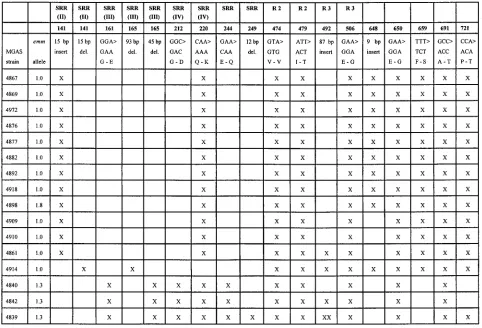
variation in emm and speA, there was substantial allelic poly-morphism in sic in M1 strains (Fig. 2). Seven variants were identified among the 16 strains containing this gene. None of the sic sequences in this Mexican strain sample was identical to the sequence of the sic gene deposited in GenBank under accession no. X92968. Variation was due to nucleotide substi-tutions distributed throughout the entire length of the gene, and insertions and deletions were located mainly in the SRR and R motif regions (Fig. 2). Ten strains had identical 9-bp inserts at position 684 (GGCTTTGAT [Gly-Phe-Asp]) (Table 2). Three strains had an 87-bp insert located in the R3 motif, and one strain had two contiguous 87-bp insertions in R3. These 87-bp inserts were apparent duplications of nucleotides 493 through 580, encoding amino acids 165 through 194. These inserts are reminiscent of structural alterations that can arise from slipped-strand mispairing events during replication (10, 16). Interestingly, 10 of the 11 single-nucleotide substitutions identified would result in amino acid replacements in the Sic protein. The three organisms recovered from patients with acute rheumatic fever had a total of five sic polymorphisms that were not found in other isolates in the sample (Fig. 2).
Lack of effect of laboratory passage on sic variation.Because
[image:2.612.53.288.69.144.2]the analysis showed that allelic variation in sic was unusually high, we were concerned that some of the polymorphism might be accumulating in the course of laboratory passage. To test this hypothesis, we passaged two strains (MGAS 4861 and MGAS 4872) three times each in the laboratory and then characterized the sic gene in the resulting derivative strain. For each passage, a single colony was picked, streaked onto a new blood agar plate, and grown overnight at 37°C. The sic se-quences in the parental and laboratory-passaged organisms were identical.
FIG. 1. Schematic of the sic gene. The diagram shows the location of the 915-bp sic gene in the chromosome of an M1 strain of GAS as described previously (3). The gene is located in the Mga regulon that encodes several virulence genes. mga encodes a regulatory protein, emm1 codes for serotype M1 protein, sph encodes protein H, and scpA codes for streptococcal C5a peptidase. Ss, signal sequence; SRR, amino-terminal short repeat region; R1 to R3, tandem repeats. The numbers below the sic gene are base pair designations. sic.1 through sic.4 denote oligonucleotide primers used for sic gene amplification (see Mate-rials and Methods).
TABLE 1. Characteristics of 54 GAS strains from children in Mexico with pharyngitis
emm sequencea No. of isolates No. (%) of isolates
speA positive
emm1b 16 12 (75)
emm3 13 12 (92)
emm4 4 0
emm5 1 0
emm6 7 7 (100)
emm10/12 3 0
emm22 1 0
emm72 1 0
emm75 2 0
emm78 1 0
emm4245 2 1 (50)
Nontypeable 3 1 (33)
aSee data presented in reference 38.
bTwelve isolates had allele emm1.0, 3 had emm1.3, and 1 had a newly recog-nized variant, designated emm1.8.
on May 15, 2020 by guest
http://jcm.asm.org/
[image:2.612.50.291.563.701.2]DISCUSSION
This study is the first to characterize nucleotide variation in virulence-related genes of GAS strains recovered from patients in Mexico. Our analysis was motivated by four factors. First, results from several studies have demonstrated that a large percentage of GAS strains recovered from areas of the world not yet extensively sampled are frequently serologically non-typeable with antisera directed against known M types (12, 13, 34). This suggests that strains circulating in areas outside of,
[image:3.612.56.538.69.397.2]for example, the United States and western Europe, may con-tain a large pool of new M types, and hence emm sequences, awaiting discovery. Second, there is a relative lack of ready availability of the large battery of typing sera necessary to identify GAS M types. Because M serologic specificity is en-coded by a region of the emm gene that is less than 400 bp (38), an automated DNA sequencing strategy is ideally suited for strain characterization. Third, with the exception of extremely limited data (23, 25), little information is available bearing on the issue of virulence gene polymorphism outside of regions such as the United States and western Europe. Fourth, inas-much as Texas and Mexico share a 1,248-mile border, and there are extensive historical, cultural, and economic ties be-tween the two populations, it is reasonable to hypothesize that GAS strains circulating in Texas may be carried to Mexico, and vice versa. The affinity between Texas and Mexico is illustrated by the occurrence in 1993 of a recorded 114 million north-bound border crossings (35). In principle, GAS strain migra-tion could be an important contributor to temporal variamigra-tion in disease frequency and severity. However, our study showed that in general, most of the GAS strains analyzed were closely similar, if not identical, to previously identified clones or sub-clones. These data suggest that the GAS strains commonly circulating in Mexico City and the United States are not, as a population, genetically differentiated from one another. These preliminary data will need to be confirmed by a more extensive FIG. 2. Variation in the sic gene and SIC protein identified in M1 strains of Streptococcus pyogenes recovered from Mexican children with pharyngitis. The figure shows a compilation of structural variation found in the 16 strains characterized. Strains MGAS 4840, MGAS 4842, and MGAS 4839 were recovered from children with pharyngitis who were contacts of patients with acute rheumatic fever. The numbers refer to the nucleotide sequence position designated in reference 3. The single-letter amino acid abbreviations are used. Strain MGAS 4839 has two 87-bp insertions beginning at nucleotide 492. SRR, amino-terminal short repeat region; R 2 and R 3, tandem repeats.
TABLE 2. Structural changes in the S. pyogenes sic gene and Sic protein caused by insertions and deletions
Nucleotide
positiona Length(bp) Amino acids
Insertion
141 15 SGDDW
492 87 PPYGGALGTGYEKRDDWGGPGTVATDPYT
648 9 GFD
Deletion
141 15 PEDDW
165 45 GLSKYDRSGVGLSQY
165 93 GLSKYDRSGVGLSQYGWSQYGWSSDKEEWPE
249 12 WPED
aDesignated according to the numbering system described in reference 3.
on May 15, 2020 by guest
http://jcm.asm.org/
[image:3.612.50.290.605.716.2]analysis of GAS strains recovered from patients in areas out-side of the Mexico City region.
Previous studies have shown that strains grouped together based on the emm allele generally have restricted variation in other characterized virulence-related genes (23, 25). In addi-tion, strains of serotype M1 have generally been refractory to extensive subdifferentiation by molecular strategies (19, 20, 22, 23, 25, 27, 29, 32). Hence, the discovery of a substantial level of allelic variation in the sic gene among strains with the emm1 family of alleles was unexpected. In recent years, M1 strains have been the most common serotype recovered from patients with invasive GAS disease in the United States and western Europe (26). They have also been important causes of disease in New Zealand and Australia (6, 19). Based on sequence analysis of the emm gene and pulsed-field gel electrophoresis, it was demonstrated that many strains recovered from patients with invasive episodes represented the same subclone (25). Comparative sequencing of the genes encoding streptokinase, streptococcal pyrogenic exotoxin B, pyrogenic exotoxins A and C, and C5a peptidase has generally failed to identify allelic variation that could serve as a useful strategy for additional differentiation among M1 isolates (25). The variation present in sic provides a convenient molecular tool for obtaining fur-ther insights into the molecular epidemiology of M1 organ-isms, associations of subclones with specific auxiliary virulence factors, such as pyrogenic exotoxins, and the relationship be-tween distinct subclones and disease character. We will re-port elsewhere on the utility of sic sequencing for extensive M1 strain differentation among strains from intercontinen-tal sources (33).
Although our study did not investigate the molecular mech-anism responsible for sic variation, we infer that at least two processes are driving allelic diversity: nucleotide substitutions and insertion and deletion events. It is also a formal possibility that horizontal gene transfer and recombination processes (15) are contributing to sic allelic variation. Importantly, 10 of the 11 nucleotide substitutions would result in amino acid replace-ments in the Sic protein. Moreover, the insertion and deletion events we identified would also result in expression of struc-turally distinct molecules. Taken together, these observations indicate that positive Darwinian selection is contributing to generation of structural variation in the Sic protein. Selection could be due to antibody pressure, but thus far, no evidence has been presented that the protein is either expressed in vivo during human infection or that patients generate an immune response to Sic. However, inasmuch as Sic has a typical leader sequence characteristic of secreted proteins and it binds to human proteins in vitro, it is reasonable to speculate that there might be a premium on structural variation. Additional studies will be required to address this issue.
ACKNOWLEDGMENTS
We thank Romeo Rodriguez and Silvia Giono for providing some of the strains.
This study was supported by Public Health Service grant AI-33119 and Fogarty International Center grant TW-37004-03S1. J.M.M. is an Established Investigator of the American Heart Association.
REFERENCES
1. Abdala´, A. L., M. C. A. Castan˜eda, C. N. Gonza´lez, A. R. Ca´rdenas, J. R.
Manzur, and L. C. Rodrı´guez.1995. Evaluacio´n ecocardiogra´fica en pacien-tes con fiebre reuma´tica con corea de Sydenham. Pediatria 62:44–47. 2. Abdala´, A. L., R. Sandoval, L. Lastra, C. Vidales, L. Carbajal, and F. D.
Clavijo U.1980. Comportamiento clı´nico de 200 casos de fiebre reuma´tica. Acta. Pediatr. Mex. 1:83–89.
3. Akesson, P., A. G. Sjoholm, and L. Bjorck. 1996. Protein SIC, a novel extracellular protein of Streptococcus pyogenes interfering with complement function. J. Biol. Chem. 271:1081–1088.
4. Beall, B., R. Facklam, T. Hoenes, and B. Schwartz. 1997. Survey of emm gene sequences and T-antigen types from systemic Streptococcus pyogenes infec-tion isolates collected in San Francisco, California; Atlanta, Georgia; and Connecticut in 1994 and 1995. J. Clin. Microbiol. 35:1231–1235.
5. Beall, B., R. Facklam, and T. Thompson. 1996. Sequencing emm-specific PCR products for routine and accurate typing of group A streptococci. J. Clin. Microbiol. 34:953–958.
6. Carapetis, J. R., R. Robins-Browne, D. Martin, T. Shelby-James, and G.
Hogg.1995. Increasing severity of invasive group A streptococcal disease in Australia: clinical and molecular epidemiological features and identification of a new virulent M-nontypeable clone. Clin. Infect. Dis. 21:1220–1227. 7. Cockerill, F. R., III, K. L. MacDonald, R. L. Thompson, F. Roberson, P. C.
Kohner, J. Besser-Wiek, J. M. Manahan, J. M. Musser, P. M. Schlievert, J. Talbot, B. Frankfort, J. M. Steckelberg, W. R. Wilson, M. T. Osterholm, and the Investigation Team. 1997. An outbreak of severe invasive group A streptococcal disease associated with high carriage rates of the invasive clone among school-aged children. JAMA 277:38–43.
8. Dale, J. B., M. Simmons, E. C. Chang, and E. Y. Chang. 1996. Recombinant, octavalent group A streptococcal M protein vaccine. Vaccine 14:944–948. 9. Fischetti, V. A. 1989. Streptococcal M protein: molecular design and
biolog-ical behavior. Clin. Microbiol. Rev. 2:285–314.
10. Harbaugh, M. P., A. Podbielski, S. Hugl, and P. P. Cleary. 1993. Nucleotide substitutions and small-scale insertion produce size and antigenic variation in group A streptococcal M1 protein. Mol. Microbiol. 8:981–991. 11. Hauser, A. R., and P. M. Schlievert. 1990. Nucleotide sequence of the
streptococcal pyrogenic exotoxin type B gene and relationship between the toxin and the streptococcal proteinase precursor. J. Bacteriol. 172:4536– 4542.
12. Jamal, F., S. Pit, D. R. Johnson, and E. L. Kaplan. 1995. Characterization of group A streptococci isolated in Kuala Lumpur, Malaysia. J. Trop. Med. Hyg. 98:343–346.
13. Kaplan, E. L., D. R. Johnson, P. Nanthapisud, S. Sirilertpanrana, and S.
Chumdermpadetsuk.1992. A comparison of group A streptococcal sero-types isolated from the upper respiratory tract in the USA and Thailand: implications. Bull. W. H. O. 70:433–437.
14. Kapur, V., S. Topouzis, M. W. Majesky, L.-L. Li, M. R. Hamrick, R. J.
Hamill, J. M. Patti, and J. M. Musser.1993. A conserved Streptococcus pyogenes cysteine protease cleaves human fibronectin and degrades vitronec-tin. Microb. Pathog. 15:327–346.
15. Kehoe, M. A., V. Kapur, A. Whatmore, and J. M. Musser. 1996. Horizontal gene transfer among group A streptococci: implications for pathogenesis and epidemiology. Trends Microbiol. 4:436–443.
16. Levinson, G., and G. A. Gutman. 1987. Slipped-strand mispairing: a major mechanism for DNA sequence evolution. Mol. Biol. Evol. 4:203–221. 17. Loredo-Abdala´, A., J. J. S.-G. De Quevedo, and L. Carbajal-Rodriguez. 1991.
Fiebre reuma´tica. Perfil clı´nico de una enfermedad persistente. Gac. Med. Mex. 127:227–232.
18. Lukomski, S., S. Sreevatsan, C. Amberg, W. Reichardt, M. Woischnik, A.
Podbielski, and J. M. Musser.1997. Inactivation of Streptococcus pyogenes extracellular cysteine protease significantly decreases mouse lethality of se-rotype M3 and M49 strains. J. Clin. Invest. 99:2574–2580.
19. Martin, D. R., and L. A. Single. 1993. Molecular epidemiology of group A streptococcus M type 1 infections. J. Infect. Dis. 167:1112–1117. 20. Muotiala, A., H. Seppala, P. Houvinen, and J. Vuopio-Varkila. 1997.
Mo-lecular comparison of group A streptococci of T1M1 serotype from invasive and noninvasive infections in Finland. J. Infect. Dis. 175:392–399. 21. Musser, J. M. 1997. Streptococcal superantigen, mitogenic factor, and
py-rogenic exotoxin B expressed by Streptococcus pyogenes, p. 281–310. In D. Y. M. Leung, B. T. Huber, and P. M. Schlievert (ed.), Superantigens. Molecular biology, immunology, and relevance to human disease. Marcel Dekker, Inc., New York, N.Y.
22. Musser, J. M., A. R. Hauser, M. H. Kim, P. M. Schlievert, K. Nelson, and
R. K. Selander.1991. Streptococcus pyogenes causing toxic-shock-like syn-drome and other invasive diseases: clonal diversity and pyrogenic exotoxin expression. Proc. Natl. Acad. Sci. USA 88:2668–2672.
23. Musser, J. M., V. Kapur, S. Kanjila, U. Shah, D. M. Musher, N. L. Barg,
K. H. Johnston, P. M. Schlievert, J. Henrichsen, D. Gerlach, R. M. Rakita, A. Tanna, B. D. Cookson, and J. C. Huang.1993. Geographic and temporal distribution and molecular characterization of two highly pathogenic clones of Streptococcus pyogenes expressing allelic variants of pyrogenic exotoxin A (scarlet fever toxin). J. Infect. Dis. 167:337–346.
24. Musser, J. M., V. Kapur, J. E. Peters, C. W. Hendrix, D. Drehner, G. D.
Gackstetter, D. R. Skalka, P. L. Fort, J. T. Maffei, L.-L. Li, and G. P. Melcher.1994. Real-time molecular epidemiologic analysis of an outbreak of Streptococcus pyogenes invasive disease in US Air Force trainees. Arch. Pathol. Lab. Med. 118:128–133.
25. Musser, J. M., V. Kapur, J. Szeto, X. Pan, D. S. Swanson, and D. R. Martin. 1995. Genetic diversity and relationships among Streptococcus pyogenes strains expressing serotype M1 protein: recent intercontinental spread of a subclone causing episodes of invasive disease. Infect. Immun. 63:994–1003. 26. Musser, J. M., and R. M. Krause. The revival of group A streptococcal diseases, with a commentary on staphylococcal toxic shock syndrome. In
on May 15, 2020 by guest
http://jcm.asm.org/
R. M. Krause (ed.), Emerging infections, in press. Academic Press, Inc., San Diego, Calif.
27. Mvlvaganam, H., B. Bjorvatn, T. Hofstad, R. Hjetland, E. A. Hoiby, and S. E.
Holm.1994. Small-fragment restriction endonuclease analysis in epidemio-logic mapping of group A streptococci. J. Med. Microbiol. 40:256–260. 28. Nelson, K., P. M. Schlievert, R. K. Selander, and J. M. Musser. 1991.
Characterization and clonal distribution of four alleles of the speA gene encoding pyrogenic exotoxin A (scarlet fever toxin) in Streptococcus pyo-genes. J. Exp. Med. 174:1271–1274.
29. Norgren, M., A. Norrby, and S. E. Holm. 1992. Genetic diversity in T1M1 group A streptococci in relation to clinical outcome of infection. J. Infect. Dis. 166:1014–1020.
30. Relf, W. A., D. R. Martin, and K. S. Sriprakash. 1992. Identification of sequence types among the M-nontypeable group A streptococci. J. Clin. Microbiol. 30:3190–3194.
31. Rodriguez, R. S., A. L. Abdala, and A. Vizcaino. 1974. Evaluacion de la parametasona en la etapa aguda de la carditis reumatica. Bol. Med. Hosp. Infant. Mex. 31:1149–1163.
32. Seppala, H., J. Vuopio-Varkila, M. Osterblad, M. Jakhola, M.
Rummu-kainen, S. E. Holm, and P. Huovinen.1994. Evaluation of methods for epidemiologic typing of group A streptococci. J. Infect. Dis. 169:519–525.
33. Stockbauer, K. E., D. Grigsby, L. M. Perea Mejia, X. Pan, A. Cravioto, and
J. M. Musser.Hypervariability generated by natural selection in an extra-cellular complement inhibiting protein made by serotype M1 strains of group A streptococcus. Proc. Natl. Acad. Sci. USA, in press.
34. Tran, T. P. O., D. R. Johnson, and E. L. Kaplan. 1991. The presence of M protein in non-typeable group A streptococcal upper respiratory tract (URT) isolates from South-East Asia. J. Infect. Dis. 169:658–661. 35. United States Immigration and Naturalization Service. 1994. Statistical
yearbook of the Immigration and Naturalization Service—1993. U.S. Gov-ernment Publishing Office, Washington, D.C.
36. Upton, M., P. E. Carter, M. Morgan, G. F. S. Edwards, and T. H.
Penning-ton.1995. Clonal structure of invasive Streptococcus pyogenes in Northern Scotland. Epidemiol. Infect. 115:231–241.
37. Upton, M., P. E. Carter, G. Orange, and T. H. Pennington. 1996. Genetic heterogeneity of M type 3 group A streptococci causing severe infections in Tayside, Scotland. J. Clin. Microbiol. 34:196–198.
38. Whatmore, A. M., V. Kapur, D. J. Sullivan, J. M. Musser, and M. A. Kehoe. 1994. Non-congruent relationships between variation in emm gene se-quences and the population genetic structure of group A streptococci. Mol. Microbiol. 14:619–631.