DETERMINATION OF PHTHALATE ESTER COMPOUNDS IN
SEMBRONG RIVER SEDIMENT
Aida bt Muhamad1, Ahmad Tarmizi Bin Abd. Karim2, Nur Fathanah bt Zakaria3, Krystabel Jonya Ak Rapok4
1,2,3,4
Universiti Tun Hussein Onn Malaysia, Batu Pahat, Johor, Malaysia
[email protected], [email protected] [email protected], [email protected]
ABSTRACT
River sediment contamination is a cause of decline in water quality which brings a detrimental effect on aquatic ecosystems and human life. The purpose of this study is to determine the existence and pollution level of PAEs compound in the Sembrong River sediments. Sembrong River was chosen because the river has been found to contain heavy metals and other pollutants according to previous studies. Sediment samples were collected using a core sediment sampler at 3 different locations along the river banks. Laboratory tests were conducted using GC-MS to determine the concentration of phthalate ester compounds in Sembrong River sediments. Results showed that the concentrations of PAEs are in the range of 0.01-15.63 mg/kg. Di-n-butyl phthalate (DBP), and di-(2-ethylhexyl) phthalate (DEHP) are the highest concentration of compounds found in the sediment. Other PAEs detected in the sediment of Sembrong River are dimethyl phthalate (DMP), diethyl phthalate (DEP), benzyl butyl phthalate (BBP), and di-n-octyl phthalate (DNOP).
Keywords: River sediment; phthalate ester (PAES); Environmental Risk Limits (ERLs).
1.0 INTRODUCTION
Rivers are the main source of water supply for various daily use such as drinking water supply, food supply, domestic, recreation and tourism, and also used as a medium of transport and communication. However, rivers are increasingly threatened by numerous sources of pollution. Among the main causes of deterioration of water quality problems is the process of sedimentation in the river bed itself. It is often associated with factors affecting land use for development projects such as housing and many other sources (Toriman et. al.,.2012). Based on reports by the National Sediment Quality Survey (2004), toxic chemicals that accumulate in sediments have adverse effects on aquatic life and human health. Pollutants sink into the environment through a variety of sources, and can be divided into point sources and non-point sources. Point source refers to the transfer of specific pollutants
from pipes, plumbing or drains which passes out the contaminants. Meanwhile, the cause of a non-point source is not dotted and is generally found in agricultural or urban areas that make it easy for pollutants to be transferred into surface water during and after rain. In Malaysia, there are two main causes of river pollution namely land development activities as well as the disposal of waste into water. Land development activities and natural resources involve opening new settlements and agriculture, logging, construction of infrastructure such as housing and industrial areas. All these activities create soil erosion problems that pollutes river water such as suspended solids, turbidity, organic matter and stream sedimentation problems (Shazarina, 2009).
Among the pollutants present in the contaminated sediment are phthalate ester compounds. Phthalates or phthalate esters are phthalic acid esters which are mainly used as an additive in plastic materials in the plastic industry. The phthalate esters increase the flexibility, transparency, durability, and longevity of products. Phthalic acid esters (PAEs) are a class of widely found emerging organic compounds (EC) found in surface water, groundwater, sediments and soil (Zeng et. al., 2009; Wu et. al., 2011; Liu et. al., 2009; Lin et. al., 2008; Zeng et. al., 2008). According to Chen et. al. (2013), PAEs bind physically with plastic but do not react chemically with the molecular bonds of plastic polymers. Hence, PAEs may be discharged into the environment directly when raw materials and products are produced and applied so that PAEs commonly exist in various environmental media such as food, air, water, soil, sediment, and living creatures (Fromme et al., 2002; Lin et al., 2003). Phthalate esters give a negative impact on human health, therefore the use of phthalate in most of the products in the United States, Canada, and European Union are now banned. In 2010, the market was still dominated by phthalate plasticizers. However, due to legal provisions and growing environmental awareness, manufacturers are forced to use non-phthalate plasticizers. Accumulation of phthalate esters in the soil can lead to the contamination of vegetables and the food chain directly or indirectly as a result of exposure (Liang et. al.,2010). As the use of phthalate esters present risks to human health and the environment, several phthalate esters which have the potential to contribute to the danger have been placed in the list of priorities of different pollutants (U.S. Environmental Protection Agency, 1999).
In this study, the samples of sediment were taken from two sampling points along Sembrong River; Sembrong River Upstream and Sembrong River Downstream. The determination of PAE compounds was carried out for DBP, DMP, DEP, BBP, DEHP and DNOP. The Sembrong River is a freshwater source for the residential area in Batu Pahat, Johor, Malaysia. About 60-70% of the Sembrong River catchment is allocated for oil palm and paddy field plantations. Another 30-40% are private lands owned by the villagers. The Sembrong River has been reported to contain high levels of aluminium, manganese and ferum concentration due to the acid sulphate soil type of the catchment area (Abdul Latif. et. al., 2009).
2.0 LITERATURE REVIEW
Phthalate esters (PAEs) are commonly found in domestic and industrial products because PAEs with low molecular weights, such as dimethyl phthalate (DMP), diethyl phthalate (DEP), di-isobutyl phthalate (DIBP), and di-n-butyl phthalate (DBP), are often used as ingredients for cosmetic and personal hygiene products. Additionally, DIBP and DBP are also used in the preparation of epoxy resins, cellulose esters, and special bonding agents. According to Magdouli et. al. (2013), the most common phthalates used in the chemical industry as plasticizers are DEP, DEHP, BBP, MBP, DBP, DiNP and DiNP. PAEs with long and branching chains such as butylbenzyl phthalate (BBP), di-cyclohexyl phthalate (DCHP),
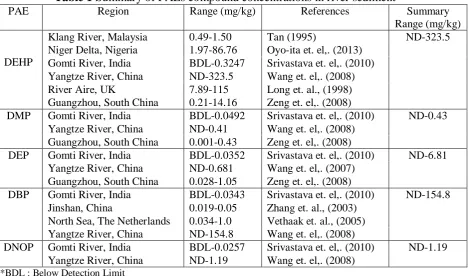
di-n-octyl phthalate (DNOP), di-n-nonyl phthalate (DNP), and di-(2-ethylhexyl) phthalate (DEHP) have been widely applied as non-reactive agents in plastic polymers (Chen et al., 2013). DEHP constitutes about 50–60% of the total consumption of all the aforementioned chemicals (Liu et al., 2010). Additionally, plasticizers may constitute 10–60% of 15 billion tons of annual plastic products (Zeng et al., 2009). PAE pollution has become an environmental pollution issue of serious concern. According to reports, global water bodies and sediments contain about 0.3–300 μg/L and 0.1–100 μg/g PAEs (Sung et al., 2003) on average. In Taiwan, major research efforts on PAE pollution have been directed toward stream water bodies and sediments (Yuan et al., 2002). Most of the researchers focused on the DEHP study because it has exhibited similar toxicogenomics and various effects on humans and animals. Table 1 shows the summary of PAEs compound concentrations in river sediment reported in a number of research journals.
Table 1 Summary of PAEs compound concentrations in river sediment
PAE Region Range (mg/kg) References Summary
Range (mg/kg)
DEHP
Klang River, Malaysia 0.49-1.50 Tan (1995) ND-323.5
Niger Delta, Nigeria 1.97-86.76 Oyo-ita et. el,. (2013)
Gomti River, India BDL-0.3247 Srivastava et. el,. (2010)
Yangtze River, China ND-323.5 Wang et. el,. (2008)
River Aire, UK 7.89-115 Long et. al., (1998)
Guangzhou, South China 0.21-14.16 Zeng et. el,. (2008)
DMP Gomti River, India BDL-0.0492 Srivastava et. el,. (2010) ND-0.43
Yangtze River, China ND-0.41 Wang et. el,. (2008)
Guangzhou, South China 0.001-0.43 Zeng et. el,. (2008)
DEP Gomti River, India BDL-0.0352 Srivastava et. el,. (2010) ND-6.81
Yangtze River, China ND-0.681 Wang et. el,. (2007)
Guangzhou, South China 0.028-1.05 Zeng et. el,. (2008)
DBP Gomti River, India BDL-0.0343 Srivastava et. el,. (2010) ND-154.8
Jinshan, China 0.019-0.05 Zhang et. al., (2003)
North Sea, The Netherlands 0.034-1.0 Vethaak et. al., (2005)
Yangtze River, China ND-154.8 Wang et. el,. (2008)
DNOP Gomti River, India BDL-0.0257 Srivastava et. el,. (2010) ND-1.19
Yangtze River, China ND-1.19 Wang et. el,. (2008)
*BDL : Below Detection Limit *ND : Not Detectable
DEHP compound was detected in high concentration in each sample of every studied location. Among the five PAEs compounds studied, DBP and DEHP dominated the PAE concentrations in the river sediment of Yangtze River, China. This was probably because both DBP and DEHP are the most widely used plasticizers around the world. The sediment from Gomti River, India had the lowest concentration of DBP (BDL-0.0343 mg/kg) and DEHP (BDL-0.3247 mg/kg) compounds recorded among other countries. Among all PAEs compounds, DBP and DEHP compounds recorded the highest proportions among other PAEs compounds. United States Environmental Protection Agency (2015) included eight PAEs compounds which are DBP, diisobutyl phthalate (DiBP), butyl benzyl phthalate (BBP), di-n-pentyl phthalate (DnPP), DEHP, di-n-octyl phthalate (DnOP), diisononyl phthalate (DINP) and diisodecylpththalate (DIDP). These emerging contaminants (EC) such as DBP and DEHP are difficult to degrade because these PAEs compounds are widely used and possess a longer structural chain (Shaw et. al., 2007).
3.0 MATERIALS AND METHODS
3.1 Sample Preparation
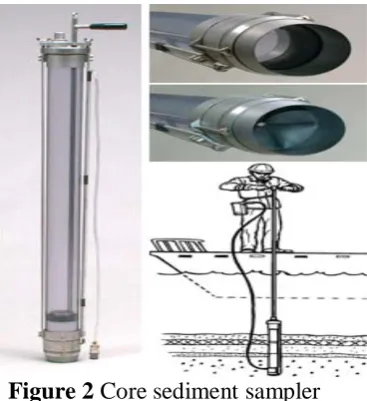
In this study, the sediment samples were taken from two sampling points along Sembrong River which are Sembrong River Upstream and Sembrong River Downstream as shown in Figure 1. The sampling tool used to collect the sediment samples was a core sediment sampler.Figure 2 shows the core sediment sampler.
Figure 1 Location of sampling.
Figure 2 Core sediment sampler
The sampling works were carried out from the bridge to obtain the sample from the middle of the river. The samplings of sediment were done at approximately 1 meter depth from the surface of the river sediment. Three sediment samples were taken at each location. The samples obtained were stored in glass bottles. The dried samples were then grounded before the extractions of PAE were carried on all samples.
3.2 The Extraction of Phthalate Esters in Sediment
About 10 g of dried sediment samples were weighed. The weighed samples were then put into 100 ml Schott bottles. Thirty milliliters of dichloromethane was added to the glass bottle. The glass bottles were placed on a shaker for 5 minutes at 30 rpm for the purpose of mixing the sample with the solvent. The samples were then put in the sonication bath with a
temperature of 60°C for 10 minutes to extract the PAE compounds. The samples were centrifuged at 2500 rpm for 10 minutes to separate the sediments from the solution. The supernatant liquid was collected, dried with anhydrous sodium sulfate and reduced to about 1 ml before being analysed using gas chromatography-mass spectrometer (GC-MS). The samples were analysed with an Agilent 6890 N GCMS. The capillary column Agilent J&W DB-5 MS, 30 m x 0.23 mm with id 0.25 µm was used. The inlet temperature operated at 290°C. Helium at 1mL/min was used as a carrier gas. The extracts of 1 µL were injected into split less with pulse injection at 35 psi for 0.5min. Oven program was at 50°C for 1min to 280°C at 30°C/min and to 310°C at 15°C/min. PAEs were monitored by considering the corresponding ions with the following masses. (m/z) = DMP: 194, 163; DEP: 222, 177, 149; DBP: 149, 167, 205, 223; BBP: 91, 149, 206; DEHP: 149, 167, 279; DNOP: 149, 167, 261, 279.
4.0 RESULT AND DISCUSSION
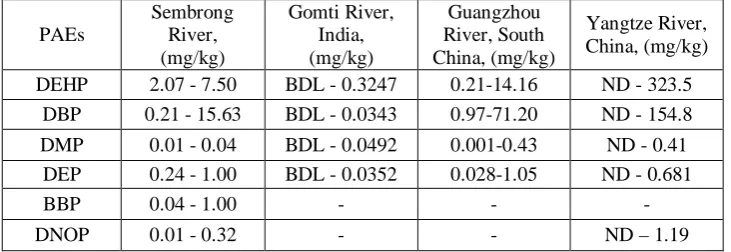
Table 2 shows the concentrations of DBP, DMP, DEP, BBP, DEHP and DNOP compounds in the Sembrong River sediment. The result shows that the concentrations of PAEs in the sediment river were in the range of 0.01 – 15.63 mg/kg. Di-n-butyl phthalate (DBP), and di-(2-ethylhexyl) phthalate (DEHP) recorded the two highest concentrations of PAEs compounds found in the sediment. The results were similar to the results reported from the study of PAEs in the sediment of Yangtze River, China, which indicated that the DBP and DEHP were the highest concentration of PAEs in the sediment. Table 3 shows the comparison of PAE compound concentrations of this study with the study carried out on Gomti River, Yangtze River and Guangzhou, South China sediments. The DEHP and DBP concentrations in Yangtze River, China sediment shows the highest concentration compared to the concentration in Gomti, Guangzhou and Yangtze River sediments. This clearly showed that the DEHP is widely used in plastic industries that constitutes about 50–60% of the total consumption of all the PAEs compounds (Liu et al., 2010). Thus, it is expected that the concentration of the DEHP is high in the environment.
Table 2 Concentrations of PAE compounds in Sembrong River sediment.
PAE compounds Range (mg/kg)
Dibutyl phthalate (DBP) 0.21 - 15.63
Dimethyl phthalate (DMP) 0.01 - 0.04
Diethyl phthalate (DEP) 0.24 - 1.29
Benzyl butyl phthalate (BBP) 0.04 - 1.00
Bis(2-ethylhexy) phthalate (DEHP) 2.07 - 7.50
Di-n-octyl phthalate (DNOP) 0.01 - 0.32
Table 3 Comparisons of PAE compound concentrations in Sembrong River sediment with other river sediments
PAEs Sembrong River, (mg/kg) Gomti River, India, (mg/kg) Guangzhou River, South China, (mg/kg) Yangtze River, China, (mg/kg)
DEHP 2.07 - 7.50 BDL - 0.3247 0.21-14.16 ND - 323.5
DBP 0.21 - 15.63 BDL - 0.0343 0.97-71.20 ND - 154.8
DMP 0.01 - 0.04 BDL - 0.0492 0.001-0.43 ND - 0.41
DEP 0.24 - 1.00 BDL - 0.0352 0.028-1.05 ND - 0.681
BBP 0.04 - 1.00 - - -
DNOP 0.01 - 0.32 - - ND – 1.19
5.0 CONCLUSION
The concentration of PAEs in the Sembrong River sediment is between 0.01-15.63 mg/kg. Among the PAEs compounds, di-n-butyl phthalate (DBP), and di-(2-ethylhexyl) phthalate (DEHP) showed the highest concentration found in the sediment followed by diethyl phthalate (DEP), benzyl butyl phthalate (BBP), di-n-octyl phthalate (DNOP), and dimethyl phthalate (DMP). The results of the study indicate that the Sembrong River sediments pose potential risks to the local ecological system. Hence, an effective PAE management and control strategy must be developed and implemented in order to improve the river sediment quality and keep the river ecological environment free from the interference of chemicals that interrupt endocrine hormones.
6.0 ACKNOWLEDGEMENT
This study was financially supported by the short term research grant scheme funded by UTHM.
REFERENCES
Chen, C.-W., Chen, C.-F., & Dong, C.-D. (2013). Distribution of Phthalate Esters in Sediments of Kaohsiung Harbor, Taiwan. Soil and Sediment Contamination: An International Journal, 22(2), 119–131.
Latiff, A.A.A. Karim, A.T.A. Muhammad, A. Hashim, N. H. Hung, Y. T. (2009). Study of metal pollution in Sembrong River, Johor, Malaysia. International Journal of Environmental Engineering, (4), 384-404.
Fromme, H., K¨uchler, T., Otto, T., Pilz, K.,M¨uller, J., and Wenzel, A. (2002). Occurrence of phthalates and bisphenol A and F in the environment. Water Res., 36, 1429–1438.
Lin, Z. P., Ikonomou, M. G., Jing, H., Mackintosh, C., and Gobas, F. A. P. C. (2003). Determination of phthalate ester congeners and mixtures by LC/ESI-MS in sediments and biota of an urbanized marine inlet. Environ. Sci. Technol., 37, 2100–2108.
Lin, C. Lee, C.J. Mao, W.M., Nadim, F. (2008). Identifying the potential sources of di-(2-ethylhexyl) phthalate contamination in the sediment of the Houjing River in southern Taiwan. Journal of Hazardous Materials, (161), 270-275.
Liang P, Zhang L, Peng L. (2010). Determination Of Phthalate Esters In Soil Sample By Microwave Assisted Extraction And High Performance Liquid Chromatography. Bull Environ. Contam. Toxicol., 85(2), 147-151.
Liu, H. Liang, H. Liang, Ying. Zhang, D. Wang, C. Cai, H. Shvartsev, S. L. (2009). Distribution of phthalate esters in alluvial sediment: A case study at JiangHan Plain, Central China. Chemosphere, (78), 382-388.
Liu, H., Liang, H., Liang, Y., Zhang, D., Wang, C., Cai, H., and Shvartsev, S. L. (2010). Distribution of phthalate esters in alluvial sediment: A case study at JiangHan Plain, Central China. Chemosphere 78, 382–388.
Long, J. L. A., House, W. A., Parker, A., and Rae, J. E. (1998). Micro-organic compounds associated with sediments in the Humber rivers. Sci. Total Environ. 210/211, 229–253.
Magdouli, S. Daghrir, R. Brar, S.K. Drogui, P. Tyagi, R.D. (2013). Di 2-ethylhexylphthalate in the aquatic and terrestrial environment: A critical review. Journal of Environmental Management. (127). 36-49.
National Sediment Quality Survey (2nd ed) (2004). A report on The Incidence and Severity of Sediment Contamination in Surface Waters of the United States. Washington DC : United States Environmental Protection Agency.
Oyo-Ita, O. E., Ekpo, B. O., Oyo-Ita, I. O., & Offem, J. O. (2013). Phthalates and Other Plastic Additives in Surface Sediments of the Cross River System, S.E. Niger Delta, Nigeria: Environmental Implication. Environment and Pollution, 3(1), 60–72.
Sha, Y. J., Xia, X. H., Yang, Z. F., and Huang, G. H. (2007). Distribution of PAEs in the middle and lower reaches of the Yellow River, China. Environ. Monit. Assess., 124, 277–287.
Shazarina, H. (2009). Kajian Hakisan Tanah dan Keberkesanan Perangkap Sedimen di Tapak Pembinaan: Universiti Teknologi Malaysia: Tesis Sarjana.
Srivastava, A., Sharma, V. P., Tripathi, R., Kumar, R., Patel, D. K., & Mathur, P. K. (2010). Occurrence of phthalic acid esters in Gomti River Sediment, India. Environmental Monitoring and Assessment, 169(1-4), 397–406.
Sung, H. H., Kao, W. Y., and Su, Y. J. (2003). Effects and toxicity of phthalate esters to hemocytes of giant freshwater prawn, Macrobrachium rosenbergii. Aquat. Toxicol. 64, 25–37.
Toriman M.E. et al (2012). Pengurusan sedimen terhadap sumber air bersepadu :satu kajian kes di Sungai Chini, Pekan Pahang. Journal of social sciences and humanities. 1(7), 267-283.
Tan, G. H. (1995). Residue levels of phthalate esters in water and sediment samples from the Klang River basin. Bull. Environ. Contam. Toxicol., 54, 171–176.
USEPA. 2009. United States Environmental Protection Agency Phthalates Action Plan. Retrieved from http://www.epa.gov/oppt/existingchemicals/pubs/actionplans/phthalates ap 2009 1230 final.pdf.
Vethaak, A. D., Lahr, J., Schrap, S. M., Belfroid, A. C., Rijs, G. B.J., Gerritsen, A., et al. (2005). An integrated assessment of estrogenic contamination and biological effects in the aquatic environment of the Netherlands. Chemosphere, 59, 511–524.
Wang, F., Xia, X., & Sha, Y. (2008). Distribution of Phthalic Acid Esters in Wuhan section of the Yangtze River, China. Journal of Hazardous Materials, 154(1-3), 317–324.
Yuan, S. Y. Liu, C. Liao, C.S. Chang, B.V. (2002). Occurrence and microbial degradation of phthalate esters in Taiwan River sediments. Chemosphere, (49), 1295-1299.
Zeng, F., Cui, K., Xie, Z., Liu, M., Li, Y., Lin, Y., Li, F. (2008). Occurrence of phthalate esters in water and sediment of urban lakes in a subtropical city, Guangzhou, South China. Environment International, 34(3), 372–380.
Zeng, F. Wen, J. Cui, K. Wu, L. Liu, M. Li, Y. Lin, Y. Zhu, F. Ma, Z. Zeng, Z. (2009). Seasonal distribution of phthalate esters in surface water of the urban lakes in the subtropical city, Guangzhou, China. Journal of Hazardous Materials, (169), 719-725.
Zhang, Y. H., Chen, B. H., Zheng, L. X., Zhu, J. H., and Ding, X. C. (2003). Determination of phthalates in environmental samples. J. Environ. Health 20, 283–286.