© Universiti Tun Hussein Onn Malaysia Publisher’s Office
JTET
http://penerbit.uthm.edu.my/ojs/index.php/jtet
ISSN 2229-8932 e-ISSN 2600-7932
Journal of Technical Education and
Training
Enhancing Learners’ Geometric Thinking Using Dynamic
Geometry Computer Software
Folake M. Adelabu
1*, Moses Makgato
2, Manto S. Ramaligela
31,2Department of Technology and Vocational Education, Tshwane University of Technology, Soshanguve North Campus, Private Bag X07, Pretoria North, 0116, SOUTH AFRICA
3Department of Mathematics Science and Technology Education, University of Limpopo, The Registrar Academic-Turfloop Campus, Private Bag X1106, Sovenga, 0727, SOUTH AFRICA
DOI: https://doi.org/10.30880/jtet.2019.11.01.006
Received 26th August 2018; Accepted 30th October 2018; Available online 31 March 2019
1.
Introduction
The appropriate use of technology in teaching and learning geometrical concepts is an essential factor of quality mathematics in secondary schools and Technical and Vocational Education and Training (TVET) colleges (Yanik, 2013). According to NCTM, (2000), technology is very crucial in teaching and learning mathematics; this influences mathematics that is taught and enhances learners’ learnings. Technology facilitates mathematics teachers to construct lessons resources that include a precise mathematical content and illustration. Also, technology gives a prospect for learners to be launched to mathematical ideas and perception in some absolutely new ways (Clark-Wilson & Mostert, 2016). Mathematics is a science which the likeness can occasionally see directly as well as use to gain meaning in someone’s life.
Therefore, mathematics, which affects lives, has great significance in secondary schools and TVET colleges as a lesson. Hence, it is essential to teach mathematics’ subjects with technology which can be the way that will give learners
Abstract: The appropriate use of dynamic geometry computer software in teaching and learning geometrical concepts is an essential factor of quality mathematics in secondary schools and TVET colleges. The aim of this study is to measure learners’ Geometric Thinking (GT) according to van Hiele model. The study was conducted with pre and posttest non-equivalent control group quasi-experimental method. The control group were taught by conventional method while the experimental group learnt geometry through the use of Dynamic Geometry Computer Software. Convenient and purposive sampling were used for participants’ selection. The sample of the study was 87 ninth grade learners. A GMAT on geometric thinking was used as the data collecting instrument. Data analysis was done according to Van Hiele theory using ANOVA. The result showed that there was significant difference in the GT levels of the experimental and control groups, but the GT points were the same. The indication means the use of DGCS increase the learners’ GT. The improvement will enable learners in both secondary and technical colleges to make informed decision and solve problem in various fields in the future. Since learners enroll to TVET colleges at grade nine, the improvement will also help the learners when encountering problem in geometry in vocation education training. Lack of sufficient geometry thinking in learning geometry, make learners to be deficient in building foundational geometry thinking skills and problem solving which are useful in TVET colleges. This study suggest that further study is necessary to extend the investigation to more topics across the mathematics curriculum both in secondary and TVET colleges.
the capability to solve factual problems (Tezer & Cumhur, 2017). Geometry is one of the essential areas of mathematics curriculum that deals with shapes and space. Geometry is a combining theme to the whole mathematics curriculum and as such is a rich foundation of visualization for arithmetical, algebraic and statistical concepts (Choudhury & Das, 2012). It is the background of technical subject. Geometry can be found in art, architecture, engineering, robotics, astronomy, sculptures, space, nature, sports, machines, cars, and much more (Russell, 2018; Velichova, 2002). Geometrical tools have been an important part of geometry teaching and learning. These tools have transformed from physical objects, such as a compass and straightedge (ruler), to technological tools such as computer and handheld like graphing calculators and iPad (Hollebrands & Stohl Lee, 2011). Learning geometry in school is very important especially in secondary schools and TVET colleges. Geometry objects are used all the time at different workplace. For example, the architects and civil engineers use a point to develop a plan for a building. In addition, a Computer Aided Designers (CAD) use a line segment to draw mechanical parts of machine which are complex (Hollebrands & Stohl Lee, 2011).
Further, geometry is generally collected with study of abstract idea, such as points, that have no dimension or lines of one dimension that go on without end. These objects can only be imagined in the mind. Geometry is a visual subject. It is difficult to imagine thinking geometrically without sketch a picture or using some variety of visual to represent an abstract geometric idea. For example, technician-engineer always sketch the intended project graphically for others to reach them (Velichova, 2002). Learners often have difficulty reasoning about representation of different geometric objects. Also, representation can sometimes difficult for learners to interpret (Hollebrands & Stohl Lee, 2011). Many research studies confirmed that geometry as being too formal, too complex and also too hard to understand (Atebe & Schäfer, 2010; Alex & Mammen, 2016).
Studies have also discovered that most learners enter secondary school geometry with a low Van Hiele level of understanding. Also, most of the geometry taught before secondary school does not develop learners into higher level of Geometry Thinking (GT). Geometric thinking is a form of mathematical thinking within a definite content domain. It is underlying in the type of skills that teachers need to nurture in learners. The important part of GT is visualization where learners can imagine rotating an object in mind and see the object from different angles (Dindyal, 2007; NTCM, 2000). According to Fulton (2013) many geometry textbook problems are based on calculations such as “calculate the area, circumference, perimeter and radius of a shape”. Textbooks problems concentrate too much on calculating and using formulas which made learners result into memorizing the formulas, definitions andcalculation. There was not enough on analyzing and investigating figures and making conjectures about the properties of the shape and testing them (Fulton, 2013). Doodle (2017) claims that Van Hiele levels for learners are based around the idea that learners can understand geometry visually at a younger age since learning geometry does not start from secondary schools. It starts from elementary and middle schools. Then from there learners develop the concepts following the properties to the point that can first just recognise, and then think more abstractly about the principles. Learners got to the point of analysing a figure or shape. Eventually, they then advance to the point of making deductions.
In South Africa a new curriculum was released in 2003 where mathematics content bands Shape, Space and Measurement were included. Since the released of the new curriculum, the researchers Moore-russo, Schroeder, Mudaly, Ball, and Nutakki, (2010) reported that the shape, space and measurement (geometry) content has been difficult for learners and teachers. The report from South Africa National Senior Certificate (SANSC) showed that, learners could not do basic mathematics of lower grades such as grade 9 and also learners are poor in reasoning and thinking (South Africa. Department of Basic Education, 2015 & 2016). The report from Annual National Assessment (ANA) for intermediate phase learners showed that learners lacked geometry language, geometry terminology and geometry reasoning or thinking skills (South Africa. Department of Basic Education, 2014). As a result, geometry remains problematic in the country. The feasible way to help learners improve in learning geometry and to enhance their GT is to integrate technology in teaching and learning mathematics environment. The integration of technology is very important in schools and technical colleges in order to enhance teaching and learning practices, and make learners ready for the workplace where ICTs are becoming more and more important. Technology helps learners to develop higher order of skills in the most effective way. Technology also is used in creating learning environments and support is an ideal learning which was impossible to achieve in the past (Chigona, Chigona, & Davids, 2014). Integration of technology in mathematics classroom encourages constructive learning such that learners thinking can be developed in a more efficient way than traditional teaching practices (Bester, & Brand, 2013).
The software can be used for discovering mathematics since learners are able to arrange data and explore by themselves, making learning more learner-centered as opposed to teacher-centered. The software can be used by the teachers for preparing lesson materials in such a way that it could be used as a collaboration, communication and illustration tool (Hohenwater, & Fuchs, 2004).
Considering the learners Geometric Thinking Levels (GTL), the van Hiele geometry theory with the help of (DGCS) allows learners to move along the level. According to Kurniawati, Junaedi and Mariani, (2016) the theory is phased-based using DGCS has positive effect to enhance the learners’ levels of GT which is characterized by visualization, analysis and informal deduction. Kurniawati, et al, (2016) further explained that, teachers can give appropriate task to the learners based on their levels. This will enable the learners to conjecture and develop to deductive reasoning. Manizade and Manson (2010) encourage teachers to use DGCS to design an ideal dynamic activity for learners at different levels of van Hiele in order to address the needs of each learner. The indication means, teachers can use DGCS to design activities for learners in level 1, level 2 and level 3 by grouping them according to their levels. According to Olkun, Sinoplu, and Deryakulu, (2003) using dynamic geometry application in the teaching geometry encourages learners to move to higher levels of geometrical thinking instead of having to memorize a list of shape properties. In addition, the theoretical approaches concerned with the development of the geometrical thinking of learners should be internalized by the teachers so that they are able to provide a rich learning environment.
Therefore, the purpose of this research study is to investigate how the use of DGCS enhances learners’ geometry thinking.
The study was informed by the following research questions:
• Is there any significant effect of using DGCS (GeoGebra) in learners’ GTL?
• Is there any significant effect of using dynamic geometry computer software (GeoGebra) in learners’ geometric thinking points (GTP)?
2.
Methodology
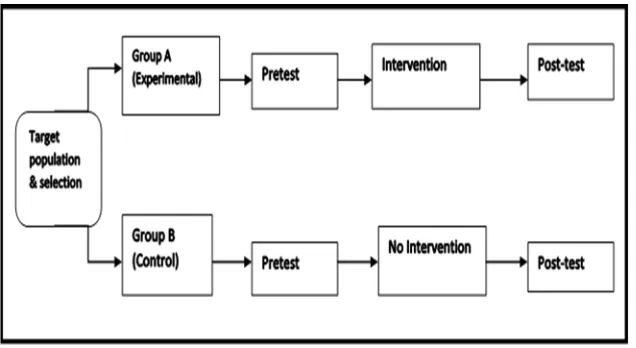
A quantitative approach with the use of quasi experimental research design was employed in the study. A quasi experimental, non-equivalent control group was used. The reason was that; it was not possible to assign the learners randomly into two groups because of differences in the schools. Figure 1 illustrates the quasi experimental design.
Figure 1: Quasi Experimental Design
2.1
Sample
The study was conducted in Tshwane South District Gauteng Province South Africa. Two schools were conveniently and purposively selected because of the availability of computer laboratory. A total number of 87 grade nine learners from two schools participated in the study.
2.2
Instrument and procedure
new to the learners at the commencement of the experiment, though, they might have the knowledge of such in their lower grades. The geometry mathematics achievement test was administered to both experimental and control groups again as post-test to compare learners’ geometric thinking. The study lasted for eight weeks.
Reliability of the instrument was established using Cronbach’s alpha coefficient which was 0.9. The distribution of participants to experimental and control groups is illustrated in table 1 below.
Table 1- Number of learners in the study
Group Male Female Total
Experimental 12 25 37 Control 23 27 50
Total 35 52 87
The instrument used in this study was geometry mathematics achievement test for GT. The test was used as pre-test and post-test to examine and compare learners’ GT in both experimental and control groups. The test was adopted from test of Van Hiele geometry thinking level which consists of 15 items. The data collected from both groups was analysed using Analysis of Variance (ANOVA) to find the improvement of learners in geometric thinking.
2.3 Data analysis
To determine learners’ geometric thinking in term of Van Hiele geometry theory, Van Hiele geometric thinking test levels and points have to be analysed. Also, analysis of variance test (ANOVA) was performed for statistical analysis. For that purpose, Microsoft Excel 2016 was used to observe whether there is significant difference between the two groups. The significance of the difference between the mean scores of the groups interpreted as p< 0.05.
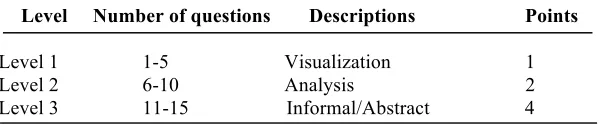
From the van Hiele theory, there were five levels of GT. In this present research study, the first three levels were considered, that is, level one to level three. According to Usiskin, (1982). From the grading key, a learner can get minimum 0, and maximum 31 points based on five levels. However, for this current study the maximum point is 7 according to the Usiskin grading key based on three levels. The administered Geometry Mathematics Achievement Test (GMAT) contained 15 questions based on van Hiele geometry theory. The questions related to each level, descriptions and points are in table 2 below.
Table 2- The GMATs’ questions numbers about the levels and the descriptions (Usiskin, 1982)
Level Number of questions Descriptions Points
Level 1 1-5 Visualization 1 Level 2 6-10 Analysis 2 Level 3 11-15 Informal/Abstract 4 Usiskins’ grading key for van Hiele geometric thinking test is as follows:
I. If at least three questions (between 1 and 5) are answered correctly: 1 point II. If at least three questions (between 6 and 10) are answered correctly: 2 points III. If at least three questions (between 11 and 15) are answered correctly: 4 points. If two of the questions among these groups are answered correctly: 0 point.
The understanding of the grading was that learners need to answer correctly at least three of previous level questions in order to pass from one level to another. For instant, if a learner was able to answer three questions from 1 to 5 questions, two questions from 6 to 10 and three questions from 11 to 15, such learner gets 1 point from level 1, 0 point from level 2 and 4 points from level 3, the total geometric thinking test points is 5 while the geometric thinking test level of such learner is level 1. The total points for the GMAT questions 1 – 15 is 7 points.
3.
Results
Table 3- Experimental group learners’ van Hiele geometric thinking test levels Pre-test Post test
Levels Frequency (%) Frequency (%) Below level 1 17 45.95 13 35.14 Level 1 16 43.24 17 45.95 Level 2 4 10.81 5 13.51 Level 3 0 0 2 5.40 Total 37 100 37 100
According to table 3, the pre-test of the experimental group recorded 45.95% of the learners were below level 1, which were not up to any level, 43.24% of the learners were in level 1 while 10.81% in level 2 and 0% in level 3. There was an improvement in the post test. In thepost test, the number of learners below level 1 reduced from 17 to 13 which means 10.81% of the learners has upgraded to level 1. There was a little increase in the percentage of learners in level 1 as 45.95% was recorded. The percentage of learners in level 2 and 3 were also increase as 13.51% and 5.4% were recorded respectively. The GTLs for control group are shown in table 4.
Table 4- Control group learners’ van Hiele geometric thinking test levels
Pre-test Post test
Levels Frequency (%) Frequency (%) Below level 1 31 62.0 24 48.0 Level 1 18 36.0 21 42.0 Level 2 1 2.0 5 10.0 Level 3 0 0 0 0.0 Total 50 100 50 100
According to table 4, the pre-test of the control group recorded 62% of the learners were below level 1, that is, they were not up to any level, 36% of the learners were in level 1 while 2% in level 2 and 0% in level 3. There was an achievement in the post-test also. In the post test of the control group, the number of learners below level 1 was reduced to 24 with 48%. Learners in level 1 were21 with 42%. Also, 10% of the learners were now in level 2 while 0% of the learners were in level 3.
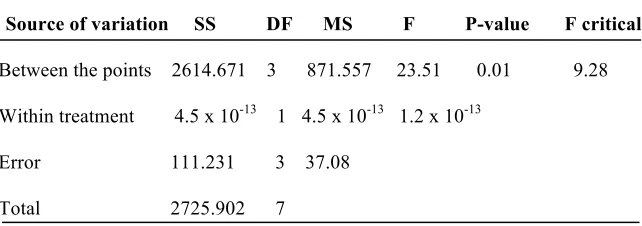
Examining table 3 and 4, it is seen that the GTL of learners in experimental group are higher than the control group. Two of the learners in the experimental group are in level 3, while there are no learners in the control group. To find the significant effect of using DGCS in learners’ GTL, Analysis of variance (ANOVA) was performed. Table 5 shows the ANOVA for percentage of the post-test of the geometric thinking levels of the experimental and control groups.
Table 5-Analysis of variance for percentage of post-test of the geometric thinking levels of the experimental and control groups
Source of variation SS DF MS F P-value F critical
Between the points 2614.671 3 871.557 23.51 0.01 9.28 Within treatment 4.5 x 10⁻¹³ 1 4.5 x 10⁻¹³ 1.2 x 10⁻¹³
Error 111.231 3 37.08
Total 2725.902 7
T-value significant at p < 0.05
different to the GTLs of learners in the control group. This finding reveals that DGCS did affect learners’ geometric thinking levels.
3.3
Learners van Hiele geometric thinking points in both experimental and control
groups
emphasized before, no matter how the van Hiele GTPs are higher in order to upgrade the levels, learners must correctly answer 3 questions of that level. Nevertheless, increasing rate of the points is very important for the intervention of DGCS effects. As indicated in the data analysis, any learner can get minimum of 0 and maximum of 7 points (1+2+4) from the GMAT. Analysing the data obtained from both tests, learners GTPs were also determined. The GTPs for experimental group are shown in table 6.
Table 6- Experimental group learners’ van Hiele geometric thinking test points
Pre-test Post test Points Frequency (%) Frequency (%) 0 point 17 45.95 4 10.81 1 point 15 40.54 11 29.72 2 points 1 2.70 1 2.7
3 points 4 10.81 5 13. 51 4 points 0 0 6 16.22 5 points 0 0 6 16.22 6 points 0 0 2 5.41 7 points 0 0 2 5.41 Total 37 100 37 100
According to table 6, the pre-test of the experimental group recorded approximately 46% of the learners with no point, 40.54% of the learners with 1 point while 2.7% with 2 points and 10% with 3 points. The result of post-test showed the increase in the number of learners that get 3,4,5,6 and 7 points. There was reduction in the percentage of learners with 0 point from 45.95% to 10.81 and 1 point from 40.54% to 29.72%. Table 7 showed the geometric thinking points of the control group.
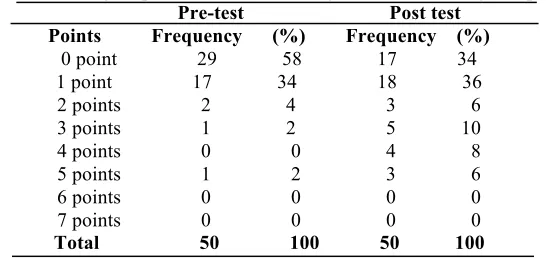
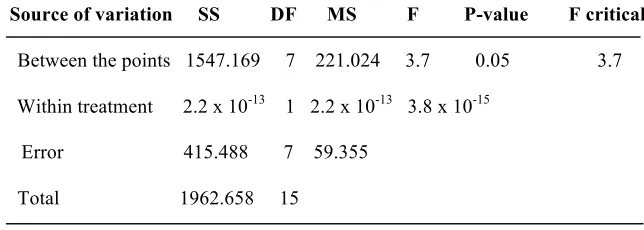
According to table 7, the pre-test result showed that the maximum points that a learner got is 5 points, though there were no learners that get 4 points. While the result of post-test showed the increase in the number of learners with 4 and 5 points. Examining table 6 and 7, it is seen that GTPs of learners in experimental group are higher than the control group. There were learners who get 6 and 7 points in the experimental group and there was no learners that get 6 and 7 points in the control group. To find the significant effect of using DGCS in learners’ GTP, Analysis of variance (ANOVA) was performed. Table 8 shows the ANOVA forpercentage of the post-test of the geometric thinking points of the experimental and control groups.
Table 7-Control group learners’ van Hiele geometric thinking test points Pre-test Post test
Points Frequency (%) Frequency (%)
0 point 29 58 17 34
1 point 17 34 18 36
2 points 2 4 3 6
3 points 1 2 5 10
4 points 0 0 4 8
5 points 1 2 3 6
6 points 0 0 0 0
7 points 0 0 0 0
Table 8- Analysis of variance for percentage of post-test of the geometric thinking points of the experimental and control groups
Source of variation SS DF MS F P-value F critical
Between the points 1547.169 7 221.024 3.7 0.05 3.7 Within treatment 2.2 x 10⁻¹³ 1 2.2 x 10⁻¹³ 3.8 x 10⁻¹⁵
Error 415.488 7 59.355 Total 1962.658 15
T-value significant at p < 0.05
It is understood from the ANOVA table that the percentage of the post-test of the geometric thinking points of the two groups shows the p-value 0.05 which is equal to 0.05 of the significant level. Also, the value (3.7) is equal to F-critical (3.7), therefore, the statistically significant effect on the learners’ geometric thinking points using DGCS and learners without computer software are the same. According to the result of the analysis of variance the learners’ GTPs of the experimental group is the same to the GTPs of learners in the control group. This finding reveals that DGCS affect learners’ geometric thinking points in the same way with the conventional method.
4.
Discussion
The aim of this study was to investigate how the use of DGCS enhances grade nine learners GT as indicated that learners lacked geometry reasoning and GT skills. As a result of analysis in this study, it is seen that GTL of learners taught using conventional method is relatively lower than the GTL of learners taught using DGCS. The result also, showed that GTPs of both groups are the same after the intervention of DGCS. Geometric thinking level of learners taught using DGCS (GeoGebra) improved significantly more than the learners taught with textbook and chalkboard and this is a meaningful improvement according to the analysis of variance. While the geometric thinking points of learners in both groups were the same. The indication of these results is that DGCS enhances the GTL of learners more than their GTPs. The reason is that learners who used DGCS could revisit the activity several times while the control group could not be able to do. In the control group teaching was limited to few examples, because drawing geometry shapes on the chalkboard spent time and space. Furthermore, not all teachers have the skill to illustrate good and excellence geometry shapes on the chalkboard. Therefore, with DGCS drawing and outlines are well-ordered and precise. DGCS allowed learners in the experimental group instantaneous exploration opportunities. The results in this study agreed with other conducted studies by Manizade & Manson (2010); Driscoll, (2007); Idris, (2009); Kutluca, (2013); Battista (2002); Yildiz (2016); Al-Migdady and Qatatsheh (2017) and Elvi & Nurjanah (2017) which show DGCS has improved learners GT in terms of van Hiele theory.
This study has found that there is improvement in learners GT from level 1 to level 3 through the use of DGCS. From the five geometric thinking levels of the Van Hiele theory geometric thought, learners were able to visualized, analysed, and informal deducted geometry shape (similarities and congruency) using DGCS. The DGCS served as a teaching medium, and sharing ideas among learners as the geometry shapes were dragging on the computer screen. Dragging was a tool that learners used to discover the similarity and the congruency of two geometrical shapes on the computer screen (Larios-Osorio 2007). The dynamic changes of the geometrical shape on the computer screen (dynamic environment) made learners in experimental group think visually, analytically and deductively to solve problems on similar and congruent triangles. On the other hand, the control only learnt in the static environment where dynamic nature of geometrical could not be visualized. Van Hiele (1999) claimed that learners improve from lower level to higher level of geometric thinking when an activity is carried out by the learners themselves. Therefore, the van Hiele theory through the use of DGCS encouraged learners to build concrete geometric thinking.
The use of DGCS as technology and relevant geometrical tools in teaching and learning geometry has positive contribution to learners’ geometric thinking. Thus, in order to move from one level to another great instruction as DGCS is needed. Consequently, DGCS enhances the level of learners’ geometric thinking and help them to attain some adequate measurements to accomplish in learning geometry. These were possible because learners are used to the visual, holistic style of TV watching and computer gaming. In this regard, their thought was influenced and considerably reduced the analytical constraint of the conventional method.
5.
Conclusion
Finally, from the above results and discussion, conclusion can be made that the use of DGCS in learning geometry augments the learners’ GT. Learners’ levels of GT can be improved from low level to higher level as learners’ progresses in secondary schools by the help of DGCS in terms of van Hiele theory. There was specific instantaneous response in dynamic form served as the function of improving learners reasoning and thinking during the activity. During the activity, while dragging and manipulating the figure in DGCS environment, learners may have seen the concepts in action, unlike the static form in the textbook. Learners worked in pairs and were encouraged to discuss their view and reflect the activity answer together with others. Thus, this would have supported learning for the low thinking learners in the group. Hence, learners progressed in the levels of GT. All the three levels; visualization and recognition; analysis; and abstraction and relationship demonstrated during the course of the study helped learners in experimental group improved in GT more than control group.
Using DGCS improves learners’ geometric thinking in order to make informed decision and solve problem. Geometric thinking helps learners’ problem-solving skills with a series of techniques in both cognitive and behavioural that can be applied in different fields such as art, architecture, engineering, robotics, astronomy, sculptures, space, nature, sports, machines, cars, and much more. Lack of sufficient geometry thinking in learning geometry, make learners to be deficient in building foundational geometry thinking skills such as logical reasoning, deductive reasoning, analytical reasoning and problem solving which are useful in both secondary and TVET colleges. The result of this study is applicable to and useful for learners in secondary schools and TVET colleges’ students. This study suggest that further study is necessary to extend the investigation to more topics across the mathematics curriculum both in secondary schools and TVET colleges.
References
Alex, J. K. & Mammen, K. J. (2016). Lessons learnt from employing van hiele theory based instruction in senior secondary school geometry classrooms. Eurasia Journal of Mathematics, Science & Technology Education, [Online], 12(8):2223-2236. Retrieved from https://www.researchgate.net
Al-migdady, A. M. & Qatatsheh, F. (2017). The effect of using Crocodile Mathematics software on Van Hiele level of geometric thinking and motivation among ninth-grade students in Jordan. International Journal of instructional Technology and Distance Learning [Online], 14(3), 87-102. Available from https://www.researchgate.net/.../317000843 Atebe, H. U. & Schäfer, M. (2010). Research evidence on geometric thinking level hierarchies and their relationships with students’ mathematical performance. Journal of the Science Teachers Association of Nigeria, [Online],45(1&2), April & September: 76-86. Retrieved from: http://www.stanonline.org/mydomain/Templates/pdf/p8.pdf
Becta. (2003). What the research says about using ICT in science. [Online]. Retrieved from: http://39lu337z51l1zjr1i1ntpio4.wpengine.netdna-cdn.com/wp.../04/wtrs_18_science.pdf
Bester, G. & Brand, L. (2013). The effect of technology on learner attention and achievement in the classroom. South
African Journal of Education, [Online], 33(2):15. Retrieved from:
http://www.sajournalofeducation.co.za/index.php/saje/article/viewFile/405/344
Chigona, A., Chigona, W. & Davids, Z. (2014). Educators’ motivation on integration of ICTs into pedagogy: case of disadvantaged area. South African Journal of Education, [Online], 34(3):1-8. Retrieved from: https://www.ajol.info/index.php/saje/article/download/107453/97322
Choudhury, R. & Das, D. 2012. Influence of Geometrical Ability and Study Habit on the Achievement in Mathematics at Secondary Stage 1. International Journal of Computational Engineering Research [Online]. 2(6) 232-237
Clark-wilson, a. & Mostert, I., (2016). Teaching and learning mathematics with technology. In C. Hopkins, J. Anghileri & J. Gage (Eds.), AIMSSEC Maths Teacher Support Series: Mathematical Thinking in the Lower Secondary Classroom. Cambridge: Cambridge University Press. Retrieved from: http://discovery.ucl.ac.uk/pdf
Dindyal, J. (2007). The Need for an Inclusive Framework for Students' Thinking in School Geometry. The Mathematics Enthusiast [Online]. 4(1) Available from: https://scholarworks.umt.edu/tme/vol4/iss1/5
Driscoll, M. (2007). Fostering geometric thinking: A guide for teachers, grades 5-10. Mathematics Knowledge: Books. Leadership in Mathematics Education. Retrieved from: www.mathedleadership.org
Elvi, M. & Nurjanah, (2017). Improvement of the ability of Junior High School students thinking through visual learning assisted Geogebra Tutorial. IOP Conf. Series: Journal of Physics [Online], 812 (2017) 012008. Available from: http:// iopscience.iop.org
Fulton, B. (2013). Why students don’t understand geometry and how we can fix that. Practical and Proven Professional Development. Retrieved from: https://www.tttpress.com/.../why-students-dont-understand-geometry-and-how-we-can Hohenwater, M. & Fuchs, K. (2004). Combination of dynamic geometry, algebra and calculus in the software system geogebra. University of Salzburg. [Online]. Retrieved from http://www.mathed.byu.edu
Hollebrands, K., & Stohl Lee, H. (2011). Introduction to dynamic geometry environment, Chapter 1. [Online]. Retrieved from https://he.kendallhunt.com
Idris, N. (2009). The impact of using geometers’ sketchpad on Malaysian students’ achievement and Van Hiele geometric thinking. Journal of Mathematics Education, [Online]. 2(2), 94-107 Retrieved from: http://www.academia.edu/.../The_Impact_of_Using_Geometers_Sketchpad_on_Malaysian_.
Kurniawati, M. Junaedi, I. & Mariani, S., (2016). Characteristics of geometric thinking through Van Hiele’s phase-based learning using geometer sketchpad [Online]. Retrieved from: https://text-id.123dok.com › Lain
Kutluca, T. (2013). The effect of geometry instruction with dynamic geometry software; geogebra on van hiele geometry understanding levels of students Global Educational Journal of Science and Technology, [Online], 1(1):1-10. Retrieved from: https://eric.ed.gov/?id=EJ1017439
Larios-Osorio, V. (2007). Geometrical ridigity and the use of dragging in a Dynamic geometry environment. Working group 7. Geometrical thinking CERME 5
Manizade, A. G. & Manson, M., (2010). Choosing geogebra applications most appropriate for teacher’s current geometry classroom: pedagogical perspective. Ithaca College, Ithaca, NY, USA [Online]. Retrieved from: https://geogebraithaca.wikispaces.com/file/view/z10_os3-4-1.pdf
Moore-russo, D., Schroeder, T. L., Mudaly, V., Ball, J. D., & Nutakki, N. (2010). Using GeoGebra to create resources for teachers in high needs area: A collaboration between U.S and South African teacher educators. Ithaca College, Ithaca, New York.USA. [Online]. Retrieved from:https://geogebraithaca.wikispaces.com.pdf
Nctm. (2000). Principles and Standards for School Mathematics [Online]. Retrieved from: http://www.nctm.org/Standards-and-Positions/Principles-and-Standards
Olkun, S. Sinoplu, N. B. & Deryakulu, D. (2003). Geometry exploration with dynamic geometry applications based on van Hiele levels. International Journal for Mathematics Teaching and Learning [Online] http://www.ex.ac.uk/cimt/ijmtl/ijmenu.htm
Russell, D. (2018). Measuring lines, shapes, angles and circles. Retrieved from: http://www.thoughtco.com
South Africa. Department of Basic Education (2015). National Senior Certificate Examination. Diagnostic Report. See
SOUTH AFRICAN Department of Basic Education. [Online]. Retrieved from
http://www.governmentpublications.lib.uct.ac.za/.../2015-national-senior-certificate-examin...
South Africa. Department of Basic Education (2016). National Senior Certificate Examination. Diagnostic Report. See
SOUTH AFRICAN Department of Basic Education. [Online]. Retrieved from
https://www.education.gov.za/.../NationalSeniorCertificate(NSC)Examinations/2016NSC
South Africa. Department of Basic Education (2014). The annual national assessment of 2014 diagnostic report intermediate and senior phases’ mathematics [Online]. See SOUTH AFRICA. Department of Basic Education. Retrieved from www.saqa.org.za
Tezer, M & Cumhur, M. 2017. Mathematics through the 5E Instructional Model and Mathematical Modelling: The Geometrical Objects. EURASIA Journal of Mathematics Science and Technology Education [Online]. 13(8), 4789-4804. Available from: http://www.ejmste.com
Usiskin, Z. (1982). Van Hiele levels and achievement in secondary school geometry. CDASSG project. National Inst. of Education (ED), Washington, DC. The University of Chicago [Online]. Retrieved from: http:// ucsmp.uchicago.edu/resources/van_hiele_levels.pdf
Velichova, D. (2002). Geometry in engineering education. European Journal of Engineering Education. [Online], 27(3), 289-296. Retrieved from: http://www.tandf.co.uk
Yanik, H. B. (2013). Learning geometric translations in a dynamic geometry environment. Education and Science [Online], 38(168), 272-287. Retrieved from: http://search.ebscohost.com