2496
Intervention For All: A Strategy For Creating
Inclusive Culture In Multicultural Classes
Melina Lestari, Sunaryo Kartadinata, SunardiAbstract: The purpose of this study is to look at the picture of the efforts of the school in creating an inclusive culture; develop a Strategy for creating inclusive cultures in multicultural classes; and knowing the impact of applying intervention Strategies. This research is a qualitative research which is designed with a Design Based Research approach. Participants in this study were teachers, principals, administrative staff and parents of all students in a multicultural playgroup and kindergarten in East Jakarta, Indonesia. The instrument developed was a guide to observation, interviews and documentation studies whose indicators were based on the Index for Inclusion. Based on data analysis, the results of the study are as follows: 1) School efforts in creating an inclusive culture can be seen from school policies, teacher training, educational activities for parents, and the contact book; 2) interventions for all are Strategies in creating an inclusive culture in multicultural classes by inviting all parties to assess all students and make interventions that are individual to all students; 3) Interventions for all succeed in creating an inclusive culture by developing several indicators, namely (1 ) Staff and students respect each other; (2) All parties share inclusive values; (3) All students are valued fairly; (4) Treat one another as whole human beings and have the same role; (5) Staff and teachers try to remove barriers to learning and encourage active participation of students.
Keywords: intervention, inclusive culture, multicultural class.
—————————— ——————————
1
INTRODUCTION
The issue of providing educational services for all individuals on this earth has long been discussed and has a strong legal umbrella. Starting with the Universal Declaration of Human Rights (1948), the World Declaration on Education for All (1990), the UN Standard Rules on Equal Opportunities for Persons with Disabilities (1993), Salamanca Declaration and UNESCO Framework for Action (1994), Disability Act (1997), Dakar Action Framework (2000) and up to the Declaration of the International Congress of Children (2004). Not only in the international world, the 1945 Constitution of the Republic of Indonesia expressly guarantees the rights of every citizen in obtaining education. In addition, it is strengthened by Law of the Republic of Indonesia no. 20 on the National Education System. The aforementioned law set the foundation for the birth of an inclusive education approach, which is expected to serve all children without exception. Even in Minister of Education Regulation no. 70 of 2003 expressly regulates inclusive education [8] [34]. Inclusive education is a form of education reform that is based on anti-discrimination principles [34]. Inclusive education is an open system in responding to the various needs of every child through increasing the involvement of children in learning and community, as well as reducing exclusivity in education, so that all children are served in the nearest school in ordinary classes together with friends their age [4] [31]. In a broader context, inclusive education serves the diversity of children in race, ethnicity, customs, religion, other differences and children with special needs [3]. Whereas in Indonesia, inclusive education places more emphasis on providing broad access to education for children with special needs. As affirmed in article 1 of RI Minister of Education Regulation no. 70 of 2009 that inclusive education is a system of providing education that provides opportunities for all students who have disabilities and have the potential for intelligence and or
special talents to attend education or learning in an educational environment together with students in general [34]. But in reality, the entry of children with special needs into public schools is not as easy as imagined. Various obstacles must be faced by children with special needs in undergoing inclusive education. Like the bullying problem that other students do with special needs children [12]; social participation of students in the category of children with special needs who are still considered less [26]; negative perceptions, attitudes and behavior given by teachers and other school personnel towards the presence of children with special needs in school [2] [6] [15] [19] [22] [24]. Not only in the school environment, sometimes serious problems are also experienced by children with special needs at home. This can be an external factor causing the severity of special needs experienced by children, such as the negative attitude of most parents towards children with special needs [5], thus triggering the onset of parental stress [1]. Parents who have children with special needs experience more problems in interacting, frequent divorce and pathological behavior [32] that have an impact on poor parenting that hinders the growth and development of children with special needs. The poor practice of inclusive in schools is due to the suboptimal cultural dimensions and inclusive policies. This is because the dimension of developing inclusive practices in schools reflects an inclusive culture and policy [9]. The dimensions of inclusive policy have been upheld by many related parties. Therefore, we need a special Strategy that can create an inclusive culture in the classroom that has teachers and students from different cultural backgrounds.
2.
LITERATURE
REVIEW
Inclusive education does not merely include children with special needs in regular classes, but more than that. Inclusive is a process of overcoming and responding to the diverse needs of all students through increased participation in learning, culture, society, and reducing the exclusivity of education [7] [21]. Inclusive is about accepting and valuing human diversity and providing the support needed so that children and their families can participate successfully in their chosen program [23]. Inclusion can be defined more positively as efforts to unite children with disabilities in realistic and _______________________________
• Melina Lestari: Doctoral student, Department of Educational Psychology and Guidance, Universitas Pendidikan Indonesia / lecturer Universitas Indraprasta PGRI Jakarta. [email protected]
• Sunaryo Kartaditana: Department of Educational Psychology and Guidance, Universitas Pendidikan Indonesia. [email protected] • Sunardi: Department of of Special needs education, Universitas
2497 comprehensive ways in a comprehensive educational life. The
goal for students who have obstacles is the actual involvement of each child in the whole school life. Inclusion can also mean the acceptance of children who have obstacles into the curriculum, environment, social interaction and vision-mission of the school [32]. Inclusion in education is a process of increasing student participation and reducing its separation from culture, curriculum and local communities. What is built in inclusive education are: (1) cultural, policy and practice restructuring to respond to students' diversity in their environment; (2) learning and participation of all students who have opportunities for exclusion pressure; (3) improving the quality of schools both in increasing the ability of staff and students; (4) overcoming barriers to access and participation; (5) it is the right of all students to be educated within their community; (6) views diversity as a source of wealth, and not as a problem; (7) maintaining relationships between schools and the community; (8) views inclusive education as an access from inclusive communities [33]. Creating an inclusive culture is one of the dimensions that must be restructured in inclusive education. In this dimension what must be built is to create security, acceptance, collaboration, stimulate society, where everyone is valued as the foundation for the highest achievements. This develops with inclusive values which are conveyed to all teachers, staff, principals, students and parents / guardians. Principles and values, in an inclusive culture in schools, guide the decisions of policies and practices in the classroom, so that school development becomes a continuous process. In the dimension of creating an inclusive culture there are two parts, namely building a community and upholding inclusive values [9]. The part of building an inclusive society can be seen from several indicators, namely everyone is made to feel accepted; learners help each other; cooperation between staff and teachers; staff and students respect each other; there is cooperation between employees and parents of students; staff and headmasters work well together; and the local community is involved in the school. The part of upholding inclusive values can be seen from expecting all students to develop their potential; all parties share inclusive values; all students are valued fairly; treat each other as fully human beings and have the same role; staff and teachers try to remove barriers to learning and encourage active participation of students; and schools try to minimize all forms of discrimination [9].
3.
METHODS
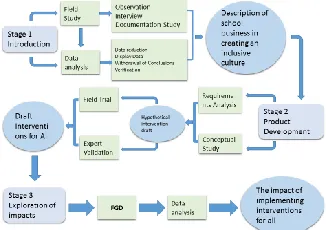
This research aims to produce an intervention strategy to create an inclusive culture in multicultural classes. The research location chosen was one of multicultural Playgroups and Kindergartens in Jakarta, in which both teachers and students came from different cultural backgrounds and each class had students who were indicated to have special needs. Participants are school principals, teachers, staff and parents of all students who become a development environment for students, in order to create an inclusive culture. The stages of research activities using Design Based Research by adopting the Research and Development design are stated by Dick and Carey [10] [14], which are divided into three stages:
Figure 1. Research Stages
Exploration stage
Researchers want to know by exploring and understanding more deeply, so this research uses a qualitative approach to find out complicated details about phenomena that are difficult to extract through more conventional methods [13]. Researchers collect data by observing, interviewing, and documenting studies that focus on how schools attempt to create an inclusive culture that refers to the index for inclusion [9].
Table 1. Indicators of Creating an Inclusive Culture
No Section Code Indicator
1
Building Commu nities
B1a Everyone is made to feel welcome B1b Students help each other
B1c Cooperation between staff and teachers
B1d Staff and students respect each other
B1e There is cooperation between the teacher and parents
B1f Staff and headmasters work well together
B1g The local community is involved in the school
2
Uphold inclusive values
B2a Expect all students to develop their potential
B2b All parties share an inclusive value B2c All students are valued fairly
B2d Treat each other as whole human beings and have the same role
B2e
Staff and teachers try to remove barriers to learning and encourage active participation of students
B2f Schools try to minimize all forms of discrimination
2498
Figure 2. Componen of Data Analysis:Interactive Models
The results of the exploration phase are a description of how the school has done in creating an inclusive culture.
Product development stage.
The researcher designs the intervention based on various information that the researcher has obtained from stage 1. After the hypothetical intervention, the researcher looks for experts who can provide assessment and input to improve the quality of the intervention better. Expert validation was carried out by four experts from several scientific fields, including expertise in the areas of Guidance and Counseling, Early Childhood Education, Inclusive Education and Children's Languages. Hypothetical interventions that have been formulated were tested in schools within 1 semester. Input from experts and the field was reviewed so as to produce a draft Intervention for All as a Strategy for creating inclusive cultures in a multi-cultural class.
Impact exploration stage
The researcher evaluates the results of behavioral changes that appear through FGD (Focus Group Discussion) which were attended by all participants in the study to determine the impact of interventions for all.
4 FINDINGS
4.1. 1. Description of school efforts in creating an inclusive culture
In the dimension of creating an inclusive culture, there are two parts namely building society and upholding inclusive values [9]. Each section has indicators that must be met. The following will explain how the school has provided opportunities for teachers and parents to participate in creating an inclusive culture
.
Figure 3. School's Efforts in Creating Inclusive Culture
Based on the results of data analysis conducted qualitatively. The role of staff and teachers in creating an inclusive culture is evident from the policies given that impact everyone feels accepted, cooperation between staff and teachers, and schools try to minimize all forms of discrimination such as affordable school fees. Teacher training given by the principal is an activity that shows good cooperation between teachers and the principal, in addition the teacher realizes in learning activities that students are invited to help each other and the
teacher expects all students to develop their potential. Indicators of cooperation between teachers and parents through parenting education activities and teacher and parent contact books. In addition, the involvement of local communities can be seen from the fillers of parenting activities that present figures from the surrounding environment. But there are still staff who appear to have not appreciated students by using bad words or high intonation when communicating with students. They reasoned because the cultural background that was accustomed to speaking styles such as: "... the way of talking to each other was different, to the B the intonation was rather high, it had been reminded, the Betawi people did not have to go so fast when talking". One mother even saw staff talking: "You are just a big body, but you can't do anything".In upholding the inclusive values of staff and teachers not yet civilizing all parties to share inclusive values, not all students are valued fairly, treating students as fully human, and have not yet appeared to be trying to eliminate barriers to learning and there are still students who have not participated in learning. Judging from the indicators that have not yet appeared, it can occur because of the ineffective training of teachers and staff that have been conducted. For this reason, a new Strategy is needed in the provision of interventions to create an inclusive culture in the classroom which consists of individuals whose cultures are different. The interventions developed will exploit the existing potential, namely cooperation between teachers and parents. The interventions developed will change the existing cooperative relationship between teachers and parents. In building an inclusive culture, all parents should be invited to take an active role as school partners. All parents should understand the plan to establish an inclusive, child-friendly environment [32].
4.2. Development of interventions for all
Interventions for all are activities aimed at building an opportunity structure so that teachers and parents become inclusive environments for children. The indicators developed are (1) Staff and students respect each other; (2) All parties share inclusive values; (3) All students are valued fairly; (4) Treat one another as whole human beings and have the same role; (5) Staff and teachers try to remove barriers to learning and encourage active participation of students. Intervention measures for all:
Stage 1. preparation:
The activity stage begins with the teacher conducting an assessment of the developmental aspects of all students in the class. Then do FGDs for problem exploration and intervention plans for all students.
Stage 2. FGD:
a. Invite parents of each class to conduct FGD by exploring every aspect of student development using the instruments that have been prepared in the module.
b. The results of parent and teacher assessments are combined with discussions so that aspects of development have not been achieved by students. Then determine the aspects of development that will be given an intervention first.
2499 and parents.
Stage 3. Individual interventions:
Provision of interventions at home and at school in accordance with the agreement for one week. In providing interventions, teachers and parents write the implementation process in the module provided.
Stage 4. Evaluation:
After one week of giving interventions to students at school and at home, the activity is evaluated by the teacher checking the module and providing input for further activities. At the end of the semester, parents who give intervention to students get an award.
Figure 4. Stages of Intervention for All
This begins with an assessment of every aspect of student development such as the physical-motor, language, social-emotional, and cognitive aspects of the teacher and parents. The results of the assessment are discussed with parents and a special program is made if needed. When designing learning, teachers can ask parents about students' fondness at home, so that teachers can plan learning according to the potential and interests of students. Initial assessment is very important because it contributes to the achievements of all students. This is because the development of students is also seen from the results of the initial assessment of each individual not achieving class. Children's assessment and learning are very important in designing, implementing and evaluating classroom activities. Assessment is also a tool to monitor the progress of children's development in accordance with educational goals [30]. The results of the assessment are used as a consideration in designing the activity. Effective collaboration with parents is characterized by good communication between home and school both formally and informally, teacher and parent meetings (dialogue), parental education, and parental involvement in their children's educational practices [17]. In addition the teacher recognizes the choices and goals of parents for their children, and responds with sensitivity and respect for the preferences and focus of parents without giving up professional responsibility towards children [11]. The Strategy developed is also in accordance with the Principles of learning based on Developmentally Appropriate Practice. The learning process involves all dimensions of learners, learning must be fun, information is conveyed attractively, varies because it will be
meaningful to be stored long in memory, involving all sensory learners, relevant, contextual, and directly involved. Developmentally Appropriate Practice that develops three dimensions, namely learning must be in accordance with the stages of child development, view children as unique individuals with (have different strengths, interests and needs), and can not be separated from the socio-cultural context [23].
4.3. Impact of interventions for all
From the point of view of parents, individual intervention activities for all have a positive impact on the development of learners. Among them in aspects of language development. Some students at the beginning of the semester experience language difficulties, after giving an intervention, students can communicate both ways well. Optimal communication between teacher and family provides benefits for children [18]. Another impact for parents is to become more aware of the purpose of education in play groups and kindergartens. Previously the purpose of parents entering their children into kindergartens was to be able to read, write and count, but after giving interventions to all, parents became more aware of the interventions provided tailored to the needs of each different child. Parents with children with special needs argue that he no longer feels awkward when the school invites to school, he feels he is getting the same treatment as other parents who have normal children. So that the indicator that appears in the perception of parents is an indicator of all parties sharing inclusive values and treating each other as fully human beings and having the same role. For teachers, this activity is considered successful if parents are also truly committed in carrying out interventions at home. This is in accordance with the opinion of Greenspan, et al [20] which is a half-hearted or rushed approach, will not work well, students will not achieve the desired progress and their achievements will not last long. The development of students will change positively if the interventions at school and at home are carried out together. In addition, teachers feel more confident when conveying the development of students to parents because it is based on the results of the assessment. Teachers are also more diverse in providing learning strategies and content without the demands of parents who want their children to immediately have reading skills, this is due to changes in parents' understanding of their children's needs. Parents are involved in making decisions and planning activities in inclusive classes [32]. Parents need to be empowered to collaborate with teachers, in making educational decisions based on shared services that are appropriate for children [25]. Although teachers need to take special time to often remind parents in carrying out interventions at home. In classes with a smaller number of students, the change in student behavior in a positive direction is very apparent. Like, all students actively participate in the learning process. The teacher plays an important role in this activity, to keep the transaction interventions at home going well, through verbal reminders. So from the point of view of school principals and teacher interventions for all can develop indicators to create an inclusive culture that has not been fulfilled by previous interventions.
5 CONCLUSION
2500 have not been developed optimally. For this reason, other
interventions are needed that can develop all indicators to create inclusive culture in multicultural classes. New interventions developed are interventions given to all parties involved in the school. for all is a Strategy in creating an inclusive culture in multicultural classes by inviting all parties to assess all students and make interventions that are individual to all students; 3) Interventions for all succeed in creating an inclusive culture by developing several indicators, namely (1) Staff and learners respect one another; (2) All parties share inclusive values; (3) All students are valued fairly; (4) Treat one another as whole human beings and have the same role; (5) Staff and teachers try to remove barriers to learning and encourage active participation of students.
6
REFERENCES
[1]. Alazemi, SS. Et al. (2015). Stress Levels of Kuwaiti Mothers of Children with SLD: Does Work and Educational Status Matter?. International Journal of Special Education, Vol. 30, No. 1, P 120 – 131.
[2]. Al – Natour, M. Et, al. (2015). Examining Collaboration and Constrains on Collaboration between Special and General Education Teachers in Mainstream Schools in Jordan. International Journal of Special Education, Vol. 30, No. 1, P. 64 – 77.
[3]. Alfian. (2013). Pendidikan Inklusif Di Indonesia. Edu-Bio, Vol 4, hlm. 68 – 80.
[4]. Alimin, Z. (2016). Paradigma Pendidikan Inklusif sebagai Upaya Memperluas Akses dan Perbaikan Mutu Pendidikan. Jassi Anakku, 10(1), 71–81. Retrieved from https: //ejournal.upi.edu/index.php/jassi/article/viewFile/4063/2926 [5]. Anggraini, RR. (2013). Persepsi Orangtua Terhadap Anak
Berkebutuhan Khusus. E-JUPEKhu (Jurnal Ilmiah Pendidikan Khusus), Vol 1, Hlm. 258 – 265.
[6]. Avlidou, MD. (2015). The Educational, Sosial and Emotional Experiences of Studentswith Dyslexia: The Perspective of Postsecondary Education Students. International Journal of Special Education, Vol. 30, No. 1, P. 132 – 145.
[7]. Bendová, P., Čecháčková, M., & Šádková, L. (2014). Inclusive Education of Pre-school Children with Special Educational Needs in Kindergartens. Procedia - Social and Behavioral Sciences, 112(Iceepsy 2013), 1014–1021. https://doi.org/10.1016/j.sbspro.2014.01.1263
[8]. Bines, H and Lei, P. (2011). Disability and education: The Longest Road to Inclusion. International journal of educational development, vol 31, P. 419-424.
[9]. Booth, T and Ainscow, M. (2002). Index for Inclusion: Developing Learning and participation in Schools. London: CSIE.
[10].Borg, W.R & Gall, M.D. (2003). Educational Research: An Introduction. London: Longman, Inc.
[11].Bredekamp, S & Copple, C (1997). Developmentally Appropriate Practice in Early Childhood Programs. Washington DC: National Association for the Education of Young Children. [12].Carter, BB and Spencer, VG. (2006). The Fear Factor: Bullying
and Students with Disabilities. International Journal of Special Education, vol 21 No. 1, P. 11 – 23.
[13].Creswell, JW. (2015). Riset Pendidikan: Perencanaan, Pelaksanaan, dan Evaluasi Riset Kualitatif dan Kuantitatif. Yogyakarta: Pustaka Pelajar.
[14].Dick, W and Carey, L. (2001). The Systematic Design of Instruction (5th ed). New York: Longman.
[15].Elisa, S dan Wrastari, AT. (2013). Sikap Guru terhadap Pendidikan Inklusi Ditinjau dari Faktor Pembentuk Sikap. Jurnal Psikologi Perkembangan dan Pendidikan, Vol. 2, No. 01, hlm. 1 – 10.
[16].Emzir. (2010). Metodologi Penelitian Kualitatif Analisis Data. Jakarta: Raja Grafindo Persada.
[17].Friend, M dan Bursuck, WD. (2015). Menuju Pendidikan Inklusi: Panduan Praktis untuk Mengajar. Yogyakarta: Pustaka Pelajar.
[18].Gestwicki, C. (2007). Developmentally Appropriate Practice: Curriculum and Development in Early Education. Canada: Thomson.
[19].Ghosh, SC. Et al. (2014). A Cross-Cultural Comparison of Teacher’ Perspectives on Inclusive Education through a Study Abroad Program in Brazil and in the U.S. International Journal of Special Education, Vol. 29, No. 1, P. 4 – 13.
[20].Greenspan, dkk. (2006). The Child with Special Needs: Anak Berkebutuhan Khusus. Jakarta: Yayasan Ayo Main.
[21]. https://en.unesco.org/world-education-forum-2015/incheon-declaration
[22].Holmberg, JB. Et al. (2014). Inclusive and Individually Adapted Education in Norway: Results from a Survey Study in Two Municipalities Focusing the Roles of Headteachers, Teachers and Curriculum Planning. International Journal of Special Education, Vol. 29, No. 1, P. 47 – 60.
[23].Jackman, H.L. (2010). Early Education Curriculum: A Child’s Connection to The World. Belmont: Wadsworth.
[24].Johnson, YH. Et al. (2014). What Does Teachers’ Perception Have to Do with Inclusive Education: A Bahamian Context. International Journal of Special Education, Vol. 29, No. 1, P. 143 – 157.
[25].Karten, TJ. (2005). Inclusion Strategies That Work! Research- Based Methods for the Classroom. California: Corwin Press. [26].Koster, M. Et al. (2010). Sosial Participation of Students with
Special Needs in Regular Primary Education in Netherlands. International Journal of Disability, Vol. 57, No. 1, P 59 – 75. [27].Kustawan, D. (2012). Pendidikan Inklusif dan Upaya
Implementasinya. Jakarta: PT Luxima Metro Media.
[28].Miles, MB and Huberman, AM. (1994). Qualitative Data Analysis: An Expanded Sourcebook. California: Sage Publications.
[29].Morrison, GS. (2017). Dasar-dasar Pendidikan Anak Usia Dini. Jakarta: Indeks.
[30].NAEYC. (2009). Developmentally Appropriete Practice in Early Children from Birth through Age 8.
[31].Praptiningrum, N. (2010). Fenomena Penyelenggaraan Pendidikan Inklusif bagi Anak Berkebutuhan Khusus. Jurnal Pendidikan Khusus, Vol. 7, No. 2, hlm. 32 – 39.Setiono, K. (2011). Psikologi Keluarga. Bandung: PT. Alumni.
[32].Smith, JD. (2014). Pendidikan Inklusif: Konsep dan Penerapan Pembelajaran. Bandung: Nuansa Cendikia.