4332
A Simple Balanced CH Selection Method For
Network
Life Time Maximization And Energy
Utilization In Heterogeneous
WSN
C.Sudha, D.Suresh, A. Nagesh
Abstract : To Extend Wireless networks is required to solve challengeable considerable energy reduction to make balanced cluster of WSN. To overcome this challenge selecting a proper cluster Head (CH) is identified as one the solutions. Simple Balanced Cluster Head (SBCH) selection Method is one will save energy due to its centralized approach. We have considered four parameters in SBCH selection method. It is residual energy, Neighbor sensor nodes calculation; between BS and CHs distance plus information of one neighbor sensor hop. In addition, energetically adjusted distance value of each round with a new factor of β which will helps in reducing the energy utilization and WSN network life time increased. Also the proposed method will help to reduce back transmission issue and sensing of sensor network in every point with a stable manner which also save significant energy. We have simulated our method and evaluated result with LEACH, LEACH-C and PSO-C. SBCH method was simulated and establishes major upgrades and performance relates to 1st sensor node demise, last sensor node demise along with energy utilization vs Round.
Keywords: Clustering, Cluster Head, Wireless Sensor Network Life time, Energy utilization
————————————————————
1
INTRODUCTION
In Wireless Sensor Network (WSN) an efficient allocation of energy may be executed by way of arranging wireless sensor nodes into clusters. They incorporate a large number of sensors distributed indiscriminately in areas typically hostile and or inaccessible to humans. For massive quantity of sensor nodes in a WSN, clustering involves group of sensor nodes into one place are referred to as clusters. An Entire network is dividing addicted to clusters as well as for every group of nodes a head sensor node is nominated acknowledged as Cluster Head (CH). At Cluster-Head sensor node details is maintained something like the associated recognized sensor node and its cluster group [3]. CH of a cluster imparts among every one of the node of its very own cluster utilizing the stored perceptive to it has. Cluster Head gather statistics as of every nodes of its possess cluster along with filters the statistics, after that compresses that statistics in the direction of transmit. This compacted as well as non-redundant information is transmitted toward sensor nodes of unlike cluster otherwise BS on Cluster Head transmits understand-a way toward sensor nodes of one-of-a-type clusters both through manner of the gateways or by way of associated CH of that cluster organization. Toward select for CH of a cluster, a procedure includes selection among each and every one of sensor nodes of that cluster and this method transparency on the community as for the duration of this approach additional energy is depleted through way of the wireless network sensor nodes. At some point in efficient CH determination process it is extremely complex toward reload
energy of the wireless sensor network nodes. More than a few schemes are proposed with the aid of the researchers which do not forget the barriers of the sensor nodes resembling battery usage and memory boundaries, energy utilization.
Fig.1.Clustering Process in WSN
The remainder of the paper work is ordered as follows. The Related Work is summarized in Part -II. Review: Cluster Head selection based on Heuristic Approaches is discussed in Part-III and Simple Balanced Cluster Head Selection Method (SBCH) proposed work analyzed in Part-IV In Part-V consist of Simulation Result. In Part-VI include Conclusion based on the above study is discussed.
2 RELATED WORKS
_______________________________
C.Sudha, Research Scholar, Annamalai University, Chidambaram,
Tamilnadu,India. Email:[email protected].
D.Suresh, Assistant Professor Dept.of IT, Annamalai University,
Chidambaram, Tamilnadu,India Email:
A.Nagesh, Professor, Dept.of CSE, Mahatma Gandhi Institute of
4333
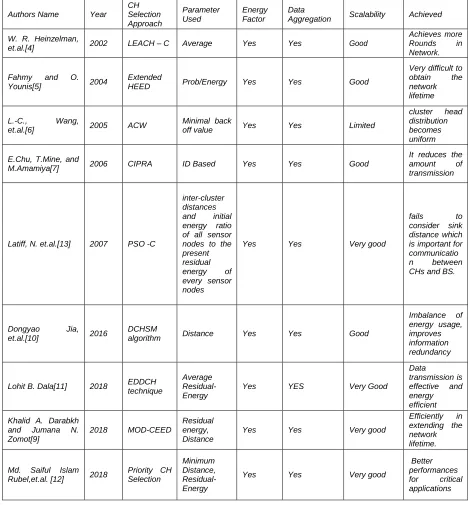
Table -I: Summarization of available related studies undergone in Cluster Head Selection Approaches
Authors Name Year
CH Selection Approach
Parameter Used
Energy Factor
Data
Aggregation Scalability Achieved
W. R. Heinzelman,
et.al.[4] 2002 LEACH – C Average Yes Yes Good
Achieves more
Rounds in
Network.
Fahmy and O.
Younis[5] 2004
Extended
HEED Prob/Energy Yes Yes Good
Very difficult to
obtain the
network lifetime
L.-C., Wang,
et.al.[6] 2005 ACW
Minimal back
off value Yes Yes Limited
cluster head
distribution becomes uniform
E.Chu, T.Mine, and
M.Amamiya[7] 2006 CIPRA ID Based Yes Yes Good
It reduces the
amount of
transmission
Latiff, N. et.al.[13] 2007 PSO -C
inter-cluster distances
and initial
energy ratio of all sensor nodes to the present residual
energy of
every sensor nodes
Yes Yes Very good
fails to
consider sink distance which is important for communicatio
n between
CHs and BS.
Dongyao Jia,
et.al.[10] 2016
DCHSM
algorithm Distance Yes Yes Good
Imbalance of
energy usage, improves information redundancy
Lohit B. Dala[11] 2018 EDDCH
technique
Average Residual-Energy
Yes YES Very Good
Data
transmission is
effective and
energy efficient
Khalid A. Darabkh
and Jumana N.
Zomot[9]
2018 MOD-CEED
Residual energy, Distance
Yes Yes Very good
Efficiently in
extending the network lifetime.
Md. Saiful Islam
Rubel,et.al. [12] 2018
Priority CH Selection
Minimum Distance, Residual-Energy
Yes Yes Very good
Better performances
for critical
4334
3 REVIEW: CLUSTER HEAD SELECTION
BASED ON HEURISTIC APPROACHES
Though there are effective methods for CH selection in WSN, still there is no improvement in lifetime of the network and energy usage. It is required to improve technologies for solving such existing problems. FGF [1] has more energy, and has less time complexity and delay. But, there are few conflicts like it is quickly fascinated into local optimal value, and has low accuracy. FBECS [2] has high stability, and more left over energy. Still, on application of optimization theory will improve the lifespan of the network. Semi-Markov Process [3] permits non-exponential distributions for evolutions among states and for generalizing many types of stochastic procedures, and has mathematical traceability and easy analysis. Yet, has more delay in health applications. GA [4] concept is very simple to understand, and supports multi-objective. Although, there are some disadvantages such as the objective function is unstable, and it requires more parameters. Fuzzy-TOPSIS provides constant preference order, and it performs well in decision making process. However, it has more time complexity. PSO [6] has less computational time and easy to implement. But, it is complex to define original design parameters. Attenuation Probabilistic Algorithm [7] is fast and has high performance, and it is used to select redundant nodes. But, it consumes more time. RE-TOPSIS [8] decreases the utilization of energy, and improves the lifespan of the network. Yet, it requires further evaluation of the computational distance between the positive and the negative solutions. Thus, the existing clustering approaches are not much effective. One of the main problem or issue in WSN is Un-reasonable CH assortment and energy use. This makes errands for ventures and instructive elements. Therefore, forward energy utilization coping is one amongst the method to amplify the system network lifetime. Primarily shrinking the system energy utilization will help in increasing the system network lifetime. Once the separation among sensor nodes persists the energy use of the system is high as well maintaining single CH will increase the work load. The aim of the proposed approach is increasing the sensor network lifespan and scale back the chance of node failures. Node failure may cause the network breakdown. It can be reduced by minimizing the load on nodes and squat the battery power usage. The LEACH-C was proposed in to any develop LEACH protocol. LEACH-C the cluster arrangement is completed toward the establishment of every spherical utilizing a federal formula by the BS. The base station utilizes the data gotten from each sensor amid the setup stage to discover a sure range of CH specified the clusters fashioned help reduce the energy utilization of non-cluster nodes. The draw back of this protocol is that it fully overlooks the arrangement of clusters, which ends up in energy inefficiency of the net-work. An energy aware cluster head improvement was developed by Latiff et al. [13] exploitation PSO referred to as PSO clustering (PSO-C). Whereas it considers which means inter-cluster distances and quantitative relation of the primary energy of all sensor nodes to this residual energy of every node, it fails to contemplate sink distance that is important for communication between CHs
and BS. Hybrid meta-heuristics algorithms have additionally been enforced
4
PROPOSED WORK
4.1 Network Model
The network model is taken into account toward exist free area model. The transmitter and receiver separate with distance d. The electronic amplifier circuits also are there at each tx with Rx. the subsequent properties concerning the WSN area unit assumed:
All sensor nodes are randomly deploy and are permanent. • All heterogeneous sensor nodes have restricted energy. • The Base station (BS) is mounted as well as it will be placed at intervals or exterior the area of sensor.
• Each sensor node gathers the data sometimes and every one the time includes a amount of data to forward.
• Sensor Nodes don‘t grasp their actual positions nor the position of different nodes.
• The nodes are self-organizing and want not be monitored once preparation.
• Data fusion is employed to attenuate the entire quantity of forwarded data.
• Each sensor node has the potential toward work as a CH.
The WSN scenario thought for network simulation have all the advanced than properties and boundaries. The nodes will calculate the distance between the BS and alternative nodes by com-paring the received signal strength. Hence, it doesn‘t would like any extra system with location services like GPS. Also, a node joins the cluster whose CH is nearest to that
Fig.2. Deployment of Nodes
4.2Energy Model
4335
Fig.3. Energy Model
Let d is Distance, l is no of bits and do is threshold value,
Eelec is one bit needed for processing energy then energy
desired
(1) 4.3 Cluster Creation
The Wireless sensor nodes are deployed arbitrarily within the area. The sensor nodes pick the CH. among themselves which does the task of collection of data, and data aggregation and finally transferring the information to the BS.
Fig. 4 demonstrates the formation of clusters and their CH in the network. The BS is situated in the middle of the wireless sensor network region.
Fig.4.Formation of Cluster
4.4 Cluster Head Selection
Simple Balanced Cluster Head Selection Method
Algorithm Steps:
Step1: ‗n‘ sensor nodes will be created by arbitrarily. Step2: All the deployed nodes will drive Residual energy and node location to Base Station.
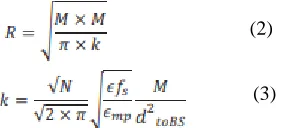
Step3: Base station calculates Radius and distance from itself.
Here, area of network is M×M, no. of cluster is k, N is entire sensor nodes, d2 to BS is avg. distance from BS to sensor node. £fs &£mp are energy desired for transmitting 1 bit to
an permissible bit error rate in free space and multipath model in that order.
Step 4: Base station prepare Neighbor set and total no of neighbors with in Radius
Base station (BS) will compute weight for every sensor node to given formula:
Weight=RE + α × NN + β Distance
Four Parameters:
1. Residual Energy (RE)
2. No of Neighbor set (NS) with a constant α 3. Base station and sensor node Distance in decreasing order with adjusting value of β
4. One hop information
Step 5: BS will arrange the Weighted Value (WV) of n no of sensor nodes by downward order.
Step 6: CH Selection based on Maximum Weighted Valued node, then measured next uppermost Weight valued sensor node in the cluster.
Adjusting factors are we consider as α and β that will control amount of neighbors surrounded by R ie Radius and distance for every sensor node among Remaining energy. Within our analysis process α value is 0.1.
5 PERFORMANCE EVALUATIONS
5.1 Simulation environment
We have simulated our SBCH method for concert study. We used NS 3.23 simulator for simulation, we include measured a Network simulation atmosphere for diverse factors as per given parameter as mentioned in Table 2. We are deployed 100 sensor nodes initially and initial energy for each node is 0.5J/node and whole initial energy in the network is 40nJ. Later than that we include comparison of our SBCH result with LEACH and LEACH-C [13] and PSO-C according to wireless sensor network life-time, no of Round vs. active nodes; Round essential for 1st, 30th and last node demise; Round vs. departed Nodes; Round vs. remaining energy. After comparing among existing methods, we got most essential improvement of network lifetime. The WSN sensing area was implicit to be 200 x 200 m2. The primary Network simulations are on 1-WSN among 100 sensor nodes and 10 CHs. Then, the Network simulations were as well performed on 2-WSN among 150 sensor nodes, 15 CHs .The base station (BS) location was also diverse for unlike cases. In the first case the base station was situated center of the sensing area and after that in the second case the BS is located at the Right corner of the sensor unit and lastly, in third cases
(2)
(3)
4336
the BS is situated out of the sensor unit and lastly, in third cases the BS is situated out of sensing unit area. The various parameters measured for network simulations are specified in Table 2.
Table -II: Parameter Considered
Number of Nodes 150
Routing Protocol. AODV/Light path
Agent. UDP
Application. CBR
Communication range. 200 ×200 meter2
Traffic CBR 8 Kbps per flow
No of Flows. 50
Pause Time. 5 Second
Max Speed. 10 unit per second
Network Interface Type. Physical Wireless
Node Placement. Random
No of Traffic Flows 2 to 5
MAC Protocol. IEEE 802.11 p
MAC Rate. 2 Mbps
5.2 Performance evaluation metrics
In order to determine the recital of the proposed method, the following parameters have been used.
1. Energy Utilization - The entirety energy utilization at a specified round can give an excellent approximation of the energy efficiency of the algorithm and total energy utilization increases with increasing no. of rounds.
2. Network Life-time - The life-time of the network is distinct as whole quantity of rounds waiting which the last node is energetic. Last node demise (LND) can be renowned by plotting no. of demise nodes vs the number of rounds. Network lifetime increases with increase in energy efficiency.
3. Network Through-put - The through-put of the network gives an approximate of the sum of helpful data being received by the BS. Throughput of the net-work is noted each round and is plotted. Hence, network throughput is an important condition for any routing algorithm
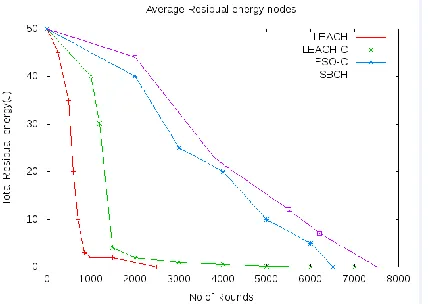
Energy consumption performance: The algorithm was run under dissimilar environment. There were three diverse cases, WSN-1 with 100 nodes and 10 CHs, WSN-2 with 150 nodes and 15 CHs. Other routing protocols were also tested under similar conditions for performance comparisons. LEACH, LEACH-C, PSO-C was compared with the proposed algorithm SBCH with WSN-1 as the default WSN scenario. Here, the energy expenditure of unlike routing methods is compared. Fig. 5 gives the residual energy of the sensor network using different routing techniques in WSN-1 with 100 amount of sensor nodes and 10 CHs, with a center BS position.
Fig .5. Evaluation in expressions of total residual energy in WSN-1 among 100 nodes and 10CHs
The SBCH performs better because of the fact that the SBCH considers the energy of the node before selecting it as CH. Also, the nodes transmit to the nearby CH and consume smaller amount energy as a result.
Fig .6. Energy utilization vs. BS positions in WSN-1 with 10 CHs
The energy consumption in each case varies for different algorithms. As the size of the network increases, the energy performance of LEACH, LEACH-C and PSO-C diminishes. The proposed method SBCH, performs much better as the no. of nodes increase.
Fig .7. Energy utilization vs. BS positions in WSN-2 with 15 CHs.
4337
offers. Network life-time performance: Next, the method was run for evaluation of a lifetime under different cases. Network lifetime is taken as the last round until which at least 1 node is alive. It can be seen from Fig. 8 that SBCH gives much better lifetime compared to LEACH and is on par with PSO-C, LEACH-C. The reason for PSO-C and SBCH giving better performance is that these algorithms use better CH selection process which involves considering the residual energy of a wireless sensor node before decide it as a CH. The LEACH has a lifetime of 2500 rounds while LEACH-C lasts for around 4800 rounds. PSO-C performs enhanced owing to the restricted collection of CHs and lasts for about 6750 rounds and lastly, SBCH has a network lifetime of 7350 clearly outperforming other algorithms.
Fig .8. Network lifetime in WSN-1 with 100 nodes and 10CHs
Fig .9. Network lifetime vs. BS positions in WSN-1 with 10 CHs
Fig .10. Network lifetime vs. BS positions in WSN-2 with 15 CHs.
As shown in the above figures, SBCH consistently performs better even under varying conditions such as changes in a number of cluster heads, network size, and different BS positions. Through-put evaluation. The simulations are run for comparing throughput across various algorithms.
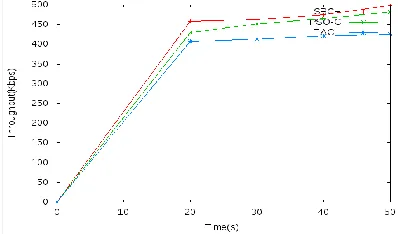
Throughput is distinct as the total no. of packets expected by the BS at a particular instant of time. Throughput is calculated for 1-WSN with 100 nodes and 10 CHs, since the proposed method uses lesser energy, it has more network lifetime. This implies that the SBCH has a higher number of live sensor nodes in the wireless network at any given point of time when compared to other algorithms. Hence, the throughput of the SBCH is higher than the remaining algorithms although the performance of PSO-C comes close. The throughput of the network with more nodes will be higher due to more number of sensors. Moreover, the SBCH is stable even when BS positions are changed. The throughput of the Wireless network corresponds to the total no. of live sensor nodes in the network and hence the network in which BS is centrally positioned usually gives a better throughput.
Fig .11. Throughput comparison in WSN-1 with 100 nodes
and 10CHs
6 CONCLUTION
As WSNs activate among restricted battery power and nodes are very complex to change or renew, therefore rising sensor network life time by decreasing usage of energy level is most important concern. In previous few years a bunch of Cluster Head Selection methods have been developed by in view of avg. energy consumptions, effective node location, sensor node distance, Residual energy of CH, neighbor count and information of one hop neighbor . However a lot of them are not effective in creating entirely balanced cluster or suffer as of back transmission concern. Now we consider efficient parameters in SBCH method is information of initial energy, CH neighbor details and sensor node Distance. Considering these parameters to reduce back transmission difficulty and saves major quantity of sensor nodes energy. We worn for whole network energy is 40nJ. We did data transmission and clustering tasks as similar to LEACH-C and calculate our investigation with Existing method PSO-C approach and LEACH and get significant improvement.
7 REFERENCES
[1]Mainetti, L., Patrono, L., Vilei, A.: Evolution of wireless sensor networks towards the in-ternet of things: A survey. In: 19th International Conference on Software, Telecommunica-tions and Computer Networks (SoftCOM),IEEE, pp. 1-6 (2011)
4338
[3] Sadouq, Z. A., El Mabrouk, M., Essaaidi, M.: Conserving energy in wsn through cluster-ing and power control. In: 2014 Third IEEE International Colloquium on Information Sci-ence and Technology (CIST), pp. 402-409 (October 2014)
[4] W. R. Heinzelman, A. Chandrakasan, and H. Balakrishnan, ―Energy-efficient communication protocol for wireless microsensor networks,‖ in Proc. 33rd Annual Hawaii Internatio,al Conference on Syste Sciences, 2000, pp.1-10.
[5]Karmaker, A., Mahedee Hasan, M., Showkat Moni, M. and Shah Alam, M., ―An efficient cluster head selection strategy for provisioning fairness in wireless sensor networks‖ in IEEE International WIE Conference on Electrical and Computer Engineering (WIECON-ECE), pp. 217-220, December 2016.
[6]A. More, V. Raisinghani, ―A survey on energy efficient coverage protocol in wireless sensor networks,‖ Journal of King Saud University-Computer and Information Science, vol. 29, pp. 428-448, Oct. 2017.
[7] R. Sruthi, ―Medium Access Control Protocols for Wireless Body Area Networks: A Survey,‖ Global Colloquium in Recent Advancement Effectual Researches in Engineering, Science and Technology, pp. 621628, 2016.
[8] M. Ahmed, M. Salleh, M. I. Channa, ―Routing protocols based on protocol operations for underwater wireless sensor network: A survey,‖ Egyptian Informatics Journal, vol. 9, pp. 57-62, Mar. 2018.
[9] T. Firdaus, M. Hasan, ―A Survey on Clustering Algorithm for Energy Efficiency on Wireless Sensor Networks,‖ International Conference on Computing for Sustainable Global Development , pp. 759-763, 2016.
[10] V. S. Chandrawanshi, R. K. Tripathi, N. U. Khan, ―A Comprehensive Study on K-means Initialization Techniques for Wireless Sensor Networks,‖ International Conference on Signal Processing and Communication, pp. 154-159, 2016.
[11] Saiful Islam,et.al‖ Cluster Head Selection Technique Using Four Parameters of Wireless Sensor Networks‖ 978-1-5386-8260-9/19/$31.00 ©2019 IEEE
[12] Lohit B. Dalal‖ An Efficient Dynamic Deputy Cluster Head Selection Method For Wireless Sensor Networks‖ IRJET, Volume: 05 Issue: 12 | Dec 2018pp:187-192. [13]Latiff, N. A., Tsimenidis, C. C., Sharif, B. S.:
Energy-aware clustering for wireless sensor networks using particle swarm optimization. In: IEEE 18th International Symposium on Personal, Indoor and Mobile Radio Communications (PIMRC), pp. 1-5 (2007)
[14] Nadeem, Q., Rasheed, M. B., Javaid, N., Khan, Z. A., Maqsood, Y., Din, A.: M-GEAR: gateway-based energy-aware multi-hop routing protocol for WSNs. In: 8th International Conference on Broadband and Wireless Computing, Communication and Applications, France, pp. 164-169 (October 2013)
[15] Xiaoyan, M.: Study and design on cluster routing protocols of wireless sensor networks. Ph.D Dissertation. Zhejiang University, Hangzhou (2006) [16] Yassein, M. B., Khamayseh, Y., Mardini, W.:
Improvement on LEACH protocol of wire-less sensor network (VLEACH. In: International Journal of Digital Content Technologies and Applications, 3(2), 132–136 (June 2009)
[17] Xiangning, F., Yulin, S.: Improvement on LEACH protocol of wireless sensor network. In: Proceedings of International Conference on Sensor Technologies and Applications, Sen-sorComm 2007. pp. 260-264 (October 2007)
[18] Hani, R. M. B., Ijjeh, A. A.: A survey on leach-based energy aware protocols for wireless sensor networks. Journal of Communications, 8(3), 192-206 (2013) [19] Chilamkurti, N., Zeadally, S., Vasilakos, A., Sharma, V.:
Cross-layer support for energy efficient routing in wireless sensor networks. Journal of Sensors, 2009, 1– 9. doi:10.1155/2009/134165.