Licensed under Creative Common Page 1
http://ijecm.co.uk/
ISSN 2348 0386
ORGANIZATIONAL SOLUTIONS LEARNING AND CHANGE
A SHORT CASE STUDY ON INTEL
Tolu Igbalajobi
CEO, Global Business Consulting Services, USA [email protected]
Abstract
Organizational Learning is used for the successful implementation of Innovation and change.
The purpose of Intel’s Leadership Development Forum (LDF) was to serve as a learning
process and not a training program on the ability of leadership to effect positive organizational
changes and improve performance goals. Leadership Development Forum emphasizes the fact
that leadership should plan, set direction, support components and inspire everyone in the
organization. Solutions learning (SL) is used to identify innovative solutions to introduce
innovation and change. Intel’s approach to developing the leadership development forum is a
design strategy that corresponds with solutions learning. Innovative change is needed to
increase product and service base of an organization, and also for introducing something new
for the improvement of organizational functions. This may include the use of a new method of
production or a new form of business organization. Implementation for success is the key here.
Intel utilizes a systematic approach that develops and coaches leaders in a unique way for
innovation and change that includes self-reflection, coaching and action learning methodologies.
Keywords: Solutions Learning, Innovation, Intel, Organizational Learning, Leadership
INTRODUCTION
In today’s fast paced atmosphere, staying competitive with market leadership depends on the
ability of an organization to learn quicker, better, and cheaper than other competitors. Process of innovation involves searching for the innovation strategy systematically, and survey and synthesis of the new processes (Dooley &O'Sullivan, 2001). This can be a whole organizational survey, or cycles of differing thoughts on new process such as the practice exercises at Intel’s
Licensed under Creative Common Page 2 processes in form of evaluation and feedback (Davila et al., 2006). Intel is an American global technology company, the world's largest semiconductor chip maker based on revenue, and the inventor of the x86 series of microprocessors found in most personal computers. In 2010, Intel announced a 10-year, $200 million commitment to advance education in math and science in the United States. Intel’s leadership program offers an innovative, comprehensive leadership
development process utilizing unique learning methods over a five-month period. Participants are held accountable to apply new leadership behaviors on the job. As a result, several participants reported that they experienced leadership development, growth, and personal transformation (Carter et al., 2005).
SAMPLE RESULTS OF INNOVATION AND CHANGE AT INTEL
Leadership is a skill that must be learned, and developed which ultimately becomes part of you. It is a self-expression of someone and a process; you do not just do it for nothing (Fields, 2011). Being a coach and part of the leadership team, there is the responsibility of helping participants recognize the value of the program in actually seeing themselves as a change agent. The coach will have to make participants reflect and engage them in problem solving exercise by asking relevant questions, with assignments, and feedback to feel and see the value of the change. Research results based on Intel’s best practices showed that:
47% of participants who have completed leadership development forum have better
prospects with new positions of greater responsibility.
There was 68% improvement in participant’s ability to apply leadership practices to their work. 89% of leadership development forum participants report a well-connected network of
interdepartmental colleagues.
100% of the participants reported improved leadership skills and styles.
In comparison to some other member companies, the leadership development was established to be the most innovative and results-oriented leadership program reviewed. When staff members were surveyed at Intel on the effectiveness of the program, 100% of the participants agreed to the ongoing need for the program. Intel has definitely initiated an innovative program that is part of the corporation’s culture for continuous and creative changes (Carter et al., 2005).
APPLICATION OF THE STAGES OF SOLUTION LEARNING
Licensed under Creative Common Page 3 themselves, it enhances performance goals they can then successfully work with other team members until it becomes company-wide culture (Anthony, Eyring, & Gibson, 2006). Leadership forum is a learning process to effect changes and meet company. Research also shows that leadership is being able to inspire others, setting directions, having flexibility in applying different techniques to various situations with openness, leading breakthrough projects, and reinventing as against just having fundamental management skills (Davila et al., 2006). Intel is a high-tech company and it is imperative that changes be made when necessary to match up to new developments in our dynamic environment for success and profitability.
Upper level management at the corporation budgeted for the change and aggressively wanted to create changes, make a difference within the organization, at the community level, as well as maintain a global competitive advantage. The leadership at Intel supported the leadership development forum, participated, and applied the model for success (Bates & Khasawneha, 2005).This shows the significant effect that senior level management can have on the smooth running of the organization. Furthermore, Intel’s approach to developing the
leadership development forum is the adoption of the following design strategies which corresponds to the solutions learning stages.
IDENTIFY AND DIAGNOSE
Licensed under Creative Common Page 4
LEADERSHIP RESEARCH
According to Carter et al. (2005), the organizational development team at Intel conducted research on leadership based on data collected which showed a consistent theme of the emergence of learned leadership. It is a process, an expression of who we are as humans in action (Joonmo, 2005). This program was delivered onsite which was more convenient, cost effective, and builds peer relationships across all departments. Ninety percent of LDF is delivered on-site. Leadership development is highly effective when integrated in the day-to-day activities of not just some managers but the whole organizational system (Brown, 2009). At Intel, for example, leadership development forum is delivered weekly over a five-month period to allow new leadership behaviors impact the organizational culture (Davila et al., 2006). Embedding innovation as part of the whole organizational culture has a positive impact on relationships but should be holistic in nature to involve everyone (Laszlo, 1996; Porter, 2004).
DESIGN
Each leadership session is designed to accommodate the goals and objectives of each department. Intel team developed a shared vision that identified a high-level program schedule and key learning concepts to eliminate redesigning of the entire program before the first pilot session (Porter, 2004). At the completion of each session, feedback is reviewed and inputs are incorporated into the design of upcoming sessions. This process encourages real commitment but the limitation is that only group leaders and managers that are truly interested in developing their leadership abilities participates in leadership development forum. However, the ultimate goal for Intel is to involve everyone on a rotational basis. For maximum return on investments, organizations must balance creativity and value (Davila et al. 2006).
IMPLEMENT/FOLLOW-UP
Carter et al. (2005) noted that Intel applied Warren Bennie’s innovative learning methods to the
Licensed under Creative Common Page 5 appropriate innovation behavior. So, every session must include action learning for all participants to put into practice lessons learned and conclude with sharing of new learning’s for
practical applicability on the job.
EVALUATE/MONITOR
Coaches make sure that all participants self-reflect and utilize problem solving skills to evaluate problems by asking questions, providing feedback, with assignments that encourages the thinking of new innovative ideas and monitor (Huggett & Kaplan, 2011). Self-assessment at the conclusion of Intel’s LDF session measured participants’ ability in the application of effective
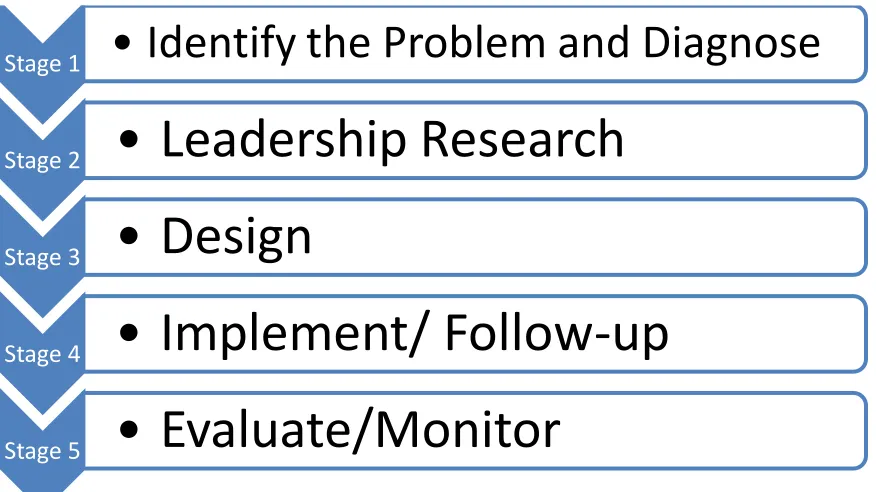
leadership practices for personal and organizational growth. Participants score themselves openly at the forum against the leadership practices and then discuss the results. In effect, the leadership development forum at Intel provided an innovative leadership development program for the organization to engage in a conference based on the organizational vision with excellent examples. Also, pre and post program self-assessments need to be conducted. These stages are depicted below in Figure 1.
Figure 1: Leadership Solution Learning Stages
Stage 1
• Identify the Problem and Diagnose
Stage 2
• Leadership Research
Stage 3
• Design
Stage 4
• Implement/ Follow-up
Licensed under Creative Common Page 6
LEADERSHIP PARTICIPATIVE SKILLS FOR INNOVATION
Expounding on some important leadership participative management skills for successful innovation includes:
Establishment of Vision and Strategy
How can there be a focus or purpose without a plan? As inspiring leaders, a plan must be developed with motivation, vision and a strategy that involves everyone from the very beginning to achieve success. Without this process it is almost impossible to sustain any business process.
This is the initial phase when the Chief Executive Officer (CEO) meets with the leadership team to brainstorm on several strategies including the best way to involve everyone in the innovation process on an ongoing basis with questions such as: What will the company look like in five years? How successful will the business be? What will the corporate culture be like? How will the business be viewed in the industry? Hence, all member of the team would be involved in a writing exercise like writing of an article about the business as if it would be read in a major business publication. Each senior leader will share writings and stories to the rest of the team. After this collaborative session, leadership will now coach the managers and involve everyone as a team on the process for consistency in shared values. It is a leadership development tool that sets the tone of the organizational culture and the level of leadership involvement and support (Brown, 2009).
Formation of Shared Values
This is where executive meetings and workshops are used to establish problems and solutions with a plan in place taking into consideration everyone’s view point. A diverse organization has
human capital with diverse perspectives (Huggett & Kaplan, 2011). Leadership forum will include all the organizations top executives. Everyone in the organization should participate and contribute. The process of implementing changes with everyone’s buy-in should be established
as well. Without coaching top leaders, then changes cannot be effectively implemented.
Mentoring and Nurturing
Organizational culture based on the example of Silicon Valley and Hewlett Packard’s early days
Licensed under Creative Common Page 7
Invest in People
This is an excellent business practice that is rewarding for leaders and managers who also become coaches and leaders which eventually results in the training of all team members. Investment in people should be on-going and supported by leadership for sustainability. Carter et al. (2005) reported that Intel’s best practices on leadership development Forum (LDF) was
embedded into the organizational culture with emphasis on constant practice and repetition for learning and embracing change.
Common Set of Metrics
Follow up of the vision, strategy, and values using a participative seminar that focuses on value drivers can be very effective. Corporate metrics has to be something meaningful to all employees including frontline employees and supervisors. This provides the organization with the opportunity to monitor everyday activities. Employees become cognizance of the impact performance has on the daily activities of the business which means that leaders attending this seminars are prepared with the data and information for total business alignment at all levels. Leadership groups go back to the organization and coach the concepts learned to other team members.
Assessment
Best practices can be replicated all the way down to frontline management. Follow up can be in the form of about two or three progress reviews per year at every level of the business to involve everyone. Leaders must lead by example with courage and conviction and provide timely feedback. Key participative management skills are depicted in Figure 2 below.
Figure 2: Some Key Participative Management Skills
Clear Vision and Strategy
Formation of shared
values
Mentoring and Nurturing
Invest in people
Common Set of Metrics
Licensed under Creative Common Page 8 For leadership to be successful in leading innovation and change, the best fit for the organization based on a combination of theories, models and best practices should be adopted. There are no hard and fast rules set on concrete stone for managing and leading innovation and change. Vision, strategy, embracement of values fuel an organization while recognizing humans as living systems in the process, working together as team members while acknowledging diversity using high ethical standards will result in positive organizational growth (Hesselbein et al. 2002).
RECOMMENDATIONS
It is essential that leaders build enduring excellent ethical organizations from the beginning or turn good organizations into great ones which is the most powerful and profound form of innovation called social innovation must be developed (Huggett & Kaplan, 2011). This type of innovation is the first concept that makes human productivity possible for organizational innovation growth and success. Invention of constitutional government, private property as a social mechanism, money, public stock ownership, the corporation, the free-market economy, free public education, and free health care are all social innovations are ultimately more significant than the invention of the personal computer, the telephone, the automobile, the jet airplane, or the Internet. Today, there is a need for leadership to motivate, coach, energize, inspire, and empower based on respect for people who already know what to do with added support. Leaders manage with flexibility and get people involved and inspired to do what is right. The greatest of all inventions is human organization and society, the ultimate tool for achieving human objectives (Hesselbein et al., 2002). So, emphasis will be moved from product and technology innovation to social innovation. For example, Thomas Edison's greatest invention was not the light bulb, phonograph, or telegraph rather; it was the modern research and development laboratory which was asocial invention.
CONCLUSION
Licensed under Creative Common Page 9 that includes everyone in the organization (Porter, 2004). In a fast-changing environment, the ability to learn faster, better, and more cheaply than your competitors could mean the difference between retaining market competitive edge and losing it (Brown, 2009). This article provided a short overview of solution learning innovation method. Use of an applicable example like Intel have been included with a short strategy model proposed that can be viewed at a glance for starting solutions learning process for successful organizational growth through continuous improvement with an ongoing monitoring system in place for sustainability. It is vital to understand the process of innovation, how it might best be structured and managed, and what outcomes might result. Building and enhancing knowledge is clearly a challenge that researchers in all sectors must take seriously. This research was conducted in a way that should provide useful insights for future researchers choosing to focus on innovative solutions and issues.
REFERENCES
Anthony, S., Eyring, M., &Gibson, L. (2006). Mapping your innovation strategy. Harvard Business Review,84(5), 104-113.
Barnett, E., &Storey, J. (2001). Narratives of learning, development and innovation: Evidence from a manufacturing SME. Enterprise and Innovation Management Studies, (2), 83 – 101.
Bates,R.,& Khasawneha, S. (2005). Organizational learning culture, learning transfer climate and Perceived innovation I Jordanian organizations. International Journal of Training&Development,9(2), 96-109.
Berkowiz, S. (2001). Measuring and reporting human capital. The Journal of Government Financial Management,50(3), 13–17.
Brown, T. (2009). Change by design: How design thinking transforms organizations and inspires innovation. New York, NY: Harper Collins
Carter, L., Ulrich, D., &Goldsmith, M. (2005). Best practices in leadership development and organizational change: How the Best Companies Ensure Meaningful Change and Sustainable Leadership. San Francisco, CA: Pfeiffer.
Davila, T., Epstein, M.J., & Shelton, R. (2006). Making innovation work. Upper Saddle River, NJ: Wharton School Publishing.
Dooley, L., &O'Sullivan, D. (2001). Structuring innovation: A conceptual model and implementation methodology. Enterprise and Innovation Management Studies,(2), 177-194.
Fields, R. M. (2011). The new “best practices”standard? Independent legal counsel for compensation committees.TheCorporateGovernanceAdvisor,19(4), 13–15.
Hammond, J., Keeney, R., &Raiffa, H. (2006). The hidden traps in decision making. Harvard Business Review, 84(1), 118–126.
Hesselbein, F., Golsmith, M., Somerville, I. (2002). Leading for innovation and organizing for results. New York, NY: Jossey-Bass.
Hrebiniak, G.L.(2006). Making strategywork: Leading effective execution and change. Upper Saddle River, NJ: Wharton School.
Licensed under Creative Common Page 10 Joonmo, S. (2005). Organizational innovation: Studies of program change in community agencies. Contemporary Sociology,34(3), 262-263.
Kouzes, J., & Posner, B. (1999). Encouraging the Heart: A Leader’s Guide to rewarding and Recognizing Others. San Francisco, CA: Jossey-Bass.
Laszlo, E. (1996). The systems view of the world: A holistic vision for our time. Cresskill, NJ: HamptonPress.