ORIGINAL ARTICLE
IJPHY
ABSTRACT
Background: Expert athletes in archery can rapidly achieve postural stability compared to beginners and novice ath-letes. This study investigated the effectiveness of a core stability training program in reducing the postural sway among adolescent archers.
Methods: Participants (n=12) of this study were aged between 13-18 years; were divided into two groups (i.e., experi-mental and control). The experiexperi-mental group underwent a supplementary eight-week core stability training program apart from their regular training program. Data were collected at three-time points; pre, after four weeks and post-train-ing. Postural sway was measured in the anteroposterior plane and medio-lateral plane – center of pressure (CoP). Results: Mixed factorial ANOVA yielded significant interactions over time in the performance of the push up; plank; archery performance and postural sway. Postural sway between the experimental and control group was significantly different on both planes at T2; (CoP range x - F(1,10) = 7.952, p <.05, d = 1.302; CoP range y - T2; F(1,10) = 7.887, p <.05). The results were replicated at T3; CoP range x - F(1,10)= 7.952, p <.05; CoP range y - F(1,10)= 11.105, p <.05). Conclusion: The experimental group showed a smaller range in postural sway on both axes; indicating a reduction in the postural sway. A significant relationship was also evident between CoP range x, CoP range y and the participants’ performance in archery. It is recommended that a core stability training program is incorporated into an archery train-ing program for adolescent archers.
Keywords: Archery, Postural sway, Postural stability, Core muscle training, Center of pressure, Bodyweight exercises.
Received 26th May 2017, revised 15th July 2017, accepted 02nd September 2017
www.ijphy.org
10.15621/ijphy/2017/v4i5/159425
CORRESPONDING AUTHOR
Int J Physiother. Vol 4(5), 296-301, October (2017) ISSN: 2348 - 8336
THE EFFECTIVENESS OF A CORE MUSCLES STABILITY PROGRAM
IN REDUCING THE POSTURAL SWAY OF ADOLESCENT ARCHERS: A
PANACEA FOR A BETTER ARCHERY PERFORMANCE
*1Pathmanathan K. Suppiah
²Tomny Wong Kee Kiet ³Rabiu Muazu Musa
⁴Mohamad Razali Abdullah ⁵Jeffrey Low Fook Lee
⁶Ahmad Bisyri Husin Musawi Maliki
*1Pathmanathan K. Suppiah
Faculty of Psychology and Educational Studies, Universiti Malaysia Sabah, Malaysia.
E mail: [email protected] ²National Sports Institute of Malaysia.
3,4,6Faculty of Applied Social Sciences, Universiti Sultan Zainal Abidin, Terengganu, Malaysia. ⁵Faculty of Sports Science and Coaching, Sultan Idris Education University, Perak, Malaysia.
INTRODUCTION
Archery can be described as a static sport that requires strength and endurance and the ability to maintain stability. Maintaining and maximizing postural stability increases the accuracy of the arrows hitting the target [1]. Postural control is a complicated task that involves the ability to counter the movement of external factors (gravity) and self-produced actions that disturb the equilibrium that preserves posture. Defining the geometrical relationship of the whole body will include the relationship of the body with the environment (body relative to the support phase) [2]. The equilibrium that is achieved by the counteraction of the muscles with the external force is defined as balance [2]. In postural sway, the center of gravity moves within the base of support [3]. To accommodate this sway in the mediolateral (ML) direction, the archer produces a postural sway in the anterior-posterior (AP) direction [3]. It’s been suggested that these postural synergies are flexible and can be engaged by task parameters which respond to changes in biomechanical constraints or attentional factors. However, the inclusion of core stability activities in main exercise programs has been shown to improve posture during standing [4] and facilitating optimal production and transfer of force and motion [5].
An underlying trait in the studies focusing on core stability; is that core stability interventions are rarely performed as an isolated training modality. This approach is logical as the daily routine of individuals and the definition of physical fitness itself incorporates multiple physical fitness components. Improvements in performance are thus not attributed exclusively to the core strengthening training program but rather effects of a supplementary program. Common measures of general performance were a vertical leap; shuttle runs, sprints and one repetition maximum (1RM) lifts, along with balance measures, and core stability testing. To this effect, some researchers have investigated the effectiveness of strength training in posture improvements among both athletes and nonathletes.
The efficacy of two diverse training programs was compared in improving balance among recreationally active individuals [6]. The participants were divided into three different groups; core strength training group (CSTG), balance training group (BTG) and a control group. The CSTG focused on enhancing the awareness and the activation of the local stabilizer muscles, which are attached close to the active subsystem of the spinal stability mechanism. The training activities focused on the activation of the transverse abdominus (TrA) and lumbar multifidus (LM). The activities encompassed both static and dynamic activities such as “bird dog,” front plank stability and back bridge on a stability ball. Both training interventions elicited significant improvements in both the static balance (stork balance test) and dynamic balance (star excursion balance test). On the other hand, no significant improvements were observed in the functional balance test (multiple single leg hops).
Other researchers [7] investigated the effects of Swiss ball
training on core stability and running economy. Utilizing 18 adolescent male athletes (15.5 ± 1.4 years), they found that Swiss ball training positively affects core stability, but there were no concomitant changes between the control group and experimental group. The utilization of Swiss ball in their training activities was appropriate as the movements to maintain balance on a Swiss ball reflected the constant changes in body posture experienced during running. The experimental group performed two sessions of Swiss ball training per week, which could have contributed to the absence of differences in the running economy. Strength training required between 48 and 72 hours to super compensate [8], thus a slight increase in training sessions would have elicited positive changes in running economy. Contrary to the findings of [7]; another study suggested that core stability training has a positive effect on running performance [9].
A study on archery reported a significant relationship between postural sway with the shooting performance of skilled archers [10]. Utilizing 21 skilled Malaysian archers, the researchers measured the postural sway from the stance phase to the follow through phase utilizing a bio-harness device. The results indicated that postural sway was lowest, indicating stability, during the aiming phase. They further concluded that reducing postural sway during the release will improve shooting performance. Although related studies have examined interventions in improving postural sway, those studies concentrated on rehabilitative approaches aimed at improving the balance and mobility of elderly population [11,12]. To the best of the authors’ knowledge, no studies have attempted to examine the efficacy of core stability training program in improving the performance of athletes, especially in archery. Thus the purpose of this study was to examine the effects of a core stability programme on improving the postural stability among adolescent archers. We predicted that a core stability intervention would reduce the postural sway among adolescent archers.
MATERIALS and METHODS
Participants
The participants of this study (n= 12; males = 6 and females = 6) were athletes from an archery development program between the ages of 13 and 19 (x = 14.6; SD = 1.435). The participants were divided randomly to two groups; control group (CG) and experimental group (EG). Both the groups participated in their regular training routine; the EG underwent a supplementary core stability together with the regular training program. Participants were informed about the objectives of the study and signed consent forms. Ethical approval was obtained from the ethical committee of Universiti Sultan Zainal Abidin, Malaysia (UniSza/02/1/2016/Jil.
Procedure
warm-up activities. Focusing on the core muscles; activities consisted of body weight exercises targeting muscles that were involved in mediating the anteroposterior sway and mediolateral sway. All participants were tested on a selected number of fitness components in line with the physical fitness requirements for archery. The fitness components measured were flexibility (sit and reach test), push-ups; sit-ups (1 minute with bent knees) and core stability (the prone plank test – participants held the prone position with their arms bent at the elbow for maximum duration possible).
Postural Sway Measurement
Postural sway was measured via the displacement of the center of pressure (CoP). CoP refers to the location of the vertical ground reaction force vector. The CoP is the point location of the vertical ground reaction force vector. As the term suggests, CoP is the weighted average of all the pressure over the surface of the area in contact with the ground. The location of the CoP is dependent upon the physical area in contact with the ground. Assuming a vertical force, Fz is applied upon a distance xcp and ycp from the center of the coordinate system. The force plate would provide measurements of Fz and the associated Mx and My moments generated by Fz about the force plate’s x and y-axes, respectively. With the known variables, the deviation of the CoP on the x-axis and the deviation of the CoP on the y-axis were computed.The force platform was specially commissioned and built for this study. Force and moment data collected during each shot were relayed through an amplifier via a 16-bit data acquisition analog to digital conversion (ADC) system. A 16bit ADC system was deemed sufficient for accurate conversion of data [13]. To ensure operational stability; an industrial level PC/104 was utilized for the connections. The PC/104 enabled boards to be stacked to produce a customized embedded system. The device utilized the QNX operating system, and a user-friendly interface enabled easy extraction of data. The force platform was calibrated before data collection. Figure 1 presents the layout for the data collection process.
Figure 1: Data collection site and axes alignment.
Archery Shooting Test
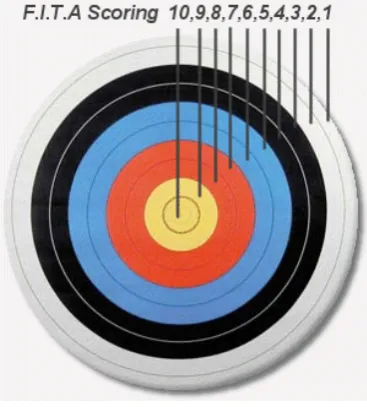
A simulated competition shooting area at the University Sultan Zainal Abidin (UniSZA) was set up. All participants were given six attempts (one end) at a 50-meter target. The 50-meter target was chosen as it was the common shooting distance among age group competitions. Scoring was conducted by World Archery Federation (FITA) guidelines.
Data Analysis
On the onset of the data collection phase, participants participated in a pre-test and were randomly distributed into two groups. Independent t-tests were conducted to identify if there were statistically significant differences between the two groups in the fitness components and the postural sway measurements. A two-way between-within subject’s ANOVA was conducted to evaluate the effects of the core muscles training program on postural sway. The dependent variables were the performance of the participants in all the physical fitness components, postural sway, and archery shooting performance. The within-subjects factors were the time points along the training program; i.e., post four weeks and post eight weeks. Correlation statistics were used for associations between body sway parameters and archery shooting performance. The significance level was set at p < 0.05. The estimation of the effect size used Cohen’s d [14] formulae to evaluate the magnitude of differences [15]. The effect size interpretation criteria were: very small = 0.00–0.19; small = 0.20–0.59; moderate = 0.60–1.19; large = 1.20–1.9; very large = 2.0– 4.0; and nearly perfect > 4.0 [16].
RESULTS
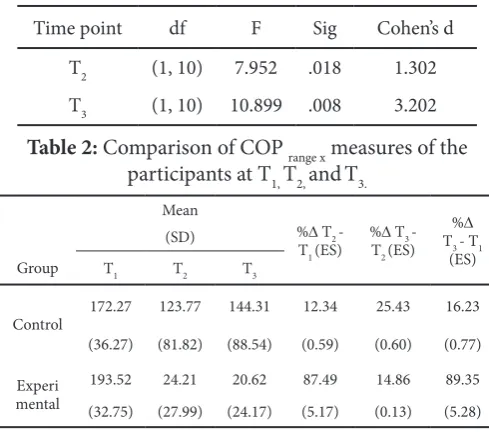
T2; F(2,10)= 7.952, p <.05; d = 1.302. The results were also replicated at T3; F(2,10)= 10.899, p <.05; d = 3.202.
The difference in COP range x was significant between T2 and T1 (M= 169.309, SE=19.236, p<.05) and between T3 and T1 (M=172.908, SE=18.475, p< .05). Table 2 presents the mean, standard deviation, the percentage of improvement and effect size between the time points of the control group and experimental group.
Table 1: Comparison of COP range x measures between the
control group and experimental group at T2 and T3.
Time point df F Sig Cohen’s d
T2 (1, 10) 7.952 .018 1.302
T3 (1, 10) 10.899 .008 3.202
Table 2: Comparison of COP range x measures of the
participants at T1, T2, andT3.
Mean %DT
2 -
T1 (ES) %T2 D(ES)T3 - %D
T3 - T1
(ES) (SD)
Group T1 T2 T3
Control 172.27 123.77 144.31 12.34 25.43 16.23 (36.27) (81.82) (88.54) (0.59) (0.60) (0.77)
Experi mental
193.52 24.21 20.62 87.49 14.86 89.35 (32.75) (27.99) (24.17) (5.17) (0.13) (5.28) Medio-lateral (ML) postural sway refers to the movement of the center of pressure (COP) in the direction parallel to the line of shot and will be referred to as COP range y. The data met the assumptions for Mixed ANOVA and was analyzed to identify if a significant interaction between the core strengthening program and COP range y. The analysis yielded a significant difference in COP range y between the control group and experimental group F(2,20)= 6.647, p < .05. Further univariate analysis to identify simple main effects showed that there was a statistically significant difference with a large effect size in COP range y between the control group an experimental group at T2; F(1,10)= 7.887, p <.05; d=1.172. The results were also replicated at T3; F(1,10)= 11.105, p <.05 (Table 3).
Table 3: Comparison of COP range y measures between the
control group and experimental group at T2 and T3.
Time point df F Sig Cohen’sd
T2 (1, 10) 7.887 .019 1.172
T3 (1, 10) 11.105 .008 1.419
The effect size (ES) between the control group and experimental group in the performance of the plank test was large at both T2 (d= 1.302) and T3 (3.202). The objective of the push-up test is to measure the upper body strength and endurance. The performance of the experimental group was significantly different than the performance of the control group at both time points. The mean COP range y of the experimental group was lower indicating a smaller postural way.
The performance of the participants from the experimental group in four identified variables was analyzed for linear relationships. The variables were a performance in the plank test and score; COP range x and COP range y. Pearson correlation coefficients between the variables at T2 are in Table 4. The results showed that performance in the four variables was significantly related between one another. At T3; Pearson correlation coefficients showed a significantly strong positive relationship between COP range x and COP range y. The strong significant relationship was also evident betweenCOP range x and the participants’ performance in archery; and betweenCOP range y and the participants’ performance in archery. The relationship between the performances in the plank test and archery was strong but insignificant (p=.077). Table 5 presents the results of Pearson correlation analyses at T3.
Table 4: Pearson correlation coefficients between variables
at T2
COPrange x COPrange y Plank Score
COPrange x
Pearson
Correlation 1 .781 .831 .924
Sig.
(2-tailed) .003 .001 .000
COPrange y
Pearson
Correlation .781 1 .489 .798
Sig.
(2-tailed) .003 .107 .002
Plank
Pearson
Correlation .831 .489 1 .626
Sig.
(2-tailed) .001 .107 .030
Score
Pearson
Correlation .924 .798 .626 1
Sig.
(2-tailed) .000 .002 .030
Measures of general performance included pushups, situps, sit and reach and the plank. As the core training intervention was not done in isolation; but as a supplementary training intervention for the participants of the experimental group; it was not surprising to note that improvements in performance were not uniform over all the fitness components.
Table 5: Pearson correlation coefficients between variables
at T3
COPrange x COPrange y Plank Score
COPrange x
Pearson
Correlation 1 .781 .487 .962
Sig.
(2-tailed) .003 .109 .000
COPrange y
Pearson
Correlation .781 1 .748** .553
Sig.
(2-tailed) .003 .005 .062
Plank
Pearson
Correlation .487 .553 1 .529
Sig.
(2-tailed) .109 .062 .077
Score
Pearson
Correlation .962 .748 .529 1
Sig.
DISCUSSION
This study attempted to compare the effectiveness of core stability intervention in reducing the postural sway among adolescent archers. Results showed significant differences and large effect sizes in the performance of the physical fitness tests of the experimental group, thus suggesting that supplementing normal training program with the core muscles training program improved performance. The results of the plank test, which assesses global muscle endurance [16], suggested a contributory factor in the reduction in the range of the deviation of the CoP on the anterior-posterior plane and mediolateral plane
As mentioned earlier, postural sway was measured on two planes; the anteroposterior plane and the medio-lateral plane. When postural sway increased on a particular plane; a corresponding increase in the other plane was observed. This strategy in minimizing the postural sway was observed, and Pearson correlation results pointed towards a strong positive relationship between these two variables. Results of the study showed significant differences between the means of the control and experimental at both T2 and T3. The significant difference and smaller CoP range x and CoP range y of the experimental group at both time points and both planes validate the positive effects of the core training program. The smaller range of both planes can be interpreted as an increase in postural stability [2] by negating the effects of muscle fatigue on postural stability [18].
The transient effect of the intervention was also observed [4]; with the absence of significant differences between the T2 and T3 for the experimental group. The period between T2 and T3 coincided with school and public examinations which had a negative effect on training attendance. As the participants of the experimental group were unable to participate in training regularly over the second 4-week period, the effects of the intervention were minimal. One of the advantages of using a time series design was that it enhanced ecological validity by allowing non- experimental factors (e.g., competitions and school examinations) to run its course. As in the case of adolescent athletes; various commitments, be it academic or social, infringe on the importance or necessity of regular training.
CONCLUSION
The intervention which brought about the increased postural stability comprised of low threshold body weight exercises. The low threshold training improved the CNS function of recruiting motor units. Correlation between core strength and archery performance was positive and significant, validating the effectiveness of the intervention. The evidence here suggests that core stability training can reduce postural sway among adolescent archers. The large effect sizes between the control group and experimental group provide evidence on the benefits of including a specific core training program.
While the rapid gains in performance over the first four weeks were pleasant to note, attention should be paid to
the transient effects. Although there was a slight increase, the importance of regular training was emphasized. The activities that were part of the intervention were specially chosen and performed as close to the movements in archery. As such it can be concluded that core training should be made an integral part of archery training among adolescent archers.
While the study produced the desired results and net its objectives, future research should strive towards examining the effects of psychological factors and competitive environments on postural sway and archery performance. REFERENCES
[1] Mononen, K., Konttinen, N., Viitasalo, J., and Era, P. Relationships between postural balance, rifle stability and shooting accuracy among novice rifle shooters. Scandinavian Journal of Medicine and Science in Sports.2007; 17(2): 180-185.
[2] Balasubramaniam, R., and Wing, A. M. The dynamics of standing balance. Trends in Cognitive Sciences.2002; 6(12): 531-536.
[3] Balasubramaniam, R., Riley, M. A., and Turvey, M. T. Specificity of postural sway to the demands of a precision task. Gait and Posture.2000; 11(1): 12-24.
[4] Kaji, A., Sasagawa, S., Kubo, T., and Kanehisa, H. Transient effect of core stability exercises on postural sway during quiet standing. The Journal of Strength and Conditioning Research.2010; 24(2): 382-388.
[5] Kibler, W. B., Press, J., and Sciascia, A. The role of core stability in athletic function. Sports Medicine.2006; 36(3): 189-198.
[6] Aggarwal, A., Zutshi, K., Munjal, J., Kumar, S., and Sharma, V. Comparing stabilization training with balance training in recreationally active individuals. International Journal of Therapy and Rehabilitation.2010; 17(5): 244-251.
[7] Stanton, R., Reaburn, P. R., & Humphries, B. The effect of short-term Swiss ball training on core stability and running economy. The Journal of
Strength & Conditioning Research.2004; 18(3):
522-528.
[8] Bompa, T. O., and Haff, G. G. Periodization: Theory and methodology of training.2009. Human Kinetics Publishers.
[9] Sato, K., and Mokha, M. Does core strength training influence running kinetics, lower-extremity stability, and 5000-M performance in runners? The Journal of Strength and Conditioning Research.2009; 23(1): 133-140.
[10] Zawi, K., and Mohamed, M. N. Postural sway distinguishes shooting accuracy among skilled recurve archers. The Online Journal of Recreation and Sports. 2013;2(4).
and field-based measures of balance. Clinical Biomechanics.2015; 30(8): 832-838.
[12] Ball, K., Best, R., and Wrigley, T. Body sway, aim point fluctuation and performance in rifle shooters: inter and intra individual analysis. Journal of Sports sciences.2003; 21(7): 559-566.
[13] Paterno, M. V., Schmitt, L. C., Ford, K. R., Rauh, M. J., and Hewett, T. E. Altered postural sway persists after anterior cruciate ligament reconstruction and return to sport. Gait and Posture.2013; 38(1): 136-140. [14] Cohen, J. The t test for means. In J. Cohen (Ed.),
Statistical power analysis for the behavioral sciences. 1977;(pp. 19–74). New York, NY: Academic Press. [15] Rhea, M. R. (2004). Determining the magnitude of
treatment effects in strength training research through the use of the effect size. The Journal of Strength and Conditioning Research.2004; 18(4): 918-920.
[16] Hopkins, W. G. A scale of magnitudes for effect statistics. 2006. Retrieved from http://www.sportsci. org/resource/stats/effectmag.html
[17] Tong, T. K., Wu, S., and Nie, J. (2014). Sport-specific endurance plank test for evaluation of global core muscle function. Physical Therapy in Sport.2014;15(1): 58-63.
[18] Squadrone, R., Rodano, R., and Gallozzi, C. Fatigue effects on shooting archery performance. In ISBS-Conference Proceedings Archive.1994; (Vol. 1, No. 1).
Citation