Page 242
VALIDITY AND RELIABILITY OF STUDENTS AND ACADEMIC STAFF’S SURVEYS TO IMPROVE HIGHER EDUCATION
Zuhair A. Al-Hemyari, Abdullah M. Al-Sarmi Ministry of Higher Education, Sultanate of Oman
Abstract
It is well known that higher education institutions nowadays are affected by many serious structural factors which create a very intense competitive situation among these HEIs. In addition, the existence of institutions strongly depends on attracting students and in the retention of students. The reputation of institutions, the quality of institutional facilities, the quality of academic departments, the level of satisfaction, participation and engagement of students and academic staff, overall satisfaction …etc. are all important indicators in attracting students and in the retention of students. Institutions in Oman need to study and identify the above important indicators. In this paper, two surveys for students and academic staff are proposed, validated and tested in a pilot experiment. The surveys are to be applied, studied and analyzed in 40 private HEIs. The measures of internal consistency / reliability and item-inter correlation coefficients are performed to test the accuracy of the surveys’ instruments. The numerical results and conclusions are then discussed. The results of testing the surveys show that the scales of measurement have a high internal consistency and that the items of the surveys have good item-inter correlation coefficients.
Key words: surveys, satisfaction, participation and engagement, validity, reliability
1. INTRODUCTION
The relation between teaching quality, student achievement and students and academic staff satisfaction on the one hand, and participation and engagement on the other, is well recognized by the policymakers in higher education. Institutional services, resources, academic staff experience and quality, teaching and learning strategies and methods, student and academic staff satisfaction and engagement have been considered as the most important factors related to student achievement. Most of the recognized higher education institutions focus on reinforcing student achievement in general; in particular they give close attention to those factors affecting student achievement, such as the quality of teaching and learning: attention is also being directed in the way of investment in teaching and learning Strydom et al. (2012).
In addition, higher education institutions are giving considerable time and money to improve the institutional environment; this can result in further development in the areas of student achievement, institutional reputation, attracting students and retention of students. Hutchings, Huber and Ciccone (2011, p.3) posed the question “How would you describe the impact of engagement with the scholarship of teaching and learning on the ways that faculty approach teaching on your campus?” to 58 institutions, and, by the use of surveys, studied very important factors related to “scholarship of teaching, learning and institutional assessment and how the work of teaching is valued and evaluated.” They also concluded that “institutional-level assessment, such as student engagement surveys, can provide evidence of the impact that the development of teaching and learning scholarship has had in institutions” Strydom et al. (2012, p.1).
Page 243
of satisfaction, Prades and Sebastián (2006); Hutchings et al. (2011); Anderson and Warfviinge (2012); Strydom et al. (2012) and HEA (2014).
In addition, studying the students’ and academic staff’s surveys are very important factors in identifying the participation levels and involvement of students and academic staff, as the participation and involvement levels will have significant effects upon the quality of teaching and learning: a.) measuring the quality of teaching and learning b.) measuring the students’ and academic staff’s satisfaction and engagement c.) identifying the participation levels and involvement in academic and non-academic activities d.) identifying the participation and involvement levels of students and academic staff: Goodlad et al. (2008); Billups (2008); Delaney et al. (2010); Strydom (2012); Mills et al. (2013).
In order to study some qualitative important indicators related to the teaching and learning in institutions in Oman, the purpose of this research was to propose two surveys designed to identify the levels of satisfaction in the institutions and the extent of the participation and engagement of their students and faculties in their various forms of activity. The first such survey was directed at the student body, and the second at academic staff. Subliminally, the purpose of the aforementioned surveys was to study the validity and reliability of the surveys themselves.
The paper contains seven subsections. In Section 2, the literature of the subject is reviewed. The objectives of this research are given in Section 3. Different definitions of satisfaction and engagement are discussed in Section 4. In Section 5, the validity of the surveys is discussed. In Section 6, the reliability of the surveys is discussed. The conclusions and discussion are discussed in Section 7.
2. BACKGROUND
The importance given and the attention paid to satisfaction, participation and engagement and the effect of these on teaching and learning, allowed the national and international institutions to study many important indicators through implementing the findings of the surveys of satisfaction, participation and engagement. In addition, the significant attention given to these surveys produces a significantly large compilation of literature on the notions of satisfaction, participation and engagement of students and academic staff in institutions. Thus, for space consideration, not all, but many papers and reports published on this topic will be reviewed in this section.
In order to develop the Universities’ Strategic Plan, many leading universities and colleges around the world have conducted surveys to determine the opinions of academic staff, students and graduates regarding a variety of institutional activities. In addition, one of the most important obligations of international institutions of most developed countries is in the area of increasing student retention numbers. In this regard they developed and disseminated the results of satisfaction, participation and engagement of students and academic staff. Examples of some institutions are: Harvard University, 1995; University of Oxford, 2014; Higher Education Funding Bodies, UK, 2016; HEA, 2014; Nebraska University, 2015; University of Colorado, 2010; Anglia Ruskin University, 2016-17; Glasgow Caledonians University, 2016; Manchester Metropolitan University, 2015-16; University of Manitoba, 2015; University College London, 2016; Indiana University, 2016 and Australasian Surveys of Student Engagement, 2016.
It may be worthwhile to mention that in all of the above surveys some important qualitative indicators are calculated, compared and disseminated. The results of satisfaction, participation and engagement are considered as being important by the institutions as these qualitative indicators are seen as crucial factors in the way which the institutions can enhance their reputation in society, while at the same time being a great source of information to society; and with specific regard to students, these aforementioned indicators will be of great assistance to them in terms of their choice of which institution to enroll in.
Page 244
other support services provided for students” O’Driscoll (2011, p.3). In order to incorporate academic staff satisfaction and take into account the academic staff’s opinions in the planning of the institutions, the surveys have to be conducted in institutions and their results studied. Another supporting reason for this purpose is the relationship between academic staff satisfaction and the processes of teaching and learning because of its significant relationship to student satisfaction, participation and engagement.
It is also worthwhile mentioning that many papers and reports have been published on academic staff satisfaction; Kroncke (2006, p.2) pointed out the importance of incorporating the survey of academic staff as the “faculty members play a vital role in contributing to student satisfaction. Many publications hypothesize that one of the best ways to effect student satisfaction is to increase job satisfaction among the university’s faculty members”. Kuh (2009) mentioned two other important points concerning student satisfaction - participation and engagement. The only way of putting into effect a satisfactory level of student involvement in extra-curricular activities is by conducting the surveys of satisfaction, participation and engagement and in analyzing their results.
Some other literature focuses on the surveys of satisfaction, participation and engagement and on how these can be used as effective tools in the study of the problems related to the students’ backgrounds, the impact of the scholarship in teaching and learning, fostering the teaching and learning, measuring the level of engagement, and educational experiences Wiers -Jenssen et al.(2002) ; Gibbs (2003); Douglas et al. (2006); Chaney et al. (2007); Artino (2008); Gibbs (2009); Floyd et al.(2009); Hightower et al.(2011); Hutchings et al.(2011); Anderson and Warfviinge (2012); Henard and Roserveare (2012); Costa et al.(2012); Strydom, et al. (2012); Kuo et al. (2013); Kashif, and Basharat (2014); Al-Hemyari and Al-Sarmi (2014, 2015a & c); Al-Sarmi and Al-Hemyari(2014a, b and c& 2015b) and Mbwesa (2014).
Many other authors included Harvey (1995), Hill (1995), Wilson et al. (1997), Elliot and Healy (2001), Pereira and DaSilva (2003), Green and Jack (2004), Navarro et al. (2005), Bonnin (2006), Prades and Rodríguez (2006), Brus et al. (2006), Sapri et al. (2008), Sapri et al. (2009), Adenike (2011), Machada et al. (2011), Silva and Odete (2012), Dužević et al. (2014) and Duque (2014) proposed surveys to be conducted in different ways for student and academic staff satisfaction.
3. RESEARCH OBJECTIVES
The background of the surveys of satisfaction, participation and engagement of students and academic staff is discussed in the final section. In this section, the objectives of this paper are summarized as follows[to]:
1. Discuss the concepts of satisfaction and engagements;
2. Propose the surveys of satisfaction, participation and engagement of students and academic staff; 3. Study the validity of the surveys and
4. Study the reliability of the surveys.
4. SOME DEFINITIONS
In order to design the surveys of satisfaction, participation and engagement, the notions of satisfaction and engagement have to be studied and defined. In this section different definitions of satisfaction and engagement are discussed. First, we define the student satisfaction by means of the following:
Page 245
Definition 2: Student satisfaction may also be defined “as the extent to which students are satisfied with a number of college-related issues, such as advising, quality of instruction, course availability, and class size” Tessema et al. (2012, p.35).
The concept of student engagement is defined as,
Definition 3: Student engagement is comprised of two parts. The first part is “the amount of time and effort students spend on academic activities and other activities that lead to the experiences and outcomes that constitute student success. The second part is the ways in which institutions allocate resources and organize learning opportunities and services to induce students to participate in and benefit from such activities” Strydom et al. (2012, p.3).
Definition 4: In some other domains, student engagement is called the “total student experience” which “refers to all aspects of the engagement of students with higher education” (Analytic Quality Glossary).
As is the case with any social concept, the academic staff satisfaction/job satisfaction and academic staff engagement are complex and multidimensional concepts and relatively new notions. These notions were defined in different settings and so are not unified. However, for the purpose of this research, the following definition is appropriate:
Definition 5: Job satisfaction is defined as “the sense of achievement and success that is experienced by an employee at the place of employment, which constitutes the main component in the attainments of goals set by the employee” Strydom (2012, p.18).
The problem of defining engagement in business and academia is well noticed. In order to define the job engagement in academic environment, Schaufeli (2013) reviewed several publications and used four approaches for the task of defining the concepts. The approaches are: “the Needs-Satisfying Approach; the Burnout-Antithesis Approach; the Satisfaction-Engagement Approach and the Multidimensional Approach” (p. 5-7). Based on the above approaches, the notion of engagement may constitutes the following aspects: i. “it’s relation with the role performance”; ii. “its positive nature in terms of employee wellbeing as opposed to burnout”; iii. “its relation to resourceful jobs” and iv. “its relations with both the job as well as with the organization” Schaufeli, (2013, p.7).
The divergence and then the difficulty of defining the concept of engagement in one concrete definition is also identified by Macey and Schneider (2008). Moreover, Macey and Schneider (2008) explained this notion through fourteen propositions. A simple and useful but not comprehensive definition is,
Definition 6: The engagement is defined as a “personal satisfaction and a sense of inspiration and affirmation they get from work and being a part of the organization” Wu et al. (2010, p.5).
5. INSTRUMENTS DESIGN AND VALIDITY
The definitions of satisfaction and engagement of students and academic staff are described in section 4. In this section, the design and the validity of the survey are discussed. It may be worthwhile to mention that there were no available comprehensive surveys to study the level of satisfaction, participation and engagement of student and academic staff prior to this project at the Directorate of Private Universities and Colleges-Ministry of higher education. In order to study the level of satisfaction, participation and engagement of student and academic staff, the surveys have to be proposed and they have to utilize the definitions of these notions. The process of design the surveys took seven steps for determining and aligning elements, setting the scales of measurement, testing and analyzing the surveys.
In the first step, the purposes of the surveys were identified as,
Page 246
studies, their achievements, their advisors, the academic staff in general and the institutions in which they study.
The surveys’ aim was for academic staff to respond to and measure their level of satisfaction and participation regarding most of the above-mentioned items/activities along with a request to respond and evaluate the level of student’s participation and achievement in the courses they have taught in last year using the same items of student survey.
The quality indicators which were supposed to be studied by the surveys are identified in second step. These indicators are: the work assigned to and done by a student during a course of study; student capability; teaching strategies; teaching assessment methods; perceived teaching quality; the engagement (interaction) of students and academic staff in classrooms, laboratories, practical sessions, field visits, … and extra-curriculum activities; the performance of academic advisors; the quality of academic programs; the quality of academic departments; student skills and attributes; the quality of information and communication technologies; the quality of institutional facilities; the workload of academic staff; communicating the rules and regulations to students and academic staff; the level of institutional activities/program directed to the community; the development opportunities and programs directed to academic staff; research performance; international engagement; performance of registration offices; performance of heads of academic departments; performance of executives and overall satisfaction.
In order to study the above indicators and the geographical variables, 76 questions/items were included in the student survey of satisfaction, participation and engagement, and 60 items were included in the academic staff survey of satisfaction, participation and engagement in third step (the surveys were written in both the Arabic and English languages).
The scales of measurement of all items of the surveys based on five Likert scales, were developed in the fourth step. In the fifth step, the language and content of the survey, the importance of each item and the relevance between items and the above qualitative indicators were studied by a panel of reviewers. Addressing any supplementary items and indicators was also requested from the reviewers. Editing the surveys on the basis of the opinion of the reviewers was done at the end of the sixth stage (the final forms of the surveys are attached).
In order to study the reliability of the surveys, to find out any misunderstandings concerning the items of the surveys and to check the level of data transmission from the institutions to the databases of the Ministry of Higher Education, two institutions and participants from the institutions were selected for the pilot study which constituted the final step. In this step 40 students and 40 academic staff from the two institutions were selected to participate in the surveys electronically.
6. ENSURING THE RELIABILITY OF THE INSTRUMENTS
In last section, the design and the validity of the student and academic staff surveys are explained. In this section, the measures of “Cronbach’s alpha reliability”, “split-half reliability Cronbach’s alpha if item deleted” and “inter-item correlation coefficients” of student and academic staff survey are computed to study the accuracy of the surveys.
It is well known that in most practical and opinion researches based on surveys, the internal consistency or the stability of a scale/survey over time is a very significant measure and has to be given high attention. The concept of the internal consistency is, in some settings, referred to as reliability. The reliability usually is measured by devices; they are: “Cronbach’s alpha reliability”, “split-half reliability” and “Cronbach’s alpha if the item is deleted”. In order to achieve accurate scales of measurement, the scales of measurement should not be affected by random error, where “the accuracy of a measurements is important, for whatever scientific or practical purposes, the investigator should evaluate how much random error affects the measurement” Cronbach, (2004, p.1).
Page 247
estimate the degree of linear relation between two variables. In this research the correlation coefficient is used to study the linear relations between the items of the survey Dennis and Cramer (2008).
In this section, ways of ensuring the quality of measurement processes and the scales of measurement practically, i.e. estimation of the reliability measures of student and academic staff surveys, is demonstrated. It may be worth mentioning that the dimensions of student and academic staff participation and engagement surveys have to be functionally relevant and positively correlate, and the scales of measurement of the survey have to be stable and consistent Gibbs, (2003); Cronbach (2004); Chaney et al. (2007) and Al-Hemyari et al. (2015).
For the purpose of evaluating the internal consistency of both surveys, they were tested in a pilot sample and the above measures were estimated. For space consideration, some of the numerical results are given in Tables 1 to 8 of the following subsections. The data was collected and analyzed by the statistical package SPSS (IBM 22) Dennis and Cramer (2008).
6.1. Reliability of Student Survey
As mentioned in the last section, the internal consistency of the scale may be studied using many well-known and sophisticated measures such as “Cronbach’s alpha reliability”, “split-half reliability”, “Cronbach’s alpha if item deleted” and “inter-item correlation coefficients”. The linear relation between the items of the survey can also be studied by the “inter-item correlation coefficient”.
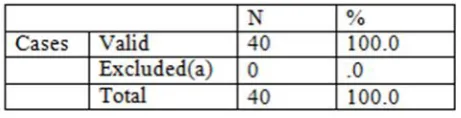
In this section, the results of “Cronbach’s alpha reliability”, “split-half reliability”, “Cronbach’s alpha if item deleted” and “inter-item correlation coefficients” of student survey are demonstrated. Table 1 shows the total number of valid cases (the number of students qualified to participate in the surveys) and Table 2 shows an excellent estimated value (the acceptable value is ≥ 0.7) of Cronbach’s alpha reliability equaling to .965. The estimators of “split-half reliability” of the scale were very good for the both parts (part 1 (part 2) =.890 (.891)) and “Guttman Split-Half Coefficient” was excellent (= .901). The second column of Table 3 displays some estimated values of “Cronbach’s alpha if item is deleted
)
(
” of some items. These estimates (≥ 0.945) show that there is no need to eliminate any dimension from the survey.Page 249 6.2. Reliability of Academic Staff Survey
As in section 6.1, the same tests were carried out for the academic staff survey; the numerical estimators are given in Tables 5, 6, 7 and 8 below.
Table 5 shows that there are 40 valid cases (the number of academic staff qualified to participate in the surveys). Table 6 shows a very good estimated value of “Cronbach’s alpha
(
)
Reliability” equals to .899. The estimators of “Split-half reliability for the scale” are estimated for each part (part 1, part 2) and are very good and equal to .820 and .823 respectively. The “Guttman Split-Half Coefficient” is also very good and equals to .811. The second column of Table 7 displays some of the estimated values of “Cronbach’s alpha if item is deleted(
)
” of forty-four items. Table 7 shows that all the estimates are ≥ 0.847, i.e. no need to eliminate any subject from the survey.Page 251 7. DISCUSSION AND CONCLUSIONS
In this paper, we discuss the notions of satisfaction and engagement and shed light on the importance of satisfaction, participation and engagement of students and academic staff in higher education institutions. This research shows that the survey can be used to enhance the teaching and learning of institutions. Two surveys have been proposed to study the level of performance of several qualitative indicators. The indicators were identified and were to be measured through the surveys. The first survey consists of 76 items designed to measure the qualitative indicators of satisfaction, participation and engagement of students. The second survey consists 60 items designed to measure the indicators of satisfaction, participation and engagement of academic staff. The surveys were tested in a pilot study. The results of the measures of validity and reliability of the surveys were studied; their results indicated that the surveys were characterized by good levels of validity and reliability.
ACKNOWLEDGEMENTS
Page 252 REFERENCES
Adenike, A 2011, ‘Organizational climate as a predictor of employee job satisfaction: evidence from covenant university’, Business Intelligence Journal, vol. 4, no.1, pp. 151-165, viewed 2 July 2013, http://www.saycocorporativo.com/
Al-Hemyari, ZA & Al-Sarmi, M 2015a, ‘Standards, benchmarks and qualitative indicators to enhance the institution’s activities and performance: Surveys and data analysis’, International Journal of Knowledge-Based Organizations (IJKBO), vol.5 , no.4, pp.38-62.
Al-Hemyari, ZA & Al-Sarmi, M 2015b,‘Performance Measurement in Private HEIs: Performance Indicators, Data Collection and Analysis’, Proceedings of the Conference of The Future of Education, Florence, pp.511-516.
Al-Hemyari, ZA & Al-Sarmi, M 2015c,‘Developing and Establishing Statistical Indicators for Fostering the Quality of Omani HEIs’, International Journal for Cross-Disciplinary Subjects in Education, vol. 6, issue 2, pp. 2142-2151.
Al-Hemyari, ZA & Al-Sarmi, M and Salman, F A 2015, ‘Enhancing metacognition skills of higher education students: Methodology, statistical analysis and survey outcomes’, Int. J. of Information and Decision sciences, vol.7, no. 1, pp.71-98.
Al-Hemyari, ZA & Al-Sarmi 2014, ‘Features of performance indicators in quality improvement of HEIs’, Proceedings of the Ireland International Conference in Education, Dublin, pp. 390-395.
Al-Sarmi, M& Al-Hemyari, ZA 2014a,‘Some statistical characteristics of performance indicators for continued advancement of HEIs’, Int. J. of Quality and Innovation, vol. 2, no.3/4, pp. 285–309. Al-Sarmi, M& Al-Hemyari, ZA2014b,‘Quantitative and Qualitative Indicators to assess the Quality of Teaching and Learning in Higher Education Institutions’, Int. J. of Information and Decision Sciences, vol.6, no.4, pp.369-392.
Al-Sarmi, M& Al-Hemyari, ZA 2014c,‘Goals and Objectives : Statistical techniques and measures for Performance Improvement of HEIs in Oman’, Int. J. Management in Education, vol.8, no.3, pp.244– 264.
Analytic Quality Glossary,viewed 2 September 2013,
http://www.qualityresearchinternational.com/glossary/totalstudentexperience.htm
Anderson, R&Warfviinge, P2012,‘Developing a teaching and learning culture: Case study of faculty of engineering at Lund University’,Proceedings of the 40th annual conference, Thessaloniki, Greek, pp.1-8, viewed 19 March 2014, http://www.sefi.be/conference-2012/Papers/Papers/047.pdf
Anglia Ruskin University 2016-17,‘Our People Strategy’, viewed 10 March 2016, http://web.anglia.ac.uk/hr/staffarea/public/People%20Strategy%202016-17.pdf
Artino, AR, 2008,‘Motivational beliefs and perceptions of instructional quality: predicting satisfaction with online training’, Journal of Computer Assisted Learning, vol.24, issue 3 , pp.260–270.
Australasian Survey of Student Engagement (AUSSE), viewed 10 March 2016, https://www.acer.edu.au/ausse/survey-instruments
Billups, F D 2008,‘Measuring College Student Satisfaction: A Multi-Year Study of the Factors Leading to Persistence’,Proceedings of the 39th annual meeting of the Northeastern Educational Research Association, Rocky Hill, CT, pp. 1-19,viewed 15 May 2013, http://digitalcommons.uconn.edu/nera_2008/14
Page 253
Brus, S., JanjaKomljenovič, Daithí Mac Síthigh, Geert Noope and ColinTück2006,‘Student participation in QA: strengths and challenges’, Proceedings of the 1st European forum for quality assurance,Berlin, pp.53-58, viewed 9 June 2014, http://www.enqa.eu/indirme/papers-and-reports/associated-reports/EUA_QA_Forum_publication.pdf
Chaney, BH , Eddy, JM, Dorman, SM, Glessner, L , Green, BL& Lara-Alecio, R 2007, ‘Development of an Instrument to Assess Student Opinions of the Quality of Distance Education Courses’, The American Journal of Distance Education, vol.21, no.3, pp.145–164.
Costa Vieira, Paulo Roberto da, Irene Raguenet Troccoli & Jose Maria Carvalho da Silva2012,‘Perceived quality in higher education service in Brazil: the importance of physical evidence’,RevistaCientifica International, Edicao, vol.1, no.2, pp.16-40.
Cronbach, LJ 2004,‘My current thoughts on coefficient alpha and successor procedures’, Educational and Psychological Measurement, vol.64, no.3, pp.391-418
Delaney, JG, Johnson, AN, Johnson TD&Treslan, DL 2010,‘Students’ perceptions of effective teaching in Higher Education’,Proceedings of the 26th Annual Conference on Distance teaching and learning, San Francisco, California, pp. 1-102, viewed 10 September, 2013, http://www.uwex.edu/disted/conference/Resource_library/handouts/28251_10H.pdf
Dennis, H & Cramer, D 2008, Introduction to SPSS in Psychology, 1st ed., Pearson Education Limited: England.
Douglas, J, Douglas, A & Barnes, B 2006,‘Measuring student satisfaction at a UK university’,Quality Assurance in Education, vol.14, no.3, pp.251-267.
Duque, LC 2014,‘A framework for analyzing higher education performance: Students' satisfaction, perceived learning outcomes, and dropout intentions’,Total Quality Management & Business Excellence, vol.25, no.1-2, pp.1-21.
Dužević, I, TonćiLazibat, and Mia Delić2014,‘Examining Individual and InstitutionalInfluences on Students’ Engagement’, Proceedings of Economics Development & Research, Hong Kong, pp. 90-95.viewed 9 April 2014,
http://www.ipedr.com/vol70/018-rp020-ICEMI2014_H00033.pdf
Elliot, KM., and Healy, MA, 2001,‘Key factors influencing student satisfaction related to recruitmentand retention.Journal of Marketing for Higher Education’, vol.10, p.4, pp.1-11.
Floyd, KS., Susan, JH&Julie, Santiago 2009,‘The Effect of Engagement andPerceived Course Value on Deep and Surface Learning Strategies’, The International Journal of an Emerging Transdiscipline, vol.12, pp.181-190.
Glasgow Caledonians University 2016, Staff Survey, viewed 10 March 2016,
http://www.mmu.ac.uk/academic/casqe/experience/voice/docs/enhancement_plan.pdf
Gibbs, G 2003,‘Improving teaching and learning through institution-wide strategies’, Proceedings of the conference of Teaching and Learning in Higher Education, Aveiro, pp.1-15, viewed 19 March 2014, http://event.ua.pt/iched/main/invcom/p151.pdf
Gibbs, G 2009,‘Developing students as learners – varied phenomena, varied contexts and a developmental trajectory for the whole endeavor’, Journal of Learning Development in Higher Education, issue.1, February, pp. 1-12.
Goodlad, S, Redman, C. and Watts, C 2008, Academic Satisfaction Review: the undergraduate student experience, University of Warwick, QUAD research, UK, viewed 19 March 2014. http://www2.warwick.ac.uk/fac/soc/cei/staff/research_projects/?ssn=2BVW6ygdaiQ=&inst=WARWI CK.
Page 254
Harvard University 2015,‘The Faculty Job Satisfaction Survey’, viewed 10 March 2016, http://coache.gse.harvard.edu/survey
Harvey, L 1995, ‘Student satisfaction’, The new Review of Academic Librarianship, vol.1, no.1, pp.161-173.
Higher Education Funding Bodies, UK, 2016, The National Student Survey (NSS), viewed 10 March 2016, http://www.thestudentsurvey.com/
HEA 2014, Higher Education System Performance Framework, viewed 19 March 2014, (https://www.education.ie/en/The-Education-System/Higher-Education/HEA-Higher-Education-System-performance-Framework-2014-2016.pdf
Henard, F and Roseveare, D 2012, Fostering Quality Teaching in Higher Education: Policies and Practices, OECD, Publishing, viewed 10 September 2013, http://www.oecd.org/edu/imhe/QT%20policies%20and%20practices.pdf
Hightower, AM, Delgado, RC, Lioyd, SC, Wittenstein, R, Sellers, K& Swanson, CB 2011, Improving student learning by supporting quality teaching, viewed 2 July 2013, http://edweek.org/
Hill, FM 1995,‘Managing service quality in higher education: the role of the student as primary consumer. Quality Assurance in Education, vol.3, no.3, pp.10-21.
Hutchings, P, Huber, MT., and Ciccone, A 2011,‘Getting There: An integrative vision of the Scholarship of Teaching and Learning’,International Journal for the Scholarship of Teaching and Learning, vol.5, no.1, pp.1-14.
Indiana University 2016, National Survey of Student Engagement (NSEE), viewed 10 March 2016, http://nsse.indiana.edu/
Indiana University 2016, Faculty Survey of Student Engagement (FSEE), viewed 10 March 2016, http://nsse.indiana.edu/
Kashif, M and Basharat, S 2014,‘Factors impacting university students' engagement with classroom activities: qualitative study’, Int. J. of Management in Education, vol.8, no.3, pp.209 – 224.
Kroncke AK 2006, Correlation between Faculty Satisfaction and Student Satisfaction in Higher Education, MSc thesis presented to Ohio State University, pp.1-67,viewed 23 March 2014. https://kb.osu.edu/dspace/bitstream/handle/1811/6535/Kristin_Kron?sequence=1
Kuo, Yu-Chun, Walker, E, Andrew, Belland, RB &Shroder, EEK, 2013,‘A predictive study of students satisfaction in on line education programs’, The International Review of Research in Open and Distance Learning, vol. 14, no.1, pp.16-39.
Kuh, GD 2003, The National Survey of Student Engagement: Conceptual Framework and Overview of Psychometric Properties, Indiana University Center for Postsecondary Research and Planning, pp.1-26, viewed 13 March 2013, http://nsse.iub.edu/pdf/conceptual_framework_2003.pdf
Machado, ML., Brites, R., Magalhaes, A & Sa, MJ, 2011,‘Student satisfaction with higher education: Critical data for student development’, European Journal of Education, vol.46, no. 3, pp. 415-432.
Macey, W H, & Schneider, B, 2008, ‘The meaning of employee engagement’,Industrial and Organizational Psychology: Perspectives on Science and Practice, vol.1, no.1, pp.3–30.
Manchester Metropolitan University2015-16,‘Student and Academic Services’, viewed 10 March 2016, http://www.mmu.ac.uk/academic/casqe/experience/voice/docs/enhancement_plan.pdf
Page 255
Mills, L, Hamill, D & Rapple, C 2013, IS Service 2013 Student Satisfaction Results, Trinity College, The University of Dublin, viewed 9 June 2014, http://isservices.tcd.ie/general/satisfaction-survey-2013.php
Navarro, MM, Iglesias, M, and Torres, MPR 2005, ‘A new managementelement for universities:satisfaction with the offered courses’, International Journal of Educational Management, vol.19, no. 6, pp.505-526.
Nebraska University 2015, Employee Engagement Survey, viewed 10 March 2016, http://www.unmc.edu/employment/satisfaction-survey.html
Pereira, M AC, and Da Silva, MT 2003,‘A key question for higher education: Who are the customers?’, Proceedings of the 31st Annual Conference of the Production and Operations Management Society, POM-2003, Atlanta, GE, pp. 1-16, viewed 10 September 2013.
http://www.marco.eng.br/publicacoes/2002-POMS-%20A%20Key%20Question.PDF
Prades, A. &Sebastián Rodríguez 2006,‘What can institutions learn from graduate surveys?, Proceedings of the 1st European forum for quality assurance’, EUA,Brussels, pp. 69-75, viewed 4 July
2011,
http://www.enqa.eu/indirme/papers-and-reports/associated-reports/EUA_QA_Forum_publication.pdf
Robertson-Smith, G &Markwick, C 2009, Employee Engagement: A review of current thinking, Institute for employment studies, Brighton, UK, viewed 24 June 2012, http://www.employment-studies.co.uk/pubs/summary.php?id=469
Sapri, M, Kaka, A, & Finch, E, 2008,‘Higher education students' preferences in relation to library design: a repertory grid analysis’,The International Journal of Interdisciplinary Social Sciences, vol.2, no.6, pp.21-30.
Sapri, M, Kaka, A, and Finch, E 2009, ‘Factors That Influence Student’s Level of Satisfaction With Regards To Higher Educational Facilities Service’, Malaysian Journal of Real Estate, vol.4, no.1, pp.33-51.
Silva, F and Odete, FP 2012, ‘Empirical Study on the Student Satisfaction in Higher Education: Importance-Satisfaction Analysis’, World Academy of Science, Engineering and Technology,vol.66, pp.1192-1197.
Schaufeli, WB 2013, ‘What is engagement?’, in C Truss, K Alfes, RDelbridge, A Shantz, & E Soane(Eds.), Employee Engagement in Theory and Practice. London: Routledge, pp.1-37.
Strydom, A 2012,‘The Job Satisfaction of Academic Staff Members on Fixed-Term Employment Contracts at South African Higher Education Institutions’, PhD thesis. University of the Free State Bloemfontein.
Strydom, JF, Basson, N and Mentz, M 2012, Enhancing the quality of teaching and learning: Using student engagement data to establish a culture of evidence. CHE-SASSE, viewed 16 July 2013, http://www.che.ac.za/
Tessema, MT., Kathryn Ready and Wei-Choun, 2012, ‘Factors Affecting College Students’ Satisfaction with Major Curriculum: Evidence from Nine Years of Data’, International Journal of Humanities and Social Science,vol.2, no.2, pp.34-44.
University College London 2016, National Student Survey, ,viewed 10 March 2016,
https://www.ucl.ac.uk/news/staff/staff-news/0116/13012016-nationalstudentsurvey2016howyoucanhelp
Page 256
University of Colorado 2010, Report of Performance Contract,, viewed 10 March 2016, http://www.learningace.com/doc/466196/9ca2107dabd0aee73d5786b6e4e1fd53/performancecontract2 010annualreport
University of Oxford 2014, The National Student Survey,, viewed 10 March 2016, https://www.ox.ac.uk/students/life/feedback?wssl=1
Wiers-Jensen, J, Stensaker, B, &Gogaard, JB, 2002,‘Student satisfaction: towards an empirical deconstruction of the concept’,Quality in Higher Education, vol.8, no.2, pp.183-195.
Wilson, K, Lizzio, A, &Ramsden, P 1997,‘The development, validation and application of the course experience questionnaire’, Studies in Higher Education, vol.22, no.1, pp.33-53.
Wu, H, Tennyson, RD, & Hsia, T 2010,‘A Study of Student Satisfaction in a Blended E-Learning System Environment’,Computers and Education, vol.55, no.1, pp.155-164.
Page 257
SURVEY OF STUDENTS SATISFACTION, PARTICIPATION & ENGAGEMENT Dear student
Thank you for participating in this survey “Satisfaction & Engagement”. The following questions cover a wide range of activities/topics related to your studies, examinations, academic advising, registration and interactions with executive management, faculty members, and students. Your response is highly appreciated, and will help your institution better understand your needs as a student in order to create an institution environment that is engaging, challenging and productive for students. Please mark your response on this survey. We appreciate the time and effort you put into this survey. Please note that all information provided in this survey will be strictly confidential.
Gender: Program: Field of study: Degree of study (Diploma, Bachelor): Department: College: University: Nationality: Residential area: Period of study:
Date of completing this survey: Day: Month: Semester: Year:
1. Based on your experience at your University/College during the current academic year, how often have you done each of the following? Please respond to the following items (Scale: 1=never, 2=rarely, 3=sometimes, 4=often, 5=very often)
1 2 3 4 5 1 Directed questions or contributed to discussions in a class
2 Pursued advice from academic advisor regarding your studying, registration, future
3 Submitted a class or online presentation: joint 4 Submitted a class or online presentation: individual 5 Received free text books at the beginning of the semester 6 Submitted assignments/homework/tutorial in: a class/office 7 Submitted assignments/homework/tutorial in: online
8 Discussed the degree plan with your academic advisor in: a class/office 9 Discussed the degree plan with your academic advisor in: online 10 Came to class having completed readings
11 Participated in activity/community group 12 Utilized library resources: inside campus 13 Utilized library resources: outside campus
14 Worked with classmates on essay/reports/projects: inside campus 15 Worked with classmates on essay/reports/projects: outside campus 16 Discussed the timetable with your advisor/instructors
17 Discussed your performance with teaching staff
18 Received at the beginning of the semester: The course outline
19 Received at the beginning of the semester: Teaching and assessment methods 20 Received at the beginning of the semester: Attendance rules
Page 258 23 Discussed with teaching staff: question papers 24 Discussed with teaching staff: midterm/final grades
2. In current weekly study, how many theoretical/lab./tutorial and homework’s, do you submit? that take: (Scale:
1
0
,
2
1
,
2
,
3
3
,
4
,
4
5
,
6
,
5
7
)
25 One hour or less to complete
26 More than one hour to complete
27 3. About how many presentations/reports have you submitted/completed in each semester? (Scale:
1
0
,
2
1
,
2
,
3
3
,
4
,
4
5
,
6
,
5
7
)
4. Based on your study during the current academic year, roughly how much have the teaching strategies emphasized the following? (Scale: 1=very little, 2=little, 3=some, 4=much, 5=very much)
28 Theoretical lectures
29 Labs./practical sessions/tutorial classes 30 Field visits
31 Seminar 32 Others
5. Based on your study during the current academic year, roughly how much have the teaching assessment methods emphasized the following? (Scale: 1=very little, 2=little, 3=some, 4=much, 5=very much)
33 Theoretical Midterms
34 Practical Midterms/Labs Midterms
35 Writing joint or individual reports/research 36 Presentations
37 Others
6. Based on your study during the current academic year, roughly how often have you done each of the following activities? (Scale: 1=never, 2=rarely, 3=sometimes, 4=often, 5=very often)
38 Attended cultural/scientific fairs
39 Taken part in sport/poem/other competitions
40 Participated in internship/learning/training (commercial, industrial, clinical…) 41 Involved in part time working
7. Based on your study at this institution, to what extent has your experience contributed to your knowledge, personal development and interest in the following areas? (Scale: 1=very little, 2=little, 3=some, 4=much, 5=very much)
42 Acquiring graduate studies
43 Acquiring a good job
44 Thinking critically and analytically
45 Analyzing quantitative problems
Page 259
47 Working effectively with others
8. Based on your study during the current academic year; how would you evaluate the quality of the registration process (Scale: 1=never, 2=little, 3=some times, 4=often, 5=very often)?
48 I completed registration before the first class session: on line 49 I completed registration before the first class session: others 50 I was registered for some of my courses before the first class session: on line 51 I was registered for some of my courses before the first class session: others 52 I was not registered for any of my courses before the first class session
53 I was not completely registered for my courses before the first class session because of (Scale: 1=Strongly Disagree, 2=Disagree, 3=Cannot Say, 4=Agree, 5=Strongly Agree):
54 The failure of on line system
55 The clashes in my timetable
56 The limited number of offered courses
57 The overlapping between multiple degree plans
58 The limited number of teaching staff
59 The communication between Registration office and students (Scale: 1=poor, 2=fair, 3=good, 4=very good, 5=excellent)
60 The suitability of your timetable in general (Scale: 1=poor, 2=fair, 3=good, 4=very good, 5=excellent)
61
The average number of students in your class (Scale:
1
51
,
2
41
51
,
,
41
31
3
4
21
31
,
5
20
).
9. Based on your study during the current academic year, how would you evaluate the quality of academic advisor through the following? (Scale: 1=very little, 2=little, 3=some, 4=much, 5=very much)
62 Read and explain the roles and regulations of the institution
63 Explain and distribute the degree plan
64 Explain and distribute the advisory plan
65 Follow and apply the rules of offering courses/timetable
66 Follow and apply the rules of registration policy
67 10. Based on your study during the current academic year, overall, how would you evaluate the quality of academic program? (Scale: 1=poorly, 2=satisfactory, 3=good, 4=very good, 5=excellent)
68 11. Based on your study during the current academic year, overall, how would you evaluate the quality of your entire educational experiences at this institution? (Scale: 1=poorly, 2=satisfactory, 3=good, 4=very good, 5=excellent)
69 12. If you could start over again, would you go to the same institution you are now attending from? (Scale: 1=definitely no, 2=probably no, 3=not sure, 4=probably yes, 5=definitely yes)
Page 260
13. Overall satisfaction, based on your study during the current academic year (Scale: 1=absolutely not satisfied, 2=…, 3=…, 4=…, 5=completely satisfied)
70 Overall, how would you evaluate the quality of academic support/advice that you have received from your university?
71 Overall, how would you evaluate the quality of academic support/advice that you have received from your college?
72 Overall, how would you evaluate the quality of academic support/advice that you have received from your department?
73 Overall, how would you evaluate the quality of technical support/advice that you have received from your IT center?
74 Overall, how would you evaluate the quality of academic support/advice that you have received from the registration office?
75 Overall, how would you evaluate the quality of academic support that you have received from your library?
76 Overall, how would you evaluate the quality of other services that you have received from other units?
Page 261
SURVEY OF ACADEMIC STAFF SATISFACTION, PARTICIPATION & ENGAGEMENT Dear faculty member
Thank you for participating in this survey “Satisfaction & Engagement”. The following questions cover a wide range of activities/topics related to your teaching, advising, research, feelings and interactions with students. Your response is highly appreciated, and will help your institution better understand your needs as an academic-staff in order to create an institution environment that is engaging, challenging and productive for students. Please mark your response on this survey. We appreciate the time and effort you put into this survey.
Please note that all information provided in this survey will be strictly confidential.
Qualification: Position Level: Gender: program: Area of Teaching: Department: College: University: Nationality: Part time or Full time: Which one of the following best describes your employment at your institution: Dean Assistant Dean Head of Dept. Head of Sec. Academic-Staff other
1. Based on your experience at your University/College during the current academic year, please respond to the following items by reflecting on the students you have taught (Scale 1=never, 2=rarely, 3=sometimes, 4=often, 5=very often)
1 2 3 4 5 1 Directed questions or contributed to discussions in a class
2 Pursued advice from you regarding teaching, registration, …, community and his future
3 Submitted a class or online presentation: i-joint 4 Submitted a class or online presentation: ii- individual 5 Received free text books at the beginning of the semester 6 Submitted assignment/homework/tutorial in: i- a class/office 7 Submitted assignment/homework/tutorial in: ii- online 8 Discussed the degree plan with you: i- a class/office 9 Discussed the degree plan with you: ii- online 10 Came to class having completed readings 11 Participated in activity/community group 12 Utilized library resources: i- inside campus 13 Utilized library resources: ii- outside campus
14 Worked with classmates on essay/reports/projects: i- inside campus 15 Worked with classmates on essay/reports/projects: ii- outside campus 16 Discussed the timetable with you
17 Discussed their performance with you
18 Received at the beginning of the semester: i- Course outline
19 Received at the beginning of the semester: ii- Teaching and assessment methods
Page 262 22 Utilized ICT resources: ii- outside campus
23 Discussed with you: i- question papers 24 Discussed with you: ii- midterm/final grades
2. How well did university/college short training programs/workshops (directed to academic staff) prepare you to do the following: (Scale 1=not at all, 2=poorly, 3=adequately, 4=well, 5=very well)
25 Develop curriculum to meet the objective learning outcomes and includes perspectives, experiences, and contributions of different cultural and community groups.
26 Use different teaching strategies to meet the needs of different levels of students (e.g., 1. Theoretical lectures; 2. Labs./Practical Sessions/Tutorial classes; 3. Field visits; 4. Seminars; 5. Others).
27 Choose different teaching procedures to help students to become independent thinkers and solving problems on their own.
28 Set appropriately challenging learning expectations for all students 29 Read and understand the roles and regulations of registration, exams,
attendance, …
30 Develop students’ abilities in applications and to understand how to use software packages and other technologies as an essential and integrated part of teaching
31 Develop and distribute course syllabi and assessment methods at the start of the course.
32 Follow and apply the rules of i: recruitment policy 33 Follow and apply the rules of ii: resignation policy 34 Follow and apply the rules of iii: co-examiner policy 35 Follow and apply the rules of iv: academic-advising policy
36 Use different methods of assessments (e.g., 1. Theoretical Midterms; 2. Practical Midterms/Labs Midterms; 3. Writing joint or individual
reports/research; 4. Presentations; 5. Others) to support the learning of students and to determine student strengths and needs.
37 Submit course portfolio and grade reports at the end of the course.
3. Institutional strategy (Scale 1=not at all, 2=poorly, 3=adequately, 4=well, 5=very well) 38 How well did Executive Management communicate vision and mission of the
institution to academic-staff?
39 How well did Executive Management communicate vision and mission of the college to academic-staff?
40 How well did Executive Management communicate goals and objectives of the department to academic-staff?
41 How well did Executive Management communicate core values, strengths, weaknesses, threats and opportunities of the department to academic-staff?
Page 263
42 Overall, how would you evaluate the quality of academic support/advice that you have received from your university?
43 Overall, how would you evaluate the quality of academic support/advice that you have received from your college?
44 Overall, how would you evaluate the quality of academic support/advice that you have received from your department?
45 Overall, how would you evaluate the quality of technical support/advice that you have received from your IT center?
46 Overall, how would you evaluate the quality of academic support/advice that you have
received from the registration office?
47 Overall, how would you evaluate the quality of academic support that you have received from your library?
48 Overall, how would you evaluate the quality of other services that you have received from other units?
5. Load and Research Activities:
49 What is the average number of credit hours that you have taught during this academic year? (Scale:
1
21
,
2
19
21
,
3
16
18
,
4
13
15
,
5
12
).
50 What is the average number of students in your class that you have taught during this
academic year: (Scale:
1
51
,
2
41
51
,
3
31
41
,
4
21
31
,
5
20
).
51 What is the total number of papers in peer reviewed journals that you have published during this academic year?
52 What is the total number of national/international patents (registered and approved) that you have completed during this academic year?
53 What is the total number of national/international awards that you have received during this academic year?
54 What is the total number of research projects sponsored by The Omani Research Council that you have been granted during this academic year?
55 What is the total number of international conferences that you have attended during this academic year?
56 What is the total number of posts in the national core business (national scientific
cooperation, counseling and tutoring of students) that you have taken up during this academic year?
57 What is the total number of posts in the international core business (international scientific cooperation, counseling and tutoring of students) that you have taken up during this academic year?
58 What is the total number of co-editorships (editorial committees) in national journals that you have taken up during this academic year?
59 What is the total number of co-editorships (editorial committees) in international journals that you have taken up during this academic year?