Earth Syst. Dynam., 4, 287–300, 2013 www.earth-syst-dynam.net/4/287/2013/ doi:10.5194/esd-4-287-2013
© Author(s) 2013. CC Attribution 3.0 License.
EGU Journal Logos (RGB)
Advances in
Geosciences
Open Access
Natural Hazards
and Earth System
Sciences
Open AccessAnnales
Geophysicae
Open AccessNonlinear Processes
in Geophysics
Open AccessAtmospheric
Chemistry
and Physics
Open AccessAtmospheric
Chemistry
and Physics
Open Access DiscussionsAtmospheric
Measurement
Techniques
Open AccessAtmospheric
Measurement
Techniques
Open Access DiscussionsBiogeosciences
Open Access Open Access
Biogeosciences
Discussions
Climate
of the Past
Open Access Open Access
Climate
of the Past
Discussions
Earth System
Dynamics
Open Access Open Access
Earth System
Dynamics
DiscussionsGeoscientific
Instrumentation
Methods and
Data Systems
Open Access
Geoscientific
Instrumentation
Methods and
Data Systems
Open Access DiscussionsGeoscientific
Model Development
Open Access Open Access
Geoscientific
Model Development
DiscussionsHydrology and
Earth System
Sciences
Open AccessHydrology and
Earth System
Sciences
Open Access DiscussionsOcean Science
Open Access Open Access
Ocean Science
DiscussionsSolid Earth
Open Access Open Access
Solid Earth
Discussions
The Cryosphere
Open Access Open Access
The Cryosphere
DiscussionsNatural Hazards
and Earth System
Sciences
Open Access
Discussions
Consistent increase in Indian monsoon rainfall and its variability
across CMIP-5 models
A. Menon1,2, A. Levermann1,2, J. Schewe1, J. Lehmann1,2, and K. Frieler1
1Potsdam Institute for Climate Impact Research, 14473 Potsdam, Germany 2Institute of Physics, University of Potsdam, 14476 Potsdam, Germany
Correspondence to: A. Menon ([email protected])
Received: 3 December 2012 – Published in Earth Syst. Dynam. Discuss.: 7 January 2013 Revised: 27 May 2013 – Accepted: 24 July 2013 – Published: 28 August 2013
Abstract. The possibility of an impact of global
warm-ing on the Indian monsoon is of critical importance for the large population of this region. Future projections within the Coupled Model Intercomparison Project Phase 3 (CMIP-3) showed a wide range of trends with varying magnitude and sign across models. Here the Indian summer monsoon rain-fall is evaluated in 20 CMIP-5 models for the period 1850 to 2100. In the new generation of climate models, a consistent increase in seasonal mean rainfall during the summer mon-soon periods arises. All models simulate stronger seasonal mean rainfall in the future compared to the historic period under the strongest warming scenario RCP-8.5. Increase in seasonal mean rainfall is the largest for the RCP-8.5 sce-nario compared to other RCPs. Most of the models show a northward shift in monsoon circulation by the end of the 21st century compared to the historic period under the RCP-8.5 scenario. The interannual variability of the Indian monsoon rainfall also shows a consistent positive trend under unabated global warming. Since both the long-term increase in mon-soon rainfall as well as the increase in interannual variability in the future is robust across a wide range of models, some confidence can be attributed to these projected trends.
1 Introduction
Indian summer monsoon rainfall affects the lives of the large population of India by determining its water availability as well as food security (Parthasarathy et al., 1988; Auffham-mer et al., 2006). About 80 % of the annual precipitation over India occurs during the monsoon months from June to
September (Kripalani et al., 2003; Turner and Annamalai, 2012), and the released latent heat plays an important role in the atmospheric circulations as well as the radiative heat budget of the region (Webster, 1972). Even after achieving growth in service and industrial sectors, agriculture plays a vital role in the economy of the country as it is the predom-inant occupation in the rural regions of India. Extreme rain-fall events and crop failure have adverse effects on the mil-lions of inhabitants as well as the national economy. Hence it is of critical importance to understand how the monsoon will change under future warming, in order to take sufficient adaptation measures.
monsoon rainfall in a homogeneous region over central In-dia shows no significant long-term trend during the past few decades (Goswami et al., 2006). Even though the frequency and magnitude of extreme events show a rising trend over central India (Rajeevan et al., 2006; Goswami et al., 2006), a significant trend is absent in seasonal mean rainfall. This is attributed to a decrease in the frequency of moderate events (Goswami et al., 2006). A study by Fu et al. (1999) shows an increase in the Indian monsoon rainfall in relation to an abrupt warming around the year 1920.
By contrast several ice core records and speleothem records show a decreasing trend in the Indian summer mon-soon (ISM) rainfall in the last century. ISM rainfall inten-sity measured from the Dasuopu ice core shows a decreas-ing trend durdecreas-ing the past century (Thompson et al., 2000; Duan et al., 2004). ISM intensity from speleothem record over southern Arabia also shows a decreasing trend over the past century, which is attributed to the increase in sea sur-face temperature over the Indian Ocean (Burns et al., 2002). The ISM intensity reconstructed from a tree ring record over Tibetan Plateau also shows a decreasing trend from 1860 to present (Xu et al., 2012).
Models have their own limitations in capturing the re-gional rainfall accurately (Turner and Annamalai, 2012). While some model studies find very little impact on the all India monsoon rainfall in transient and time-slice climate change experiments (Mahfouf et al., 1994; Lal et al., 1994; Timbal et al., 1995; Lal et al., 1995), some others suggest an increase in the mean Indian monsoon precipitation as well as the interannual variability under enhanced warming (Meehl and Washington, 1993; Kitoh et al., 1997; Hu et al., 2000; Lal et al., 2001; Cubasch et al., 2001; May, 2002; Fan et al., 2012). A study (Ashfaq et al., 2009) based on a high-resolution nested model suggests a suppression in the Indian monsoon rainfall in the future, which is attributed to a weakening of the monsoon circulation and a suppression of the intraseasonal modes. CMIP-5 models consistently project a significant increase in Indian summer monsoon rainfall sub-seasonal variability under unmitigated climate change (Menon et al., 2013). The Hamburg COSMOS model shows a complex behavior with changing skewness of the rain-fall distribution and an associated increase in monsoon fail-ure events (Schewe and Levermann, 2012). A subset of the IPCC AR4 models suggest an increase in the strength of the monsoon precipitation (Kripalani et al., 2007), whereas the monsoon circulation is projected to weaken (Tanaka et al., 2005; Ueda et al., 2006), while earlier studies using slab ocean models suggest a strengthening of monsoon precipita-tion as well as the circulaprecipita-tion (Zhao and Kellogg, 1988). The projected precipitation from few CMIP-3 models, which are considered more realistic, shows a range of trends including negative trends in monsoon rainfall by 2100 (Turner and An-namalai, 2012) under the SRES A1B scenario. Cherchi et al. (2011) analyze global monsoons based on a fully coupled atmosphere–ocean general circulation model and suggest
that the Indian summer monsoon intensifies in the future, mainly in response to the increased moisture content un-der various CO2forcings. Studies based on CMIP-5 models under RCP-4.5 scenario project an increase in global mean precipitation of around 3.2 % K−1 (Hsu et al., 2013) and a larger increase in annual mean precipitation over the entire Asian monsoon region with less uncertainty as compared to 3 models (Lee and Wang, 2012). Compared to CMIP-3 models, CMIP-5 models have higher horizontal and verti-cal resolution in the atmosphere and ocean, and they have a more detailed representation of aerosols. Some of the CMIP-5 models have a more complete representation of the car-bon cycle compared to CMIP-3 models. Sperber et al. (2012) suggest that, because of the higher spatial resolution, CMIP-5 models have a better representation of rainfall compared to CMIP-3 models, especially in the vicinity of steep to-pography (like Western Ghats). CMIP-5 models outperform CMIP-3 models in simulating the monsoon annual cycle, the onset of monsoon as well as the time of the monsoon peak. The spatial extent of monsoon in CMIP-5 multi-model mean (MMM) is more realistic than in the CMIP-3 MMM. The magnitude of intra-seasonal variance is also more realistic in 5 MMM compared to 3 MMM. Both CMIP-5 and CMIP-3 MMM capture low-level monsoon circula-tion quite well with pattern correlacircula-tions of 0.98 and 0.97 re-spectively, compared to ERA40 observational dataset. Even though the time–mean rainfall error has a consistent pattern between CMIP-5 and CMIP-3 MMM, the amplitude of er-ror is less for CMIP-5 MMM compared to CMIP-3 MMM (Sperber et al., 2012).
Rainfall (mm/d)
MIROC−ESM
MIROC−ESM−CHEM
CCSM4 NorESM1−M
GFDL−CM3
GFDL−ESM2G
GFDL−ESM2M
INM−CM4
ACCESS1.0
MPI−ESM−LR
FGOALS−s2
CNRM−CM5
CanESM2
BCC−CSM1.1
HadGEM2−CC HadGEM2−ES
IPSL−CM5A−MR
IPSL−CM5A−LR CSIRO−Mk3.6.0 MRI−CGCM3
1 2 3 4 5 6 7 8 9
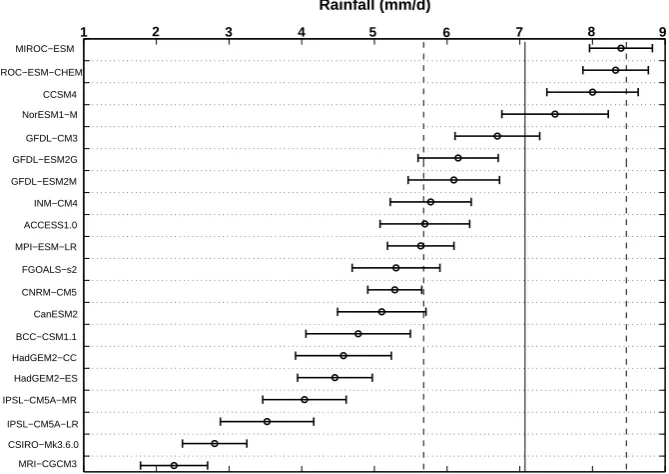
Fig. 1. JJAS mean rainfall over all India region from different models for the historic period. The black vertical line shows the all India mean monsoon rainfall from observations for the period 1871–2004, and the dashed lines show mean plus/minus twice the standard deviation of all India mean rain. Circles with error bars represent mean and mean plus/minus one standard deviation for the 20 comprehensive models from 1871 to 2004.
In order to capture the full range of possible future scenar-ios, including mitigation strategies, the Representative Con-centration Pathways (RCPs) have been developed as a basis for the IPCC fifth assessment report. There are four RCPs categorized according to their approximate radiative forcing in the year 2100. We use data from RCP model simulations in order to study the projected changes in the mean and variabil-ity of ISM rainfall in the future. In this study, we examine the mid-19th century to the end of the 21st century variability of ISM rainfall simulated by 20 of the models that participated in the CMIP-5. Section 2.1 shows a brief model evaluation of the Indian summer monsoon mean rainfall. Section 2.2 gives the trend in all India mean monsoon rainfall and Sect. 2.3 its interannual variability in the RCP-based simulations. Sec-tion 2.4 deals with the changes in monsoon circulaSec-tion in the future. The results are discussed in Sect. 3.
2 Results
2.1 Model evaluation
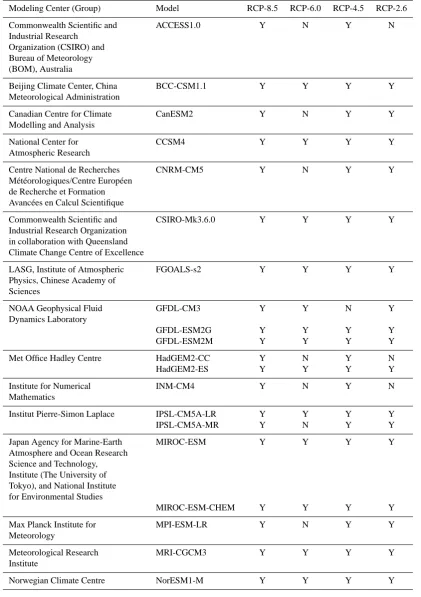
In this study, we use simulated rainfall obtained from 20 of the models that participated in the CMIP-5. Models are cho-sen according to the availability of the data: only those mod-els are analyzed for which data for historic period (1850– 2005), RCP-8.5 and at least one more scenario were avail-able at the time of the study. The model information is sum-marized in Table 1. The range in global mean temperature
as constrained by past climate observations allows for a wide range of responses within an RCP (Schewe et al., 2011). His-torical simulations are based on solar and volcanic forcing, land use, observed concentrations of greenhouse gases, and reconstructed aerosol emissions. Future projections are based on the four Representative Concentration Pathways (RCPs) (Moss et al., 2010). RCP-8.5 is the pathway for which ra-diative forcing reaches 8.5 W m−2by 2100. Similarly RCP-4.5 and RCP-6.0 represent the pathways for which radiative forcing reaches 4.5 and 6 W m−2in 2100. RCP-2.6 peaks in radiative forcing at 3 W m−2before 2100 and declines after-wards reaching 2.6 W m−2 in 2100. India as a whole (all-India) is selected for the study, and data are masked over all-India region. Mean rainfall is obtained by averaging the June–September (JJAS) rainfall over the all-India land region and denoted as all-India summer monsoon rainfall (AISMR). The all-India rainfall dataset from Parthasarathy et al. (1994) is used to compare the seasonal mean rainfall from mod-els during historical periods with observations. The obser-vational data cover a period from 1871 to 2004.
Table 1. Details of the data availability for the 20 comprehensive models used in the study. Only those models are selected for which data for historic period, RCP-8.5 and at least one more scenario are available at the time of the study.
Modeling Center (Group) Model RCP-8.5 RCP-6.0 RCP-4.5 RCP-2.6
Commonwealth Scientific and ACCESS1.0 Y N Y N
Industrial Research Organization (CSIRO) and Bureau of Meteorology (BOM), Australia
Beijing Climate Center, China BCC-CSM1.1 Y Y Y Y
Meteorological Administration
Canadian Centre for Climate CanESM2 Y N Y Y
Modelling and Analysis
National Center for CCSM4 Y Y Y Y
Atmospheric Research
Centre National de Recherches CNRM-CM5 Y N Y Y
M´et´eorologiques/Centre Europ´een de Recherche et Formation Avanc´ees en Calcul Scientifique
Commonwealth Scientific and CSIRO-Mk3.6.0 Y Y Y Y
Industrial Research Organization in collaboration with Queensland Climate Change Centre of Excellence
LASG, Institute of Atmospheric FGOALS-s2 Y Y Y Y
Physics, Chinese Academy of Sciences
NOAA Geophysical Fluid GFDL-CM3 Y Y N Y
Dynamics Laboratory
GFDL-ESM2G Y Y Y Y
GFDL-ESM2M Y Y Y Y
Met Office Hadley Centre HadGEM2-CC Y N Y N
HadGEM2-ES Y Y Y Y
Institute for Numerical INM-CM4 Y N Y N
Mathematics
Institut Pierre-Simon Laplace IPSL-CM5A-LR Y Y Y Y
IPSL-CM5A-MR Y N Y Y
Japan Agency for Marine-Earth MIROC-ESM Y Y Y Y
Atmosphere and Ocean Research Science and Technology, Institute (The University of Tokyo), and National Institute for Environmental Studies
MIROC-ESM-CHEM Y Y Y Y
Max Planck Institute for MPI-ESM-LR Y N Y Y
Meteorology
Meteorological Research MRI-CGCM3 Y Y Y Y
Institute
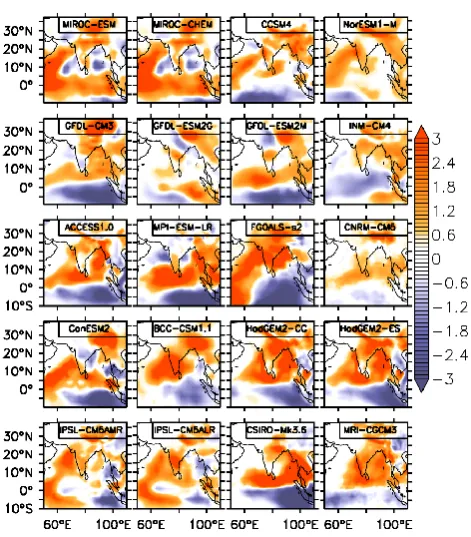
Fig. 1) of the observed mean for the period 1871 to 2004. Models like MIROC-ESM and MIROC-ESM-CHEM show a slight overestimation of seasonal mean rainfall, while models like CSIRO-Mk3 and MRI-CGCM3 show an underestima-tion. The error bars in Fig. 1 represent long-term standard de-viations for each of the models under consideration, and the values vary from 0.4 to 0.7 for various models. NorESM1-M and GFDL-CNorESM1-M3 capture the mean rainfall closest to the observed mean. The spatial pattern of JJAS rainfall clima-tology over India (Fig. 2), from the India Meteorological De-partment observational dataset (Rajeevan et al., 2006), shows that the mean precipitation is highest over the south-west coast, central India and the north-east India. The spatial pat-terns of rainfall during the monsoon season as simulated by all models are shown in Fig. 3. The models that underes-timate the climatological rainfall do not capture the spatial pattern of monsoon well. CSIRO-Mk3.6.0 and MRI-CGCM3 model more rainfall over the east coast of Bay of Bengal and the tropical Indian Ocean. They show very low rain-fall over the all-India region. Similarly, the Hadley Centre models (HadGEM2-CC and HadGEM2-ES) and the Institute Pierre Simon Laplace models (CM5A-LR and IPSL-CM5A-MR) capture very little rainfall over the all-India re-gion with comparatively higher rainfall over the Himalayan mountains and the Bay of Bengal.
As discussed by Levermann et al. (2009), the monsoon re-gion can enter a climatic regime in which latent heat trans-port towards land is insufficient to sustain a monsoon circula-tion, which may lead to abrupt monsoon transition (Zickfeld et al., 2005) as observed in the past (Schewe et al., 2012; Cook et al., 2010; Sinha et al., 2011). While observations clearly show that the ISM is currently within the active mon-soon regime, it is possible that the CMIP-5 models that ex-hibit a very weak ISM are outside this regime. In this study, we decide to interpret the results of the future monsoon evo-lution from models with historical mean precipitation be-low the observed mean minus twice its standard deviation (5.7 mm day−1) as well as the ones with an unrealistic spa-tial pattern, with care as they are less likely to provide a good approximation of the real evolution. Full information is, how-ever, provided for all models.
2.2 Long-term trend in Indian monsoon rainfall under various RCP warming scenarios
AISMR is analyzed for the four RCPs (Figs. 4 and 5). AISMR shows a clear positive long-term trend in all mod-els under the RCP-8.5 scenario, whereas the long-term trend is small under RCP-2.6 scenario (Fig. 4). And even for the lowest concentration scenario RCP-2.6, only 3 out of 20 models show a small decreasing trend in rainfall. Under RCP-8.5 scenario, the majority of the models simulate rain-fall response outside the envelope of the baseline variability (black horizontal lines) towards the end of the 21st century. FGOALS-s2 shows a rainfall response beyond the baseline
Fig. 2. June–September (JJAS) rainfall climatology (mm/day) dur-ing the period 1970–2000 from the India Meteorological Depart-ment (IMD) daily gridded observational dataset. Mean precipita-tion is highest over south-west peninsular India, north-east India and central India.
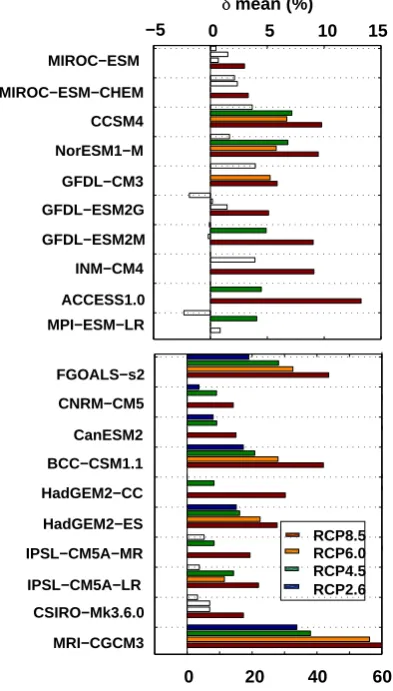
variability from the beginning of the 21st century onwards under all RCP scenarios. The percentage changes in the AISMR (δmean) by the end of the 21st century (2070–2100) with respect to the pre-industrial period (1870–1900) un-der all RCPs are summarized in Fig. 6. Models listed in the upper panel of Fig. 6 are those that capture the AISMR well with mean rainfall for the historic period (1871–2004) falling within twice the standard deviation (0.7 mm day−1) of the observed mean (7.1 mm day−1). The relative increase in mean monsoon rainfall is less (up to<15 %) for these mod-els compared to the ones with a much lower historic mean. The significance of δmean values are obtained from a Stu-dent’sttest, and it shows that 19 out of the 20 models show a significant increase inδmean under the RCP-8.5 scenario at a 95 % confidence level. MPI-ESM-LR shows a slight in-crease in the AISMR during the end of the 21st century com-pared to the pre-industrial period under RCP-8.5 scenario, which is not significant at a 95 % confidence level. MRI-CGCM3 shows the maximum increase in AISMR of about 60 % by the end of the 21st century compared to the end of the 19th century for RCP-8.5 and RCP-6.0 scenarios. But as shown in Fig. 3, MRI-CGCM3 does not capture the spatial pattern of AISMR realistically. All models show a consistent increase inδmean at 95 % confidence level under all scenar-ios. None of the negative values ofδmean are significant at a 95 % confidence level. In summary, a consistent picture of an increasing seasonal mean rainfall under global warming arises from the CMIP-5 intercomparison.
8 10
MIROC−ESM MIROC−ESM−CHEM CCSM4
8 10 NorESM1−M
6 8
GFDL−CM3 GFDL−ESM2G GFDL−ESM2M
6 8 INM−CM4
6 8
ACCESS1.0
JJAS Rainfall (mm/d)
MPI−ESM−LR FGOALS−s2
6 8 CNRM−CM5
4 6 8
CanESM2 BCC−CSM1.1 HadGEM2−CC
4 6 8 HadGEM2−ES
1900 2000 2100 2
4 6
IPSL−CM5A−MR
1900 2000 2100 IPSL−CM5A−LR
1900 2000 2100 CSIRO−Mk3.6.0
1900 2000 2100 2 4 6 MRI−CGCM3
Fig. 4. Indian summer monsoon seasonal (June–September) mean rainfall for the period 1850–2100 from the 20 comprehensive climate models. Gray shadings represent the yearly values, and red and blue lines represent the nonlinear trend in seasonal mean rain obtained from a singular spectrum analysis with a window width of 21 yr for RCP-8.5 and RCP-2.6 respectively. The non-linear trends are calculated using a routine from Aslak Grinsted, and the method is discussed in Moore et al. (2005). The horizontal black lines represent mean±standard deviation for each model for the period 1871–2004, which shows the range of baseline variability.
8 10
MIROC−ESM MIROC−ESM−CHEM CCSM4
8 10 NorESM1−M
6 8
GFDL−CM3 GFDL−ESM2G GFDL−ESM2M
6 8 INM−CM4
6 8
ACCESS1.0
JJAS Rainfall (mm/d)
MPI−ESM−LR FGOALS−s2
6 8 CNRM−CM5
4 6 8
CanESM2 BCC−CSM1.1 HadGEM2−CC
4 6 8 HadGEM2−ES
1900 2000 2100 2
4 6
IPSL−CM5A−MR
1900 2000 2100 IPSL−CM5A−LR
1900 2000 2100 CSIRO−Mk3.6.0
1900 2000 2100 2 4 6 MRI−CGCM3
MIROC−ESM
MIROC−ESM−CHEM
CCSM4
NorESM1−M
GFDL−CM3
GFDL−ESM2G
GFDL−ESM2M
INM−CM4
ACCESS1.0
MPI−ESM−LR
δ mean (%)
FGOALS−s2
CNRM−CM5
CanESM2
BCC−CSM1.1
HadGEM2−CC
HadGEM2−ES
IPSL−CM5A−MR
IPSL−CM5A−LR
CSIRO−Mk3.6.0
MRI−CGCM3
RCP8.5 RCP6.0 RCP4.5 RCP2.6
−5 0 5 10 15
0 20 40 60
Fig. 6. Percentage change in mean rainfall for 8.5 (red), RCP-6.0 (orange), RCP-4.5 (green) and RCP-2.6 (blue) for all models under consideration. Relative change is calculated as the change in seasonal (JJAS) mean rainfall for the period 2070–2100 with respect
to the period 1870–1900, i.e.,
JJASrain2070−2100
JJASrain1870−1900
·100
−100. The
gap separates models with rainfall values for 1871–2004 lying within and outside twice the standard deviation of the observed mean as per Fig. 1. Bars on the panels are transparent if theδmean values are not significant at 95 % confidence level.
change in AISMR as a function of global mean temperature change or AISMR change per degree of warming. It is given in Fig. 7. RCP-2.6 scenario is not considered here as the tem-perature changes are very low under this scenario. Consider-ing only trends that are significant at a 95 % confidence level, all models project an increase in the AISMR with an increase in temperature. The trends are comparatively smaller for the more realistic models. Figure 8 shows the histogram of the trends per degree kelvin. The relative changes in AISMR per degree of warming range from 1 to 19 % K−1; 66.5 % of the trends for an ensemble of all models lie in the range of 1– 9 % K−1 with a median increase of 3.2 % K−1. While con-sidering only the more realistic models in the upper panel of Fig. 7, 66.5 % of the relative changes in AISMR per degree of
MIROC−ESM
MIROC−ESM−CHEM
CCSM4
NorESM1−M
GFDL−CM3
GFDL−ESM2G
GFDL−ESM2M
INM−CM4
ACCESS1.0
MPI−ESM−LR
δ mean (%) /K
0 2 4 FGOALS−s2
CNRM−CM5
CanESM2
BCC−CSM1.1
HadGEM2−CC
HadGEM2−ES
IPSL−CM5A−MR
IPSL−CM5A−LR
CSIRO−Mk3.6.0
MRI−CGCM3
RCP8.5 RCP6.0 RCP4.5
0 2 4
0 5 10 15 20
Fig. 7. Percentage change in mean rainfall per degree change in temperature for RCP-8.5 (red), RCP-6.0 (orange) and RCP-4.5 (green) for all models. As the temperature change in RCP-2.6 is very small, it is not taken into consideration. Transparent bars are the values that are not significant at 95 % confidence level.
warming are in the range 1.3–3 % K−1. These models show a median increase of 2.3 % K−1. This value is closer to the projected increase in global mean precipitation per degree of warming (2.2±0.52 % K−1) given by Frieler et al. (2011) for CMIP-3.
Figure 9 represents the changes in the spatial pattern of rainfall under the RCP-8.5 scenario compared to the historic period. The majority of the models show an increase in rain-fall over almost all parts of India by the end of the 21st cen-tury compared to the end of the 20th cencen-tury. GFDL-ESM-2M, GFDL-ESM-2G, MPI-ESM-LR and CanESM2 show a reduction in rainfall over central India in the future but cap-ture an increase in rainfall over other parts of India.
2.3 Future evolution of interannual variability
0 2 4 6 8 10 12 14 16 18 20 0
2 4 6 8 10 12
δ mean (%)/ K
Fig. 8. Histogram of the percentage changes in mean rainfall per de-gree change in temperature for all significant scenarios of all models as in Fig. 7. Red dots represent the values for the models in the up-per panel of Fig. 7. Black dashed line shows the median value for the ensemble of all models, and red dashed line shows the median value for the most realistic models (i.e., the ones in the upper panel of Fig. 7).
Fig. 9. JJAS rainfall composite difference (mm day−1) for the pe-riod 2070–2100 under RCP-8.5 scenario and for the pepe-riod 1970– 2000. The majority of the models capture an increase in summer monsoon mean rainfall by about 0–3 mm day−1 in most parts of India.
MIROC−ESM
MIROC−ESM−CHEM
CCSM4
NorESM1−M
GFDL−CM3
GFDL−ESM2G
GFDL−ESM2M
INM−CM4
ACCESS1.0
MPI−ESM−LR
δ std (%)
−10 0 10 20 30 40 −20
−30
−20 0 20 40 60
FGOALS−s2
CNRM−CM5
CanESM2
BCC−CSM1.1 HadGEM2−CC
HadGEM2−ES
IPSL−CM5A−MR
IPSL−CM5A−LR
CSIRO−Mk3.6.0
MRI−CGCM3
RCP8.5
RCP6.0
RCP4.5 RCP2.6
Fig. 10. The percentage change of standard deviation (STD) ing the second half of 21st century to the standard deviation dur-ing the first half of the 20th century under RCP-8.5 (red), RCP-6.0 (orange), RCP-4.5 (green)and RCP-2.6 (blue) for all models under consideration. All values greater than 0 show an increase in variabil-ity. The percentage change is given as
STD
2050−2100
STD1900−1950 ·100
−100.
The upper and lower panels are separated as in Figs. 6 and 7.
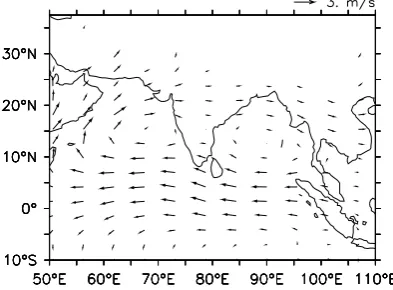
Fig. 11. June–September 850 hPa wind (m s−1) climatology for the period 1970–2000 from NCEP/NCAR reanalysis data (Kalnay et al., 1996).
of interannual variability, most of them are under the RCP-2.6 and RCP-4.5 scenarios. The interannual variability has a clear positive trend in most of the models under the higher scenarios RCP-6.0 and RCP-8.5.
2.4 Changes in monsoon circulation in the future
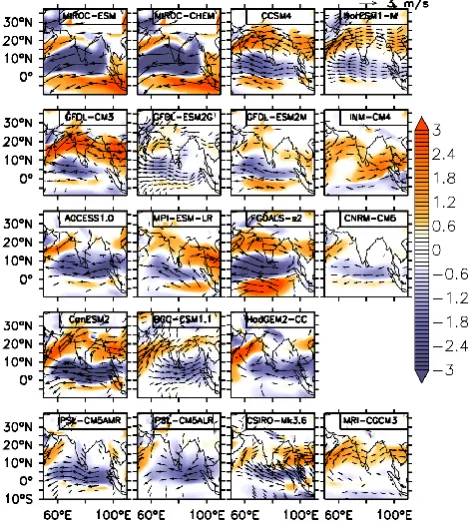
Some studies suggest a weakening of the monsoon circula-tion in a number of CMIP-3 models under global warming (Tanaka et al., 2005; Ueda et al., 2006). The 850 hPa summer wind climatology from observational data shows the low-level monsoon circulation that carries moisture from over ocean to the Indian land region (Fig. 11). Figure 12 depicts the composite difference in the wind anomaly between the end of the 21st century under RCP-8.5 and the end of the 20th century from the CMIP-5 models. The majority of the models show an increase in wind speed (shaded) in the north of India and a decrease in wind speed in southern peninsular India as well as the north equatorial Indian Ocean by the end of the 21st century. Anomalies in wind direction (vectors) are opposite to the direction of the mean wind over the southern peninsular India, and along the direction of the mean wind over central and northern India, in most of the models. This could indicate a northward shift in the monsoon circulation in the future. The ensemble mean over all 19 models under con-sideration also shows the same pattern (Fig. 13). This pattern resembles that of the wind anomaly from the CMIP-3 mod-els (cf. Fig. 2a in Ueda et al., 2006). The monsoon circulation strengthens over northern India, but it weakens over the south of India. Figure 14 shows the meridional pattern of the zonal wind averaged over the longitudes 50–110◦E for all 19 mod-els under consideration. The majority of the modmod-els show a slight northward shift in monsoon circulation of the order of about 2◦by the end of the 21st century under RCP-8.5. Kitoh et al. (1997) suggest a similar northward shift in the mon-soon circulation under global warming. Such a latitudinal shift of the circulation would be important to consider when
Fig. 12. Difference in wind speed (shading, in m s−1) and direc-tion (vectors) during June–September for the period 2070–2100 un-der RCP-8.5 and 1970–2000 for 19 models unun-der consiun-deration. HadGEM2-ES is not shown as wind data for historic period were not available at the time of the study. Wind vector anomalies are in the direction of the mean flow over the northern parts of India and are opposite to the mean flow over the southern parts of India in most of the models.
assessing changes in the total strength of the circulation. Fig-ure 14 shows that the overall magnitude of the zonal mon-soon winds decreases in a few models (e.g., MIROC-ESM, MIROC-ESM-CHEM, IPSL-CM5A-MR, IPSL-CM5A-LR, CanESM2), but remains fairly constant in most models, or even increases in some (e.g., INM-CM4).
3 Discussion and conclusions
1
1
Fig. 13. Differences in June–September 850 hPa winds (m s−1) for the period 2070–2000 (under RCP-8.5) compared to the historic pe-riod (1970–2000) for the ensemble mean of all 19 models under consideration.
summer monsoon rainfall increases under future warming. All models except MPI-ESM-LR simulate the maximum positive trend in mean monsoon rainfall under the highest concentration pathway RCP-8.5. This result agrees with Fu et al. (1999), who find an increase in the Indian monsoon rainfall during abrupt warming, and suggests a relationship between global temperature increase and the Indian monsoon rainfall.
An increase in seasonal mean precipitation can occur due to changes in the inter-tropical convergence zone (Hu et al., 2000). In coupled models under global warming, it has been attributed predominantly to an increase in the water-holding capacity of the atmosphere with an increase in surface tem-perature (Trenberth, 1998). For example, Meehl et al. (2005) suggest the increase in water vapor content associated with an increase in sea surface temperature in a warmer climate as the reason for enhanced precipitation in the tropics in some IPCC AR4 models. The atmospheric water vapor is projected to increase by 12–16 % over large parts of India (Kripalani et al., 2007) at the time of CO2 doubling. This increased moisture content can lead to enhanced precipitation. In this study, we see that the increase in AISMR per degree change in temperature is about 2.3 % K−1, which is similar to the projected increase in global mean precipitation per degree change in temperature in CMIP-3 (Frieler et al., 2011).
A second trend that emerges consistently across models in CMIP-5 is an increase in interannual variability. The mon-soon variability shows a general increasing trend under vari-ous RCPs in most of the models. Rainfall variability is partic-ularly important for societal and economic adaptation strate-gies, defining the required year-to-year flexibility for agricul-tural management, disaster preparedness, etc. Further studies are needed to understand the physical reasons behind the in-crease in interannual variability. One of the reasons attributed to the increase is the increase in El Ni˜no Southern Oscilla-tion (ENSO) variability in the future, which is transmitted to
Fig. 14. Meridional pattern of zonal wind (m s−1) averaged over the region 50E–110E for the 19 CMIP-5 models during June– September. Black lines represent JJAS mean zonal wind for the pe-riod 1970–2000, and red lines represent JJAS mean zonal wind for the period 2070–2100.
so the intensification of monsoon variability, requires long-term adaptation strategies to cope with future climate change in India.
Acknowledgements. This work was funded by the
BMBF PROGRESS project (support code 03IS2191B). We acknowledge the World Climate Research Programme’s Working Group on Coupled Modelling, which is responsible for CMIP, and we thank the climate modeling groups (listed in Table 1) for producing and making available their model output. For CMIP, the US Department of Energy’s Program for Climate Model Diagnosis and Intercomparison provided coordinating support and led development of software infrastructure in partnership with the Global Organization for Earth System Science Portals. We have used the NCEP Reanalysis Derived data provided by the NOAA/OAR/ESRL PSD, Boulder, Colorado, USA, from their website at http://www.esrl.noaa.gov/psd/.
Edited by: M. Huber
References
Ashfaq, M., Shi, Y., Tung, W., Trapp, R. J., Gao, X., Pal, J. S., and Diffenbaugh, N. S.: Suppression of south Asian summer mon-soon precipitation in the 21st century, Geophys. Res. Lett., 36, L01704, doi:10.1029/2008GL036500, 2009.
Auffhammer, M., Ramanathan, V., and Vincent, J. R.: Integrated model shows that atmospheric brown clouds and greenhouse gases have reduced rice harvests in India, P. Natl. Acad. Sci., 103, 19668–19672, 2006.
Burns, S., Fleitmann, D., Mudelsee, M., Neff, U., Matter, A., and Mangini, A.: A 780-year annually resolved record of Indian Ocean monsoon precipitation from a speleothem from south Oman, J. Geophys. Res., 107, 4434, doi:10.1029/2001JD001281, 2002.
Cherchi, A., Alessandri, A., Masina, S., and Navarra, A.: Effects of increased CO2levels on monsoons, Clim. Dynam., 37, 83–101, doi:10.1007/s00382-010-0801-7, 2011.
Cook, E. R., Anchukaitis, K. J., Buckley, B. M., Di Arrigo, R. D., Jacoby, G. C., and Wright, W. E.: Asian Monsoon Failure and Megadrought During the Last Millennium, Science, 328, 486– 439, 2010.
Cubasch, U., Meehl, G., Boer, G., Stouffer, R., Dix, M., Noda, A., Senior, C., Raper, S., and Yap, K.: Projections of future climate change, in: Climate Change 2001: The Scientific Basis: Contri-bution of Working Group I to the Third Assessment Report of the Intergovernmental Panel, edited by: Houghton, J. T., Ding, Y., Griggs, D. J., Noguer, M., Van der Linden, P. J., Dai, X., Maskell, K., and Johnson, C. A., Cambridge University Press, UK, 526–582, 2001.
Duan, K., Yao, T., and Thompson, L.: Low-frequency of southern Asian monsoon variability using a 295-year record from the Da-suopu ice core in the central Himalayas, Geophys. Res. Lett., 31, L16209, doi:10.1029/2004GL020015, 2004.
Fan, F., Mann, M. E., Lee, S., and Evans, J. L: Future changes in the south Asian summer monsoon: An analysis of the CMIP3 multi-model projections, J. Climate, 25, 3909–3928, 2012.
Frieler, K., Meinshausen, M., von Deimling, T., Andrews, T., and Forster, P.: Changes in global-mean precipitation in response to warming, greenhouse gas forcing and black carbon, Geophys. Res. Lett., 38, L04702, doi:10.1029/2010GL045953, 2011. Fu, C., Diaz, H., Dong, D., and Fletcher, J.: Changes in atmospheric
circulation over Northern Hemisphere oceans associated with the rapid warming of the 1920s, Int. J. Climatol., 19, 581–606, 1999. Goswami, B. N.: Interannual variations of Indian summer monsoon in a GCM: External conditions versus internal feedbacks, J. Cli-mate, 11, 501–522, 1998.
Goswami, B. N., Venugopal, V., Sengupta, D., Madhusoodanan, M. S., and Xavier, P. K.: Increasing Trend of Extreme Rain Events Over India in a Warming Environment, Science, 314, 1442–1445, 2006.
Guhathakurta, P. and Rajeevan, M.: Trends in the rainfall pattern over India, Int. J. Climatol., 28, 1453–1469, 2008.
Hsu, P.-C., Li, T., Murakami, H., and Kitoh, A.: Future change of the global monsoon revealed from 19 CMIP5 models, J. Geophys. Res.-Atmos., 118, 1–14, doi:10.1002/jgrd.50145, 2013. Hu, Z., Latif, M., Roeckner, E., and Bengtsson, L.: Intensified Asian
summer monsoon and its variability in a coupled model forced by increasing greenhouse gas concentrations, Geophys. Res. Lett., 27, 2681, doi:10.1029/2000GL011550, 2000.
Jagannathan, P. and Parthasarathy, B.: Trends and periodicities of rainfall over India, Mon. Weather Rev., 101, 371–375, 1973. Kalnay, E., Kanamitsu, M., Kistler, R., Collins, W., Deaven, D.,
Gandin, L., Iredell, M., Saha, S., White, G., Woollen, J., Zhu, Y., Chelliah, M., Ebisuzaki, W., Higgins, W., Janowiak, J., Mo, K. C., Ropelewski, C., Wang, J., Leetmaa, A., Reynolds, R., Jenne, R., and Joseph, D.: The NCEP/NCAR 40-Year Reanalysis Project, B. Am. Meteorol. Soc., 77, 437–471, 1996.
Kitoh, A., Yukimoto, S., Noda, A., and Motoi, T.: Simulated changes in the Asian summer monsoon at times of increased at-mospheric CO2, J. Meteorol. Soc. Jpn., 75, 1019–1031, 1997. Kripalani, R., Kulkarni, A., Sabade, S., and Khandekar, M.: Indian
monsoon variability in a global warming scenario, Nat. Hazards, 29, 189–206, 2003.
Kripalani, R. H., Oh, J. H., Kulkarni, A., Sabade, S. S., and Chaudhari, H. S.: South Asian summer monsoon precipita-tion variability: Coupled climate model simulaprecipita-tions and projec-tions under IPCC AR4, Theor. Appl. Climatol., 90, 133–159, doi:10.1007/s00704-006-0282-0, 2007.
Kucharski, F., Scaife, A. A., Yoo, J. H., Folland, C. K., Kinter, J., Knight, J., Fereday, D., Fischer, A. M., Jin, E. K., Kr¨oger, J., Lau, N.-C., Nakaegawa, T., Nath, M. J., Pegion, P., Rozanov, E., Schu-bert, S., Sporyshev, P. V., Syktus, J., Voldoire, A., Yoon, J. H., Zeng, N., Zhou, T.: The CLIVAR C20C project: skill of simulat-ing Indian monsoon rainfall on interannual to decadal timescales. Does GHG forcing play a role?, Clim. Dynam., 33, 615–627, 2009.
Kumar, K., Pant, G., Parthasarathy, B., and Sontakke, N.: Spatial and subseasonal patterns of the long-term trends of Indian sum-mer monsoon rainfall, Int. J. Climatol., 12, 257–268, 1992. Lal, M., Cubasch, U., and Santer, B.: Effect of global warming
on Indian monsoon simulated with a coupled ocean-atmosphere general circulation model, Current Sci., 66, 430–438, 1994. Lal, M., Cubasch, U., Voss, R., and Waszkewitz, J.: Effect of
Lal, M., Nozawa, T., Emori, S., Harasawa, H., Takahashi, K., Ki-moto, M., Abe-Ouchi, A., Nakajima, T., Takemura, T., and Nu-maguti, A.: Future climate change: Implications for Indian sum-mer monsoon and its variability, Current Sci., 81, 1196–1207, 2001.
Lee, J.-Y. and Wang, B.: Future change of global monsoon in the CMIP5, Clim. Dynam., 39, 1123–1135, 2012.
Levermann, A., Schewe, J., Petoukhov, V., and Held, H.: Basic mechanism for abrupt monsoon transitions, P. Natl. Acad. Sci., 106, 20572–20577, 2009.
Mahfouf, J., Cariolle, D., Royer, J., Geleyn, J., and Timbal, B.: Re-sponse of the Meteo-France climate model to changes in CO2 and sea surface temperature, Clim. Dynam., 9, 345–362, 1994. May, W.: Simulated changes of the Indian summer monsoon
under enhanced greenhouse gas conditions in a global time-slice experiment, Geophys. Res. Lett., 29, 1118, doi:10.1029/2001GL013808, 2002.
Meehl, G. A. and Arblaster, J. M.: Mechanisms for projected future changes in south Asian monsoon precipitation, Clim. Dynam., 21, 659–675, 2003.
Meehl, G. A. and Washington, W. M.: South Asian Summer Mon-soon Variability in a Model with Doubled Atmospheric Carbon Dioxide Concentration, Science, 260, 1101–1104, 1993. Meehl, G. A., Arblaster, J. M., and Tebaldi, C.:
Understand-ing future patterns of increased precipitation intensity in cli-mate model simulations, Geophys. Res. Lett., 32, L18719, doi:10.1029/2005GL023680, 2005.
Meehl, G. A., Stocker, T. F., Collins, W. D., Friedlingstein, P., Gaye, A. T., Gregory, J. M., Kitoh, A., Knutti, R., Murphy, J. M., Noda, A., Raper, S. C. B., Watterson, I. G., Weaver, A. J., and Zhao, Z.-C.: Climate Change 2007: The Physical Science Basis, Contribu-tion of Working Group I to the Fourth Assessment Report of the Intergovernmental Panel on Climate Change, chap. Global Cli-mate Projections, Cambridge University Press, Cambridge, UK and New York, NY, USA, 2007.
Meehl, G. A., Arblaster, J. M., and Collins, W. D.: Effects of black carbon aerosols on the Indian monsoon, J. Climate, 21, 2869– 2882, 2008.
Menon, A., Levermann, A., and Schewe, J.: Enhanced future vari-ability during India’s rainy season, Geophys. Res. Lett., 40, 3242–3247, doi:10.1002/grl.50583, 2013.
Mooley, D. and Parthasarathy, B.: Fluctuations in All-India summer monsoon rainfall during 1871–1978, Climatic Change, 6, 287– 301, 1984.
Moore, J., Grinsted, A., and Jevrejeva, S.: New tools for analyzing time series relationships and trends, EOS Trans. Am. Geophys. Union, 86, 226, 2005.
Moss, R. H., Edmonds, J. A., Hibbard, K. A., Manning, M. R., Rose, S. K., van Vuuren, D. P., Carter, T. R., Emori, S., Kainuma, M., Kram, T., Meehl, G. A., Mitchell, J. F. B., Nakicenovic, N., Riahi, K., Smith, S. J., Stouffer, R. J., Thomson, A. M., Weyant, J. P., and Wilbanks, T. J.: The next generation of scenarios for climate change research and assessment, Nature, 463, 747–756, 2010. Parthasarathy, B., Munot, A., and Kothawale, D.: Regression
model for estimation of Indian foodgrain production from sum-mer monsoon rainfall, Agr. Forest Meteorol., 42, 167–182, doi:10.1016/0168-1923(88)90075-5, 1988.
Parthasarathy, B., Munot, A., and Kothawale, D.: All-India monthly and seasonal rainfall series: 1871–1993, Theor. Appl. Climatol., 49, 217–224, 1994.
Rajeevan, M., Bhate, J., Kale, J. A., and Lal, B.: High resolu-tion daily gridded rainfall data for the Indian region: Analysis of break and active monsoon spells, Current Sci., 91, 296–306, 2006.
Ramanathan, V., Chung, C., Kim, D., Bettge, T., Kiehl, J. T., Wash-ington, W. M., Fu, Q., Sikka, D. R., and Wild, M.: Atmospheric brown clouds: Impacts on South Asian climate and hydrological cycle, P. Natl. Acad. Sci., 102, 5326–5333, 2005.
Sabade, S., Kulkarni, A., and Kripalani, R.: Projected changes in South Asian summer monsoon by multi-model global warming experiments, Theor. Appl. Climatol., 103, 543–565, 2011. Schewe, J. and Levermann, A.: A statistically predictive model for
future monsoon failure in India, Environ. Res. Lett., 7, 044023, doi:10.1088/1748-9326/7/4/044023, 2012.
Schewe, J., Levermann, A., and Meinshausen, M.: Climate change under a scenario near 1.5◦C of global warming: monsoon inten-sification, ocean warming and steric sea level rise, Earth Syst. Dynam., 2, 25–35, doi:10.5194/esd-2-25-2011, 2011.
Schewe, J., Levermann, A., and Cheng, H.: A critical humid-ity threshold for monsoon transitions, Clim. Past, 8, 535–544, doi:10.5194/cp-8-535-2012, 2012.
Sinha, A., Berkelhammer, M., Stott, L., Mudelsee, M., Cheng, H., and Biswas, J.: The leading mode of Indian Summer Monsoon precipitation variability during the last millennium, Geophys. Res. Lett., 38, L15703, doi:10.1029/2011GL047713, 2011. Sperber, K. and Palmer, T.: Interannual tropical rainfall variability
in general circulation model simulations associated with the At-mospheric Model Intercomparison Project, J. Climate, 9, 2727– 2750, 1996.
Sperber, K. R., Annamalai, H., Kang, I.-S., Kitoh, A., Moise, A., Turner, A., Wang, B., and Zhou, T.: The Asian summer monsoon: an intercomparison of CMIP5 vs. CMIP3 simulations of the late 20th century, Clim. Dynam., doi:10.1007/s00382-012-1607-6, in press, 2012.
Tanaka, H., Ishizaki, N., and Nohara, D.: Intercomparison of the in-tensities and trends of Hadley, Walker and monsoon circulations in the global warming projections, SOLA, 1, 77–80, 2005. Thompson, L., Yao, T., Mosley-Thompson, E., Davis, M.,
Hender-son, K., and Lin, P.: A high-resolution millennial record of the South Asian monsoon from Himalayan ice cores, Science, 289, 1916–1919, 2000.
Timbal, B., Mahfouf, J., Royer, J., and Cariolle, D.: Sensitivity to prescribed changes in sea surface temperature and sea ice in dou-bled carbon dioxide experiments, Clim. Dynam., 12, 1–20, 1995. Trenberth, K.: Atmospheric moisture residence times and cycling: Implications for rainfall rates and climate change, Climatic Change, 39, 667–694, 1998.
Turner, A. and Annamalai, H.: Climate change and the South Asian summer monsoon, Nat. Clim. Change, 2, 587–595, 2012. Ueda, H., Iwai, A., Kuwako, K., and Hori, M.: Impact of
an-thropogenic forcing on the Asian summer monsoon as sim-ulated by eight GCMs, Geophys. Res. Lett., 33, L06703, doi:10.1029/2005GL025336, 2006.
Xu, H., Hong, Y., and Hong, B.: Decreasing Asian summer mon-soon intensity after 1860 AD in the global warming epoch, Clim. Dynam., 39, 2079–2088, doi:10.1007/s00382-012-1378-0, 2012. Zhao, Z. and Kellogg, W.: Sensitivity of soil moisture to doubling of carbon dioxide in climate model experiments, Part II: The Asian monsoon region, J. Climte, 1, 367–378, doi:10.1175/1520-0442(1988)001<0367:SOSMTD>2.0.CO;2, 1988.