https://doi.org/10.5194/esd-8-977-2017
© Author(s) 2017. This work is distributed under the Creative Commons Attribution 3.0 License.
Towards representing human behavior and decision
making in Earth system models – an overview of
techniques and approaches
Finn Müller-Hansen1,2, Maja Schlüter3, Michael Mäs4, Jonathan F. Donges1,3, Jakob J. Kolb1,2, Kirsten Thonicke1, and Jobst Heitzig1
1Potsdam Institute for Climate Impact Research (PIK), Member of the Leibniz Association,
P.O. Box 60 12 03, 14412 Potsdam, Germany
2Department of Physics, Humboldt University Berlin, Newtonstraße 15, 12489 Berlin, Germany 3Stockholm Resilience Centre, Stockholm University, Kräftriket 2B, 114 19 Stockholm, Sweden 4Department of Sociology and ICS, University of Groningen, Grote Rozenstraat 31, 9712 TG Groningen,
the Netherlands
Correspondence to:Finn Müller-Hansen ([email protected])
Received: 26 February 2017 – Discussion started: 2 March 2017 Accepted: 16 August 2017 – Published: 8 November 2017
Abstract. Today, humans have a critical impact on the Earth system and vice versa, which can generate com-plex feedback processes between social and ecological dynamics. Integrating human behavior into formal Earth system models (ESMs), however, requires crucial modeling assumptions about actors and their goals, behav-ioral options, and decision rules, as well as modeling decisions regarding human social interactions and the aggregation of individuals’ behavior. Here, we review existing modeling approaches and techniques from vari-ous disciplines and schools of thought dealing with human behavior at different levels of decision making. We demonstrate modelers’ often vast degrees of freedom but also seek to make modelers aware of the often crucial consequences of seemingly innocent modeling assumptions.
After discussing which socioeconomic units are potentially important for ESMs, we compare models of in-dividual decision making that correspond to alternative behavioral theories and that make diverse modeling as-sumptions about individuals’ preferences, beliefs, decision rules, and foresight. We review approaches to model social interaction, covering game theoretic frameworks, models of social influence, and network models. Finally, we discuss approaches to studying how the behavior of individuals, groups, and organizations can aggregate to complex collective phenomena, discussing agent-based, statistical, and representative-agent modeling and eco-nomic macro-dynamics. We illustrate the main ingredients of modeling techniques with examples from land-use dynamics as one of the main drivers of environmental change bridging local to global scales.
1 Introduction
Even though Earth system models (ESMs) are used to study human impacts on the complex interdependencies between various compartments of the Earth, humans are not repre-sented explicitly in these models. ESMs usually consider hu-man influence in terms of scenarios for comparison of the impacts of alternative narratives about the future develop-ment of key socioeconomic characteristics. For instance, the
natural Earth system and the social, cultural, and economic responses to them are not captured.
The concept of the Anthropocene epoch implies that hu-mans have become a dominant geological force interfer-ing with biophysical Earth system processes (Crutzen, 2002; Maslin and Lewis, 2015). However, a changing environment also alters human behavior (Palmer and Smith, 2014). For example, climate change will affect land use and energy con-sumption. Likewise, perceived environmental risks modify consumption and mobility patterns. Therefore, with increas-ing human impact on the Earth system, feedbacks between shifts in the biophysical Earth system and human responses will gain importance (Donges et al., 2017c, b; Thornton et al., 2017). Donges et al. (2017a) provide a classification of these feedbacks in this Special Issue.
Studying feedback loops between human behavior and the Earth system, projecting its consequences, and developing interventions to manage the human impact on the Earth sys-tem requires a suitable dynamic representation of human be-havior and decision making. In fact, even a very accurate sta-tistical description of human behavior may be insufficient for several reasons. First, in a closed loop, humans constantly respond to changes in the Earth system, facing novel envi-ronmental conditions and decision problems. Hence, their response cannot be predicted with a statistical model. Sec-ond, for a correct assessment of different policy options (e.g., command and control policy vs. market-based solutions), a sound theoretical and empirical account of the principles un-derlying decision making in the relevant context is needed because they guide the development of intervention pro-grams, such as incentives schemes, social institutions, and nudges (Ostrom, 1990; Schelling, 1978; Thaler and Sunstein, 2009). A statistical model could mislead decision makers that want to design policy interventions to induce changes in hu-man behavior.
Incorporating human behavior in ESMs is challenging. In contrast to physical laws that traditional ESMs can use as a basis, there is no single theory of human behavior that can be taken as a general law (Rosenberg, 2012). The understanding of human behavior is limited by its determinants often being contingent and socially formed by norms and institutions. This allows for a view on social systems as socially con-structed realities, which is in stark contrast to the positivist epistemology of one objective reality prevalent in the natu-ral sciences. In fact, past attempts to develop grand theories have been criticized for being too remote from reality and, as a consequence, hard if not impossible to test empirically (Boudon, 1981; Hedström and Udehn, 2009; Hedström and Ylikoski, 2010; Merton, 1957). Accordingly, many social scientists favor a so-called “middle-range approach”, trying to tailor theoretical models to specific contexts rather than developing overarching general theories. This acknowledges, for instance, that individuals act in some contexts egoisti-cally and based on rational calculus, while in other contexts they may act altruistically and according to simple
heuris-tics. The principles that determine human decisions depend on, for example, whether the decision maker has faced the decision problem before, the complexity of the decision, the amount of time and information available to the individual, and whether the decision affects others or is framed in a spe-cific social situation. Likewise, different actor types might apply different decision principles. Furthermore, the deci-sion determinants of agents can be affected by others through social interactions or aggregate outcomes of collective pro-cesses.
Here, we give an overview of existing approaches to model human behavior and decision making to provide readers with a toolbox of model ingredients. Rather than promoting one theory and dismissing another, we list decisions that ers face when modeling humans, point to important model-ing options, and discuss methodological principles that help in developing the best model for a given purpose.
We define decision making as the cognitive process of de-liberately choosing between alternative actions, which may involve analytic and intuitive modes of thinking. Actions are intentional and subjectively meaningful activities of an agent. Behavior, in contrast, is a broader concept that also includes unconscious and automatic activities, such as habits and re-flexes. The outcome of a decision is therefore a certain type of behavior, which might be explained by a decision-making theory.
In ESMs, only those human decisions and behaviors that have a considerable impact on the Earth system are relevant, i.e., primarily behavior towards the environment of a large number of individuals or decisions amplified through the so-cial position of the decision maker or technology. Therefore, this paper also covers techniques to model interactions be-tween agents and to aggregate behavior and interactions to a macrolevel. On the microlevel, relevant decisions include the reproduction, consumption, and production of energy-and material-intensive products, place of living, energy-and lenergy-and use. These decisions lead to aggregate and long-term dynamics of populations, production and consumption patterns, and mi-gration.
dynamics), while normative models aim at answering ethi-cal questions (e.g., which policy we should choose to reach a certain goal).
Recent reviews focus on existing modeling approaches and theories that are applied in the context of environmental management and change. For example, Verburg et al. (2016) assess existing modeling approaches and identify challenges for improving these models in order to better understand Anthropocene dynamics. An (2012), Meyfroidt (2013), and Schlüter et al. (2017) focus on cognitive and behavioral theo-ries in ecological contexts, providing an overview for devel-opers of agent-based, land-use, and social–ecological mod-els. Cooke et al. (2009) and Balint et al. (2017) review differ-ent micro- and macro-approaches with applications to agro-ecology and the economics of climate change, respectively. The present paper complements this literature by review-ing modelreview-ing approaches of (1) individual agent behavior, (2) agent interactions, and (3) the aggregation of individual behaviors with the aim of supporting the integration of hu-man decision making and behavior into Earth system models. The combination of these three different categories is cru-cial to describe human behavior at scales relevant for Earth system dynamics. Furthermore, this review highlights the strengths and limitations of different approaches by connect-ing the modelconnect-ing techniques and their underlyconnect-ing assump-tions about human behavior and discusses criteria to guide modeling choices.
Our survey of techniques has a bias towards economic modeling techniques for two simple reasons. First, eco-nomics is the social science discipline that has the longest and strongest tradition in the formal modeling of human deci-sion making. Second, economics focuses on the study of pro-duction and consumption as well as the allocation of scarce resources. In most industrialized countries today, a major part of human interactions with the environment is medi-ated through markets, which are central in economic analy-ses. This review aims to go beyond the often narrow framing of economic approaches while at the same time not ignor-ing important economic insights. For instance, consumption and production decisions not only follow purely economic calculations, but are also deeply influenced, for instance, by behavioral patterns, traditions, and social norms (The World Bank, 2015).
Because we discuss different approaches to model deci-sion making and behavior from various disciplinary or sub-disciplinary scientific fields, there are considerable differ-ences in terminology that make a harmonized presentation of the material challenging. For example, the same terms are used to describe quite separate varieties of an approach in different fields, and different terms from separate fields may refer to very similar approaches. We adopt a terminology that aims for a better interdisciplinary understanding and point out different understandings of contested terms where we are aware of them.
This paper works with land-use change as a guiding and illustrative example. Land-cover change and land use make up the second-largest source of greenhouse gases – besides the burning of fossil fuels – and thus contribute strongly to climate change. Behavioral responses related to land use will play a crucial role for successful mitigation and adaptation to projected climatic changes, thereby challenging modelers to represent decision making in models of land-use change (Brown et al., 2017). The complexity of land-use change pro-vides various examples of how collective and individual de-cision making interacts with the environment across spatial scales and organizational levels. Land-use models consider environmental conditions as important factors in decision-making processes, giving rise to feedbacks between environ-mental and socioeconomic dynamics (Brown et al., 2016). However, this paper does not provide an exhaustive overview of existing land-use models. For this purpose, the reader is referred to the various reviews in the literature (e.g., Baker, 1989; Brown et al., 2004; Michetti, 2012; Groeneveld et al., 2017).
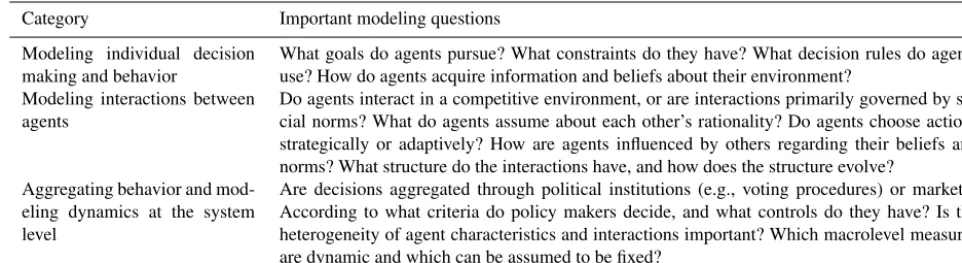
The remainder of the paper is organized as follows. In Sect. 2, we give an overview of different levels of descrip-tion of social systems and the socioeconomic units or agents associated with them. Sections 3–5 form the main part of the paper, presenting different modeling techniques and their un-derlying assumptions about human decision making and be-havior. First, Sect. 3 introduces approaches to model indi-vidual decisions and behavior from rational choice to learn-ing theories. Many of these techniques can be used to also model higher-level social entities. Second, Sect. 4 puts the fo-cus on techniques for modeling interactions between agents. Strategic interactions and social influence are significant de-terminants of individual decisions and therefore important for long-term changes in collective behavior, i.e., the group outcome of mutually dependent individual decisions. Third, Sect. 5 reviews different aggregation techniques that allow for a description of human activities at the level of social col-lectives or systems. These approaches make use of simplifi-cations to scale up theories about individual decision mak-ing. Figure 1 summarizes these main parts of the paper, the corresponding modeling approaches, and important consid-erations for model selection, which we discuss in detail in Sect. 6. The discussion also reflects on important distinctions between models of natural and social systems that are crucial to consider when including human behavior into ESMs. The paper concludes with remarks on the remaining challenges for this endeavor.
2 The challenge: modeling decision making and behavior across different levels of organization
in-Figure 1.Overview of modeling categories, corresponding modeling approaches, and techniques discussed in this paper and important considerations for model choice and assumptions about human behavior and decision making.
dividual humans, it is often useful to not represent individ-ual humans in a model but to treat social collectives, such as households, neighborhoods, cities, political and economic organizations, and states, as decision makers or agents.
Figure 2 shows a hierarchy of socioeconomic units, i.e., the groups, organizations, and structures of individuals that play a crucial role in human interactions with the Earth sys-tem. We consider a broad scheme of levels ranging from the microlevel across intermediate levels to the global level. This hierarchy of socioeconomic units is not only distinguish-able by level of complexity but also by the different spatial scales involved. However, there is no one-to-one correspon-dence. For instance, some individuals have impacts at the global level, while many transnational organizations operate at specific local levels. Especially in the context of human– environment interactions in ESMs, scaling and spatial extent are therefore important issues (Gibson et al., 2000). Further-more, we note that the strict separation between a microlevel and macrolevel may result in treating very different phenom-ena alike. For instance, many economic models describe both small businesses and transnational corporations as actors on the microlevel and model their decision processes with the same set of assumptions, even though they operate very dif-ferently.
One major challenge for modeling humans in the Earth system is therefore to bridge the diverse levels between in-dividuals and the global scale, thereby integrating different levels of social organization and spatial and temporal scales. The relation between individual agents and social collec-tives and structures has been the subject of considerable de-bate in the social sciences. In the social scientific tradition of methodological individualism1, the analysis aims to ex-plain social macro-phenomena, for example phenomena at the level of groups, organizations, or societies, with theories
1We note that there are different accounts of methodological
in-dividualism, and it often remains unclear to what extent structural and interactionist elements can be part of an explanation (see Hodg-son, 2007; Udehn, 2002).
of individual behavior. This approach deviates from struc-turalist traditions, which claim that collective phenomena are of their own kind and thus cannot be traced back to the behav-ior of individuals (Durkheim, 2014). Positions between these two extremes emphasize the interdependency of individual agents and social structure, which is understood as an emerg-ing phenomenon that stabilizes particular behaviors (Cole-man, 1994; Homans, 1950). While it very much depends on the purpose of the given modeling exercise whether the model should represent individuals or collectives, we mainly focus here on the research tradition that acknowledges the fact that complex and unexpected collective phenomena can arise from the interplay of individual behavior.
In Table 1, we provide an overview of socioeconomic units at different levels that are potentially important for Earth sys-tem modeling. We list common theories, frameworks and assumptions made about decision making and behavior for these socioeconomic units and link them to scientific fields that focus on them.
At the microlevel, models consider individuals, house-holds, families, and small businesses. For instance, individ-uals can make decisions as policy makers, investors, busi-ness managers, consumers, or resource users. At this level, decisions about lifestyle, consumption, individual natural re-source use, migration, and reproduction are particularly rele-vant in the environmental context. Individual decisions have to be made by a large number of individuals or have to be re-inforced by organizations, institutions, or technology to be-come relevant at the level of the Earth system. Individuals’ participation in collective decision processes, such as voting, may also have consequences for the environment at a global level.
ter-Table 1.Overview of particular levels of description of socioeconomic units, associated scientific fields and communities, and some common approaches and assumptions about decisions and behavior. The list gives a broad overview but is far from being exhaustive.
Level Socioeconomic units Fields/communities Common approaches and theo-ries
Common assumptions about decision making
Micro Individual humans Psychology, neuro-science, sociology, economics, anthropol-ogy
Rational choice, bounded ratio-nality, heuristics, learning the-ory, cognitive architectures
[All assumptions presented in this column]
Households, families, small businesses
Economics, anthropol-ogy
Rational choice, heuristics, so-cial influence
Maximization of consumption, leisure, profits
Intermediate Communities (villages, neighborhoods), cities
Sociology, anthropol-ogy, urban studies
Social influence, networks Transmission and evolution of cultural traits and traditions Political parties, NGOs,
lobby organizations, educational institutions
Political science, soci-ology
Strategic decision making, pub-lic/social choice, social influ-ence and evolutionary interac-tions
Agents form coalitions and co-operate to achieve goals, influ-enced by beliefs and opinions of others
Governments Political science, opera-tions research
Strategic decision making, cost–benefit and welfare anal-ysis, multi-criteria decision making,
Agents choose for the common good
Nation states, societies Economics, political science, sociology
welfare maximization, social choice
Majority vote
Global Multinational firms, trade networks
Economics, manage-ment science
Rational choice Maximization of profits or shareholder value
Intergovernmental organizations
Political science (inter-national relations)
Strategic decision making, cost–benefit analysis
Coalition formation
Figure 2.Socioeconomic units and their corresponding level and scales.
ritories, from cities to nation states, enact laws that strongly frame the economic and social activities of their citizens. Im-portant decisions for the Earth system context include envi-ronmental regulations and standards, the production and dis-tribution of commodities and assets, trade, the extraction and use of natural resources, and the development and building of physical infrastructures.
At the global level, multinational companies and intergov-ernmental organizations negotiate decisions. This level has considerable impacts on policy and business decisions even
An overarching question that has triggered considerable debate between different disciplines is the allocation of agency at different levels of description. Even if individu-als can decide between numerous options, the perception of options and decisions between them are shaped by social context and institutional embedding. Institutions2and orga-nizations can display their own dynamics and lead to out-comes unintended by the individuals. On the other hand, social movements can initiate disruptive changes in institu-tional development. The attribution and perception of agency for a specific problem is therefore important for the choice of a suitable level of model description. The following section starts our discussion of different modeling techniques at the level of individual decision making and behavior.
3 Modeling individual behavior and decision making
In a nutshell, models of individual decision making and be-havior differ with regard to their assumptions about three cru-cial determinants of human choices: goals, restrictions, and decision rules (Hedström, 2005; Lindenberg, 2001, 1990, 1985). First, the models assume that individuals have mo-tives, goals, or preferences. That is, agents rank goods or outcomes in terms of their desirability and seek to realize highly ranked outcomes. A prominent but debated assump-tion of many models is that preferences or goals are assumed to be stable over time. Stable preferences are included to pre-vent researchers from developing trivial explanations, as a theory that models a given change in behavior only based on changed preferences does not have explanatory power. How-ever, empirical research shows that preferences can change even in relatively short time frames (Ackermann et al., 2016). Changing individuals’ goals or preferences is an important mechanism to affect their behavior, for example through poli-cies, making flexible preferences particularly interesting for Earth system modelers.
Second, decision models make assumptions about restric-tions and opportunities that constrain or help agents pursue their goals. For instance, each behavioral option comes with certain costs (e.g., money and time), and decision makers form more or less accurate beliefs about these costs and how likely they are to occur depending on the information avail-able to the agent.
2The notion of institution is used in the literature with slightly
different meanings: (1) formal and informal rules that shape behav-ior, (2) informal social order, i.e., regular patterns of behavbehav-ior, and (3) organizations. Here, we adopt an understanding of institutions as formal (e.g., law, property rights) or informal rules (e.g., norms, religion). However, formal rules often manifest in social, political, and economic organizations and informal rules may be shaped by them.
Third, models assume that agents apply some decision rule that translates their preferences and restrictions into a choice. Although decision rules differ very much in their complex-ity, they can be categorized into three types. First, there are decision rules that are forward looking. Rational choice the-ory, for instance, assumes that individuals list all positive and negative future consequences of a decision and choose the optimal option. Alternatively, backward-looking approaches, such as classical reinforcement learning, assume that actors remember the satisfaction experienced when they chose a given behavior in the past and tend to choose a behavior with a high satisfaction again. Finally, there are sideward-looking decision rules, which assume that actors adopt the behavior of others, for instance because they imitate successful others (Kandori et al., 1993). Theories assume different degrees of the context dependency of rules and make different implicit assumptions about the underlying cognitive capabilities of agents.
In the remainder of this section, we describe in more de-tail three important approaches to individual decision making and point out typical assumptions about motives, restrictions, and decision rules.
3.1 Optimal decisions and utility theory in rational choice models
Rational choice theory, a standard model in many social sci-ences (especially in economics) that is widely studied in mathematics, assumes that decision making is goal oriented: rational agents have preferences and choose the strategy with the expected outcome that is most preferred, given some ex-ternal constraints and potentially based on their beliefs (rep-resented by subjective probability distributions; see the be-liefs, preferences, and constraints model in Gintis, 2009). It can either be used to represent actual behavior or serve as a normative benchmark for other theories of behavior.
How to judge the “rationality” of individual decisions is subject to ongoing debates. Opp (1999) distinguishes be-tween strong rationality (“homo economicus”), assuming purely self-interested agents with unlimited cognitive capac-ities knowing all possible actions and probabilcapac-ities of con-sequences, and weak rationality that makes less strong as-sumptions. Rabin (2002) distinguishes between standard and nonstandard assumptions regarding preferences, beliefs, and decision-making rules. Before discussing nonoptimal deci-sion making in Sect. 3.2, we review here common assump-tions on preferences and beliefs.
Preferences can be modeled as binary preference relations, x Pi y, denoting that individual i prefers situation or out-come x toy. Most authors assume thatPi is complete (for every pair (x, y) eitherxPiyoryPix) and transitive (ifxPiy and yPiz then xPiz), which allows for the representation of the preferences with a utility functionui (Von Neumann and Morgenstern, 1953).3 Some authors also allow for in-complete or cyclic preferences (Fishburn, 1968; Heitzig and Simmons, 2012). In the land-use context,icould be a farmer, x might denote growing some traditional crops generating a moderate profit, andygrowing hybrid seeds for more profit but makingidependent on the seed supplier. Ificonsiders in-dependence valuable enough to make up for the lower profit, x Pi ywould denotei’s preference ofxovery.
In decision making under uncertainty, agents have to choose between different risky prospects modeled as prob-ability distributionsp(x) over outcomesx. In expected util-ity theory,pis preferred top0if and only ifP
xp(x)ui(x)> P
xp 0(x)u
i(x). Empirical research shows that only a minor-ity of people evaluate uncertainty in this risk-neutral way (Kahneman and Tversky, 1979). Prospect theory therefore models agents that overestimate small probabilities and eval-uate outcomes relative to a reference point, which leads to risk-averse or risk-seeking behavior regarding losses or gains, respectively. (Kahneman and Tversky, 1979; Bruhin et al., 2010). A conceptual example from the land-use con-text illustrates decision making under risk. A farmerimight face the choice of whether to stick to her current cropx or switch to a new cropy. She may think that with 20 % proba-bility the switch will result in a 50 % reduction in her profits, while with 80 % probability the profits would double. If her utility is proportional to the profits and she evaluates this un-certain prospect as described by expected utility theory, her gain from switching toywould be positive. If, however, she is averse to losses and thus conforms to prospect theory, she might evaluate the switch as negative and prefer to stick tox. If several time pointst are involved in a decision, agents are typically assumed to discount future consequences by us-ing utility weights that decay in time and reflect the agent’s time preferences. Discounted utility quantifies the present desirability of some utility obtained in the future. Most au-thors use exponentially decaying weights of the form e−rt with a discounting rater >0 because this makes the evalua-tion independent of its time point. However, empirical stud-ies suggest that people often use slower decaying weights (e.g., hyperbolic discounting), especially in the presence of uncertainty (Ainslie and Haslam, 1992; Jamison and Jami-son, 2011), although this might lead to time-inconsistent choices that appear suboptimal at a later time. A farmer i may compare different crops not only by next year’s expected profitui(x,1) but, due to the various crops’ different effects on future soil quality, also by future years’ profitsui(x, t) for
3u
i(x)> ui(y) impliesx Pi y, whereui is only defined up to
positive linear (affine) transformations.
t >1. Cropymight promise higher yields thanxin the short
run but lower ones in the long run due to faster soil depletion. Ifiis “patient”, having smallr, she might prefery Pixeven thoughui(x,1)> ui(y,1).
Preferences can be aggregated not only in time but also across several interrelated issues or consequences. For exam-ple, consumer theory (Varian, 2010) models preferences over consumption bundles by combining the utility derived from consuming different products into a total consumption util-ity and simply adding up these utilities or combining them in some nonlinear way with imperfect substitutability of goods (Leontief, Cobb–Douglas, or CES utility functions). A farm-ers’ utility from leisure time and crop yieldy(l) depending on working timelmight, for example, be combined using the Cobb–Douglas utility functionui=yα(12−l)1−α for some elasticityα∈(0,1).
Complex optimization problems arising from rational choice theory can be solved by mathematical programming, calculus of variations, and similar methods (see, e.g., Kamien and Schwartz, 2012; Chong and Zak, 2013). Optimal deci-sions under constraints are not only discussed as a descrip-tion of human behavior, but are also often taken as the nor-mative benchmark for comparison with other nonoptimal ap-proaches that we discuss in Sect. 3.2.
Regarding decision modeling in ESMs, rational choice theory is useful when agents have clear goals and possess enough information and cognitive resources to assess the op-timality of strategies. For instance, individuals’ decisions re-garding long-term investments or the decisions of organiza-tions, such as firms or governments, in competitive situations can often be assumed to follow a rational choice model rea-sonably well. It can also be useful when actors make repeated similar decisions and can learn optimal strategies from fast feedback, making them behave “as if” they were rational.
3.2 Bounded rationality and heuristic decision making
al-ready introduced in the previous subsection are also often considered as boundedly rational (Gintis, 2009). Boundedly rational agents can be considered as satisficers that try to find a satisfying action in a situation given their available in-formation and cognitive capabilities (Gigerenzer and Selten, 2002).
Constraints on information processing imply that agents do not integrate all the available information to compute the utility of every possible option in complex decision situations and choose an action with maximal utility. Instead, agents use heuristics to judge the available information and choose actions that lead to the more preferred outcome over less pre-ferred ones. Gigerenzer and Gaissmaier (2011) define heuris-tics in decision making as a “strategy that ignores part of the information, with the goal of making decisions more quickly, frugally, and/or accurately than more complex methods.” It is argued that instead of an all-purpose tool, the mind carries an “adaptive toolbox” of different heuristic decision schemes applicable in particular environments (Gigerenzer and Sel-ten, 2002; Todd and Gigerenzer, 2007).
In general, heuristic rules are formalized either as deci-sion trees or flowcharts and consist of three building blocks: one for information search, one for stopping the information search, and one to derive a decision from the information found. They evaluate a number of pieces of information – so-called cues – to either categorize a certain object or to choose between several options. Many heuristics evaluate these cues in a certain order and make a decision as soon as a cue value allows for classification or discriminates between options.
This is illustrated by means of the take-the-best heuristic: pieces of information (cues) are compared between alterna-tives according to a prescribed order, which is crucial for the decision process. At each step in the cue order, some infor-mation is searched for and evaluated. If the inforinfor-mation does not allow for discrimination between the options, the pro-cess moves on to the next cue. This repeats as the propro-cess moves down the cue order until a cue is reached for which the differentiation between options is possible and the option with the higher cue value is chosen. Another notable example is the satisficing heuristic that evaluates information sequen-tially and chooses the first option satisfying certain criteria. Heuristics, especially cue orders, can be interpreted as en-coding norms and preferences in individual decision making as they prioritize features of different options over others and hierarchically structure the evaluation of available informa-tion. An overview and explanation of numerous other deci-sion heuristics can be found in the recent review paper by Gigerenzer and Gaissmaier (2011).
Gigerenzer and Todd (1999) question the usefulness of ra-tional choice theory as the normative benchmark because it is not designed for so-called “large worlds” where informa-tion relevant for the decision process is either unknown or has to be estimated from small samples. Instead, they want to relieve heuristic decision making of its stigma of cogni-tive laziness, bias, and irrationality. With their account of
ecological rationality, they suggest that heuristics can also serve as a normative choice model providing context-specific rules for normative questions. This is motivated by the ob-servation that in many real-world situations, especially when high uncertainties are involved, some decision heuristics per-form equally good or even better than more elaborated deci-sion strategies (Dhami and Ayton, 2001; Dhami and Harries, 2001; Keller et al., 2014).
So far, heuristics have been used to describe decisions, for instance in consumer choice (Hauser et al., 2009), voter behavior (Lau and Redlawsk, 2006), and organizational be-havior (Loock and Hinnen, 2015; Simon, 1997). However, fast and frugal decision heuristics are not yet commonly ap-plied in dynamic modeling of human–nature interactions. One exception is the description of farmer and pastoralist behavior in a study of the origins of conflict in East Africa (Kennedy and Bassett, 2011). However, as the following example shows, similar decision trees have been used to model decision making in agent-based simulations of land-use change. The model by Deadman et al. (2004) describes colonist household decisions in the Amazon rainforest. Each household is a potential farmer who first checks whether a subsistence requirement is met. If this is not the case, the household farms annual crops. If the subsistence requirement is met, the household eventually plants perennials or breeds livestock depending on the soil quality. The model shows how heuristic decision trees can be used to simplify com-plex decision processes and represent them in an intelligible way. However, the example also shows the many degrees of freedom in the construction of heuristics, pointing at the dif-ficulty to obtain these structures from empirical research.
Heuristics are a promising tool for including individual hu-man decision making into ESMs because they can capture crucial choices in a computationally efficient way. In order to describe the long-term evolution of preferences, norms, and values relevant for human interactions with the Earth sys-tem, heuristics could also be used to model meta-decisions of preference or value adoption. Recent findings suggest that cue orders can spread via social learning and social influence (Gigerenzer et al., 2008; Hertwig and Herzog, 2009) anal-ogously to norm and opinion spreading in social networks (see Sects. 4.3 and 4.4), which could be a promising ap-proach to model social change. However, in contrast to fully rational decision making, it can be very challenging to ag-gregate heuristic decision making analytically to higher or-ganizational levels. Therefore, approaches like agent-based modeling are suitable to explore the aggregate outcomes of many agents with such decision rules (see Sect. 5.5).
3.3 Learning theory
af-fects future payoffs, while the procedures to optimize may be more or less bounded. However, these techniques do not specify how the information is acquired and how the beliefs are formed. Computational learning theory focuses on behav-ior from a backward-looking perspective: an agent learned in the past that a certain action gives a reward that feels good or is satisfying and is therefore more likely to repeat this be-havior. It can describe the adaptivity of agent behavior to a changing environment and is particularly suited for modeling behavior under limited information. To model the learning of agents, unsupervised learning techniques are mostly used be-cause they do not require training with an external correction. Reinforcement learning is such a technique that models how an agent maps environmental conditions to desirable ac-tions in a way that optimizes a stream of rewards (and/or pun-ishments). The obtained reward depends on the state of the environment and the chosen action, but may also be influ-enced by chosen actions and environmental conditions in the past. According to Macy et al. (2013), reinforcement learning differs from forward-looking behavioral models regarding three key aspects. (1) Because agents explore the likely con-sequences and learn from outcomes that actually occurred rather than those which are intended to occur but may only be obtained with a certain probability, reinforcement learn-ing does not need to assume that the consequences are in-tended. (2) Decisions are guided by rewards or punishments that lead to approach or avoidance rather than by static util-ities. (3) Learning is characterized by stepwise melioration and models the dynamic search for an optimum rather than assuming that the optimal strategy can be determined right away.
The learning process is modeled via a learning algorithm (e.g., Q-learning, SARSA learning, actor-critic learning) based on iteratively evaluating the current value of the en-vironmental state utilizing a temporal difference error of ex-pected value and experience value (Sutton and Barto, 1998). Artificial neural network algorithms can explore very high dimensional state and action spaces. Genetic algorithms, which are inspired by evolutionary mechanisms such as mu-tation and selection, are also applied to learning problems. The learning algorithm has to balance a trade-off between the exploration of actions with unknown consequences and the exploitation of current knowledge. In order to not exploit only the currently learned strategy, many algorithms use ran-domness to induce deviations from already learned behavior. The environment in reinforcement learning problems is often modeled with Markovian transition probabilities. The special case of a single agent is called a Markov decision process (Bellman, 1957). In each of the discrete states of the environment the agent can choose from a set of possible ac-tions. The choice then influences the transition probabilities to the next state and the reward. As an illustration, consider a farmer adapting her planting and irrigation practices to new climatic conditions. The environment could be modeled by a Markov process with different states of soil fertility and
moisture, in which transitions between states reflect the in-fluence of stochastic weather events. Without the possibility to acquire knowledge through other channels, she would ex-plore different possible actions and evaluate how they change the yield (her reward). Eventually, through a trial-and-error process, her yield would increase on average.
A common approach to model the acquisition of subjective probabilities associated with the consequences of actions is Bayesian learning, which has also been applied to reinforce-ment learning problems (Vlassis et al., 2012). Starting with some prior probability (e.g., from some high-entropy “unin-formative” distribution)P(hi) that some hypothesishi about the relation of actions and outcomes is true, new information or evidenceP(E) is used to update the subjective probabil-ity with the posteriorP(E|hi) calculated with Bayes’ the-orem:P(hi|E)=P(E|hi)P(hi)/P(E) (Puga et al., 2015). The most probable hypothesis can then be chosen to deter-mine further action.
By combining various approaches to model the acquisi-tion of beliefs through learning, the formaacquisi-tion of preferences and different decision rules discussed in the previous sections with further insights from psychology and neuroscience has led to the development of very diverse and detailed behav-ioral theories which are often formalized in cognitive archi-tectures (Balke and Gilbert, 2014). These approaches can be used to describe human behavior in computational models, but are too complex and diverse to discuss them here in de-tail.
Learning and related theories that emphasize the adapt-ability of human behavior might be important building blocks to model the long-term evolution of human interac-tions with the Earth system from an individual perspective. On the other hand, they can capture short-term responses to drastically changing natural environments that are relevant, for instance, in the context of tipping elements in the Earth system.
Table 2 summarizes the approaches that focus on indi-vidual human behavior. Besides the forward- and backward-looking behavior that we introduced in this section, agents may exhibit sideways-looking behavior: agents can copy the behavior of successful others, thereby contributing to a so-cial learning process. For this kind of behavior, interactions between different agents are crucial. This will be the focus of the next section.
4 Modeling interactions between agents
aggrega-Table 2.Summary table for individual behavior and decision making.
Theories Key considerations Strengths Limitations Optimal decisions in
ratio-nal choice: individuals make the decision that maximizes their expected utility given eco-nomic, social, and environmen-tal constraints.
What are the agent’s prefer-ences? What information (and beliefs) do they have?
Highly researched theory with strong theoretical foundation and many applications
Individuals assumed to have strong capabilities for informa-tion processing and perfect self-control
Bounded rationality and heuris-tic decision making: individuals have biases and heuristic deci-sion rules that help them navi-gate complex environments ef-fectively.
Which cue order is used to gather and evaluate informa-tion? When do agents stop gath-ering more information and de-cide?
Simple decision processes that capture observed biases in deci-sion making
Suitable decision rules highly context dependent
Learning: agents explore pos-sible actions through repeated learning from past experience.
How do agents interact with their environment? What is the trade-off between exploitation of knowledge and exploration of new options?
Captures information and belief acquisition processes
High degree of randomness in behavioral changes
tion mechanisms (e.g., voting procedures and markets) will be discussed in Sect. 5.
The section starts with a review of strategic interactions as modeled in classical game theory and dynamic interac-tions in evolutionary approaches. Then, we address models of social influence that are used to study opinion and pref-erence formation or the transmission of cultural traits, i.e., culturally significant behaviors. Finally, we discuss how in-teraction structures can be modeled as dynamic networks.
4.1 Strategic interactions between rational agents: classical game theory
Game theory focuses on decision problems of “strategic in-terdependence”, in which the utility that a decision maker (called the player) gets depends not only on her own decision, but also on the choices of others. These are often situations of conflict or cooperation. Players choose an action (behavioral option, control) based on a strategy, i.e., a rule specifying which action to take in a given situation. Classical game the-ory explores how rational actors identify strategies, usually assuming the rationality of other players. However, rational players can also base their choices on beliefs about others players’ decisions, which can lead to an infinite regress of mutual beliefs about each other’s decisions.
Formally, a game is described by what game theorists call a game form or mechanism. The game form specifies the actionsai(t) that agents can choose at well-defined time points t from an action setAi(t) that may vary over time, having to respect all kinds of situation-dependent rules. The game form may furthermore allow for communication with the other agent(s) (signaling) or binding agreements (com-mitment power). Simple social situations are formalized in
so-called normal-form games represented by a payoff ma-trix specifying the individual utilities4for all possible action combinations, while more complex situations are modeled as a stepwise movement through the nodes of a decision tree or game tree (Gintis, 2009).
Classical game theory assumes that players form consis-tent beliefs about each other’s unobservable strategies, in par-ticular that the other’s behavior results from an optimal strat-egy. However, multiplayer interaction and optimization often leads to recursive relationships between beliefs and strate-gies, which makes solving complex classical games often very difficult. Many problems have several solutions, called equilibria (not to be confused with the steady-state meaning of the word), and call for sophisticated nonlinear fixed-point solvers (Harsanyi and Selten, 1988). Only in special cases, for example in which players have complete information and moves are not simultaneous but alternating, game-theoretic equilibria can easily be predicted by simple solution concepts such as backwards induction (Gintis, 2009). In other cases, one can identify strategies and belief combinations consis-tent with the following two assumptions. First, each player eventually chooses a strategy that is optimal given her be-liefs about all other players’ strategies (rational behavior). Second, each player’s eventual beliefs about other players’ strategies are correct (rational expectations). The solutions are called Nash equilibria. However, many games have mul-tiple Nash equilibria, and the question of which equilibrium will be selected arises.
4Note that despite the term “payoff matrix”, these utilities are
Therefore, game theorists try to narrow down the likely strategy combinations by assuming additional forms of con-sistency and rationality (Aumann, 2006), such as concon-sistency over time (sequential and subgame perfect equilibria), sta-bility against small deviations (stable equilibria, Foster and Young, 1990), or small random mistakes (trembling hand perfect equilibria, Harsanyi and Selten, 1988). After a plau-sible strategic equilibrium has been identified, it can be used in a simulation of the actual behavior resulting from these strategies over time, possibly including noise and mistakes.
As an example from the land-use context, consider two farmers living on the same road. They get their irrigation wa-ter from the same stream. A dispute over the use of wawa-ter emerges. Both may react to the actions of the other in sev-eral turns. The upstream farmer located at the end of the road may increase or decrease her water use and/or pay compensa-tion for using too much water to the other. The downstream farmer at the entrance of the road may demand compensa-tion or block the road and thereby cut the access of the up-stream farmer to other supplies. A complex game tree en-codes which actions are feasible at which moment and what are the consequences on players’ utilities. If it is possible to specify the information and options available to the players at each time point, then a classical game theoretical analy-sis allows for the determination of the rational equilibrium strategies that the farmers would follow.
Classical game theory is widely applied to interactions in market settings in economics (see also Sect. 5.2), but in-creasingly also in the social and political sciences to polit-ical and voting behavior in public and social choice theory (see, e.g., Ordeshook, 1986; Mueller, 2003, and Sect. 5.1). For example, public choice theory studies strategic interac-tions between groups of politicians, bureaucrats, and voters with potentially completely different preferences and action sets.
While many simple models of strategic interactions be-tween rational and selfish agents will predict only low levels of cooperation, more complex models can well explain how bilateral and multilateral cooperation, consensus, and stable social structure emerges (Kurths et al., 2015). This has been shown in contexts such as multiplayer public goods problems and international climate policy (e.g., Heitzig et al., 2011; Heitzig, 2013).
To model relevant decision processes in the Earth system, classical game-theoretic analysis could be used for describ-ing strategic interactions between agents that could be as-sumed as highly rational and well informed, i.e., interna-tional negotiations of climate agreements between govern-ments, bargaining between social partners, or monopolistic competition between firms. Similarly, international negotia-tions and their interacnegotia-tions with domestic policy can also be framed as two-level or multilevel games (as in some mod-els of political science, e.g., Putnam, 1988; Lisowski, 2002). Furthermore, social choice theory could be used to simulate
simple voting procedures that (to a certain extent) determine the goals of regional or national governments.
4.2 Interactions with dynamic strategies: evolutionary approaches and learning in game theory
In game-theoretic settings, complex individual behavioral rules are typically modeled as strategies specifying an action for each node in the game tree. Consider as an example the repeated version of the prisoners’ dilemma in which each of two players can either “cooperate” or “defect” in each period (Aumann, 2006). A typical complex strategy in this game could involve reciprocity (defect temporarily after a defec-tion of your opponent), forgiveness (every so often not re-ciprocate), and making up (do not defect again after being punished by a defection of your opponent after your own de-fection).
Many or even most nodes of a game tree will not be visited in the eventual realization of the game, and strategies may involve the deliberate randomization of actions. Therefore, strategies, unlike actual behavior, are principally unobserv-able, and assumptions about them are hard to validate. For this and other reasons, several kinds of additional assump-tions are often made that constrain the set of strategies further that a player can choose, e.g., assuming only very short mem-ory or low farsightedness (myopic behavior) and disallowing randomization, or allowing only strategies of a specific for-mal structure such as heuristics (see Sect. 3.2).
The water conflict example from Sect. 4.1 bears some sim-ilarity to the repeated prisoners’ dilemma in that the farmers’ possible actions can be interpreted as either defective (using too much water, blocking the road) or cooperative (not do-ing any of this, compensatdo-ing for past defections). Assumdo-ing different levels of farsightedness may thus lead to radically different actions because myopic players would much more likely get trapped in a cycle of alternating defections than farsighted players. The latter would recognize some degree of forgiveness because that maximizes long-term payoff and would thus desist from defection with some probability. In any case, both farmers’ choices can be modeled as depend-ing on what they believe the other will likely do or how she will react to the last action.
(transmis-sion of memes), social learning through the imitation of suc-cessful strategies, or the emergence of cooperation (Axelrod, 1984, 1997).
In an evolutionary game, a population of agents is di-vided into factions with different strategies. They interact in a formal game (given by a payoff matrix or game tree, see Sect. 4.1), in which their strategy results in a fitness (or payoff). The factions change according to some replicator rules that depend on the acquired fitness. This can be mod-eled using different techniques. Simple evolutionary games in well-mixed large populations can be described with repli-cator equations. The dynamics describing the relative change in the factions with a particular strategy is proportional to the deviation of the fitness of this faction from the average fitness (Nowak, 2006).
Alternatively, the behavior resulting from evolutionary in-teractions is often easy to simulate numerically as a discrete-time dynamical system even for large numbers of players if the individual action sets are finite or low-dimensional and only certain simple types of strategies are considered. This type of agent-based model (see Sect. 5.5) simply im-plements features such as mutation or experimentation and replication via strategy transfer (e.g., imitation and inheri-tance) at the microlevel. Combined with network approaches (see Sect. 4.4), the influence of interaction structure can also be studied (Szabó and Fáth, 2007; Perc and Szolnoki, 2010). Strategies can be characterized as evolutionary stable if a population with this strategy cannot be invaded by another, initially rare strategy. If a strategy is furthermore stable for finite populations or noisy dynamics, it is called stochasti-cally stable.
In our water conflict example, the farmers could use a heuristic strategy (see Sect. 3.2) that determines how much water they extract given the actions of the other. The evolu-tion of the strategies could either be modeled with a learn-ing algorithm, repeatlearn-ing the game again and again. Alterna-tively, to determine feasible strategies in an evolutionary set-ting, a meta-model could consider an ensemble of similar vil-lages consisting of two farmers. The strategies of the farmers would then be the result of either an imitation process be-tween the villages or of an evolutionary process, assuming that less successful villages die out over time.
Evolutionary approaches to game theory are a promising framework to better understand the prevalence of certain hu-man behaviors regarding interaction with the Earth system. This is especially interesting regarding the modeling of long-term cultural evolution and changes in individuals’ goals, be-liefs, and decision strategies or the transmission of endoge-nous preferences (Bowles, 1998).
4.3 Modeling social influence
Human behavior and its determinants (beliefs, goals, and preferences) are strongly shaped by social influence, which can result from various cognitive processes. Individuals may
be convinced by persuasive arguments (Myers, 1982), aim to be similar to esteemed others (Akers et al., 1979), be unsure about what is the best behavior in a given situation (Bikhchandani et al., 1992), or perceive social pressure to conform with others (Wood, 2000; Festinger et al., 1950; Homans, 1950).
Models of social influence allow for the study of the out-comes of repeated influence in social networks and have been used to explain the formation of consensus, the development of monoculture, the emergence of clustered opinion distri-butions, and the emergence of opinion polarization, for in-stance. Models of social influence are very general and can be applied to any setting in which individuals exert some form of influence on each other. However, seemingly innocent dif-ferences in the formal implementation of social influence can have decisive effects on the model outcomes, as the follow-ing list of important modelfollow-ing decisions documents.
A first question is how social influence changes individ-ual attributes. For example, a farmer deciding when to till his field might either choose the date that most of his neigh-bors think is best, take the average of the proposed dates, or even try to counter coordinate with disliked farmers. Clas-sical models incorporate influence as averaging, which im-plies that interacting individuals always grow more similar over time (Friedkin and Johnsen, 2011). Averaging is an ac-cepted and empirically supported model of influence result-ing, for instance, from the social pressure that an actor exerts on someone else (Takács et al., 2016). Models assume differ-ent forms of averaging. Rather than following the arithmetic average of all opinions, actors might only consider the major-ity view (Nowak et al., 1990). In other models, social influ-ence can lead to polarization (Myers, 1982). For instance, in models of argument communication, actor opinions can turn more extreme when the interaction partners provide them with new arguments that support their own opinion (Mäs and Flache, 2013; Mäs et al., 2013).
Second, modelers need to decide whether there is just one or multiple dimensions of influence. For instance, it is of-ten argued that political opinions are multidimensional and cannot be captured by the one-dimensional left–right spec-trum. Explaining the dynamics of opinion polarization and clustering is often more difficult when multiple dimensions are taken into account (Axelrod, 1997). Additionally, model predictions often depend on whether the influence dimen-sion is a discrete or a continuous variable. Models of indi-viduals’ decisions about certain policies often model the de-cisions as binary choices (Sznajd-Weron and Sznajd, 2000; Martins, 2008). However, binary scales fail to capture the fact that many opinions vary on a continuous scale and that differences between individuals can therefore also increase in a single dimension (Feldman, 2011; Jones, 2002; Stroud, 2010). Therefore, models that describe opinion polarization usually treat opinions as continuous attributes.
influ-ence is bidirectional in that an actor who exerts influinflu-ence on someone else can also be influenced by the other (Macy et al., 2013; Mäs et al., 2010). In diffusion models, in contrast, the effective influence is directed. For instance, information can spread only from informed to uninformed individuals, but not the other way around. Furthermore, actors may be influenced dyadically or multilaterally. Model outcomes often depend on whether the influence that a group exerts on an actor is modeled as a sequence of events involving dyads of actors or as a single opinion update in which the actor considers all contacts’ influences at once (Flache and Macy, 2011; Lorenz, 2005; Huckfeldt et al., 2004). In models that assume binary influence dimensions, for instance, dyadic influence implies that an agent copies a trait from her interaction partner. When influence is multilateral, agents aggregate the influence ex-erted by multiple interaction partners (using, e.g., the mode of the neighbors’ opinions), which can imply that agents with rare traits are not considered even though they would have an influence in the case of dyadic influence events. For ex-ample, a farmer seeking advice on whether to adopt a new technology can either consult his friends one after another or all together, likely leading to different outcomes if they have different opinions on the matter.
Fourth, agents may slightly deviate from the influence of their contacts. The exact type of these deviations affects model outcomes and can introduce a source of diversity into models of social influence (Mäs et al., 2010; Pineda et al., 2009; Kurahashi-Nakamura et al., 2016). For instance, some models of continuous opinion dynamics include deviations as Gaussian noise, i.e., random values drawn from a nor-mal distribution. In such a model, opinions in homogeneous subgroups will fluctuate randomly and subgroups with sim-ilar opinions can merge that would have remained split in a model without deviations (Mäs et al., 2010). In other con-texts, deviations are better modeled by uniformly distributed noise, assuming that big deviations are as likely as small ones. This can help to explain, for instance, the emergence and stability of subgroups with different opinions that do not emerge in settings with Gaussian noise5(Pineda et al., 2009). Finally, the effects of social influence depend on the struc-ture of the network that determines who influences whom. Complex dynamics can arise when this interaction network is dynamic and depends on the attributes of the agents, as we discuss in the following section.
Models of social influence are a promising approach to explore how social transitions interact with the Earth sys-tem, for example transitions of norms regarding admissible resource use and emissions, lifestyle changes, and adoption of new technology. They can be used to explore the condi-tions under which social learning enables groups of agents to adopt sustainable management practices.
5Gaussian noise needs to be very strong to generate enough
diversity for the emergence of subgroups with different opinions. However, when noise is strong, subgroups will not be stable.
4.4 Modeling the interaction structure: (adaptive) network approaches
In most of the models discussed in the previous section, the social network is formally modeled as a graph (the mathe-matical notion for a network): a collection of nodes that are connected by links. In this mathematical framework, nodes (vertices) represent agents and links (edges) indicate inter-action, communication, or a social relationship. Agents can only interact and thus influence each other if they are con-nected by a link in the underlying network.
Classical social influence models study the dynamics of influence on static networks, assuming that agents are al-ways affected by the same subset of interaction partners (e.g., DeGroot, 1974; French, 1956; Friedkin and Johnsen, 2011). These networks can be undirected or directed, possibly re-stricting the direction of influence, but their structure does not change over time. Furthermore, the topology of the net-work, i.e., the arrangement of links, can be more or less ran-dom or regular, clustered, and hierarchical. In social influ-ence models on static networks, connected populations will usually reach consensus in the long run.
Especially when modeling social processes over longer timescales, it is reasonable to assume that the social network is dynamic, i.e., that its structure evolves over time. This time evolution can be independent of the dynamics on the network and encoded in a temporal network (Holme and Saramäki, 2012). However, for many social processes, the structure of the social network and the dynamics on the network (e.g., so-cial influence) interact. Adaptive network models make the removal of existing and the formation of new links between agents dependent on attributes of the agents by building on the insight that the social structure influences the behavior, opinions, or beliefs of individual actors, which in turn drives changes in social structure (Gross and Blasius, 2008).
of social tipping points in opinion formation (Holme and Newman, 2006), epidemic spreading (Gross et al., 2006), the emergence of cooperation in social dilemmas (Perc and Szolnoki, 2010), and the interdependence of coalition for-mation with social networks (Auer et al., 2015). Such adap-tive network models exhibit complex and nonlinear dynam-ics such as phase transitions (Holme and Newman, 2006), multi-stability (Wiedermann et al., 2015), oscillations in both agent states and network structure (Gross et al., 2006), and structural changes in network properties (Schleussner et al., 2016).
While adaptive networks have so far mostly been applied to networks of agents representing individuals, the frame-work can in principle be used to model coevolutionary dy-namics on various levels of social interaction as introduced in Table 1. For instance, global complex network structures such as financial risk networks between banks, trade net-works between countries, transportation netnet-works between cities and other communication, organizational, and infras-tructure networks can be modeled (Currarini et al., 2016). Furthermore, approaches such as multi-layer and hierarchi-cal networks or networks of networks allow for the modeling of the interactions between different levels of a system (Boc-caletti et al., 2014).
As an illustration, consider a community of agents each harvesting a renewable resource, for example wood from a forest. The agents interact on a social network, imitating the harvesting effort of neighbors that harvest more and may drop links to neighbors that use another effort. The interac-tion of the resource dynamics with the network dynamics ei-ther leads to a convergence of harvest efforts or a segregation of the community into groups with higher or lower effort de-pending on the model parameters (Wiedermann et al., 2015; Barfuss et al., 2017).
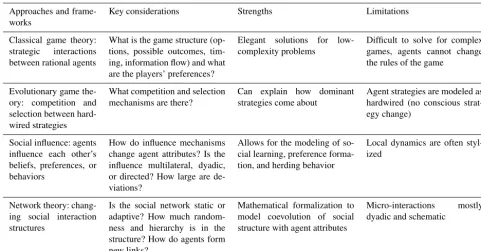
In the context of long timescales in the Earth system, the time evolution of social structures that determine interactions with the environment are particularly important. Adaptive networks offer a promising approach to modeling the struc-tural change of the internal connectivity of a complex system (Lade et al., 2017). For example, this could be applied to explore mechanisms behind transitions between centralized and decentralized infrastructure and organizational networks. Table 3 summarizes the different modeling approaches that focus on agent interactions in human decision making and behavior. These interactions occur between two or sev-eral agents. For including the effect of these interactions into ESMs, their aggregate effects need to be taken into ac-count as well. Therefore, we introduce in the next section ap-proaches that allow us to aggregate individual behavior and local interactions and to study the resulting macrolevel dy-namics.
5 Aggregating behavior and decision making and modeling dynamics at the system level
So far, we focused on theories and modeling techniques that describe the decision processes and behavior of single actors, their interactions, and the interaction structure. This section builds on the previously discussed approaches and highlights different aggregation methods for the behavior of an ensem-ble or group of agents. This is an important step if models shall describe system-level outcomes or collective decision making and behavior in the context of Earth system mod-eling. Aggregation techniques link modeling assumptions at one level (often called the microlevel) to a higher level (the macrolevel). They enable the analysis of macrolevel out-comes and help to transfer models from one scale to another. In general, this could link all levels introduced in Sect. 2.
In this section, we describe different approaches that are used to make this connection. Analytical approaches gen-erally represent groups of individual agents through some macrolevel or average characteristic, often using simplifying assumptions regarding the range of individual agents’ char-acteristics. Simulation approaches describe individual behav-ior and interactions and then compute the resulting aggregate macroscopic dynamics.
The question of how to aggregate micro-processes to macro-phenomena is not specific to modeling human deci-sion making and behavior. The aggregation of individual be-havior and the resulting description of collective action, such as collective motion, is also an ongoing challenge in the nat-ural sciences (Couzin, 2009). Specific assumptions about in-dividual behavior and agent interactions have consequences for the degree of complexity of the macrolevel description. For instance, if agent goals and means do not interact, the properties of single agents can often be added up. If, on the contrary, agents influence each other’s goals or interact via the environment, complex aggregate dynamics can arise.
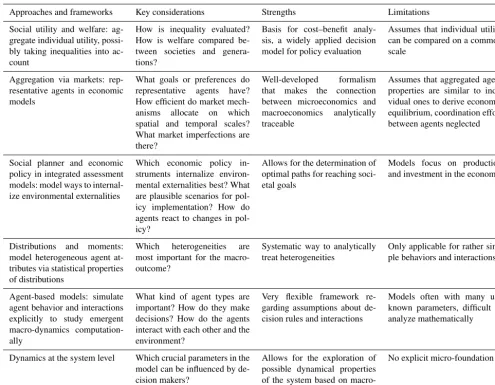
The following sections discuss different aggregation tech-niques, their underlying assumptions, and how these reflect specific aggregation mechanisms. They are summarized in Table 4.
5.1 Aggregation of preferences: social welfare and voting
Table 3.Summary table for agent interactions.
Approaches and frame-works
Key considerations Strengths Limitations
Classical game theory: strategic interactions between rational agents
What is the game structure (op-tions, possible outcomes, tim-ing, information flow) and what are the players’ preferences?
Elegant solutions for low-complexity problems
Difficult to solve for complex games, agents cannot change the rules of the game
Evolutionary game the-ory: competition and selection between hard-wired strategies
What competition and selection mechanisms are there?
Can explain how dominant strategies come about
Agent strategies are modeled as hardwired (no conscious strat-egy change)
Social influence: agents influence each other’s beliefs, preferences, or behaviors
How do influence mechanisms change agent attributes? Is the influence multilateral, dyadic, or directed? How large are de-viations?
Allows for the modeling of so-cial learning, preference forma-tion, and herding behavior
Local dynamics are often styl-ized
Network theory: chang-ing social interaction structures
Is the social network static or adaptive? How much random-ness and hierarchy is in the structure? How do agents form new links?
Mathematical formalization to model coevolution of social structure with agent attributes
Micro-interactions mostly dyadic and schematic
of the total monetary value of the individual’s consumption. Social welfare functions are indeed used to find optimal pol-icy, for example in cost–benefit analysis (Feldman and Ser-rano, 2006). Consider a village of farmers growing crops that need different amounts of water so that water management policies affect farmer incomes. The effects of a water policy could then be evaluated using the average, minimal, or av-erage logarithmic income of farmers as a measure of social welfare. The policy option maximizing the chosen indicator should be implemented.
However, it is highly debated whether the utilities of dif-ferent individuals can really be compared and substituted in the sense that a drop in collective welfare resulting from an actor’s decrease in utility can be compensated for by increas-ing the utility of another actor. Definincreas-ing suitable group pref-erences is especially hard when group composition or size changes over time as in intergenerational models (Millner, 2013). Also, in complex organizations, real decisions might be nonoptimal for the group and more explicit models of ac-tual decision procedures may be needed. Models in subfields of game theory (bargaining, voting, or social choice theory) explore the outcomes of formal protocols that are designed to aggregate the group member’s heterogeneous preferences. Under different voting or bargaining protocols, subgroups may dominate the decision or the group may be able to reach a compromise (Heitzig and Simmons, 2012). In the above ex-ample, the farmers may not agree on a social welfare measure that a policy should optimize but instead on a formal protocol that would allow them to determine a policy for water usage that is acceptable for all.
5.2 Aggregation via markets: economic models and representative agents
A major part of the relevant interaction of contemporary societies with the Earth system is related to the organiza-tion of producorganiza-tion and consumporganiza-tion on markets. Markets not only mediate between the spheres of production and consumption, but they can also be seen as a mechanism to aggregate agents’ decisions and behavior. Economic the-ory explores how goods and services are allocated and dis-tributed among the various activities (sectors of production) and agents (firms, households, governments) in an economy. Goods and services may be consumed or can be the input factors to economic production. Input factors for production are usually labor and physical capital but can also include financial capital, land, energy, natural resources, and inter-mediate goods. In markets, the coordination between the de-mand and supply of goods is mediated through prices that are assumed to reflect information about the scarcity and produc-tion costs of goods. Economics compares different kinds of market settings (e.g., auctions, stock exchanges, international trade) with respect to different criteria such as allocative ef-ficiency.