WWJMRD 2016; 2(6): 17-25 www.wwjmrd.com Impact Factor MJIF: 4.25 e-ISSN: 2454-6615
Danielle L. Troup Department of Special Education Gonzaga University Spokane, WA
Pauline Chung Department of Special Education Gonzaga University Spokane, WA
Jennifer Neyman Department of Special Education Gonzaga University Spokane, WA
T. F. McLaughlin Department of Special Education Gonzaga University Spokane, WA
Heidi Schuler Department of Special Education Spokane Public Schools Spokane, WA
Correspondence: T. F. McLaughlin Department of Special Education Gonzaga University Spokane, WA
The use of behavior specific praise and a token
economy to increase on-task behavior for a male high
school student with Asperger’s syndrome (AS) and
ADHD: variable outcomes
Danielle L. Troup, Pauline Chung, Jennifer Neyman, T. F. McLaughlin,
Heidi Schuler
Abstract
The purpose of this study was to increase on-task behavior using a token economy system paired with positive teacher reinforcement in a high school student with ADHD and Asperger’s syndrome. Our participant was a 15-year-old ninth grade student enrolled in a self-contained special education classroom. He was diagnosed with both ADHD and Asperger’s Syndrome. The dependent variable measured was the percent of on-task behavior across two academic periods of the school day. On-task behavior was tallied using a partial interval recording system. After baseline, a token economy was implemented. The token system was a leveled system where the more on-task that was noted, the greater his reward. The overall outcomes indicated large increases in on-task behavior. The procedures were easy to implement and evaluate in a high school classroom setting.
Keywords: Token Economy, Behavior Disorders, High School, On Task Behavior
Introduction
Student involvement in academic tasks is a significant part of the learning process (Rusnock & Brandler, 1979). When a student misses out from academic learning time, including engaging in off-task behaviors, it results in lower academic achievement. Students with low academic success rates and low academic performance are at high risk of abandoning their schooling and dropping out (Araque, Roldan, & Salguero, 2009). Dropping out of school is not the only bleak outlook for these children with low academic performance and success, they are also likely to be incarcerated, have behavior problems, be unemployed, or have substance abuse issues (Arvans, 2009).
Children who have Asperger’s syndrome (AS) can have general cognitive skills that are preserved but often have deeply impaired social skills as a core feature of AS (Rao, Beidel, & Murray, 2008). These impaired social skills permeate all area of academic, emotional and social development. Likewise children with Attention Deficit Hyperactive Disorder (ADHD) also have impaired academic skills because of a lack of the ability to focus when necessary (Barkley, 2014; Fowler, 2010). Not only do these disorders affect children singularly, but when a child is born with multiple disabilities these disorders may exacerbate each other (Kutscher, Attwood, & Wolff, 2006). Teachers and parents often have difficulty figuring out what the problem is when two different diagnoses are present and this makes treating the problems difficult for teachers.
and self-monitoring procedures (Simonsen, Little, & Fairbanks, 2010). But this does little to address the academic needs of students who represent a compounding diagnosis of Asperger’s and ADHD.
Among research conducted in support of increasing on-task behavior and decreasing problem behavior are two teacher centered strategies: the delivery of teacher praise as positive reinforcement of appropriate behaviors and increasing the amount of opportunities the student in given to respond (Moore-Partin, Robertson, Maggin, Oliver, & Wehby, 2010). If large numbers of opportunities to respond are already available to the student, then using a positive reinforcement procedure becomes key to increasing on-task behavior in students with multiple disabilities (Alberto & Troutman, 2012; Crawford & McLaughlin, 1982; Shapiro, 2014). An additional teacher implemented procedure to assist children with disabilities has been the use of behavior specific praise when students are behaving appropriately (Alberto & Troutman, 2012). The use of behavior specific praise has been often paired with behaviors in an ongoing token economy (Kazdin, 1977; McLaughlin, 1982; McLaughlin & Williams, 1988) and has been recommended for use by teachers and parents (Evans et al., 2013).
In addition a wide range of school-based interventions have been employed to improve the on-task behavior of students with ADHD or without ADHD (Crawford & McLaughlin, 1982; DuPaul, Eckert, & McGoey, 1997). These have included self-monitoring (Edwards, Salant, Howard, Brougher, & McLaughlin, 1995; Harding, Howard, & McLaughlin, 1993; Stewart & McLaughlin, 1992; Willis, Whalen, Sweeney, & McLaughlin 1995, token reward systems (Kazdin, 1977; McLaughlin & Williams, 1988; Pfiffner & O’Leary, 1993; Pfiffner, Rosen, & O’Leary, 1985) and daily report card systems (Volpe & Fabiano, 2013). These interventions have been labeled evidence based procedures for use in the school and home setting (Evans, Owens, Reinicke, Brown, & Grove, 2013).
The purpose of this study was to increase on-task behavior using a token economy system paired with behavior specific praise for a high school student with ADHD and Asperger’s syndrome. We wanted to assess the effects of employing positive teacher praise with a token economy to increase on-task behavior. A changing criterion was also implemented as an additional consequence to begin to fade the token program Finally we wanted to increase his on-task behavior to increase overall academic performance and decrease the chances of the participant leaving school.
Method
Participant and Setting
Our participant was a 15-year-old ninth grade male. He was born with Albinism; this condition limited the participant’s vision to the point that he has been diagnosed as legally blind. His vision abnormalities required him to wear glasses, although refusals to wear the glasses occurred frequently. Our participant qualified for special education under the category of multiple disabilities on his Individualized Education Plan (IEP). He had been officially diagnosed as having ADHD and AS. Also included in his IEP was that the participant had been identified as attention maintained when a functional behavioral assessment had been carried out. His mother insisted that his IEP also include her unofficial diagnosis that the participant was
bipolar. Our participant was taking no medications for his ADHD or any other medical issue. His IEP assessment also indicated that our participant was two grade levels or more behind in all critical academic areas: science, math, reading, writing, and history.
The participant also had little to no friends and he often ate lunch at the outside corner of the school alone. Our participant would be off-task a majority of the school day, which led to his teachers’ suggestion that the first two authors implement an intervention with this particular student. The participant constantly probed other students and faculty with questions that had nothing to do with the task at hand. He often disrupted others while they were working to ask these questions. Our participant was fixated on movie making, movie ideas, and movies in general; most of his questions stemmed from this fixation. The participant would also play with his glasses, jewelry, clothing, water bottles, or look off into space for extended periods of time. According to his teachers and the instructional assistants, the amount of time spent off-task put his academic progress in jeopardy.
The setting for this study took place at a public high school in the Pacific Northwest. About 41% of the students qualified for free and reduced lunch. Data were taken by the first two authors in two separate self-contained classes for the students with behavior disorders, that our participant attended each day. These were two consecutive 90-minute class periods that will be referred to as period A and period B. This classroom has been employed in several research projects involving the special education teacher education candidates from the Department of Special Education and the local school district (Carter, McLaughlin, Derby, Everman, & Schuler, 2011; Doll, McLaughlin, Neyman, & Schuler, 2013; LeBrun, Jones, Neyman, & Schuler, 2014; Troup, McLaughlin, Neyman, & Schuler, 2014).
In period A, social and life skills were the content taught. The classroom could be described as a quiet and relaxed environment and was located directly across the hallway from the office and next to the main doors that led outside. Eight to ten students, on average, were present during this period along with the one teacher and the two first two authors. The room was set up in traditional classroom fashion, with four rows of three desks and computers lining the walls. The teacher’s office area was directly adjacent to the door and this is where the first two authors sat to take data. Our participant was often on the far side of the room away from the first two authors, but was still in the line of sight of the first two authors. The teacher maintained a structured classroom with designated times for writing, discussions, and independent work. The teacher and classroom maintained throughout the research.
two authors, but was still able to be observed by the first two authors. The science teacher maintained a structured classroom with an emphasis on independent work, but also provided one-on-one assistance to students when needed. The teacher and classroom maintained throughout the research.
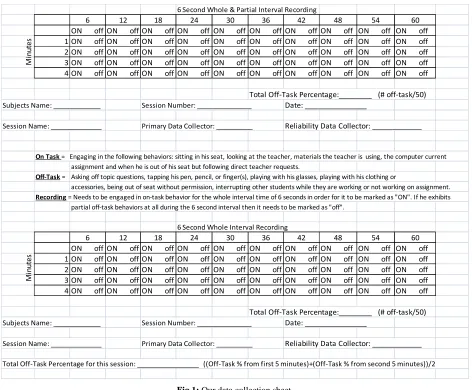
Materials The materials used in this study were straightforward. A 6 second-interval recording system was used. This was developed by the first two authors and used for recording their own intervals on a playback device which could be used with headphones while in the classroom setting. A six-second data recording sheet accompanied the recording; the data sheet can be located in Figure 1. The first two authors used a daily point sheets for
the participant; see Figure 2. A total of five point sheets were used throughout this study. The rewards our participant received were mainly attention from the first two authors; this was free. A $20 gift card was promised to our participant if he was able to gain the maximum amount of check marks per period. Our participant was also very interested in movies, so a movie was brought in by the first author for him to watch when he received the qualifying amount of check marks. A piece of paper stating these rewards was printed out for our participant to sign and keep with him as a reminder of the rewards to be earned (See Figure 3). Reward sheets were altered once a fading procedure was introduced, so a total of five reward sheets were used.
Fig 1: Our data collection sheet.
Dependent Variable and Measurement
The dependent variable measured was the percent of on-task behavior for our participant. On-on-task behaviors were defined as engaging in one or more of the following behaviors: sitting in his seat, looking at the teacher, materials or the computer; working on an assignment, out of his seat but following teacher directions, or raising his hand without talking. The behaviors identified that would prevent our participant from being marked as on-task would be: asking off topic questions, tapping his pen, pencil, finger, glasses or magnifier, playing with his glasses, clothing or accessories, being out of seat without permission, interrupting other students while working, staring off into space, or raising his hand while talking.
Data Collection and Interobserver Agreement
A six-second interval recording system was used over a total of two five-minute time periods, equaling one session, to record the amount of on-task and off-task behaviors. The two five-minute time periods’ results were then averaged together to determine the total on-task percentage for the entire session.
A whole and partial interval system was used to record the amount of on-task and off-task during each of the five-minute time periods. The amount of on-task was recorded using whole interval recording. This meant that in order for our participant to be considered on-task he would have had to been on-task for the entire 6-second interval on the data recording sheet. The amount of off-task was recorded using
6 Second Whole & Partial Interval Recording
6 12 18 24 30 36 42 48 54 60
ON off ON off ON off ON off ON off ON off ON off ON off ON off ON off 1 ON off ON off ON off ON off ON off ON off ON off ON off ON off ON off 2 ON off ON off ON off ON off ON off ON off ON off ON off ON off ON off 3 ON off ON off ON off ON off ON off ON off ON off ON off ON off ON off 4 ON off ON off ON off ON off ON off ON off ON off ON off ON off ON off
Total Off-Task Percentage:________ (# off-task/50)
Subjects Name: _____________ Session Number: _______________ Date: _______________
Session Name: ______________ Primary Data Collector: __________ Reliability Data Collector: ____________
On Task = Engaging in the following behaviors: sitting in his seat, looking at the teacher, materials the teacher is using, the computer current assignment and when he is out of his seat but following direct teacher requests.
Off-Task = Asking off topic questions, tapping his pen, pencil, or finger(s), playing with his glasses, playing with his clothing or
accessories, being out of seat without permission, interrupting other students while they are working or not working on assignment.
Recording = Needs to be engaged in on-task behavior for the whole interval time of 6 seconds in order for it to be marked as "ON". If he exhibits partial off-task behaviors at all during the 6 second interval then it needs to be marked as "off".
6 Second Whole Interval Recording
6 12 18 24 30 36 42 48 54 60
ON off ON off ON off ON off ON off ON off ON off ON off ON off ON off 1 ON off ON off ON off ON off ON off ON off ON off ON off ON off ON off 2 ON off ON off ON off ON off ON off ON off ON off ON off ON off ON off 3 ON off ON off ON off ON off ON off ON off ON off ON off ON off ON off 4 ON off ON off ON off ON off ON off ON off ON off ON off ON off ON off
Total Off-Task Percentage:________ (# off-task/50)
Subjects Name: _____________ Session Number: _______________ Date: _______________
Session Name: ______________ Primary Data Collector: __________ Reliability Data Collector: ____________
Total Off-Task Percentage for this session: _________________ ((Off-Task % from first 5 minutes)+(Off-Task % from second 5 minutes))/2
M
in
ut
es
M
in
ut
partial interval recording. This meant that if the participant displayed any of the defined off-task behaviors during any part of each 6-second interval then the participant was considered off-task for that interval. It was not possible for our participant to be considered both on-task and off-task for any given 6-second interval.
Interobserver agreement data were collected for 52% of sessions. Each observer sat next to each other, sharing one piece of the headphone connected to the audio recording device which contained the recording of the six second intervals while simultaneously observing our participant’s on and off-task behaviors. The first two authors independently marked the on and off-task behaviors accordingly on the data sheet as ON or OFF for every 6-second interval in each 5-minute time period. During the observation periods no discussion between the first two authors occurred. Interobserver agreement was calculated using the following formula: (Agreements / Agreements + Disagreements) x 100 = % agreement. The first two authors used a total interval per session ratio. The mean agreement score was 92 % with a range of 78% - 98%.
Experimental Design and Conditions
The experimental design used was a combination ABCAC single-subject multiple setting design with an increasing criterion to earn consequences (Kazdin, 2011; McLaughlin, 1983). An intervention of a token economy system was implemented for eight sessions. A return to baseline condition occurred for two sessions, before re-implementing the intervention of a token economy for two sessions. As intervention continued throughout this study, the amount of on-task behavior required by the participant increased but the amount of work the participant was required to complete stayed consistent. During a normal classroom day the teachers of Period A and Period B would give the participant an assignment with a request to complete the assignment. If our participant was inattentive to the assignment given, the classroom teachers would verbally prompt him to work on the assignment.
Baseline. During baseline the typical classroom procedures were in place. Data taken for baseline occurred in two separate classrooms our participant attended. If, in Period A, our participant was emitting off-task behaviors, the teacher would redirect his attention by asking him a question to help him focus on being on-task. Appropriate responses or behaviors from the participant were generally paired with a verbal praise such as “Thank you for paying attention.” or “Great job listening!” Verbal prompts were directed at our participant for being off task and inappropriate behaviors, these included “Our participant pay attention” or the behavior was ignored. If tangible items on his desk or around his desk area were distracting then his teacher would remove these items. Nothing was defined as an error that needed correcting in this study. If, in Period B, Our participant was engaging in off-task behaviors, his teacher would redirect his attention by asking him a question to help him focus on being on-task or would approach our participant and verbally direct him to focus on staying on-task. Appropriate responses or behaviors from our participant were usually paired with a verbal praise such as “Good Job ______!” or “Nice job staying on task.” Verbal prompts were given if the participant was off task or if he displayed any inappropriate
behaviors. These verbal phrases included ones such as “________ look at the projector screen.” If tangible items on his desk or around his desk area were distracting then the teacher would remove these items. If our participant continuously exhibited off-task behaviors and refused to work then his teacher would send our participant outside to the library. Nothing was defined as an error that needed correcting in this study.
Token economy. A token economy system (McLaughlin & Williams, 1988) was employed. During the token program, when an assignment was given to our participant by his teacher and he was then asked to complete this assignment. While our participant completed this assignment, the first two authors awarded the participant with check marks if he was able to stay on-task for a specified amount of time. This amount of time was determined through a variable interval schedule that ranged from 12s to 36s of on-task. Our participant was informed that he was informed of the reward system as well as the criteria for earning such rewards. (See Figure 2).
If (our participant) gets 14 check marks in (Period A) class then…
-Between (Period A) and (Period B) Mrs. Danielle will walk (our participant) to class and give him 2 “awesome” movie ideas.
If (our participant) gets 14 check marks in (Period B) then…
-Ms. Pauline will walk (Our participant) to the lunchroom to get his lunch.
If (our participant) gets 20 check marks in any class then… -(our participant) can have lunch with Ms. Pauline and Mrs. Danielle and can talk about any appropriate topic.
If (our participant) gets 28 check marks in any class then… -(our participant) gets to watch 20-25 minutes of Mrs. Danielle’s favorite movie during lunch.
If (our participant) gets 28 check marks in both classes then…
-(our participant) will get a $20 gift card to the movie theatre of his choosing on the following day.
Our participant required to obtain a certain amount of check marks throughout one entire class and that these check marks were able to be exchanged for a reward. The first two authors gave him the token economy reward list and explained these procedures to him. In order to prevent the participant from anticipating when the check marks would be received it was also explained to the student that he was going to be getting check marks “at random”. If the participant engaged in on-task behaviors throughout the specified intervals then a researcher would go over to him, give him a check mark paired with a verbal phrase. These phrases included, “Good job staying on task ________”, “Thanks for doing so well” or “You’re doing awesome ____.”
Date = ____________________ Session = ____________________
Period (A): Social & Life Skills Class
Goal = (#) Check Marks
__________________________________________________________________ Period (B): Science Class
Figure 3. The check mark system recording sheet used in social and life skills and science.
Goal = (#) Check Marks
Results
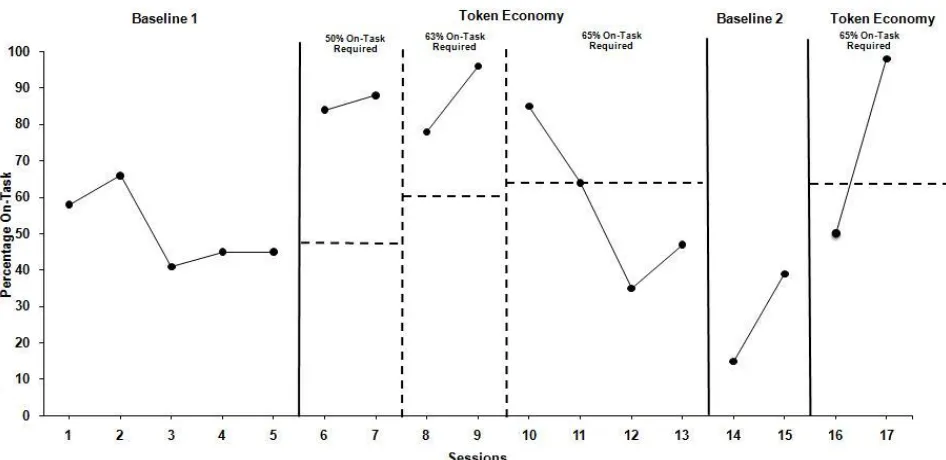
Baseline 1 and 2. The results for Period A for baseline can be seen in Figure 4. During baseline our participant’s on-task performance in Period A indicated low. His on-on-task ranged from 41% to 66% overall with mean of 51% of intervals as being scored on-task. When a return to baseline occurred Our participant’s on-task behaviors were found to be at an increasing trend (range 15 to 39%; M = 27%.). The results for Period B can be found in Figure 5. In baseline our participant’s on-task performance in Period B indicated a stable low level of performance. Baseline for
Fig 4: The percentage of on-task behaviors during Period A, during a 90-minute time frame. The horizontal dashed lines were the minimum percent of on task required to earn his reward.
Token Economy + Criterion Changes
The results of the token economy procedure are also seen in Figures 4 and 5. In Period A for the first criterion, our participant was required to be on-task for 50% of the time, his performance ranged from just 84% to 88% on task. For the second criterion, 63% of on-task behaviors were required for our participant and his behavior increased with a range of 78% to 96% on-task. For the third criterion, our participant was required to be on-task for 65% of the time, his on-task data were variable (range 35 to 85%). After the second baseline, the token program was again put in effect. His on-task behavior increased to a mean of 74% with a range from 50 to 98%.
In Period B for the first criterion where our participant was required to exhibit on-task behaviors 50% of the time, his data were began at a high of 78% on-task with a slight decrease to 69% on-task. In the second criterion where 63% of on-task was required, our participant’s on-task increased and ranged between 86 to 87% on-task. When our participant was expected to stay on-task for 65% of the sessions his on-task was variable and ranged from low of 50% on-task to a high of 80%. When the token economy was again in effect after the second baseline, his on-task behavior increased to a mean of 63% with a range of 49 to 77%.
Discussion
The results of this study indicated that a token economy procedure could be implemented to increase the on-task behavior of a single high school student with Asperger’s syndrome (AS) and ADHD. Initially the percentage of on-task behaviors increased in both Period A and B with the implementation of the token-economy procedure for the first and second criterions. However in the third criterion phases, the participant consciously made the decision to be noncompliant and defy any requests put forth by the teachers in the classroom. This change accounts for the variable data with percentage of on-task behaviors. When data were taken on the last session, our participant decided to comply with the requirements of the intervention and increased his on-task performance. The token economy procedure that the first two authors implemented indicated that extensive research still needs to be completed on our participant’s variable behaviors in order to figure out an alternative intervention approach. Experimental control was not achieved as the data indicates with the variability in the researcher’s data. Finally, the use of the token program with praise was effective and these outcomes replicate the large body of literature on token systems (Kazdin, 1977; McLaughlin & Williams, 1988).
The changing criterion design was implemented because the first two authors wanted to reduce the intervention in order to eventually transfer the reinforcement procedure to the teachers. The first criterion was established by taking an average of on-task behaviors of both classes in baseline. This indicated that our participant could stay on-task for approximately 55% of the time. The first two authors decided to set the first criterion of on-task behaviors slightly lower at 50% because our participant was competent enough to meet the expectations and successfully access the reinforcers as a result. As the data shows, the participant easily exceeded his 50% requirement. Consequently, our intervention procedures increased his percentage of on-task behaviors to 63%. Similarly, our participant easily accomplished the new requirement as well. As a result, the first two authors increased his new goal to 65% on-task behaviors which the participant never fully met so the last criterion never changed in the first two authors’ limited time available for the study.
The first two authors completed informal interviews with both of our participant’s teachers and the participant himself prior to the start of intervention. It was determined and agreed upon by the teachers and the participant that he would work for the rewards indicated on the reward sheet. Although a preference assessment could have made the study stronger, our participant was competent enough to tell the first two authors if the rewards were interesting enough for him to work for it. The reward for the point sheet system was specifically chosen because his teachers indicated that our participant was highly attention maintained and has a strong interest in movies.
The first two authors conducted interobserver agreement at a higher frequency because the target behavior was subjective in measuring our participant’s on-task and off-task behaviors according to the first two authors’ definition. On the third session of Period A the interobserver agreement was so low that the first two authors decided that interobserver agreements should be conducted more frequently at a closer rate.
The ability for a student to consistently exemplify on-task behaviors has significant implications in a school setting. Without the ability to stay on-task for an extended duration of time our participant’s academic performance will suffer and as his assignments continue to go unfinished he will lag behind his peers. Showcasing off-task behaviors will distract other classmates’ ability to complete their assignments or listen to the teacher as well. Learning how to consistently stay-on task would allow him to complete his assignments in a timely manner and receive satisfactory grades in return to pass his classes.
Future research could focus on increasing the length of time the study was conducted. In addition, more sessions could have been completed within the extended period of time. With an extended amount of time, more data could have been shown to prove our participant’s variable and unpredictable behaviors. Also, if more time was available more data could have been conducted to see if the trend from the last session when our participant exceeded his criterion requirement would continue. Finally, we were never able to remove the token economy by the end of data collection.
The first two authors relied on information given from the participant’s teacher to explain and account for his behaviors. For future research, instead of relying on informal interviews in order to validate the function of the participant’s behavior a structural analysis should have been implemented. Structural analyses are conducted in order to manipulate various antecedent events to assess what is really maintaining the function of the participant’s behavior.
In addition to a structural analysis, a preference assessment should be conducted in future research. A preference assessment provides a thorough explanation of rewards that would be reinforcing to our participant and what he would be willing to work for in order to increase his on-task behaviors (Alberto & Troutman, 2012).
The ultimate goal for high school special educators is for their students to successfully graduate from high school and integrate themselves to be productive members in society. A successful student maintains a high on-task performance percentage in order to complete assignments and attend to lectures to pass his/her classes necessary to graduate. Exhibiting on-task behaviors is an integral part of every successful student who hopes to graduate from high school.
Acknowledgements
This paper was written in partial fulfillment of the requirements of for an Endorsement in the special education from Gonzaga University and the Office of the Superintendent of Public Instruction, The State of Washington. Mrs. Danielle Troup is a high school special education behavior intervention teacher in a Freeman School District in Eastern Washington. Ms. Chung is an early childhood special education teacher in Bellevue Public Schools in the State of Washington. Ms. Schuler is now teaches students with behavior disorders in a middle school setting for Spokane Public Schools.
References
1. Alberto, P. A., & Troutman, A. C. (2012). Applied
behavior analysis for teachers (9th ed.). Upper Saddle
River, NJ: Pearson Education.
2. Araque, F., Roldan, C., & Salguero, A. (2009). Factors influencing university drop out rates. Computers &
Education, 53, 563-574.
3. Arvans, R. (2010). Improving reading fluency and comprehension in elementary students using Read Naturally. Dissertation Abstracts International, 71(01B), 74-649.
4. Barkley, R. A. (2014). Attention deficit hyperactivity disorder: A handbook for diagnosis and management
(4th ed.). New York, NY: Guilford.
5. Carter, M., McLaughlin, T. F., Derby, K. M. Schuler, H., & Everman, J. (2011). Differential effects of cover, copy, and compare in spelling with four high
school students with severe behavior
disorders. Academic Research International, 1, 44-52,
Retrieved from:
http://174.36.46.112/~savaporg/journals/issue.html 6. Colberg, L. (2010). Classroom management and the
ADHD student. Online Submission, Retrieved from EBSCOhost.
7. Crawford, D. & McLaughlin, T. F. (1982). Token reinforcement of on-task behavior in a secondary special education setting. Behavioral Engineering, 7, 109-117.
8. Doll, C., McLaughlin, T. F., Neyman, J., & Schuler, H. (2013). The use of cover, copy, compare procedure to teach spelling words with a high school student enrolled in a behavior intervention special education classroom: A brief report and partial replication.
Educational Research International, 1, 51-57.
Retrieved from:
http://www.erint.savap.org.pk/nextissue.html
9. DuPaul, G. J., Eckert, T. L., & McGoey, K. E. (1997). Interventions for students with attention-deficit/hyperactivity disorder: One size does not fit all.
The School Psychology Review, 26, 369-381.
10. Evans, S. W., Owens, J. S., Reinicke, C., Brown, R., & Grove, A. (2013). What parents and teachers should know: Effective treatments for youth with ADHD. In C. Franklin, M.B. Harris, & P. Allen-Meares (Eds.).
The school services sourcebook: A guide for
school-based professionals. New York, NY: Oxford
University Press.
11. Edwards, L., Salant, V., Howard, V. F., Brougher, J., & McLaughlin, T. F. (1995). Effectiveness of self-management on attentional behavior and reading comprehension for children with attention deficit disorder. Child & Family Behavior Therapy, 17, 1-17. 12. Fowler, M. (2010). Increasing on-task performance for
students with ADHD. Education Digest, 76, 44-50. 13. Harding, L. R. H., Howard, V. F., & McLaughlin, T. F.
(1993). Using self-recording of on-task behavior by a preschool child with disabilities. Perceptual and
Motor Skills, 77, 786.
14. Kazdin, A. E. (1977). The token economy: A review
and evaluation. New York, NY: Plenum.
15. Kazdin, A. E. (2011). Single case research designs:
Methods for clinical and applied settings. New York,
NY: Oxford University Press.
16. Kutscher, M., Attwood, T., & Wolff, R. (2006). Kids
in the syndrome mix of ADHD, LD, Asperger's, Tourette's, bipolar, and more!: the one Stop guide for
parents, teachers, and other professionals.
Philadelphia, PA: Jessica Kingsley Printers.
17. LeBrun, C., Jones, S., Neyman, J., McLaughlin, T. F., & Schuler, H. (2014). The effects of a modified direct instruction flashcard system on a 14 year-old-student with learning behavioral issues enrolled in a behavior intervention classroom. International Journal of
Undergraduate Education and Creative Activities, 6,
Article 5, 1-9. Retrieved from:
http://commons.pacificu.edu/ijurca/
18. McLaughlin, T. F. (1982). The effects of teacher praise on accuracy of math performance for an entire special education class. Behavioral Engineering, 7, 81-86.
19. McLaughlin, T. F. (1983). An examination and evaluation of single subject designs used in behavior analysis research in school settings. Educational
Research Quarterly, 7, 35-42.
20. McLaughlin, T. F., & Williams, R. L. (1988). The token economy in the classroom. In J. C. Witt, S. N. Elliott, & F. M. Gresham (Eds.). Handbook of
behavior therapy in education (pp. 469-487). New
York, NY: Plenum.
21. Moore-Partin, T. C., Robertson, R. E., Maggin, D. M., Oliver, R. M., & Wehby, J. H. (2010). Using teacher praise and opportunities to respond to promote appropriate student behavior. Preventing School
Failure, 54, 172-178.
22. Pfiffner, L. J., & O’Leary, S. G. (1993). School-based
psychological treatments. In J. L. Matson (Ed.)
Handbook of hyperactivity in children (pp. 234-255).
Boston: Allyn & Bacon.
23. Pfiffner, L. J., Rosen, L. A., & O’Leary, S. G. (1985). The efficacy of an all-positive approach to classroom management. Journal of Applied Behavioral Analysis, 18, 257-261.
24. Rao P. A., Beidel, D. C., & Murray, M. J. (2008). Social skills interventions for children with Asperger's syndrome or high-functioning autism: A review and
recommendations. Journal of Autism and
Developmental Disorders, 38, 353-361.
25. Rusnock, M., & Brandler, N. (1979). Time off-task: Implications for learning. Proceedings of the Annual meeting of the American Educational Research
Association (pp. 1-14). Pittsburgh, PA:
http://eric.ed.gov/PDFS/ED171407.pdf. ED171407 26. Shapiro, E. S. (2014). Academic skills problems:
Direct assessment and intervention (5th. edition). New
York, NY: Guilford Press.
27. Simonsen, B., Little, C. A., & Fairbanks, S. (2010). Effects of task difficulty and teacher attention on the off-task behavior of high-ability students with behavior issues. Journal for the Education of the Gifted, 34, 245-263.
28. Stewart, K. S., & McLaughlin, T. F. (1992). Self-recording: Effects for reducing off-task behavior with a high school student with attention deficit hyperactivity disorder. Child & Family Behavior
Therapy, 14(3), 53-59.
consequences to increase the typing fluency and accuracy for seven high school students with severe behavior disorders. Journal of Education and Human
Development, 3, 181-201.
30. Volpe, R.J. & Fabiano, G.A. (2013). Daily behavior report card: An evidence based system for assessment
and intervention. New York, NY: Guilford Press.
31. Willis, R., Whalen, K. P., Sweeney, W .J., & McLaughlin, T. F. (1995). Effects of self-recording and contingent computer time on the off task behavior of an adolescent with emotional disturbances. Child &