A 802.22b protocol for inter/intra WRAN
communication
Carla Passiatore
1, Pietro Camarda
1,∗1DEI, Politecnico di Bari, Bari, Italy
Abstract
In this paper we focus on cognitive 802.22b Wireless Regional Area Networks (WRANs). In particular a
protocol, namedinter intra-resource sharing algorithm (2I-RSA), is presented to address the problem of self
coexistence for WRANs and secondary users of the WRAN. The purpose of the proposed resource sharing mechanism is to allow P2P communications avoiding interference among users of the same network or of neighbouring cells, optimizing, at the same time, fairness and network capacity.
Receivedon 16 December 2014;acceptedon 04 February 2015;publishedon 12 March 2015
Keywords: cognitive networks, 802.22b, fair spectrum allocation,Intra-cell communication, Inter-cell communication, TV white space
Copyright© 2015 Carla Passiator and Pietro Camarda, licensedtoICST. Thisisanopenaccess articledistributedunder the terms of the Creative Commons Attribution license (http://creativecommons.org/licenses/by/3.0/), which permitsunlimiteduse,distributionandreproductioninanymediumsolongastheoriginalworkisproperlycited. doi:10.4108/casa.2.3.e5
1. Introduction
In the last years we are observing the continuous and growing request of various services and smartphone wireless applications, corresponding to a continuous and growing request of spectrum availability. At this problem a inefficient resource usage is combined. The spectrum inefficient exploiting is related to a static channel assignment policy. Proof of this is the analysis directed by the Federal Communications Commission (FCC) which has demonstrated the usage of the spectrum [1]. The point of issue is that the band is not exploited with time continuity but there are temporal intervals where the users are idle and, consequently the transmission channel is unused. As an example, below some spectrum occupancy measurements are reported, [1]: in New York City the maximum total spectrum occupancy is only 13.1% from 30 MHz to 3 GHz; in Washington the band occupancy is less than 35% for the radio spectrum below 3 GHz.
Cognitive Network (CN) paradigm focuses on the idea to increase the spectrum utilization by allowing unlicensed users to exploit licensed spectrum during the inactivity period of licensed users, without causing harmful interferences each other. A CN is composed by primary and secondary users well as spectrum
∗
Corresponding author. Email:[email protected]
holes. A spectrum hole, also called white space, is a region of space-time-frequency temporally unused for communication by licensed users. Primary Users (PUs) are the licensed consumers which have the right to access a channel whenever they need. While Secondary Users (SUs) are unlicensed users who have the capability to sense the spectrum, and transmit on the temporally unallocated band, (i.e. spectrum holes), with the condition of not cause any harmful interference to the PUs. In this context, one of the major challenge is to share the licensed spectrum among SUs without interfering with PUs, and the same SUs. Moreover, one of the most important challenges for enabling efficient cognitive network systems is the coexistence problem [2]. Coexistence can be between SUs of the same network, called self-coexistence, or between secondary networks. The self-coexistence problem is emerging for network overlapped in the same geographical area. In this paper we propose a protocol to address self-coexistence problems, and coexistence among different cognitive networks. This paper is an extension of the previous work [3], where only the CPE coexistence problem in a WRAN was studied.
when the TV bands are underutilized, WRAN service providers can exploit these resources. IEEE 802.22 standard adopts a centralized topology with a Base Station (BS) and Customer Premise Equipments(CPEs) which are the SUs of the network. According to the centralized structure all the messages have to transit through the BS. This uselessly increases the data traffic in the network if the two nodes that attempt to communicate are within the same WRAN. Furthermore, this model leads to a limited network capacity, because in downlink transmission a channel can be exploited by only one CPE per time slot. At the aim to overcome also this limitation a new working group, namely 802.22b, was approved by the IEEE 802 committee. According to the 802.22b standard the peer to peer (P2P) communication is made available, in other words direct CPE to CPE is allowed if the users are managed by the same BS. In this way, inside a WRAN the same channel can be used simultaneously by different couples of CPEs, provided that the transmissions are not interfering each other and with PU activities.
An issue of this topic is the channel allocation prob-lem which influences the network performance sig-nificantly in different features, as fairness, network capacity and interference. The resource sharing prob-lem happens at two levels, among the CPEs of the same WRAN, i.e.intra-network, and among neighbour-ing WRANs,inter-network. In this paper we present a two level algorithm to improve intra and inter network resource sharing, exploiting the frequency reuse and maximizing the total throughput. The proposed proto-col holds all these characteristics, providing a spatial reuse mechanism, for inter and intra resource sharing, named Inter and Intra Resource Sharing Algorithm (2I-RSA) . The main idea of the presented method is based on the Interference Map (IM), which is a picture of the possible interference among CPEs and WRANs. This is a method already introduced in literature but we exploit IM and channel reuse in such a way to maximize fairness and network capacity. In literature, other works were proposed which focus on channel management for cognitive P2P networks ([4],[5],[6] or [7]), but in these papers the number of available channels is variable while the bandwidth is always the same, what’s more these works focuses or on the inter networks resource sharing or intra networks. In our work we have con-sidered also the bandwidth, which, according to the 802.22 standard, can be equal to 6,7 or 8 MHz. Channels with different bandwidth have different weights in the network, allowing to transmit, in the same time, more or less data. Moreover, we have proved, computing the Jain’s index [8], that our method compared with the proposed one in [5] is more fair. In [7] is proposed a resource sharing algorithm for P2P network which tries a trade offbetween fairness and network capacity, but the proposed solution is static which is not suitable
in a cognitive environment. While our protocol adapts to a dynamic environment, which is the feature of a cognitive network.
The rest of the paper is organized as follows. In Section 2 we show a brief overview of the latest update on IEEE 802.22 working group activities. In Section 3 we give a detailed description of the proposed resource sharing algorithm In Section 4, the performance is investigated through a simulation tool, and the results are compared with those obtained in [5]. Section 5 draws the conclusions.
2. 802.22b Overview
In this Section an overview of the 802.22b working group is presented. The new IEEE 802.22b task group has been formed by IEEE 802 working group to extend and improve IEEE 802.22 applications in TV white space. In particular 802.22b architecture proposes an enhancement for broadband services and monitoring applications.
After the switch from analog to digital broadcasts many frequency bands are unexploited, this trend is in opposition with the continuous growing request of spectrum availability. To compensate for the lack of bandwidth, cognitive radio networks have been developed. IEEE 802.22 is a standard which allows to exploit unused TV frequency spectrum, in the specific TV channels from 54 to 862 MHz with a bandwidth of 6, 7 or 8 MHz. IEEE 802.22 WRAN has a centralized topology composed by one BS which manages CPEs (which are the SUs of the network) and the medium accesses control. The BS is responsible of spectrum sensing, channel distribution among CPEs, and routing messages to the CPEs. On the one hand the present of the BS, in the centralized structure, makes the implementation of the resource management very simple. On the other hand this structure has a negative impact on the network capacity; because every communication transits through the BS, both if the messages are addressed from CPE to the BS either if the communication is between CPEs of the same 802.22 network. Consequently, in downlink transmission, a channel can be exploited by a CPE at a time slot. Moreover, the coverage area of a WRAN is on the order of some kilometres [6], so the number of inter communications is very high.
In the light of what is said, the availability of WRAN peer to peer communication is necessary to improve the network performance, such as capacity, and energy consumption. So IEEE 802.22b working group was introduced, at the aim to implement direct communication between CPEs of the same network.
devices operating is VHF/UHF TV broadcast bands, such as real-time, emergency broadband services or remote medical services, [9]. None of these use cases are implemented by the IEEE Std. 802.22-2011.
In the following the main features of 802.22b standard are listed, [10] [9] [11]:
• working in TV white spaces
• working in Very High Frequency (VHF)/Ultra High Frequency (UHF) TV broadcast
• enabling monitoring applications
• enabling peer-to-peer connection
• individual spectrum sensing technologies
• supporting very large number of CPEs, more than 512 devices in a network.
• supporting high reliability and QoS
• supporting real-time monitoring system with low latency, for channel sensing
• exploiting interface with various sensors, also to improve sensing ability
• supporting high data rate
• managing mechanisms to enable coexistence with other 802 systems.
CPE to CPE communication is an essential feature and key function of the smart grid, broadband services, monitoring application, or other applications based on IEEE 802.22b networks.
3. 2I-RSA
In this Section 2I-RSA is explained.
The features of the assignment policy are:
• reuse of the spectral frequencies;
• resource sharing with regards to the spatial diversity, i.e. the availability of some channels only for some users;
• resource sharing according to the variance of the channel availability;
• fairness, i.e. channel distribution according to the CPE spectrum demands.
Before presenting the proposed algorithm some definitions are given. Two CPEs are definedoverlapped
if the communication (transmitting or receiving) of the first CPE could interfere with the transmission of the second one and vice versa. Otherwise the CPEs could exploit the same channel without causing interference each other. The BS has to coordinate
the transmissions in its WRAN in such a way to avoid harmful interference. Nevertheless this approach is not sufficient to totally avoid collisions, because there is the risk of interference among CPEs that belong to different, but neighbouring, WRANs. We say that two neighbouring WRANs are overlapped if the transmissions of CPEs , that are in the two different cells, exploiting the same channel at the same time, interfere each other.
The algorithm is composed by two steps, the first one is the inter network-RSA, and the second one named intra network-RSA. The scenario is composed by multiple cognitive 802.22 networks, each of which composed by multiple CPEs and one BS. The BS is responsible of the device channel access of its network. The scope of the proposed protocol is to create a two level resource sharing map for interfering users. The channel assignment is used to allocate the set of idle channels to the overlapped WRAN cells in the first level, and to the overlapped CPEs in the second level.
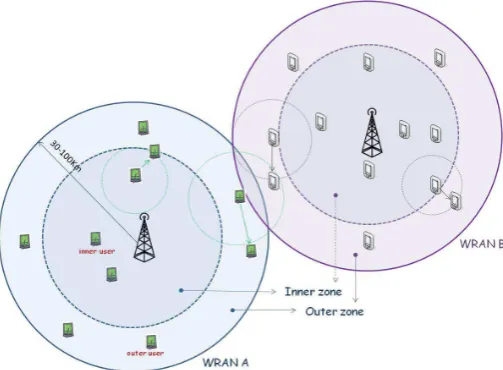
The WRAN could be divided into two parts, the inner and the outer zone [12]. Considering that the typical 802.22 cell radius is in the range 30-100 Km [13], and that the range for a CPE is 33 Km, CPEs in the inner zone do not have the possibility to interfere with user of another 802.22 network, the same cannot be said of users in the outer zone. Referring to the figure1, two overlapped WRANs are represented. The figure shows as the communication between two outer zone users of the WRAN-A interferes with the transmission of the outer CPEs of the neighboured WRAN-B.
The algorithm is divided into two phases, after the first phase a Channel Access Map (CAM) is computed (which is shared among WRANs), while during the second one each BS evaluates a channel access map for the CPEs of its WRAN. The first part of the algorithm is exploited to determine the resources which are allowed to the the outer zone CPEs. While the intra-RSA is implemented to elaborate a channel access map in each network.
In figure 2 a 2I-RSA summarizing scheme is showed. The roles of the first step are represented with blue lines, which are I) the CPEs-BS and BSs-Coordinator communications, II) the data elaboration at the coordinator to compute the WRAN CAM, and III) the transmission of this to the BSs. While in the second step the operations are illustrated with green lines, in particular they are the procedures made at the single BSs to compute the CPE CAM , and the broadcasting of this in the cell.
Figure 1. Interference among CPEs of overlapped WRANs.
CPEs
Location Sensing Request
CPEs
Location Sensing Request
Coordinator
Overlay Table
Channel Table
WRAN Clusters
WRAN CAM
Requests CPEs
Location Sensing Request
BS
Overlay Table Channel
Table CPE Clusters CPE
CAM
BS
Overlay Table Channel
Table CPE Clusters CPE
CAM
BS
OverlayTable Channel
Table CPE Clusters CPE
CAM
Figure 2. 2I-RSA Scheme.
3.1. Inter Network-RSA
As in [14] we refer to a scenario composed by multiple overlapped 802.22 networks, which form a community made by a coordinator and other memberships, namely WRANs. The coordinator, which is the community leader, is elected among the BSs. In literature different methods are well known for electing a leader, as [15] or [16]. In [14] the coordinator manages the membership access to the channels, in such a way to avoid harmful interference among the WRANs. Each BS is able to transmit information to the coordinator which exploits these data for resource sharing optimization. For the inter-network communication the 802.22 standard
specifies a protocol, Coexistence Beacon Protocol (CBP) [17], a self-coexistence mechanism based on beacon transmissions among the coexisting WRAN cells.
The information transmitted by the BS to the coordinator is previously collected inside the WRAN with the CPE collaboration.
i.e. their sensing results. The concept of request will be clarified in the following. Note that the amount of information exchanged among CPEs and the BS is exiguous; each device has to communicate only the channel availability, the CPE in interfering area and its requests. The BS collects this information, computing the total request of its network, which is the sum of all the requests of the SUs of its cell, and WRAN’s available channels. The BS exploits these data to avoid interference among users of the neighbouring WRANs. According to these data the inter-network RSA is implemented to define the frequency bands which are allowed for the transmission of the CPEs in the outer zone.
After the sensing period and the information exchange between BS and CPEs, every BS conveys to the coordinator I) its geographic position II) its WRAN resource request, III) its WRAN sensing results. For this protocol we assume that if a BS hears a channel it is available for all the CPEs of the WRAN, which is a plausible hypothesis considering that the channels are those made free by TV broadcasters.
IEEE 802.22 is a time slotted protocol [19]; the operations are spread in a slotted structure composed by frames and superframes. The 802.22 superframe is composed by 16 MAC frames, composed by time slots which are preceded by a preamble and a frame control header (FCH). The coordinator exploits data for resource sharing optimization, in this context the resources are the frames. According to the data and implementing the first step of 2I-RSA, the coordinator determines the WRANs which are allowed to transmit and the respective channels to be occupied. The information elaborated by the coordinator is included in the inter network channel access map, named also WRAN CAM, broadcast by the coordinator to the BSs. With the inter network channel access map the coordinator communicates to each WRAN during which time slots and which channels its outer CPEs can exploit for the transmission.
To maximize the spectral efficiency, taking into account the spatial diversity, the coordinator has to verify, for each channel, the group of WRANs which are able to transmit simultaneously without causing interference, it has to create the interference map.
Data are collected with the help ofoverlayandchannel table, the first one exploited to memorize topology information, the second one for the available resources and the spacial diversity. Theinter-network overlay table
and channel table have to be updated as soon as new information is received.
Theinter-network overlay tableis a square matrix, with sizeN, whereN is the total number of WRANs in the community. The (i, j) element of the matrix is equal to 1 if theW RAN i and the W RAN j could interfere each other. While thechannel tablehas the number of rows
equal to the number of WRANs in the community, and a number of columns equal to the number of channels. The (i, j) element of thechannel tableis equal to 1 if the
channeljis available for theW RAN i.
As an example in tab.1shows aninter-network overlay table. For reasons of compactness in tab.1 and in the other tables of this paper the notation W1 stands for
W RAN1, and so on.
Table 1. Inter-network Overlay Table
W1 W2 W3 W4 W5 W6
W1 1 0 0 1 0 1
W2 0 1 1 1 1 1
W3 0 1 1 0 1 0
W4 1 1 0 1 0 1
W5 0 1 1 0 1 0
W6 1 1 0 1 0 1
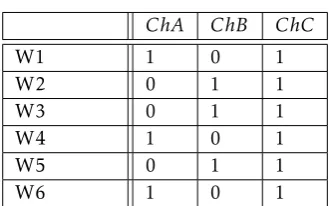
Thechannel tableis created according to the received sensing information. Moreover, we suppose to have three available channels with different coverage area, which allow to build up thechannel tableshown in tab.2. As an example, we supposed thatchannelAis available only for W RAN1, W RAN4 and W RAN6, channelB
is available only for W RAN2, W RAN3 and W RAN5, while the third channel covers all the network.
Table 2. Channel Table
ChA ChB ChC
W1 1 0 1
W2 0 1 1
W3 0 1 1
W4 1 0 1
W5 0 1 1
W6 1 0 1
According tochannelandinter-network overlay table, the WRAN header is able to elaborate the sets of WRANs which could transmit simultaneously without interfering each other. In the following these WRAN groups are called clusters. The procedure to compute the clusters is:
• for each channel the coordinator has to examine which are the WRANs allowed to use it; i.e. for eachchannel tablecolumn the coordinator checks the elements marked with 1.
In the exposed example W RAN1, W RAN4, and
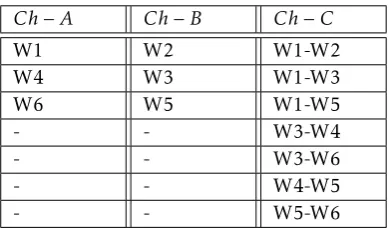
W RAN6 are overlapped among them, then only one of these can occupy the channelA, simultaneously. While more users can transmit simultaneously using thechannelCwithout interfering each other. In tab.3are shown all the possible channel assignments. Precisely, each column of the table is referred to a specific channel. Each row shows the possible groups of
W RANs which can transmit simultaneously, without interfering each other, occupying the same channel, which is indicated on the top of the column.
Table 3. WRAN Cluster
Ch−A Ch−B Ch−C
W1 W2 W1-W2
W4 W3 W1-W3
W6 W5 W1-W5
- - W3-W4
- - W3-W6
- - W4-W5
- - W5-W6
The coordinator exploits these tables for resource sharing optimization. It creates the CAM, which indicates WRANs allowed to transmit at a given moment. The map is created selecting for each channel a single cluster which is allowed to occupy it for a superframe. The choice is taken with the aim to assign resources proportionally to the requests, taking into account the spatial diversity. Note that the protocol is dynamic because CPEs update information every two seconds, whenever an environment change is detected, as PU transmission or new requests. The exploited resource sharing algorithm takes into account two different aspects: the resource already assigned to the user and the fairness of the allocation. The goal is to take the fairest choice among the ones which maximize the total throughput of the network community. In the Appendix section a mathematical description of the algorithm is introduced, to provide a formal justification for the choice of the algorithm; while in this section an intuitive exposition is suggested. Each BS communicates to the coordinator the resource request, to each BSi a reqi is associated, where reqi is the amount of data that BSi needs to transmit. In the exposed case the WRAN set which can transmit simultaneously without producing interference are illustrated in Tab.3. As an example in Tab.3, 7 different combinations are individuated for channelC, namely [W1-W2], [W1-W3], [W1-W5], [W3-W4], [W3-W6], [W4-W5], [W5-W6]. To define the
channelC access map the coordinator must select one of the above sets to assign the resource, for each slot.
The criteria introduced in order to chose the best cluster among the available group for each channel, is the one which maximizes theyfunction:
y= N X
i=1
piln(ni+ 1). (1)
Whereni is the amount of data already transmitted by W RAN i, with ni ≥0. While, pi, the transmission probability, is a factor that takes into account the amount of data that the single user desires to send;pi is computed in the Appendix.
The function y was build as in eq.3 because it increases when the resources are assigned to the WRANs with higher requests: they have higher pi, so increasing the corresponding ni the global value of y will increase too. Moreoveryhas a logarithmic growth, for this reasony raises very fast with the first assigned superframes to the users with higherpis. Subsequently, in the sum, the contributes of these will raise more slowly, because it is a logarithmic function, then, for increasing y, it is necessary to assign resources to the WRANs with lower pis. Moreover, as shown in the appendix, in the optimal solution,ni is proportional to the relatedpi, this confirms the fairness of the proposed method.
The coordinator creates the WRAN CAM choosing for each time slot, for each channel the WRAN cluster which is enabled for transmission in that period. The coordinator dispenses the channel access map to each BS of the community. With this transmission the inter-RSA concludes; now the intra WRAN transmission has to be coordinated.
3.2. Intra Network-RSA
The BS is the coordinator of its WRAN. It has to disposes the channel access map of its WRAN, theintra network channel access map, taking into account the CPE requests and the inter network channel access map. As previously explained, the inter network interference problem is connect to the CPEs in the outer zone of the WRAN, while the inner zone CPEs do not interfere with users of neighbouring WRANs. Then, the BS, creating the CAM for its cell, has to schedule the resource avoiding interference intra WRAN and inter WRANs, at this aim the BS conducts the second step of the 2I-RSA. The BS has all to implement the Intra-RSA: the CPEs’ request and position, channel availability and WRAN CAM. The BS builds the overlayand channel table, for its WRAN, and consequently the table for the CPE clusters which are allowed to transmit simultaneously without interfering, as in table 3, but referred to the CPEs. In the subsequent phase the BS, exploiting they
by the inter-RSA, in computing final y value, there is another constraint, which is represented by the WRAN CAM. Calculating they value the BS has to exclude the outer CPEs if they are not allowed to transmit according to the inter network channel access map. That is why in figure.2 the input data for computing CPE MAP are CPE clusters, CPE requests and WRAN CAM.
4. Simulation Results
In this section the performance of the 2I-RSA are evaluated.
In particular 2I-RSA is compared with the previous version, P2P-RSA [3], at the aim to demonstrate that the new version is equally fair. Moreover the proposed method is compared with another algorithm to prove that it is more fair without losing performance in terms of network throughput. The comparing protocol, named self-adapting interference map building proto-col (SIMBP), exploits the interference map to maximize the total throughput of the network [5]. SIMBP is intro-duced as comparison protocol because it is used in a 802.22 network for multiple channel allocation, as 2I-RSA.
In the simulation scenario we have supposed a wide area covered by five overlapped WRANs. In the multichannels environment, the number of available channels is varied in the range [1,3]. The number of nodes in the single network is increased, with step of 10 units, in the range [10:30]. Results have been computed supposing CPE request and position randomly chosen.
Since SIMBP and P2P-RSA are exploited for resource sharing in a single WRAN, the showed results are refereed to a WRAN of the scenario, but while 2I-RSA is an intra network collision free protocol, the other cited protocols suffer of interference for the overlapped CPEs.
The results obtained simulating 2I-RSA are illus-trated by red lines, while the P2P-RSA results with green lines, and SIMBP with yellow.
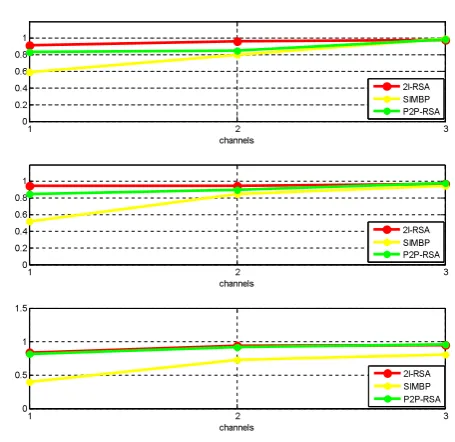
In figure3 the Fairness Index (FI) is computed whit the use of the Jain’s index, for more details see [8]. The index was computed varying the number of available channels and users in the WRAN.
The results illustrated in figure3 show that the proposed method is more fair then SIMBP, and also compared with P2P-RSA the performance is not decreased. Note that the maximum value of Jainśindex is 1, so figure3demonstrates that the proposed protocol is a really fair resource sharing method.
In the same scenarios we computed the network capacity, as the total throughput of a WRAN. The results are shown in figure4
Figure4 shows that the network capacity grows increasing the number CPEs and channels. It is important to notice that, exploiting 2I-RSA, the total
1 2 3
0 0.2 0.4 0.6 0.8 1 channels FI n. no de s = 10
1 2 3
0 0.2 0.4 0.6 0.8 1 channels FI n. no de s = 20
1 2 3
0 0.5 1 1.5 channels FI n. no de s = 30 2I-RSA SIMBP P2P-RSA 2I-RSA SIMBP P2P-RSA 2I-RSA SIMBP P2P-RSA
Figure 3. FI evaluated with different algorithms
1 2 3
0.6 0.8 1 1.2 1.4 1.6x 10
5 channels Th ro ug hp ut n-no de s= 10
1 2 3
0.5 1 1.5 2 2.5
3x 10
5 channels Th ro ug hp ut n-no de s= 20
1 2 3
1 1.5 2 2.5 3 3.5x 10
5 channels Th ro ug hp ut n-no de s= 30 2I-RSA SIMBP 2I-RSA SIMBP 2I-RSA SIMBP
Figure 4. WRAN Capacity
capacity of the network is not less than the one obtained with SIMBP, this is because 2I-RSA is not affected by inter network interference.
The purpose of our algorithm was to create a fair resource sharing protocol, the showed results demonstrate that the goal is reached without losing performance in term of network capacity.
5. Conclusions
to build the inter network interference map. This first interference map is used to avoid collision among CPE overlapped in two different WRANs. The allocation resource intra network is managed by the BS, which according with inter network-IM, CPE requests and geographic positions, builds the intra network channel access map. The proposed protocol is an evolution of the previous P2P-RSA,[3]. 2I-RSA compared with P2P-RSA presents similar values of FI, in addition it solves interference problems with neighbouring cells.
Appendix
In this Section the resource sharing algorithm is explained in detail, demonstrating that it allows the best resource distribution.
Note that the algorithm is used to schedule resources or among CPEs, in this case the BS implements the algorithm, or among WRAN, here the coordinator implements the RSA. In this section we refer to the inter RSA, so we named WRAN and coordinator, but the same line of reasoning is applicable to the intra-RSA with CPEs and BS.
The algorithm aims to schedule in a fairness way the transmission. To achieve this, for each frame and for each available channel, the coordinator considers the WRAN clusters which may transmit simultaneously, see table3, and it chooses the fairest option among the ones which maximize the assigned resources.
Each BS, BSi, estimates the total amount of data which its CPEs need to transmit, namedrequesti, which is the number of frames requested byW RAN i;requesti is computed according to the channel bandwidth and the amount of data to be transmitted by W RAN i. According to the requests the coordinator computes the transmission probabilitypi, for eachW RAN i, by using the following formula:
pi =
requesti PN
j=1requestj
, (2)
whereN is the number of WRANs in the scenario. All thepi of the community are included in the probability vector, where the ith element is the transmission probability of the WRANi.
To choose the WRAN cluster, the state_vector, namely
s_v, is used. It is a vector of N elements, where the ith-element indicates how many frames have been totally assigned to theW RAN i. As an example, vector [3,3,0,0,0,0] represents the state where 3 frames have been assigned toW RAN1 andW RAN2. Specifically, the bests_v is the one which maximizesy, where:
y= N X
i=1
piln(ni + 1), (3)
withni ≥0, whereni is the number of frames assigned toW RAN i. In practice, theni value introduced in the eq.3is theith-elementof thes_v.
The RSA goal is to maximize y in eq.3; in the following is demonstrated that the optimal solution is obtained whenni =n·pi, wherenis the total number of assigned frames. In other words, in the optimal solution
ni is proportional to the related pi, according to the WRAN requests.
At the beginning of the assignment process the s_v
is a null vector with length equal to the number of the community members. For the example of tab.1 it iss_v=[0,0,0,0,0,0], because there are 6 WRANs. Every time that the coordinator increases the number of frame where a WRAN can exploit a channel, theithelement of the s_v is incremented of a unit. For each available channel and for each superframe, the coordinator has to choose among the combinations of tab.3the one that gives thes_vwhich maximizes the function of eq.3.
To choose the WRAN clusters for the transmission, a greedy algorithm is implemented. Starting from the channel with larger band, the coordinator evaluates all the possible finals_vs which could be chosen according to the cluster of tab.3. For each entry of tab.3, the result of eq.3 must be calculate, evaluating the s_v
and computing the correspondingy value, and finally choose the state which returns as result the highest value ofy. In this way thes_vis updated according with the selected cluster.
The criterion on witch RSA is based is to maximize the eq.3, in particular we prove that the optimal solution is obtained when ni =n·pi, where n is the total number of frames assigned. This means that, in case ofpi all equal among them, the algorithm chooses the state_vector whereniapproaches more to the mean valueni =n/N. In general, in the optimal solutionni is proportional to the relatedpi, i.e. respects the resource request ofW RANi.
To show the optimality condition we assume the following approximation:
N X
i=1
piln(ni + 1)≈ N X
i=1
piln(ni). (4)
Eq.4is true forni >0; note thatni = 0 implies ln(ni + 1) = 0 and thus it does not give a contribution to the sum. So we can considerni ≥1.
To show the optimality condition eq.3 can be rewritten in the following way :
N X
i=1
piln(ni+ 1) = N X
i=1
pi[ln(ni + 1) + lnni−lnni]. (5)
N X
i=1
piln(ni+ 1) = N X
i=1
pilnni+ N X
i=1
pilnni+ 1 ni
. (6)
It is possible to observe that the following inequality is always true:
N X
i=1
pilnni + 1 ni
≤1. (7)
In particular, the above sum has limit 0 when ni increases. The second term of eq.6 is negligible and consequently:
N X
i=1
piln(ni + 1)≈ N X
i=1
piln(ni). (8)
Let us now prove the following inequality:
N X
i=1
piln(ni)≤ N X
i=1
piln(npi), (9)
and in particularPN
i=1piln(ni) is maximized when ni =npi.
Now we consider: N X
i=1
piln(ni)− N X
i=1
piln(npi), (10)
which can be written as:
N X
i=1
piln ni npi
. (11)
Given that that lny≤y−1, see [20], we obtain: N
X
i=1
piln ni npi ≤ N X i=1
pi[ ni npi
−1]. (12)
The second member of the inequality is equal to 0, in fact:
N X
i=1
pi[ ni npi
−1] = N X
i=1
pi ni npi
− N X
i=1
pi = 0. (13)
Then eq.12can be written as:
N X
i=1
piln ni npi
≤0; (14)
We proved that:
N X
i=1
piln(ni)≤ N X
i=1
piln(npi), (15)
which means that first and second member become equal when ni =n·pi, i.e. PNi=1piln(ni) is maximized whenni =n·pi.
6. Acknowledgements
This work was supported by the PON projects (RES NOVAE, ERMES- 01-03113, DSS-01-02499 and EURO6-01-02238) funded by the Italian MIUR and by the European Union (European Social Fund).
References
[1] Khaled and W. Zhang, “Cooperative communications for cognitive radio networks,” Proceedings of the IEEE, vol. 97, pp. 878–893, May 2009.
[2] M. Hani, H. Salameh, Y. Jararweh, and A. Bousselham, “Traffic-aware self-coexistence management in IEEE 802.22 WRAN systems,” in GCC Conference and Exhibition (GCC), 2013 7th IEEE, pp. 507–510, Nov 2013. [3] C. Passiatore and P. Camarda, “A P2P resource sharing algorithm (P2P-RSA)for 802.22b networks,” in Proc. of International Conference on Context-Aware Systems and Applications (ICCASA), (Dubai, United Arab Emirates), Oct. 2014.
[4] J. Shimonovich, A. S. Baruch, and S. S. Shitz, “Cognitive cooperative communications on the multiple access channel,” in Information Theory Workshop (ITW), 2013 IEEE, pp. 1–5, Sept 2013.
[5] H. Shi, R. Prasad, V. Rao, and I. Niemegeers, “Procedure to build interference map in peer to peer ieee 802.22 networks,” inGlobal Communications Conference
(GLOBECOM), 2012 IEEE, pp. 1103–1108, Dec 2012.
[6] H. Shi, R. Prasad, and I. G. M. M. Niemegeers, “An intra-cell peer to peer protocol in IEEE 802.22 networks,”
in GLOBECOM Workshops (GC Wkshps), 2011 IEEE,
pp. 533–537, Dec 2011.
[7] H. Shi, R. Prasad, V. Rao, and I. Niemegeers, “Fairness and network capacity trade-offin P2P IEEE 802.22 net-works,” in Global Communications Conference
(GLOBE-COM), 2012 IEEE, pp. 1435–1440, Dec 2012.
[8] C. D. . H. W. Jain, R., “A quantitative measure of fairness and discrimination for resource allocation in shared computer systems,” tech. rep., September 1984.
[9] [Online]. Available at: http://www.ieee802.org/22/. [10] C.-W. Pyo, X. Zhang, C. Song, M.-T. Zhou, and H. Harada,
“A new standard activity in IEEE 802.22 wireless regional area networks: Enhancement for broadband ser-vices and monitoring applications in tv whitespace,” in
Wireless Personal Multimedia Communications (WPMC), 2012 15th International Symposium on, pp. 108–112, Sept 2012.
[11] M.-T. Zhou, C. Song, C. Sum, and H. Harada, “Energy/bandwidth-saving cooperative spectrum sens-ing for two-hop wran,” inCognitive Radio Oriented Wire-less Networks and Communications (CROWNCOM), 2014 9th International Conference on, pp. 51–56, June 2014. [12] T. sub Kim, S. joon Lee, S. Chhorn, C. ho Cho, and
S. Ryu, “Resource allocation and power control scheme for interference avoidance in lte-advanced device-to-device communication,” inComputing and Convergence Technology (ICCCT), 2012 7th International Conference on, pp. 1201–1204, Dec 2012.
networks,” Wireless Communications, IEEE Transactions on, vol. 12, pp. 4363–4375, September 2013.
[14] C. Passiatore and P. Camarda, “A centralized inter-network resource sharing (CIRS) scheme in IEEE 802.22 cognitive networks,” in Ad Hoc Networking Workshop (Med-Hoc-Net), 2011 The 10th IFIP Annual Mediterranean, pp. 17–24, June 2011.
[15] S.-H. Park, Y. Kim, and J. S. Hwang, “An efficient algorithm for leader-election in synchronous distributed systems,” inTENCON 99. Proceedings of the IEEE Region 10 Conference, vol. 2, pp. 1091–1094 vol.2, Dec 1999. [16] W. Hu, D. Willkomm, M. Abusubaih, J. Gross, G. Vlantis,
M. Gerla, and A. Wolisz, “Cognitive radios for dynamic spectrum access - dynamic frequency hopping commu-nities for efficient ieee 802.22 operation,” Communica-tions Magazine, IEEE, vol. 45, pp. 80–87, May 2007. [17] “IEEE standard for information technology– local and
metropolitan area networks– specific requirements– part
22: Cognitive wireless ran medium access control (mac) and physical layer (phy) specifications: Policies and procedures for operation in the tv bands,” IEEE Std 802.22-2011, July 2011.
[18] S. Sengupta, S. Brahma, M. Chatterjee, and S. Shankar, “Enhancements to cognitive radio based IEEE 802.22 air-interface,” in2007 IEEE International Conference on Communications, pp. 5155 – 5160, June 2007.
[19] H. Shi, R. Venkatesha Prasad, V. Rao, and I. Niemegeers, “Adapting IEEE 802.22 OFDMA system for P2PWRANs,” in Global Communications Conference
(GLOBECOM), 2013 IEEE, pp. 974–979, Dec 2013.