GSJ: Volume 6, Issue 9, September 2018, Online: ISSN 2320-9186
www.globalscientificjournal.comEXTERNAL
DEBT,
FOREIGN
EXCHANGE
AND
SUSTAINABLE
DEBT
MANAGEMENT:
THE
NIGERIA
EXPERIENCE,
1980
–
2017.
1
Israel Onokero Imide (Ph.D); 2Richard Chinye Osadume (Ph.D, FCA); 3Melvin U. Eko-Raphaels; 4Blessing C. Uzomah.
1
Nigeria Maritime University, Okerenkoko, Nigeria; 1Email: [email protected]
2
Nigeria Maritime University, Okerenkoko, Nigeria; 2Email: [email protected]
3
Nigeria Maritime University, Okerenkoko, Nigeria; 3Email: [email protected]
4
Nigeria Maritime University, Okerenkoko Nigeria; 4Email: [email protected]
Abstract
The study examined the External Debt, Foreign Exchange and Sustainable Debt Management- the Nigeria Experience, 1980 - 2017. The main objective of the study is to examine the effect of External Debt and Foreign Exchange on Sustainable Debt Management within the Nigerian context; the work which selected Nigeria as its sample, covered a period of 37 years. The model developed for the research has sustainable debt management (SDM) as dependent variable and independent variables were; External Debt (ED) and foreign exchange (EXCHR). Secondary data used were collected from the Central Bank of Nigeria and National Bureau of Statistics. The techniques used for analysis are the Ordinary Least Square Techniques, the Augmented Dickey Fuller Unit Root Test Techniques and the Co-integration Test. The econometric techniques of Ordinary Least Squares (OLS) results show that EXCHR had significant relationship with SDM in both short and long run periods while ED showed positive but insignificant relationship with SDM in both periods. The study concludes that while there is a significant relationship between EXCHR and SDM in both short-run and long-run periods, there is however, an insignificant relationship between ED and SDM in both periods. The study recommends amongst others appropriate pricing of external debt by the government and the engagement of such debt only for reproductive assets while diversifying the export base to earn sustainable foreign exchange, as these will assist in ensuring the attainment of sustainable debt management.
1.0 Introduction
1.1 Background to study
External debt is one of the avenues for financing government expenditures. It is usually
employed when government expenditure exceeds its receipts. Thus, borrowing from foreign
nations, clubs or nationals of other countries is called External Debt.
External debts should be productive or reproductive in order to trigger relevant economic
growth and development. It is a productive debt when the debts are fully covered by assets of
equal or greater value and the source of the interest is the income from the ownership of these
assets such as manufacturing corporation, agriculture and railways. Thus a debt is productive
when its amount is spent to finance a project which in the long-run brings revenue to the
government out of which interest is paid on the debt, (Jhingan, 2010). Hence, this study
focused on the effect of external debt and foreign exchange on the Nigeria Debt
Management.
According to Mukolu and Ogodor, (2012) deficit usually occurs as a result of government
inability to match the tax revenue with its expenditure. The deficit is financed either through
borrowings (domestically or foreign) or use of foreign reserve to settle the deficit as more
money will be spent by government on servicing the debt which creates more expenditure
and deficit. Persistence of this may result to high and variable inflation, debt crisis with
crowding out of investment and macroeconomic imbalance in general.
This study is subdivided into; section 1 which is the Introduction, section 2 of the study will
deal with the reviews of literature, section 3 presents the methodology while section 4 will be
used for the presentation of the result and section 5 concludes and provides possible
recommendations.
1.2 Statement of the problem.
It is expected that external debt increase will generate foreign exchange source, capital
project development and consequently growth in economic development measured in terms
of real productive output. However, studies have shown that such external debt increase does
not necessarily result to project infrastructural growth and economic development. Most
often, external debt are incurred to finance non-productive purposes thereby not resulting to
economic growth and development, though some researchers on the other hand argue against
economies, however, which has led to increase in public debt as well as government
contingent liabilities. The increase in government debt levels and fiscal sustainability has
triggered the market reaction, as the sovereign bond spreads have widened sharply, which has
particularly raised the cost of borrowing from international markets. The decline in
exchange rates in the region was primarily due to reversal in capital flows impacted by the
death of the export base of the economy, and easy monetary policies pursued in response to
credit crunch. When debts are incurred, they will have to be repaid, both interest and
principal but when such external debt are not linked to reproductive assets, it creates
servicing problems. One question that one may then ask is that; what is the impact of this
external debt and foreign exchange associated with debt management on economic growth in
an emerging economy like Nigeria? This becomes the problem in which this study tries to
examine, so as to draw up a reasonable conclusion for the study.
1.3 Motivation for the study
Public debt leads to the transference of money from one set of people to another. External
debt management which may be defined as policy which seeks to alter the stock composition,
structure and terms of debt with a view to maintaining at any given time, a sustainable level
of debt service payment, has become an important issue in macroeconomic management
(Ojo, 1997).The link between external debt management and economic growth has been
extensively documented in the growth literature, see for example, Poirson and Ricci (2002)
and Pattilo, Poirson and Ricci (2004), these studies provide empirical evidence of a non-
linear relationship between external debt and economic growth. A number of studies have
dealt with the external debt and economic growth relationship during the two last decades.
Most of the studies carried out so far in this area have focused mainly on the impact of
external debt on foreign direct investment and economic growth.
The rationale behind this study is therefore to; empirically examine the effects of external
debt management on sustainable economic growth and development in the era of government
deficit financing. It is hoped that this study will add to the existing literature as only few of
this kind of study have been done in Nigeria and also serve as a reference to intending
1.4 Objectives of the Study
The main aim of the study is to examine the effects of external debt and foreign exchange on
sustainable debt management in Nigeria.
1.5 Hypothesis of the Study
For the purpose of this study the following hypothesis was tested.
HO There is no significant relationship between external debt, foreign exchange and
sustainable debt management in Nigeria.
2.0 Review of Related Literature
2.1 Conceptual Literature
Debt is created by an act of borrowing. It is defined according to Oyejide T.A. &
Kayode M.O. (2004) as the resource or money uses in organization that is not contributed
by its owner and does not in any other way belong to them. It is a liability represented by
a financial instrument or any other formal equivalent. External debt therefore refers to the
resources of money in use in a country that is not generated internally and does not in any
way come from local citizens whether corporate or individual. The world Bank (1998,
cited in oke, 2012) described external debt as the amount of money at any given time
disbursed and outstanding contractual liabilities of residents to pay interest, with or
without principal. The external problem facing Nigeria has been receiving increasing
attention in which adequate solutions are yet to be found. A clear and persistent lesson of
debt crisis has been that adequate debt management is essential if external resources are
to be used efficiently. Many developing countries result to external borrowing to bridge
the domestic resource gap in order to accelerate economic development. It means that the
processes are utilized in a productive way that facilitates the external servicing and
liquidation of debt.
2.1.2 Rationale for External Debt
According to Jhingan (2010), the government could borrow externally for the following
reasons;
1. Deficit Budget – The government borrows when there is budget deficit, when its
expenditure is higher than its receipts. This often times fast and more productive
2. War: The government borrows from the public when it is involved in a war.
3. Natural Calamities: Natural calamities like earthquake, flood and famine etc tend
to increase government expenditure. This necessitate large government
expenditure.
4. Economic Development: Both developed and underdevelopment borrow for the
economic development. Developing countries do not have sufficient resources to
finance their development plan, hence they borrow.
5. Public enterprises and Utilities: Countries borrow to finance certain public
enterprises and utilities like railways.
6. Economic Stability: Government borrow to stabilize the economy, to control
inflationary conditions and also to take away excess money supply from the
economy.
2.1.3 Effect of Public Debt
Creation of public debt transfers money from one type of people to another. Money flows
from the people to the government, and further to those on whom the government spends the
borrowed money. These leads to expenditure effect of the public debt. When the government
pays the interest and repays the loan, money is again transferred from those who are taxed
(by the government in order to pay the interest and principal) to those who hold government
bond. This leads to revenue effect of public debt. These transferences of money from one set
of people to the other through public debt affects consumption, production, distribution and
business activity on the whole.
2.1.4 External Debt Burden
External debts are required to be paid back along with interest from whom the government
borrows (Jhingan, 2010). This is done by levying taxes on the people. This involves hardship
on the tax payers which is the burden of external debt. The burden of debt, both internal and
external, may be direct money burden, indirect money burden, direct real burden and indirect
real burden.
2.1.5 Sustainable Debt Management
Sustainable debt management is often referred to as the amount, composition and refunding
of the external debt. It is referred to as the composition (the types of securities sold) and the
defined as all actions of the government, including both the treasury and central bank, which
affect the composition and retirement of the debt held by the public.
The main objectives of debt management include to minimise the interest cost of
servicing the external debt to the tax payer; and to employ it contra cyclically as a
stabilization weapon to supplement monetary and fiscal policy. Jhingan (2010), identified
four techniques for sustainable debt management as follows;
1. Lowering the interest cost: This will make the burden of servicing the debt to be
minimal to the tax payer.
2. Changing the maturity structure: This is used as a device for economic stabilization.
This is done by swapping operations by the central bank. The apex authority sells
more long-term government securities in the open market and purchases a
corresponding amount of short-term government securities with the same amount of
money. This lengthens the average maturity structure of existing external debt which
tends to raise the interest rate.
3. Advance Refunding: The monetary authority swaps holders of near maturing debt
with new longer period maturing debt that carries a little higher yield. This helps the
monetary authority to avoid the use of open market operations and its attendant costs.
4. Co-ordination with monetary and fiscal policies. The activities of the monetary
authorities are synchronized and harmonised with those of the government fiscal
policies to achieve the same macroeconomic objective.
2.1.6 Foreign Exchange
Foreign exchange refers to the rate of exchange of one country‟s currency for another. It
is the price at which one country‟s currency will exchange for one US dollar. Several
factors determine this exchange price such as demand for foreign exchange, supply of
foreign exchange, tastes, individual‟s preferences, activities of the black market etc.
The exchange rate between countries changes due to changes in demand or supply in the
foreign exchange market. According to Jhingan (2010), the responsible factors include;
1. Changes in Prices: It is changes in the relative price levels that causes changes in
exchange rate.
2. Changes in Exports and Imports: If exports of a country are more than its import,
Conversely, if the country‟s imports are more than its export, the rate of exchange will move against the country‟s currency.
3. Capital Movements: Short-term or long-term capital movements also influence the
exchange rate. Capital flows tend to appreciate the value of the currency of the
importing country and depreciates the value of the currency of the
capital-exporting country.
4. Influence of Banks: Usually through their forex activities
5. Influence of Speculation: It causes short-run fluctuations in the exchange rate.
Uncertainties in the international money market encourages speculation in foreign
exchange.
6. Stock Exchange Influences: Stock exchange operations in foreign securities exert
significant influence on the foreign exchange rate.
7. Structural Influences: Structural changes are those changes which in turn causes
changes in consumer demand for commodities. Structural changes tend to increase
the foreign demand for domestic products.
8. Political Conditions: This exerts very phenomenal influence on foreign exchange
rate. Foreign investors cluster their investments in countries with politically stable
and strong government and this increases level of foreign exchange in such
countries with attendant rise in demand for their domestic currency and exchange
rate swinging in the favour of the domestic currency.
2.2 Theoretical Literature
The impact of public debt (both positive and negative) cannot be overemphasized.
This assumption is not farfetched when it comes to the analysis of the relationship
between capital investment and debt in the growth and development process of
developing countries of the world. In this line of thought, this study will be incomplete
without a proper review of some theories of debt and economic performance in an attempt
to have a better understanding of the subject matter. All economists believe in the
equality of saving and investing, in the production process (Jhingan, 2010). But they
2.2.1 Theories of Growth
2.2.1.1 The Keynesian View
There are two views with regards to saving-investment equality as put forth by
Keynes. These are:
(a) Accounting or definitional equality: This tells us that actual saving and actual
investment are always equal all time and at any level of income. In order to show
it, he defined saving and investment in the current period are defined as excess of
current income over current consumption, so that they are necessarily equal;
St=Yt - Ct………….I
It=Yt – Ct…………II
SinceYt Ct is common to both equation
Then St =It
Where S is saving, I is investment, Y is income, C is consumption and t is current
period.
(b) Functional equality:This stipulates that saving and investment are equal only at
the equilibrium level of income. i.e. saving and investment are not only equal but
also in equilibrium. This is brought about by the adjusting mechanism of income
as distinct from the classical view of variations in the rate of interest. Here,
income is functionally related to saving and investment. When saving is more than
investment income falls and when investment is more than saving, income rises,
this dynamic process will continue till saving and investment are equal but are
also in equilibrium.
2.2.1.2 The growth with debt theory
The growth-with-debt theory, developed by Green and Khan (1990) argue that most
developing countries face a shortage of capital and there is no presumption that foreign debt
can and should be utilised to augment the stock of capital over and above what could be
provided for domestic savings. This presumption implies that the typical developing country
should be a net foreign borrower. The addition to the stock of external debt over time must contribute to growth and development in particular to the country‟s abilities to make payment
“sustainability” of the stock of foreign debt. The analytic framework of the “growth-with-debt” theory provides a way of determining debt capacity and optimal foreign borrowing
(Mac Donald, 1982). The standard model used for this purpose contains two building blocks.
The first one of these is growth relationship in which domestic real output is assumed to
depend on factors of production, such as capital, labour and imported inputs, and a total
factor productivity. This is basically the neo-classical form of the model (khan and Montiel,
1989). Let us assume that domestic output (q) is a function of the domestic capital stock only
while others are held constant.ie.
Q=f(K)………(1)
Differentiating equation (1), we have
Marginal product of capital, dq/dk=fk>0……….. (2)
Real national income (Y) is the difference between real output interest payments on foreign
debt,
Y=q-rd ……… (3)
Where r is interest payments on foreign debt and D is the stock of external debt
Substituting the value of q equation (1) into equation (3), we have
Y=f(K)-rD ……….. (4)
Differentiating equation (4) with respect to time we have,
Y=f(K)-rtD-rDt ……… (5)
The second building block of the model is the savings relationship. Total savings (S) is made
up of private savings (Sp), government savings (Sg) and foreign savings (Sf)
S=Sp+Sg+Sf ………. (6)
Private savings can be specified as a function of disposable income i.e.
Sp=Y-t
Sp=S (I-t)Y ………(7)
Where S= average propensity to save, t= tax
Government savings (Sg) is the fiscal balance which in this model comprises only income tax
revenues (ty) less government expenditure on goods and services (G)
Sg= ty-G ……….. (8)
Foreign savings is equal to current account balance (net foreign borrowing). Sf=Cb……… (9)
Substituting equations (7),(8),(9) into equation (6) gives
S=s(I-t)Y +ty-G+Cb
Converting equation (5) into growth rate and substituting for S from equation (10) yields
Y/Y=fk[S(I-t) +_t-G/Y]Y +(fK-r)D/Y-rD/Y………….. (11)
Equation (11) yields the basic propositions of growth-with-debt-theory
2.3. Empirical Literature
Morriset(2002) examines the effect of debt reduction within a macroeconomic
framework and tested various direct and indirect relationships between external debt,
investment and economic growth. In order to explain the drastic reduction in private
investment, some direct and indirect channels are considered. It is argued by most authors
that if private sector is credit rationed, then the high level of foreign debt affects productive
investment through a disincentive effect.
Saint-paul (1992) and josten (2000) consider continuous –time overlapping generations
models in the tradition of Blanchard (1985). In the words of Gurley and Shaw (1956),
mounting volume of public debt is a necessary feature of a strong and healthy financial
structure of an economy. Therefore some secular increase in public debt should be planned
by every government of a market-oriented economy.
Ajayi (1999) traces the origin of Nigeria‟s debt problems to the collapse of the international oil price in the early 80‟s and the persistent suffering of the international oil
market and partly due to domestic lapses. As a result of the debt problem, credit facilities
gradually dried up, which led to a number of projects getting stalled. He advocated the
revival of the economic growth as the best and most durable solution to the debt burden. The
needed growth however, is distributed by two factors, which include, limitation imposed by
inappropriate domestic policies and external factors, which are beyond the control of the
economy.
Sanusi (1998) is of the view that faulty domestic policies which range from project
financing mismatch, inappropriate monetary and fiscal policies was responsible for domestic
borrowing problem. He believes that some of the policies were of little significance because
of the perceived temporary effect of the external shocks. The expansionary policies, he
believes led to stupendous macroeconomic fallout, which encourage import and discourage
export production.
Bauerfreund (2000) uses a computable general equilibrium model to measure the cost of
external debt to the Turkish economy. His dissertation explains the issue of debt overhang,
the debt overhang is to compare the growth rate of the Turkish economy following
hypothetical debt forgiveness. In order for government to pay debt obligations, they need to
levy a tax on the private economy. This increasing taxation causes a decrease in the net
returns of investment, resulting in a reduction of investment in the debtor countries, and a
negative effect on future production and income. It is believed that indebted countries are
able to achieve this by, increasing exports, but in practice, the experience shows that
maintaining the increase in export is very difficult. On the other hand, the ratio of imports of
developing countries grows more rapidly than that of developed countries.
3.0 Data and Methodology
3.1 Sources of Data and Description
This research study makes use of secondary data. The variables used are the Sustainable
Debt Management (SDM), proxy by Gross Domestic Product (GDP), External Debt (ED),
Foreign Exchange (EXCHR), and Error Term (U). The data are collected by CBN statistical
bulletin, the publication of CBN, the international Financial Statistics (IFS), and the World
Development Indicators 2018. It covers the period of 1980-2017.
3.2 Model Specification
Following Odugbemi and Oyesiku, (2000). The functional model is specified thus;
SDM=F(ED, EXCHR)……. (1)
Where
SDM = Sustainable Debt Management
ED = External Debt
EXCHIR= Foreign Exchange
U= Error Term
For the purpose of statistical test, equation (1) would be stated as follows:
SDM=β1+β2ED +β3 EXCHIR + U………. (2)
β1>0, β2<0, β3>0, (Parameters)
Model
3.3 A Priori Expectations
A priori refers to what the theory (with regard to the different schools of thought) says about
each of the variable considered in this study. Based on this we expect our independent
variables to display their respective behaviour according to what the theory says in relation to
the dependent variables that is being specified in our model. Hence, on apriori we expect a
significant relationship, this is developed to see the overall impact of the global financial
crisis on foreign debt management in Nigeria.
4.0 Data Presentation and Analysis
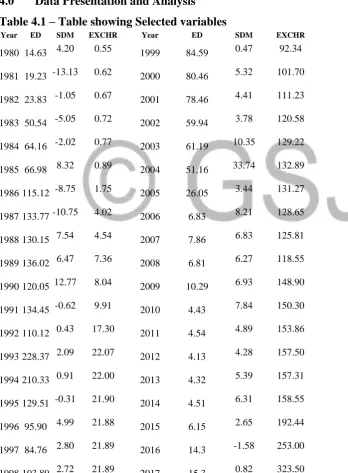
Table 4.1 – Table showing Selected variables
Year ED SDM EXCHR Year ED SDM EXCHR
1980 14.63 4.20 0.55 1999 84.59 0.47 92.34
1981 19.23 -13.13 0.62 2000 80.46 5.32 101.70
1982 23.83 -1.05 0.67 2001 78.46 4.41 111.23
1983 50.54 -5.05 0.72 2002 59.94 3.78 120.58
1984 64.16 -2.02 0.77 2003 61.19 10.35 129.22
1985 66.98 8.32 0.89 2004 51.16 33.74 132.89
1986 115.12 -8.75 1.75 2005 26.05 3.44 131.27
1987 133.77 -10.75 4.02 2006 6.83 8.21 128.65
1988 130.15 7.54 4.54 2007 7.86 6.83 125.81
1989 136.02 6.47 7.36 2008 6.81 6.27 118.55
1990 120.05 12.77 8.04 2009 10.29 6.93 148.90
1991 134.45 -0.62 9.91 2010 4.43 7.84 150.30
1992 110.12 0.43 17.30 2011 4.54 4.89 153.86
1993 228.37 2.09 22.07 2012 4.13 4.28 157.50
1994 210.33 0.91 22.00 2013 4.32 5.39 157.31
1995 129.51 -0.31 21.90 2014 4.51 6.31 158.55
1996 95.90 4.99 21.88 2015 6.15 2.65 192.44
1997 84.76 2.80 21.89 2016 14.3 -1.58 253.00
1998 103.89 2.72 21.89 2017 15.3 0.82 323.50
Source: Central Bank of Nigeria, World Bank and National Bureau of Statistics
SDM - Gross Domestic Product Growth Rate
EXCHR-Exchange Rate to the US Dollar
Summary:
The table shows unstable and rising debt to GDP ratio between the periods 1980 to 2017 (37
years). The period also shows high government expenditure to GDP while the exchange rate
post crisis period have moved up to unimaginable levels from N0.55 to 1 US Dollar in 1980
to N323.50 to 1 US Dollar by close of 2017. The national output growth rate depicted by
SDM has remained below double digit and sometimes in the negative, indicating an economy
that has been in and out of crisis.
4.1 Diagnostic Tests
The aim here is to carry out various diagnostic tests to ensure that our data and model used in
this research work conforms to the basic assumptions of the classical linear regression. This
will ensure that the output of this process is not error prone and is reliable.
4.1.1 Unit Root Tests
The test for stationarity requires that the variables in the series model must be stationery at a
given level and p-value must be significant at that level. Stationerity is attained where the test
statistics is most negative and greater than the critical value of the chosen level of
significance.
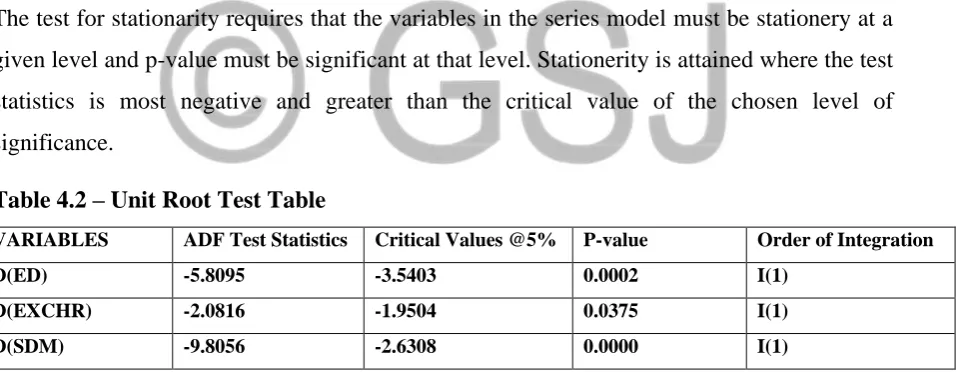
Table 4.2 – Unit Root Test Table
VARIABLES ADF Test Statistics Critical Values @5% P-value Order of Integration
D(ED) -5.8095 -3.5403 0.0002 I(1)
D(EXCHR) -2.0816 -1.9504 0.0375 I(1)
D(SDM) -9.8056 -2.6308 0.0000 I(1)
Source: Author‟s E-view 7 Computation
Table 4.2 reports the tests for stationarity properties of the series following the Augumented
Dickey Fuller (ADF) statistics. All the variables were found to be stationery at order one (1).
At the First difference as reported, the ADF Statistics for the respective variables were more
negative than the critical values at 5% significance level. The reported P values were all less
than 0.05 chosen level of significance for which cause, the Null Hypothesis of the presence of
unit root in all the variables is convincingly rejected. For the purposes of Co-integration
analysis and tests, it is also interesting to state that the variables are all integrated of the same
4.1.2 Descriptive Statistics
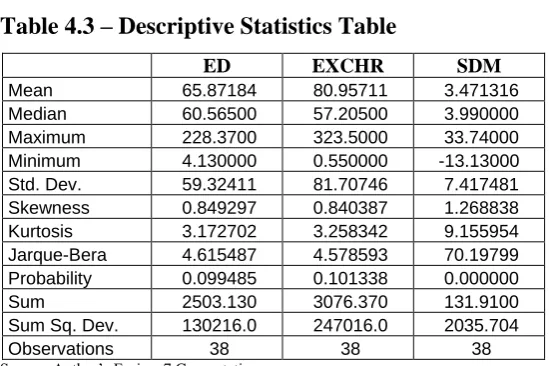
Table 4.3 – Descriptive Statistics Table
ED EXCHR SDM
Mean 65.87184 80.95711 3.471316
Median 60.56500 57.20500 3.990000
Maximum 228.3700 323.5000 33.74000
Minimum 4.130000 0.550000 -13.13000
Std. Dev. 59.32411 81.70746 7.417481
Skewness 0.849297 0.840387 1.268838
Kurtosis 3.172702 3.258342 9.155954
Jarque-Bera 4.615487 4.578593 70.19799
Probability 0.099485 0.101338 0.000000
Sum 2503.130 3076.370 131.9100
Sum Sq. Dev. 130216.0 247016.0 2035.704
Observations 38 38 38
Source: Author‟s E-view 7 Computation
The descriptive statistics in table 4.3, reveals the skewness as a swing between positive and negative
signs and the Kurtosis between leptokurtic (ED, EXCHR) and platykurtic ( SDM). The Jarque-Bera
statistics p-values while significant for SDM, it was however not significant for ED and EXCHR at
the 5% threshold of significance, indicating an outlinear in the data distribution. This observed
outlinear will be corrected either through data differencing, log transformation or addition of dummy
variables or even dropping of variables in the models to improve our R2. The testing of single
dependent variable against single independent variable will greatly assist to cure this defect.
4.1.3 Test For Serial Correlation – Breusch-Godfrey (BG) Tests
The Breusch-Godfrey tests is used to test for the presence or absence of serial or
autocorrelations in the model with the Null hypothesis stating that there is No autocorrelation.
This holds if p-value is greater than the chosen level of significance otherwise reject
Table 4.4 – B-G Serial Correlation Result
Breusch-Godfrey Serial Correlation LM Test:
F-statistic 0.453337 Prob. F(2,31) 0.6397
Obs*R-squared 1.079824 Prob. Chi-Square(2) 0.5828
Source: Author‟s E-views Computation
From table 4.4, the p-value is greater than the chosen level of significance of 5%, indicating
the absence of autocorrelation in the model. This is further enhanced with a Durbin-Watson
statistics of 1.948. Hence, we do not suspect any violation of the assumptions of classical
linear regression.
4.1.4 Test for Heteroskedasticity
The assumption of the classical linear regression that the variance of the errors is constant is
known as Heteroskedasticity. Hence, we test for the presence of heteroskedasticity with the
intention of treating same if found. The treatment method adopted here is the Autoregressive
conditionally Heteroscedastic test known as BRESCH-PAGAN-GODFREY. The Null
hypothesis states that there is no Heteroscedasticity if the p-value is greater than the level of
significance (Brooks, 2014).
Table 4.5 – Heteroskedasticity Test Outcome
Heteroskedasticity Test: Breusch-Pagan-Godfrey
F-statistic 0.587617 Prob. F(4,33) 0.6739
Obs*R-squared 2.526637 Prob. Chi-Square(4) 0.6399
Scaled explained SS 6.194112 Prob. Chi-Square(4) 0.1851
Source: Author’s E-View 7 computations
The null hypothesis states that there is No heteroskedasticity if p-value is not significant and
is greater than the chosen level of significance of 5%. Hence, in table 4.5, we accept the Null
hypothesis that there is no evidence of heteroskedasticity since p-value is greater than 5%
significance level. Also, the Durbin Watson statistics of 2.2184 further supports this position.
4.1.5 Test for Ramsey Reset Specification
Ramsey (1969)proposed a general functional form misspecification test, Regression
Specification Error Test (RESET), which has proven to be useful. The Reset test is a general
test for the following type of specification errors:
a) Omitted Variables
b) Incorrect Functional form
c) Correlation between variables which may be caused by measurement error,
simultaneous equation combination, combination of lagged values and serially correlated
disturbances.
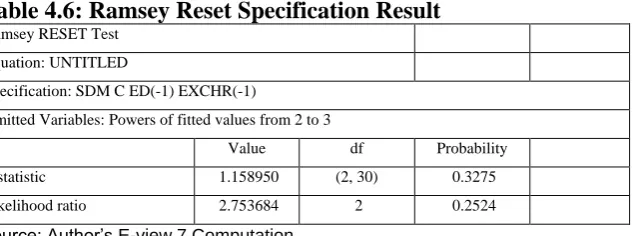
Table 4.6: Ramsey Reset Specification Result
Ramsey RESET Test Equation: UNTITLED
Specification: SDM C ED(-1) EXCHR(-1)
Omitted Variables: Powers of fitted values from 2 to 3
Value df Probability
F-statistic 1.158950 (2, 30) 0.3275
Likelihood ratio 2.753684 2 0.2524
Source: Author’s E-view 7 Computation
level, indicates that the test statistics are not significant at the 5% level. We thus accept the
Null hypothesis that the regression model in equation 2, is linear.
4.2 Hypothesis Testing
4.2.3 Restatement of Hypothesis
HO3 There is no significant relationship between external debt, foreign exchange and
sustainable debt management in Nigeria.
Hi3 There is significant relationship between external debt, foreign exchange and
sustainable debt management in Nigeria.
4.2.3.1 Regression Test
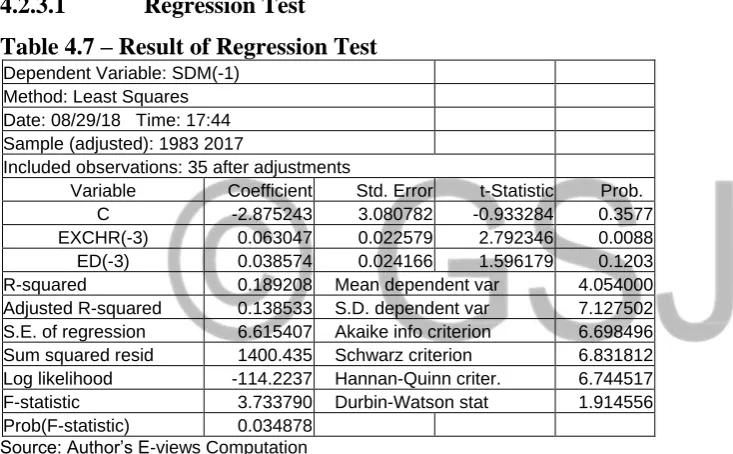
Table 4.7 – Result of Regression Test
Dependent Variable: SDM(-1) Method: Least Squares Date: 08/29/18 Time: 17:44 Sample (adjusted): 1983 2017
Included observations: 35 after adjustments
Variable Coefficient Std. Error t-Statistic Prob.
C -2.875243 3.080782 -0.933284 0.3577
EXCHR(-3) 0.063047 0.022579 2.792346 0.0088
ED(-3) 0.038574 0.024166 1.596179 0.1203
R-squared 0.189208 Mean dependent var 4.054000
Adjusted R-squared 0.138533 S.D. dependent var 7.127502
S.E. of regression 6.615407 Akaike info criterion 6.698496
Sum squared resid 1400.435 Schwarz criterion 6.831812
Log likelihood -114.2237 Hannan-Quinn criter. 6.744517
F-statistic 3.733790 Durbin-Watson stat 1.914556
Prob(F-statistic) 0.034878
Source: Author’s E-views Computation
In table 4.7, the R2 and Adjusted R2 both showed 18.92% and 13.85% respectively. This
shows that the variable under consideration does not exert much influence on the outcome of
the overall model as18.92% of changes in the model are explained by this variable.
F-statistics of 3.7338 is considered good being positive and significantly large enough and it
shows that there is significant positive relationship between the dependent and explanatory
variables. The overall probability (F-statistics) of 0.0349 is rightly signed and very significant
and displays a Durbin-Watson of 1.9146, which is considered good as it shows little or no
effect of autocorrelation on the chosen data.
Hence, from table 4.7, the EXCHR(-3) was lagged by 3 periods, has a t-statistic value of
2.7923 and a p-value of 0.0088, was found to have a positive effect on Sustainable debt
below 0.05. Therefore, we reject null hypothesis to accept the alternative. The implication of
this result is that a 1% increase in EXCHR will result to a 0.0631% increase in Sustainable
debt stock and the coefficient of the future levels of EXCHR variable has a positive sign and
is positive at the 5% significance level. Conversely, for ED, the p-value of 0.1203 indicates
that there is an insignificant relationship between external debt and sustainable debt
management.
4.2.3.2 Co-integration Test
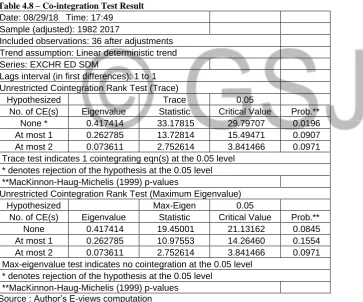
Table 4.8 – Co-integration Test Result
Date: 08/29/18 Time: 17:49 Sample (adjusted): 1982 2017
Included observations: 36 after adjustments Trend assumption: Linear deterministic trend Series: EXCHR ED SDM
Lags interval (in first differences): 1 to 1 Unrestricted Cointegration Rank Test (Trace)
Hypothesized Trace 0.05
No. of CE(s) Eigenvalue Statistic Critical Value Prob.**
None * 0.417414 33.17815 29.79707 0.0196
At most 1 0.262785 13.72814 15.49471 0.0907
At most 2 0.073611 2.752614 3.841466 0.0971
Trace test indicates 1 cointegrating eqn(s) at the 0.05 level * denotes rejection of the hypothesis at the 0.05 level **MacKinnon-Haug-Michelis (1999) p-values
Unrestricted Cointegration Rank Test (Maximum Eigenvalue)
Hypothesized Max-Eigen 0.05
No. of CE(s) Eigenvalue Statistic Critical Value Prob.**
None 0.417414 19.45001 21.13162 0.0845
At most 1 0.262785 10.97553 14.26460 0.1554
At most 2 0.073611 2.752614 3.841466 0.0971
Max-eigenvalue test indicates no cointegration at the 0.05 level * denotes rejection of the hypothesis at the 0.05 level
**MacKinnon-Haug-Michelis (1999) p-values Source : Author’s E-views computation
Table 4.8 shows the trace test for co-integration that only EXCHR with a p-value of 0.0196
has a co-integration relationship with sustainable debt management (SDM), in which case we
reject the Null hypothesis to accept the alternative that there is a long-run relationship
between EXCHR and SDM. It is instructive to note that in contrast, ED has no co-integration
relationship with SDM, in which case we accept the null hypothesis in order to reject the
4.3 Discussion of Findings
This study on External Debt, Foreign Exchange and Sustainable Debt management: the
Nigeria experience examined one objectives for which an hypothesis was developed and
tested. Preliminary tests were carried out on the data and model, it was discovered that the
variables under study were all stationery at first difference level with highly significant
p-values. They also passed the relevant serial correlation tests, Heteroscedasticity tests and the
Ramsey reset specification tests with an acceptance of their relevant null hypothesis since the
p-values were all greater than the chosen level of significance. Based on above success, we
proceeded to test the hypothesis now discussed below;
a) To examine the effect of external debt and foreign exchange on sustainable debt
management in Nigeria – The regression and co-integration result reveals the
exchange rate and sustainable debt management both have significant and positive
relationship in the short-run (p = 0.0088) and long-run (p = 0.0196) respectively and
this outcome is corroborated by growth-debt-theory of a positive and significant
relationship. However, the External Debt and sustainable debt management showed
positive but insignificant relationship in both short-run (p = 0.1203) and long-run (p =
0.0907) respectively at the 5% level of significance. A plausible interpretation of this
would be that external debt within these periods have not added to the stock of
economic growth and development while increasing the debt stock. While this
situation runs contrary to the expectations of the growth-debt-theory of Green and
Khan (1990), the outcome is however supported by the findings of Sanusi (1998) of
financing mismatch and Ajayi (1999) of inappropriate domestic policies.
5.0 Conclusions and Recommendations
The study investigates the impact of External Debt and Foreign Exchange on sustainable debt
management in Nigeria. The findings from this study revealed that while external debt had
insignificant effect on sustainable debt management, foreign exchange on the other hand had
convincing significant effect on the dependent variable (sustainable debt management) in
both runs. From the findings and conclusion of this study, we recommend that;
1. Government should adopt appropriate pricing of external debt and the engagement of
such debt only for reproductive assets while diversifying the export base to earn
References
Abubakar, M. (2008). The implication of Global Financial Crisis on International Marketing.
Unpublished M.sc Assignment on International Marketing, Bayero University, Kano.
Ajayi, S.I. (1995). Capital Flight and External Debt in Nigeria. AERC Research Paper No.
35, Nairobi. AERC.
Ajayi, S.I. (2002). Macroeconomic Approaches to External Debt: The case of Nigeria. AERC
Research Paper No. 8, Nairobi. AERC.
Aluko, F & Arowolo, D. (2010). Foreign Aid, The third world‟s Debt Crisis and the
Implication for Economic Development: The Nigeria Experience. African Journal
of political science and International Relations, vol. 4(4), pp. 120-127, April
Development of Dickey, D.A, and Fuller, W.A. (1979). Distribution of the Estimators
for Autoregressive Time Series with a Unit Root. Journal of the American Statistical
Association, 74, 427-431.
Bamidele T.B and Joseph A.I; (2013). “Financial Crisis and External Debt Management in Nigeria”, International Journal of Business and the Rural Science Vol. 3.
Brooks, (2014). Econometrics, fourth Edition, USA.
Engle, R.F. & Granger, C.W.J. (1987). Co-integration and Error Correction: Representation;
Estimation, and Testing. Econometrical, 55,251-276.
Josten, S.D. (2000, March). Public debt in an endogenous growth model of perpetual
Kindleberger, C.P and Aliber, R. (2005). Manias, Panics and Crashes: A History of
Financial Crises (Hoboken, N.J.: John Wiley and Sons).
Laeven, L.& Valencia, F. (2008). „Systemic Banking crises: a new database‟ International
Monetary fund Working Paper 08/224.
Morisset, J. (1991). Can Debt Reduction Restore Economic Growth in highly indebted
countries. Revie D’economique Politique, 101, pp. 639-666.
Mukolu, M.O. & Ogodor, B.N. (2012). The Impacts of Macroeconomic Variables on Nigeria
External Debt (1975-2005). Journal of science and Management.Vol. 1(1).
Nijathaworn, B. (2010) “Post-crisis challenges to emerging markets- what are at stake for
Central Banks?” (online) available at http://www.bis.org/review/r100326e.pdf
(accessed May 11, 2011).
Oke, M.O. & Suleiman L.A. (2012). External Debt, Economic Growth and Investment in
Nigeria: European Journal of Business and Management Vol. 4.
Osadume, R.C. & Mbachu, A. (2017). Impact of Global Financial Crisis on the Nigerian
Economy. International Journal of Economics and Financial Management, 3(1),
1-19, 2017.
Oyejide T.A. Soyede A. & Kayode M.D. (2004) Nigeria and the IMF. Heinemann
Educational book Nig. Ltd Ibadan, pp. 9.
Pattillo, C.A. Poirson, H. & Ricci, L.A. (2002). External Debt and Growth. IMF Working
Papers No. 02/69. International Monetary Fund.
Pattillo, C. Ricci L, Poirson, H. & Ricci, L.A. (2001). Non-Linear Impact of External Debt on
Growth. IMF Working Papers No. 02/69). International Monetary Fund Washington
DC.
Pattillo, C, Ricci L, Poirson, H & Ricci, L.A. (2002). External Debt and Growth. IMF
Working Paper International. Monetary Fund Washington DC. Economic and
Review, Vol, 42 No. 2 41-66.
Saint-Paul, G. (1992, November). Fiscal Policy in an endogenous growth model. The
Quarterly Journal of Economics, 107(4) 1243-59.
Sanusi. J.O. (2011). The Impact of The Global Financial Crisis on the Nigerian Capital
Market
And the Reforms. Lecture delivered at the 7th Annual Pearl Awards and Public Lecture
Held at the Muson Centre, Onikan, Lagos.