E-Commerce Web Site Trust Assessment
Based on Text Analysis
Banatus Soiraya
Faculty of Information Technology
King Mongkut's University of Technology North Bangkok 1518 Pibulsongkram Road, Bangsue Thailand, 10800
Anirach Mingkhwan
Faculty of Industrial and Technology Management King Mongkut's University of Technology North Bangkok
1518 Pibulsongkram Road, Bangsue Thailand, 10800 [email protected]
Choochart Haruechaiyasak
Human Language Technology Laboratory (HLT)
National Electronics and Computer Technology Center (NECTEC) 112 Phahonyothin, Pathumthani, Thailand, 12120
ABSTRACT
This paper reports the efficiency and effectiveness of our proposed text analysis module for a Web-site trust assessment system. One main factor that influences the level of trust for an e-commerce Web site is the textual content appearing on each Web page, especially the main page. The textual content refers to words, phrases, and sentences appearing on the page. A Web site that has a high trust level should contain meaningful keywords related to the e-commerce domain, such as return policy, payment option, and security. To analyze the textual content, our text analysis module adopts automatic classification techniques to learn from the example Web site data set. We perform experiments on two e-commerce domains (a jewelry store and a book shop) by using three well-known classification algorithms. A sample set of Web sites under each domain are collected and labeled as trust or untrust for performing our experiments. Two approaches for constructing the feature set are (1) using all extracted words from the textual contents (baseline), and (2) mapping extracted words into the meaningful groups of e-commerce terminology (EC-word). The best text analysis result of 83.5% accuracy was obtained when the support vector machines based on a sequential minimal optimization (SMO) algorithm was applied with the EC-word feature set.
1. INTRODUCTION
Currently, Web sites provide people with a convenient way to shop on-line. However, in some countries, including Thailand, the number of on-line shoppers is still very low compared with countries such as the United States.
Based on some previous surveys, two major problems regarding Web sites are security and lack of trust. Although most e-commerce Web sites provide some form of secured payment, this provision does not guarantee that the Web site will gain better credibility.
The first or main page of a Web site is very important when users access the site for the first time. If it is not properly designed, a customer may leave the site after viewing the main page without browsing other parts of the site [Fogg et al., 2002]. W3 Trust Model (W3TM) is proposed for trust value calculation from meta-data provided on Web sites [Yang, 2004]; however, it does not include analysis of other important factors, such as contents and layout and, more important, the ability to automatically recommend trust-assessment improvement. At present, there are no effective tools for evaluating trust assessment on Web sites. An effective trust assessment tool must be able to correctly identify and determine the trustworthiness level of sites. In addition, the tool should provide recommended information, based on trust assessment, in order for Web masters to use it to improve the site for better trust.
We have developed a research framework called “E-commerce Web-Site Trust Assessment Framework” (WTA) [Soiraya, et al., 2007]. It has three major core components:
(1) Web content mining for analyzing Web site contents, such as text and other meta-data
(2) Web content mining for page layout detection of the Web sites
(3) Recommendations that are generated for both on-line shoppers and the Web master of the site
The recommendation messages given to the Web master include, for example, “Your Web site is lacking a privacy policy; please fill in,” or “Your Web site contains too many advertisements; please reduce them.”
In this paper, we mainly discuss Web content mining. We collect a data set from the jewelry store and book shop domains. We evaluate three well-known classification techniques:
• Naïve Bayes (NB)
• k-Nearest Neighbor (kNN)
• Support Vector Machines, based on Sequential Minimal Optimization (SMO) training [Chakrabarti, 2003; Witten and Frank, 2000; and Platt,1999] in the WTA aspect
We propose two approaches for constructing the feature set: (1) Using all extracted words from the textual contents (baseline)
From the previous research [Liu, 2006], we find that most of the best accuracy in text classification is the SVM classifier. In this paper, our experiment has shown similar results. The best accuracy in both approaches is the SMO classifier (SVM classifier base on sequential minimal optimization training).
Although we propose two approaches, we found several limitations and impracticalities in the first approach (baseline). For one thing, it was necessary to store all of the words from every Web site before our classification. Both informative data (meaningful information such as e-commerce word and various policies, as shown in section 4.1) and non-informative data (meaningless information such as product description, product characteristics, and Web site characteristics) are collected together, which can reduce the accuracy in the classification process. Another disadvantage is that the approach is both storage consuming and time consuming, which impacts the efficiency of our system.
The second approach (EC-word) has five advantages:
• Elimination of non-informative data. We must select the meaningful information feature selection (words and phrases) from our corpus (trust Web sites training set). Only e-commerce or trust e-commerce words will be chosen from trust categories, as shown in section 4.1. Non-informative (the other attribute of product or other characteristic of Web sites besides trust categorization sample set) data will be removed from our repository.
• Increasing accuracy of classification. After we eliminated non-informative data from our corpus, we have only the pure EC-word that will discriminate between trust Web sites and untrust Web sites. In our results, we notice that the best accuracy in the second approach is 83.5% by using the SMO classifier, compared with 79.5 % in the first approach.
• Feature selection reduction. After the elimination step, we have only the e-commerce word in our corpus. In our results, we notice that the number of features in the second approach (EC-Word) is smaller than those of the first approach (baseline) by 14 times.
• Rapid classification. The small number of features in the second approach will be processed for classification by using a time shorter than the first approach. As shown in the section 4.3, for the book shop domain, we use 375 features from the second approach instead of 5,382 features. In other words, we can reduce the comparison time from 5,382 to 375 in our experiments.
• Guideline for developing feature selection algorithm. We could develop a feature selection algorithm according to the trust categorization in section 4.1. This algorithm could identify the best suit features (word, phrase). We could increase the accuracy of classification in future research [Ozono and Shintani, 2006].
The rest of this paper is organized as follows. In Section 2, we present the topics related to trust assessment. Section 3 discusses the conceptual idea of our proposed framework. Section 4 provides an example of e-commerce Web site categories. Section 5 discusses automatic classification algorithms. Section 6 presents our evaluation methods and experiment results, which integrate all necessary components and their functionality. Section 7 contains our conclusions and suggestions for future work.
2. RELATED WORK
Egger [2003] developed a model of trust in e-commerce called MOTEC, which describes characteristics of trust in e-commerce in terms of interaction, information, usability, and relationship. Consumer trust patterns were considered to be the component of trust assessment terms such as information policy, return policy, and warranty policy [Kaluscha and Grabner-Krauter, 2003]. At present, only one prototype tool for a trust assessment of Web sites is performed with W3 Trust Model (W3TM) by assessing the relevant metadata of Web documents [Yang, 2004]. This tool proved impractical when we applied it to real Web sites. This tool cannot detect various types of trust information such as content and layout on the Web site.
Web mining has become a popular method of discovering useful information and knowledge from the Web hyperlink structure, page content, and use data by using data mining techniques. In general, Web mining consists of three categories:
• Web content mining
• Web structure mining
• Web use mining
Some of the well-known classification techniques for Web content mining such as Naïve Bayes, k-Nearest Neighbor (k-NN), and Support Vector Machines (SVM) will be adopted in this paper [Chakrabarti, 2003; and Liu, 2006] . Most of the previous researches were Web page or Web site classification using the categories [Kriegel and Schubert, 2004; and Liu,2006], but there were no previous works on Web site classification using the trust assessment feature in the area of e-commerce area.
3. OUR PROPOSED FRAMEWORK
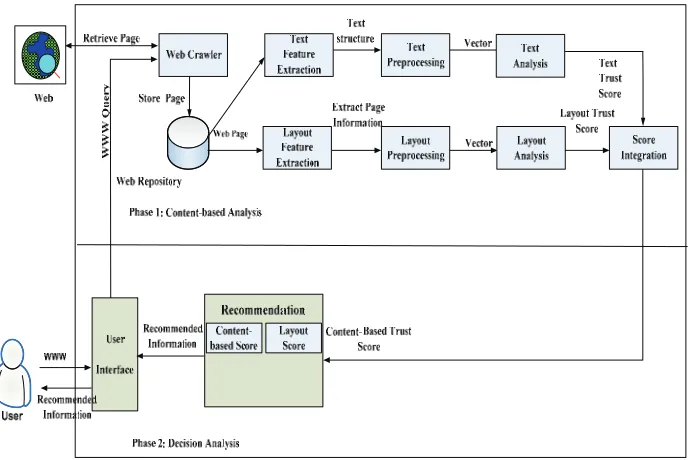
In our previous paper, “E-commerce Web-Site Trust Assessment Framework,” we proposed a framework for helping users select trust Web sites and improve Web site design in terms of trust assessment [Soiraya, et al., 2007]. Our proposed framework consists of two phases:
(1) Content-based analysis (2) Decision analysis.
Figure 1. E-Commerce Web-Site Trust Assessment Framework
(1) Content-Based Analysis. This phase analyzes a Web site in terms of both text and layout. The output is a content-based score that corresponds to the trust assessment level of the Web site. The first step is information gathering, in which information is collected from the Web site and the Web pages are stored automatically in the Web repository. The second step is feature extraction and pre-processing, which eliminate the html tag and unnecessary words in the plain text. The third step is the analysis of the text and layout, which includes a comparison between the data set and the test set, using the trust assessment conditions.
(2) Decision Analysis. This phase uses the total trust score from the previous phase. Two processes are then performed: (a) trust criteria, and (b) recommendations for improving the Web site.
(a) Trust criteria. We consider four trust levels:
• High trust Web sites: Web sites that provide high-quality layout and textual content
• Moderate trust Web sites: Web sites that provide medium-quality layout and textual content
• Low trust Web sites: Web sites that provide low-quality layout and textual content
(b) Recommendations for improving the Web site: For example, the following types of messages could be given to the Web site administrator.
• “Your Web site lacks a privacy policy. Please provide the infor-mation to improve the Web site’s credibility.”
• “Your Web site layout looks unprofessional and there are too many advertising banners. Please arrange your layout and reduce the advertising banners.”
The user benefits from this framework in terms not only of improving Web site trustworthiness, but also in obtaining recommendations for overall Web site improvement.
4. E-COMMERCE WEB SITE DATA SET
For our experiments, we collected and labeled example pages from Web sites as trust and untrust. In this paper, we perform text analysis on two different domains: a jewelry store and an on-line book shop. We classify trust patterns (textual content) that appear on each Web site; i.e., privacy policy, 30-day return policy, and secured transaction [Adkisson, 2002; Egger, 2003; and Yang, 2004].
4.1. Jewelry Store Domain
In the jewelry store domain, we classify Web sites into four categories: (1)Trust Web sites with high-quality content and layout
(2)Candidatetrust Web sites with high-quality layout (3)Candidatetrust Web sites with high-quality content (4)Untrust Web sites with low-quality content and layout
(1)
Trust
Web sites with high-quality content and layout
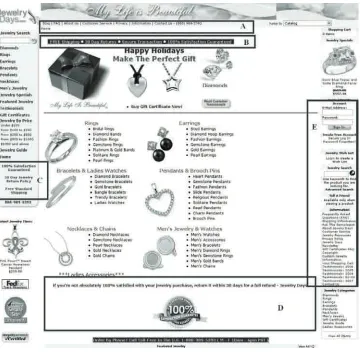
Figure 2shows the main page of the web site www.jewelrydays.com, which
Figure 2. Example of a Trust Web Site with High-Quality Content and Layout
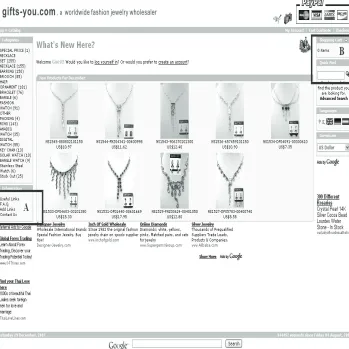
(2)Candidate trust Web sites with high-quality layout
Figure 3. Example of a Candidate Trust Web Site with High-Quality Layout
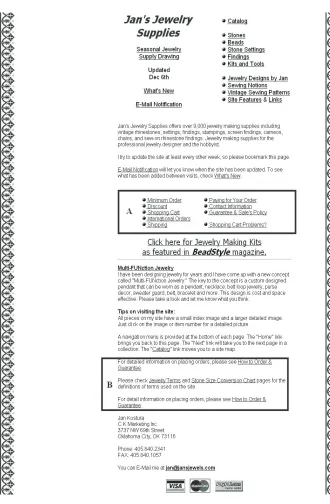
(3) Candidatetrust Web sites with high-quality content
(4)
Untrust
Web sites with low-quality content and layout
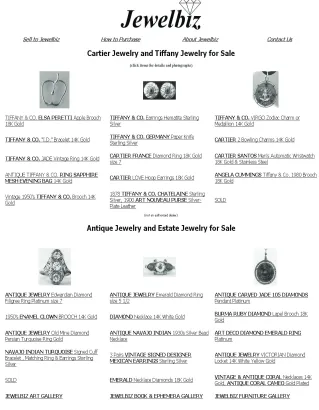
From the Web site
www.jewelbiz.com, we notice that there are only
product descriptions and that the trust context is absent on the main page
(Figure 5). A few words such as
Contact Us
and
About Jewelbiz
do not
provide more confidentiality to customers. The Web site design is also
unprofessional.
4.2. Book Shop Domain
In the book shop domain, we classify Web sites into three categories: (1) Trust Web sites with high-quality content and layout
(2) Candidate trust Web sites with high-quality layout (3) Untrust Web sites with low-quality content and layout
Following are the Web site characteristics of the three categories.
(1) Trust Web sites with high-quality content and layout
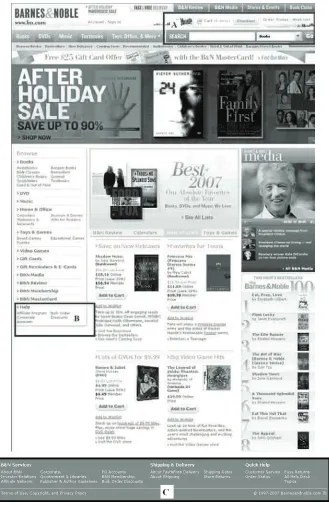
For www.barnesandnoble.com (Figure 6), we used the same concept
from the previous domain.
We classified it in three blocks (A, B, and C). Thereare some words in Block A, such as Shopping Cart, Order Status, and Search. In Block B, there are some words such as Help and Affiliate Policy. Block C provides more security to customers, such as Return Policy and Customer Service.
(2) Candidate trust Web sites with high-quality layout
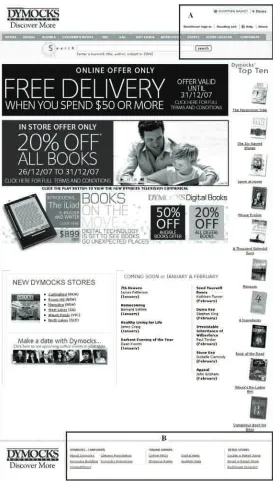
For www.dymocks.com.au (Figure 7), we classify the site in two blocks. Both Block A and Block B provide service to customers, but there are no security or trust words such as Secure Payment, Privacy, or Return Policy on this page. This Web site has a very nice graphic and professional layout design, but lacks of high-quality textual content.
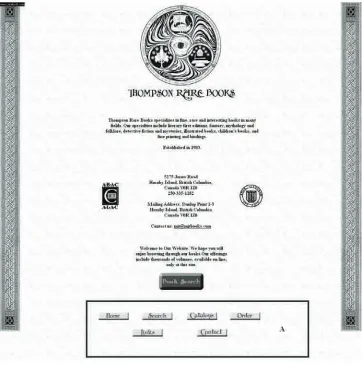
(3) Untrust Web sites with low-quality content and layout
Figure 8. Example of Untrust Web Site with Low-Quality Content and Layout
5. AUTOMATIC CLASSIFICATION ALGORITHMS
Automatic classification is used to classify the Web sites into trust and untrust
categories. Various techniques are the foundation of data mining algorithms such as Naïve Bayes, kNN, and Support Vector Machine [Chakrabarti, 2003; Liu, 2006]. This section discusses the classification method for WTA.
5.1. Naïve Bayes Classifier
(1)
We assume E denotes the attribute set and cidenotes the class variable. We have the conditional probability that we called P(ci | E) in terms of posterior probability for ci. And we called P(ci) in terms of prior probability. P(E | ci) is called the class-conditional probability , and P(E) is called the evidence. Bayes theorem can express the posterior probability in terms of the prior probability. A naïve Bayes classifier estimates the class condition probability by assuming that the attributes are conditionally independent, given the class label ci.
(2)
5.2. kNN Classifier
The kNN algorithm [Liu, 2006; Shintani et al., 2006] is quite simple. It finds the k nearest neighbors of the test document from the training documents. The categories of these nearest neighbors are used to weight the category candidates. The similarity score of each neighbor document to the test document is used as the weight for the categories of the neighbor document. Because there is no model creation, this method is called lazy learning. Typical similarity is measured with a cosine function or Euclidean distance. We illustrate Euclidean distance in the following equation.
(3)
We can measure the distance between two objects in term of coordinates of a pair of objects. We assume d(p,q) denotes the distance and p , q is the coordinate of the x or y axis.
5.3. SVM and SMO Classifier
Support Vector Machine (SVM) is based on the statistical model. In this paper, we focus only on the linear form [Liu, 2006; Aixin, Sun et al., 2002]. SVM has a hyperplane that separates a set of positive examples from a set of negative examples with maximum margin.
Let the set of training examples D be
{(x1,y1), (x2,y2),…, (xn,yn)},
where xi =(xi1,xi2,…, xir) is an r-dimensional input vector, yi is its class label (output value). and yi €{-1,+1}. 1 denotes the positive class and -1 denotes the negative class. ) ( ) | ( ) ( ) | ( E P c E P c P E c
P i i
i =
∑
−
=
i
p
iq
iq
p
d
2)
(
)
,
(
) | ( ) | ( ) | ( 1 2 1∏
= = ∧ ∧ ∧ = m j i j i mi P e e e c P e c
c E
To build a classifier, SVM finds a linear function of the form
ƒ(x) = <w · x>+b (4)
so that an input vector xi is assigned to the positive class if ƒ(xi) ≥ 0, and to the negative class, otherwise; i.e.,
yi = 1 if <w · x>+b ≥ 0 (5) yi = -1 if <w · x>+b ≤ 0
We will call <w · x> that dot product of w and x (or Euclidean inner product). In other words, we can describe in
ƒ(x1,x2,..,xr)=w1x1+w2x2…+wrxr+b,
In essence, SVM finds a hyperplane that separates positive and negative training examples.
<w · x>+b=0 (6)
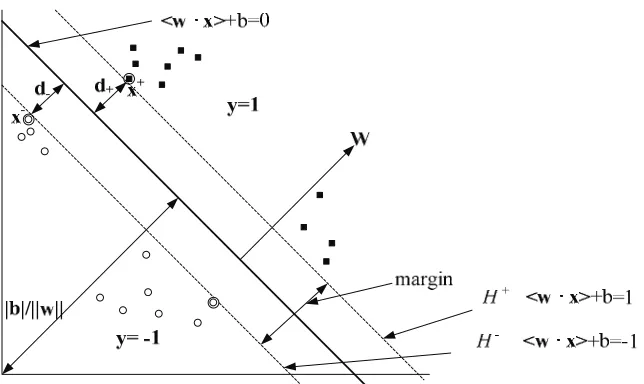
This hyperplane is called the decision boundary or decision surface, since SVM maximizes the margin between positive and negative data points. SVM looks for the separating hyperplane with the largest margin, which is also called the maximal margin hyperplane, as the final decision boundary.
We consider a positive data point(x+, 1) and a negative (x-,-1), which are closest to the hyperplane <w · x>+b=0. We define two parallel hyperplanes, H+
and H-, which pass through x+ and x- , respectively, in Figure 9.
H + <w · x>+b=1 (7)
Figure 9. Support Vector Machine (SVM)
Now, we compute the distance between the two margin hyperplanes, H + and H -. Their distance is the margin (d++ d-). We ignore the step for Euclidean distance computation. Finally, we have this equation:
Margin= (d++ d-) = 2/||w|| (9)
where ||w|| is the Euclidean norm of w (||w||= (w1 2
+w2 2
+…+wr 2
)1/2 (10)
Because of SVM’s slow training and algorithm complexity, Sequential Minimal Optimization (SMO) is used to solve the problem, and we adopt the SMO technique in our research [Platt, 1999]. SMO is new algorithm for training Support Vector Machine. It is constructed using three components:
(1) An analytic method to solve for the two Lagrange multipliers (2) A heuristic for choosing which multipliers to optimize
(3) A method for computing
This paper does not discuss the technique in mathematical detail.
6. EVALUATION METHOD AND RESULTS
This section discusses evaluation methods (6.1), data preparation (6.2), and the results obtained (6.3).
6.1. Evaluation Methods
Vector Machine (SVM), based on Sequential Minimal Optimization (SMO) training.
Two domains of Web sites (jewelry store and book shop) are studied in two approaches, using the Weka [www.cs.waikato.ac.nz/ml/weka/] machine learning tool. We use three tools in our experiments: Weka [Ian and Witten, 2000], Java, and HTML Tag Removal. Weka is used as a classification tool for accuracy measurement of each approach, The Java program is used for feature selection algorithms such as word extraction, stop word removal, and stemming. HTML Tag Removal is used to convert HTML files to normal text.
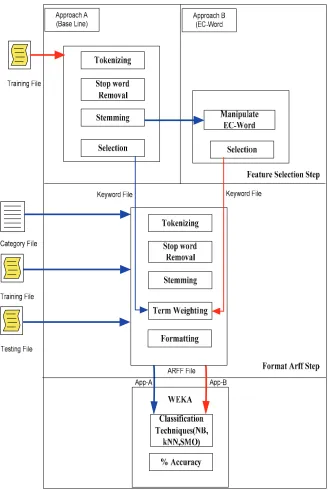
6.1.1. Approach A (Baseline)
This is called the baseline approach since it uses all extracted words from the textual content. It has two major components: (1) feature selection for creating the feature or keyword file from the training file, and (2) format ARFF for creating file format input for Weka.
(1) Feature Selection selects features (keywords) from the training file or training set. Feature selection is a program for tokenizing the text to individual token words. This program checks against stop words (a, an, the) and removes them from the keyword file. Then, the stemming process transforms those words in either singular or plural forms into root words such as Privacy, Privacies (Privaci), to eliminate the ambiguity shown in Figure 10. Moreover, this step detects and keeps the word occurrences in the keyword file since they have a frequency equal to at least three times in our experiment. The output of this part is a keyword file that stores feature words.
Figure 11. ARFF File Format
ARFF consists of five major areas:
(a) Relation name (such as@relation jewelry.train) is the first line in the ARFF file. It identifies the starting point in each file.
(b) Attribute declaration is an ordered sequence of attribute statement. The <datatype> can be any of several types, such as numeric, integer, and string. We use the numeric (0-374) for feature selection in Approach B.
(c) Class declaration defines how many classes (such as trust
(d) @ data declaration is followed by a single line denoting the end of the instance. It starts with an open parenthesis and ends with a close parenthesis, which includes the class label (trust, untrust). We adopt a sparse ARFF format in our research. Because of the column reduction, data with value 0 is not explicitly represented. The first position is the location of each attribute. The next position is the frequency of each attribute, along with the row, until the last attribute is shown. If this position is 0, it is not represented.
(e) Data declaration is the same as (d), Notice that the untrust
class is labeled at the end of each line. The number of lines after @data depends on the training set.
6.1.2. Approach B (EC-Word)
This approach is called EC-Word because it maps extracted words into the meaningful groups of e-commerce terminology. This approach is similar to Approach A, except for the feature selection part, as shown earlier in Figure 10. There are two major parts of Approach B: (1) Manipulation EC-Word, for creating the feature or keyword file from trust assessment criteria, and (2)
Format ARFF for creating file format input for Weka.
(1) Manipulation EC-Word creates trust e-commerce words using the trust assessment criteria. We adopt the previous papers [Egger, 2003; Yang, 2004] and use our own empirical research from real Web sites. There are six classes for building trust assessment in EC-Word, as shown in Figure 12.
(a)
Company Class: This property provides useful company information and appropriate company characteristics, as illustrated in Table 1. The appropriate word is called EC-Word in the right column.Table 1. Company Class Property Information
Index Trust Description Name EC-Word
1 Company Information About Us
Corporate Information Company Overview Company History
2 Investor Information Investor Relation
Press
3 Information Updated Last updated
(b)
Product Class: This property provides useful product or service information and their characteristic to customers, as illustrated in Table 2. The appropriate word is called EC-Word in the right column.Table 2. Product Class Property Information
Index Trust Description Name EC-Word
4. Product & Service Reputation Award Winning
5. Warranty, Guarantee Insurance
6. Professional Service Professional Service
Table 3. Security Class Property Information
Index Trust Description Name EC-Word
7. Standard Compliant Policies
8. Secure Payment Secure Shopping
Secure Ordering Paypal
Visa, Master Card , JCB, etc.
9. Certification SSL
Certificate
10. Return Policy Return Policy
11. Financial Compensation Money Back Guarantee
Replacement
12. Third-Party Guarantee Insurance, Verisign, Bizrate, Hacker
(d)
Privacy Class: This property provides customer privacy and assures confidentiality for protection personal of customers, as shown in Table 4. The appropriate word is called EC-Word in the right column.Table 4. Privacy Class Property Information
Index Trust Description Name EC-Word
13. Customer Information
Personal Confidential
Privacy Policy
14. Privacy Seal Web Trust
Web Seal Trust E BBBonline
Table 5. Relation Management Class Property Information Index Trust Description Name EC-Word
15. Online Contact Chat
email login logon
16. FAQ FAQ
17. Customer Support Affiliate Program
Support Customer Care Customer Service
18. Track Order Track Orders
Shipping Information Ordering
Order Tracking Order Status
19. Customer Review or
Customer Recommend Feedback Testimonials Customer Satisfaction Customer Commend Suggestion Box
(f)
Usability Class: This property provides the useful facilitation tool for helping customers, as illustrated in Table 6. The appropriate word is called EC-Word in the right column.Table 6. Usability Class Property Information Index Trust Description Name EC-Word
20. Help Help
21. Web Directory Site Map
Site Index
Directory of all stores
22. Search Search Go
23. Shopping Indicator Shopping Basket
Shopping Bag
24. Order Indicator View Basket
View Bag Wish List
25. Account Information Account Information
The output of this part is the keyword file, which includes the EC-Word in this file (shown earlier in Figure 10).
6.2. Data Preparation
We collected the first or main page of two domain Web sites – i.e., a jewelry store and a book shop – from the search engine tools (Google directory) and Dmoz (open directory project). We performed with 100 trust Web sites and 100 untrust Web sites in each domain, according to trust criteria. The criteria for the untrust Web sites are not good in visualization or graphical design, security context in each Web site, and the lack of trust categories in Approach B. We filtered out the undefined Web sites from our corpus (i.e., only graphic page, flash, unidentified with text). From our experiment, we noticed that there were some different business types between the jewelry store domain and the book shop domain.
In the first, the jewelry store domain, we noticed that there were three business types in trust Web sites and untrust Web sites, as shown in Table 6.
Table 6. Business Types Analysis in Trust and Untrust Jewelry Store Web Sites
No. Trust Web Sites % No. Untrust Web Sites %
1 Focus luxury jewelry and diamond
50 1 Focus luxury jewelry and
diamond 12
2 Variety jewelry 10 2 Variety jewelry 6
3 Special jewelry body and lower price jewelry
40 3 Special jewelry body and
lower price jewelry 82
In the second, the book store domain, there were three business types in
trust Web sites and four business types in untrust Web sites, as shown in Table 7.
Table 7. Business Types Analysis in Trust and Untrust Book Shop Web Sites
No. Trust Web Sites % No. Untrust Web sites %
1 Variety book selling 46 1 Variety book selling 29
2 Focused book selling 51 2 Focused book selling 59
3 Used book selling 3 3 Used book selling 4
4 Independent & small press 8
6.3. Experimental Results
We used the Weka machine learning tool for our experiments. A standard measurement for general classification performance is classification accuracy. The data were prepared in ARFF format (Weka’s input). Each classification technique was based on 10-fold-cross validation; that is, we divided data for the training and testing set from the same source file into 10 groups. Each group was divided into 9:1 by training: testing ratio. We had two domains for this evaluation -- the jewelry store Web sites and the book shop Web sites. The results of both approaches in the first domain are shown in Figure 13.
Figure 13. Comparison of Three Classifiers with Two Approaches (Jewelry Store Domain)
We compared each classification technique and approach with accuracy.
The highest performance was an SMO algorithm, which yielded 80% accuracy on both approaches. The worst performance was a kNN algorithm, which yielded 55% accuracy on Approach A. We noticed that, by using the kNN and SMO algorithms, the accuracy of Approach A was lower than, or equal to, Approach B. On the other hand, the Naïve Bayes algorithm yielded a higher accuracy for Approach A than Approach B. Therefore, the best accuracy was the SMO on both approaches, but Approach A has 3,731 features and Approach B has 254 features.
highest accuracy was an SMO algorithm on both approaches, which yielded 79.5% for Approach A and 83.5% for Approach B (EC-Word approach), respectively. The worst performance was a kNN algorithm, which yielded 60.5% for Approach A and 70% for Approach B. We noticed that, by using the kNN and SMO algorithms, the accuracy of Approach A was lower than that of Approach B. On the other hand, the Naïve Bayes algorithm yielded a higher accuracy on Approach A than on Approach B. Therefore, the best accuracy was the SMO algorithm for both approaches, but Approach A has 5,382 features and Approach B has 375 features.
Figure 14. Comparison of Three Classifiers with Two Approaches (Book Shop Domain)
(5,382/375). Hence, we will adopt the SMO algorithm into our system in future research. For the Naïve Bayes algorithm, we noted that there were different results from the other algorithms, as mentioned previously.
7. CONCLUSIONS
In this paper, we adopted automatic classification algorithms to learn from the example Web site data sets. From our experiments using two approaches, we gained accuracy from the Support Vector Machine (SVM), based on Sequential Minimal Optimization (SMO) training techniques of at least 80% for both the jewelry sstore domain and the book shop domain. The best accuracy, using SMO, was 83.5% for Approach B (EC-word), with 375 features for the book shop domain. The SMO was very powerful in our experiments. In addition, we found that Approach B can work efficiently, saving both data storage space and rapid processing for WTA in the future.
In future research, we plan to develop and improve the accuracy of WTA with the new feature selection algorithm. At present, our proposed system can work efficiently with high quality in a textual content. Currently, we are developing the additional layout and link analysis for increasing the accuracy of the system.
REFERENCES
Adkisson, H. 2002. Identifying de-facto standards for e-commerce Web Sites, M.S. Thesis, University of Washington.
Chakrabarti, S. 2003. Mining the Web: Discovering Knowledge from Hypertext Data, Morgan Kaufmann Publishers.
Egger, F.N. 2003. Designing the trust experience for business to consumer electronic commerce, Ph.D. Thesis.
Fogg, B.J.; Soohoo, C.; Danielson, D.; Marable, L.; Stanford, J.; and Tauber, E.R. 2002. How do people evaluate a Web sites's credibility? A report of research by Persuasive Technology Lab Standford University.
Kaluscha, E.A., and Grabner-Krauter, S. 2003. Towards a pattern language for consumer trust in electronic commerce, Proceedings of the 8th European Conference on Pattern Languages of Programs (EuroPLop'03).
Kriegel, H-P., and Schubert, M. 2004. Classification of Web sites as sets of feature vectors, Proceedings of the IASTED International Conference on Databases and Application.
Kohavi, R. 2001. Mining e-commerce data: The good, the bad, and the ugly, Proceedings of ACM (KDD 2001).
Liu, B. 2006. Web Data Mining: Exploring Hyperlinks, Contents, and Usage Data, Springer.
Ozono, T., and Shintani, T. 2006. Paper classification for recommendation on research support system papits, IJCSNS International Journal of Computer Science and Network Security 6, pp. 17-23.
Platt, J.C. 1999. Fast Training of Support Vector Machines Using Sequential Minimal Optimization. MIT Press, pp. 185-208.
Soiraya, B.; Mingkhwan, A.; and Haruechaiyasak, C. 2007. E-commerce Web-site trust assessment framework based on the Web-content mining approach. Proceedings of the 24th South East Asia Regional Computer Conference (SEARCC’07).
Sun, A.; Lim, E-P.; and Ng, W-K. 2002. Web classification using Support Vector Machine. ACM Proceedings of (WIDM'02).
Wang, W., Hodges, J., and Tong, B. 2003. Classification of Web documents using a Naive Bayes Method, Proceedings of the 15th IEEE International Conference on Tools with Artificial Intelligence(ICTAI'03).
Witten, I. H., and Frank, E. 2000. Data Mining Practical Machine Learning Tools and Techniques with Java Implementations, Morgan Kaufmann Publishers.
Yang, Y. 2004. W3 Trust Model (W3TM): A trust-profiling framework to assess trust and transitivity of trust of Web-base service in a heterogeneous Web environment, Ph.D. Thesis.
ABOUT THE AUTHORS
Banatus Soiraya received his master of science in information technology from Assumption University, Thailand. Currently, he is a Ph.D. candidate in the Department of Information Technology at King Mongkut's University of Technology, North Bangkok. He has researched and published papers on web mining. In addition, he is also interested in data networking and Internet security.
Anirach Mingkhwan received his Ph.D. (computer network) in computing and mathematical sciences from Liverpool John Moores University. He has researched and published in various fields, such as wireless network, sensor network, and information science. Currently, he is assistant professor of Industrial and Technology Management at King Mongkut's University of Technology, North Bangkok (Thailand).