33
Boris Jarinovsky Rezekne Higher Education Institution, Latvia E-mail: [email protected]
Abstract
The situation on preparation of experts in the fi eld of ICT in the Latvian high schools and in average edu-cational institutions is analyzed, and is concrete in East region. It is established, that preparation of such experts does not satisfy needs for the industry and sphere of service. According to researches of enterprise Euro Data now (2007) in Latvia in ICT branch there are no 3500 experts. This problem is actual and for other countries of the Europe. Of graduates in the fi eld of ICT in an expert are made great demands. In opinion of many scientists and experts term of training 3-4 years is not so suffi cient for good professional and scientifi c preparation of experts. Besides in the majority of educational institutions under ICT programs there is a big elimination of students. The main reasons of deduction of students are: a low level of knowledge on the phys-ics, the mathematphys-ics, foreign language, etc. to subjects; a signifi cant part of students work and study on day time branch and practically at them does not remain to time not only for independent work, but also visiting of lectures and seminars.
The low level of the grant, social and economic problems, payment for study, compels students to study and work. Ways of the decision of the above-named problems are offered. Such ways are improvement of formation in high schools, increase of prestigiousness of a speciality, improvement of social and economic conditions of students and graduates, increase in expenses on ITC from the state and etc.
In opinion of E. Silkina the measure of promotion to an information society is refl ected with a level of devel-opment of an information-technical complex of the country, the including interconnected set of manufactures and kinds of activity – from the industry of integrated schemes, electro-computing mechanical engineering, manufacture of offi ce equipment and technics of communication up to the market of computer and communica-tion services, maintenance to consumers of informacommunica-tion products and services.
Keywords: preparation of ICT experts, educational institutions of Latvia, formation improvement, increases in expenses on ICT.
Introduction
ICT – dynamical branch of economy of the European Union (EU) which relative density exceeds 6.3 % of a cumulative internal total product. Whether it is enough formed experts ICT in Europe? By calculations International Data Corporation in 2001 in Europe there was no 1, 1 million such experts, was no in 2005 1,7 million not only by quantity, but also and on quality. In Latvia, according to the enterprise “Euro data” (Sakaru pasaule, Nr. 2 (46), 2007) in 2007 there are no 3500 ICT experts. The
34 international researches show, that the problem of shortage of experts ICT is actual for all Europe. According to scientists of Latvia (Klavina, 2007) demand for experts ICT is satisfi ed now on 30%. If the situation in preparation of experts of higher education ICT does not improve, by 2010 demand for experts in the market will be satisfi ed only on 15 %. Considering a critical demographic situation in Latvia follows, that at present at the basic schools in the second classes studies less than 19000 pupils. It means, that after 10 years when to these pupils time will come to arrive in the higher schools, resources of students will decrease twice. Already now in many higher schools of Latvia, and especially in east region, budgetary places on specialities ICT practically are not fi lled.
The chairman of Council of vocational training, the vice-president of enterprise DATI Exigen Group U.Smilts (Klavina, 2007) informs that in Latvia at present a surprising situation in preparation and demand of qualifi ed ICT experts: on the one hand, unemployment is marked, on the other hand – employers cannot fi nd ICT workers of corresponding qualifi cation. But such situation is observed not in all enterprises. Unfortunately vocational training Council cannot solve the compromise of preparation of qualifi ed ICT experts and to satisfy requirements of employers for these experts.
The purpose of research - to reveal the main problems of preparation of experts in the fi eld of information technologies in Latvia and in the countries of the near abroad.
Methodology of Research
Statistical reports of the Ministry of Education and statistical reports of educational institutions are used. The analysis on problems on ICT in educational institutions (http://www.likta.lv, http:// www.liis.lv) in Latvia and the countries of the near abroad is lead. Despite of a urgency, lack of the information on problems of preparation of experts of ICT in Latvia is marked.
The situation on preparation of experts in the fi eld of ICT in the Latvian higher educational institutions and colleges is analysed. The estimation of reception and release of ICT students for last 2 years in comparison with other specialities is spent. The most actual problems of reception, training, getting industrial and pre-degree practice skills, release, an employment and others are studied., the enterprises connected with insuffi cient maintenance with highly skilled experts.
According to experts of ICT (Agamirzyan, Ivannikov, 2003) professional staff of ICT are most demanded on a labour market. The education system develops in Russia already during 40-45 years. However if for this time in the West counties preparation of the professional staff in the fi eld of information technologies (IT) was appreciably stabilized, in Russia till now it is impossible to consider such system even to the ordered and mismatching needs of the industry.
Characteristic attribute of disorder of system of a professional training is discrepancy of spe-cialities from the nomenclature of the Ministry of Education to real trades which are necessary in the IT-industry. Such specialities are: Software Design Engineer, Hardware Design Engineer, Tester, Program Manager, Project Manager, Business Analyst, IT manager. At the same time the Russian higher schools prepare for the experts concerning to IT: applied mathematics and physics, applied mathematics and computer science, the software of computer facilities and the automated systems. The low level of teaching of base mathematical disciplines and weak preparation of graduates on the major modern technologies and products leads to that IT - the industry is compelled to develop own system of retraining of young experts through which there pass even graduates of the best high schools. Except for that the insuffi cient quantity of let out experts of IT is marked.
35 Volume 3, 2008
Results of Research
It is established, that ICT experts in Latvia are prepared by many higher schools and colleges, basically it is educational institutions of large cities (Riga, Daugavpils, Liepaja, Jelgava), and also the regional higher schools and colleges (Ventspils, Rezekne, Valmiera).
Prestige of curriculums on which prepare engineers of a different profi le including in ICT, has practically considerably decreased. Exception makes programs on preparation of engineers of con-struction and building specialities where competition has considerably increased in many educational institutions for last two years. If earlier, 20 years ago, engineers of different level prepared on nar-rower specialisations and for narrow branch now there is a considerable quantity of programs, but not always places for training of students are fi lled completely, even budgetary places remain free.
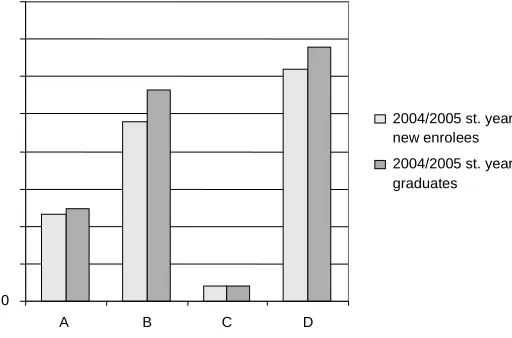
Comparing preparation of students of different specialities, follows, that the total of students on speciality Information Technology is considerable below level of students of other specialities (Figure 1). (Statistical Data Collection, 2006)
Figure 1. Students by thematic education groups.
Notes: A - natural science, mathematics and information technologies, B – engineering, manufacturing and construction, C – agriculture, D – health and welfare
Established, that at the students accepted on 1 course, especially in the regional higher schools, there is no fundamental knowledge for high school on physics, mathematics, foreign languages. In this connection in study there is a deduction of students as a result of poor progress (Figure 2, 3) (Statistical Data Collection, 2006).
Figure 2. Students by thematic groups (New enrollees, graduates).
Notes: A - natural science, mathematics and information technologies, B – engineering, manufacturing and construction, C – agriculture, D – health and welfare
0
A B C D
2004/2005 st. year new enrolees
2004/2005 st. year graduates 0
2000 4000 6000 8000 10000 12000 14000
A B C D
2004/2005 st. year
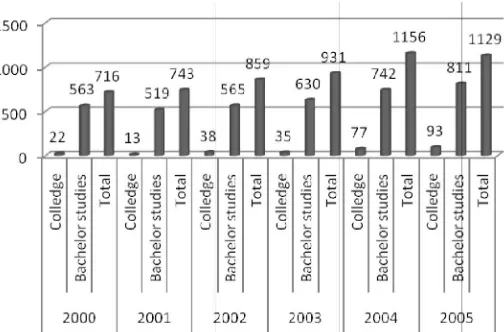
36 Analyzing dynamics of reception and release of students on years on a speciality “Engineer – programmer” in the Rezekne Higher Education Institution, sharp decrease in release of experts, basically because of deduction for poor progress is marked (Figure 4).
Thus the quantity of budgetary places remains free. Principal causes of deduction of students are: weak knowledge of many subjects for high school, the irresponsible relation to study. Basically, deduction of students occurs after fi rst and second year studies.
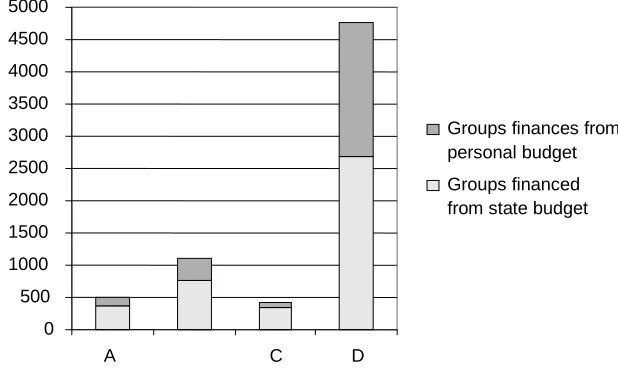
Investigating quantity of students on specialities: “Life sciences”, “Physical sciences”, “Math-ematics and statistics” and “Computer science”, follows, that on speciality “Computer science” the quantity accepted of the general number 6792 makes 70 %, from enrolled persons of 56 % of them are on budgetary places (Figure 5).
Deduction of students according to separate teachers (Тarasov, 2007) occurs not only because of poor progress.
Figure 3. Enrolment at Rezekne Higher education Institution on Engineer – program-mer speciality.
Figure 4. Groups enrolment by fi nancing.
Notes: A – Life sciences, B – physical science, C – mathematics and statistics, D – Computer science
As the grant at the majority of students small, a part of needy students is compelled to work on one, and even on two places of work. Study combination and work negatively affects in the afternoon progress of students. According to many students and teachers, the grant is in what that to a measure stimulating factors in study. Besides, as a rule, it is necessary for students of computer sciences to have the personal computer with various remote terminal units which costs certain expenses. Many
0 10 20 30 40 50 60 70 80
2001/ 2002
2002/ 2003
2003/ 2004
2004/ 2005
2005/ 2006
2006/ 2007
2007/ 2008
Graduates
0 500 1000 1500 2000 2500 3000 3500 4000 4500 5000
A C D
Groups finances from personal budget
37 Volume 3, 2008 higher schools and colleges load balancing of students on 1 computer big enough. (Table 1).
For preparation of highly skilled and competitive experts it is necessary for educational institu-tions modern means ICT. Not in all higher schools and colleges are available modern ICT. Statistical data show, that available computers of new generation are in administrative personnel using, older computers are used by students.
Table 1. Number of computers in Higher Educational Institutions and colleges.
Higher Education Institutions and
Colleges
Number of computers
of which Number
of students
per computer
for studies administrativefor needs
for scientifi c research
University of Latvia 2981 1983 635 363 14
Riga Technical University 1739 1158 225 356 14
Daugavpils University 485 359 82 44 15
Liepaja Pedagogical Academy 240 114 109 17 35
Rezekne Higher Education
Institution 227 76 151 - 52
Ventspils Higher Education
Institution 180 100 30 50 8
Latvian University of Agriculture 991 576 264 151 17
Transport and Telecommunication
Institute 406 266 90 50 16
Riga Technical College 264 186 68 10 4
Given tables 1 testify that are most provided by computers University of Latvia, Riga Technical University and Latvian University of Agriculture. The greatest load balancing of computers on 1 student is marked in Rezekne Higher Education Institution and Liepaja Pedagogical Academy.
Analyzing statistical materials (Borzov, 2005) has been drawn a conclusion that insuffi cient release of experts in the fi eld of ICT is marked. It is necessary to note that the qualifi ed teachers can prepare the qualifi ed experts only. The fi rst but not a unique parameter of qualifi cation of the teacher – a scientifi c degree of the doctor. In Latvia defi ciency of scientifi c doctors – nearby 200-300 person is at present marked.
38
Figure 7. Graduating statistics at Latvian higher education schools and universities on faculties of computer science.
Conclusions
For the best preparation of ICT experts in the higher schools according to the author 1.
and many researchers it is necessary to increase quantity of the hours which have been taken away on practice; training term under programs of the bachelor and the master to increase at least for 1 year.
Within the limits of the program it is necessary to increase quantity of hours by special 2.
courses. Some elective courses which have lost the actual meaning to exclude from the program or to replace their most actual.
Because on separate specialities catastrophically there are no teachers in average educa-3.
tional institutions and in the higher schools of Latvia teachers pre-pension and a pension age, not all having a pedagogical education work. At passage of courses of improve-ment of qualifi cation of different level teachers it is necessary to enter certain quantity of hours on ICT.
In the Latvian higher schools, and especially in east regions, with a view of improvement 4.
of preparation of ICT experts, it is necessary to increase enrolment to doctor studies and improve preparation of youngdoctors of engineering sciences.
It is necessary for higher schools, colleges to involve more widely students in research 5.
work and to participation in the international projects.
For preparation and to use of competitive experts educational institutions should use more 6.
full means allocated of the state budget of Latvia and the European fund.
To Latvian association of ICT to promote students and graduates working in the fi eld 7.
of ICT.
References
Borzovs, J. (2005). IKT izglītības stāvoklis un perspektīvas, LIKTA 7. gadskārtējā konference “IKT potenciāls un informācijas sabiedrības attīstība Latvijā”, http://www.litta.lv/lv/konferences/conf-07/
Kļaviņa, G. (2007). Sakaru Pasaule 1 (45), Sakaru pasaule Nr. 2(46) (2007) 7 pp. < http://anton.world.lv/sakarup/main.php3?sub=view&RID=1360>
Education Institutions in Latvia. (2006). Statistical Data Collection, Central Statistical Bureau of Latvia, pp. 51-54, 63-65, 86-87.
Тарасов, А. (2007). Гдеты, идеальныйстудент? Digital Times, 28 (538), 24.07.2007, стр. 15
39 Volume 3, 2008
Попов, С.Е., Поршнев, С.В., Потоскуев, С.Э. (2001). Учебно-методическое обеспечение образова
-тельногопроцесса подготовки педагогическихкадров вобласти информационных технологий. 2-я
телеконференция ”Информационныетехнологиивобщеобразовательнойшколе”, http://www.websib. ru/ites/2000/index.html
Силкина, Е. (2006). Современныйуровеньразвитияинновационнойинфраструктуры. Наукаиинно
-вации, Nr. 11 (45), с. 46 – 50.
Наранович, О. И., Ционенко, Д. А. (2007). К вопросу овнедрении информационных технологийв процессе преподаванияестественнонаучных дисциплин. В кн.: Техника итехнологии: инновации и
качество (Материалымеждународнойнаучно-практическойконференции). Барановичи: РИОБарГУ,
с. 272-274.
Анципорович, П. П., Алейникова, О.И., Булгак, Т.И., Луцко, Н.Я. (2007). Общепрофессиональная подготовкастудентовсиспользованиеминформационныхтехнологий. Вкн.: Техникаитехнологии:
инновацииикачество (Материалымеждународнойнаучно-практическойконференции). Барановичи:
РИОБарГУ, с. 229-231.
Adviced byRytis Vilkonis, SiauliaiUniversity, Lithuania.
Boris Jarinovsky Leading Researcher at Rezekne Higher Education Institution, Latvia. Atbrivoshanas aleja 90, LV-4601 Rezekne, Latvia.