(PLATE 110)
S INCE the first discovery of a painted altar in 1932,1 the excavations at Corinth
have brought to light many new fragments of similar dedications, and others of unmistakably Corinthian origin have been found elsewhere.2 Both in shape and size these altars resemble those found at several Greek sites in Italy,3 but the Corinthian examples are for the most part earlier. If there is any connection between the two groups, it must be assumed that the type originated at Corinth and from there was introduced in the colonies of Magna Graecia. A comparatively well preserved example and two smaller fragments were found at Corinth in 1949.
The altar shown in figures 1-3 and Plate 1 lOa-c ' was discovered in a garden well dug in the plain below the modern village, not far from the North Cemetery which was excavated by T. L. Shear in 1929-30. The fragments were turned over to the guard of the Archaeological Museum by the owner of the well, Anastasios Yambourannis. The circumstances of discovery did not permit accurate observation, but it is likely that the altar formed part of a tomb offering, since pieces of a stone sarcophagus appeared in the well at about the same level. The flow of water was so copious that further investigation of the place proved impractical.
The altar is very nearly complete; only the lower portion of the right flank, the lower right corner of the front panel, and parts of the undecorated back are missing. The decorations are poorly preserved. Since the altar was found below water level, much of the glaze, especially the purple, has disappeared, leaving only faint traces of color and the incised lines visible. This is particularly true of the principal motive on the front panel.
The dimensions of the new altar 5 with one exception correspond very closely to
those of the less well preserved specimens from Corinth published in a previous article in this journal.6 The height is slightly less than that of the Pygmy and Crane
1 See Mary Swindler, A.J.A., XXXVI, 1932, pp. 512-520.
2M. Z. Pease, Hesperia, VI, 1937, pp. 313-314, Nos. 240-242; C.V.A., Robinson Collection, fasc. 1, pl. 48 (cf. Beazley in J.H.S., LIV, 1934, p. 90); B.S.A., XXXII, 1931-32, p. 260; S. S. Weinberg, A.J.A., XLIII, 1939, p. 592; and 0. Broneer, Hesperia, XVI, 1947, pp. 214-223.
3 Elizabeth Jastrow, A.J.A. L, 1946, pp. 67 ff.; Inez Scott Ryberg, An Archaeological Record
of Rome, p. 155.
4 Inventory No. M.F. 9422. The drawings for figures 1 to 3 were made by Marian Welker,
Fulbright Scholar to Greece 1949-1950. I am indebted to Miss Welker for minute observations of certain details, particularly the discovery of the wreath on the head of the reclining figure.
5 Dimensions: Height, 0.137 m.; total preserved length at top, 0.258 m.; total estimated length at top, 0.269 m.; width at top, 0.118-0.122 m.; height of decorated panels 0.085 m.; length of front panel, 0.245 m.; width of panel at left end 0.109 m.; thickness of walls, 0.02-0.03 m.
6 Cf. Broneer, loc. cit., pp. 214-218.
American School of Classical Studies at Athens is collaborating with JSTOR to digitize, preserve, and extend access to
Hesperia
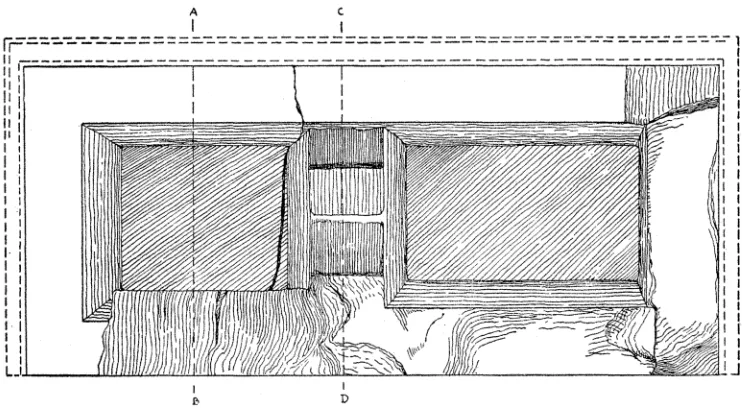
altar,7 and the height of the painted panels is exactly the same as that of the altar with the Siren and Swan, and only 4-6 mm. less than the height of the panels on the Pygmy and Crane altar. None of the published fragments preserves the length of the panels, but the figure of the siren on the altar found in 1946 would require a panel 0.12-0.14 m. in length, just half the length of the front panel on the new altar. Like all the other altars of the series the new specimen is hollow underneath, but a median wall with a toothed edge (see profile, section C-D, Fig. 2), divides the hollow into two compartments of about equal dimensions (Fig. 1). The left flank, which is complete, is less than half as wide as the length of the front panel. The width of the top is about the same as that of a published fragment from the tile factory,8 and the (estimated) length is somewhat less than twice the (estimated) length of the same piece.9 This remarkably close correspondence in dimensions indicates that there was a standard size, with slight variations, and that the altar under discussion was conceived as a double specimen, having the same width but twice the length of the common variety. Unlike the smaller examples, which usually have a depression in the top surface the new altar is flat on top, and around the edge is a painted border in purple, ca. 1 cm. wide (see P1. llOa).
The material is the pinkish buff clay of Corinth, lighter on the surface and slightly reddish on the inside. It is the same type of clay as that used for Corinthian tiles, rather coarse and gritty except on the surface which is smooth. The altar was made in a mould. At first a thin layer of fine clay was applied, covering all the sides of the mould, and then the walls of the altar were built up with the coarse clay which is less fragile than the fine clay used for the surface. The mouldings at the top, made entirely of the fine variety of clay, have a tendency to break away.
The decoration is applied in two colors, black and purple,9" but the glaze seems to have been lightly fired and the colors have faded from being immersed in the water. The black is now a dull grayish brown, and the purple a reddish brown with a slight purple tinge. The front and two sides carry a moulding at the top consisting of a plain band, a Doric hawksbeak, and a small astragal. The flat band at the top is deco- rated with a key pattern with alternating purple and black squares separated by a single broken line in black. In the centers of the squares are carelessly scratched crosses. The hawksbeak moulding has a tongue pattern with alternating purple and black tongues outlined with a reserved band in red-figured technique and arranged so that the colors of the tongues below the " beak " alternate with those on the beak. Through
7 Cf. Swindler, loc. cit., pp. 512 and 513.
8 Cf. Broneer, loc. cit., p. 218.
s Total (estimated) length of altar from tile factory: 0.146 m., including width of moulding. With this cf. half of new altar at top 0.1345 m., to which should be added width of the moulding on one side, 0.024 m., a total of 0.1585 m. The altar in the Robinson Collection measures 0.115 m. in
height; 0.127 m. in width (- length); 0.127 m. in depth (= width).
A C
I 1
Fig. 1. Terracotta Altar. Bottom.
A - 0 13c -DP
the middle of each tongue, both above and below, runs an incised line. The tongues are wider (27 mm.) than those on the Pygmy-and-Crane altar (13 mm.). The narrow astragal below the tongue pattern is decorated like a barbershop pole with alternating slanting sections of purple and black, separated by sections of equal width in the color of the clay.
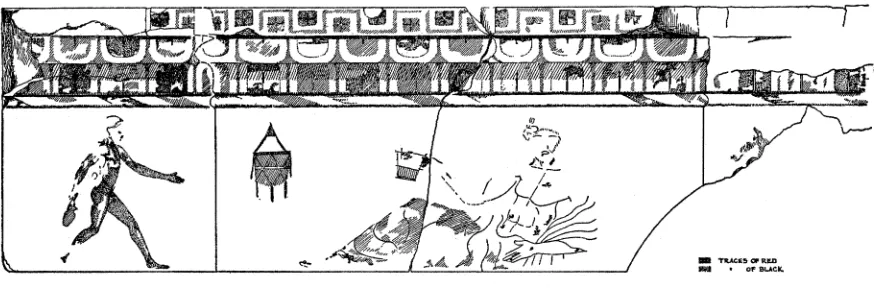
The figured decoration is in the black-figured technique, with the nude parts rendered in purple and the clothing in black and with a rather sparing use of incised lines. In the center of the front panel (P1. 1 iGa and Fig. 3) is a reclining male figure, resting on his left arm and holding a cup in his right hand. The features of the face are nearly obliterated, but traces of a beard and of a leafy wreath may be distinguished. The drapery falls over the left arm and covers the lower part, leaving the upper part of the body exposed. Of the purple color only small patches remain, but the black of
Ti~~~~~~~~~~~~~~~~~~~~~~~~~~~~~~7... ....t F A I
| ( yw E =
- -g | RR- i/ /
- - --- ." -- - ~ '- ~ . .
Fig. 3. Terracotta Altar from Corinth.
the drapery is better preserved. The cup in his hand is a skyphos with rays at the bottom. In the field to the left is a basket rendered in black with purple fillets and incised lines forming two rows of triangles separated by a double line.
On the left panel (P1. 1 1Gb and Fig. 3) is a nude male figure striding toward the right. He carries a pitcher in his right and his left hand is extended toward the front in a gesture of rapid motion. His hair and the pitcher were in black, the rest of the figure in purple. Incised lines are used very sparingly. The decoration on the right flank (P1. 110c and Fig. 3) is missing, except for the head of some animal, probably a dog or a wolf, rendered with black glaze and incised lines.
The reclining figure on the front has the pose familiar in banqueting scenes and in hero reliefs,' but the ivy wreath and the extended cup are particularly appropriate to the god Dionysos. The suspended basket is common in Dionysiac groups as well as in banqueting scenes. Moreover, the nude figure on the left flank, hurriedly bringing his pitcher of wine, has the characteristic gestures of a satyr, but the tail,
if one existed, has disappeared. The " dog " in the opposite panel is the common companion in such scenes, without specific significance.
The poor preservation of the figures makes it difficult to fix a definite date for the altar. Though decorated in the black-figured technique, the subject matter and mode of representation follow the tradition of red-figured pottery at the end of the sixth and in the first quarter of the fifth century. The Suspended basket is common on red-figured pottery in the early archaic style,'1 but is rare on black-figured pottery 12
and on later fifth century vases.
The small fragment shown in Plate 1 lOd, left,18 was picked up by George Kachros, the Guard of the Museum, in the vicinity of the Bema. Though none of the edges is preserved, its resemblance to other fragments of altars leaves little doubt that this is part of a similar dedication. It is made of the same material with a thin layer of fine clay on the surface backed by the coarser variety. The color is a brick-red, but on the surface it is a brownish buff. The figures are in very low relief.
At the right end of the fragment is preserved part of a seated figure, to left, probably female, draped to the ankles in a garment painted dark brown. The out- stretched right arm was rendered in purple, and a painted vertical line in front is probably part of a spear. She is seated on an object outlined with a purple border. The other object visible at the left edge seems to be a draped figure stooping forward, but there is not enough left to identify the object with certainty.
A fragment of a third altar (P1. 1 Od, center)14 was discovered by Robert Scran- ton in the area north of the Archaic Temple. It preserves the total height, 0.135 m., only 2 mm. less than the height of the double altar described above. At the top was a moulding, probably a tongue-and-dart, similar to the moulding on three relief altars from the tile factory.'5 At the base is a raised moulding with a broad toros at the top and a plain band at the bottom.
The fragment preserves a seated male figure to right enveloped in a heavy cloak. His face and feet are rendered in purple, his hair and the edge of his cloak in black. There are three purple dots at the back, like weights suspended from the edge of the garment. The seat is very low, like a cushion. There is nothing to indicate the identity of the figure.
11 It appears on vases of Euphronios (E. Pfuhl, Malerei und Zeichnung der Griechen, III, 130, No. 405), but is particularly common on vases by the Brygos painter; cf. Richter and Hall, Red- figured Athenian Vases, pls. 44 and 45, Nos. 44, 46, 50; E. Pfuhl, op. cit., III, 140-141, No. 422. See also Richter and Hall, op. cit., pl. 35, No. 36 (Colmar painter) and pl. 53, No. 53 (Makron); and M. Z. Pease, Hesperia, V, 1936, p. 258, Fig. 6 (Nikoxenos painter).
12 A somewhat similar basket carried in the mouth of a dog appears on a black-figured
lekythos by the Gela painter of the early fifth century. C. H. E. Haspels, Attic Black-Figured Lekythoi, P1. 24, 2a.
Both in the pose of the figure and in the general appearance the fragment re- sembles a small piece published in 1947 (P1. 1 10d, right) .16 The two fragments are not
parts of the same altar, however, nor could they have been made in the same mould, since the moulding at the base is different. The seated figures are not identical, but the pose is rather similar, and the black line used to indicate the hem of the garment is applied in the same way. Both pieces seem to date from the early fifth century B. C.
The surprisingly large number of terracotta altars from Corinth discovered in recent years indicates that this had become a favorite type of dedication in the last quarter of the sixth and the first quarter of the fifth century B. C. It may have con- tinued in use into later times, but the best examples were probably made during those fifty years. They fall into two distinct categories. One had a broad moulding at the top and painted panels on three sides; the other had mouldings both at the top and at the bottom and the figures were in low relief and likewise painted. Of the two varieties the relief altars may have come into use later, about the end of the sixth century, whereas the painted variety began some three decades earlier and continued into the fifth century. There can be no reasonable doubt regarding the original home of these altars, which represent a late phase of Corinthian ceramic art, not unworthy of the tradition of Corinthian pottery of earlier times.
OSCAR BRONEER OLD CORINTH
GREECE
l~ ~ ~ ~ ~ i
I~[ / ,
a. Terracotta Altar, Front - V. '
. 7-1
~~~~~~~~~~~~~~~~~~~b. Teracttal Altar, Left Flank
NV: - - S :X X 1 - - E -