(PLATES
1-5)
Dating the Construction Filling by the Amphora Stamps Contained . . . . 5
Size and Composition of the Group . . . .. 6
Evidence of the Rhodian Stamps. . . . 7
Evidence of the Knidian Stamps . . . . 13
Evidence of the Less Numerous Classes . . . . 18
The Date of Molded Relief Bowls with Long-petal Decoration . . . . 21
Summary of Evidence that Brings Us to ca. 183 B.C. for the Date of the Filling . . . . 24
An Epigraphically Known Royal Gift to Athens Dated about 183 B.C. . . . . . . . . . . . . . 25
The Function of the Middle Stoa . . . . 26
Appendix 1: Dated List of Eponyms in Knidian Stamps . . . . 31
Appendix 2: Remarks on Revised 3rd-century Dating, on the Stamps in Thompson's Hellenistic Groups A-E, and on Agora Deposits H 13:1 and Q-R 10-11:1 and 2 . . . . 36
Appendix 3: Clarification on the Wrecks at the Grand Congloue Site near Marseilles . . . . 40
Appendix 4: Figures on Production of Rhodian Stamped Amphoras . . . . 42
Appendix 5: Note on the Dates of Rhodian Eponyms named Za,oKXfjs . . . . 44
Catalogue of Illustrated Items . . . . . . . . 45
Index ... . 50
If
N HIS ADDRESS at the celebration of the first hundred years of the Archaeological
A
Institute of America, Kurt Bittel attributed to the work of some earlier German excava-
tors a perhaps undue emphasis on architecture at the expense of "the observation and evalu-
ation of small movable objects" found in excavating the buildings.1 Stamped amphora
1 K. Bittel, "The German Perspective and the German Archaeological Institute," AJA 84, 1980, pp. 271-
277; the quotation is from p. 275. The paper was read by H. G. Guterbock at the Eighty-first General Meet- ing of the Archaeological Institute of America, in Boston, on December 28, 1979.
The present article was originally intended for the Festschrift for Homer Thompson, Hesperia, Supple- ment XX. I hope he will accept it as a further supplement to that volume. I am obliged to him for comments on the manuscript which have resulted in various needed clarifications in my text. I have profited also from helpful suggestions by other readers, in particular W. B. Dinsmoor, Jr., P. M. W. Matheson, M. B. Wallace, and A. Boegehold; others are mentioned below. None of these is responsible for my errors or for my con- clusions.
Works frequently cited will be abbreviated as follows:
Agora XII = B. A. Sparkes and L. Talcott, The Athenian Agora, XII, Black and Plain Pottery of the 6th, 5th and 4th Centuries B.C., Princeton 1970
Agora XIV = H. A. Thompson and R. E. Wycherley, The Athenian Agora, XIV, The Agora of
Athens, Princeton 1972
Agora XXII = S. I. Rotroff, The Athenian Agora, XXII, Hellenistic Pottery: Athenian and Imported Moldmade Bowls, Princeton 1982
Amphoras = V. R. Grace, Amphoras and the Ancient Wine Trade, Excavations of the Athenian
Agora, Picture Book No. 6, rev. ed., Princeton 1979
Coulton 1976 = J. J. Coulton, The Architectural Development of the Greek Stoa, Oxford 1976
De'los XXVII = V. R. Grace and M. Savvatianou-Petropoulakou, "Les timbres amphoriques grecs"
(Chapitre XIV) in Exploration arche'ologique de De'los, XXVII, L'Ulot de la Maison
des Come'diens, P. Bruneau, ed., Paris 1970, pp. 277-382
Hesperia 54, 1
American School of Classical Studies at Athens is collaborating with JSTOR to digitize, preserve, and extend access to
Hesperia
0 C) Ql
;>
QT
AP +?
X
<
(t7
-
sto~~~0
II
CENT. B.C.''j
0~~~~~~~~~ /
LEOKOREION\
0~~~~0
40
-- - . t-s-f ! g . tse .- / l t ~~~~* 40
/ : A.AS.;.m f. AO .~~~~~~~~~~* .H 0
0 <_<-->\</ jj ;1 q r-< l
!
-o ,' ~~~~~~~SOUTH SQUARE os
/ / ,' , * . | ~~~~~~~~SOUTH STOA It
I \ ,-
0
~
~
~
~
~
x 100 197
< _<X ~~~~~~~= = J~~W. I f^L4
handles, to be sure, sometimes escaped such oblivious enmity in those days by dint of being
counted as inscriptions rather than as small finds and by appearing in large numbers. Thus
we have the excellent and still basic publication by Schuchhardt in 1895 of some 782 am-
phora stamps, mostly Rhodian, found in Pergamon in a filling dumped in ancient times
between the foundations of a room set between thie earlier and the later city walls.2 Professor
Bittel had more in mind than the mutual development of chronologies that might result
from studies of small finds in relation to buildings. The dimension of time, however, must be
set up in the best possible way before we can learn what we should in, as he suggests, the
Garlan 1979 = Y. Garlan, "Koukos, donnees nouvelles pour une nouvelle interpretation des timbres amphoriques thasiens," BCH, Suppl. V, Paris 1979, pp. 213-268
Grace 1934 =V. Grace, "Stamped Amphora Handles found in 1931-1932," Hesperia 3, 1934, pp. 197-310
Grace 1949 = V. Grace, "Standard Pottery Containers of the Ancient Greek World," Hesperia, Suppl.
VIII, Commemorative Studies in honor of Theodore Leslie Shear, Princeton 1949, pp. 175-189
Grace 1952 = V. Grace, "Timbres amphoriques trouves a Delos," BCH 76, 1952, pp: 514-540 Grace 1968 = V. Grace, "Die gestempelten Amphorenhenkel aus stratigraphisch gesicherten Fundzu-
sammenhangen," Exkurs in 0. Ziegenaus and G. de Luca, Altertiumer von Perga- mon, XI, i, Das Asklepieion, Berlin 1968, pp. 175-178. The author saw no proof of this Exkurs, which contains many errors not in the manuscript.
Grace 1971 = V. R. Grace, "Samian Amphoras," Hesperia 40, 1971, pp. 52-95
Grace 1974 = V. R. Grace, "Revisions in Early Hellenistic Chronology," AthMitt 89, 1974,
pp. 193-200
Grakov 1929 = B. N. Grakov, Ancient Greek Pottery Stamps with the Names of Astynomoi, Moscow 1929 (in Russian)
Guide3 = H. A. Thompson, The Athenian Agora, A Guide to the Excavation and Museum, 3rd ed., Athens 1976
Knackfuss 1924 = H. Knackfuss, Milet, I, vii, Der Sudmarkt und die benachbarten Bauanlagen, Berlin 1924, pp. 156-176 (on the Magazinhalle)
Nessana I =V. R. Grace, apud H. D. Colt et al., Excavations at Nessana I, London 1962, pp. 106-130
Nilsson 1909 = M. P. Nilsson, "Timbres amphoriques de Lindos," Exploration archeologique de Rhodes V (Academie royale des sciences et des lettres de Danemarke, Bulletin), Copenhagen 1909
Pnyx = V. R. Grace, "Stamped Wine Jar Fragments," in Hesperia, Suppl. X, Small Objects from the Pnyx: II, Princeton 1956, pp. 113-189
Rickman 1971 = G. Rickman, Roman Granaries and Store Buildings, Cambridge 1971
Schuchhardt 1895 = C. Schuchhardt, in Altertumer von Pergamon, VIII, Inschrijten ii, Berlin 1895, pp. 423-499
Tarsus I = H. Goldman et al., Excavations at Gozliu Kule, Tarsus, I, The Hellenistic and Roman Periods, Princeton 1950
Thompson 1934 = H. A. Thompson, "Two Centuries of Hellenistic Pottery," Hesperia 3, 1934, pp. 311-480
2 See Schuchhardt 1895, p. 423. For a recent discussion of the deposit, see Delos XXVII, especially
Li
/l_Tr~
1966
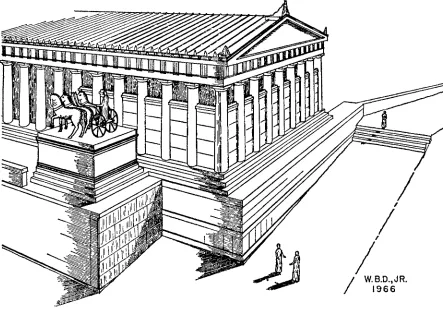
FIG. 2. Middle Stoa, West End in Original Form, from Northwest (W. B. Dinsmoor, Jr.)
economic and social fields. Such studies of material in context in a large excavation can only
be enabled by a complex, well-planned, and strict system of recording, such as that devised
by T. Leslie Shear for the excavations of the Athenian Agora of the 1930's and greatly
developed by Lucy Talcott.3 The basis of such records is, of course, the excavator's grasp of
what he sees and his managing to record it while the impression is fresh. One of my early
recollections of Homer Thompson is of learning from him, in 1932, that although stamped
amphora handles were supposed to be Hellenistic, he had found some in definitely Classical
company; he showed me several, which gave me a permanent taste for the Thasian class.4 If
the information no longer surprises, it is in great part becauseT
of the impact of the large
group of early Thasian stamped handles excavated by Thompson at the Pnyx, in the Filling
of Period III of the Assembly Place, which established the priority of the two-name Thasian
I For appreciation still felt, see Grace 1934, p. 200 with note 5; De'los XXVII, p. 278, last paragraph of note.
stamps, fixing them before about 340
B.C.5For the place of container amphoras in the
general archaeological mind in 1932, I quote from a letter (of 1951) from a distinguished
archaeologist, the late Professor C. H. Emilie Haspels of Amsterdam, in reference to an
investigation of what must have been an ancient pottery works for the production of am-
phoras in Thasos, a workshop which in the light of modern information is seen to have
operated from early in the 4th century
B.C.:"Re the amphoras: I called them Hellenistic at
the time (in 1932 or '33) for the only reason that we . .. were used to speak of 'Hellenistic
pointed amphorae'. Almost a term like West Slope ware or Megarian bowls."6 Here is one
of the places where Homer Thompson has enabled us to take a big step forward.
DATING THE CONSTRUCTION FILLING
BY THE AMPHORA STAMPS CONTAINED
The thesis of the present paper has been known to Thompson and other interested persons
since July 11, 1956, when I completed a report on the stamped amphora handles found in
the building fill of the Middle Stoa in the Athenian Agora, about 1500 in number. The
report was circulated at the Agora and has remained on file there.7 The date which the
handles seemed to indicate as that of the lower limit of the fill was the second decade of the
2nd century
B.C.8So early a date was not generally accepted at that time; there were conflicts
to be resolved: for instance some coins in the fill had been dated in the second quarter of the
century. Further studies of the various stamp sequences represented in the fill continued to
point to the same decade for its probable lower limit; eventually, counting the terms of
dating officials in Rhodian stamps brought us to a proposed end date of the stamps in the
filling of about 183 or 182
B.C.9Finally, we have in 1972 Homer Thompson's considered
date for the start of construction of the Middle Stoa itself, "late in the first quarter of the 2nd
century
B.C."10The coins have now been published by F. S. Kleiner, who finds nothing that
he need date later than about 180
B.C.More recently, the molded relief bowls in the filling
Summary on the Pnyx: J. Travlos, Pictorial Dictionary of Ancient Athens, London 1971, pp. 466-476, with bibliography, p. 467. Summary on the Pnyx evidence dating the two-name stamps: Delos XXVII, bottom of p. 355. Cf. Garlan 1979, p. 246 with note 12. Most recently on the Pnyx as a whole, see H. A. Thompson, "The Pnyx in Models," Hesperia, Suppl. XIX, Studies in Attic Epigraphy, History and Topography Pre- sented to Eugene Vanderpool, Princeton 1982, pp. 133-147.
6 On the Haspels investigation in Thasos, see Garlan 1979, pp. 256-258, taken from an unpublished
excavation report, apparently of late 1933.
7 Filed with Deposit Summaries, under its grid position H-K 12-14. Text accompanied by extensive lists,
and analyses by class, of the stamped handles from the Middle Stoa construction filling, also of those from some related groups found in the neighborhood; lists also of the individual grid positions cited by the ex- cavators. We are under considerable obligation to G. R. Edwards for making definitive the primary list, of items to be counted as coming from the filling, especially for the earlier (pre-war) finds. Cf. p. 22 below with footnote 57.
8 Published statement in 1962, Nessana I, p. 124.
9 Delos XXVII, p. 291, and see pp. 9, etc. below in the present article.
10 Agora XIV, p. 67. The date given for the filling in Agora IV (1958), VIII (1962), and XII (1970), in the deposit lists, had been to ca. 150 B.C., a date evidently derived from that appearing in Edwards' 1956 publica-
have been described by S. I. Rotroff as "similar to those in other deposits of early 2nd
century."l
1
The stamped amphora handles from the Middle Stoa building fill are worth a volume
to themselves, so numerous and rich and varied is the material and of such wide bearing.
The evidence is summarized here as a prime example of the possibility of mutual develop-
ment of chronologies, in this case between the amphora fragments in the fill, a large hoard
assembled as bulky rubbish to fill in for a level floor for a building 150 meters long, set on
sloping ground, and the building itself, for which the detailed dating of the stamps suggests
an identification. In turn, the identification implies independent support for a rather nar-
row dating for the cutoff point of the material in the construction filling of the building,
because of the historical probabilities as to when work would have begun on such a project,
as will be discussed below. What is attractive is that the archaeological indications and the
historical probabilities arrive at the same date, about 183
B.C.In the course of making a report on this material, I have found it necessary to take up
matters that needed more extensive presentation than their relevance to the present dis-
cussion might justify. In order not to interrupt overmuch the account of the dating and
identification of the Middle Stoa, I have put this material into appendices at the end of the
main text of the article (see p. 1 above for titles).
SIZE AND COMPOSITION OF THE GROUP
Let us look now at the assortment of amphora stamps in the filling of the Middle Stoa:
Rhodian 885 or 59% of the whole number
Knidian 343
Early Knidian 39
382 382 or 25%
Thasian 60 or 4%
Koan 53
Chian (some from lagynoi) 23
Corinthian 7
Sinopean 6
Parmeniskos Group 5
Zenon Group 5
Parian 2
Samian(?) prow stamp 1
with Latin stamp 1
miscellaneous unclassified 68
1498
A detailed count of the stamped amphora handles at the Agora excavations as a whole
(including those from the Middle Stoa filling) was made in 1960. I add figures from this
I F. S. Kleiner, Hesperia 44, 1975, pp. 303-31 1. (For his separate Deposit III, p. 31 1, I have not been able
count as a background for that of the Middle Stoa: Rhodian, 4432; Knidian, 12002; Thas-
ian, 674; general total at the Agora in May 1960,19267.12 Note a reversed percentage of the
two large classes: Rhodian, 23%, Knidian, 62%. We are particularly concerned here with
the end date of the Middle Stoa filling but in considering percentages should reckon with the
fact that it contained much earlier material; of the stamps, there are many Rhodian of the
3rd century and Thasian of the 4th as well as of the 3rd. Knidian stamps with names (as
distinct from what we call Early Knidian, that have abbreviations, monograms, ligatures, or
just devices13)
do not seem to have been produced before the last quarter of the 3rd century.
Once in use, stamped Knidian gain steadily on stamped Rhodian as imports to Athens.
Already by the middle of the 2nd century, figures for the Stoa of Attalos filling show about
35 stamped handles to 70, Rhodian to Knidian, and none of the Rhodian is datable later
than the first quarter of the century. A group of stamped handles in Athens datable in the
second half of the century may be 100% Knidian: see below, Appendix 2, on Thompson's
Hellenistic Group E. The shrinking of the Rhodian figures in Athens during the 2nd
century
B.C.(which makes something of a slide rule for dating deposits) does not reflect a
decrease in production and export from Rhodes, but, according to Rostovtzeff,14
"the gra-
dual emancipation of Athens from the commercial hegemony of Rhodes, an emancipation
which began earlier than 166, ...." That there was indeed no decrease in production of
stamped amphoras in Rhodes before the late 2nd century
B.C.is another story, important in
itself; see Appendix 4 for relevant figures derived from the Benaki collection in Alexandria.
EVIDENCE OF THE RHODIAN STAMPS
For the Rhodian in the Middle Stoa filling, we have an extensive correspondence
with
those in another big foundation filling, that in the building in Pergamon cited above (p. 3).
The Rhodian in the Pergamon deposit are 782 to our 885, and there are a great number of
individual parallels. A difference is that those in Pergamon are mostly close together in date,
while those from the Middle Stoa filling, as noted above, include many earlier items. A
difference more interesting for the lower limit of the Middle Stoa filling is that a few
Rhodian eponyms (dating officials), who are named in the Pergamon deposit on as many as
4 to 24 handles per name, do not appear at all in the Middle Stoa filling. These are as
12 The count of 1960 was made by M. Petropoulakou and A. Dimoulinis, to whom I owe much help in the preparation of the present article as of previous ones. The handles were counted as laid out in their classified storage, and figures include some 4865 items which have not been inventoried because they are inferior dupli- cates of inventoried items and have no useful excavation context. The figures are not very up to date, but in any case recent excavations have not added new stamped handles to our collection at the earlier rate. Last inven- tory number of the 1960 count: SS 14402; last of the 1980 season: SS 14843. Cf. De'los XXVII, p. 282.
13 Cf. Grace 1934, p. 280, no. 233, Early Knidian stamp on a whole amphora from Thompson's Group B; cf. ibid., p. 202, fig. 1, no. 6, for the jar. For the date of Group B, see Appendix 2 below (date now ca. 240 B.C.). Cf. Grace 1952, pl. XIX:1, for another Early Knidian stamp.
follows; figures in parentheses show how many handles in the Pergamon deposit name each
individual:
'AyclaTpaTos- 2nd (4)
'Apa-ro4acv,qs 1st (8) 'Apo-rTd'bas- 2nd (10)
'Apo-roba,uos 2nd (24)
'ApLto-rwv 2nd (20)
'ApXLXat8as- (5)
-EVO4+6WV (4)
No one of these seven eponyms occurs in the Middle Stoa filling (an
'ApLO-rcEbas,named
on a single handle, SS 12862, is readily distinguishable as a homonym of the 3rd cen-
tury
B.C.by the shape and finish of the handle). On the other hand, despite the steady de-
crease, discussed above, of Rhodian imports to Athens during the first half of the 2nd cen-
tury, we do have handles at the Agora (although not in the Middle Stoa filling) that are
dated by all seven of these eponyms, some from consistent post-Middle Stoa deposits:
cf. four from the Stoa of Attalos filling, SS 10492 naming 'Aparo4a6 s 1st, and SS 10730,
10739, and 13370, naming
'ApLOTrELbas,2nd.
These seven eponyms therefore suggest a period of seven years immediately after the
end date of the Middle Stoa filling but before the close of the Pergamon deposit. The sug-
gestion is strengthened by the fact that all seven names are known on handles that bear also
secondary stamps set in the common way at the attachment of the handle to the neck of the
jar, a practice that was just beginning in the period of the Middle Stoa. Only one such stamp
appears in the filling, a small rose with no letters, in a single example, SS 12717; for a
similar stamp, better preserved, see Plate 1, 1. No part of the main stamp of SS 12717 is
preserved, but this secondary stamp is known only on handles from amphoras of the potter
AapoKpaT/sn
in the terms of
KaXALKpar'bas,2nd,
KXEVKparqs-1st, and
EV4ulaxos,; allthese
persons occur in both the Pergamon and the Middle Stoa fillings. The rose secondary stamp
is an early one in this series, dated in the early 2nd century
B.C.by context in Tarsus.15 Of
eponyms named in the Middle Stoa filling, only three are known to occur with secondary
stamps of the slightly later kind in which a letter replaces the earlier rose, the kind that
accompany the seven names listed above, those present in the Pergamon deposit but not in
the Middle Stoa filling. The three in the Middle Stoa filling are
NLKao-ayopas,1st,
OEaib'ros-,
and 'AOavJoboros-,
perhaps in that order; for samples of the secondary stamps
15 Tarsus I, p. 145, no. 75 B; the context, "top level, Middle Hellenistic Unit", indicates a date of late 3rd- early 2nd century B.C., cf. ibid., pp. 30-31. Note that the restoration of the name KaXXL#cpaTr in the main stamp of no. 75 does not now seem correct.
On secondary stamps on Rhodian handles, usages and dates, see De'los XXVII, p. 380, index to dis- cussions on the subject in various parts of our chapter in that volume, where references to the earlier literature on the subject will be found. Corrigendum: the early Rhodian fabricant w-rag there mentioned, now dated ca. mid-3rd century B.C., does use secondary stamps; a nearly whole amphora of his in Rhodes has a secondary stamp (with a monogram) beside each of its main stamps on the tops of the handles (temporary inv. no. ME 547, dated by the eponym 'ErtdXap,wos-; mentioned here by permission of Mr. I. Papachristodoulou).
accompanying the first two, see Plate 1, 2b and 3b. These are then probably the latest
Rhodian eponyms in the Middle Stoa filling and were no doubt preceded by the three
mentioned as occurring with the rose secondary stamp. It seems at present a fair guess that
the use of these secondary stamps, by certain potters with large output, began in or soon
after 188
B.C.,at the time of the chief Rhodian expansion on the continent; through the 2nd
century these additional control stamps continued in use by big producers such as MLbas
(see below, Appendix 4); many stamped handles from his jars bear secondary stamps. For
thoe-end
date of the Rhodian in the Middle Stoa filling, I lay out the proposed sequence of
eponyms, with figures for the number of handles bearing these names in the two large
deposits:
188-186 KaXXLKparL'3as- 2nd, KXEVKpa5ris 1st, and 1v'/t/axos-
185 NLKao-ayopas- 1st (Middle Stoa filling 8; Pergamon deposit 9) 184 OEaL'8,-ros- (Middle Stoa filling 6; Pergamon deposit 12) 183 'AOavdoboros- (Middle Stoa filling 4; Pergamon deposit 17)
182-176 The 7 present in the Pergamon deposit and not at all in the Middle Stoa Building fill
('AyE' o-rparos- 2nd, etc., listed above).
The dates assigned are supported by a variety of other bits of evidence, including other
contexts, and the chain of name connections between potters and dating officials, derived
from the study of pairs of names from the two series, of which the most convincing are found
combined on whole amphoras or fragments preserving both stamped handles. See Plate 1,
which illustrates two whole jars, 2 and 3, from the stamped tops of the handles of which we
take two such pairs of names. 2a and 2c show the dating and endorsing stamps respectively
of 2, an amphora of
A?a/oKpcarrqs-dated in the term of
NLKao-aydpas-,in the month
HlLVOLosI,3a
and
3cthe stamps of
3,an amphora of '
1G7aroKpcairsqin the term of
OEaLb'qros-,in the
month
HavalAosQ 16Each of these jars has also a secondary stamp, set on the side of the upper
attachment of (in the case of these jars) the fabricant handle, actually visible in the side
views of the two jars, as well as in 2b and 3b. Attested secondary stamps used by
Aayo-KpaTr7S
(those of which we have rubbings or photographs) are the little rose (P1. 1, 1) and
slightly variant rose types, and the letters occur, singly, A, K, C (i.e. lunate sigma), T, Y.
Most of these are used also by '
17r7roKpa7r)s,that is, the dies seem to have been taken over;
for this and other reasons we conclude that the products of the two potters are from the same
shop. The shop will have changed hands between the making of the two jars shown: 2
names the latest of many dating officials known with
Aa1uoKpacr7s,and 3 the earliest of still
more known with
'1nroKpar7s-,whose career can be followed to probably the middle of the
2nd century. The secondary stamp 3b with its distinctive beta is so far on record only from
jars of
'I7r7roKpa'r7s,not those of
Aa,uoKpac1qs.This may be an accident of preservation for
the moment; someone may find a handle with the rose stamp of
Aa,oKpairson top and this
characteristic beta stamped on its side. Otherwise the handle in
Tarsus17that combines this
secondary stamp with a rose main stamp naming
NLKao-aydpas,suggests that the change in
management took place during the term of this eponym; which is, I suppose, more likely
16 For documentation, readings, etc., of the illustrated items, see Catalogue below.
17 Tarsus I, fig. 117, 76 A, 76 B. Note a second (unpublished) example of the combination: duplicates of
than not. At present this particular beta is known only with the eponyms
NtLKaoayopas,1st
and ?EatLb7'Tosg
and with the fabricant
'I7r7roKpa'T7s.Contemporary with the activities of
'I7rT0KpaT?7s!were those of the Rhodian 'Apt-
o-TOKA?S!
who made and marked Knidian amphoras as well as producing a great number of
Rhodian ones with rose stamps like those of
'I 9'9oKpaT-qs;for some of his Knidian stamps,
see Plate 3, 19-21. The two men seem both to have succeeded to the shop of
AaUoKpaT-qs;perhaps they were brothers; in any case this
'ApLO-roKXAqs!seems to have been the son of the
AaMAoKpaTis!
who made the amphora on Plate 1, 2. The two contemporaries,
'ApL-TroKX7^sJand 'I
17oKpal Tq,used over the years a great number of secondary stamps, at least 25
different ones each, some of which appear to be common to both (but a study of dies has not
yet been made). Oddly, although for both brothers(?) there are many known or reasonably
guessed pairs with dating officials, all datable between about 183
B.C.and the middle of the
century, we have up to the present no indication that both
'Apw7-oTKXi^s!and '
IroKpar1s!ever dated jars in the same year.18 During the period of production of these two, no other
fabricants are known to have used secondary stamps; but about the middle of the century,
their amphoras seem to have been replaced by those of TtLtoeEvos!,
again bearing circular
rose stamps plus secondary stamps. It is interesting to note that secondary stamps were used
also on Knidian amphoras by fabricants named
'ApL-TroKAjs!and
TL tloevoswho used rec-
tangular main stamps; their dates correspond with those of the Rhodians of the same names.
After the mid-century, other Rhodian fabricants used secondary stamps, including some
whose main stamps are rectangular: cf. Mt'bas!
(see Appendix 4).
Through a lapse in processing, the eponym 'AOavd0oros!
had not been listed in our
archives as occurring with secondary stamps, but in fact there are a few handles that name
him in circular rose types and bear also secondary stamps with the letters tau and upsilon
(singly) like those used by both
AauoKpaTi-sand
'I r7roKpa?7Ts(i.e. apparently from the
same dies). 'AOavd8oros!
had in any case been listed in my tentative sequence only a few
years too early, because name connections place him closely. Potters known to have dated
jars by his name are
'AyaOoKXAqs!2nd,
'AltvVTas!with wreath, 'AvT't',aXos!
with caduceus,
'Ap&'TCov
with caduceus,
Iapa7n'wvwith asterisks, and
DXat'vtos!;this is to name only the
"real" pairs, i.e. whole jars or tops of jars with both stamped handles preserved. The epo-
nyms named by these potters on other jars of theirs in each case overlap the period ca.
188-176
B.C.and in some cases are only of this period. It now seems likely that
'AOavd0oros!is the latest Rhodian eponym whose name is present in the Middle Stoa building fill.19
18 On the dynasty /a,oKpac7Tn, 'ApLG-ToKX f, AacMoKpa'T7, o 'ApLo-TOKXEv, etc., cf. Delos XXVII, p. 280, also pp. 327-328 under E 66, and elsewhere (see index, pp. 375, 376). On 'I7r7roKp a6T7), see now V. Grace apud J. Bouzek, Anatolian Collection of Charles University [Kyme I], Prague 1974, pp. 94-95, under A 3.
Note that this 'ApLo-T0KX i^ (contemporary of 'I7r7roKpa'T7) is not the earliest to endorse Rhodian circu- lar stamps with rose, but there was at least one earlier Rhodian fabricant of this name, who worked probably in the third quarter of the 3rd century B.C. For a published stamp of his, see M.-T. Lenger, BCH 81, 1957,
pp. 164-165, no. 88, fig. 2 (from Argos). Presumably the 'ApLGrTo0Kfjq named in Mlle. Lenger's stamp was the father of the fabricant of 2.
19 Rose stamps naming the eponym 'AOavdo0oTo and accompanied by secondary stamps:
1) with month AaiXtov, secondary stamp tau like those on handles of AaMoAKPaT?,9 and 'I7r7oKpa'T?):
So much for the usefulness of eponym-fabricant name connections in building the
chronology of amphora stamps, for an indication of where we find the most convincing
pairs, and for the corroborative evidence supplied by secondary stamps. Whole amphoras,
however, and even large fragments help, of course, in another way to supplement and con-
solidate the dating evidence, and that is by the evolution of the shapes and dimensions of the
jars, the most obvious tendency of Rhodian ones, from the late 3rd to perhaps the late 2nd
century
B.C.,being to grow slowly taller and slimmer, the neck and handles taller in propor-
tion to the jar as a whole. 2 and 3 in Plate 1, closely contemporary, fit into the Rhodian
series in Amphoras, fig. 62 after the first jar in that picture; they postdate it by about 20
years, according to the eponyms named. They are even closer, especially 3, to another pub-
lished amphora, one of
'ApLo-ToKAXfs!in the term of 'ApXtXatLas!,
an eponym present in the
Pergamon deposit but not in the Middle Stoa filling, hence datable very soon after
?EaL'-bip-os~
of
3.20The stages of the change in shape, placed according to the tentative sequence of
names, form a control, and thus the chronology is adjusted. Contrast in shape and dimen-
sions of the amphoras makes it easy to distinguish between eponyms of the same name who
may be two generations apart, when whole jars are preserved that name them; for instance
between the NLKao-ayopas
of ca. 185
B.C.who dates 2 (P1. 1), and the later one named on an
amphora of
E'v4pacvwp,perhaps there the NLKao-ayopas!
whose term as priest of Halios is
dated epigraphically shortly after 123
B.C.The later jar (unpublished) has considerably
longer neck, handles, and body, and the handles bow out noticeably, another relatively late
feature; its capacity is about 25% greater than that of
2.212) with month OEoMuobopLov, secondary stamp upsilon like those used by LAauoKpa'T7, and 'I7rroKpa-
T7)g: Eton College Collection, no. 138 of the stamped handles. My records of the collection I owe to the kind-
ness of the late George Tait and of several of his students of the '60s, including particularly Nicholas Harington.
3) with same month and probably same die as in (2), a secondary stamp is indicated in a drawing but not identified or mentioned: F. Benoit, "Nouvelles epaves de Provence," Gallia 16, 1958, reading on p. 33, draw- ing in fig. 41, p. 32 (from Anse Saint-Roch, Antibes).
4) with unrestored month, secondary stamp upsilon: D. B. Shelov, "Pottery Stamps from the Excavations at Phanagoria," Materials and Studies of Archeology in the USSR, no. 57, [1957] (in Russian), p. 138, table, eponym entry 37. The stamps are not illustrated so the dies are not known. I have restored the name of the eponym: ['AOavz]o8T0ov. There is no other possibility.
The data for 'AOavd'o0oTo are given here in detail because this name was omitted from among the latest eponyms in the Middle Stoa building fill in information given to S. I. Rotroff: see Agora XXII, p. 102. It is perhaps also of interest to show for one name the kind of evidence available as documentation for statements on others.
20 Grace 1949, pl. 19 and p. 186, no. 5; stamps, pl. 20 and p. 187, nos. 4, 5; regrettably, the secondary stamp
beta is not illustrated.
21 On two eponyms NtKacrayodpav and references to the two jars, see De'los XXVII, p. 306 under E 15 (upper
paragraph). Capacity of the later jar and comparative figures, cf. "The Commercial Amphoras from the Anti- kythera Shipwreck," TAPS 55,1965, p. 7, note 8; the jar is in the Nicosia Museum, Cyprus, inv. no. CMC 198. The "bowing out" of the handles results from drawing them in below to accommodate to a slimmer body; cf. op. cit., p. 6. For the epigraphical date of an eponym NLKacrayopav, see C. Blinkenberg, Lindos, Fouilles de l'Acropole 1902-1914, II, Inscriptions I, Berlin and Copenhagen 1941, p. 536, no. 246 (NLKacrayopav
'I7r7roKXEvs); 123 B.C. is the date attributed to him as priest of Athana Lindia, cf. ibid., p. 125, and the priest-
Historical considerations have bearing, and it may be noted that in the original publica-
tion the proposed date for the Pergamon deposit was late 3rd to early 2nd century
B.C.,as a
time of friendly relations between Pergamon and Rhodes.22 Sometimes, as with NtKa-
o-ayopas
2nd just mentioned, one may suggest identifications of persons in stamps with
persons known in epigraphical or literary texts. Thus it is possible that
OEaiaT0jros!,tenta-
tively listed here as the next to latest Rhodian eponym in the Middle Stoa filling, was the
father of
'AorTv,Iu8j1
OE)EatLbrTrov,who was the priest of Athana Lindia in 154
B.C.and
perhaps then of Halios a year or so afterward. According to Polybios, the son was sent to
Rome on missions in 168, 164, and 153
B.C.;and the father, perhaps the
?EaL'p-qT0osof
3,died in Rome in 167/6, being then over eighty years of age.23 One would like, again, to
associate with the potter dynasty
AaLOKpaT-qs!-'ApLo-ToKXqjs!,etc. (see p. 10 above, with
footnote 18), a Rhodian mentioned on a Thasian stone,
'ApLo-ToKXiq^ o [ ]KpaTEVs,secre-
tary of the boula of Rhodes in the term of the priest of Halios
?E'po-av3pos.A date of
69/68
B.C.is tentatively proposed for the stone in the publication; the authors tell us, how-
ever, that the letter forms could well be of the second half of the 2nd century
B.C.Such a date
would fit with that of the eponym
GE'po-av8pos!known in stamps; we have no evidence of a
later homonym. In that case, perhaps the secretary of the Rhodian boula had actually been,
in his creative youth, the
'ApLo-ToKAXfs!of the stamp types 19, 20, and 21 (P1. 3). By, say,
22 Schuchhardt 1895, p. 432. In the excellent dissertation of F. Bleckmann, De inscriptionibus quae legun-tur in vasculis Rhodiis, Gottingen 1907, Schuchhardt's dating is used and developed; see especially Bleck- mann's p. 25. Cf. De'los XXVII, p. 290.
23 For the Lindian priesthood of 'AG TV,U))8-qg OEalq'Tov, see Blinkenberg, op. cit. (footnote 21 above), p. 121, under the year 154, with commentary below; see further ibid., pp. 488-490. (No mention in these in- scriptions of a priesthood of Halios. It should be observed that Blinkenberg counted the existence of a name as eponym in Rhodian amphora stamps as sufficient evidence that the person named was a priest of Halios.) On names of Rhodian eponyms in stamps for whom identifications have been proposed with priests named in inscriptions, cf. De'los XXVII, p. 299 with references. Of particular interest is the triple correspondence examined ibid., p. 313, under E 34, of three known stamp eponyms with three priests of Halios cited in SEG III, 674. The stone has been discussed recently by P. M. Fraser (Rhodian Funerary Monuments, Oxford 1977, pp. 60-61), but in his documentation (pp. 150-151) the author fails to use the text on E 34 with its clarification on the dates of the stamp eponyms, which is based on information not available to the scholars he quotes.
On 'AUTV/L 382)v and ?)Eat8)ToT in stamps, apparently persons mentioned by Polybios, see the com- mentary by Bleckmann, op. cit. (footnote 22 above), pp. 19-20. Cf. recently F: W. Walbank, A Historical Commentary on Polybios, Oxford 1979, p. 303, on persons with these names; correct the priesthood of 154 B.C., which (as just noted) was that of Athana Lindia, not that of Halios. The stamps provide an earlier eponym 'AUTV,U 8pq, but his year as priest of Halios should date nearer 213 than 204 (cf. loc. cit.; they pro- vide also a much later one, who has been identified tentatively with a priest of Athana Lindia of 46 B.C., see De'los XXVII, p. 299 with note 3).
OEaL'837To9 is given a year, 188 B.C., as priest of Athana Lindia by H. van Gelder ("Over Rhodische Kruikstempels en hun Belang voor onze Kennis van den Rhodischen Handel," Verslagen en Mededeelingen der Koninklijke Akademie van Wetenschappen, Afdeeling Letterkunde, 5e Reeks, Deel I, Amsterdam 1915, p. 202). Van Gelder gives as source an inscription "not yet published" by Blinkenberg. No such inscription appears in Blinkenberg's comprehensive volume of 1941 cited above; and P. M. Fraser kindly informs me, in a letter of 22.VII.81, that there is no epigraphical reference for any priesthood of )Eati8)TOS9 in the records from which he is compiling the new Lexicon of Greek Personal Names.
140
B.C.,and given his family history, our man must have been a substantial citizen.24
Analogous to the Rhodian potter dynasty
AayOKpdiTrj9-'ApLo-ToKA^SDwould be the earlier
Thasian one, again with aristocratic names, recently identified at Kalonero on Thasos by
Y. Garlan. In the waste of an ancient pottery works he found many amphora fragments
bearing stamps of one or other of two potters,
'Aptffrayoprand
AZ7yUAK'7)K,the potter's
name always combined with that of a dating official, the two series of dating officials entirely
distinct from one another. Two-name Thasian stamps date from about 390 to about
340
B.C.,cf. p. 18 below, footnote 43. Garlan has matched the two potters' names with those
of an epigraphically known Thasian family in which fathers and sons were called suc-
cessively A/?7faAXK7)s and 'AptwrTayopr7s, an alternation of names that can be followed in
Thasian inscriptions from about 370
B.C.for nearly a century.25
EVIDENCE OF THE KNIDIAN STAMPS
The Knidian amphora stamps in the Middle Stoa filling are possibly even more critical
than the Rhodian for dating the filling itself as well as for establishing the earlier chrono-
logical sequence of their class, i.e. for the mutual development of chronologies. They are
largely a close group. Over half are dated in 11 eponym terms, those of A ajkoyEvYS-
1st,
EivKpa47TS'1st,
0rqpoKpaT-7s1st,
KaAXXtTros,A&cov,
Avo-cavtos-,MnTrpobopos-,
NtKaol/3ov-xos-, noAtovx7s-, 1COKpa4ThJS, (h'XLt'TOS9 1st; the names are variously abbreviated in the
stamps. At least 9 handles in the filling are dated by each of the foregoing names; see Appen-
dix 1 below for individual figures. Three more eponyms whose names each appear on 5
handles in the filling are
?EqG-Tco'Paaros-, KXEtT0ocv,and
h(XtrTt'cov(again variously ab-
breviated); these probably preceded or followed pretty closely the 1 1. Eponyms seen on only
one handle in the deposit may be earlier than the others, or they may be the very latest (no
time for much breakage), or some might theoretically turn out to be impurities in the
deposit. 26
To help place the period of the 11 (plus) eponyms, two obvious groups of Knidian
known to date before about 150
B.C.were examined: those found in Corinth and those from
the construction filling of the Stoa of Attalos in Athens; from the Corinth list, certain names
were omitted which clearly belong to the renewed (small-scale) activity there after the
24 For the Thasian inscription, see C. Dunant and J. Pouilloux, Etudes thasiennes, V, Recherches sur
1'histoire et les cultes de Thasos II, Paris 1958, pp. 26-35, no. 172; on the "ecriture", see top of p. 31. The authors' date depends on their identification of a Roman governor who is mentioned; they examine seven possibilities and choose the last; the second would suit the G,E'po-av8pos of the stamps and perhaps a date within 141-135 B.C., which seems to be available. On O(E'po-ap8pos, cf. Nessana I, p. 116, under no. 7. This eponym dates known whole jars of the fabricants 'Aya0d/3ovAos, EV'KAELTOS, Ka'AAcov, and TtpapaTos.
25 See Garlan's article in Trade in the Ancient Economy, P. Garnsey, K. Hopkins, and G. R. Whittaker, edd., London (Chatto and Windus) [1983], p. 34. Note that 'Apt-ray6pr1g regularly has the eta ending in the earlier Thasian inscriptions and stamps. Cf. J. Pouilloux, Etudes thasiennes, III, Recherches sur l'histoire et les cultes de Thasos I, Paris 1954, p. 273, no. 34, lines 9 (genitive) and 45. For the name unabbreviated in one of the earlier (two-name) stamps, cf. A.-M. and A. Bon, Etudes thasiennes, IV, Les timbres amphoriques de Thasos, Paris 1957, p. 119, no. 278. Cf. also the comment, ibid., p. 118.
destruction of 146
B.C.27In a fair number of the Knidian stamps from the two sources, the
eponym is entitled phrourarchos in the stamp. Many more of the names included occur with
that title in stamp types28 other than those found in Corinth or in the Stoa of Attalos filling;
i.e. some potters, or their scribes, did not include the title in their stamps, although referring
to the same official. These phrourarchoi, or garrison commanders, should date 188-167
B.C.,the period of control of certain mainland states by Rhodes; it appears that some of them at
least were neither Knidians nor Rhodians but mercenaries employed by Rhodes.29 In
contrast with what seems to have been normal for eponymous officials named in Knidian and
Rhodian stamps, the terms of these phrourarchoi were not full years but perhaps four-
month periods. Compare practice in Priene, but we have evidence for the usage in Knidos
itself in a small group of stamps in which a phrourarchos is named in addition to an ordinary
eponym, and we find (in different stamp types) two and probably three different phrour-
archoi named with the same eponym.30
Three changes per year, if throughout the 22 years
from 188 to 167
B.C.,call for 66 terms, and I count now in our records at least 54 different
names accompanied by the title. These are the names with annotation IV A in the list in
Appendix 1 below. The stamps that give the title with the name are often known in very few
examples, perhaps in a single type; no doubt we lack some such types by accident of pre-
servation.31 The series may be filled out. We have, actually, some dozen eponym names
which by known combinations with the names of fabricants must be close to the beginning of
the period of phrourarchoi;
although not yet known to us with the title, perhaps most of them
were phrourarchoi. In the eponym list below, Appendix 1, they are marked III-IV, i.e. close
to the end of III and the beginning of IV. (On the periods identified by Roman numerals, see
the introduction to this Appendix.) They are not present in the Middle Stoa filling save for
'AprE(,acwv)
and DLX4a7,uwEAos-,
a single example each.
For eponym names found in Corinth or in the filling of the Stoa of Attalos, most of those
not identified as phrourarchoi and not dated early by association with the Middle Stoa or
other early filling, or by name connections, or by what can be seen of the shape of the jar,
most of these are probably to be dated ca. 166-146
B.C.See again Appendix 1, names
marked IV B. If I have there assigned to that period one or two more eponyms than there
are years, any that have been dated before 146 only by presence in Corinth should be recon-
sidered and possibly moved further into the third quarter; cf. footnote 27 above. On the
other hand, those annotated as having examples in the filling of the Stoa of Attalos are
27 Cf. now C. K. Williams, II, Hesperia 47, 1978, pp. 21-23.
28 On Knidian stamp types, see Delos XXVII, p. 323. In our usage, a stamp type is a group of one or more
dies having the same content and arrangement of letters or devices or of both, i.e. the same minuscule reading.
29 Cf. P. M. Fraser, The Rhodian Peraea and Islands, Oxford 1954, pp. 93-94, with note 3.
30 F. Frhr. Hiller von Gaertringen et al., Inschriften von Priene, Berlin 1906, p. xiii; cf. ibid., p. 28 under
no. 19, lines 6-8. M. B. Wallace refers me to R. Merkelbach et al., Die Inschriften von Kalchedon (Inschriften griechischer Stddte aus Kleinasien 20), Bonn 1980, p. 5 for various ancient mentions of officials serving for parts of a year rather than for the whole year. For the evidence of the stamps, see Delos XXVII, p. 319.
31 M. B. Wallace suggests that particular uncommonness in some phrourarch names may be compared with
the "rare months" in Rhodian stamps, taken to be those of seasons not best suited for the production of am- phoras. A four-month period falling mostly in the winter might see a relatively small production of Knidian jars. On seasonal production in Rhodes, cf. Nilsson 1909, pp. 126-132, also the recent study by C. B6rke-
perhaps not later than 157
B.C.,since of the eponyms of IV B only 9 have been found in that
filling. Perhaps the terracing for that building was started by Attalos right after he became
king, in 159.
In any case, it is plain that for the series of Knidian eponyms assembled by presence in
the Middle Stoa building fill (and knitted together by the close interconnection of eponym
and fabricant names) there is no possible place in the Knidian sequence between the second
decade and the middle of the 2nd century
B.C.We can be more precise. The title phrourarchos does not occur in the Middle Stoa
filling. With the Knidian as with the Rhodian, however, an overlap after 188 is clear. The
eponym names in the filling include 9 which do sometimes occur with the title: 'A7roAAc4-
vtos', 'ApXEorparos., 'A-KX7Tta ys-, ?Ev/avToS, NtKaduaXosa , ao,LAt7TTOS, (tIAoKparTs-,
FtAo4'pcOv, 'NATaros.
(These names also are sometimes rather radically abbreviated.) In
addition, we have two of the eponyms sometimes named in stamps in combination with
various phrourarchoi, mentioned above, and considered to date early in the period of Rhod-
ian control; those in our fill are
nIoAvXap,uos-and
1'&K0pa TqS(cf. 13, 16). The first of these is
present in a single example (SS 757); but note that
1&JKp4a'T7Sis one of the 11 Knidian
eponyms listed above as the commonest in the filling.
'A7rroAAc4vtos,and
htAoKparTJsare
two of the phrourarchoi known to have officiated during his term; canceling these from the
above list of 9, we have 7 thirds of a year left in addition to the two full years (the two epo-
nyms named with phrourarchoi). Probably again, as with the Rhodian, we come down
about five years after 188
B.C.We should compare Knidian finds in the Pergamon deposit with those from the Middle
Stoa filling, as we have done for the Rhodian. The import to Pergamon from Knidos was,
however, very much less than that to Athens. Such evidence as there is corresponds with
what the Rhodian tell us. Most of the Knidian in the Pergamon deposit are contemporary
with those in the Middle Stoa filling, but a single example (Schuchhardt 1895, no. 1291,
reading corrected) names a phrourarch KAqv0d'roAts-
not present in the Middle Stoa filling;
while a second handle (ibid., no. 1290, reading again corrected) apparently names
?Ev-yEP71s,, another of the eponyms known with phrourarchoi in the same stamp, like I&KpaT?7rS
or
floAvXap,lsos,but not present in the Middle Stoa filling.32 So the Knidian in the Perga-
mon deposit, like the Rhodian, go down a little later than those in the Middle Stoa fill.
For the Knidian chronology, whole amphoras, or at least joined pairs of handles, are
less of a requirement than for the Rhodian, since, as remarked, the names from the two
series (dating names and endorsing names) are usually combined within the stamps. In
some cases, however, we do have two complementary stamps on the two handles of an
amphora (P1. 2, 4, and representations of its stamps, 7 and 8). And certainly what we can
observe about the changing shapes of the jars, as with the Rhodian, supplements and
32 Both corrections were made recently with the help of Dr. Borker (cited in footnote 31, now a professor at
Erlangen), who is preparing a new study of the stamped handles in Berlin from the Pergamon deposit. He provided us with rubbings of the Knidian, for the identification of which our archives in Athens provide easy and reliable reference material, not available to Schuchhardt. The eponym's name in KT 210, the type of Pergamon no. 1290, is abbreviated to OE( and the restoration is not quite certain.
consolidates the sequence. Again, only fragments come from the deposit we are studying,
but they are filled out in this article by more or less whole jars similarly dated; the reader
should fill out a little further by restoring in his mind on every jar the characteristic ringed
toe which is largely broken away or concealed by marine deposit in those shown in Plates 2
and
3.33The first and earliest of the jars in Plate 2 (4) is dated in the term of 'ApxtWndt'as-;
a
duplicate of its dating stamp is 7, and a variation of the die of its endorsing stamp impressed
8. The amphora 4 was found in Rhodes in a Hellenistic filling above and among some tombs
of the 4th and 3rd centuries
B.C.,with four Rhodian amphoras of which I should date three
in the next to last decade of the 3rd century
B.C.and one in the third quarter.34
Beside the jar
from Rhodes, 5 should be slightly later; it is from the earlier of the two wrecks at Grand
Congloue near Marseilles, from which the Rhodian material dates by present estimate in
the last decade of the century.35 It is difficult to see a development from 4 to 5. In contrast,
change
isnoticeable between 4 and 6, in increased height and decreased diameter, in the
narrowing of neck and mouth, in the handles of 6 that rise and arch a little from the upper
attachment, instead of dropping like those of 4. This drop identifies early Knidian handles
even without the jar as a whole; it is noticeable in the handle fragments 7 and 8 (see
Catalogue below). The dating name of 4, 'ApYt,rxtas, occurs once in the Middle Stoa
filling; that of 6, IloAtovtxS, 48 times (indicating 24 amphoras, since the same stamp was
impressed on both handles).
FIoAtovtXJSis in fact the commonest Knidian eponym of the
filling, and perhaps therefore one of the later ones, but not datable as late as 188, as he is not
known as a phrourarchos nor as an eponym contemporary with phrourarchoi. On Plate 3,
13 names an eponym
1Kpa-T7S,apparently (chiefly according to name connections) the
same one in whose term phrourarchoi sometimes accompany the eponym in the stamps,
hence dating in or soon after 188
B.C.according to the hypothesis of this article. The
amphora 13, so far as visible behind the marine deposit (favored by collectors) is not very
different from 6. Actually no phrourarchoi are named on it, but (as with 6) the same stamp
was impressed on both handles, duplicates of that shown here as 16. Perhaps general
compliance was not exacted at the start of the new system of dimensions and markings of the
containers; or possibly the system was altered during the term of
KjPaXTS.A noticeable change does show itself between 6 and 14 (P1. 3). The
AtXr'ros-
named as
eponym in the stamp of 14 (see a duplicate in 17, P1. 3) I take to be the one who dates nu-
merous handles from the Middle Stoa filling; he is one of the 11 common eponyms. I take
him to be the phrourarchos of this name and one of the earliest known with the title.36 The
33 For more complete shapes, see Grace 1934, p. 202, fig. 1, nos. 6-8 and Amphoras, fig. 64.
34 The three Rhodian of the next to last decade are A 230 (ME 620) dated in the term of Ev-exrTpaTosg, and A 232 and 233 (ME 622, 623) dated in the term of 'AOTV u'1 3 1st. The slightly earlier Rhodian is A 231
(ME 621), dated in the term of E--VapEToS. All the eponyms occur in the Middle Stoa filling. The five jars, including A 236 (4, P1. 2), were found during the excavations (1961-1964) by G. Konstantinopoulos in the Pavlides lot in Rhodes (on Lindos Street). I am obliged to Mr. Konstantinopoulos for permission to publish 4 and to mention the others; also to Olga Kakavoyannis for the information given above; also to P. M. W. Matheson for calling my attention to these stamped amphoras during our work period in Rhodes in May, 1980; and finally to I. Papachristodoulou, Ephor of the Dodecanese, for much facilitation of our work in Rhodes in recent years.
3 On two wrecks at Grand Congloue and their dates, see Appendix 3 below.
evidence is chiefly the other associates of
'AptTrrayopas-,the fabricant of 14 (see again 17):
the dating names in his stamp types are all either of known phrourarchoi or of persons
known in any case to date near the beginning of the period 188-167. There is no other
'Aptwrayopas-
in Knidian stamps. This amphora 14 should identify for us the shape of the
latest Knidian container of which there are stamped handles in the Middle Stoa filling,
those datable during a few years after 188
B.C.at the beginning of the period of Rhodian
control of the mainland including Knidos; this is the time of the Rhodian amphoras 2 and 3.
The distinction in appearance of 14 as compared for instance with 6 (noticeable lengthening
of the upper parts and narrowing of the body) is enhanced when the actual jar is seen, by its
pink color, the result of a cream slip applied over the red Knidian clay of 14, perhaps in
intended imitation of Rhodian amphoras. Another Knidian amphora of close to the same
date has been published.37
In 15 (P1. 3) we see what was produced for a while after control was withdrawn: the jar
is dated by its stamp (see 18, a duplicate; P1. 3) in the period 166-146
B.C.,or perhaps
166-157.38
Neck and handles have stopped pushing up to greater height; the body, while
lengthening and narrowing a bit, is more slack; detail is less careful. Later Knidian am-
phoras show again a tendency toward longer neck and handles and better potting: see Am-
phoras,
fig. 64, the central jar, third quarter of the 2nd century. In that picture, directly to
the left of this tall jar, is our 14 of
'Apt-Tiay6pas-,bright with its cream slip; next and furth-
est left in the same picture is the Early, Knidian amphora from the latest part of Thompson's
Group B, which he now dates at about 240
B.C.,39perhaps twenty or twenty-five years
earlier than 4 of the present paper. This jar from Group B allows a guess at the recon-
struction of some of the "Early Knidian" of which 39 are listed as in the Middle Stoa filling;
but some of these without full names are probably (by the shape of their handles) no earlier
than some of the Knidian whose stamps do have names.
'AptTrrayopas,
is a new name in Knidian stamps at the beginning of the period of Rhod-
ian control, but it is not known at all in Rhodian stamps. More direct and personal interven-
tion from Rhodes strikes us in the Knidian types of
'AptrToKX\^s'the Rhodian, illustrated on
Plate 3, 19-21. The stamp 21 is very close to the Rhodian rose types of the same potter, for
instance in the term of 'Apxta't'8as';
see references in footnote 20 above. Three duplicates of
19 occur in the Middle Stoa building fill, see Catalogue below; as this type also is known on
handles with secondary stamps,40
no doubt the three are among the latest in the filling, after
37 Grace 1934, p. 202, fig. 1, and text p. 305, no. 7. (Found in fragments in 191 1: see 'ApX'E4, 1913,
pp. 215-216.) A third amphora (Agora SS 7210) of the same period is interestingly, if not fully, visible as its capacity is being taken by H. A. Thompson and E. Vanderpool in 1939: see Grace 1949, pl. 19:1-3, and see text p. 185. The single preserved stamp (one handle is missing) bears the name 'tXraros, no doubt the epo- nym of that name, an early phrourarch whose name appears in the Middle Stoa filling; the stamp is an exam- ple of KT 1254. SS 7210 is from the construction filling of Agora well L 18:1.
38 The eponym 'ApLroKXTKjs , who dates 15, occurs in the filling of the Stoa of Attalos (SS 11362, example of KT 214), to which the end date is possibly 157 B.C.; see above, pp. 14-15.
39 See Grace 1974, p. 198, note 19; and cf. Appendix 2 below, under Group B.
40 Secondary stamp with single letter theta on the side of the handle at the upper attachment on Agora
188 B.C.
One would like to see whole jars with the Knidian endorsements of
'ApLo-7o0iKiJs';one would like to know what, if any, dating stamps accompanied these circular types with
bull's head, lion, and rose; no candidates have been identified. 19 and 20 (P1. 3) are arche-
types in clay, with symbols adapted from coin types of Knidos, of a long series of Knidian
stamp types with bull's head, or head or forepart of lion, as device; especially numerous are
the bull's head stamps of
Aa,lOKpaT)s,o'
'ApLo-7OK\EivS', whowas no doubt the son of the
Rhodian who used 19, 20, and
21.41 'ApLO-o7i\Ojs,himself was probably the same man
whose Knidian amphoras were sometimes made of actual Rhodian clay and perhaps the one
who became secretary of the Rhodian boula in the third quarter of the 2nd century.42
It may be observed that the ethnic
Kvi%Lovis not present in the first four Knidian
stamps shown in Plates 2 and 3 but only in the last two, both of which are datable after
188 B.C. Most of the Knidian stamps in the Middle Stoa filling are without ethnic, and its
use perhaps did not begin much before the second decade of the 2nd century.
EVIDENCE OF THE LESS NUMEROUS CLASSES
(Thasian, Koan, Roman, etc., and especially of
the Sinopean class)
We may have a brief look at some of the other classes of amphoras as represented by
stamped fragments in the Middle Stoa filling, against the background of the Rhodian and
Knidian which make up 84% of the lot. The Thasian, as already remarked, include stamps
of the earlier 3rd and of the 4th century
B.C.(some items as early as the first quarter of the
4th). As with the Rhodian and the Knidian, the most interesting of the Thasian for chrono-
logy may be the latest, if it turns out that, contrary to some recent opinion,43 Thasian am-
phoras continued to be stamped after 200 B.C. All Thasian that have been found at the
Athenian Agora are to be included in the new edition of the corpus of Thasian stamps.44
For
the Koan class particularly, the context of the Middle Stoa is of value for the chronology, for
which there is relatively little other evidence; the large group of this class in the filling forms
an important part of the Koan corpus of which plates and catalogue text are nearly com-
plete. The Corinthian will be published in C. G. Koehler's forthcoming corpus of this class
41 On Knidian lion types, see summary, De'los XXVII, p. 335, under E 103. On the son of 'AptLrroKXns^, cf. footnote 18 above.
42 For spectroscopic tests of handles from jars of probably the same 'ApL0roKXiKs\, see De'los XXVII, pp. 319-320 with note 1, p. 320. For the secretary of the boula, see p. 12 above.
43 Y. G. Vinogradov, "Pottery Stamps of the Island of Thasos," Numismatics and Epigraphy X (The Institute of Archeology of the Academy of Sciences of the USSR), Moscow 1972 (in Russian), pp. 39, 44, and 59 (table, see bottom). The evidence cited (which is not new) shows that Thasian amphoras were stamped as late as ca. 200 B.C. (stamps from the Pergamon deposit and from Villanova in Rhodes) but not that the practice stopped then. Now that finds at Koukos in Thasos have shown that the names in one-name Thasian stamps are very probably those of annual officials (and not of potters), w,e should attempt a count, starting from about 340 B.C., and making allowance for repeated names. On the Koukos finds, see Garlan 1979. My own most recent summary on Thasian stamps (De'los XXVII, pp. 354-357) had not the benefit of the Koukos finds and also does not discuss the Thasian stamps with names but without device (cf. Pnyx, pl. 52:1-4). There is much new information, and I hope to publish a revised short study of the Thasian class, including the shape develop- ment. In the meanwhile it should be said that, following further examination of Agora deposits, there does not now seem to be good evidence to date any of the Thasian stamps with names before 400 B.C., and perhaps not before 390. For the change in ca. 340 B.C. from two-name to one-name stamps in Thasos, see above, pp. 4-5.