©2014 JNAS Journal-2014-3-S1/1503-1509 ISSN 2322-5149 ©2014 JNAS
CONTRASTIVE ANALYSIS OF PREPOSITIONAL
ERROR
Yasin Nuryanfar
Department of English Language Teaching, Islamic Azad University, Ilam branch, ilam, Iran
Corresponding author:
Yasin Nuryanfar
ABSTRACT: This quantitative study attempts to examine the English prepositional errors exhibited in the written specimen of secondary school students of sarableh while learning English as their second language. Error analysis is used in this study, as a method of diagnosing errors in the written compositions. Cordor (1973) classified errors into four categories: omission, addition, substitution and disordering. Moreover, errors may be interlingua i.e. L1 or mother tongue influence as suggested by James (1998).Along with this, moderate version of Contrastive Analysis Hypothesis (CAH) is used as a method for describing prepositional systems of Kurdish and English languages as Bloomfield (1933) , Fries (1945) and Lado (1957) claimed that by comparing the systems of the native language and language to be learned, predictions could be made about possible difficulties in learning. The study sample was composed of 100written compositions collected from randomly selected different private and Government secondary schools in sarableh .This paper will highlight the identification, description, categorization and explanation of errors found in the gathered written data. The findings conclude that interference of Kurdish (L1 of learners) is maximum as the results exhibit the dominance of inters language in prepositional errors. Further, this study suggests the need for exploring new teaching strategies particularly to teach tricky areas of second language i.e. prepositions.
Keywords: CAH, error analysis, interlanguage, prepositional errors.
INTRODUCTION
A man's command of English can be judged by the way he deals with tricky and problematic tiny words called prepositions. As we know that prepositions give spice and sentence to make Sense of it and to convey message completely as they express relationships between two parts of a sentence. 'A preposition is a word placed before a noun or a pronoun to show in what relation the thing denoted by it stands in regard to something else'(Wren & Martin, 2006, p.106). English has 60 to 70 prepositions, a higher number than most other languages (Koffi, 2010, p.297). Many prepositions in English are monosyllabic (on, for, to,) while half of them have two syllables (without, under, behind, without) or more (underneath, notwithstanding).It is estimated that over 90 percent of preposition usage involves these nine prepositions: With at by To in for From of on Prepositions can be categorized on the basis of their functions e.g. Preposition for time (I will reach at five O' clock), place (He lives in ilam), direction (Maria went to laboratory), agent (The room was painted by him), and instrument (She opened the locker with key).Why so are considered so sly! Prepositions in English possess a vast variety of meaning depending on the context. Sometimes choice of particular preposition changes the meaning of same verb (A).Verb +DIFFERENT preposition = DIFFERENT meaning
I am not agreed to this proposal = (Idea)
I am not agreeing with you = (participant) Sometimes there is little or no change in meaning even when different prepositions are used with same verb as:
(B). VERB + DIFFERENT preposition = SAME Mike competes with his friend too much = SAME
1504
He hijacked the plane with gun = (instrument)He hijacked the plane with his gang = (Participants)
One major grammatical error reflected in both speech and writings of Non-native learners is
Prepositional error. The language learning process, being a complex one, involves committing many errors like any other process of acquiring any skill may include. As observed that a earner's errors are crucial in regard that they provide an evidence of learning and reveals various strategies or procedures the learner is employing in the process of discovering the language (Corder, 1981).
It is quite uncommon to find proper structures of Kurdish in English language so it is not possible to produce precise and exact translations from Kurdish to English. It is observed that difference lies in the prepositional systems of kurdish and English as different prepositions aroused to indicate various sorts of relationships as one preposition might have several translations in one's native language depending on context. Consequently, when students attempt to write or speak a sentence they strive to find structures similar to Kurdish in English language resulting in committing grammatical errors. So learners cannot hinge on the prepositional knowledge of their First language. If learners do make 'assumptions of semantic equivalence between the first and second languages’, it often results in prepositional errors(Lam, 2009, p.3).
LITERATURE REVIEW Contrastive Analysis
C.C Fries, a distinct American linguist, holding that the most effective materials consist of scientific description of target language compared with parallel description of one's native language, instituted the study of contrastive linguistics in 1945 (Pan, ned). After ten years, theoretical foundation of CAH was laid down by Robert Lado in his memorable work 'Linguistics across Cultures’. As Lado stated: "In the comparison between native and foreign
language lies the key to ease or difficulty in foreign language learning....Those elements that are similar to (the Learner's) native language will be simple for him, and those that are different will be difficult" (Lado, 1957, p.1-2).CAH model was developed in sixties when structural linguistics and behavioral psychology were dominant. In chapter 8 of his book 'Language Learning and Teaching', Brown states:"CAH claimed that the principle barrier to second language acquisition is the interference of first language system with the second language system, that a scientific, structural analysis of the two languages in question would yield a taxonomy of linguistic contrasts between them, which in turn would enable the linguist to predict the difficulties a learner would encounter("Brown, 2000, p.208(.
Bloomfield (1933) expounded the linguistic model of CAH, and this model is further elaborated in by Fries (1945) and Lado (1957). According to James (1985), the psychological bases of CAH are associations and S-R theory. The assumption of CAH is that L2 learners second language learners) tend to transfer features of L1 (native language) in L2 utterances.In the words of Lado: “Individuals tend to transfer forms and meanings and distribution of forms and meanings of their native language and culture to foreign language and culture"Lado, 1957, p.2). Here 'transfer' means 'carrying over the habits of his mother tongue into the second language'. (Corder, 1971, p.158).
Three different versions of CAH
CAH is classified into three versions: strong, moderate and weak. Ronald Wardaugh called Strong version of CAH quite unrealistic and impractical version (Brown, 2000).Wardaugh Noted that 'at the very least, this version demands of linguists that they have available a set of linguistic universals formulated within a comprehensive linguistic theory which deals adequately with syntax, semantic and phonology' (1970, p.125). Wardaugh termed Observational use of contrastive analysis in the weak version of CAH (Brown, 2000) Wardaugh, this weak version of CAH had successfully used by teachers and Linguists and had intuitive appeal 'the best linguistic knowledge available ....in order to count for observed difficulty in second language learning' (1970, p.126). A moderate Version of CAH, proposed and summarized by Oller and Ziahosseiny as: 'The categorization Of abstract and concrete patterns according to their perceived similarities or differences is Basis for learning; Therefore, whenever patterns are minimally distinct in form and.I one or more systems, confusion may result' (1970, p.186).
Error Analysis
1505
Corder noted that 'A learners.... errors are significant in (that) they provide researcher Evidence of how language is learned and acquired, what strategies or procedure the learner is Employing in the discovery of the language' (1967,p.167). In words of Richard" the field of error analysis may be defined as dealing with the differences between the way people Learning a language speak and the way adult native speakers of the language use the Language" (Richard,1971,p.1). Four categories of error are noted by Cordor (1973): omission of some required elements; addition of some unnecessary elements; selection of incorrect Elements; disordering of some elements.Interlanguage
The term 'interlanguage' refers to an intermediate language, a stage in process of second Language learning, between the native (L1) and the target language. In 21th century, there Came a drastic change in the field of error analysis and the focus shifted from the interlanguage errors to interlanguage errors. In this regard, most influential contribution was Made by Uriel Weinreich in his famous publication, named as 'Language in contact' (1953).He suggested a psychological and psycholinguistic explanation for language interference that any speaker having more than two languages will tend to identify sounds and structures of one language with sound and structures of other language. In other words, speakers of two or more languages are engaged in process of making 'interlingua identifications' (Weinreich,1953, p.7).The term interlanguage was first used by Selinker in his earlier paper on language transfer(1969, p.71).Selinker (1972) worked with Corder and presented his famous paper ‘Interlanguage’ based on error approach. He explained the term 'interlanguage' on a continuum that on one end is mother tongue of the learner and on other end, there is target language. Selinker used the term 'language transfer' instead of "language interference" to stress the active role of the learner. In this scenario, James (1998) also pointed out that errors can be interlingua i.e. mother tongue influenced. These errors occur due to learners’ indulgence in literal translation from L1 to L2.
MATERIALS AND METHODS
One hundred compositions were collected from randomly selected 10 secondary schools of sarableh district. Collected data were guided composition, that is to say, a topic was given to students by teacher for writing session. It was made sure that all the students speak kurdish as their first language. Out of 100 compositions, 70 compositions contained errors in prepositions. The sentences comprised of prepositional errors were isolated. By using the frameworks of Richards (1974) and James (1998), the prepositional errors were described and categorized.
RESULTS AND DISCUSSION
Description of the Prepositional Systems of Kurdish and English
After the collection of data, a careful analysis showed that about 89% written compositions contained errors in use of prepositions. A moderate version of CAH is used now to recognize the significance of interference across languages .As Brown (2000), observed that these inferences can explain the linguistic differences of learners. A glimpse of differences in structures of Kurdish and English languages is shown in the box below.
English
Ali is going into the room لام ارا وچ هب یاو هت یلع Ali is in the room لام هل اه یلع Book is on the table هزیم ناب اه هوات هک Mina is at the home لام هل اه انیم Ahmad is at the station هاگتسیا هل اه دحما John is on the bus stop هل یس وبتا ی ج هل اه ناج We travelled by train میچ وراطق هو هیما I go to school on foot هسردم ارا مچ هدایپ هو هم
1506
languages e.g. the translation of Kurdish Preposition its different in English language,in some cases it can be to and in other it can be into .However, one thing should be kept in mind that both sentences with words to and into are entirely different from one another. This example can also be described in the sense of other (هل اه)) Persian preposition like )هم )in comparison to omission, and disordering are used in this study. Following results appeared after data English prepositions on, at etc. To describe learner's errors, Lennon’s categories (cited in Brown, 1994) including substitution, addition, omission, and disordering are used in this study. Following results appeared after data analysis;Table 1.Analysis of Errors
Percentage Frequency
Description of Errors
61% 54 Substitution 26% 23 Addition 11% 10 Omission 2% 2 Disordering 100% 86 Total
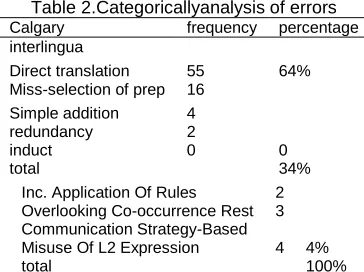
The results demonstrate that incorrect use of prepositions is highest, particularly in domain of substitution i.e. 60%, indicating that differences in prepositional systems of native languages (Kurdish) and target language (English) confused students in the process of selecting appropriate preposition to describe different relationships between linguistic elements. Now at this stage, there is a need of error diagnosis. Primary diagnosis simply explains why these errors occur and secondary diagnosis discusses the forms of errors. The four major categories of errors are: a) Interlingua errors, b) Intralingua errors, c) Communication strategy-based errors d) Induced errors (James, 1998).Interlingua errors are caused by the interference of L1 learner’s native or mother tongue. Learners engage in exact or word-to-word translation of native language into the target language. Under the category of intralingua errors, miss selection of preposition, incomplete rule application, exploiting redundancy, over co-occurrence restrictions errors can be noted (James, 1998). Communication strategy-based errors are due to the learner's using near equivalent L2 items. Induced errors are the results of misleading explanations, definitions and Examples given by teachers. From above results, it is difficult to note that whether these errors are Interlingua or Intralingua. So, to make it clear Richard and James taxonomies, are used to categorize these errors.
Interlingua Errors
Interlingua errors are 62% according to the results obtained in table 2. These errors occur due to learners attempt to produce over literal translations of L1 (Kurdish) prepositions into L2(English).
Examples
1. We were all sitting on the table.(at) یا ناب هل نام هت شگ هیما
نم یتشین هزیم
This sentence is the exact translation of: I was writing letter of my brother. (to) مویب مگارب ارا همان ناسون لاح هل هم
L2 (English) L1 (Kurdish)
Table 2.Categoricallyanalysis of errors
percentage frequency Calgary interlingua 64% 55 Direct translation 16 Miss-selection of prep
4 Simple addition 2 redundancy 0 0 induct 34% total
Inc. Application Of Rules 2
Overlooking Co-occurrence Rest 3 Communication Strategy-Based
Misuse Of L2 Expression 4 4%
1507
InterlanguageIt is observed that structures of L1 interfere with the structures of L2 to cause interlanguage
Intralingua Errors
Miss-Selection of Preposition
Most of errors in domain of intralingua errors occurred in this category. Errors in miss election of prepositions occur not due to interference of L1 in L2, but within the complex
system of target language itself. As complex categorization, large number and polysemous nature of prepositions lead a learner towards miss election of correct and appropriate Preposition.
Examples
1. Mahdi compared his father with tyrant. (To) 2. Muhammad ran to(towards) the door.
Incomplete Application of Rules
These errors are evident in instances where learners fail to use a requiring preposition in verb Phrases or certain idiomatic expressions.
Examples:
1. I really felt sorry ____________what happened in my life. (Upon)
2. At that stage of my life, I was unable to dispose______ almost all my anger. (off)
Simple Addition
This error occurs because of the unnecessary use of a preposition in well-formed sentences.
Examples
1. After this mishap, We returned to home. 2. Suddenly, my sister saw at a man.
Redundancy
Learner's over use of words to embellish the target language results in circumlocution cause Redundancy.
interlanguag
e L2(ENGLISH))
1508
Examples1. At the end, Sarah was guilty of her false misstatement. 2. We, three brothers had nothing in common with each other.
Overlooking Co-occurrence Restriction
Failure of the learner to recognize the restrictions of using a specific rule in specific context cause error
Examples
1. I opened up my umbrella, an intentional attempt at protection from the rain.(protecting). 2. I do not enjoy go in the same class where I was being insulted once. (going).
Communication-Strategy Based Errors Misuse of L2 Expression
This error refers to learner's deficiency to use correct idiomatic expressions.
Examples
1. Get in the wrong side of the law. (Get in phrasal verb assumed by the learner instead of using get on) 2. She is sitting and talking to her friend. (Over generalization of lie in the bed).
CONCLUSION
Taken up together, this paper shows that errors in use of preposition by ESL learner are a Matter of serious concern for teachers. As study reveals the sly and polysemy nature of Preposition and explains learners’ failure to grasp these tiny words-prepositions .First, as Findings of the paper also show, there is a mismatch between English and other languages .Celce-Murcia &Larsen Freeman, 1999). Thus, native language system intersecting target Language system resulting in ambiguity as learners cast around to get L2equivalents in L1though very basic structure of Kurdish (SOV) and English (SVO) is very different. Therefore, Prepositional system lies between the notorious clashes points that exist between languages. Second, prepositional system of English itself is very erratic so quite onerous for second language learners. Therefore, English prepositional errors manifested in writings of Kurdish Speaking learners are for the most part inter-language errors but a sufficient amount is also because of intra-language errors. As tremendous contribution on the part of the teacher is indispensable, while teaching English as a second language to Urdu speaking learners, as a teacher should rectify these Grammatical errors so that these may not be fossilized. Moreover, learners should be provided an ample exposure to language so that they learn prepositions in different contexts. Unfortunately, ongoing pedagogical practices iniran, especially in government sector, exhibit lack of expertise to address this problem. There is an immediate need to re-evaluate teacher's proficiency in English; efforts should be made to train teachers’ pedagogical skills while teaching English to learners in iran. As private sector is working efficiently and implementing effective and new strategies in teaching English as a second language, so it can lend a helping role to ameliorate teaching skills and techniques in government schools. Furthermore, research should be encouraged in the area of error, so that extra attention may be paid in teaching tricky areas of language like Prepositions.
REFERENCES
Brown D. 1994. Teaching by Principles: An interactive approach to language pedagogy.New York: Pearson Longman. Brown D. 2000. Principles of Language Learning and Teaching (4th ed.). New York: Pearson Longman.
Bloomfield L. 1933. Language. New York: Holt, Rinehart and Winston.
Celce-Murcia M, Larsen Freeman D and Williams HA. 1999. The grammar book: An ESL/EFL teacher's course (2nd ed.). Boston: Mass: Heinle and Heinle Publishers.
Corder SP. 1967.The significance of learner's errors. International Review of Applied Linguistics in Language Teaching. Carder SP. 1971. Idiosyncratic dialects and error analysis. International Review of Applied Linguistics in Language Teaching. Corded SP. 1973. Introducing Applied Linguistics. UK: Penguin Education.
Coder SP. 1981. Error Analysis and Interlanguage. Oxford: Oxford University Press
Fries C. 1945.Teaching and Learning English as a Foreign Language. Ann Arbor: University of Michigan Press. James C. 1985. Contrastive Analysis. Singapore: Longman Singapore Publishers.
1509
Kofi E. 2010. Applied English Syntax: Foundations for word, phrase and sentence analysis. Dubuque, Iowa: Kendall Hunt Publishing Company
Lado R. 1957. Linguistics across Cultures. Ann Arbor, Michigan: Univ. of Michigan Press.
Lam Y. 2009. Applying Cognitive linguistics to teaching the Spanish preposition Pore and para. Language Awareness, 18(1), 2-18.
Oller JW and Ziahosseiny SM. 1970. The contrastive analysis hypothesis and spelling errors. Language Learning, Pan, A. (ned). Contrastive and error analysis: Methodology of language teaching. Khoaanh.org. Retrieved on July 29, 2013, from http://www.khoaanh.net/index.php?module.
Richards JC. 1971. A Non- Contrastive Approach to Error Analysis. Journal of ELT, 25, 204-219.
Selinker L. 1972. Interlanguage. International Review of Applied Linguistics in Language Teaching, 10(3), p.209. Wardaugh R. 1970. The Contrastive analysis hypothesis. TESOL Quarterly, 4, 123-130.
Weinreich U. 1953. Languages in Contact. The Hague: Mouton Publishers.