www.scientistlink.com/ijeecc
527
The Performance of Different Routing Protocols
Available in Underwater Wireless Sensor Network-A
Survey
N.Hemavathy 1, M.Mugesh2,P.Indumathi3 1
Assistant Professor, 2UG Scholar, 3Associate Professor
1,2,3
Department of Electronics and Communications Engineering,
1,2
Velammal Engineering College, India
3
Madras Institute of Technology, India
1
[email protected], [email protected], [email protected]
Abstract: To reduce the adverse effects in Underwater Sensor Networks, many promising Routing Protocols are available to achieve many applications such as Marine information collection, underwater climate observation, pollution management, navigation and disaster prevention. The Routing Protocols plays a vital role in specific characteristics like high bit error rate, energy efficiency, packet delivery ratio and quality measures for the betterment of these applications. So, in this article we focus on the survey of the performance of different routing protocol Available in underwater wireless sensor networks.
Keywords-Localization, Routing, Reliability, Routing Protocols, Underwater Wireless Sensor.
I. INTRODUCTION
The Ocean consists of large amount of resources. Most of our oil and gas reserves lies beneath the sea floor and many are yet to be discovered. In order to avoid the difficulties in underwater resource management, we are going for underwater wireless sensor networks to achieve many applications for the future project. [1]Using underwater sensor weather forecasting, pollution and disaster control etc., are deployed. [2]Different routing protocols are deployed for different specific purpose and they are categorized into energy based routing protocols, geographic information based routing protocols and hybrid routing protocols. In this article we are going to study about the different types and comparison of underwater routing protocols.
II. BASIC ARCHITECTURE OF UNDERWATER SENSOR NETWORKS
The Underwater wireless sensor made up of different basic parts namely cluster(uw sensor +uw sink), surface station, surface sink, on shore sink. The Sensor will collect the information and forward that information to the surface station through underwater sink in case of two dimensional architecture and onshore station ,surface sink will receive the information from the surface station and this network is managed by satellite for further improvement. there is no underwater sink in three dimensional architecture all are directly communicated . [1,3]
www.scientistlink.com/ijeecc
528 N.Hemavathy et.al
III. CHALLENGES IN UNDERWATER ROUTING PROTOCOLS DESIGN
The Challenges faced by the underwater routing protocols while designing [4]
o Inside the water, the deployment of underwater wireless sensor is very difficult and maintenance of sensors is difficult.
o Because of high bit error rates of routing protocols for underwater sensor network Bandwidth capacity becomes very low
o Exchange of battery, battery recharging are not possible often in underwater, so energy efficiency is a main challenge.
o Nodes are anchored on the sea bed, if they are not anchored at the sea bed leads to high node mobility.
o Radio waves provides high propagation delay which is not suitable for routing protocols in underwater sensor networks.
IV. DIFFERENT ROUTING PROTOCOLS AVAILABLE IN UNDERWATER WIRELESS SENSOR NETWORK
There are different types of underwater routing protocols are available. There are categorized into major parts based on their performance
Routing Protocols used for Delivery ratio
Adaptive Routing Protocol [4]
Adaptive Routing protocols provide balancing structure on delivery ratio, end to end delay and energy consumption. This protocols assign priorities for every packet which are collected from the sensor and based on those priorities protocols will sends the information.
Multipath virtual sink [8]
In this architecture all the nodes are connected to a local aggregate .These aggregate points are collectively forms a small network with local sink.
Fig.2.Basic Flow diagram for multipath virtual sink
www.scientistlink.com/ijeecc
529 End to End Delay
Information Carrying based routing protocol (ICRP) [6]. In this protocol a virtual path is created without any Route Request (RREQ). The source node will send a data packet and the intermediate nodes rebroadcast the received packets. When the destination node receives the received packet than it will sends a reply. By collecting the path information from the destination node, the source node will broadcast the information without any RREQ. This will reduce the delay of time consumed by the RREQ packet. Focused Beam Routing protocols (FBR) [4, 6, 8] FBR protocols works under sparse (or) lesser complex network. This is works on the principle called Geographic Routing. Using Dijkastra’s shortest path algorithm, route for the best energy and delay efficiency is defined. The Throughput of the overall network will be reduced due to unknown location information; large number of broadcast queries can burden the network. We can reduce the error by fixing the sink stable and its location is already known.FBR schemes are location based which have its own location and destination. Hence it is deployed in end to end scheme.
Energy Efficiency
Energy Efficiency Routing Protocol (EUROP) [8] In underwater we cannot recharge or replace the battery for the underwater sensor network. This protocol is used to reduce the energy consumption of the network. This protocol gives importance to the depth sensor and sensor nodes use RREQ and RREP packets for communication. By introducing a new protocol to avoid problems based on depth sensor and packets energy efficiency will be increased. Minimum Cost Clustering Protocol (MCCP) [6] As name indicate this protocol is a cluster based protocol which gives priority to(a) Requirement of energy (b) Positioning (c) Residual energy of cluster head in MCCP, formation of the cluster is performed in a distributed manner. The distributed approach will minimize the energy consumption. Reliable and Energy Balanced routing protocol (REBAR) [7, 9] From the name itself this protocol is used for reliable service and energy efficiency and it is also a location based protocol as FBR. This will transfer geographic information from sensor nodes to surface sinks. REBAR is based on these assumption all nodes should know their location and all the information are passes to the destination by multi-hop routing, specific rate is maintained for transfer of data from sensor node to the destination node.
Reliable Routing
Direction Flooding Based Routing (DFR) [7] This Protocol plays a vital role in Reliability. Source can transmit the data to the destination (sensor node to sink) because of dynamic condition and high packet loss some of the packets are loosed than we have to transmit that information to the sink. In order to increase the reliability of packet transmission each node will kno wn its location and destination location. Floating of sensor will also lead to packet loss. Hence in this protocol we are going to use limited amount of sensor to reduce higher mobility. Hop-by-Hop Vector Based Forwarding (HH-VBF) [8]. This protocol is used to overcome the problems arises in VBF (Vector Based Forwarding). To avoid these problems in VBF a virtual pipe line is introduced between all nodes. All intermediate nodes should know the pipe direction on the basis of current location. This protocol is best protocol for Packet Delivery Ratio.
Mobility
www.scientistlink.com/ijeecc
530 N.Hemavathy et.al
above challenges by applying multi sink, Energy efficiency protocol. The main aim of this protocol is to maximize the deliver y ratio, optimize energy consumption and minimize the message latency.
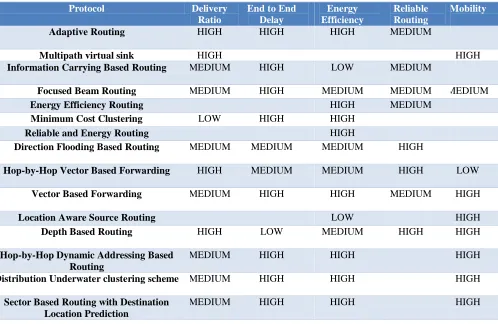
Table 1 The Comparison on the performance of Routing Protocols in Underwater Wireless Sensor.
Protocol Delivery
Ratio
End to End Delay
Energy Efficiency
Reliable Routing
Mobility
Adaptive Routing HIGH HIGH HIGH MEDIUM
Multipath virtual sink HIGH HIGH
Information Carrying Based Routing MEDIUM HIGH LOW MEDIUM
Focused Beam Routing MEDIUM HIGH MEDIUM MEDIUM MEDIUM
Energy Efficiency Routing HIGH MEDIUM
Minimum Cost Clustering LOW HIGH HIGH
Reliable and Energy Routing HIGH
Direction Flooding Based Routing MEDIUM MEDIUM MEDIUM HIGH
Hop-by-Hop Vector Based Forwarding HIGH MEDIUM MEDIUM HIGH LOW
Vector Based Forwarding MEDIUM HIGH HIGH MEDIUM HIGH
Location Aware Source Routing LOW HIGH
Depth Based Routing HIGH LOW MEDIUM HIGH HIGH
Hop-by-Hop Dynamic Addressing Based Routing
MEDIUM HIGH HIGH HIGH
Distribution Underwater clustering scheme MEDIUM HIGH HIGH HIGH
Sector Based Routing with Destination Location Prediction
MEDIUM HIGH HIGH HIGH
Distributed Underwater Clustering Scheme (DUCS) [5, 7]. This is Cluster based protocol like H2-DAB this protocol also does not require any location information and it works on a distributed approach. These protocols have two phases to work namely initial phases (setup phases) and second phases (steady phases). This protocol is used to overcome energy efficiency, end to end delay. Sector Based Routing with Destination Location Prediction (SBR-DLP) [4, 6, 8]. In most of the protocols two assumptions are made fixed destination and its location is already known, but in SBR-DLP every node know its own location information and pre planned movement of destination nodes. Sector based flooding is performed where a sector is selected on the basis of closeness of the sector to the destination node. This is used in energy efficiency and end to end delay.
V. Conclusion and Future Scopes
www.scientistlink.com/ijeecc
531 REFERENCES
[1] Ian F. Akyildiz,Dario Pompili, Tommaso Melodia,2005,” Underwater acoustic sensor networks: research challenges,Elsevier,” Ad Hoc Networks 3 (2005) 257-279.
[2] Guangjie Han, Jinfang jiang, Na Bao, Liangtian wan, and Mohsen Guizani,2015, “Routing Protocol for Underwater Wireless Sensor Networks,” IEEE Communications Magazine,0163-6804/15.
[3] Mr.A.Manigopal, Mr.R.Panneerselvam,2012,”Underwater Wireless Sensor Networks:A Survey,”IRACST,ISSN:2249-9555,vol.2,2012.
[4] Aman Sharma et al,”International Journal of Computer Science and Communication Networks,”vol2(1),74-82,
[5] Chris Giantsis and Anastasios A.Economides,2011,”Comparison of Routing Protocols for Underwater Sensor Networks: A Survey,” International Journal of communication Netwworks and Distributed system(IJCNDS), vol.7,No 3-4,pp. 192-228. [6] Abdul Wahid, Kim Dongkyun, 2010,”Analyzing Routing Protocols for Underwater Wireless Sensor Networks,” IJCNIS,vol.2,No.3 2010.
[7] Kifayat Ullah Jan, Zahoor Jan,2014,” Survey On Routing Protocol for Underwater Sensor Networks,” IOSR,e-ISSN: 2278-0661,vol.16,Issue 1,Ver.VI(Feb, 2014),pp 44-46.