FRANKISH CORINTH: 1991
(PLATES 33-45)
THE
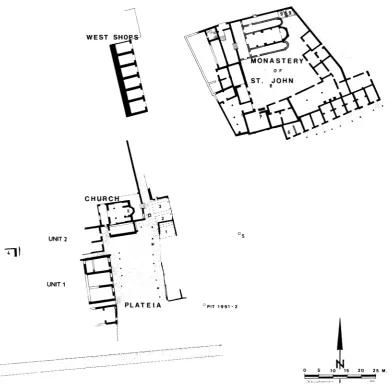
DISCOVERIES of a long plateia of the Frankish period (in 1989) and of a Frankish church with its burial ground (in 1990), all located on the high ground im- mediately south of the present-day archaeological museum of Ancient Corinth, raise the possibility for a major reexamination of the known archaeological remains of Frankish Corinth and, it is hoped, a reassessment of the position of Corinth in the Frankish Morea.THE RIDGE (Fig. 1)
In order to understand better what might have been the cultural and economic standards of the Frankish community of Corinth, one might examine the archaeological remains that still stand on the bluff above the Roman West Shops. The recently exposed 13th-century buildings were constructed on the high ground which had already been shaped by man to define the west end of the forum of the Roman city.2 The Roman colonists had cut into the natural slope of the ridge to construct a portico with vaulted chambers and a central stair- way; today this complex is known as the West Shops. The southernmost three rooms (1, 2,
I Works frequently cited are abbreviated as follows:
Corinth XI = C. Morgan, Corinth, XI, The Byzantine Pottery, Cambridge, Mass. 1942
Corinth XVI = R. Scranton, Corinth, XVI, Mediaeval Architecture in the Central Area of Corinth, Princeton 1957
MacKay = T. S. MacKay, "More Byzantine and Frankish Pottery from Corinth," Hesperia 36, 1967, pp. 249-320
Setton = K. M. Setton, The Papacy and the Levant (1204-1571) (Memoirs of the American Philosophical Society 2), Philadelphia 1978
Williams and Zervos, = C. K. Williams, II and 0. H. Zervos, "Excavations at Corinth, 1989: The Temenos 1989 of Temple E," Hesperia 59, 1990, pp. 325-369
Williams and Zervos, = C. K. Williams, II and 0. H. Zervos, "Corinth, 1990: Southeast Corner of Teme- 1990 nos E," Hesperia 60,1991, pp. 1-58
2 Williams and Zervos, 1989, pp. 345-350; Williams and Zervos, 1990, pp. 1-58, pls. 1-13.
I am indebted to the Greek Archaeological Service for its help with and attention to the activities of the American School of Classical Studies at Corinth and to Mrs. E. Zervoudakis for her oversight of the School work. This year, as in years past, I enthusiastically thank Mrs. P. Pachyianni, Ephor of Antiquities of the Argolid and Corinthia, Mrs. Z. Aslamantzidou, Epimeletria for the Corinthia, and the rest of the staff of the Archaeological Museum in Ancient Corinth for their efforts in helping make work at Corinth pleasant and rewarding. In like vein I thank Professor William D. E. Coulson, Director of the American School of Classical Studies at Athens, my fellow scholars at Corinth, and most of all Dr. Nancy Bookidis, the Assistant Director of the Corinth Excavations. Dr. Orestes H. Zervos, as usual, dispensed cheerfully his numismatic knowledge to everyone working at the excavations and contributed the appendix to this report.
Miss S. Bouzaki served as museum conservator; Messrs. N. Didaskalou, A. Papaioannou, G. Arberores, and D. Notes (part time) served as pot menders. Mr. A. Arberores, assisted by A. Notes, was indispensable as foreman. Misses L. Bartzioiti and I. Ioannidou executed the end-of-season site and small-find photographs. Julia E. Pfaff drew the pottery profiles used in this article. This report has profited greatly from their expertise. Miss Christina A. Saloway and Messrs. Mark E. Landon, James P. Sickinger, Robert E. Thurlow, and Richard W. Westall served as trench masters. In conjunction with the excavation, Dr. David G. Romano of the University Museum of the University of Pennsylvania and a team of three continued their project of recording for computer the monuments excavated at Ancient Corinth by the American School.
I thank all concerned for their professional attitude, enthusiasm, and skills.
American School of Classical Studies at Athens is collaborating with JSTOR to digitize, preserve, and extend access to Hesperia
134 CHARLES K. WILLIAMS, II AND ORESTES H. ZERVOS
WEST SHO
C H Uf :;
--
UNIT 2 _3 ..
UNIT 1 X
PLATEIA 0PIT 1991-2
-0 5 10 A 20 25 M.
FIG. 1. General plan, west end of Forum, ca. A.D. 1300
and 3, Fig. 1) retained their vaulting into modern times and thus in the Frankish period were able to support a series of rooms at the level of the Frankish church. Vaulted chambers
1, 2, and 3 not only supported Frankish rooms above but were themselves occupied in this period. Pottery found within chambers 1 and 2 of the West Shops appears to be precisely contemporary with that found in the occupation levels of the church and plateia above the vaulted chambers, although one example may be slightly later.3
FRANKISH CORINTH: 1991 135
The line of Frankish rooms built over the vaulted chambers extended for more than 36 meters southward, set behind a colonnade built of membra disjecta from various monu- ments of Roman and Byzantine date. That colonnade lined the east side of a long rectan- gular graveled square. On the west side of the square stand two buildings called Unit I and Unit 2 in this report. The original three-roomed portion of Unit 1 is endowed with a colon- nade that extends across the whole of its plateia fapade; Unit 2, closer to the church, has no such colonnade.
Another church, this one excavated in the 1930's on low ground east of the West Shops, will also be discussed in the present article. In the Frankish period the church on the ridge and the one in the lower area stood no more than 45 meters apart. The latter church, how- ever, was surrounded by a complex of monastic buildings; although the monastery itself was abandoned long before the end of the Turkish occupation of Greece, the church was desanctified and demolished only in 1937. In its final days it was Greek Orthodox, dedi- cated to St. John Theologos, but no evidence exists that it was originally dedicated in honor of that saint.
The date for the initial construction of the church in the lower area was published by Scranton as 12th century after Christ.4 Numismatic evidence exists that demands a date of construction not before the reign of Manuel (1148-1180), and very possibly later. Other evidence, largely architectural, suggests that the church was built for the celebration of the mass according to the western rite and should most logically be considered to have been constructed in the Frankish period.
THE CHURCH ON THE RIDGE (Fig. 2)
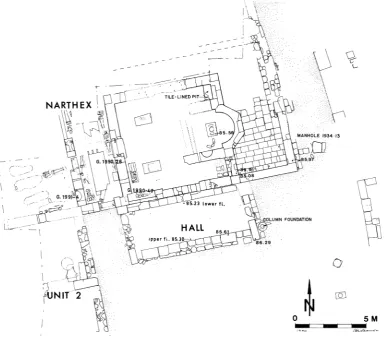
The church, with a distyle cruciform plan and narthex, is as yet not completely cleared, but it now appears to form only the southeast corner of a larger property, the western extension of which is indicated by the continuation of the south wall of the church beyond the southwest corner of the narthex. Against the south side of the church and its westward extension is built Unit 2 of the plateia, a building in which are an industrial pit and other indications of industrial use. On the other side of the wall, immediately north of Unit 2, the archaeological remains indicate a different land use: here is a burial ground, apparently used both before and after A.D. 1312. The area was accessible from the church by a door from the narthex.
Although the church can be entered from the long south plateia through the south door of the narthex, the main entrance to the church complex probably was the stepped entrance that opens off the north-south street directly into a small paved court east of the apse. The doorway is located 4.30 m. north of the southeast corner of the walled ecclesiastic property. This year, excavation has exposed the northeast corner of the paving, attesting that the east court had been 8.80 m. wide (north-south). A paper reconstruction using these dimensions accommodates a passageway 1.60 m. wide along the north wall of the church and access to a door, as yet unexcavated, in the north wall of the narthex (Fig. 1). From the southeast
136 CHARLES K. WILLIAMS, II AND ORESTES H. ZERVOS
NARTHEX TIL L-NEOPI; a
MANHOLE 934 13
/ G19912 .
COLUMN FOUNDATION
H ALL 86
0
I~~~~~~~~~~~ ________5M
FIG. 2. Plan, church at southeast corner of Temenos of Temple E
corner of the court the east wall of the property continues northward along the street for 18.90 m., at which point it disappears into unexcavated land.5
Upon entering the plateia from the road east of the church, on the right hand is a long rectangular room built against the south wall of the church. In the 1990 report this room was termed the South Hall, largely because it was considered to be an appendage to the church.6 This year the overall plan of the church and plateia are both better understood because of continued excavation in this area. More of the hall was excavated, and although no conclusive results were obtained about the function of the room, additional facts can be presented about the space (Pls. 33:a, 34:a). Because the hall now appears to stand outside church land, it may better be coupled with the plateia and its more secular buildings than with the church; certainly no burials were made within its limits while it was in use as a hall. The room was cleared in 1990 to a floor (elev. ca. +85.30 m.) that directly underlaid the sterile red fill that has been identified as the blanketing stratum over the plateia. The floor served for the last use of the hall. This year that floor and the fill immediately below it
FRANKISH CORINTH: 1991 137
were removed to a purer earth floor (elev. ca. +85.22 m.), which had no debris or rubbish in its make-up. The fill between floors, 8-12 cm. deep, contained 15 coins, 18.48 k. of pottery, of which 3.40 k. were glazed wares, and a large amount of animal bones, including sheep/goat teeth.7 Although a large amount of material was recovered, the condition left much to be desired. Both the bones and the pottery were badly crushed and scattered throughout the room. One joining rim sherd of a Protomaiolica plate, 14 (p. 151 below), was even found outside the hall in a sandy floor of the plateia but close to the southeast corner of the room. The fill appears to have been a secondary dump of gravel, garbage, and other discarded material used to cover the original floor of the room. The 15 coins in the fill are of the same date and include the same types that have been recovered throughout the plateia south of the court. It thus seems logical to assume that the material between floors in the hall is clean-up after the Catalan raid of A.D. 1312, at which time the hall was repaired
and its floor raised.
The area immediately west of the narthex has been shown by excavation this year to have been a burial yard during both the initial life of the church and during its second, rebuilt phase (Fig. 2). Although excavation has not descended to depths that allowed expo- sure of the earliest levels of graves, one can easily distinguish in the sides of the later grave shafts bones from earlier burials that had been cut through by the later interments. The most interesting fact to be considered at the moment, however, is that the burial of infants is attested for the western area (Grave 1991-4; Fig. 2). In 1990, excavation uncovered one small child (Grave 1990-26), buried against the east narthex wall during the second phase of the church and a second child (Grave 1990-40), ca. 0.80 m. long, buried within the arcosolium of the nave (Fig. 2). This was the second or upper burial from that built grave and was found well below the level of fallen plaster from the niche of the arcosolium itself.
THE FRANKISH PLATEIA, UNIT 1 (Fig. 3) The Remains of Unit 1
Unit 1, the most monumental structure on the west side of the plateia, appears to have been built in two phases, the earlier element being the northern rectangle with heavy exte- rior walls. It is composed of three rooms ranged side by side, north to south, with overall dimensions 18.02 (north-south) by 9.42 m. (east-west). The northernmost room (room 1, Fig. 3) has been almost competely excavated; only a small wedge of unexcavated soil re- mains to be removed from its southwest corner. The two rooms to the south remain only partially excavated.
Room 1 measures ca. 4.35 (north-south) by 7.80 m. (east-west) and is partitioned by a north-south wall 0.44 m. thick. Thus the whole room is divided into an eastern area 5.12 m. wide (east-west) and a western area 2.24 m. wide. Today only the southernmost stub of the partition wall is preserved, at the non-bonding joint with the south wall of the room; farther
7 See Appendix below, pp. 180-181, Stratigraphic Unit IX. Two of the 15 coins from this statistic are not included in the Zervos list because of their condition: Coin 1991-76 disintegrated; the other, coin 1991-77, was an unidentifiable canceled fragment.
138
H AL .L -
ROOM 1 8620,
$5.2~~~~~~~853
85.26~~~ . ss85.4
~~~~~~8-52 - 85.31
U N IT
X;,
0:COR
COURT,
X OI .,?...: ... lVj,,,,'d'' ,... ...'td.-,;'' ' .
1 8 ~~~6.0 2 ..
06, 60 , f5M
ROOM 5
FRANKISH CORINTH: 1991 139
north the partition has been removed to the bottom of its foundation, which descended to 0.10-0.25 m. below the clay floor of room 1.
The space east of the partition was entered from its southeast corner. This opening is in the east wall of the room with its south jamb flush with the face of the south wall; its thresh- old is flush with the clay floor of the room. The door is designed with a doorstop 0.73 m. wide, rising 0.21 m. above the floor. This doorstop, in the form of a single poros block, was inserted into the opening between jambs as a late alteration in order to keep the earth and gravel of the rising ground level of the plateia from washing into the room.
The room west of the partition was entered at the northwest corner of its west wall, and here again the door fitted into the corner of the room, directly abutting the north wall of room 1. Although the door opening probably was of the same width as that of the east door, its threshold, this one without a raised doorstop, is ca. 0.35 m. above the clay floor of the room.
The stratigraphy within this room is that which was found throughout the unit: a deep fill of wall debris composed of collapsed stone and some mud, usually starting at the level of the top of the preserved walls of the complex. Under the stone debris were found two levels of tile. The upper level was composed of tiles of Lakonian type, both pan and cover; the lower level was made up of flat, square and rectangular paving tiles. White clay or marl was well distributed among the tiles of both strata. Under the tiles was a third stratum, this of clean white clay or marl. No question exists about the definition of the floor surface for the room because the clay and tile levels separated from the pure white marl of the lowest stratum easily at the stroke of the hand pick. The floor of room 1 was found to be quite clean of pottery and artifacts. One of the few pots found was a fragmentary Protomaiolica pitcher, C-1991-8, sherds of which were found scattered on both sides of the north-south partition wall. This pot may have been part of the furnishings from the second floor of the building and may have shattered badly and scattered with the collapse of the structure. More will be said below (pp. 142-143) about the two-storied design of this unit.
The middle room (room 2) of this unit has been less extensively investigated than its northern neighbor: only the eastern half is now free of destruction debris. In its east wall is preserved a window with a large marble block reused as a sill and, at its southeast corner, a door of the same design and size as the original doorway found in the southeast corner of room 1.8
A little less than two-thirds of room 3 has been cleared. Here, however, the south wall of the room is exposed for its full length; the westernmost 0.90 m., approximately, of the south wall is completely robbed of its blocks to a course or so below the floor of the room, as is the western wall of the room. Again the access is through a door at the southeast corner of the room, and the size and design of the door are similar to that of room 2. Here one can see clear signs of a rebuilding of the threshold.
Room 3, like rooms 1 and 2 to the north, was found buried in a heavy collapse of stone debris, with tiles and marl covering the whole floor of the excavated portion of the room. The stone fall was as much as 1.10 m. deep west of the midpoint of the room, although very little of that rubble spread eastward across the whole space. Apparently the west wall of
140 CHARLES K. WILLIAMS, II AND ORESTES H. ZERVOS
Unit 1 fell toward the east when it collapsed, filling the western half of the room with debris. In the excavations of 1990 and 1991, the same type of debris, here from the collapsed east wall of the unit, was found on the plateia along the whole length of the facade (Plate 40:b shows debris from the east facade outside the doorway into room 3).
The floor within room 3 was covered by two stroses of tile and marl. The uppermost tiles were Lakonian in form, but typical for the Frankish period in their small size and execution (see below, 2, 3, and 4). Flat, square and rectangular tiles, apparently the flooring from the second story, underlay the roof debris. The ground floor of room 3 was of good hard white marl, in most places between 5 and 10 cm. thick. Upon removal of the marl floor from the eastern half of room 3, a lower, more uneven floor surface was exposed. No foun- dation trench was distinguished against any of the walls of the room at this level; thus it can be assumed that this earlier, uneven floor had served during the earlier years of the life of Unit 1. This conclusion is interesting because the fill found between the uppermost marl floor and the lower floor was a concentration of ash and charcoal containing numerous lumps of iron waste. Although the western side of room 3 remains unexcavated as of this moment, the present hypothesis offered is that this room housed a forge until some late alteration within the room apparently changed its function.
From within the ash strosis of room 3 was recovered a bronze weight, the third of its type associated with the use levels of the complex.
1. Cast-bronze weight P1. 33
MF-1991-10. Max. diam. 0.0258 m. Weight 12.38 g.
Cast-bronze, bowl-shaped weight with flaring, low sides, smooth, horizontal squared rim slightly in- cised in one area. Centering point for milling visible in floor. Undersurface incised with circle.
Cf. MF-1989-10, weight 59.08 g.; MF-1990-65, weight 77.89 g. See Williams and Zervos, 1989, no. 17, p. 350. (The figure recorded in grams in this report is the result of weighing by an electronic scale. I thank Professor S. G. Miller, Director of the Nem- ea Excavations, for permission to borrow and use the scale.)
A corridor 1.28-1.34 m. wide runs along the south side of room 3; it apparently was designed as part of the original fabric of Unit 1. A door controlled access to it from the plateia on the east side of the building, and the stonework around its opening bonds into the south wall of room 3. As in room 3, the door into the corridor is constructed in the style of the eastern door of room 1 but preserves signs of alteration from its original state: a poros block with a pivot cutting in its top surface is preserved in situ, 0.38 m. above the original pivot hole. The corridor floor that served with the original threshold is well preserved; it is a horizontal surface of marl and shows no evidence that the corridor had been used as a stair well. Unfortunately, the western end of the corridor, starting about seven meters west of the threshold, is poorly preserved to completely destroyed. Farther west the building lies totally buried under unexcavated fill. One cannot tell, therefore, exactly what function the corridor was designed to serve or where it led.
FRANKISH CORINTH: 1991 141
the north end of the plateia. Where the walls of this addition meet the original unit and are well preserved, the two structures show no tendency whatsoever to bond. This is seen clearly at the east facade wall of Unit 1, where the east wall of room 4 abuts the south wall of the corridor, and at the joint where an iinterior buttress is applied against the north wall of room 4 (which is the south wall of the corridor and the original south wall of Unit 1).
Another peculiarity of the addition that includes rooms 4 and 5 is the position of well 1991-1, with its wellhead intact but buried completely within the east wall of room 4 (P1. 34:a). Apparently the well was originally freestanding, positioned just south of the southeast corner of the original unit. It appears to have been sealed and incorporated within the east facade wall of room 4 when the original part of Unit 1 was expanded to the south. The pottery and coins retrieved from the well indicate a date of filling noticeably before the sack of the whole complex by the Catalans in A.D. 1312. Well 1991-1 is more fully discussed
below (p. 145).
The east facade wall of rooms 4 and 5 is oriented almost exactly north and south. Without complete excavation of the plateia and all its surrounding buildings, one cannot be sure why this southward extension was built to deviate from the already established orienta- tion of Unit 1. The most logical explanation, however, is that the addition was oriented in respect to the course of the Byzantine-Frankish roadway that passes along the south side of the plateia complex and the buildings of earlier date that lined it. Perhaps with future excavation the addition will be found to abut at right angles a Frankish structure or struc- tures flanking the north side of that road. The Frankish road in question has not yet been excavated in the area immediately south of the Frankish plateia, but it has been exposed at some 40 meters farther west. There excavation has shown it to be the last of a long accumu- lation of road metals which had accumulated over the centuries above the Roman decuma- nus now exposed in that area.9 The decumanus, paved and flanked by sidewalks, follows the lines established in the original Roman colonial centuriation of the site and as such has an almost exactly east-west direction. Even as the ground level rose, the original Roman road still determined the orientation of the subsequent westward roadways crossing the bluff at this point, south of Temple E. 10
Along almost its full extent, the east wall of room 4, which is 0.65-0.68 m. thick, is still preserved to ca. 0.30-0.45 m. above the floor. The wall is laid out almost due north and south; the north and south walls of the room, however, maintain the original orientation of the unit. The west wall has been robbed of all its stones down through its foundation. The trench that remains there has sides so badly damaged that it is hard to determine what, exactly, was the orientation of the back or west wall of room 4; one can hypothesize, how- ever, that the walls of the room formed a parallelogram or a close approximation to one.
The entrance through the east wall is not exactly at the southeast corner of room 4; this forms a slight variation on the pattern established by the doors of the original unit. Rather, its south jamb stands 0.35 m. north of the corner. Within the room are two buttresses: one, placed against the north wall, is 3.80 m. west of the northeast corner of the room; the
I C. K. Williams, II and 0. H. Zervos, "Corinth, 1987: South of Temple E and East of the Theater," Hesperia 57, 1988, pp. 95-108.
142 CHARLES K. WILLIAMS, II AND ORESTES H. ZERVOS
answering buttress against the south wall stands 3.40 m. west of the southeast corner. The west face of the north buttress is well plastered, although without trace of color, as is the wall west of it. No traces of such plaster appear on the walls in the eastern half of the room. It is here hypothesized that the superstructure of room 4 rose only one story, and that the buttresses, which narrowed the 5.20 m. width of the room to 3.52 m., were designed to carry a heavy transverse ridge beam, which would have held rafters that sloped down east and west from the ridge pole. The application of a buttress against the north wall allowed the addition of the ridge pole against the original south wall of Unit 1 without damaging its original fabric or surface with the new roof.
Finds of special interest from the northeast corner of the room are two jetons that were struck for the Tolomei, a banking family of Siena. A similar jeton was found in the corridor of Unit 1, immediately north of room 4. If the jetons had been stored together on a shelf against the north wall of room 4, then it is not surprising that two were recovered from destruction debris within the room and the third from destruction debris just north of the wall. A fourth jeton was also recovered; this was a token struck either for the Biccherna or Buonsignori family of Siena or the Bardi family of Florence. It was found, unfortunately, in backfill within the trench left after part of the north wall of room 4 had been robbed of its stones. 1 I
The next room to the south, room 5, has been exposed to its second floor level, but only along the eastern segment of its north wall. The east wall is well built and 0.66 m. thick; cement is even used in its east face. The western limit of the room has not yet been estab- lished. The walls appear not to have been buttressed like those of its northern neighbor. Its top floor is laid at approximately the same level as that in room 4. A small strip of the top floor of room 5 was removed to reveal a second floor, ca. 0.40 m. lower, which, like the top floor, has a marl surface. A large amount of glass was recovered from the destruction fill over the lower floor (see below, 8, 9, p. 149).
Evidence for the Reconstruction of Unit 1
The archaeological evidence strongly indicates that the area occupied by rooms 1, 2, 3, and the corridor of Unit 1 was two-storied. It is here suggested that the two stories were limited to the area defined by their exterior walls, which were made wider specifically to carry the added height. Not much can be said, however, about the form of the second floor nor about the arrangement of its room or rooms.
The most important indication that the main block of Unit 1 rose to a height of over eight meters is obtained from an analysis of the debris excavated east of its plateia facade. The lower facade still stands today in stone to a height of 0.90 m. at the north end of the unit and to ca. 0.60 m. at the southeast corner of room 3. A fall of wall blocks has been excavated along the full length of this wall, the accumulation at its thickest rising to a height of ca.
0.60 m. and spreading eastward over the floor of the plateia for a distance of ca. 4.50 m. Overlapping this rubble was a sterile red fill into which burials were later dug. Although that red soil buried most of the stone tumble, it did not extend so far west as to cover the in
I ICoins 1991-88, 1991-142, 1991-144, and 1991-294. For further discussion, see Appendix below, nos. 44,
FRANKISH CORINTH: 1991 143
situ blocks of the top of the east facade wall of Unit 1, nor was the spread of red soil found inside the unit."2 The stone debris definitely fell from the wall and probably should be restored directly on top of the wall as it is now preserved. The fall contained enough stone by volume to restore, on paper, masonry to the level of the floor beams for the second floor. The volume does not, however, allow the restoration of a wall with the thickness of 0.80 m. to rise much above a height of three and a half meters. From within the rubble were recov- ered a number of the cut-stone jamb blocks of the three doorways but no large stones that could be recognized as lintel blocks. The lintels of the three doorways and the window may have been constructed of wood.
The sterile red earth appears to be fallen and disintegrated pise that originally had been bedded upon the stone lower wall. The upper wall should be restored as tamped earth, not mud brick, for nowhere in the sterile red strosis (except in areas of later disturbance such as grave shafts) was any change in the color of the soil distinguished: no fragmentary bricks or squares of differently colored earths were observed within the red fill. The combined height of the lower stone wall and overlying pise suggests the restoration of a facade wall over eight meters high.
In the stone tumble east of the facade were found two large slabs of poros, only 0.1 75 m. thick but 0.49 m. high; one definitely can be identified by its three-stepped profile as a stone console. The second block is too battered at its stepped end to be easily identified, but it was recovered from the debris in a position very close to the first. This type of block can be paral- leled in numerous mediaeval structures, where they are the supports for exterior balconies. 1 3
These blocks were probably built into the facade wall at the top of the stone coursing of Unit 1 and demand, therefore, the restoration of a balcony on the east facade of the unit.
A third indication that the unit was two-storied has been found in the close examination of the tiles from the destruction debris of the buildings that surround the Frankish plateia. Under the rockfall within rooms 1, 2, and 3 of Unit 1 two stroses of tile were isolated, in some cases the one bleeding into the other. In every case the upper level of tile debris was composed of covers and pans of Lakonian type. The Frankish tiles are distinctive both in their small size and in their method of execution. For those reasons at least one tile of each type is presented in the catalogue. As should be expected, the clay is local and fired pinkish cream to greenish; no tiles are glazed or slipped.
2. Frankish pan tile P1. 33
FP-1991-3. L. 0.52, W. 0.20-0.256, Th. 0.013- 0;025 m. Fully preserved. Weight 4.30 k. Local clay, unglazed.
3. Frankish cover tile, pinkish clay
Notebook 834, basket 68. L. 0.40, max. W. 0.14, Th. 0.025 m. Weight 2.490 k.
From Unit 1.
12 Williams and Zervos, 1990, p. 24: "the sterile red earth ... [was] too deep and too widespread for it all originally to have been mud brick tumbled from the upper walls. ..." Such a conclusion now seems less feas- ible, for the stratigraphy shows no evidence of occupation in Unit 1 after its collapse; an apparently aborted attempt to rehabilitate the building was made before the falling of the walls. No logical reason can be offered at the moment for trucking in the heavy deposit as part of a special project. On the other hand, the stratigraphy now indicates that the red fill may have been part of the collapse of the unit itself.
144 CHARLES K. WILLIAMS, II AND ORESTES H. ZERVOS
4. Frankish cover tile, greenish over-fired clay Notebook 834, basket 68. L. 0.39, max. W. 0.135, Th. 0.012 m. Weight 2.050 k.
From Unit 1.
Rectangular and square flat tiles of a heavier sort made up the debris underlying the roof- tile collapse within rooms 1, 2, and 3 of Unit 1. Nowhere else around the plateia was this double layer observed. Similar paving tiles were found still in situ, set here and there within the hard-packed marl floor of room 2 of Unit 2. The best example of this type of paving, spottily used on the ground floor, is in an area under the window of the east wall of room 2 of Unit 1. Here, apparently, traffic or heavy use demanded durable flooring. The following statistics are presented to give an idea of the amount of tiles that was recovered from the debris. The statistics are not complete, except those for room 1 of Unit 1, which at the moment is the only room almost totally excavated, but they show that floor (paving) tiles were recovered only from the debris within rooms 1, 2, and 3 of Unit 1, another indication that a second floor must be restored to this unit.
From rooms 1 through 3, Unit 1, 628 kilograms of roof tiles, 437 kilograms of floor tiles; from rooms 4 and 5, Unit 1, 71 kilograms of roof tiles, no floor tiles; from rooms 1 and 2, Unit 2, 114.60 kilograms of roof tiles, no floor tiles.
The means of access to the second story is difficult to fathom at this moment owing to the incomplete state of the excavation of Unit 1. Existence of the east-west corridor between rooms 3 and 4 must stand as the best, but still tenuous, evidence for such ingress, even if only during the initial life of the unit.
The walls of this corridor are an integral part of the initial construction of Unit 1, for the north jamb of the eastern doorway of the corridor bonds with the wall at the southeast corner of room 3. There is no question here of addition or repair. The identification of the space as a corridor seems clear and straightforward, as well as being a logical solution for circulation between an eastern plateia and the west side of Unit 1, but only once the addition of rooms 4 and 5 has caused the extension of the unit southward. A corridor for horizontal east-west circulation makes no sense just inside the exterior south wall of the freestanding unit at the time when only well 1991-1 inhibited free circulation in this area. One can thus hypothesize that the original stairway to the upper floor had been housed between the two southernmost east-west walls of the unit, eliminated only when rooms 4 and 5 were added south of the staircase. In the second phase the stairway was converted into a corridor and floored in marl, becoming the east-west passageway now preserved in the ruins.
A new staircase must have been built to replace the original one, probably added to the exterior of the building. The only position that can be postulated for it is along the west side of Unit 1, in an area that is yet to be excavated.
FRANKISH CORINTH: 1991 145
corridor wall the blocks used for facing are put on end and the interior cavity, ca. 0.10 to 0.20 m. wide, is filled with earth and an admixture of small stones. No special care seems to have been made to use headers to bond the two faces of the wall.
A second construction detail, apparently found only in the east wall of rooms 4 and 5, is the use of white, not especially hard, plaster mortar in the jointing. The mortar is applied only to the exterior face of the wall.
Third, the pointed arch is used in this unit. Ten voussoirs and one keystone have been recovered thus far from within the stone debris of the southern extension of Unit 1.14 The blocks are not necessarily all from one arch. In fact, they were found in two isolated groups: one outside room 4, the other close to the south interior buttress within room 4. One set of blocks is thin from front to back, between 0.19 and 0.20 m. in thickness; the second set, preserved in four examples, is between 0.26 and 0.35 m. thick, the back face of the voussoirs rough, as though they had been designed to be built into a wall. Indeed, two of these blocks preserve on the soffit a cement line 0.27 m. back from the front face, probably attesting to the amount they projected from the wall into which they were built. One should imagine the arch blocks found within room 4 to have been a structural element of a wall and not an arch that spanned an open space. The blind arch is not strange for architecture of the 12th and 13th centuries in Europe. This same structural device was used in the arcosolia of the church north of the plateia, and the device was used both in rounded and pointed form in the nave of the Church of St. John, not far northwest of the complex now under discussion. Although it is not yet possible to give the actual span of the arches in question, the estimate of a span of ca. 1.60 m. may not be far off the mark.
THE FRANKISH COURT, MID-13TH CENTURY THROUGH A.D. 1312 Well 199 1-1
The poros wellhead of well 1991-1, a hollowed-out Doric column drum, today can be seen built into the fabric of the east wall of room 4, Unit 1 (Pl. 34:a). Apparently it had been covered by large wall blocks when room 4 was added to the original structure and, thus incorporated and sealed, served thereafter as nothing more than a building block within the wall. The shaft of the well descends 14.45 m. from the top of the wellhead. An underground passageway leads to the west; its floor is preserved at 1.40 m. above the bottom of the shaft. This tunnel is 1.10 m. wide, with a clearance of about 1.40 m. The silt that almost com- pletely blocks the tunnel was not removed during the 1991 excavation season.
The well shaft was free of fill to a depth of 6.55 m. From -6.55 m. to about -13.30 m., the fill contained almost no pottery or bones. Artifacts started to be recovered from about -13.30 m.; the shaft fill was dry-sieved from this level to the bottom of the shaft. From -13.85 m. downward large amounts of fragmentary amphoras were recovered. The types and quantity of pottery stayed consistent to the very bottom. The fill below the -13.30 m. point also contained 13 coins struck by the Corinth mint under William Villehardouin (coins 1991-356, 1991-357?, 1991-361-368, 1991-370-372; see Appendix below, nos. 18, 46, 47, pp. 184, 186, 190). No later coins were found in the shaft.
146 CHARLES K. WILLIAMS, II AND ORESTES H. ZERVOS
Based on the evidence supplied by the coins for the date for the closing of the well, the construction of room 4 is here considered to have occurred during the reign of William Villehardouin, A.D. 1245-1278. The following material was recovered from below the
-13.85 m. level:
5. Cooking-ware round-mouthed pitcher P1. 33 C-1991-42. H. 0.20, Diam. of bottom ca. 0.085, max. Diam. of body 0.17 m.
Dark reddish brown to dark gray clay, rough fab- ric. White stony particles, sparkling inclusions, a few dark inclusions. 2.5YR 5/5 at reddest. Flat bottom on spherical body; upper body dented before firing; top of body flattens to horizontal at base of neck. Very slightly flaring cylindrical neck with spiral grooving under flaring lip. Vertical strap handle 0.038-0.04 m. wide from just above maxi- mum diameter to lip.
6. Green-glazed round-mouthed pitcher, P1. 33 local
C-1991-43. H. 0.184, Diam. of foot 0.091, max. Diam. of body 0.123 m.
Brown clay, rough at break; gray at core of han- dle; white, a few reddish brown inclusions, air holes. 2.5YR 5.5/4.
False ring foot, slightly recessed convex undersur- face, beveled on outer face. Globular body, upper half with traces of wheelmaking, three spiral grooves at transition to vertical neck. Slightly flaring neck to rounded lip, only articulation is low wheel ridging. Vertical handle attached from just above midpoint of body to 0.018 m. below lip. Potting technique coarse, surface lime pocked.
Body completely dip glazed; bevel of foot and un- dersurface reserved. Olive glaze going to metallic black on body at side of handle; glaze highly lus- trous, at places resembling polished metal. Opposite handle on body, letter gamma in black under glaze.
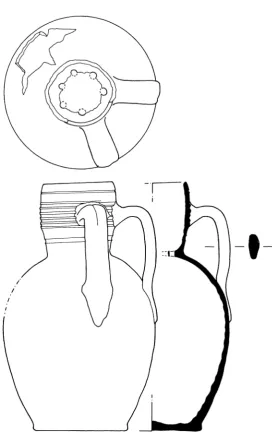
7. Two-handled sieve-mouthed jar Fig. 4, P1. 34 C-1991-48. H. 0.264, Diam. of base 0.101, max. Diam. of body 0.162, min. Diam. of neck 0.066 m. Hard-fired, light reddish brown clay, some air holes, black and small light-gray inclusions, ran- dom large pieces of lime that cause pocking. Thin whitish slip. 1YR 6/6 to 2.5YR 6/6.
Flat base with slight articulation at bottom of ovoid body. Maximum diameter of body at height of ca. 0.11-0.12 m. Cylindrical neck, rising at 90-degree angle from shoulder, flares slightly to vertical, ta- pered lip. Interior sieve in neck, 0.07 m. below lip. Groove spiraling five times on rim at point of handle attachment; single incised line 0.01 m. below lip. Two vertical handles, wide ovoid in section, rise from shoulder with vestigial end continuing down body to maximum diameter; upper end attaches to midpoint of neck. Handles at right angles to each other, attached together on same quarter of rim. Pos- sible spout (now missing) on shoulder at opposite side of pot from handles.
FRANKISH CORINTH: 1991 147
FIG. 4. Sieve-mouthed jar 7. Scale 1:3
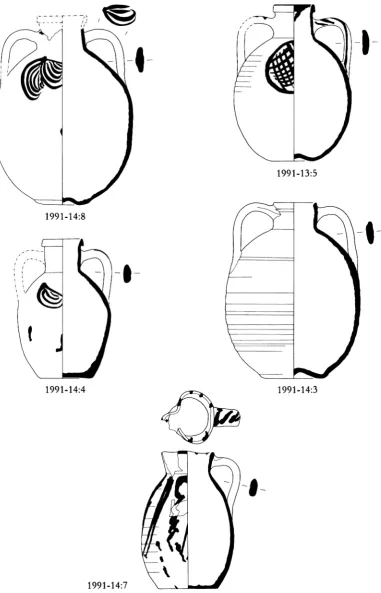
outward-thickened rim, distinctly triangular in section (Fig. 5, Pls. 34:b, 35:a, b, d?). The neck and rim of the medium-sized jar together rise to a height of ca. 0.06 m. The small version of the triangular-rimmed amphora is ca. 0.28 m. tall (Fig. 5, Pls. 35:f, 36:a?, b?, c).5 A third group, ca. 0.25 m. tall, is more correctly referred to as table amphoras because
15 The 0.28 m. size of this amphora type is common at Corinth throughout the 13th century, e.g. C-59-74:
148 CHARLES K. WILLIAMS, II AND ORESTES H. ZERVOS
~~-
I-
--r o1991-13:5
1991-14:8
'~~~~~~~~~~ -
1991-14:4 1991-14:3
1991-14:7
FRANKISH CORINTH: 1991 149
of their heavy, flat bottoms for added stability. These amphoras also have triangular rims, but the handles are ovoid, not strap (Fig. 5, P1. 36:d, e?). The body is more ovoid than those of bigger examples, but the matt decoration again resembles in simplified patterns the deco- ration on the largest of the amphoras of this type.
A second type of amphora rises to a squared, unthickened rim with a groove running around the outside not far below the lip (Fig. 5, P1. 35:c). The groove is overlapped by the joint of rim with handle. Only four amphoras of this type were recovered from the fill. One is ca. 0.312 m. tall; a second variety, of which two examples are preserved, is 0.265 m. tall. The smaller version has a flat base. None is matt-painted. The neck-rim combination is slightly shorter than that of the matt-painted variety, or ca. 0.04-0.045 m. tall in the large example. In two cases the amphora has a groove almost immediately under the lip.
A third type of amphora, represented in this fill by only two examples, has a low neck and high-swung handles. In one case, the neck and rim together rise only 0.01 m. above the shoulder; the rim is sharply angled and beveled toward the inside. The handles are straps and are noticeably high swung; they attach directly to the lip from the grooved upper shoul- der. The second example has a longer neck, ca. 0.04 m. high, and the handles rise only slightly above the lip (P1. 35:e).
The matt-painted trefoil pitchers recovered from the well are flat based and have slen- der ovoid bodies with the maximum diameter wandering around midheight (Fig. 5, P1. 36:f, g, h). Again, the dimension of the neck and lip together is low; combined, the elements rise to a height of no more than 0.035 to 0.04 m.
Various designs in coarse fabric, such as the double handled jar 7 (p. 146 above), were recovered from this well. As of this moment none has mended to a complete shape.
The designs on the shoulders of the various matt-painted containers are so varied that it is difficult to see a signature pattern of any individual painter. Rather, it appears that the various designs, ranging from crosshatched circles or loops and types of concentric C's to, more rarely, spirals, may be the result of whimsy, imagination, or hurried execution.
The following fragments are a selection of shattered glass found in the destruction debris recovered from room 5, Unit 1, in a level that predates the Catalan destruction of
A.D. 1312:
8. Blown glass bottle P1. 37
MF-1991-30. Diam. of rim. 0.0204 m.
From destruction debris immediately over lower floor.
Blown, faintly greenish glass bottle; heavy wall with partially folded rim, giving it an outward-thickened profile; concave interior. Long neck with cut-out bulge at its base. Vertical ribs of applied strands par- tially marvered to body downward from shoulder. Blowing spirals.
At least one other neck from same debris. Close parallel in MF 774. See G. Davidson, Corinth, XII,
The Minor Objects, Princeton 1952, no. 784, p. 119, fig. 17.
9. Blown glass bottle P1. 37
MF-1991-31. Est. Diam. of base 0.06 m.
From destruction debris immediately over lower floor.
Full body of bottle constricted just above folded base. Undersurface rises deeply and is slightly domed. Not preserved to central pontil mark. Clear blue-green glass with blowing spirals.
150 CHARLES K. WILLIAMS, II AND ORESTES H. ZERVOS
Destruction Debris of A.D. 1312
A general stratum of debris has been distinguished throughout the Frankish plateia complex, both inside the various buildings that surround the plateia and from the floor of the open area itself. The ceramic assemblage recovered from it was in use until A.D. 1312, at
which time Corinth was attacked and, apparently, badly misused by the Catalans. The pottery in the following catalogue is presented according to fabrics and, within those cate- gories, subdivided according to shape. The precise findspot of each object is recorded under the specific catalogue entry. A commentary follows an entry only if parallels within the general Corinth Museum inventory add information concerning the specific pot or class of pottery or if other objects that parallel the catalogued material are of chronological or strat- igraphic significance in the study of the related Frankish buildings or levels at Corinth.
PROTOMAIOLICA WARES
10. Pitcher P1. 37
C-1991-8. Fragments; max. Diam. of body proba- bly ca. 0.13 m.
From clay floor and roof-tile debris within room 1 of Unit 1.
Fine buff clay with small voids, rough fracture. 10YR 8/3.5.
Pitcher with flaring foot, ovoid body with maximum diameter close to base; vertical handle circular in sec- tion attached to body immediately above maximum diameter.
White slipped outside above reserved foot, blue and manganese (brown) paint, clear glaze applied inside and out. Two horizontal manganese lines around bottom of body. On body under handle two heavy diagonal brush dabs in blue, five horizontal manganese bars on handle, then blue. Body zone broken by vertical panels flanking the handle; panel frames of three vertical black lines, filling ornament of chevrons pointing downward.
Shape probably close to C-63-546 (see under 12); decoration close to C-37-1792.
11. Pitcher, rim fragment P1. 37 Lot 1991-52: 1, 2, 3. Pitcher approximately same size as preceding.
From room 4 of Unit 1 and in late pit over north wall of room 4.
Cream clay with air pockets and minuscule black inclusions. Clay at times breaks in laminations. 10YR 7.5/2.5.
Trefoil pitcher with ovoid body, rim 0.04 m. tall. Exterior of body white slipped from bottom of body to lip. Two horizontal manganese lines just above bottom edge of slip; above, blue curvilinear lines, ca.
0.06-0.08 m. thick, background either undecorated or filled with dotted-net pattern. Top of body divided from rim by pair of horizontal lines, above which is a horizontal chain pattern in blue within a zone 0.025 m. wide. Top of zone framed by single manga- nese line below lip.
12. Pitcher P1. 38
C-1991-38 a, b. Est. Diam. of base 0.11 m. From plateia east of room 1 of Unit 2, south of southwest corner of hall south of church, and from passageway between Units 1 and 2.
Fine, hard, cream clay, few voids, minuscule black inclusions. lOYR 8/3.
Flat base with slightly concave undersurface, beveled edge; continuous profile from slight contraction above base to ovoid body with low maximum diameter.
Base reserved, white slip above; on white slip at bottom of body two horizontal manganese lines frame decorated zone. Body decoration broken by vertical panels flanking vertical handle. Panels framed vertically by triple lines; within, wavy blue line rises vertically, small vertical manganese squig- gle between each wave. Main body panel decorated with blue wavy bands that form almond-shaped areas filled by dotted-net pattern.
Compare C-63-546 for main decoration of body; it was recovered from fill within the room of a build- ing south of the South Stoa.
13. Archaic Maiolica pitcher P1. 37 C-1991-24 a-d. Similar in size to C-63-546 (see under 12).
FRANKISH CORINTH: 1991 151
and clay of collapsed wall within room 5, and from level that postdates destruction of Unit 1. Fine buff clay with small voids, minuscule dark inclusions. lOYR 7/2 to lOYR 7/3.
Pitcher with ovoid body, maximum diameter near base, beginning of trefoil rim. Vertical handle from body to neck. Body wall 0.004 m. thick.
Decorated body zone 0.138 m. high, including top and bottom framing lines. Vertical panel on either side of handle framed in double vertical lines with vertical hooked guilloche therein. Body panel deco- rated with overlapping vertical arcs, overlapping area painted green, separated by vertical wavy lines. Triangular areas below arcs infilled with horizontal wavy lines, swirl patterns in triangle above intersect- ing arcs.
F. Berti, Antiche Maioliche di Montelupo secolo XIV-XVIII (Quaderni del Museo della Ceramica e del Territorio di Montelupo), Fiorentino Ponterdero 1984, p. 17, dated A.D. 1290-1330.
14. Plate with straight flaring wall P1. 38 C-1991-12. Restored Diam. of rim 0.25 m. From gravelly fill between floors in hall south of church; also from tile and gravel in court immedi- ately southeast of hall.
Moderately fine clay, buff to pale pink; scattered voids. Between lOYR 8/3 and 7.5YR 7.5/4. Bowl with flaring, slightly convex exterior wall to
concave rim with rounded lip. Rim articulated on in- terior by ridge 0.037 m. in from lip.
Off-white slip over interior, probably self-slipped on exterior. Clear glaze over interior, overlapping lip on exterior.
Interior floor preserves triangle in manganese with crosshatched apices touching plate rim and green dots among crosshatching; central line. At in- terior border of rim, but outside triangle, field deco- rated with green-glazed arc, framed with double black line. Manganese framing line on plastic rib of inside of rim, pair of lines just inside lip; diagonal green-glazed strokes between paired framing lines of rim. Exterior of plate undecorated.
15. Plate with straight flaring wall P1. 38 C-1991-5. Est. Diam. of lip ca. 0.25 m. From Unit 1, fill west of door, room 3.
Buff clay with a few black inclusions, numerous voids. Ca. 6YR 7/4.
Profile same as 14 but straighter; slightly thinner wall to rounded lip. Rim 0.07 m. wide. On interior slightly grayish white slip; slip overlaps rim to ca. 0.004 m. down outer wall.
Plate floor has diamond-shaped "flower" close to rim outlined in manganese; interior green. Manga- nese line along bottom of rim rib, another just above rib. Third line along inside of lip. Rim zone between framing lines decorated with diagonal dashes in green. Tin glaze.
VENETO WARE
The Corinth collection contains 26 examples of Veneto ware inventoried through 1991. Numerous fragmentary examples remain uninventoried in the Corinth storage lots. Veneto ware is a very common glazed fabric in Corinth at the end of the 13th century and is not limited to the strata of the Frankish plateia that is now under excavation. The types of bowls found here are of Gelichi's group of monochrome glazed ware, yellowish brown or green in color, and his fourth group, vessels with a monochrome slip. One type of rouletted bowl, C-1935-990, is not found among his rouletted shapes.16 To be included in Gelichi's fourth class are two Corinth Museum bowls with incised lines, one of which (C-34-1398) also has a spiral incised in its floor, similar to his no. 7, illustrated by Gelichi in fig. 2. The Corinth collection, however, contains only two inventoried examples of Gelichi's last class, monochrome glazed and painted (C-59-68 and C-60-137). A single bowl fragment of this
0000000~~~~~~~~~~~~~~~~~~~~~~0 000 00 U 0 000 aaa000 0 au to000
?00000)0 0aU0 0 00
O a ? a o o D 0 0 a /
a000 Dal Do (Wo
DD
3 DO 0 10 E0 \O O
OtI am CO O3 1 D
C-34-772 C-38-535
-
~~~~~~~~~~~~~~~~~~~~~aU000 00
cr ir -0 rp ~~~~~~~~~~~00 000000 S
3 a
-
|/GD3 0 0 0
a 0o a o 0
0000 000
000 000 . 0 00 0
CP 1746 C-34-1224
u u u u u U U
0~~~~~~~~~~~~~~~~~a0O u Bom 0
\
0 0 0 0 0 0
unt o o DO \ o o c \
ttUEtlE6O \ s ,ca
~~~~~~~~~~~~~~~~~~~C3n3 r
a nnnlnrQ
C-34-534 C-38-63
flu a
C-34-1 398 C-60-137
154 CHARLES K. WILLIAMS, II AND ORESTES H. ZERVOS
class has been found in the recent excavations of the Frankish plateia, in a level that post-
dates A.D. 1312.
It thus appears extremely likely that only two types of Venetian pottery were imported at the end of the 13th century and in the first decade of the 14th: the monochrome glazed bowls and the monochrome glaze and slip bowls.17
Carinated bowl, unslipped, rouletted 17, brown glazed.
C-1990-48. Manhole 1934-13.
C-34-772 (Fig. 6). South Stoa, room west of bouleuterion.
C-38-535 (Fig. 6). Westernmost shop at south side of St. John's monastery. CP 1746 (Fig. 6). Pit F (specific findspot not known).
C-34-1224 (Fig. 6). East of West Shops, chamber 1. Lot 1938-23:3. Green glazed.
Carinated bowl, unslipped, exterior wall horizontally grooved C-1990-49. Manhole 1934-13. Green glazed.
C-34-1234. Forum Southwest: West Shops, earth overlapping east wall of south tower. Brown glazed. Published: MacKay, no. 14, p. 269, pl. 63.
Carinated bowl, slipped and rouletted C-35-274. St. John's monastery. 18, green glazed.
C-34-534 (Fig. 7). Forum Southeast. Brown glaze, freehand loop incised in floor, groove at joint between floor and wall. Published: Corinth XI, pp. 173-174, fig. 156.
Carinated bowl, slipped and unrouletted
C-60-37. Bothros IV, Forum Southwest. Green glazed. Published: MacKay, no. 12, p. 269. See also Corinth XI, fig. 156.
Carinated bowl, slipped, rouletted, sgraffito
C-38-63 (Fig. 7). From South Stoa, storeroom of shop XXXI. Brown glazed, freehand loop incised in floor.
Carinated bowl, slipped, unrouletted, sgraffito
C-34-1398 (Fig. 7). West Shop 2. Green glazed, incised spiral in floor. Found along with C-34-1396, Protomaiolica bowl with gridiron pattern, C-34-1397, local plain glazed bowl, and C-34-1399, Archaic Maiolica bowl with green linear decoration on floor.
Carinated bowl, slipped, rouletted, manganese painted
C-60-137 (Fig. 7). From bothros (elev. of mouth +84.75 m.), close to but southeast of pit 1991-2. Green glazed. Published: MacKay, no. 11, p. 269, pl. 62.
C-1935-990. Upper level, area of St. John's monastery. Bowl with short horizontal rim, upturned lip. This is a rim sherd; carination, if any did exist, not preserved.
Ovoid bowl, unslipped
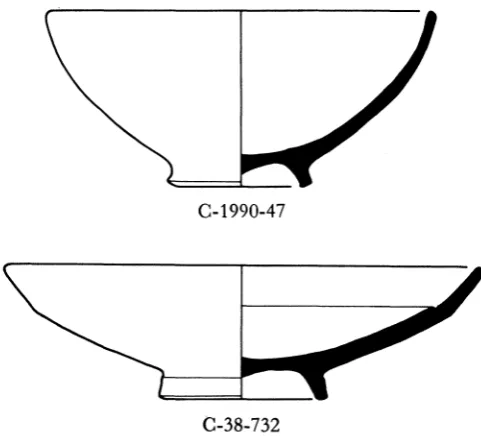
C-1990-47 (Fig. 8). Manhole 1934-13. 16.
C-34-1286. From chamber 1 of West Shops. Groove separates floor from wall.
FRANKISH CORINTH: 1991 155
C-1990-47
C-38-732
FIG. 8. Veneto-ware ovoid bowls. Scale 1:2
C-34-507. Forum Southeast.
C-38-732 (Fig. 8, Pl. 38). Westernmost shop at south side of St. John's monastery. Small plate with groove separating floor from low wall.
C-37-826. From Forum South, south of Central Shops and west of the rostra. Interior of rim concave.
Bowl with concave rim, lightly slipped interior
C-34-1317. Forum Southwest. Published: MacKay, no. 15, pp. 269-270.
Bowl, slipped, with interior grooves
C-1986-2. Destruction debris west of excavations of 1990-1991. Published: Sanders (note 15 above), no. 12, p. 174.
Plate, slipped, magnesium painted
C-59-68, related in profile to C-38-723. Forum Southwest, bothros at IH/36 (pit 1959-1); for location see Figure 1 at 5. Published: MacKay, no. 13, p. 269, pl. 62.
Bowl with outturned rim, vertical lip, slipped, rouletted, magnesium painted
C-35-990. From kitchen pit 1935-1 in St. John's monastery or stratum immediately above.
Eight uninventoried fragmentary bowls, at least two with rouletting, from the westernmost shop against the south wall of the Monastery of St. John, lot 1938-23.
It is doubtful that C-60-315 (MacKay, no. 16, p. 270) is Veneto ware, or even a related fabric.
16. Monochrome glazed bowl
C-1991-17. H. 0.059, Diam. of foot 0.054, est. Diam. of lip 0.133-0.135 m.
Orange clay with rare white (lime?) and dark, but many sparkling, inclusions. 2.5YR 5.5/6.
Slightly flaring ring foot, slightly conical undersur- face. Convex body rises to very slight carination at ca. 0.02 m. below almost vertical, tapered lip. Inte-
rior wall has no groove around floor. Single drilled hole preserved in body wall near ring foot (mend hole?). Unslipped with slightly speckled thin clear glaze over whole of body, except in two small acci- dentally reserved areas on undersurface.
156 CHARLES K. WILLIAMS, II AND ORESTES H. ZERVOS
Destruction debris over floor of room 2, Unit 2. Dark reddish tan clay with many sparkling, some white inclusions and voids. 2.5YR 6/6.
Almost vertical ring foot, undersurface with slight cone. Convex wall carinated at height of 0.021 m., rising steeply; lip not preserved. Ridge on interior at point where floor meets wall.
Mustard-brown glaze on exterior and interior; undersurface reserved. Tripod scar in glaze on floor.
18. Slipped and green-glazed bowl Fig. 9, P1. 38 with rouletting
C-1991-25. H. 0.063, est. Diam. of foot 0.055 m. In debris of roof tiles in passageway between Units 1 and 2.
Orange clay, reddish at core; many glittering min- uscule particles, clay slightly rough at the break. 1OR 6/4 or more orange.
Bowl with flaring ring foot, undersurface with cone. Lower body flares at ca. 30 degrees from horizontal to slight carination; upper wall rises at ca. 70 degrees to rounded lip. Interior floor concave, framed by dis- tinct groove with diameter of 0.092 m. at joint with upper wall. Interior of bowl white slipped, streaked and dripping over exterior to slightly below carina- tion. Bowl green glazed over slip and down to resting surface of foot. Undersurface reserved. Seven hori- zontal rows of rouletting on exterior wall between carination and lip. Trace of tripod scars in glaze on floor.
In profile this example is close to CP 1746, C-38-535, C-34-1224, and C-34-772 (Fig. 6).
METALLIC WARE
19. Green-glazed round- Fig. 10, P1. 38 mouthed pitcher
C-1991-10. H. 0.212, Diam. of base 0.095, max. Diam. of body 0.125 m.
From floor and in destruction debris of room 2, Unit 1.
Fine, pale red clay fired gray at core, greenish gray in places. A few white, black inclusions, voids. Surface 2.5Y 6/2.
Disk foot with broad resting surface (0.022 m. wide); ovoid body with maximum diameter just be- low midpoint. Vertical handle ovoid in section at- tached at maximum diameter of body in triangular terminus; at top, attached to neck just under lip. Slightly protruding ridge at joint between shoulder and tall cylindrical neck. Faint horizontal groove on body at point of handle attachment; second groove at point of attachment on neck. Neck rises to slightly flaring, rounded lip.
No slip; heavy, dark green glaze over exterior ex- cept for undersurface, which is reserved. Glaze dripped well into neck and onto bottom of interior. Body scars in glaze from stacking in kiln.
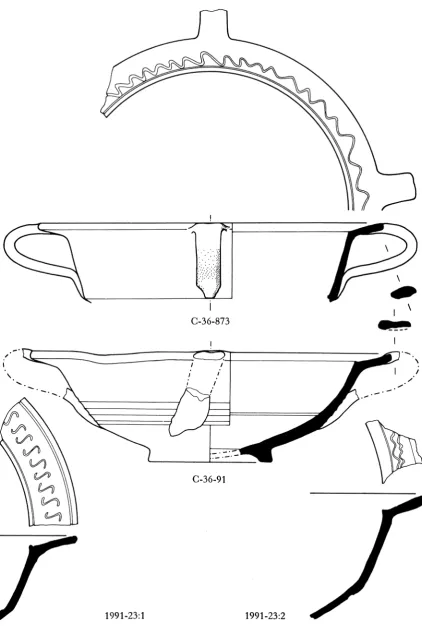
20. Multiple-handled bowl Fig. 10 C-1991-37. Restored Diam. of rim ca. 0.028 m. From destruction debris in plateia between Unit 2 and hall south of church and from debris in room 2, Unit 2.
Moderately fine clay with numerous fine voids, some white inclusions; fired pink at edges, buff core. 5YR 7/3, core lighter, grayer.
Wide bowl with straight flaring body, rising at 30 degrees from horizontal, then turning sharply to nearly vertical; almost horizontal, outturned rim, 0.028 m. wide. Probably eight vertical strap handles attached at top of carination of body and to lip. Four grooves on outside lower body.
White slip inside and out. Incised on rim: broken guilloche between framing lines. Ochre-brown glaze on interior, overlapping lip. Exterior has patches of pale green in places mixed into thin clear glaze over slip.
nau u u \
u u u bb \
Go 000 00D 0
:;{s~~~~~~~~~~~
158 CHARLES K. WILLIAMS, II AND ORESTES H. ZERVOS
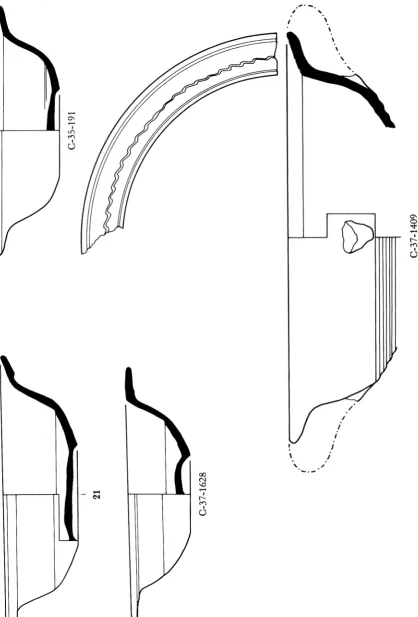
This form of bowl is common in the late 13th cen- tury at Corinth. Inventoried examples include
C-36-873 (Fig. 11).
C-36-91 (Fig. 11). Profile varies from 20, having rounder body.
C-37-1409 (Fig. 12), from Agora South Center, top soil over glass factory.
Uninventoried examples to be found stored at Corinth:
St. John's monastery, westernmost shop on south side, pottery lot 1938-23:1, 2 (Fig. 11), probably debris of A.D. 1312.
Fragments from roadway, east of church, N.B. 845, p. 10.
21. Clear-glazed mesomphalic Fig. 12, P1. 39 bowl
C-1991-9. H. 0.052, Diam. of omphalos 0.069, Diam. of lip 0.198 m.
From destruction debris of room 2 in Unit 1 and from trench of robbed north wall of Unit 2. Fine, buff to pale pink clay with tiny voids and very few small brown and white inclusions; hard fired. Paler than 7.5YR 7/4.
Concave base with convex wall curving sharply to- ward vertical; almost horizontal rim ca. 0.02 m. wide. Undersurface of rim thickened. Interior: floor of bowl articulated from wall by shallow groove, not expressed on outside.
Cf. C-35-191 and C-37-1628 (Fig. 12). Notice that these two have a smaller, lower profile and that the rims are not undercut at the bowl wall. These two bowls may be later by context than 21.
SGRAFFITO WARE
22. Local olive-green-glazed bowl P1. 38 C-1991-22. H. 0.093, Diam. of foot 0.087, Diam. of lip 0.191-0.197 m.
From roof-tile debris in passageway between Units 1 and 2.
Coarse, light-brown clay fired grayer toward inte- rior of bowl. Many pits and white inclusions; some sparkling inclusions with concentration in clay of ring foot. 5YR 6.5/5 or slightly yellower. Rounded ring foot 0.012 m. high, globular body that rises to the vertical; slightly flaring rim 0.011 m. tall; round lip.
Olive-green glaze over cream slip covering inside and over lip, dripping down reserved exterior. Six
evenly spaced spirals rise from around center of bowl, spiraling counterclockwise under rim. Two incised concentric lines on interior of rim.
OTHER GLAZED WARES
23. Green-glazed pitcher P1. 38 C-1991-19. Diam. of foot 0.089, restored Diam. of body 0.208 m.
Recovered largely from within pocket in wall out- side northwest corner of room 1, Unit 1.
Buff surface, pinkish buff clay, fired pinker at core; small pits and sparkling inclusions, also white and black. Surface near 7.5YR 7/4. Flat, string-cut base that contracts to form lower body, then flares with maximum diameter below median; ovoid body and slightly flaring neck. Verti- cal handle, oval in section, attached at maximum diameter and neck.
Dip-glazed green directly onto clay of upper three-quarters of body and handle. Five faint green- glazed rings randomly placed on reserved lower wall.
MATT-PAINTED WARES
24. Local matt-painted ovoid bowl P1. 39 C-1991-44. H. 0.082, Diam. of base 0.05, est. Diam. of lip 0.155 m.
From destruction debris in plateia between Unit 2 and hall south of church.
Buff clay with large amount of fine to large parti- cles of mudstone, some lime inclusions. Paler than 7.5YR 7/4.
Flat-bottomed bowl with slightly concave undersur- face. Steep echinoid body curves to vertical at upper wall; rounded lip. Slightly wheel-ridged exterior wall, but wall pared with vertical strokes around base. Interior of floor has cone, matt-painted with "phi"; upper interior wall decorated with non- connecting counterclockwise spirals executed in quick brush strokes, varying in width; lip matt- painted.
UNGLAZED WARES
25. Two-handled jar P1. 39
C-36-873
C-36-91
1991-23:1 1991-23:2
C-35-191
21
C-37-1 628
~~~~~~~~~~~~~~~~~~~~~~~~~~~~~~~~~~~~~~~~Je
C-37-1409